The jig pushed confidently through the soft sand, closer and closer to the turquoise sliver on the horizon. From 50 feet back, it looked like a solid and capable rig. From 20 feet out, you could certainly tell this vehicle had been around the peninsula a few times. And if you were walking up to it at a used car lot, you'd be spinning around and ducking the greaser salesman and wrinkled slacks striding your way.
At the rental facility where I first hopped in and went to let out the collection first gear, I shivered with doubt. Yep, it's a well-used rental rig, all right. When you want a 4x4 for remote desert exploration, you want a stick shift. And when you get a stick shift in a Mexican resort town, it's been driven by a lot of people who've only driven automatics.
This poor Jeep had been through the ringer, and I felt sympathy for it like an abused dog as we filled it up with fishing gear, ice, and boxes of beer. Reluctantly, we headed away from civilization and towards the Baja backcountry, skeptical of just how far this rig would take us. At the time I'd been fishing down in Baja a few times, six or so trips at that point. No veteran of the game by any stretch, but I'd started to get a basic lay of the land and gain some understanding of places that I may be able to find and target rooster fish.
Those are the fish we all dream of, right? Well, at least I do. And even though I'd been fishing for roosters in Baja more than a handful of times, I'd never been able to land anything but juveniles. With each trip down, I'd set expectations with a healthy dose of skeptical optimism, comparing outcomes to steelhead trips.
Well, maybe winter runs steelhead trips. Meaning I'd hope not to land with a standard fish a day, but simply for a shot at a fish a day, and landing a single non-juvenile fish for the trip. I knew how to keep my dreams in check, and I knew my attitude about how I wanted to fish was not eating in my aughts. I was beginning to discover that I'm the kind of person who is drawn to doing things the hard way, or for some reason, I just think certain ways of trying things are more interesting than others.
By interesting, I guess I mean there are lots of unknown variables and outcomes. And this kind of approach, when done by choice, is just intriguing to me. The chance to DIY a trip from the tarmac on, the choice of no guide, no panga, no ATV, no live bait or teaser rod, sure, those things all make perfect sense and greatly aid in success, which is why they are all ever more common now along the coastlines of Baja. But how rewarding would it be to catch my first rooster fish without any of those advantages?
That question repeated over and over in my head as a twisting ribbon of asphalt rolled out over meandering skylines of cactus, brush, and rock. I wanted to find rooster fishing success on my own terms. I wanted to bring my first good rooster to hand via an experience entirely of my own creation. For me, if all the progress and failures added up over the years could at some point result in catching a fish the hardest way possible, then everything ever after would be icing on the cake.
I didn't really know why this felt so natural to me, but it totally did. Like I had accepted stacking the deck this way as my own initiation challenge, a self-imposed benchmark I wanted to earn, failure after failure, no matter how many years it took. But this time, we were in an entirely new region of Baja. Along with my buddy Paul and my wife, Ali, we were stoked to be sharing such a unique and rewarding DIY experiences together.
From plenty of hand-gesturing and broken Spanish skills between the three of us, we were trying to reach a remote section of beach suggested to us by local fishermen. This is one of my favorite things about exploring down here, the off-road element. By a mile of two-track roads, rock gardens, washed out dry creek crossings, and towering card-owned cactuses, we were closing in on this new beach access. And it was plain to see that this beach was not often visited by vehicle, at least not by those without four by four nerves of steel and skill behind the wheel.
Sections of the road were steep and whooped out enough that careful line selection was required, even for our short wheelbase jeep to crawl up and over and for low. As we left a hardpan desert-touring behind and entered the transition to the beach and sand dunes, sections were very soft and rutted. We stopped to air down the tires and expand our treads footprint and add flotation. A balance of throttle control and momentum delivered us the final miles to reach the end of the road in an ideal parking place overlooking miles of white sandy beach.
What a place to be. I flung the door open and shot from the driver's seat, almost overcome and practically vibrating with excitement and anticipation. Rather frantically, I began digging into the back of the rig, gathering up my pack, jamming my bare feet into the smelly old running shoes, and poking a few ticotty lights into the last bits of space in my pockets. Around that time, Allie pointed out the concept of lunch, and I was reminded I would need something to eat before heading out to make the most of this day at the beach.
We popped the lid from the squeaky white foam cooler and prepared a proper baja lunch, mashed up local avocado and cheese with hot sauce atop a fresh tortillas. Simple perfection. A few liquor drinks might hit the spot too, as Allie mixed up another favorite containing Bacardi and Yeho, soda, and Peña Juice. After a few of each, we were primed and ready to make the most of this day, which was off to a start straight out of dreary winter day dreams.
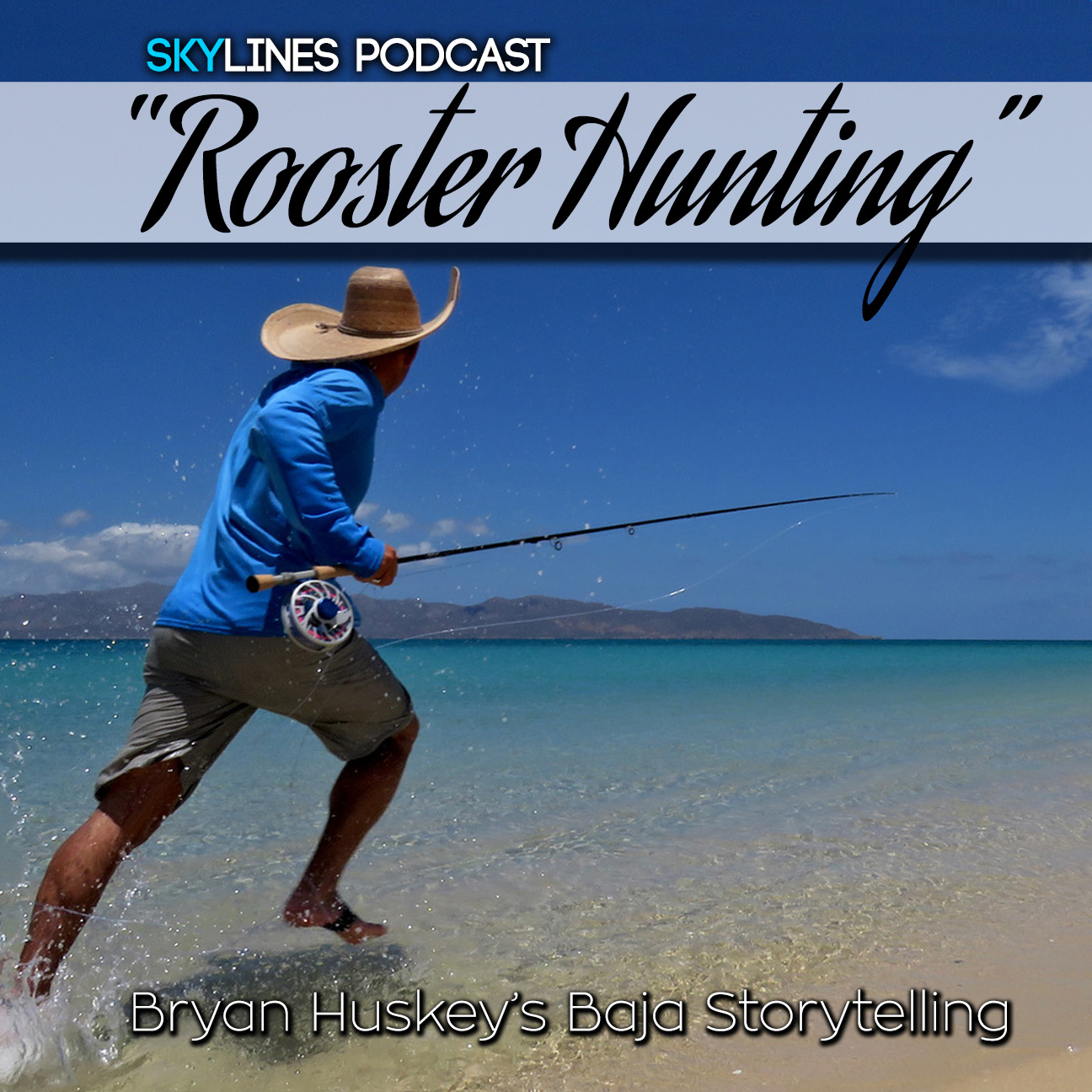
We plucked our 10-weight rods from the windshield wipers and headed in the direction we'd seen bait shifting and darting in the waves. Like the archery hunting elk, which I love so much, success could be found on any rickies first day, or it could take years for all the elements to align and come to fruition. Except roosterfish don't bugle or leaf tracks. In exchange, however, there are advantages of being able to spot feeding fish as they push prey into the air with a white spray and convention of shorebirds that can be spotted from hundreds of yards away.
So this hunting is actually quite visual, either by the flags of the feeding frenzy or the ghosts-like shapes of the fish themselves. And what's always amazing to me is just how far away fish can be seen along these beaches. Spend enough times staring at knee-high waves rolling into the shore and over time, the slightest shapes and shadows begin to materialize. A quick hustle sprinting closer will typically reveal something.
You just never know what it's going to be. Maybe a submerged plastic bag drifting along, maybe just some seaweed, or maybe a marauding pair of predatory fish. That's what I wondered while scanning the mildly wind-chopped water, squinting to locate anything that could be fish. Paul had continued around the point and was far out of sight now, and Ali was posted up under an umbrella back at the rig.
I'd noticed several large needlefish patrolling the area, and throwing flies at them was so fun because the instant the fly hit the water the fish would spot it from nearly any direction, and close in with such speed it was thrilling just to witness. Not many would actually eat my fly, but after a few hard slams I figured I'd better tie something on that I was willing to lose, given that I wasn't properly tackled for such toothy critters. Digging through my container of flies I recall looking around me and taking in just how satisfying it was just to be standing here on this moment in time. The scenario alone was enough to make me well up with emotion.
There's an overwhelming atmosphere in the parts of Baja I've experienced that is so appealing to me. Let me preface this by saying that I'm not well-traveled. Short of a handful of fishing trips to Canada and once to New Zealand, I've not traveled to globe to far off exotic places or cultures with striking reputations. So my scope is limited, but with that said, the culture and community of this place is one of simplicity, literal simplicity, getting enough to eat, drink, and survive.
Live, laugh in love, and the rest can be damned. That's all that seems to matter in Baja. In many ways it makes sense to me. Career-driven life goals can suck it.
The desert environment is brutal. Wind, heat, and dust prevail. The elements can drive a reasonable person mad and never want to come back. I acknowledge and can relate to that person too, but when the forces of nature relent, a beautifully simplistic way of life takes over.
Means to food, which is insanely delicious, cold beer and cocktails, a form of transportation or about all that matters. A person could spend week after week doing nothing but existing and fishing of course and would never draw any question or skepticism. It's the win-and-row analogy and a social standard. Coming from a world that's so complicated with so many obligations, conditions, and expectations, time in Baja is a submersion of pleasure and healing from mines taxed and warped by the American dream.
But when the wind lays down, it's pure pleasure to be standing in water, shockingly warm in the color of jewels. I'm the greatest pussy you'll ever meet when it comes to cold water, so my level of enjoyment and appreciation of water temps in the mid-80s is off the charts. I mean, being an angler that for the most part of my entire life is accustomed to wearing waders when I fish, wet waiting in water this warm, no, hot is rad. It's an element of holding cork here that makes me love it all the more.
When conditions only add and not subtract from the enjoyment of an experience, that's when you're living well. I mean, there are plenty of times when I complain, either out loud or just to myself, about being cold, but never when I'm rooster fishing. Maybe it's falling into the trance I love so much. Walking the beaches for miles with a rod in hand, the sound of the ocean, the seabirds, maybe a distant boat's hole breaking rhythmically over swells.
It's a simplicity that I'm completely drawn to. Who wouldn't be? I've noticed that once I start walking, looking for signs of fish and reading the information in front of me, I get into a groove, a zone, if you will. It's hard to stop.
Give me a minute to run down and check things out, and 10 minutes later I'll be a mile away lost in a turquoise dream. Depending on what kind of beach I'm on, I'll sometimes let my fly drag in the sand while I walk so I can pick up a cast and fire quickly. Seconds count when fish appear, and an angler needs to be ready with an adequate amount of fly line already stripped off the reel. The line needs to be carried in such a way that it can be quickly whipped into an effective cast.
Usually I'll carry my fly in my hand, with 60 or so feet of fly line dragging in a loop behind me. But one particularly long walk a few days prior, I'd let my fly just drag through the sand. I'd since noticed that the hook had been worn down considerably by this, so I demoted the fly to the JV roster. So as more and more large needlefish came funneling past the shallow beach I was fishing, I reached for a fly that I could spare, a fly that would no longer be considered for shots at legitimate target fish like roosters, jacks, or dorados.
The mullet pattern was one of a dozen I'd ordered for the strip, so sacrificing one here to witness the lightning-fast attack of a four-foot needlefish was something I considered a fair trade. I paced up and down the span of beach where I'd been spotting fish. Out where the pastel colors of shallow water turned electric blue, a faint smudge appeared and slid along a gradual heading towards the shore. I broke into a mild trot to get a closer look.
As the points of our triangle narrowed, the smudge materialized into the forms of two fish and they were moving in a direct line, unlike the swerving scavenging needlefish. These fish were moving fast too, so I shifted down and turned on the jets to catch up and see what they were. It was so easy to tell they were roosters. The elegant stripes were unmistakable, beautiful fish cruising intently along the beach as if they were pulled by a fast moving rope.
At this point I recognized an opportunity was developing in front of me and I needed to execute. We'd been fishing for days now with no shots at roosters. I'd been trying over the course of years to put myself in this very situation and only handful of times had been close. It was simple.
All I had to do was run fast enough to get myself ahead of these fish and put my fly in front of them before they passed and vanished forever. They were a ways out there. Frankly, I stripped way too much, line off of the reel and sprinted along the beach positioning myself for a shot. I had enough time.
I could see the fish continuing their course about 70 feet off the sand and paralleling the beach at my 130. From what I can remember, I grossly overshot their distance, but fortunately I also led them by far too much, so I had to wait several paralyzing seconds before I could begin stripping. This gave the 400 grain line time to sink. At god's end I realized in hindsight.
I watched as the fish approached the approximate zone where my cast had met the ocean. I didn't want to strip too early and pull my fly out of range before they saw it, but I certainly didn't want to wait until they were over my line and have the fly escape behind them without drawing their attention. Somewhere in the middle I began stripping, cautious at first, stuck in the limbo of the scenario. Then, without question I saw the behavior of the fish change.
In formation, both fish banked hard left towards the beach. I began racing my fly as it was now clear the roosters were tracking it like hounds. My dad fell in love with Baja over the bars of a motorcycle. The unlimited freedom of being a rogue silhouette on the desert skyline was where he felt at home and found his comfort.
And Baja was the canvas in which he painted himself into, returning home with wild-eyed stories of how wonderful life on the peninsula was. Eventually he trucked down with a 12-foot aluminum boat atop his truck and followed his heart into the sea of Cortez. From that point on, all fish and fishing was compared to Baja, and nothing else ever came close. I can still remember his descriptions of rooster fish chasing bait onto the dry sand, combs high in the air and white water crashing.
My dad was a emotional dynamite, and when something is thrilling as fishing the Cortez came into his life, it was just about all he would talk about once back at our home in Bend, Oregon. I guess that trait rubbed off on me a bit too. The rush of drawing something you want so bad towards you as fast as you can strip a fly is intoxicating. Coming from distant shadows in the ocean, then developing into the most incredible looking fish right before my eyes, the pair closed in on my fly, at which point was maybe about 30 feet out.
As I continued pulling line as fast as I could, their combed up dorsal fins broke the surface, and the pair charged into the shallow water and breaking waves at my feet. I'd been backing up as the storm of energy and emotion came at me. I was nearly out of line and about to wave my rod in a final zigzag at the water's edge. But for the last few strips before my fly reached dry sand, my line was still straight and the fish were still closing in on it.
An incoming wave provided maybe a foot of depth, I rotated to my left, opposite the slight angle the fish were coming in towards me. As I rolled left and stripped, both fish flared their combs in the crumbling wave and turned tight use away from me. When they did, the line tightened in my hand and the rod became heavy as I now lifted to feel the pull of a fish. The pair of fish ran hard back into the deep blue water, one of them taking me and my fly with it.
Once settled and tight with the loose line now safe on the reel, I shouted to my wife, Ali and my friend Paul. Moments later, the fish launched into a series of tarpon-esque jumps like none I've ever seen or heard of roosterfish doing. It was pure thrill. It was pure joy.
Playing this fish was incredible, formidable, and fulfilling. It was so rewarding to feel something that I'd wanted for so long, to feel its force, its meaning, its impact. That fish represented so much for me personally. While I watched the reel scream and cranked down on a flexing rod, more than a simple fish was on the line.
For me, it was a milestone victory I'll cherish for the rest of my life. It was a fish I'd pursued many times with nothing short of crushing defeats, but it was also the formation of an unbreakable bond with this place. A place that my late father loved and described was such color and enthusiasm when he spoke of it. And now, a place that he and I share together, if never at the same time.
We were like many others that come and search a fish and leave forever changed. Unless, of course, a stroke of fortune renders their rental jeep useless and strands them there. Something I hope for each time I return. Thanks for listening and coming along.