
It's very difficult to get through the crust of scams and humping up schemes and crypto bros who are just chilling coins and trying to make money by their lambos, as they say. But once you get past that, you do see that for the most part, a lot of the people who are working on the core technology and the value proposition of a lot of the technology that's being presented in the space. There's this phrase that I've never heard anyone say, I've summarized it, it's my synthesis of the environment. We're not here for money, we're here to not need it.
And I think that's something that I believe to be like a really core tenant that I'm seeing throughout the space, especially those like who are building things like seeds, building region network, building Ixo, building Bitcoin, is sure, the value of a token goes up and you might have a ton of money. But what that means is you can redistribute energy from one part of the system into another part of the system and you can create an entire new economy, a micro market, around a solution event for trying to do something and create incentives. There's a lot of things that present themselves in a space as useful and they're not necessarily useful. But then there's a lot of things that are extremely useful, but to be able to explain the technology, to say how it is that it's useful, you have to go through an entire translation layer.
And so how do you decipher this? Maybe you can just focus on where the positive externalities touch the rest of everything else. Greetings Future Fossils, happy full moon, happy new year. I am delighted to present episode 180 of the podcast that explores our place in time, which although this episode was recorded live at complexity weekend in the middle of November of last year, I think nonetheless in a coarse-grained kind of way, there's deep relevance to the ongoing evolution of our lives as they exist in a kind of superposition between the physical and the virtual.
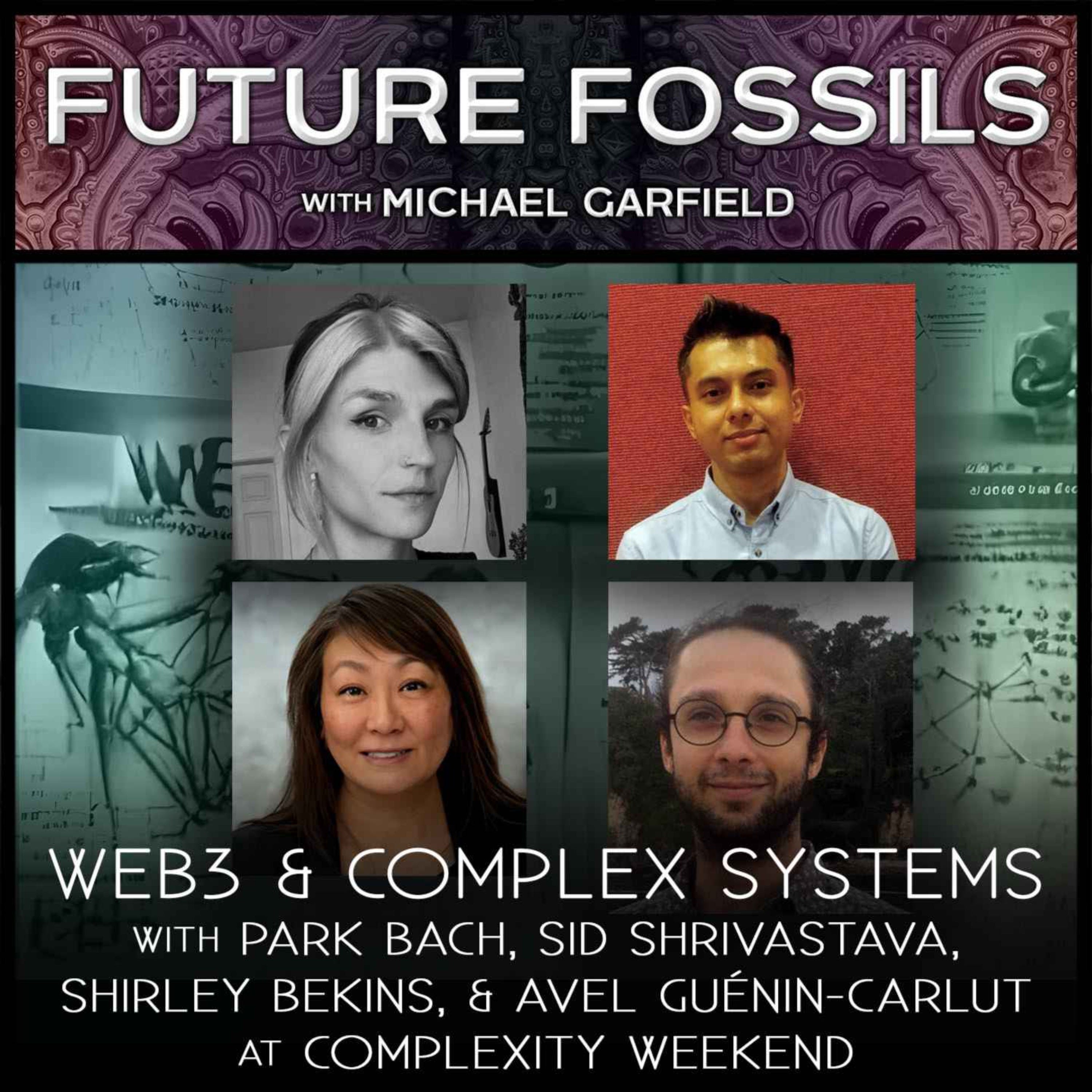
This episode I host a panel on web three from a complex systems point of view with four brilliant and not entirely aligned people. So it gets interesting and dissonant in ways that I think are very important to furthering the discourse around the potential, the promise, and the possible challenges or hazards of this new layer of the internet. The guests here are Shirley Beckins, MPA, independent writer and researcher, Park Bak, researcher at Figment.io and librarian at Gitcoin, Sdant, Shrivit Saava, researcher at Singapore University of Technology and Design, I Trust Center for Research and Cybersecurity, and Avul Gwynn Khan, I hope I said that right, founder at Kairos Research and Research Coordinator at Active Inference Lab. These are four extremely smart people, all of whom have a deep familiarity with the non-linearities of complex systems, but four very different priors, as far as understanding the landscape of distributed ledger technologies and how they will interface with, augment and complicate the web as most people are currently familiar with it.
This is a conversation of great import and I'm very glad to share it. But before we do, I have to give an enormous thanks to all of the people who have been showing up to support the show on Patreon, because God knows I complained a lot about the challenge of running this podcast while hosting, while also doing my day job at the Santa Fe Institute and helping to raise two small children. We are currently about 22% of the way to the goal of 1000 true fans, as Kevin Kelly put it on Patreon. And so I thank all of you, but a special thanks to all of the new supporters, who hold on tight, Earl Washington Kelly, Coleman Tekel, Tim Fogarty, Co-Douglas, Nick White, Adria, Henry Andrews, Rex Washburn, Kelly Matthews, Holly Grimm, Mary Charlotte Domondi, Dalton Cessumas, Narmartina's, Marshall Murphy, Ulrika Anderson, Krista Luach, Deb Fieran, Bobby Levy, Jesus Gatos, Daniel Lorche, John Lipkowski, Shibi, and of course, folks that have purchased my music, on Bandcamp, I love you too, and given the tenor of this particular episode, yes baby guy, speaking of tenors, you're more of a soprano at this point, they'll do an extra special thanks to the reincarnation podcast and the listeners of that show for their financial support as well.
Yeah, yeah, yeah, thank you all. Baby Steps, perhaps by the end of this year, I will no longer be beholden to the Coronos paycheck, and I can continue to deepen and diversify the offerings of that which is supported through my own kind of ironic wanderings through the noosphere. One thing in particular I would really like to get back into, by the way, is the musical and narrated time-lapse art videos that I used to do while I was on Festival Tour, which I will link to in the show notes. A lot of people have been telling me that they really appreciated those, and would love to see more, and well, you know the answer to that, help me make time to make art, so that I can blend it with the music and podcast excerpts into a synesthetic, immersive adventure into the frothy edges of the known and knowable.
Anyway, thank you all, I love you. I'm excited, if you're listening to the show for the first time, please go check the show notes, and the show notes are prior episodes, because the wealth of learning resources that we have constellated here goes very, very deep indeed. And stay tuned in the next coming weeks because some of the best episodes of Future Fossils ever recorded are in the hopper. The next one is with Jim Rutt, with whom I discuss the prehistory of what he and Jordan Hall and others call Game B, which I think bears mightily on the conversation that we're talking about now, as well as a four-way discussion I had with my friend Christian Lemp of the Diamond Dao, and John Hillis and Zach of Creator Cabins now.
Also, a romp into the microscopic with Civ Watkins, the magical woman behind microanimism.com, Roland Harwood of WeAreLeminal.co, and many more. Smash the subscribe button. Thank you so much, enjoy this episode, and if I can get my act together, the next episode will be out sooner than two weeks. Patreon.com slash Michael Garfield.
Thank you and enjoy. Hello and welcome everyone to Complexity Weekend November, 2021. This will be a special crossover event with some Complexity Weekend Future Fossils Fusion. And out further ado, I will pass it to Michael Garfield for facilitating the rest of this discussion.
Thanks everybody for joining and really excited to hear what you all have to share. Annual and hi everyone. It's strange to host this and gather where it would seem as though there was no one listening from the other side of this weird virtual panel discussion table that we have here. But we're not here to talk about demoralizing skeuomorphic virtual event design.
This is the third of these live future fossils recordings I've done with Complexity Weekend. And my hope is that each conversation is as fresh and different as the lineup of guests here. So I have ideas for how this could go, but given that this isn't something that I can really model in my head, what I think we should do is have everybody on this panel give a brief introduction to themselves and to their work and to the importance that they see their work providing for the value, the necessity of their work to the world, basically, because I think from that we'll be able to identify some pretty obvious points of intersection and dig in. So with that, I guess let's have Park go first.
Yeah, so my name is Park Firebock. I work in Web3 technology. And I have been interested in complexity science in the first place and seeing that there were these emergency systems happening within Web3 and cryptocurrency spaces. And so both of those things kind of fed into one another and now I do it as a job.
So I work for Staking Services as a provider without being targeting it, just means we support internet infrastructure for the new web. And then I also work with Bitcoin, who tries to do basically self-perpetuating, public goods infrastructure and trying to provide space for those things. Sure, so I am Sid and I work for my communities in the local physical world that happens to be my communities in Singapore, where I am right now, and India and the different countries where I have friends, like many of you here. And on the internet, I saw the internet community through various means.
And that means right now I'm working for Web3, and I've been exploring this whole, private whole of how critical infrastructure is being built for the physical world, in my physical job, physically demanding job. And then there's a digitally demanding job where we are building digital public goods and digital infrastructure for the internet. So that's where my role in the kernel community, which is a vector school or a new form of internet based education and a community of practice comes in. And that's where work in different dows like Bitcoin, which is exclusively focused on public goods, comes into the picture.
So yeah, complexity helps to bind all this together. And I think that's why we are all here. I've invited you into this panel as the fourth point of the tetrahedron, if you will, or like the one out in left field. Could you hear me introduce your distinct different in a way that makes a difference?
Sure, wow, I'm honored. Let's see, so my background is different than park and SIDS. So I basically have worked for a couple of decades in communities developing affordable housing, along with some integrated healthcare and social service facilities. And so after doing this work for so long, actually from the very start, I was puzzled and thinking about are we doing this the right way?
Are there other ways of perspective that could be helpful? And so that did lead me to systems thinking as well as complexity science. But on the other hand too, in some ways, there's some commonalities here. Besides everybody lives in a community.
So that's obviously commonality. But I also work really as a volunteer on civic tech initiatives in different communities through Code for America. And so that really, I think, is a great opening for me to think about having community centered around technology. Excellent.
And Aval? Hello, Michael. First of all, and that's one to be a little optimistic about blockchain. And this is a very good way to work on your thing.
So I'm trying in cognitive science and physics. I'm one of the, like, 10 people who's activating in good existence. This is not how there was something that this is like. In fact, I've kind of drifted away from academia for a better reason, which is, basically for those who are aware of it, the machine's work on social, how to say, social, democratic, social, demographic cycles.
We have a reason to believe that the current and the end model, yeah, touching cloud analytics as a day outside, that the current event model is coming and that we have to build new things. I don't think academia is good at it. So I've funded or helped organize, as you will, something called Kairos Research, formerly Kairos Caligamics, which is a lab which is meant to help understand and design organizations that are just enabled and that are intelligent. And now for the last year, I was many interested in active inference and activism, which are competing about contemporary theories or methodaries of how cognition is grounded in material beings.
I don't think you'll have to justify the significance of that particular work to any of that applies to all of you. So one thing that I saw in common in your four biographies, I think is made clear just now, is that all of you are in one way or another, committed to, actually the way that Alhel says it in his complexity we can buy, I really appreciate it, applying this field of research to understanding human societies and building social organization that will withstand the test of the Anthropocene. So just as a way of placing this conversation in space and time, addressing it for the hypothetical future archeologists that are digging this up, I think all of us recognize in one way or another that the models we were operating on for the last few hundred years are, if not wrong at the scale at which they were devised, problematic at the scale at which they are currently deployed. And there's something that I find really interesting in trying to apply a complex systems lens to specifically the restoration of the commons and the public goods that I'm interested in and holding it in tandem with this question of what ultimately is value and how do wild, non-designed evolutionary ecosystems, sorry, hold on, just a second, I have a real bug in my throat.
Folks are okay. It's a feature, actually. How is it that evolved ecosystems account for resources and distribute resources and then contrasting that against the orgations that we've come up with both in the public and private sector and how those things, basically like a biomimetic kind of approach, like what is web three doing if we look at it through the lens of evolutionary ecology, where is it, in effect of use case and where is it making things more complicated than they have to be? We had a conversation about centralization that called to this a couple of years ago, I'll link to in the show notes.
But yeah, I mean, this is a very broad place. I want each of you to feel invited, welcome, to just chime in here. So let's see, let's do Sid and then Park for thoughts on this stuff. Sure, so just to bridge the introductions with what Michael just said, all of us mentioned community or society in our introductions, like serving the community as a part of it.
And we can start there and connect it to how it's connected to ecology and different concepts. So firstly, all of us are not focused exclusively on web based societies. Like when we say web, we mean the interconnected nature of humans as a species and with the environment as well. So I really like to introduce this concept of society as the pathetic dot theory or the four pillars of society which are affecting all of us, which are technology, culture, policy and economics.
Like these can be considered as four independent pillars, which interdependently affect each other and then affect all of us. And likewise, when we change any of these four pillars, there's a change in all the other three as a result of it. So for example, when we build web three technology, there's a sudden influx of people who come in to get a financial benefit out of it. That happens with most new technologies because they come into Pelenie.
So the economic activity comes first, then somehow culture shifts as a result of so many people taking part in it. And then culture, technology and economics evolves as a part of all these changing forces. And finally, policy catches up. And regulators who have the responsibility to keep society stable and not just riff apart due to these sudden changes, they have to keep up with it.
So then we see the changes of policy on all the other three aspects. So looking at that system of like socio-economic regulation, it's very similar to how the human body also regulates itself. Like auto-regulation is a very natural phenomena in all biological systems. And we see that in society as a biological organism.
So when we talk about economy or ecology, we should consider the root word of that eco, which is derived from OICOS, which means household or the home. So economy is the study of the management of the household or ecology is the study of the home. So yeah, whenever we talk about serving society or community, we are essentially serving our homes. And that's how I like to approach these topics.
Okay. Sure, yeah, I mean, I'd love to, I think you summarize a lot of my thinking as well, quite beautifully as it is. I think that because you and I are now a lot of very similar thought camps in the spaces that we explore within Web3 itself. But one of the things that I'm really interested in, specifically when I'm still like looking at this new organizational structure within Web3 is that for the most part, in line with what you were mentioning earlier, Michael, is that it's a rejection of a lot of these norms and seeing that a lot of these things are broken.
And so I like to call it it's an economy of distance. A bunch of people who don't necessarily like the old system and so they're exploring and willfully considering new economic organization structures and really building that into the way that they operate within space. There's a lot of experimentation and willingness to fail. And I think we're that leads really well into this question of complexity sciences, that complexity is a failure event.
It's a continuous exploration of all possibilities and creating these like dynamic approaches to solutioning and responsive phenomena in inference and any one of these, you know, terminologies we want to use to approach this definition of complexity that so often escapes everyone who tries to do so. So I find that what is most fascinating to me, especially about Web3 and its approach to trying to solve problems, is that there's just so much experimentation and so much willingness to continue experimenting. And there is a little bit of an approach that emerges from that process that has a lot to do with first principle thinking. You know, looking at where problem is failing and recognizing that the problem cannot be solved if the problem is already in existence.
Often times you have to build an entirely new system and fork off from the very base structure, how does it that system is made and build a new phenomena into the system that account for the failure of the previous system. And so when you see that beautifully, is in many ways, is right now I think we're really setting the ethics in a big way. There's a lot of different components we're looking at how the economy sits together, how the ecology needs to live, but within all of the human dynamics that contribute to a new internet and a new interconnection space is a need to set new ethics. And so we're sorting towards it right now.
And so we're seeing these very beautiful things that are coming out of it. And I think one of the things that I don't touch on is this really like just astounding level of optimism. And the optimism is part of what has kept me in that space, is that there is a critical optimism that I think will actually work towards solving the problems. And because of that, we are actually seeing people who are willing to continue failing and fail upwards and keep these very aspirational goals.
There's this great, I was speaking with Daniel earlier, this weekend about this, this idea of the root question of optimism. What is optimism? Oh, optimism is optimizing. Optimizing for what your end goals should be.
You keep your intention tied into that optimism. So that's a huge part of what has me in Web3 and how it is that I see complexity sort of fitting into that space. Thank you, Shirley. You want to try, man?
Oh, yes, I'd like to. So I think I have a question about, I have a limited knowledge of Web3, but I understand some of the components and technologies that comprise it. And so a lot of these technologies are highly inequitable systems that I think, Michael, you mentioned David Wilpert in some of the unpleasant outcomes of machine learning. And so my question is really about, these are still the same components or technologies that are producing real harms in our society.
So to what extent, that's what I worry about when I see these charts is that it could also represent an acceleration of harms as they spread, because already artificial intelligence and machine learning, through some examples are automated decision making models. They are spreading into government, civil society, non-profits. We even have automated decision making algorithms for distributing benefits to people who are highly vulnerable in our society. And there is literal recourse because a lot of the stuff is pretty black box.
So it's, how do we build on what we have when we have such unequal technologies? Excellent. Yeah, actually, you took it directly into a place that if other people want to stack on that, let me just stack this block first, which is working at the Santa Fe Institute. I am doing constantly in the work of people like Jeffrey West, who has shown that the social reactor of a city basically accelerates innovation in this ratcheting way that he fears ultimately undermines the stability of the city itself, that he has this finite time singularity and says, I think he's put his projection somewhere around 10 years from now.
We're going to have to be innovating at something like one internet level advancement every six months, simply in order to stay on top of the sort of roiling collapse that we've created. And this is Zigmunt Baumann's Liquid Modernity talks about modernity, kind of a dual nature. One half of it is dedicated to control, and then half of it is dedicated to radical transformation. And those are at odds with one another.
And in fact, systems of control tend to create blind spots. And so it's this evolutionary arms race on an accelerating treadmill that I'm curious to hear about from other people because the God's honest truth is that I, too, am extremely optimistic about the potentials of this latest layer of web technologies coming online. I think I was just lecturing a group of teachers on Twitter this morning about why NFTs are not merely a scam. But a very important technology to consider if you are a young artist and how I wish that this had been around when I was 17 or 18 years old.
And so there is this question about, are we simply swallowing the spider to catch the fly? I mean, especially if we know, based on follow-up research, done by other people, collaborators of Jeff West, and he was part of this paper on how cities increase inequality faster than they increase per capita income. And if the web ultimately is, as it's made manifest, if what the web is really doing, ultimately functionally, is giving people in rural locations where essentially urban social opportunities, then how is this not going to merely amplify the existentially threatening instability that we're already grappling with and that this is largely intended to solve? And I'm just being here in the position of, I guess, like a devil's advocate because I am deeply ambivalent about this stuff generally.
And I would like to know kind of those who have given these concerns. And I'll just to loop you in, one of these concerns is based on the question of social epistemology and the degree to which we can make sense together and therefore coordinate our action. And back in 2017, I was starting to look at blockchain as a possible solution to deep fakes and extollarative counterfeiting. But in a broader sense, you zoom out and what's going on right now looks a lot like what was going on in 100 or so years after the invention of the printing press when pan fluttering and apocalyptic cults were taking over Europe and nobody could agree.
And it seems like a very, when you look at the blockchain as something that encourages forking, part to your point, there's only so many times you can walk away before everyone is standing on the peninsula of their own fork. And how can we deploy these technologies in a way that assists in the process of collective sense-making rather than primarily just encouraging people to start their own reality tunnel? So that's another huge broad set of topics I brought up. But that's what matters to me now.
And I'm curious what your thoughts are on that each of you. OK, so I see a lot of way to talk from what you say. I will focus on two things that I find most important. The first is the idea that from Geoffrey West and the local and other people research.
The scientists are basically, how do you say that? It's why you have places where innovation is strong. Places that catalyze the relation. This is what I do.
It's that how FTS and blockchain and things like that can catalyze and puts under control this relation. So this is, I will answer to these two things. The first thing I want to say is that the kind of research that I read of West, which is paper that are first offered by Ben Coor. And I did not have time to read the full West book.
So maybe I'm kind of off-charts with that research. But what I love here is not part of a meaningful explanatory framework. I elaborate now. The core point of I read of West is the idea that cities, most generally human settlements, they verify some sorts of universals that are happening in laws, will regard to a medically objective size, like the more people on the face, on one hand, and on the other hand, infrastructure that's against, suddenly we size.
And on the other hand, things like, there are more attract, like power, and vision that size superlily with size. So this kind of laws, this kind of abilities are interesting objects that are subject to central explanation, that they are not central explanation. At least they have not been since the 50s and the criticism by a lot of people like one in the proper of the oppositeities. First attempt is that it's amazing, central knowledge.
We received you that sent this chair today, outside some physicists, is that we explain by calling it to mechanisms, we explain by calling it to structures. And we look at how a system is structured, and we look at what kind of behavior, respect given instructor, and we look at the context in which behavior emerges. And this broad approach is an explanation. And then you have an aesthetic way in life sciences to do so, which is mechanical modeling.
But in principle, we can recruit different ways to get at this understanding. And as far as I'm concerned, all of these are okay. And most importantly, it's much more difficult to get positive structural models in astrology than it is in biology. So there is no way to expect astrology to abide by the law of neuroscience or biology.
So the idea that cities are forged of innovation in which you are screen-in-law is in my view plot, but no, something that is more interesting in my view is to look at the dynamics that explain the matters of cities, which are dynamics of polarization, of polarization in measurement elements, of polarization in power, of polarization in economics, in the density of communication in innovation, in things that we are interested in. And basically there are very literally no reason to believe that there is a less explanation for the identities. But we can look at patterns, you can look at dynamics. And look at, there is no way we can map the whole history of the evolution of cities, like people who try to do that.
It's very difficult to make their basic statement. But it's agreed that the fact that we focus economic and direct to its specific place, it affords at the same time for more tyranny because everyone that can be controlled is in centralized and more democracy because every place of power is at the reach of common people. So that's, I think, a core challenge of what it is to live as societies that are organized in cities. And then LFTs, blockchain, cryptocurrencies, these things, they can also block everything and start anew.
This is not like any computer's blockchain. This is not the option. What the kind of is interact in some specific system that are in the way with existing infrastructure, it's physical, social, political, and other. And the pattern that I see that's lost at the center of center of center of C with cryptocurrencies is that they are used for speculation, they are used for thumb and thumb skins.
There are tools of libertarian ideology, which is interesting, it's a aspect like we have Wikipedia, which is one of the most important key plays of human knowledge, which is a libertarian aspect. But libertarians are just naive with regard to how markets can power and political asymmetries and failure in markets. So the view that you can just build markets that are in principle not biased and expect no power asymmetry, no information asymmetry to occur is just, if not political, put this, I will say naive and it's an attachment. So what I expect from cryptocurrencies and blockchain, the risk is not a segment of principles on how great their cryptology is.
It's a segment of systemic modeling that explains how their cryptocurrencies in our specific political context will help putting social life economic life out of the reach of the winner be tyrants. And there are attempts to do that. There are things like, which are called, I know this in French, like Mona Libra, which is free money, like money of freedom, which are money which have an embedded universal body income. In not that is really specific to taxes, but that is embedded within the money direction system.
So the argument is that if I re-enter it's money, we have more democracy in economics. And this is the sort of arguments that something no one knows, and that is hugely important, is that you go, is that private banks dread money. So you have dozen of executives in the world, not more than that. You have a few of the executives in the world that basically addicts their lines on why we should generate money.
And these are the lines are entirely centered around the private profits, not the private profits. So we saw a view, and you have a seat, which is a cryptocurrencies that is centered on what they call a radioactive residence or something. But I'm still not quite hard-working, but the core product idea is to somehow funnel money in places where it helps creating more resilience, helping ecosystems grow. So I'm not aware of wild papers for the frequencies that are convincing, but very small.
And I'm aware of no white papers for this currency, but that is the kind of thing I expect from cryptocurrencies advocates. I don't expect proof and principles on the correct words that I trust, I basically trust them on this. The technology is not centered, well, they're of quantum computing, but this is a thing which I don't think is as important though. Parky, can you respond to that?
Yeah, absolutely. I mean, I think a lot of the critiques that are presented, they are very important, right? And this is actually something we deal with within the industry constantly, is this information asymmetry with people's familiarity with stuff, just everything. When someone invests in cryptocurrency, they have to become familiar enough with the product to be able to feel like what they're doing with their investment, what they're doing with their investment, right?
Is actually educated enough to do it. And I don't think almost anyone has sufficient knowledge on any given protocol to be able to say that what they're doing is necessarily the right thing. Because you end up with this like, obscurantism that comes from it. There's not obscurantism, but like this obvious gating layer that comes from the technical nature of the work itself.
And so the part of the work that I do is, as a researcher trying to distill it, for people who then want to invest in it with our services in an organization I'm a part of. And it's a very difficult problem to solve, because it's not complicated technology in application, but it's complicated to describe its utility. And that's the part that is a little bit difficult and nuanced to translate is in order to be able to describe the impact of the systems that we're building in cryptocurrency. You need to have a familiarity with it.
And in order to have a familiarity with it, you have to have a willingness to become familiar with it. Which means that in order to get past the crust of recognizing how it can be useful and that it's not just pumping up scenes and scams and all these different things, you have to already have made the decision to be a part of and to dig deeper. And so I think there's a lot to be said there. There's a lot of truth there in that it's very difficult to get through the crust of scams and pumping up schemes and crypto grows who are just chilling coins and trying to make money by their lamboes as they say.
But once you get past that, you do see that for the most part, a lot of the people who are working on the core technology and the value proposition of a lot of the technology that's being presented in the space, there's this phrase that I've never heard anyone say, I've summarized it, it's my synthesis of the environment. We're not here for money, we're here to not need it. And I think that's something that I believe to be like a really core tenant that I'm seeing throughout the space, especially those like who are building things like seeds, building region network, building Ixo, building Bitcoin is sure, the value of the token goes up and you might have a ton of money. But what that means is you can redistribute energy from one part of the system into another part of the system and you can create an entire new economy, a micro market around a solution event for trying to do something and creating centers.
There's a lot of things that present themselves in a space as useful and they're not necessarily useful. But then there's a lot of things that are extremely useful but to be able to explain the technology, to say how it is that it's useful outside of the cryptocurrency space, you have to go through an entire translation layer. And so it's very difficult to get there. And as a result, I think there's a high probability or a possibility of failure because how do you decipher this?
And so there's a lot of different approaches that people are taking. One of the things that people are trying to take here is to maybe you can just kind of create a blanket around what cryptocurrency is and just focus on where the positive externalities patch the rest of everything else. There's this concept that we've explored a little bit in this last weekend is the idea of the internet as a nervous system for people and for society more widely. And I think the emphasis here needs to be focused on the idea that in order to have a certain nervous system, you need to have a body.
The body must touch the rest of the world. The nervous system connects everything, sure, but it's not necessarily going to do anything without the other pieces of the body. It's supposed to be the connective layer. And I don't think we've necessarily figured out how to deploy that.
And so Web3 is probably our most genuine attempt to approach it and actually get to that place. I thought that you want to respond to that before I hand them back to student? Yes, I'd say that internet will be the mine of writers. I was like, your results, what research in everything biology that comes from the ITs, I think, and that we was really summarizing the 90s to others.
On the different transition, how we get collective agency to emerge from collective systems. The most important research on this is about Ivanka, I think, which is also a founder for epigenetics and, more generally, the idea of evolutionary information. And something she says is that the emergence of specialized information processing cells in the animal bodies is one of the big transition. And it's a transition that many things more efficiently.
It's a case where we can specialize in fashion systems that have existed in human societies. There are states that are already systems that are pretty much tied in a specific political system, where a specific part of the relation was the minute. It is possible to imagine states that are purely democratic, but this is not what happens. Like, even states that we call democratic, that are equal to democratic, that are designed in different revolution with the specific intent in mind to keep democracy from happening.
To prevent people at large to have a same society by introducing the election as a way to claim a presentation without having to have prisons interfering with politics. And they do that the web as completely as a way of information processing that is entirely decoupled from administrative structure is pretty radical and pretty interesting because it could, in principle, constitute a truly decoupled kind of professional processing that could be the nervous system of some other body, some other way of getting to society. And this is radical. This will be a radical shift.
And we agree, so I don't need to argue on that. But we need ways to implement this. And this is not easy because the people who have the power and money are particularly people who need this not to happen. So I don't know what the other future gives you are.
I wouldn't do whatever I have said what I need to say. Please, speak as you see. Thank you. Before I say it, the spark happens to be anything.
If we could respond to that. Yeah, I just, the last point that you made, Ava, there is like, you know, you want to make sure that people who have too much power aren't going to be able to control the system. They can't with this system. The greatest thing is all they are is a source of energy.
They might, like, in a well-designed blockchain. We have, we're very early in the process in designing a lot of these things in a well-designed blockchain. And we will get there at some point. The amount of currency that you have in the system will not be the reason you have an influence on the system.
It doesn't necessarily, it allows you to be a source of energy for how it is that the system will grow. That particular protocol will grow. But that doesn't mean you have necessarily, like, a determining structure. It's, you can still work towards a digital democracy that will provide space for people to consider what you're saying instead of just going with it.
Because you have the most tokens. You know, and that's something that comes to mind here. And I just really don't think that's going to be the future that will happen in this space. Because ideally, it won't be possible.
Should I speak to you now or do it? Michael? Okay, so you say that having accounts should not be, won't be power of the system. But if we allow trade in current, like free trade in current, I'm taking a euro in those as well as the coins and things.
Someone who has enough coins, and most importantly, someone who has enough cloud, enough time, can just decide to crash a coin because they'd like to. So I, you need a set word against it. And to get to that, you need to get to 1% attack. Like I mentioned for people who follow that spark as that this 1% attacks yet, which I understand are attacks where someone takes control of more than half of the servers that control the coin system.
This is specifically not what I'm thinking about. As you know, cases that where the rules by which the coin evolve are respected, and they intend the ability to trade the coin for all the coin. In that case, if I have like, I don't know, 1 or even other 1% of the coin, and that they sell them, and as I say the coin is shit, and I send them to other people, the coin is that and this happens to the coin all the time. I think it must destroy or at least make it up to it a lot.
And this is things that cannot possibly happen for coins that are meant to underlie actual social economic infrastructure. So if you keep the libertarian ethos of blockchain of cryptocurrencies and you get the capability to trade them basically and to have free markets get close to that. I'm questioning over them. And you keep that coupled to the capitalist system.
You did not leave capitalism. You gave new playgrounds to capitalism. And it really ways to get out of it. And I don't say there aren't ones.
I think about what the local money which are sometimes cryptocurrencies, sometimes a value printed piece of paper is where the money is tied to a territory. And so it's basically probably then or at least not the article of Jews outside the specific territory of Seilion of the Gellet and pronunciation because who will want to decorate and things that are only available in one place? Like you could have speculators within you because you didn't see it. You can do the same for Ashner's share of Demast or whoever no one wants to do that.
So this provides a set working and speculation. And this is kind of head-frontly opposed to the idea that you can trade an exchange information freely because it ties the currency to a specific place and specific network. And this is as I understand, and maybe you will show me wrong. I'm not totally at all in which most coins are thought of today.
You brought up something I'm actually very, very eager to discuss, but maybe we should put pin in the question of how do we reconcile at least sort of rhetorically indefinite scalability of digital goods with the organic constraints of our actual biosphere? I do want to return to that. But I want to make sure so that you get a word in here if you want it. Yeah, sure.
So I think we need cynics in the space. And most of us who seem like radical optimists, we lose sleep at night thinking about all the ways these things can go wrong. So we might be radical optimists in podcasts like these, but all the discussions behind the scenes are all about how do we make this not go down those routes, which cynics are always talking about. So firstly, we need healthy skepticism in this space.
And we are not Web3 Crusaders or something. There will be a Web4. There will be a Web5. And we all would move to better systems, just like there was a Web1 and Web2.
So Web3 is still so early that it's easy to poke criticisms at it. Like Bitcoin's White Paper just had its 13th anniversary two weeks back. So Bitcoin, which is the first true form of digital currency, is essentially a teenager. It just became a teenager.
And we are still to go into, we are still yet to see the rest of the aspects of evolution of society. So when I started my talk, I told you about technology, economics, culture and policy. We are still in that economic evolution stage where the mercenaries have started to come in, get financial advantages out of it. And the missionaries on the other hand are trying to build better systems and build it in a way that's different from previous systems.
So I would like to quote Buckminster of Philadelphia, like to change something, build a new model that makes the existing model obsolete. Now, why is that important for the digital world? Because the digital world does not follow the laws of physics. Like it does not constrain to the laws of the physical, biological goal as we know it.
So all the financial systems that we had earlier, backed by gold or backed by a physical asset and backed by government reserve currency. I mean, all those are evolutionary steps that took many years to understand the problems in the systems. But now we are so early and we are evolving so fast that we have the programmable power and the creativity to come up with these solutions, through these systems, solutions to these decentralization dilemmas that I will have been bringing up and part has been responding to it. So I would like to say why blockchains make sense.
And it relates to the title of the podcast. Like blockchains are the easiest, digital equivalent to a fossil. Like blockchains are future fossils, just like fossils capture information from geological leaders back into the early aspects of life on earth. Similarly, blockchains are a time change.
Like they record the events as they occur in a very orderly manner and you cannot change it, just like the physical world. So blockchains are the closest thing we have to physical models in the digital space with all the benefits of the digital world. So that I think is a great place to segue into how do we marry the benefits of physical world properties like immutability and blend it with the creativity that the programmable digital world offers. So we can get into NFTs and other such concepts now, which are changing society and interconnections and building that body and over system and all the synthetic intelligence that part has been mentioned.
So I would like to open the floor to those aspects of the blockchain. Definitely, thank you. I really hope that we get there, but I wanna make sure surely it's got our hand up. Yes, I may come across as acidic here, but I actually am not very positive about technology and really looking for ways in which it can improve people's experience and in particular marginalized communities.
One thing that really struck me said about what you just said is if I captured it correctly, the digital world is not constrained by physics. In my mind, it is in the sense that most of us don't really think about what goes into these technologies. So some work that is more recent goes to work by Mary Gray as well as Kay Croftford, that was of AI. And I know that many actually scholars have contributed to that work.
So I just point out that she has a book recently about it. But all of the minerals, all of the materials from the physical world, but most importantly, the people that go into the technology that are not seen is really important. So people all around the globe who are basically providing, in a sense, well, actually we all are providing the raw materials and data, the power, different AI and machine learning systems. And there is this, on the one hand, yes, this idea that if we could own our data, if there could be less control, centralized control, then that could be helpful.
But I just, I really think it's important to remember that the physical world is definitely part of the digital world in that sense. And in fact, it works together, again, in a feedback loop. Yeah, I just like to check right there. Oh, yeah.
Yeah, so I never said the physical world is not part of the digital world. I said it's not constrained by the laws of physics in the same way that the physical world is. And that changes the nature of society. For example, if you attended a physical workplace 50 years back, now you can just open a browser tab and open 10 browser tabs and work for 10 different companies.
So you are not physically restricted in your physical human form as your community and restricted to your physical surroundings. And that's what I mean by the digital world not being restricted by the constraints of physics. So this is actually, this is great, because we're at what I would consider an acupressure point in this whole conceptual rat king that we created for listeners. And it has to do, you know, one of the major inspirations for this podcast was Douglas Rushkoff's book, Present Shock, When Everything Happens Now, which is a look at the history of the development of our ideas of time and Western civilization and the current state of crisis due to the dissonance between the specific constraints of the digital realm and the differing constraints of the physical.
And so like, thank you for finding y'all's way into this node, because I mean, this is interesting to me. So you just made the point, you know, you can have 10 tabs open for 10 different companies, but it is also true for me as a knowledge worker that I've recognized in myself that maybe theoretically true, but in practice, it becomes immensely difficult to manage the relationships across different organizations and to manage my attention and the allocation of my attention. And the real constraints around task switching and the sensible 23 minutes, it takes to actually change stream and fully devote your attention to a new task when you've been disrupted. Noah Alair, a friend of a friend in Albuquerque, wrote a really interesting piece about the effects of COVID-19 on our memory.
He wrote a piece called Not Going Places that I'll link to in the show notes, where he was talking about how episodic memory is sliced into the episodes by movement through physical space. You know, like this is why humans organize their lives so much according to ritual is because, you know, stepping across a given threshold is an indication to your hippocampus, you know, that this is where you end one narrative arc and you begin another. And we don't have that when we are under lockdown and increasingly the question of how stuff like the so-called metaverse is going to affect our ability to navigate space and time is sort of like related to questions to move this into a more general kind of inquiry. It's related to questions around, you know, the worlds that people have imagined for autonomous vehicles and like the idea that you'll just be able to like have a car that's unapartment and you'll go to sleep and you'll wake up in a different city and like, you know, these kinds of things.
And the question of, you know, this gets back to stuff that you had said Park earlier about the inferential gap that people have to cross and even to even begin to feel as though they're making informed decisions about technologies that are evolving as fast as these are. And this foregrounds for me, again, it foregrounds for me problems with epistemology, you know, under these conditions and the fact that things are changing so rapidly and one of the major themes that we've had on this show since very, very early on is the problem of how do you even recognize or assign expertise when things are changing this fast, you know, and then again, you know, relatedly just not that this conversation needs anymore anymore, like doomer kind of thinking. But I will say that, you know, I've had this critique leveraged against the immortalist transhumanist subcult for years, which is that even if it is theoretically possible for humans to live forever biologically, the technological ecosystem that would support that must change so fast that we would have to change unprecedentedly fast in order to keep up with it, rendering the immortality of a psychological self a moot point. That like, even if we can get something, you know, there's a lot of things that look like you can reach them, but they're on the other end of a critical threshold that makes actually obtaining them impossible.
And so I think, you know, to your point, I'll avail about, you know, like the way that, you know, the actual knock-on effects of some of these systems looks and ends up looking very different from the intended effects, that's of interest to me. But so yeah, I mean, this is just, I don't know what else to say about it except that, you know, I think that in the conversations that I've been having about NFTs specifically lately, one of the things that seems to be under appreciated by both proponents and detractors is our need to identify ways to restore real world forms of scarcity in the digital environment, you know. Like if you think about Karen Wilcox, the University of Texas in Austin, whose work focuses on digital twins, and like this idea that something can have a unique and indeterminate and real-time updated digital token of itself that is useful. Like this seems like that's that kind of scientific research into complex systems, and the NFT thing are converging somewhere which is about how do we actually use the tools of digital environment in a more ergonomic way with the acknowledged constraints on human time, attention, cognition, and material resources that we actually are dealing with.
It's like where is it appropriate to use the internet, as Kevin Kelly has discussed it, as this amazingly efficient copying machine, and to pursue the new rules for a new economy that he outlined in his book in the 90s. And where is it appropriate to look at what is essentially artificial digital scarcity as a form of honesty about what limits we actually face? So yeah, I don't know if that's the specific question people are interested in answering here, but I am curious to know your thoughts on this. Yeah, I mean, there's a number of things you touched on there that I thought were really great.
I mean, the main one I think I want to address is something that I know sit on to and I have encountered, which is, you know, there's this narrative, like if you want to learn about web3, join a DAO, like join a decentralized autonomous organization. And it's like, join as many as you can. And it's like, okay, great, you're going to be split across all of these different things. But what I have noticed in doing so is, and as a result, you get no expertise, right?
But I have noticed in doing so, is that you do see people differentiate into their sometimes, which is, which I hope we need to enforce and recommend people do more often is allow people the space to differentiate into their capacity. So without being like obscure the way I'm saying that, when you differentiate into your capacity, I mean, how much work can we do for the space, for the work that you're doing? How much work can you do for the computer component that you're a part of? And we're still figuring out measurement mechanisms when it comes to centralized autonomous organizations and how to codify them.
And one of the issues that comes up a lot is people getting jobs that are getting roles that are defined as full-time jobs, or partner jobs, or things like that. And that quantification is very loose. And it means that people are expected to devote so much time to it. And one of the great things I'm doing to get coin as one of the librarians there, I only have to work two hours a week.
You know, like that's how much work I do there. I still work for get coin. I still aid the forwarding of the organization. But the amount of work I do is quantified.
And unfortunately, the reason that I'm able to do so in my particular circumstances, because what I do is I facilitate discussions in discussions are one to two hours. So it's perfect, right? There's a little bit of like forework that comes with finding people to speak in the group, something like that. So on the co-teals of this idea of like the attention economy and like people working continuously, living on the internet, doing everything on the internet, is also I think people need to start differentiating their capacity and recognizing how much effort they can put into things.
And that's a lot harder. And on the sort of the back end of that is also this recognition that maybe the idea of individuality and expertise in a single individual is less relevant. But more charismatic, right? Like, oh, you want to be an expert in something.
Maybe there is value in being able to pursue something to a level of expertise and be an authority on a certain set of knowledge. But being an expert in a certain thing may not be as important as making sure that things grow up to make sense, helping the system grow itself. And so there's some transhumanist logic that comes in there. And of course, there's some fear of the loss of the individual.
But I actually think there is also a little bit of saving of the individual. And allowing people to sort of plug and play their abilities and their skills into particular environments for the quantified amount of work that they can do for the contribution of the larger system without actually having to devote their entire selves to it and reach this sort of overload of contribution. And I think that's part of how work is being reformulated, more generally. It's happening within crypto, sure.
But it's also happening just as a result of remote work. People can work. Some people do work two jobs at the same time because they can just open up a bunch of browser. That's fine.
They found out that they can work that amount and get paid that amount. If they can manage it, that's great. But that's a logic we have to figure out is just differentiating the capacity down to the basic level. There's some other stuff I can touch on.
It comes to NFTs and creating local economies. But really that's the main thing. I think is the reason that web 3 is so interesting when it comes to complex systems is that you can have people have minimal input. And still the larger system will grow.
And still will become its own thing. And everyone gets to contribute to it. And it just grows in its own way. If anybody wants to jump on that, speak now.
Or I'm going to let part go on into the question of NFTs and local economics. Because I think that is where all of us are of a cohort of people that realize and have found a language to describe this in terms of complex system science. Why scalability and global standardization and these sort of related web-1 rhetorical stances are not necessarily desirable. And there's this movement away from large social platforms to things like Discord.
I feel like people in the way that mass capture fishing has skewed the evolution of schooling fish to smaller schools that are less desirable targets for big net operations. I think that there's something going on now where the polarization that you spoke to, Avil, that is the product of cities, if we can think of it in that way. The prime product is not always bad. And there are certainly cases where scattering into smaller and more manageable groups is desirable.
I don't know that I needed to say any of that to facilitate this. But yeah, please. I was going to say I would love to hear from Shirley on the idea of local economics a little bit more. And seeing if micro-local economics can make sense.
And then maybe I can kind of obviously, Avil as well, can kind of jump in and contribute some color on how we're seeing a lot of these quote unquote, local economics happen within our space as well. Yeah, I think that's an interesting question. And actually I attended Sysh in the last night where I was bringing up inaccessibility to the internet in the United States. So there are so many communities and also correlated with poverty and infrastructure issues as well, but a lot of inaccessibility.
So from my perspective, it's interesting because, yeah, it's a, wow, I don't know. Yeah, I think it's promising. But some of the things part that you brought up about, on the one hand, there's so much learning and translation and a lot of heavy lift around some of these technologies to understand. And so, yeah, bringing that to a local area where people, perhaps there's a core of people who have the experience and then want to disseminate and bring in local communities is really important as opposed to, I think, obviously, someone coming in who is not part of the community, or trying to impose something is really important.
So, you know, Syd was showing us in the section, you know, mesh networks and things like that. And that was something that I had actually really was only thinking about in other countries. So that, you know, yeah, my awareness is being increased. And so, yeah, that could be a possibility.
Yeah, Tanya, that speaks to the power of the internet. The internet does not discriminate. If any community wants to adopt networking services, it is up to them to set up a mesh network and eventually connected to it. If there is inaccessibility in any part of the world, a major reason of that would be the flaws in the physical systems that existed before.
So, like the programmable power of these cyber physical commons that we are building, public goods for cyber spaces and physical spaces, that allow us to create these incentive structures where people can set up their mesh network and be incentivized and rewarded for it. For example, there are projects which let people run their own node, which lets them share the network capabilities to other regions. So, yeah, I think this is a good segue into NFTs and the programmable power of these digital assets and digital technology. So, the example of sharing your network and sharing physical infrastructure with communities which do not have access to it is just one example of that.
And JPEGs and right click and save NFTs and all those means around just artwork based NFTs is just one small aspect of it. We can get into the full realm of creativity, which programmability and composability and interoperability offers us in this space. So, yeah, we can open it up with that. Can I ask what is probably an offensively naive question to some of you and a matter of dire concern to the rest of you?
I think typically when people talk about technology, what they mean is everything that was invented since they were in middle school. Or like wherever you draw the line, it's about that which has come up since you like sausage, doppu training data. And now you're in an environment where things are surprising you and not making any sense. And consequently, I see a lot of people talking about this layer of things as a Ponzi scheme.
To me, zooming out to look at this as generally as possible, it strikes me that there are always disproportionate rewards to early adopters when things go well, but that you're also looking at a massive survivorship bias. So, I've been thinking about it more in terms of like, well, how is civilization itself not a Ponzi scheme? Or perhaps another way of articulating this question would be that no matter how rich our economic models, there are always aspects of the world that are illegible to our models. And therefore, there are always externalities.
There's always invisible labor. Like theoretically, someone is always getting screwed. Theoretically, ultimately, to the extent that energy is conserved profit and unpleasant way of putting this, all profit is on some level theft. I mean, those are radical positions and I may sound like I'm moralizing here, but as an obligate participant in this system, I'm not trying to judge anyone else anymore harshly than I judge myself.
And the question of how it is that we can design systems using these tools that do not merely amplify and accelerate the characteristics that I've just acknowledged, but allow us to compute more evenly together across time scales. So as to distribute our incentives in such a way that we're not borrowing against the livelihoods of our children or the future or the biosphere, I'm not sure that this, and I've talked about this with Greg and Rila and do a region network. I think it's a very noble mission, ultimately, I've had other people like Sophia Rocklin on Future Fossils who point out that ecosystem services ends up just financializing things in a way that could ultimately be very disruptive to their persistence. And then also, we may be missing the ability to track, to quantify and analyze and act upon other forms of key information.
So, and I bring this all up again, surely, just to give you a foothold here in your thinking and your work on inequality in the city and specifically about path dependency. I mean, I think luckily, people like Kevin Wokee who helped develop Ethereum, people like that are moral leaders in a space that I think it really matters that these people are so committed to public good. But then again, Ben Franklin says, the road to hell is paved with good intentions. And if anything, all of us sitting in this conversation should have, I think, a basic epistemic humility about, especially given what you've said, Park, about, the learning curve required to even acknowledge, like to know whether you're putting your investments in the right place.
Now, these are very complicated, difficult concerns. I'm curious where each of you stands with respect to this. And then maybe that's like the place to end this because we're coming up on an hour and a half. If I can, the first issue brought something that I've been bringing myself, not to react to, but for the last 25 minutes, which is that, we call something a technology only if we do not understand.
The fact is humans are a sea box. Human are extended commission beings that understand and influence their world through as a means. And every single branching in this place has consequences. If you use flow and you use iron or rice, which is kind of combined a technology that both physical strength and build the basically other need for quick action, you will get a system that is relatively authoritarian.
If you use a fairly famous language, but both cards with octaves, that someone needs to manipulate to a flow. And after all, that need a lot of false perfecting, like wets, you will facilitate a system where men outside working with animals and women are inside the doing sheets. And we will emphasize the core-id demand get control of the system. And this is something that is not neutral.
So, I left these cryptos, etc. They are not neutral either. They will intersect with polycalcic, and they will have consequences. And here we branch on an other ID, which is, I forgot.
So, I move on to my second point, which is that, basically, there is one core reason. Oh, yeah, you said that there is something, always something that is outside, basically. Like cities and telegrowth, cities and teleplicity quality. And the fact that there is organization that there is things left outside.
So, this is both very true and very false into the ways that, basically, to entail organization. This is to entail that we will agree on ways to build things and to measure things and to edit their eyes there. And this entails that all of the potential ways that we can do things and organize them with the things will be left out. So, this entails a reaction that they face.
This entails a vision. And, basically, I urge people to look into, especially, anti-cloud work on C-forms and on practice processing it, because I can't translate to this now. But if you need to get a grip on the wall, you need to pick a way to understand the wall. This is not things that can be coupled.
So, you need to leave things outside. But the fact that we get experts, we get specific people into a specific place of power, where they are gifted with the privilege to understand a specific way of doing things and to have a very technical choice. This is a physical choice that I will not either spend on my insights, but it's especially extreme in some sort ofization by modern Europe being one of them. And by some accounts, they must extreme by one.
And we can pretty well be the ways of deciding and assigning that are collective and that are basically built upon community of interests. And this is not only a way to build and to recommend these that work. This is necessary to get people to be motivated, to give them takes. And you have basically two ways to give people's take.
Either you relate these to something that they leave and that is a little bit too there, particularly, I think we lost you. I mean, I think that there's something to be mentioned here that I can jump in a little bit and just sort of guide us towards the landing strip is sort of this. There is something very important to recognize when it comes to technological optimism, when it comes to something like being a zealot for web three, which is that this is better than anything else, but it doesn't mean it works. And just recognizing, you know, like having this critical optimism or this radical optimism around what it is that this technology can mean is just really recognizing that there are characteristics of the system.
It takes a lot of the problems we see with current systems outside of the space, outside of web three and outside of the traditional use of the internet in web two. And I think the main thing that comes to mind here is recognition that what it allows us to do is flatten the access. And it allows people to be involved a lot more easily. So of course, like you have to keep in mind here that like you have access to the internet, but hopefully that's something that is also flattening in this capacity to do.
You just need some way to interact with an interface that has a connection to the wider internet, right? The wider web. So maybe that takes a little bit of flexible defining there, but it's kind of like that adage about democracy that's always attributed to like any one of many thinkers, which is democracy is the worst system of governing, but it's better than all the other system. And it's kind of a similar thing.
I think of, you know, like at least we have a way, we have this space that is creating an optimism and affording involvement in economy to everyone who has the ability to contribute. So in that way, it's not necessarily like an acceleration of sense of thinking that, you know, this is going to solve all of society's problems. It's rather, it gives us a chance to think about whether or not it can. Interesting, thank you.
Yeah, like we have a saying in Bit3 communities that blockchains like Bitcoin and Ethereum are layer one and people are layer zero. So everything is built with the help of communities and individuals that these collective likes to work ships and facilitation of projects and communities of practice like complexity can are very important to think about these topics and go towards that goal. So yeah, I mean, keeping an open mind with technologies that Shirley has mentioned, she has also mentioned technologies like AI and machine learning, which have their own challenges and benefits to society. So we have to think of all of these in a holistic manner while keeping the physical world in our viewpoint as well.
Like I know there is an appeal to go to the digital world because the limits of social scalability are not as restrictive as the physical goal, but we have to be both hyper-local as well as be connected to our internet community. And that's where the world is going. Thank you. Shirley, you wanna read it now?
Oh, yeah. So, oh yeah, right. Kind of riffing on what Park had said also about, we're not saying this is going to solve all the world's problems or whatever. I do think it's important with anything we do to think about what could go wrong.
I know you've said also that there are sleepless nights, but that's across the board. And when I'm talking about technology, no, I'm not talking about the hammer or whatever, you know, the factory or whatnot, but I am talking about digital technologies. And yeah, when I work in communities and see what people are wanting and interested in and trying to resolve in their communities, there isn't a lot of, I think focus on what we've talked about today, but there are some real concerns about harms. So I think definitely including the community and getting feedback from people directly about what they think is really important.
Yeah, I kinda wanna also just maybe bring something in with what it is you're saying, which is like there is a predominant perspective that this is sort of an exclusive space and this space meaning like Web3, it is exclusive. And part of that is also the familiarity border that we've been talking about, right? Which is kind of like being able to get through that level of familiarity to even be a part of the space. And that's a completely valid critique because I mean, who does this space serve?
What does it actually serve? Who is it actually helping? And that's true for any sort of technology and any sort of approach to solving problems, right? And I mean, like my background is anthropology and I focused on economic development when I was doing my studies.
And that's a huge thing is people will try to create solutions for an environment. And then the people who are like, why did you solve it this way? This isn't what we wanted. And so I think part of it is also just making sure that the structures are considering that from the first right out at the outset, right?
Like you have to make sure the technology is considering that at the outset. And I truly think that there are a lot of people in this space who are, at least in crypto who are trying to do that. It's not where the predominant economy is. I think that's sure, that's for certain.
But I think a lot of people who are creating the technology are considering that. Anyone else? I mean, we lost you there. If you care to wring us out, I know that you missed most of the people's closing thoughts.
But if you personally have anything that you'd like to say before we wrap this. Yeah, so I was left saying that you can basically build systems of engagement around the motivation of helping people take control of their lives or on taking profits of taking control of their life. And this is not neutral. And this is mentioning that any technology has to have.
I think there is a sociological comfort management section between democratic and technocratic technologies. I don't remember terminology, but it is one of the other guys who work on cities as an influence or equal construct. But the good point is that if you have technologies that are meant to prolong human governance, they can take over existing institutions that are failing. And this is good.
But this has to go with stakes. This has to go with the people with decision mistakes. And that is the agreement that the functioning institution functioning resistance should be expected to map on two quantities of interest, which are often local things like cities, like companies, like places where you have families and friends and specific parks that some people want to keep some way and some people want to change in some way. And this is why it's very very skeptical on the whole cryptology because the very fact that it integrates people from all around and that it is meant to do so and tells the community for participation.
And this is not something that is built into technology. It's something that is built into what we make of it. And one of the technologies that are participative and that are specifically meant to solve political issues. Taiwan is pretty much known for having very much democracy.
That is powered by a contextual means. Barcelona is to end. And you have more and more and more and more cities that are using the CDIM. That is the software that is used for Barcelona for participation, for the political space.
But the common traits of this technology is that there are built around concrete needs for making decisions for solving a synchronization problem. And this is not the case for Bitcoin. This is not the case for Ethereum. This is not the case for Bitcoin.
As far as I know, this is not the case for NFTs or any other thing we discuss now. So this is how good as the machine platform. I'm not having against technology. It's not an info statement.
So right now I'm very skeptical of these things as they are now becoming mainstream or useful or in the zeitgeist. And I'm still waiting for people to make a situation that they are part of true changes that are both credible and positive. All right. Well, I think it takes a special kind of person to make it this far in any conversation.
It much less a conversation that leaves things as unresolved as this one. And I want to thank everybody who has sat in on this panel, everyone who has helped organize it at a complexity weekend. And everyone who's listened, we're sitting with me here with your hand in the damn box, you know, and the needle on your neck, as it were, and simply being with the tension inherent in a conversation like this. I deeply enjoyed it.
And I hope that everyone else got as much about it as I did. And I'm looking forward to releasing it soon. Let's stay in conversation about this, if any of you are interested. I'm easy to find.
And I look forward to going deeper and understanding each of you more. So thank you. Thank you so much for having us in the discussion. Yeah, it's fun.
Yeah, yeah, thanks. Thanks again for listening. I hope you enjoyed that conversation. Reminder to stay tuned and subscribe for over the next few weeks.
I'll be going deeper into these related questions and conversations with Jim Rutt, the cabin Dao, and others. You can find me on Twitter or Instagram. And patrons can hop into the members only Facebook group and Discord server. Holler if you have any questions and have a most excellent week.