
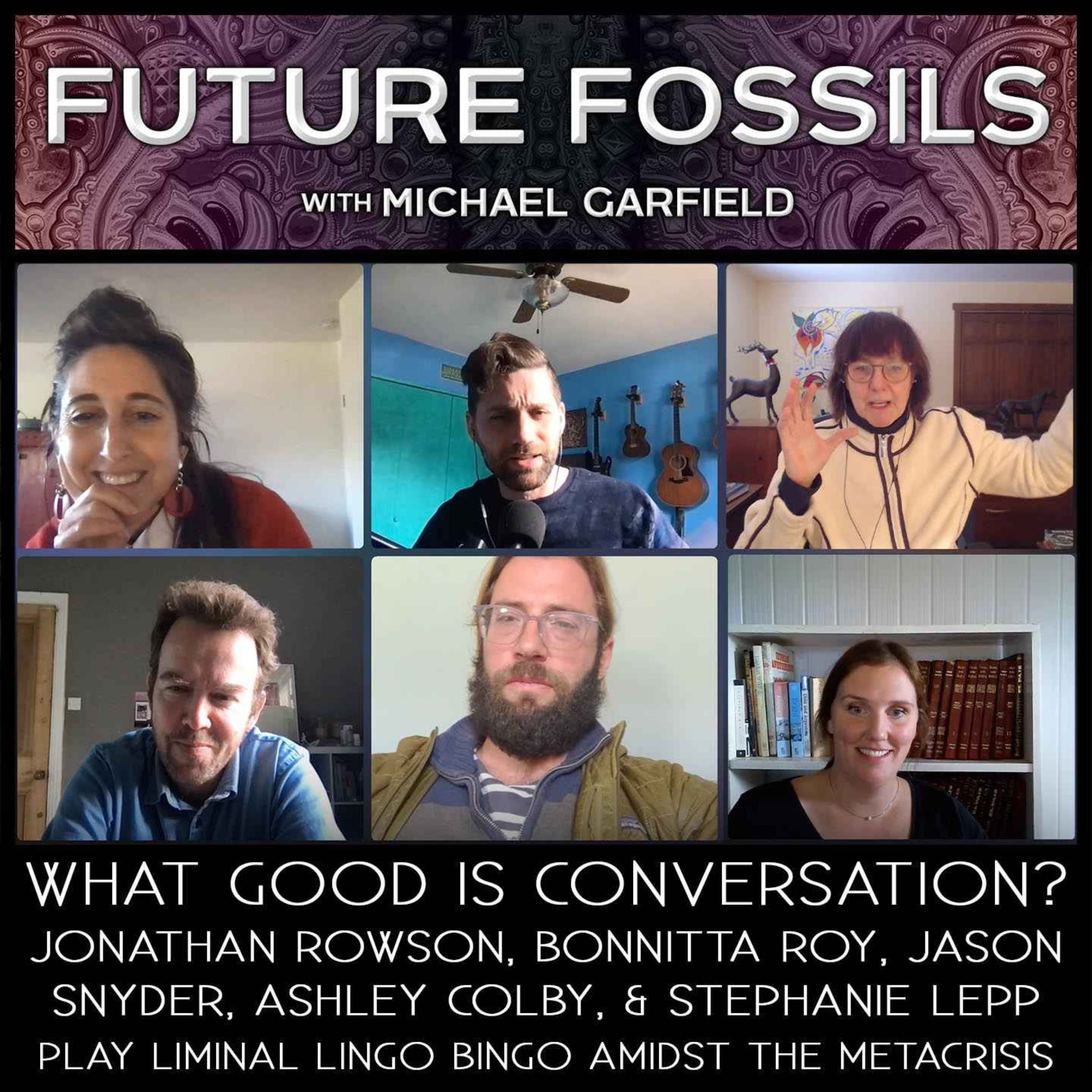
Greetings Future Fossils! Welcome to episode 185 of the podcast that explores our place and time. Oh wow, was this episode late, and I apologize for that, but I was beset by completely unprecedented technical problems from the moment we started this call until this moment. We were having unbelievable issues with call drops and software hardware incompatibility and latency issues that resulted in all of the tracks being out of sync with one another, and it was a Sisyphian challenge to get this episode into listenable shape for you, something like 25 to 30 hours of editing.
But you know what, it was worth it, because this is not just unprecedented in its technical difficulty, but in the all-star cast that I get to share with you today, Jonathan Rosen of Perspectiva, Jason Snyder, and Ashley Colby of the Duma Optimism podcast, Stephanie Lapp of the Center for Humane Technology, and Benita Roy, founder of the Elder Lore Insight Center, all came together to discuss the challenges, rewards, and ultimately the significance of being a quote unquote sense-maker in the liminal spaces of whatever is emerging here in the turbulence and tumult of our digital era. The conversation was inspired by a Twitter thread, which I will link to in the show notes you can find on Patreon, sparked by a piece of one of Jonathan's essays inquiring into the validity of some of these handles that people have tried to assign to various tenuous subcultures, such as the liminal web, and whether those labels actually have as much utility as people think, whether these subcultures count as communities at all in the first place, whether they ever can be, and ultimately what the role is of talking at a time when it's so obvious that concrete real-world action needs to be taken in so many different ways. And what a perfect time to publish this episode. I mean, it's actually a good thing that it took so long to get it out, because now here we are sitting in the wake of the announcement that Elon Musk is buying Twitter, and the value and importance of conversation is on everyone's minds and lips.
It casts a profound new second light source on this episode. We took this conversation into some very fascinating and challenging places, including one toward the end where I have to induce ontological shock in a few people by reporting some of my own truly weird experiences, and their personal significance for me in my own life and work. And I'm really, really glad that after a month of stealing time after hours, and both kids have gone to bed sometimes for the third or fourth time, I can finally share this episode with you. Incidentally, the work involved in doing so has led me to reflect rather seriously on what I can actually commit to this show and its listeners, and if you'd like to weigh in on that, I will publish a poll later this week for Patreon supporters so that you can tell me what of my work you consider the most important and what you feel I can deprioritize and triage.
And that'll be really helpful in terms of making sure that as we discuss in this episode, I'm able to balance the work of being an interlocutor for important conversations like this one with the work of parenthood, being a good neighbor, living close to the earth, and creating art and music. That is, in its own very different way, loves labor in service of the evolution of both my and the collective soul. So thank you for listening. One more time, that URL is patreon.com.com.
We're still only a quarter of the way towards making the show completely sustainable for me as a full-time thing, so each and every new member has deeply, deeply appreciated, including an embarrassment of new members I received over the last month, Aben, Karl Birkins, Megan Flores, Don Hillman, Ethan Turpin, Anon Satori, Andrew Graham, Crystal Davies, Logan Mase, Nicola Winter, Greg Corn, Renee Depaula Jr., and Matthew Alhonti. I cannot thank you people enough. Thanks to everybody who participated in this conversation, you are all amazing people. I'm honored that we have the opportunity to do this.
I look forward to hearing everybody's feedback, be it on Twitter, in the patrons only Facebook, or Discord server, or wherever you care to reach out. Thanks for taking the time to dig in, enjoy, and I look forward to hearing back from you. Well, I guess if this is where the recording starts, we should start with an acknowledgement of the technical insanity that we've been having for the last 20 minutes or so. This is not a simple thing.
And yes, Bonnie, you're correct in pointing out that the cost of participation in this conversation is becoming a cyborg. Maybe that's the right place to start. And Michael, I actually bought a microphone because you told me I had to, an expensive one, for me, and then you never even invited me on your damn podcast. Sir, sir, you are on my podcast right now, first of all.
Second of all, where's your microphone? Where's your microphone? Not to my computer, which your student software doesn't work with. Third.
Yeah, I don't know. Riverside's going to hear about this. It already is. Jason, I want to point out, this has been very flexible and has gone with the flow of these past 20 minutes.
Yes. He's a good one. Yeah. I mean, and Jeremy, who emailed us at God all this morning and said that he couldn't be here, I think it's just worth acknowledging that he's probably the wisest of us all, because he's avoided entering the machine.
You know, he's off writing a book somewhere. Like right now, he's, you know, we're hosting a conference. Like he's not doomed to the same folly as I, so thank you all for this. How did this all get started?
I can't even remember. Yeah, that's a good beginning question. Jonathan started this, and Jonathan's, which is funny because we're going to back into this conversation with him showing up because he has to take his kids to school. But Jonathan was writing about the, the Metacrisis and Liminality, and he shared some excerpts of his stuff on Twitter.
Oh, yeah. And we all started riffing on it, and I'll dig up that link and I'll share it, I guess, when we, when we share this. But it was, the question I think was around whether people working in liminal spaces can unionize, you know, like whether there's a, whether there's a there there that we can name or whether that means that we're basically like stretching a dead bat on a mat and a museum and painting it to the mat. And then it's like, it's not flying around anymore.
At what point have you killed the process of sense making by giving it a handle, you know, so that you can carry around and bring it to the store, put it on the counter, sell it, you know, and say, hey, this is what I do. I am a sense maker for your organization. I work in the liminal. I help you navigate rifts.
I provide context and people are like, oh, cool. I have economic value for you. And then at that point, are you, are you still the guy who we were living on the Hut at the edge of the village or are you like some Wall Street, bro? I have Bitcoin.
I mean, I'm, I'm, I'm a complete contradiction. What do you think two different things going on? There's nothing is really trendy. Everyone's trying to map the liminal web, even though nobody really knows what it is.
And so the maps look pretty different. And then Jonathan's trying to create a field. That's what he called it as a field because he wants it, I think to be a bigger player in the larger sense making of global affairs, I guess. And so giving it some legibility while as you say, Michael, not painting a dead bat is the, is the perennial question.
Is the subculture that's emerging and dynamic and not fully aware of itself? Can it become a field? I think that's the question. You know, I have a, I remember now what we were talking about.
I think there's like a couple of like principles or that we can kind of stress out of this. And that is one is when people map out spaces like this, they kind of go meta on the space. And one of the problems with going meta is that it exits its own domain. So if I go meta on religion, I'm no longer doing religion.
And if I go meta on education, I'm not no longer doing education. And so people get a sense that they're contributing, but they're really actually contributing in a different domain. Right. So if I map out all the ecologies of all the different types of ecology theories, there are, I'm not doing ecology.
I'm doing not a theory. And so people need to get stuck in thinking they're contributing to the domain, but they're actually contributing to a different domain. So that's one important thing. The other thing is that, you know, I just, I just post something on Twitter today, which is very hard to, for me to understand because it's from this website, Barasicum.
And it's talking about math and why math is incomplete and consistent and undecidable. But what the fundamental principle is, is that at a certain level, when you try to, we take math and then you apply math to it. So self referential move, it destroys its functionality. So they talk about touring, he understood this because his touring machine had two systems.
One, some systems would halt. Right. They would have halting programs and some would not halt. And he built the algorithms for that.
And then he put the algorithm for that back into his own system. So this notion of self referentiality in the thing got into undecidability. It could not decide anything. So I think this question of being aware, yeah, you know, I'm aware that Jason Ashley and Michael and Stephanie and Jonathan and Jeremy, I'm aware that there's relationships there that are more than the sum of the parts, but then to go, so that's an awareness, but I think we need to be careful not to be self referential about it, because then I think it gets kind of stuck.
Yeah. I mean, I wonder if it's, there's also a kind of not just whether we do it, but how we do it, because I do think there are ways to hold up a mirror that actually enable us to evolve, right? That like by virtue of seeing ourselves, it's like the social equivalent of biofeedback. It's like by seeing ourselves clearly, we can more creatively and consciously and deliberately like influence our own growth.
But I guess I would also just wonder, like, what are we trying to do? I mean, just ultimately, what are we all as individuals or as subgroups or as a limit of the system? What are we trying to achieve? Because there are taxonomies for their own sake that's like, oh, look, there are mushrooms that are red and there are mushrooms that are brown, and then there are taxonomies that are really functional.
Like these are the mushrooms that know how to bio remediate this kind of thing, and these are the mushrooms that we can really use a taxonomy in order to do something, in this case, use a mushroom taxonomy to do bio remediation. So yeah, I just wonder, like, what are we trying to do? And how can mapping ourselves or taxonomizing ourselves then serve that purpose? Actually, do you want to speak?
Because I have some thoughts on touching this, but I want to let you take a turn. I basically am very new to the liminal web. Just meeting Jason and starting humor optimism. He's been trying to get me up to speed, but I don't really know much about it.
I've been on the stove a few times, basically, as the extent of it. So it might be interesting. I don't know. Maybe this is where you were going to go, Michael, but it might be interesting for you all to just riff on the state of where you think it's at.
And are people getting fed up? It seems to me as an outsider, very broadly, that people are sick of too much talking. Just to put it very plainly. People are like, okay, cool, the sense making is useful to some degree, but also what is it in service of?
Is it in service of us just talking to each other on the internet? And then we have our little group that we all talk to each other, and we're all part of this thing, and we spend a lot of time talking about who's in what group? And making taxonomies of people's philosophical points of view? And then for what?
I think I'm just wondering if there is this feeling like we're at a sort of breaking point, or you are at a sort of breaking point where you want to make a pivot towards something else? And what would that be? Yeah, well, as someone who was, again, at Got All Last Night, removing rebar from an old fence in my yard, assembling patio furniture, and otherwise doing things that I don't get to when the kids are awake, I want to say that all the comments that everybody just made now have me reflecting on, first of all, Bonnie, there are plenty of instances in which math is recursive and works and has to work and works because it's recursive. I mean, Francisco Verrell is calculus for self-reference.
I think it's like a 1972 or 73 paper where he's basically trying to mathimatize consciousness and does so. And chaos theory has a lot of recursive functions in it. And so when you're nonlinear systems, like you think about people like Doug Hofstetter and I Am A Strange Loop, he's the guy that wrote Gertileschre Box. He's coming from that same place as the guy in Veritasium, I forget his name, but he's coming from that same study of the understanding of the incompleteness of things and of the curiosity of recursive functions.
And it seems that that's what we do as sapient beings, but of course, there is a pathology, right? You got to find that Aristotelian golden mean. And so the pathology is when, and this is well studied in psychological literature, when someone is so self-conscious that they cannot act because the people that are really depressed tend to be the most self-aware, they tend to be the most critical of themselves, like the saints are the ones that are like, help me, Father, help me, Father, I am a horrible person. And everyone else is like, when you're talking, I did that one thing when I was five.
And so there's this extent to it that inhibits doing. And so it's a valid complaint. It's a valid issue. But the problem is that that's what podcasting is.
And so the way that I think about this, even if you're a podcaster on general contracting, you're talking about general contracting. It's a different thing from podcasting. You have to be meta inherently in order to talk about things. And so I see the function that each of us are performing in this role, not throughout our entire lives, obviously, because all of us are doing lots of things.
But I see the frustration in this space as a sort of lack of understanding of the way that podcasting and podcasters are performing as one tissue, like one cell type, in the body of something that is emerging. And the body of something that is growing. And so like the question is the proportion of thought and self-reflection to action. And the question is like, how many of us, I had to block a guy I really like a couple weeks ago on Facebook because I just didn't have the patience after days with kids screaming at me and thinking about it work to deal with him critiquing this exact thing and sort of like mocking or dismissing the function of podcasting as not doing, as not building or whatever.
I mean, the problem is that Yeats put more people in the Irish Revolution with his poetry than anybody did. You know, and William Rundemund Thompson was always quick to that. It was always pointing out the function of the poets and what people in this sphere or what we call the sense makers. So I mean, I think that it's there.
It's just a question of, as my friends at work are always asking, have we reached peak podcasting? Like, how many more talking heads can this system support? How many at a given time should there be? How many people should be on stage versus listening?
You know, and oh, hey, look, we have another talking head. Perfect timing. Jonathan. So we're kind of just suggesting that the frustration that people feel with this liminal web stuff and with this whole thing in general seems to be attention between self-reflection, recursivity, self-awareness, and then doing something about it and that there's perhaps a balance that we could find from a study of the living world.
That puts the function of podcasting as one like tissue in the body of an organism. And then it just becomes then a question of how self-aware does this thing need to be in order to accomplish its tasks? And what are those tasks? And at this point, maybe it makes sense to just like pass you to baton and let you run with it for God, however long.
I just want to make some distinctions because I think you said a lot and some of this stuff was kind of conflated. So there's recursivity. So that's not problematic in that or anything else. But then there's what I said was problematic with self-referentiality.
So you're outside yourself to reference yourself outside. And now, and it's not, I don't think, coincidence that Goodell became so self-referential and so paranoid about touching anything because he thought it was dirty and he was going to die, that he starved himself to death. This is the way his mind worked. But what if you know, though he's trying to get out?
And completeness. Exactly. So recursivity, I totally agree. We're just on our self-referentiality.
And then the metamou, yeah, when you map the space, if you talk about construction, you're not doing construction. I'm not saying that it's not important. You have to realize that you're contributing in that domain, not the domain you're talking about and people get confused because they may be contributing something, but they're contributing in a different domain. And then the third one, so recursivity, self-referentiality, metamou, and the third one is aware.
Yes, we are aware of each other. This, I think, is probably the most rich thing that's happening. But maybe that helped Jonathan get away into what we're already talking about. Well, you've never failed to help and it's good to see you all.
It's nice to see that you're not just Twitter icons and that you probably, based on this evidence, are more than just based on the screen. So yeah, I'm sorry to miss the first half hour, simply parental parental duties, but it's lovely to be here. I guess you've already introduced the sort of premise of the call and the shared experience of kind of excited frustration, maybe. Stephanie, I loved your expression about what was it, the liminal bingo?
What was it again? Sorry? Liminal lingo bingo. Yeah, that's not enough.
That had the right kind of playful spirit about it, but obviously the underlying feeling is something altogether more serious. And most of us perceive something, I think, and it's not necessarily the pending apocalypse. You know, the name of Pascal recently wrote a great piece suggesting that many of us might be described as apocalypse-terians, people who are sort of seeing multiple features of the Metacrisis core rise and just sensing into not the ending of the world as such, but the ending of the world, the world that we've kind of grown up with and come familiar with and sensing that some different way of living is necessary, but being a bit tired of saying that in different ways, new conceptual arms, if you like, don't really seem to be fit for purpose in the wider battle. It seems we have to get a bit beyond yet another paper, yet another podcast.
I think all of us are having done that for sort of, I don't know, up to five years or so, last little half decade, I suppose. I think there's a little bit of an action itch among the network, but we're a bit too cool to just act. In other words, what I mean by that is, you know, you can valorize action, right? It's like an fetishization of action, like don't just think act, which is also kind of stupid.
So somehow what we're looking for is the turning way to make sense of our perception of the world as something that is crumbling slowly but surely, possibly and extra-blay, and yet not really knowing how to create the country-bailing motion of creating a new world in a way that A makes any sense vis-a-vis some of Bonnie's previous comments in terms of the dissonance between our action possibilities and our civilizational sort of mental context, but B1 that actually is sort of rewarding and feels like it's worthwhile. And that mean, you know, I look at Jason's Twitter stream. I think, God, at least the guy's planting something, you know, at least it's like real and vivid and earthy and tangible. And, you know, I have similar forms of reward in my own life, but it's that kind of feeling of what does it look like to do something that speaks to the diagnosis you've come up with, however elaborately, whether you frame it as a meta-crisis, meta-mogonism, game-b, dark or nason, stumor, optimism, civilizational crisis, multipolar trap.
It doesn't really matter. After a certain point, we're all like familiar enough with the next one, okay, now what? So that's how I see this conversation as a kind of breaking of the ice there, not really having an answer yet, but saying let's move into that. Let's allow the ice to break, melt, and see where we can swim with the water.
So the way that I've kind of resolved that for myself, and I don't have this totally worked out so bear with me, but speech is an act of creation, right, Genesis, and God said. And we are now all the way to GPT-3, where you can literally say something. Are you all familiar with what GPT-3 is? Well, for listeners who are not familiar, we are now at the point where you can describe a film or a photograph or a game or something that you want created digitally.
And AI can create it for you. It's wild. And God said, and now we are saying, and it can create. And so I think there is a way in which sometimes we're not yet fully taking responsibility for our co-creation of reality.
And so it's like when we talk about the world, we're not just talking about the world, we are shaping the world, especially. I mean, once you get to high levels of influence, and I'll just give an example, recently Ezra Klein and Fiona Hill have this conversation about what's going on in Ukraine, and they're talking about Putin. And Ezra's asking her, you know, like, how do you think things are going to end? And she's saying, like, oh, I'm hesitant to talk about different scenarios because then I might lead the world in that direction.
It's like you're already leading the world. It's already happening. So just take responsibility for where you're leading us, and actually where they led the world in that conversation, I thought it was actually very responsible. She's talking about Putin, and she's basically saying, and I almost feel like break the fourth wall and just talk to Putin because he might be listening, but they're actually saying, the gist of what she said is we abhor your actions, but we understand where you're coming from.
And the US has responsibility. I mean, imagine if they just directed that to him. I mean, they don't necessarily need to do that, don't need to break the fourth wall every time. But the point is, yeah, we are thinking and talking, I wouldn't make such a hard distinction between thinking and speech and action and doing, because we co-evolve with the stories that we tell about ourselves.
So I don't know how much we should defer to the chair here, Michael, but I'm just in response to that. I agree. And yet, I think this is the feeling we all have. On the one hand, we know that words are action, writing is action, thinking is action.
And what we come up with to make sense of the predicament and the possibilities inherent in it are meaningful contributions. So there is a world creation going on. And those were the greatest influence, perhaps the greatest responsibility, but all of us have some and should use it wisely. I suppose I want to just counter that by saying it can give rise to some dissonance, though.
There can be feelings of an enormous effort to, for example, write an essay or write a book even, and then look at the world that we're now perceiving no longer as the local bookshop or even the national conversation. But something about planet Earth in the middle of the 20th century, now moving into a different phase of geological time or already well within it, where it's not clear how much influence we can really exert on the powers that be at scale. Now, we might think we do what we can, and I agree, and one can only do that. But I think part of the frustration and part of the reason we haven't quite coalesced into anything like an action plan is that the gap between the diagnosis and the perception and our embodied action potentials are just very, very different.
They're almost incommensurate. Some people managed to find an answer to that, but many don't, and they live with a sense of is what I'm doing, really making any difference whatsoever. And the more optimistic among us, and even the more pessimistic on good days, have to affirm that and say, yes, that thing I just wrote, that really matters. That Twitter thread that I invested two hours in, of course, is important.
But another part of us, I don't know if I speak just for myself here, does wonder, maybe I should have gone to the local home shelter and helped out for a couple of hours. It's just not clear. It's just not clear at this moment how best to spend one's time to make a difference. Can I just say two things, just in response?
Go ahead, Bonnie. Well, I want to say something, unfortunately, worse, Ashley, because I wanted to try to say something that would pivot to Ashley and Jason. I just want to say that I listen to optimism because it stretches my way of inquiring into the work I do here at the farm, and it challenges me to think harder and make different decisions. And people exemplify maybe a model, some of that work that I might be better at myself.
But the bridge here is that, yes, language and our theories and our presupp physicians about the world change the world. And if we have language and then technology can amplify that change, the issue here is that downstream from all conceptualizations of change are real concrete causal implications. So downstream from you talking into a computer and making, let's say, a video that inspires people, you lower the action thresholds for actual concrete work that happens somewhere in the world. And the question is, what is your obligation to what that effect is?
Do you mind more lithium? Because you created people wanting to go to the stars. Do you market farmers out of the global agricultural economy because you have all this downstream from any kind of saying that we can do speech acts that can change the world are actually concrete world real world phenomenon. And if you get too far from knowing that, then you absent yourself from the obligations of what happens there.
So it's not that easy. Just because technology lowers the action threshold and scales what you say. What are the actual, the other end downstream, the earth is being moved, the planet is being changed, people's lives are changing. I don't know if Jason and Ashley, I kind of wanted to bridge to the other perspective looking up from the other piece of that technology and decision making.
Jason, I'll let you go first if you want. Is Jason frozen for you all too? Yeah. I think what he said was so prophetic that it just sort of turned into stone or something.
Yeah, the machine couldn't handle it. I have some thoughts too, maybe when waiting for him to get back. For me, yes, the system is crumbling and this Morris Berman dual process theory that I often cite, not a well-known scholar, but we hope to have him on the podcast soon. You know, basically when civilizations crumble, there's chaos and maybe potential cult behavior that arises out of it.
And I imagine one potential role for like the liminal web or the sense making community is you can have this sort of dialectic between attempts to experiment on the ground, doing action related things. So like when I say action related, I mean, like what is your livelihood? How do you have relationships with other people? Like what kinds of things are you doing with the material world?
For me, for example, we're like doing a form of homesteading, but then how are you building community? In what way? Is that healthy? And then it can go back and forth where we're sort of sharing our experimentation and then the sense making community can sort of assess what's going on, both as practitioners and people who are assessing.
I think there's always been this traditional role of wise, like a wise group of people, philosophers, maybe it's clergy, maybe it's even matchmakers, this kind of like class of people who help to make sense of what other people are doing and guide it in a helpful way. But I think there's no one set of prescriptions. I think the idea is to experiment and then talk about it in a way that's sort of open and reflective and I think extremely healthy or could be extremely healthy. So that's part of what we're trying to do with the ummor optimism is just, you know, basically what are you doing on the ground and critically interrogating it from like a loving friendship perspective.
We just had Gregory Landoah on who runs this organization called Regen Network. And the whole conversation was somewhat critical, but in like, I'm talking about our conversation with Gregory Landoah, but in like a loving way, like we want you to succeed. We want regeneration by a crypto, whatever you're doing to succeed, but we want to be helpful in thinking about the potential pitfalls and what you're trying to pursue, that kind of thing. So like cheerleading, but also not just sort of letting whatever experiment be whatever without like critical interrogation of like a class of people who like are thinking deeply about these things.
Yeah, well, I mean, I think I can describe my journey a little bit, which might help loosely in my point of view and perhaps actually as well as, you know, so I was part of both ends. You know, it was a lot of attempting this kind of sense making and various things in my life were changing, but I definitely had this itch of like, okay, what are we doing about it? Right, whereas with all this conversation going. And for me, it's just part of it.
It's just what's a matter of getting grounded. And part of that is kind of embodiment, you know, so different kinds of meditation that focuses more on body mints and then part of it was trying to work with some lands and develop land over time in a regenerative way, you know, hopefully. And trying to become more resilient and then, you know, kind of coming across other people with that sensibility, I think a world view arose that things are crumbling. And one way to think about it is kind of a dual process theory that actually cites a lot more as Berman, where, you know, what are we doing to actually create new communities on the ground that can weather the storm in the short term, but in the longer term can actually create new society.
One of the distinctions that my classmates last week was how technology enables you to coordinate many individuals, all these people flying all over the world, all these people talking. But that's different than integrating communities. And we noticed that that distinction is very powerful. So am I creating technologies that weren't individuals?
The problem with that is it tends to gut communities. Or do I have technologies? And this is what I think, when we wanted to be of this because I did watch that great new land out and that's what it seemed like you guys were doing. So, I think that there's a community anchored here in Uruguay.
Here's a community anchored here. Here's a community anchored here. And your questions were about each other's communities rather than technologies that that, and I see that more, most technologies I designed, and granted, we said, that's cool, you know, you can go and get on a subway in another country and all this stuff. And you get on yourself on all this stuff enables massive numbers of individuals to coordinate, but it guts community.
So what is it technology that integrates, grows and integrates communities, I think is an interesting question. Can I dip back in here for a second? There's a lot here. I feel like, first of all, that question is really interesting because it's something that I bring up a lot, not only on future fossils, but on complexity podcast because all of these complex research researchers at the Santa Fe Institute are thinking about the, basically the pickle that we're in now as a consequence of economies of scale, and as a consequence of the way that market and state have hollowed out what samples in Wendy Carlin called the civil society, which is like neighborhoods, church groups, sporting clubs, mutual aid networks, you know, communities of trust, rather than communities of convenience, which I mean, we're all in a way.
I mean, most I think people on this call would argue aren't really even communities at all. They're just like sort of cancerous systems that serve their own purposes of growth. And so there's this question, I mean, arguably a village raising child is doing that, but like still, there's this thing where, and I talked about this with Chris Ryan on Future Fossils who civilized to death, absolutely somebody you should have on do more optimism if you can get him because it was a fascinating discussion about the way that his book articulates that what's really going on here, funnily enough, is that farming is to blame in a weird way, that agricultural civilization in sort of decoupling people from the dependence that people had as foragers, the better we get at constructing our niche, the less we need everything else. And that we become more and more dependent on the institutions within which we're embedded, which are these sort of like eldritch, arkontic, they're superstructure or hyper objects that are causally impacting us from above.
Like all of us have a social contract, right? You're born into a country, you didn't choose that country, but now you have to obey its laws. So there's this sense in which really the advent of human civilization can be marked as this moment in which humans stop being in control of this process, and our institutions and our systems took over. And now we're trying to figure out how to like wrestle it back from them.
And in a weird way, I don't know, there's just an interesting tension between the obviousness of getting back to the land and the fact that it probably looks something completely different. It probably looks more like Australian Aboriginal wild crafting or something in some people's estimation, but how you do that with these systems of high technology. So that's one thing. And the other thing is, and this is naughty of me to sort of propose this like, choose your adventure here.
But Stephanie, I think you might like it. There's this question again to loop back here on the issue of legibility. And we ourselves are not legible to connect these two points. We ourselves are not legible to these massive systems.
And that's the problem. James C. Scott seeing like a state thing, which I read a song about, and I got to perform at Yellow Last Week, it was super dank. But the question of the way that the systems coarse grain us, and so we're seeing as sort of water molecules and a fluid rather than as unique singular individuals.
And this is the tension that is always existed between art and the economy, because art is out ahead of what can be named. And so the question of like, how much talking should we be doing relative to how much doing we should be doing is, I think related to this question of, do you have to name something before you use it, which is to give the sympathy to the Russians again. And this interesting tension between the way that Americans were doing science behind the iron, like on one side of the iron curtain and the way that Russians were doing science on the other side of the iron curtain, where American science now seems relatively unwilling to consider the bulk of evidence for something anomalous to its current paradigm if there is no known mechanism for that phenomenon. Whereas Russian science was always more willing to accept the existence of something like telepathy without knowing at all how it came to be.
So there's like, you know, the question of do you need a theory before you're even willing to accept that something exists. And I think that's sort of the tension that a lot of people feel in this, you know, like people like Jared Lucas who really want to make the liminal web legible to the economy so that people that are performing what he sees as a very important function can get paid for it. But on the other hand, there's something irreducibly contrary about the fact that people are out doing performing reconnaissance and describing things like the platypus that you bring this back to the Royal Society as Al Dusox talks about in the marriage of Heaven and Hell. And they thought it was a hoax.
They had just gotten spooked by the Fiji mermaid. And so they actually dissected this platypus specimen to make sure there weren't stitches in it. And so he's saying that that's what psychedelic natural historians need to be doing is like bringing these objects back like Terence McKenna talks about this too. It's like tripping as fishing that you go out into this space and you bring back something that nobody recognizes.
And then you talk about it. And so I don't know, there's a temporality to this that the fact that it's all happening at the same time seems to be the issue because ultimately these are like points along a diachronic process, not a synchronic sort of smash of us trying to like discover and understand at the same time. So I don't know, that's a lot, but thanks and how about it? I can relate to the notion that you were at least indirectly alluding to which is something about perceiving something that can't easily be named and wanting to live in some sense for it and direct your professional life towards it.
I think that's something that many of us do share at least at some tacit level. I mean, one way of why I approach that is that perspective is partly in the name, you know, does schmooze and connect with a great number, different number of perspectives on things. And we don't want to get too high on that. We keep some kind of core philosophy underlying our work, but I've noticed just in my own relationships that I encounter people who tend to have sort of one big idea.
Like, for example, there are many who believe that this is a moment that will ultimately lead to some kind of gabs area and shift of consciousness that somehow it's a period of time where all of this tinkering of political economy and technology is kind of missing the point that there's some larger vision thing that we need that's based on reconceiving the nature and purpose of the cosmos that somehow that's a kind of spiritual breakthrough. And without that, everything else is just kind of, you know, debtors on the Titanic kind of thing. There are some who see it that way, that ultimately it's about something like love or it's something about relating to the divine in a certain way. And that's one perspective.
Then I'd rather to, you know, hear the way Daniel Schmachtenberger would talk or maybe Tristan and you get the strong technological emphasis that really unless you're really attending to the power of technology, often with a sort of game theoretic analysis, then you're not going to understand what's coming or you're going to be able to prevent it. And then you hear something like Jason and Ashley speaking and they say, look, we ground our lives in our land and the people around us. We're aware of the global context. We do what we can with what we have where we are and nothing more can be done or worse of that effect, forgive me for paraphrase.
And then you have sort of a mystic seer like Bonnie who sees through it all with some sort of perspicacity and communicates in a way that people feel that what you just said is really important, but then about half an hour later they can't figure out what exactly it was. You know, then you go out and you go on the Jim Rush show, he still somehow seems part of this ecosystem, even though he's full of profanities and boomer kind of analysis. So it's a weird set of relationships and then coming back to the premise and Michael's question, there is something all about the feeling that these different ingredients are somehow pointing somewhere that cannot be named as if there's a kind of number of ingredients that are slowly cooking a cake, but we just can't we have no idea what the recipe is, we know what kind of cake it is even, but there's something about wanting to cluster around all of these different kind of flavors. And we know it's not as simple as putting it together, that's not it, but it's something like whatever is trying to arise and whatever our role in bringing it about somehow we need to become more fluent in these different ways of seeing the world that are at once political, spiritual, technological, ecological.
And then unless we develop that kind of, I don't know, polyphony or multilingual kind of approach to things, we're not going to be moving the right direction, we're not going to be moving towards the thing that can be named. And that's kind of how I feel, that's one of the reasons why I feel confused half the time. And Bonnie's very kindly pointed out to me that the confusion can be a kind of authority if it's carried in the right way, because many others feel it, you know, they feel the confusion and they if you sort of lead from the confusion authentically, that's better than pretending to know what they're doing and people can sense you really don't. But yeah, that's a lot, but that's roughly how I hear you, Michael, in that point, that this sort of unnamed pattern that we're all part of is still somehow calling us to make it sound a bit mystical.
We're trying to orient our lives in that direction. And sometimes it seems a little absurd because the different elements are so apparently unrelated to each other. And yet there's so clearly a patterning effect, a clustering effect, some kind of resonance or whatever. And figuring out what that means and what to do about it is kind of what follows.
I have a quick comment related to that. I think for me, the thing that just is so obvious, and maybe other people will eventually come to this, or maybe not, but I think we need more conversation and experience with material reality. I think we can go a little bit insane talking and thinking too much. I mean, it's just like you can just spend every day on LSD, like thinking and communing with the universe maybe just via your mind.
But there is something in the material world that's necessary to interact with and experiment with, like bake the cake, like actually bake it and you learn something different than thinking about or doing LSD and thinking about what baking a cake would be like. There are a lot of extremely popular classes that are basically what's think about the crisis and think about the world we might want to live in. I'm not supposed to, like your assignment, I mean, I'm teaching this homesteading class, your assignment today is to plant some potatoes, if to plant potatoes and see what happens. And then they come back to the class with all sorts of insights about what happens when you plant potatoes that they wouldn't get if they just think, yeah, more people should plant potatoes kind of thing.
And I think if we're talking about things like connecting with a singularity of some deity or the universe or something like that, that can also come through connection with the material world and not just necessarily doing LSD. I mean, no offense to LSD, like psychedelics have a role or whatever, but they're just not the only thing and thinking isn't the only thing. Can we do LSD and plant potatoes? Because that's kind of my jam.
I've done that. It's great. Purple potatoes. No, so I mean, I think that's actually what I've actually noticed that there is a role of psychedelic medicine or thinking or meditating, which all are all on the spectrum of thinking and changing your perspective, changing your neural wiring so that you can relate to the material world in a different way.
But I think, yeah, fundamentally, I'm pretty fed up in general with too much of the thinking and talking about thinking. Yeah, I mean, so I think there's kind of like two aspects to what do more optimism is trying to do. I mean, we're definitely trying to ground people in physical reality, but we're also curiously exploring the potentials of technology for connecting people in new novel ways, according to people's, right? So we have a few episodes with people who are interested in Web 3, regional finance, plasma local production, various things that are all kind of techno-enabled.
And I think where ourselves are trying to navigate, what is this relationship to this larger structure, this larger cake? And I think in a minimum viable sense, our relationship to it is we're all kind of trying to get in touch with the physical world, but we're connected across the globe, right? So we're creating networks across the globe. A while back on this, I did a presentation talking about trying to do some medical mediation about the localist, the bioregionalist, the metamodernus, and I call it the decentralized, the Web 3 type people.
And my point was that, yes, these are all kind of different ingredients of a cake. One thing that the kind of digital technology can provide is this infrastructure to create this larger consciousness and this larger collective action. And then what I saw metamodernus is I'm contributing was this kind of cultural maturity, cultural theory, but also human maturity, right? Understanding what kind of people do we need to become to inhabit these new structures that are forming?
So I guess I just wanted to add that also a little bit just to add an addendum to what you said, Jonathan. We're kind of like slowly inching towards trying to connect a little bit of a web and inching towards this larger connection because I at least recognize that we're all going to need each other in these different ingredients, but we're just starting, okay, plan to potato. And then tell other people how you did it, that kind of thing. Yeah, I mean, one thing that comes to mind when you say that is not to make it too political too quickly, but just that it reminds me of Clierson's injunction to make your bed, actually.
Plan your potato and make your bed. They're not quite the same thing as one sort of organism making it taps into ecology and life and so forth. But it's similar to dig where you stand and what is your material reality and what can you do to attend to it properly. And so I suppose the other good thing about that injunction to get real, I mean, the other thing that comes to mind is the world you create just because part of the emerged community that I'm involved in, we have a weekly session every Wednesday where we just invite people to come to come.
And just invite people to come and share their relationship to the unfolding reality, including people in Ukraine that are part of the network. And there's always three, no, one in five people from Ukraine who can make it if they can, of course. And the most interesting thing about that is the emerged community was forged with a kind of spiritual ethos of some kind. And I think everyone agrees that if spirits want it to mean anything, it's some kind of contact with reality.
It's at its root, whatever your distinctions or your preferences to become real or be real is part of what it's about. Nothing's sadly more real than more, right? War is reality right in your face literally. And it's been quite touching to sort of be there with people who are literally on the computer with us, sort of not quite looking over the shoulder, but not far off.
And when we do that, there's always this feeling of wanting to be a bit more like that, to be a bit closer to the front line, whatever that is. Planting a potato might not make you cry, but for me, the things that make you cry are always feeling they're the ones who want to move towards. The ones that somehow life is richer and fuller there. And that's kind of whatever it is you do to make that happen.
Or whatever has to happen to you for that to be allowed to be experienced. I'd like more of that. And I think if the whole community could have a bit more of that, we don't always have to be like crying party or something, but crying party with LSD and potatoes will be our thing. I want to get to the point where I'm crying while I'm planting a potato.
Like I want that seems aspirational to me. You'll see the potatoes cry. It's a biblically accurate angel. It's covered in eyes, right?
I was actually planning, I was on shroom planting potatoes is when I decided that that's tough flamenco dancing evolved. This is totally not accurate, but I decided that flamenco dancing evolved because you plant them with your feet. Yeah, anyway, that's not true. I was going to jump in, but Bonnie, do you want to jump in first?
I think we're laughing because it's like comedy when you laugh, but there's truth in it. And I think that maybe it'd be helpful to dig out what's the truth of the potato, because what Ashley said is not trivial. And so for me, it's like, why is it so hard to think? Why do we get into these convoluted meta self-reflective?
And that's because there's a point in this community where you realize that you've been thinking with false premises all along. And when you think with these false premises, then it leads to the conclusion of the world that we actually live in, which is problematic. So the first reason why it's hard to think is because there's some kind of realization or awareness that we're thinking with false premises. So that's one thing.
But one of the false premises, one of these things that Bonnie's going to say that people won't remember in a half hour, is one of the false premises is that all the miracles are in the invisible world, in the conceptual, invisible, the psychic, the imaginal. This isn't just not true. The other false premises is that the physical world is finite with respect to experience, and that the imaginal, the technological, metaverse is infinite. And that also is not true.
And the third false premise is that thinking is decoupled from physical work and physical action. And this is a third premise. That is not true. And in fact, it's a holistic experience.
And so when Ashley says, you get an insight when you're planting potatoes, or I heard someone on John Vervake's podcast, they say, I start by giving people a hammock and sending them off into the woods to find a place to hang it. All kinds of things happen to them. Like spatial relationships, one of the perfect trees, where would I like to be? And they start to see this places in nature that are more of all kinds of things happen.
And the insight factory and the thinking factory starts to be happened, but it's not grounded in false premises. It's grounded in the actual facticity, reality, and a relationship to the world. And that is never false premise. So I think that's Ashley said it with her presence and being.
But to me, if you want to complexify, that's the meaning that I think she's making with her life. Thank you. Yeah, that's actually a little bit where I was going. I think it's the relationship between knowing and doing.
And it's, you know, maybe this is too obvious to say, but it's not like either or. It's like tending to that relationship because that relationship can, honestly, I don't even really know how to think about it. But the way I'm thinking about it right now is that there can be a co-evolutionary relationship between knowing and doing. And there can be a de-evolutionary relationship, let's say.
And so if anything, I wonder if we might think about just tending to that relationship. And supporting a healthy relationship between knowing and doing. The other thing that's just coming up for me is just, you know, the irony, maybe of a community that accuses itself of overthinking is now overthinking. It's relationship with overthinking or wondering whether it's overthinking.
I mean, I also feel like part of the beauty of this is that we don't need to decide. We don't need to figure it out. Like, and this is part of the Jonathan you mentioned earlier that sometimes it's like no action feels adequate to the scope of the problem. But part of what we're doing here, I think, is like enabling a million flowers to bloom.
So of course, each of those individual flowers planting a potato is going to feel so small in comparison. But that's kind of what I don't know how else to say it other than democratizing power, democratizing even the capacity to enact a solution. Like I've started to think about, Tristan does get asked a lot, the question of what should we do. And the way that I started to think about it is just to turn that question around and just say what should I do?
Because everything needs to change, you know, in an infinity of ways and we're all perfectly positioned. So it's really just like what should I do here? Plant a potato, like my medium is media. So that is decidedly not very physical.
I love to work with movement and time. But yeah, I mean, it's like I understand why no solution seems adequate to the scope of the problem. But to me, the fact that anyone can do it is part of the solution itself. I really like the framework of broad scale versus large scale, right?
So oftentimes, we're looking for a large scale solution, which we're not finding. It's frustrating. But the thing about every, like you're saying, Stephanie, everybody kind of doing their thing and using the affordance of the Internet to share these things across the network, we're getting these proofs of concepts. So one direction of evolution that I can see all of us making is we're sharing ideas across the Internet and that's good.
I think that's a good thing. But we also need to be sharing proofs of concept from our own lives across the network. And so we're getting this kind of broad scale diffusion, right? You can also relate it to like this diffusion of innovation model, right?
We're slowly diffusing these innovations and proofs of concepts of new ways of living. And it can be planting, it can be forms of meditation, forms of community building, you know, whatever it is, forms of the medical mediation within a group, right? And how that works, right? It can be many different things.
But we're actually sharing these proofs of concepts across the network in addition to the ideas and the concepts. And so the idea is kind of the larger theoretical frameworks behind them. I have a brief comment if I could jump in. Two things.
One, I think in general there's this culture of like, we're kind of laughing at the potato because you kind of laugh at like people doing something so simple when you're known for thinking and being an intellectual. And I think we should just like break the chains of that and talk about simple things. And in some ways I can imagine people being much more insightful and much better intellectuals if they're, you know, like Bonnie was saying connecting to the real world and understanding all the premises on which their intellectual thoughts arise. And then to echo what Jason said, I think the other thing is like maybe it's not appropriate for everybody to plant a potato.
Like not all actions are proven to be great. Like not every single person should be homesteading. I think to go with what Stephanie was saying, like you could also be part of the action. We could also all be part of the action by sort of vetting actions.
You know, like what are you doing? Is it appropriate for your context? Like what does that do to solve the problems we're facing? Is it replicable for others or not?
And I think there's just the diversity of like the whole human experience that can come from that set of conversations. I mean, my feeling is to agree with all of that. It's just that even after the agreement, I feel uncomfortable. So it might just be that I'm unlucky to have this perpetual discomfort.
It might just be my blessing and curse in life. But I can't help but thinking that, okay, the world is this topic. There's always bad things going on. It always has been.
There was no golden age as far as we know when people weren't suffering. But it does feel that there's a kind of clock ticking at the moment. We don't know if there are other forms of intelligent sentient life out there in the wider universe. There may or may not be, but it's possible that we're, you think we do.
Anyway, it's possible that we're at least precious and possibly unique. And in that context, the fact that there is at least a chance that we would seriously damage, if not destroy our only home and that this is happening in a time frame now of years and decades rather than centuries. It does make me a little bit impatient. I know there's a conventional wisdom and slowing down and a conventional wisdom and attending and seeing more fully and deeply into your current context and acting where you are.
But it's not a part of me that wonders a conventional wisdom is so wise in this context that there might be a case for hurrying up. There might be a need to quick him in some way. I just don't quite know if that is the case because that is my sense, my intuition. At the same time, as they say that, I can think of people saying, all this action is what's causing the problem, this desire to do things and change things and that's what got us into this problem in the first place.
And so I carry that kind of contradiction of on the one hand feeling this action imperative to find ideas and forms of life and practices spiritual, ecological, domestic or otherwise. At the same time, feeling that the need to get political quickly is very strong. The need to actually find power, where is power for us? Maybe there is power in looking after your home and your community, but the kind of power we're looking at is at a different scale.
So Jason, I'm curious, this is distinction actually about different levels of scale because clearly an individual can't affect the whole planet and 8 billion are rising numbers of people. But then what should we seek to affect? What's a reasonable ambition? It's not even the right question.
That's the kind of thing that I'm wrestling with. Well, I think large scale for it to not do more harm than good, like taking the levers of power, some kind of revolution, it has to some sense to be emergent from a groundswear, like a real populist groundswear. I don't mean populist in terms of the right wing or left wing, but enough people realize that something needs to change. And the best way that I can see to do that is this kind of broad scale diffusion.
I do agree that it needs to speed up. So one of our recent series on the Substack was Action Oriented. What are you actually doing? Tell people and tell the world so that other people can get inspired and do it as well.
And create these solidarity networks that can help create some kind of groundswear to create more fertile conditions for, I think, what might eventually need to be more of a large scale change. But again, large scale changes are very dangerous, especially from a complexity of one of you. And so how do you create the conditions and so that the large scale changes are not violent? That they're just more dis-required.
Like the apple tree is already there, the apples there, you just need to pick it. Right. I mean, again, it happens after the agreement. On one hand, large scale change is definitely dangerous and revolutions go wrong.
At the moment, there's also the sense of the absence of large scale changes are dangerous too. And so I suppose I'm curious about the kind of diffusion you're looking for. So different form of life, right? We're trying to move toward, I mean, we're in a world predominantly of cities, albeit in population terms and in land terms.
That has to change perhaps the way the very urban environment, the nature of the life that we build. Population is that part of the story, what we eat clearly as part of the story, our money supply and how it acts as a clearly part of the story, the way that our data and our behavior is harvested, the extent to which we own that as part of the story, then what we're living for clearly as part of the story beyond status, beyond material acquisition. And the fusion of all of that and more, and that's just a little snapshot, of course. Yeah, I'm all for it.
I just like, is the way to do that, just to do your own thing in your own place and point towards it for others and then sit back and hope for the best? I mean, is that true? It would just briefly, I don't briefly answer definitely, and I think what would be adequate is something that feels true. And I think my problem is that I'm not getting that sense of fruition.
I'm not getting that sense of yes. In a way that I can also add, you know, as someone, people, something to ask for advice on these things or a sense of direction, in a way that I could feel was the right kind of level of confidence that, yes, do this. Right. So, no, I mean, just briefly, sorry, actually, just briefly, I mean, for what it's worth, I wrote about this, I mean, this premise of the idea of collective individuation, it's just a notion that, you know, ultimately, our job is to find our unique contribution and to help others find theirs.
And so you're right, the answer has to be, it cannot be a generic, what should I do? Because that leads to lowest hanging fruit of do your recycling and talk nicely to people, which is not really adequate. What we really need to do is to find our own unique power, which is, has a kind of spiritual philosophical basis in the uniqueness of each individual being somehow sacred, and to actually work with that sense of uniqueness, which is always contextual, which is always contextual, which is always a good thing. Which is always contextual, relational, who are you with?
What are your responsibilities? What are your resources? What can you do? And find an answer to that.
And everyone should try and do that. And that's the answer, kind of. Sorry, Ashley, go ahead. But, Jonathan, can I just ask you, like, what would be an adequate answer to your question?
And like, what would you do with the answer to that question? For yourself individually or for the liminal web? Before going to Ashley, I'm just going to offer us the, I actually did this yesterday for the first time. I was interviewed by the public radio station in New Zealand, and they asked me what should we do question.
And I was like, I'm going to try this out for the first time. What should I do? Let's all of us ask. And I just said, here's what I'm thinking of doing.
I'm curious. I should have asked the host, actually. I don't know, he might have been a little thrown off. Anyway, where do you?
Or Ashley? Yes, I would just add, like, I think just to bring it back to the thing that I'm going to keep hammering home, the material world will also, I think, inform this, I don't know, sort of revelation. And I just was listening to our interview with Neil Spaphman, who does the work of regeneration. Like, he builds ecological systems that produce food for humans, like infinite more habitat.
They can change the weather. He thinks his plan is to plant a billion mangroves before he die or by the end of his career. And he says, regenerative systems can produce an infinite amount of good over time. They contain an infinity because they're not dependent on external outputs, but because they reconstruct the foundation on which they're built.
This is a direct quote from our recent podcast with him. Just thinking about the ways in which nature can confirm these thoughts we have outside of material reality. Just to bring it back to that, I think the more time we spend in, for example, I try to do some sort of regenerative homesteading on our land. This just confirms those thoughts that I have separate from the material world and strengthens them.
I have a chicken hutch that came with the house. When we came to look at the house, the Wi-Fi network was Urban Gardener 505 in Santa Fe. Here is 505 is the area code. And the guy had 19 chickens and two goats in this backyard and was sharing goat milk and goat cheese and eggs with the whole neighborhood.
And so everyone was really excited. And they're like, oh yes, we reflect so fondly on the former homeowner as opposed to that bastard was keeping us up with his rooster. So there's that. Jonathan, I can't let this slide.
I have to tell you the story because this is a total dog leg. I'm a drop of bomb on y'all, but I feel like it matters because in the context of the question of what should I do? It's important for everyone in this call to know I'm outing myself right now because I have already done this on Stuart Davis's Aliens and Artists podcast. That I am a UFO experiencer.
Like I'm a contactee. And in 2006 and seven, when I was completely adrift in my life, I had gotten out of college. I had no idea what I was doing with myself. And I was in love with someone, but I was being tugged in a different direction academically.
And I had all these recommendation letters that I never sent to the graduate schools because I didn't want to leave this woman who was now the mother of my children, yay. And I was stuck in this sort of ruminating loop in Lawrence, Kansas trying to figure out what to do next for two years. And in that time I was working as a scientific illustrator at the Natural History Museum and it wasn't paying the bills because of Bush era educational budget cuts. You know, that was another career that could have happened that didn't.
And then so in 2006 and seven, in the span of eight months, I took three different groups of people. One was me and my wife and our friends on a double date. One was me and my buddy from high school and his college roommate. And one was me and another friend of mine from high school who I had this sort of like brother-sister relationship with that we found each other in high school.
All three groups of people at Clinton Lake in Lawrence, Kansas, over the span of eight months, saw these, like I've got a better word, UFOs, but they were like transparent objects full of lights, like embedded with lights, like bioluminescent sea creatures that had all kinds of different patterns moving around in the sky. And for the record, because we've been talking about LSD potatoes, we were on mushrooms. But this is a recursivity thing. And at the time I had been going out to this lake for years tripping mushrooms and I'd never seen anything like this.
And I had gotten very, very good at being able to tell the difference between what my brain is making up versus what the world out there is. Anyway, the point is that I saw these things and it wasn't just me seeing them. It was these other people seeing them too. And it wasn't just them seeing them too.
It was that when they showed up, the animals around this lake would start to erupt in the middle of the night in noise. These were like overnight trips where like there would be a sort of a wave of UFO activity on a full moon. And then as more and more things started to appear in the skies, birds would start squawking. They were restless and uncomfortable.
And I had what I believe to be kind of like a transmission or something in one of these experiences in which I was explained by whatever this intelligence was inhabiting or possibly embodied as the craft itself. That our world is rare and precious, as you said, but it's precisely because it is rare and precious that other worlds that had born life first took notice of it and came to it early, early in its development. And that what I was seeing were actually forms that had been embedded in the living subtle body of our planet from its inception. That the UFO is there or whatever that I was witnessing were intelligences that were basically, in some respect, more native to this planet than I am.
They had been around from the very beginning, watching and stewarding this. And then the last thing, to be clear, I am a freak because I have never been able to situate these experiences since then. I simply had to digest them and make peace with them. The last experience I had was with my ostensible sister who we had some weird dynamic.
And I had met a woman online that she had a spiritual emergency in her midlife. And she became a Reiki healer and said that she was communicating telepathically with whales. And then in the midst of all of this, her family institutionalized her and separated her from her teenage son because they were concerned about her. And then when she got out, she told me that she had been my mother in a past life.
And the same week my friend told me that she thought I had been her brother in a past life, but on another planet. And both of them said the same thing. And we were like, all right, let's take questions and go to the lake. And so my friend and I, the ostensible sister, did this and messaged that we got that night was yes, that you were.
And that everybody is, that there's this sort of cosmic web of reincarnation. And that in some way makes a lot of the people on Earth aliens, actually. That like a lot of the people who are here now are actually the aliens, whereas the UFOs are actually the ones that have been here for four billion years. So it was like a switch flipped there.
But the point was, and this is where I think I can re-embed this insane story back into this conversation, is that it was saying, don't get homesick, you were born here, you live here, you are in Earthling. This is your life. And the question of what should I do was, for me, that was the question that was crippling me at the time, because for the first 22 years of my life, I knew for a fact I was going to be a vertebrae paleontologist. And when I got to school, a number of things fell apart and that didn't come to pass, and I was deeply, deeply confused about myself.
And I had never in my questing in my search for an answer, how should I act? I had never gotten anything but don't do this, don't do that, don't do this, don't do that. And the sense that I got coming out of that experience was very specifically that, okay, when I was 12 years old, I was living in Orlando. My father worked for amusement parks.
My mother had a dream that I grew up and became a whale trainer, and that an orca breached and accidentally broke my back, landed on me and accidentally killed me, and that this orca whale was mourning me in her dream, and she made me promise to her as a child that I would never grow up to become a whale trainer. And so there was this sub-thread under paleontology of marine biology, and what I got out of that trip was, it said, you would have wasted your life looking for us, because you would have gone from being interested in the deep sea to being interested in what else is down there, and loving the film The Abyss, thinking about all this stuff, and The Abyss is more or less exactly how these things manifested themselves. The aliens that appear at the end of that film are very reminiscent of what I saw. And the point was that you are supposed to be talking to people, you are supposed to be in the fray, you're supposed to be on the land with sinus pressure so that you can't ever get scuba certified because you get a headache if you put your head more in a few feet underwater, you have these constraints that place you in the human sphere and that anchor you, and now you all know the horrible underbelly of me.
But when I think about what should I do, for me, I have to zoom out as far as possible and accept the possibility that my role and our role by extension, because we're all here, we're all implicated in this, you're my accomplices, and I am yours, is that this is a moment in the history of the planet like the advent of multicellularity or like the emergence of complex social organisms, and it's important to get it right. And in order to get it right, we need to be thinking through these things, we need to be talking through these things. I loved what you said earlier, Jonathan, about the performativity of confusion, because that was something that was very also happening at the same time, was I was starting to share this stuff on the then new Facebook and say, like, I don't know what I'm doing with my life, I don't know who I am, I don't know what I'm for, and those were the posts I got the most traction. That was what people appreciated the most, was an invitation into the question.
So I mean, really, I think that there are fine reasons to have answers, and there are fine times for them and many ways that we should, but anyway, and rant, we have probably said enough now that I can stop talking to the rest of this call and just let you all play with that Pandora's box that I just opened, and thank you. I mean, it's what you've just shared, Michael, it's sort of unexpected, and generous, and eccentric, and challenging. An incredible, not in the literal sense of not being believable, but in the sense of being extraordinary. My positive response to it is that a sort of guilty secret of mine is occasionally enjoying New Age music, and there are some New Age songs which sort of go along the lines of remember who you are, and they're a little bit similar in spirits of what you just shared.
There's a kind of extraterrestrial vantage point that asks you to see yourself as part of a human species, an organism, you know, existing on a particular planet in the far reach of the space, and somehow you're part of all that. And so the experience you had that made you feel that way, and by implication, if I've read you correctly, in effect, that was a very long way of saying it's good to talk, right? I think, and you were giving it some cosmic justification, cosmic epistemic justification for the idea that what we're doing here is actually endorsed by the alien natives of the planet, which, you know, I can be agnostic about the ontological truth of that, but I appreciate the rhetorical power of it, and I'm grateful for it because it wasn't expected this afternoon, and I don't know what to make of it at some, you know, I can't validate it in any way, but I can see that it's real for you, and I'm glad to have been here when you shared it. So thanks.
I will just pin to this that the point was that had I wasted my life in a submersible looking for evidence of alien civilizations under the seas, my job was not to prove them to anyone. That's utterly not the point. And the last time I saw them, they specifically said, this is it. We're not going to appear for you anymore.
After this, there was a fourth sighting in which I brought groups of friends together, actually later that summer, and so yeah, I think you're right to emphasize the rhetorical over the ontological here, because that was their point as well. It was just like, look, it's not your job to prove that we exist. People are not going to believe you. The last UFO sighting, I actually did have another UFO sighting in 2017, in which my friend and I watched this thing for 45 seconds.
While it was over the shoulder of a third friend in the conversation, we were trying to get to turn around and he wouldn't, and he just wouldn't turn around. And it's something irreducible about that in this, and I think that maybe that's what anchors this to the deeper thing here, which is that Sean Hargins, who's a fabulous integral scholar, wrote Integral Ecology with Michael Zimmerman at CU Boulder and has since outed himself also as a contactee. I've had him on the show to try and unpack how he understands this sort of like inactivist view of ontologically plural intelligences, that maybe we're the alien, we're the ghosts to ghosts and that kind of thing. And yeah, I think that there's something about it being ontologically plural that is what allows it to cohere in a kind of Buckminster Fuller tensegrity kind of way that we need to see things differently in order for this thing to function holistically as an ecosystem.
Biospherically speaking, we should not all agree. So anyway, thank you. I might maybe just offer some closing remarks because I might need to leave before the end of the hour. Yeah, maybe I'll just make another slug for a healthy relationship between knowing and doing.
I mean, I think, yeah, it's like, should we be knowing? Should we be doing tend to, I think Jonathan, the example you brought up of what Emerge is doing right now, doing right now with your podcast, with people in Ukraine is amazing and beautiful and in a beautiful example of, and this is something I actually asked Tristan and Azan on your own event. I asked this to do that with the show. It's like, how can we get work done with the show?
How can we treat each interview like a meeting with the person we have some work to do with, you know, work it out? But just to go back to the what should I do? On the one hand, no answer, an infinity of answers. On the other hand, good for us for continuing to ask that question and wrestle with that question.
If you wrestle with it every day, you will be going through a midlife crisis every day. And also, you know, that is part of how we continue to wrestle with whether we should be doing the things that we are doing and whether there are things we can do, there is more that we can do that would be a greater service. So I do say maybe no answer, maybe a million answers, and also keep also asking the question. But the last thing I wanted to bring in is to bring in our dear friend, Danella Meadows, and her 12 leverage points for intervening in a system.
So yeah, and oftentimes, I mean, and I still do this myself. It's like, don't discriminate based on where you are along the leverage scale, but like, I kind of do sometimes. Like, I look at the shifting paradigm and I'm like, oh yeah, it's all about that. And then look at the lower ones.
It's like, eh, but the truth is, you know, we have to play a chord. I almost think of it as a piano. We want to play a chord. And the way we know if it's working is it sounds good.
It actually sounds good altogether. And I do think there is a difference. It's not the difference between the lower down and the higher up, but the difference between the lower down that's not playing with everyone. Or the higher up that's not playing with everyone.
So, yeah, what should I do? Be part of the chord, play a beautiful chord all the way up and down the scale. Go ahead, honey. No, I thought it was really interesting.
I thought it was too long, but I was asking myself, why does this man want to be witnessed this way by us? Where's the energy coming from? They had a lot of spontaneous energy. So that's kind of what I was thinking about, I was drawing and thinking about what is the need for this energy to be witnessed here today.
So I don't know if that sounds like annoyance. It wasn't really annoyance, but I was pulled into that kind of question. Yeah, so that's what was happening. And for me, the question of truth wasn't there was more of interpretation.
I mean, I've had many experiences that I would be inclined to share. And so, what I mean was trying to map just the physical description of what was happening on separate that from the interpretation. But what I concluded, I mean, if I had to give a statement on it, was that it's interesting, you know, we're all walking around with these eschatologies, whether they've been manufactured by other people and given to us, or we've had extraordinary experiences. That creates this desire for the mind to grow its own eschatology, whether that's implicit or explicit.
And if I wanted to bend Michael's story onto my own experience, which is kind of a disservice, to make sense out of it, I see that the physical realm was not finite. It was infinite. I mean, the Native Americans also had a Taoist, you know, a Taoist have encounters of these kinds and they don't see them as extraterrestrial, but as super terrestrial, that the emanations from the earth itself. And I think there's a huge amount of conversation and encounters.
I once said we were probably moving from knowing an explanation to exploring and understanding. And I think with all the talents that humans have, in all the energy we have for encounters of a third kind, I think that there's an infinite amount of revelation that's in the direction of the potato. It's an eschatology that doesn't go ahead, Ash. I'm done.
Thank you for the time to say that. No, it's okay. So two things. One, I personally think the levers of broad scale change here have to do with getting the attention of institutional power or money or resources and sort of tipping their ear towards like, if you want, not widespread chaos, we should be talking about these things, how to be more resilient as individuals, families, communities, and this kind of thing.
So that means probably getting foundation funding toward disseminating these ideas that could potentially be taken up in a broad scale way. But the ideas themselves are not prescriptive. They're a menu. I mean, this is what we're trying to do with our little bit of volunteer time on Doom and the way that we can change everything about my life and my reality and how I relate to the world.
So I think it's really just like starting that cascading effect, connecting with other people who are on that same virtuous cycle journey and then there's also this cascading way in which people who are on that similar journey share insights and then that cross pollinates in really exciting and innovative ways. So I think some people say, like, oh, yeah, it's so silly to tell people to keep chickens. But if every, like, let's say half of the households in the United States kept chickens for eggs, we could eliminate industrial egg production, eliminate it, and we have the power to do that with that broad scale change. And so I think that we just have to empower people to the possibilities, show them the options, and say, like, just try it.
I think a lot of times we just haven't been told that we're allowed to go ahead and try something different and that action isn't something to be, or certain actions are something to be looked down upon. Okay, and now you got me going because we did this exercise in my school where we did totems and we were talking about looking at the earth and the earth is a dissipated structure. So it needs energy, you know, background microwave, radiation, energy from the sun. So we started thinking of the earth as a turtle egg, you know, like a turtle egg, the mother turtle lays the egg and then they go away.
And everything for that turtle is in the egg for whatever it manifests for the rest of its life, including the maybe the turtles that it gives birth to the seed is already whole. So we started thinking of the earth as a cosmic egg once the earth was the earth, everything, including this conversation was already included other than the sun, you know, we have it is a dissipated structure. And this is a remarkable way to look at what look at the situation. There's something about the earth that's like a turtle egg.
And so, so this notion that we can work on the earth, the earth needs something from us is completely ass backwards. But the switch of thinking of the earth as this cosmic egg that has been given everything at its instantiation of what it needs for even this to happen is a, it's a real deep dive into a different kind of astatology, including Michael's experience. Which grounded or assembled or attracted even if we want to interpret as this extraterrestrial, even including that experience. Well, now you know why the Native Americans said turtles all the way up all the way down and we think they were simple minded little stupid people.
Oh my God, Bonnie, just quickly. I actually have turtle eggs in an incubator right now. Of course you do. I have turtles.
I like this turtle in this room. I have a breeding pair across the house. Oh, man. They've shaped kind of like a potato.
They're long. They're like a potato and a chicken together. I just want to say quickly, Bonnie, to me that is a beautiful like taking of responsibility of your co-creation of reality. The stories we tell about ourselves, if we thought of the earth as a turtle egg, what would we do?
Which then brings it back to like what is the role of sense makers? And I think for me, the role is this. It's inspiration, but the inspiration is drawn from like our experiences or our converse, our experiences ourselves interacting with other people's experiences of material reality. The idea is that and the thoughts that come from that and we just interrogate them critically and it gives other people new ideas and new inspiration.
And this is why I'm going to plug, I think, Ministry for the Future, Kin Stanley Robinson's book is a masterpiece of taking responsibility for his co-creation of reality. Because he's revealing the full gravity of what we're up against. Like, wet bulls or people die in heat waves, eco-terrorism, all of it. And also rolling out this like red, but realistic carpet, red, it's a red carpet, it's like, and we can go in this direction.
And that to me is the brilliance, is being able to hold the gravity of this moment and also take responsibility for our co-creation of it, our ability to get creative with it. One, I don't know, thought that's been current to me throughout this conversation is, you know, there's a conversation a lot around optionality and millennials were kind of sold this bill of goods, you have infant out of finality. And now there's a lot of kind of pulling of hair that I'm in my 30s and I don't have a family and I'm chasing a career. And there's a lot of discussion around this and I think this relates to sense making and knowing and doing.