
If you want to understand the future, the winners and losers of the 21st century just look at how young people vote their feet today. And this is how to answer your question. And this is why I bring up places like Berlin and Finland in the book. Because it was perfectly logical.
If you are a young person and your parents who passed away or they're old, they're taken care of in retirement home, and you don't have kids or you only want kids, what you're going to do is to probably try and move to a place where other people have kids because they're so cute kids. So the reason people are pouring in East Berlin is not just because it's like fun and wild and liberal, hedonistic kind of place. It's also because young families are there. And all of the young people who do have just one kid are like, I need my kid to have someone to play with.
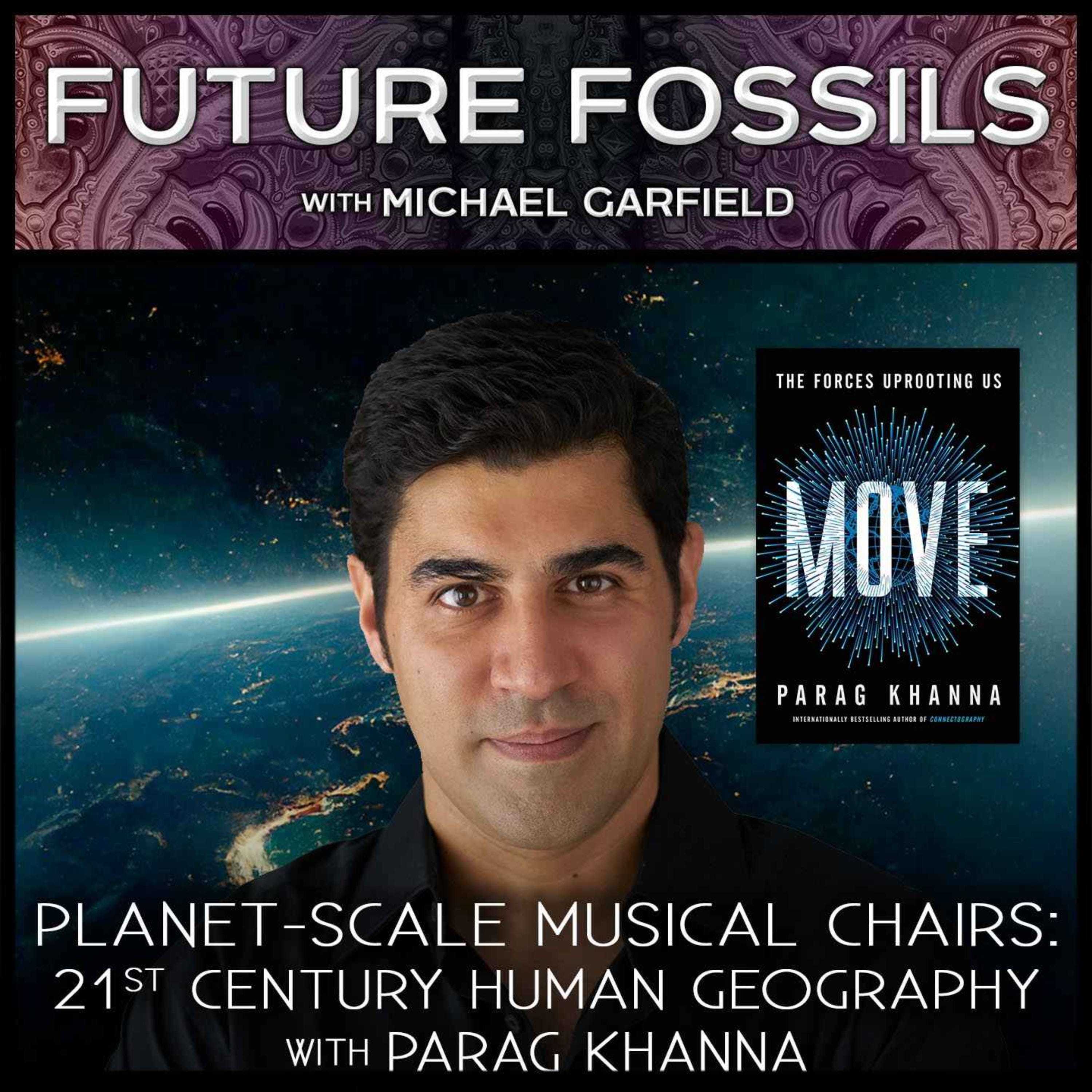
Greetings Future Fossils. This is Michael Garfield welcoming you back to the podcast that explores our place in time. This episode gets meta with an act of auto-archaeology. Our guest is Parag Kana, who I met 11 years ago as a contributor to his hybrid reality institute's platform on BigThink.com, along with people who might recognize like Jason Silva, exploring the future of human machine co-evolution.
Brag is a noted futurist and global technology thinker, author of many best-selling books, including hybrid reality with his wife Aisha, as well as Connectography and the most recent book, which we'll discuss on the show today, Move About the Forces, Uprooting Us and Sending People Around the World. I mentioned in this conversation a 2004 interview with author Alan Moore in which he describes what we're living through as a species right now as a kind of phase change between a liquid and a gas. And if you haven't noticed in this extraordinarily hot and chaotic, it's a volatile summer, and as well as more broadly and chronically under the forces that I regularly discuss on the show that are tearing at the fabric of cohesive human attention, culture and society, it would seem as though the character of these times is in a kind of gash estate in a new and more dynamic relationship with one another, with ideas, and with the very geography of human civilization. Whereas all of this tends to give me anxiety as I have not yet fully made the turn from what Richard Doyle, my mentor at Penn State, describes as the passage from paranoia to metanoia.
I would say that Purog seems rather gladly to be a fish swimming in the air. What's that? I want it down like that. Want to eat a fish swimming in the air?
That's not like a bad idea. I want to eat that fish too. Yeah, well we're not going to eat that fish. We're going to talk to him.
But he wouldn't eat us? No. Thanks, Ada. That's my three-year-old daughter swinging my lap, distracting me terribly while I try to record this intro.
Anyway, yes, Purog. A global citizen if ever I met one, someone who's profound grasp on the geopolitics and technological shifts, propelling this movement, are definitely worth our time and attention on the show. But before we get started, I just want to say thank you, thank you, thank you so much. I'm going to talk about that fish swimming in the air.
You're going to have to wait, baby girl, because I have to thank all of the new patrons, supporters of my work in a future fossils podcast that have come out of the woodwork this week in response to my rather obscene pleases for help on social media. It's been an extremely trying summer punctuating, extremely trying few years, children with sleep issues and new allergies and teething and, like I said, a chaotic environment, meteorologically, as well as in my work environment. And it means an enormous amount to me to finally see the silent majority of listeners step forward incrementally. In large part to support the content and community moderation efforts I've been putting forward in our Facebook group and Discord server, which by the way, I will now start purging non-paying members from those groups.
If you would like to stay involved, please consider either making a financial contribution or finding some other way to lend time, talent and expertise to this show, because, like I told people already, I have been literally falling apart trying to keep all of these things going for you all. So anyway, thank you so much to the profundity of new supporters on Bandcamp, Patreon and Substack, including Sumer Gosonicio, Kiaona Budnick, Bill Rice, Samuel, Emma Donovan, Moses Serulis, Ken of Godse, Dylan Helm Green, James Weir, Emily Worthland, Julian Picasa, Sarah Cantrell, David Campbell, Jake Janssen, David Sworsky, James Stroud, Marshall Murphy, Kristen Linkwist. Wow, y'all are amazing. Folks that URL is patreon.com slash Michael Garfield where you can find the complete show notes for every episode as I release them, as well as plenty of links to things like Ableton Live, Set, Sample Libraries, enormous amounts of unreleased podcast episodes and original music and links to the entire gallery of thousands of AI artworks I have been producing with the mid-journey software over the last few weeks.
I also want to give a special thanks to Future Fossils listener Tammy Poudina, who this week stepped forward to volunteer her time to help me edit the audio on this show, which is by far the biggest and most challenging piece of the production pipeline. She is an instrumental part of at least the next two episodes with Roland Harwood and Lauren Saylor and helping me get this show back onto a regular biweekly schedule for everyone who has been frustrated or disappointed that this show has not been coming up regularly. Thank you so much for your patience. Please help me find new listeners by leaving a five-star glowing, effusive review of Future Fossils on Apple Podcasts or Spotify or wherever you can.
And with that, give it up for Parag Kana in a tense, challenging, but sublime and inspiring conversation about his book Move, The Forces, uprooting Us. Thank you so much for listening and stay tuned. Okay, so this conversation is actually a conversation about I read your book and two things. First of all, I want to must remove my shoes before I enter the building.
I have to acknowledge the enormous amount of research that went into this and just honor that. One shouldn't write a book under any other condition. I'd like to think or publish one, I should say. But then the other is this question of like, when you and I met, it was over a decade ago.
And I was not a family man at that time. And now I am. And I'm sitting here, I'm looking at you and I'm scratching my head. And I'm wondering how one holds the ideas that you hold and is also doing things that you do.
Because for me, it seems like my life of movement, that family life brought that to a rather abrupt reach consideration. And I was more international than I had ever been in my life in like two years before I had a kid and then I've never been more of a place since. Well, there's the personal answer and then there's also the kind of global answer from the research. And maybe they pointed the same direction for different reasons.
And we became more, well, I can't say more because I've been traveling since I was an infant, but I need to be relocated five or six times over the course of the last 10 years with kids. And it's been incredibly fun. But part of it is that the more you move or find the places that are optimal for child raising, meaning having schools, safety, nannies, all of those kinds of considerations, they compel you to move. So having kids can be a motivator to relocate.
So for example, if I had to stop with the exact same career path, I was on fires and averaging children, I'd be working overtime in the basement of the Pentagon or the State Department right now. I'm here in Singapore in this tropical urban paradise, full of all of the amenities and comforts that life has to offer. So that's with kids. So there's a motivation to move.
But as you know, the theme of the book of course is the childless future. So after you and me comes generations of young people already today, this is not science fiction in the sense that right now we have young millennials, Gen Z, and probably Gen Alpha 2 that simply won't have children, right? And if they do, maximum, we want child. So the conditions that made people like you or me or our parents for short, is sedentary, which is to say they had kids and they bought homes.
Those two principal conditions are simply not present today. So young people are as likely as ever to just keep on moving. And that was before climate change, of course. So I foresee this global nomadism, effectively being facilitated by lack of home ownership, childlessness, climate change, obviously political alienation, all the things that have always compelled people to say, I don't like it here and I'm an act on it.
They're more capable of acting on it than ever before. So we need to give people an entry point here. And I think I want to just roam freely with you on this. But first, I want you to just give the thesis and to anchor the thesis in your own story, in your own history and biography so that how you came to this thinking and how you came to these questions, that we can really moor that there and use that.
Well, as a kind of geographer by accident, I've always been thinking about the different layers of physical, topographical existence, right? So physical, environmental, resource geography and political geography, which is definitely my most formal level of training. So again, geopolitics first and foremost, then economic geography, supply chains, urbanization, cities, also things that are written about. And this book is about human geography, the fourth layer of geography, right?
So after resources, politics and economics, it's people, human geography. So this book is basically a sequel to Connectography, which came a few years ago, and that was the geography of physical infrastructure, transportation, energy, communications, networks, and how they be mapped to the world. And this book is simply answering the question, what are we going to do with it? What will humankind, the 8 billion, 9 billion of us in the future, do all of this physical connectivity that is overlaid onto our physical geography to answer the question, where will I, where will humanity physically reside in the year 2050?
And it proves not to be a very simple answer, even if you reverse engineer it down to earlier appearance in 2025, 2030, 2040. And incrementally answering how we got to where we will be was the intent of this book and it proved that humanity becomes ever more a moving target. Whereas today we take our geography for granted, we say I am in Santa Fe, I am in Los Angeles, I am in Singapore. It was ever thus, not us particularly, but Germans are very Germans are Americans are Americans are Americans are Chinese are Chinese are, but what if the next 20, 30 years will be elite, really different and how we got to that point and how we have been more nomadic and mobile and we think and we've created the conditions and the forces that will compel us to be more mobile and where that's going to drive us in emphasis on who and where is what this book is about.
So there's a collision here, right? Because in the time since last you and I spoke, I feel like we were sort of sipping off the same strange brew of like Ricardo Hausmann, Cesar Hidalgo type thinking about like international trade network growth, complex systems of the capacities of different economies. Oh, I still swear by the economic complexity literature, it's a subset of globalization. It's part of my active and vigorous offensive globalization today is pointing out that disentangling and near-shoring global supply chains is not nearly as easy as many people make it out to be because as I said, that's not good people, which is very much like a homologist, a Ricardo Hausmann.
I said everything is made everywhere and people are learning that right now in the hard way, right? And again, that's just one part of globalization, but the original globalization, the very first globalization was mankind's first step out of Africa. And I think in the book at that moment, and I say, remember that whatever you think about globalization, globalization of people is an ongoing and in some ways accelerating phenomenon. So don't pretend for a moment that just because the rate of growth and global trade is slightly lower than the rate of GDP growth and the domestic consumer economy, then suddenly you have come up with some gotcha statistic to tell me that globalization is suddenly going into a tailspin because that's the narrowest of nonsense.
Well, okay, so I spend a lot of time on this question about the tensions between people institutions, the different scales, how much agency at any given scale is impacting agency at other scales. And when I had Kevin Kelly on the show, for instance, he put up this book Vanishing Asia, which was this photographic journey of this, you know, all of this. I'm a founding contributor to his, yeah, the prize possession of my coffee table. Totally.
I've been finishing Asia. You get it. And he, you know, he talks about the consolidation, like, yes, more opportunity, more promise. Okay, so like, let me just get this one out of the way so that we can have a nice clear footing moving forward.
But like, to me, the whole thing seems very precarious. Like I want this whole globalist human technocratic thing is kind of a Star Trek thing, but like, you know, Star Trek posits a third world war based on like bioengineering and like eugenics as a precursor, like a precedent. And I'm only wondering, like, is there a way for us to reconcile people's need for place with people's need for movement? Because for instance, late historian William Irwin Thompson talked about there being sanguine political politics, geographic policies, noetic policies, right?
And the overlaps of those three things, you know, the overlaps are confusing. Like, I want to be more international than I am, but this is me just framing the sort of nagging thing for this whole, this whole conversation in one question, I'm just going to pick apart, you and I seem aligned on this. Like it doesn't seem like that nation states are really keen on average on giving people this sort of, okay, go ahead, move where you want to go thing. Oh, I would never deny that.
I mean, you know, my work is on borders. I'm the first to acknowledge and literally count, you know, the fact that we have more borders today than ever in history. You know, I write written in Thai books just about that. So I'm not a borderless world, you know, kind of globalist.
So obviously I'm targeted in that way. It's on borders. But one of the things that I state very plainly in the book is the single one thing that people never have a global agreement about is the free mobility of people across the world. We may have trees governing everything from environmental regulation to internet technology to how we jointly colonize the movement.
I mean, you can imagine international cooperation on lots of things, even if it's still a distant dream and some of these domains today. But I literally cannot ever imagine the one thing that you're positing is sort of, you know, my ideological, which it may be, but I'll separate that fully from my analysis. We will never have governments agree on the people of the cross-border. Because when every vestige of sovereignty has been taken away from states, right, you cannot control the flow of pollutants, pathogens, cyber attacks across your borders.
The one thing left, remember, we're talking about geography. It's the control over your physical borders against the movement of people. So hardly am I in denial about this. It is the front and center.
It is about what we do despite that. How do we be aligned with the geography of people, the geography of the borders, the geography of the resources, the geography of economics? There's what we are doing, and there's what we could do, right? There's the analytical and the normative.
But surprisingly, a couple of two other points. One is there is no average state. And this is something that I think, you know, serious political scientists acknowledge. If you're a serious political scientist and you're a pure theorist, you take the state as some kind of homogenous ideal type and you impose it on the world as if that actually exists.
And that's where your relevance utterly ceases to be defensible. Because for somebody who is a traveler, for somebody who does international relations from the bottom up, the fact is there are no two states, they're exactly the life, nothing of the sort. The capacity differences, the leverage that some have over others, the hierarchy of power among them is different in different places, different from the periods and so on. So there is no normal state.
But when you say, because I know what you're referring to, you're kind of saying, well, look, what about the mood, what about protectionism, xenophobia, populism. So let's go with the facts here, right? The principle, let's just take Western civilization because you also roughly mean that when you say beat, right? So I want to ask you which country is most representative of Western civilization that quote unquote doesn't seem keen on enabling the mobility of people.
Is that state Hungary or is that state Canada? Is that state Italy or is that state England, right? Is that state Bulgaria or is that state America? Because as far as I can tell, right now, with every single census data point at our disposal right now, the foreign born populations of Canada, United States, Britain, Germany, the four most important countries in the entire Western civilization are more and more open to international migration flows.
Their populations become more diverse, more mixed race with every passing minute. And that occurred even after Brexit, after Donald Trump, we have the October 2021 census of the United States. Yes, net immigration figures were down that she began under Obama, we are not, then through Trump and then COVID. But this year, 2022, as we speak, Congress is presuming nearly one million migrants will enter the United States this year.
So we will have gone in America from 246,000 immigrants the year before to nearly a million in one year. Canada, increasing its population by 1% per year, not by accident, but by design. Germany, only country and Western Europe are the growing workforce because of immigration, right? Britain is making it easier.
Every six months, they're passing new legislation that effectively undermines the spirit of Brexit, which is making easier and easier to move there because they realize what shortages they have in everything from farmers to Trump drivers and nurses and doctors. So what is that average Western state that you are, again, our general political mood is referring to when we believe that populism, xenophobia, nationalism, protectionism, and borders are the true new meta-narrative and order of the day. The fact is that you actually look at the truth of the world from the bottom up. Data-name movements, we have more mobility than ever before.
More people live outside their country of Earth and origin than ever before. Those numbers are rising, basically, not at the rate like never before, but the net number is far, far, larger than ever before. So there's what people say and there's what people do. And one of the most fun parts to be honest with the book is to look at construction policies.
So I looked at countries that demand that the equivalent of you or me at the age of 18 has to go and serve in the army. And there is this, again, this narrative out there. And it comes very often from the avant-killer East Coast international relations elite that I sort of still in some ways a card-carrying member of, do I reject many of its meta-narrative analysis. But they say there's this return of the civilizational state.
Strong man, nationalism, look at Erdogan, look at Putin, look at Modi in India, look at even the five-star movement in Italy and so on and so forth. I'm like, OK, why don't we look at these countries? Why don't we look and see if the man that you may be ryifying into this great civilizational revanciest power actually maps on the movement and views of their people. Well, lo and behold, there's no better predictor of ordinary people, young men and women, wanting to leave, wanting to get the hell out of a country than having a leader like that.
And the best lens is to look at the construction policies. So you've got the construction in Russia, you've got the construction in Turkey, you've got the construction in all these countries. And the right of passage for every single 18-year-old male in those countries is to collect as many rubles and lira as you can and bry your way out. And that was before Russia invaded Ukraine.
So the real world again is people leaving precisely those countries. When Mateo Salvini in Italy declared a family first, immigration or pro-natal policy. Women need to stay at home and make babies. Guess what happened next year?
Women left Italy. So people move whether you want them to move or not to move. Anyway, thousands of more stories in that direction. Yeah, I guess for me, I saw 2008, I saw the writing on the wall and I was trying to convince the woman who is now the mother of my children to escape with me to Australia.
And it didn't happen. And I feel like there are a lot of people, I have to assume the majority of the listeners of this show are American. It does seem sort of like a fortress in some respects. This combination of what is it, like the $6 gas and COVID.
There's a complex systems thing here where it's like whoops, maybe we were too connected. And of course, the question for you is in running toward the obvious goods, clear lucid virtues of all of this, it seems like licking the blade. I don't know how to think about it. But first paraphrase, it's always fun to do.
You may not be interested in migration, but migration is interested in you. So even if you lead or are comfortable in existence in America, that doesn't mean others live in lands, down to years in resources and industry and geographies that you can settle and have it. So people are coming in, even if you're not leaving. The second thing, this is just a point of clarification.
Migration is not necessarily international migration. The most significant migration in all the world history is Chinese people moving from rural China and villages to coastal China. They never left China. They'll never leave China.
But they radically transformed the face and the contours and the trajectory of what is the most populous country, largely the entire world, and reshaped the entire world economy without ever leaving their country. Most human beings will never leave the country in which they were born even in the scenarios. Even in the most ludicrous outlandish scenarios, a uncontrollable mass migration that I forecast or a posit in this book. Most people will still never leave either the country in which they were born or the continent in which they were zapped.
Lots more movement of Africans around Africa, South Americans, South America, a lot more Asian regions moving around Asia and so forth. But still then, I actually at the beginning, I actually bracketed out 4 billion people. So there's probably 4 billion people at least, who are too old, too sick, too poor, too geographically marginalized to ever come anywhere close to dreaming or crossing a border. So now I'm taking the remaining 4 billion people in the world, most of whom are young.
And saying, okay, where are those 4 billion people right now? What is their capacity? What is their desire? What agency do they have to be able to move?
And is that move going to be domestic or international? And there you're talking about real world plausible scenarios. And the likelihood that India, which again, going back to the strong and national is by far, and Michael, it's like take a bar chart, raise your hand up to the ceiling, and put a giant break in the middle and down to the floor, right? The ceiling is the number of Indians who leave India every year.
The floor is the number two country on the list, okay, which is like Poland, pre-Russian Asian European. So, you're also talking about what is one of the youngest and effectively now the most populous country in the entire world. The country perhaps among the most afflicted by climate change, and you've got a recipe for a mass migrant outflow. So, India alone is going to account for more human beings crossing a border and leaving their country than many of the other countries on Earth combined.
Hey, now let's come back to America. Movement within America is a time-honored tradition, right? I mean, it is the pioneer spirit of the 19th century, manifest destiny, continentalism, you made it. But Americans have been stuck in place, and most are not advocating that Americans leave America.
Though, again, by the way, not so fun fact, the number of Americans outside of America has never been high, right? So, again, don't answer the question as if it's you or me in our comfortable existence, right? Imagine that you are a millennial or gen Z, well, you are a young lady. But imagine that you are gen Z, gen L, I'm a senile, but I'm a gen X.
Now, those are the ones who are buying the mobile homes, those ones who are moving to Costa Rica or Panama or Bali, or to B.C. Georgia or East Berlin. And you add all those people out. That's 9 million American passport holders who are not living in the United States, right?
So, the expats, people like me who have left over the last decade and been quite center-in to fight elsewhere. So, there is that, but let's just put that to the side, because that's still a very small percent of the American population, which is growing, which is within the lower 48 states. And it's going to remain in the lower 48 states. I have no problem with that.
But that doesn't limit what we're talking about when we say migration, right? Because climate migration alone, economic migration and search of opportunity, economic migration fleeing the deindustrialization of the Rust Belt, accelerated the shift of people from the northeast to the southwest of the United States. Americans are moving. Climate migration means that where there is drought, which is where you live, where there are heat waves, which is everywhere right now, where electricity grids and power failures become more frequent, people where crying becomes intolerable.
People will say, I'm out. I may move one county over. I may move another state or two over. I'm still going to be able to say, that's migration, just to be clear.
And I spent a lot of the book looking at just Americans in America, because actually we have this notion of what is the American dream. And to me, it's about mobility and skills, not just about home, having a home and earning a degree. And so to me, the best form of achieving social mobility is enabling physical mobility. And this has been very clearly documented by Raj Chetty Harvard and his work funded by Gates and other foundations.
It makes it absolutely clear, you can track people's incomes from the census tract, zip code, they grew up in, from birth to death, the prospects for everything from educational attainment to income and healthcare and life expectancy and so on. And people who are stuck in place are not going to achieve as much as if people physically get up and move to places that offer a greater opportunity, right? And so within the United States too, even if you took all Americans and closed, put up the fortress, use the fortress, that is not inappropriate at all. Literally you do put a boat around the country, put up walls, everyone, just run an experiment on what happens to the finite stock of 300 million people.
Well, obviously if you were to try and achieve autarky instantaneously, that would create a lot of dislocation. But holding all those equal, you're going to see a lot of movement. And that's every bit of important international migration. So I'm not just the airy, very globalist talking about the long-term, possible policy vision.
I'm looking at what's better, what is the best outcome for just ordinary people in order to visit. I go toe to toe a lot with German kind of conservatives on the issue of immigration. And I'm happy any given day to get in their face and say, you are killing your own parents. Why?
Because chances are your parents don't live in a big city, like Berlin or Frankfurt, they live in a second, two or three or two towns that's depopulating. They're aging because all European countries are aging rapidly. And if you are anti-immigration, that means that you're not important enough of the Bulgarian, Romanian, Ukrainian, or Filipino nurses to care for your parents. But you've left them behind, right?
You're often Berlin. You're in Hamburg. You're a gallivanting around. You're up doing your job.
And meanwhile, your elderly parents are suffering and dying alone. And the rate of elderly people who literally die alone, right, is rice. You can track it anecdotally in Spain, in Italy, in France, in America, in Japan, for sure. As you well know, you see this in the news.
You know, local policemen and prefecture, whatever in Japan, opens up an apartment and there's, you know, the dead grandma grandpa that I've been sitting there for months, and no one knows how long. Is that dignified? Is that civilized? Is that even sort of a civilized society?
I don't. It's a very advanced optimizing migration to cater to the needs of your own citizens. You know, you're effectively, in my view, in moral firm sense, you're consciously choosing a sub-optimal outcome that lowers the standard of living of your society. So immigration is part of that.
Again, I'm speaking about the needs of everyday people, not cosmopolitan place. And those who speak in actually the poetic, romantic nationalist terms about identity, you know, and hold everything as the whole, the barometer of nation-state code to be the 19th century European construct. They're the ones living in the fantasy world, right? Because if your job is it to be a public official and to actually achieve certain, even if you believe in zero growth and that's all a separate conversation, even if you believe that immigrants are damaging the environment because they will achieve higher standards of living when they come to our country and so on and so forth.
Even then, you are nonetheless in a very detailed way, right? You are harming your parents. And I want you to live with that if you actually believe that you can posit some perfect population model that doesn't include immigration while also having low fertility at the same time, because that's the world that we are in right now. This is great and I'm glad that you brought it to this because this is a core to this consideration.
Reading your book, The Demographic Age cohort piece of this was so, so, so prominent for me in the tensions that I feel as the father of a young family hundreds of miles away from anyone else, blood relations. And so this is, you know, to make it a little bit more personal, I wanted to ask you, brass tacks, like you have moved so much and are thus a model for the virtue and world space that you're advocating here. How? Okay, so at least as far back as Alan Moore, I think it was a 2004 film made about him that where he talked about how he thought that digital technologies were creating a phase transition in society that we were going from like a liquid to a gas.
And I guess even earlier, like Zimme and Bauman had written about liquid modernity and so on. You know, there's this notion of like that we are boiling here. You know, and you think about the miles traveled by a person over average per capita over the course of 20th century, it's insane. It's me that looks like what it means to be human is going to have to be fundamentally different.
Or does it? I mean, let's remember that to be human is to be bipedal and to have the capacity for mobility to be human for the past 100,000 years has meant that we have basically be located. What is actually new, right? I mean, yeah.
Absolutely. I think that you and I are aligned in that movement is actually the default state for human beings, right? But that's like movement within this web of closely held connections, like, you know, familial bonds and so on. And for me, as a transplant out here, you know, you're talking about, you know, this American liberty and go West, young man saying, well, I did that.
And I'm here in Santa Fe. I'm 700 miles from anyone. And you know, I mean, we need to hire childcare. And it's like the people I see really thriving in this town.
Oh, yeah, my seven generations deep. They can just punt the kids off to extended family. And so back to Bill Thompson's Sanguinal Geographic, noetic kind of thinking, it's like, how have you personally and how do you imagine generally? How do you see people generally making sense of missing people piece of it?
Because it's like, yes, yes, opportunity. There's no question that was the crux of my conversation with Kevin Kelly was like, yes, obviously people are moving into the city for more opportunity. But how do we carry these other things into the space? Can we?
Well, I think there's sort of like a unique go to Lancer because here in Singapore, obviously there's entrenched families born and raised here. We see this with lots of friends who are locals, the grandparents, both sets of grandparents, live within one kilometer in either direction of our friends. So they can have them come over anytime. But even if they weren't there, even if they're now deceased.
They've got helpers, nannies that come from the Philippines or Divusia, Myanmar, India, what have you in the house as most private homeowners have here in a country like this, or many other countries where there are crossroads for different populations, the different wrongs of economic ladder and different functions in society like childcare and university and so on. So even though my parents don't live here, they'll come for like six weeks at a time, come and stay over. But we have childcare anyway. And again, the fact that you don't have a nanny living in the house or the fact that lots of mothers during COVID had to fit their jobs because they didn't manage their remote schooling of their kids.
They had to take care of their parents and drive around. They took a clean into the laundry and also try and do their jobs to get each of the breaking point. So what was called the motherhood penalty during COVID? Well, that too has a solution.
Guess what that solution is? It's called immigration, right? Because even if it's lower wage immigration, even if it on paper it oppresses average wages, we know that there's labor market segmentation going on just because a nurse comes in or a caregiver comes in from El Salvador, doesn't mean a university professor earns less money, right? The fact is that women working women in America suffer the indignities of having to choose.
They're suffering a lot more indignities as I've ever had their day before yesterday. So that's a different topic. The fact is that COVID deeply, deeply exposed, you know, this huge familial divide, those that can afford to have these abundant services and those that can't and most can't and that particularly affects women. And that's again, just like having your parents die alone because there wasn't sufficient care for them.
This is a political choice for making. So that's it. But let's get back to the generation because of that search for community. And one of the things I had to do and it was not easy, which proves that I'm a little bit older than I thought I was to put myself in the shoes of today's tweens and teens and 20 something.
And I really scrambled the methodology around this book. Like, you know, obviously I go put my boots on the ground. I'll interview hundreds of thousands of people literally for any book I write. But I didn't just go to meet like, you know, Secretary of Defense, whatever, from country access time.
I actually had focused groups of like kids, went to high schools, met young professionals, digital nomads, talked to universities and colleges, like everywhere. I've been doing that all along in gathering material, but I dedicated to certain ways. I want to know what young people think. For this book, I almost only want to know what you think if you're under the age of 30.
And not under the age of 30 you'll get in the time horizon that this book is playing out. And therefore, I am going to massively overweight in my methodology, young people's points of view. And therefore, you don't hear this sanguinal kind of, you know, ethnicity first, nation first, family first, when you talk to young people. And that is not a fringe phenomenon.
Michael, that is literally more than 50% of the human population is a core demographic subject of this book. They're not peripheral. They're not secondary. They're not waiting for their turn to have their hands on the levers of control of society.
Right? They are voting with their feet. And again, if you want to understand the future, the winners and losers of the 21st century, just look at how young people go with their feet today. And this is how to answer your question.
And this is why I bring up places like Berlin and Finland in the book. Because it was perfectly logical. If you are a young person and your parents have passed away or they're old, they're taken care of their retirement home, and you don't have kids or you only want kids, what you're going to do is to probably try and move to a place where other people have kids because there's so few kids. So the reason people are born in East Berlin is not just because it's like, you know, fun, wild and liberal, hedonistic kind of place.
It's also because young families are there and all of the young people who do have just one kid or like I need my kid to have someone to play with. And so in East Berlin in particular, I say East Berlin is if it's divided from my story to my top. But the defining moment of my life was actually when the Berlin Wall came down and I went there and I was 12 years old and it was a big deal for me. So I still have this meant I've lived in Berlin like four times over the last 30 years of my home weight mode.
So I still think of it. I've lived in both sides of the city in both sides. So I say East Berlin, I've got an old timer. Like, you know, from the confidence there are always like, wait, wait, wait, wait, wait, wait, wait, wait, wait, wait, tell Sinky in Finland.
We got a new top gun this year. You're not old. Yeah. Thank you.
But like, you know, so cities like Helsinki are saying, you know what, young families come on, come on, we will redesign the physical space, the architecture, the infrastructure of childcare and education. And real estate companies are doing this, right? Fisherman's Fair, others are saying let's build new kinds of condos with lots more open shared spaces for all of those families who live in our property. So it's exactly one kid to have them play together so that the parents can go off and do their jobs and quiet time they'll volunteer and rotate space.
So all of this is happening right now. And guess what? Young people are going to those places. Where do we find that sense of identity, community, belonging?
Why does the definition of what identity belonging and community are have to be the same as what it was at a time that neither you nor I quite frankly can even remember, right? Effectively irrelevant era from a demographic standpoint. And right before I was right now, all the young people of the world are saying, I want to go find and find my own identity and find a place where I belong and participate and build in a new kind of community. And I'm going to physically go and vote with my feet and go to wherever that place is.
And it could be Denver within your own country or it could be just over the border in Toronto, which is a place thriving with building an international sense of identity. It could be London, it could be Berlin, it could be again, to Lisi, Georgia, El Mati, Kazakhstan, Bali, because that's happening. That's not again. And now it's this, this, this, this, this, this, this, this, this, this, this may seem like it's a rounding errors to just like the number of people.
Okay. Well, let's be clear. I guess I said at the beginning, you can, but all people are sadly not created equal in terms of their material circumstances. So I'm starting with the four billion, youngish people who are capable of locating.
I'm taking as a subset of that the two billion who constitute the rising young middle class of well enough educated people. And I'm then I'm looking at the construction workers or the nannies and the caregivers. I'm looking at the digital nomads, the international students, all of them, because let's face it, they move the needle here, right? You can have a whole conversation about the humanitarian nature.
And certainly I toe that line very strongly, but you and I are talking about the young versions of ourselves, right? And the young versions of ourselves, whether they are Indian or Chinese or Nigerian or Brazilian or American, are saying, I'm going to go where the hell I want because my passport now allows it. The world is more open than ever before. And there's actually a war for talent out there.
Companies, universities will pay me to come to their country. So why not? But let's put aside, because again, obviously I devote large portions of the book to the humanitarian land statements. But let's talk about people that you and I are actually talking about, because we're time at our kids.
We're time at what our kids are going to do in five years, ten years, or fifteen years. Let's be unbelievably selfish about the whole thing. And that's the world that the kids that are older than your kids are living right now. I see it every day because I employ it.
I mentor it. I tutor teach those kids. I see them everywhere. And they have zero, zero fear about leaving their local community as if it was some perfect who-colic place.
As if they lived in a multifamily household with grandparents and parents all under one rule, what reality that barely exists may be in Santa Fe, right? But that's not the world. Already most people, you were talking about a number of miles traveled by the average person in the 20th century. Let's look at it.
And I don't have this at my fingertips, unfortunately. But what is the average distance that a person, that a millennial or a gen Z lives from their parents? Now, I'm going to just hazard a guess that that distance is slightly greater than it was a generation ago, right? So let's not be shocked that that proves to be true.
Yeah. I guess, for me, I get into thinking about scaling laws, because the urbanization thing, Jeffrey West at the Santa Fe Institute talks about the finite time singularity, which is where the network benefits of living in the social reactor, right? I'm saying this for the benefit of listeners. I know you know, but the recombinant bonus of living in a city is so magnetic and so novelty producing.
But novelty producing, it's patents and STDs and organized crime and per capita income, but only 90% of it to the top decile. So there's a way in which it seems like the finite time singularity is where he says the innovation precipitates a crisis that must be solved by another innovation and that the cycle gets faster and faster and faster and faster until it happens faster than we can't respond to it and things collapse. And I think this is already happening in certain ways. And maybe COVID was an example of this, where as was the hyper-connected banking network cascading collapses in 2008, it's like we're doing the amphibian coming out of water thing here as a global civilization, right?
And what ways can we be moving this as fast as you're talking about, as you're suggesting we will, and what ways can we keep face planting? It turns out, wait a minute, we absolutely need to move know-how between these locations. We need to keep trade alive. We need to keep these connections vibrant.
And also, you know, zoonotic illnesses are going to disrupt things. There's just like all of these endogenous sort of network-based, collapsing things that get in between here and this dream and the question, it's sort of like a how do you make sense of all of, they're not edge cases. It's clear that this is extremely rocky. Part of the innovation that is happening, and that is necessary to cope with Geoffrey West's problematic that he's raising, is what I guess you could call continental circularity.
So and this is kind of a core 19th century geopolitical pieces known as pan-regionalism and continentalism, as I mentioned earlier when I'm talking about the American demographic manifest destiny. In the 19th century, geopolitical scholars sought to optimize the geographic resource base of their power, not just within boundaries, but the extension of power latitudinally so that you could grow food in all seasons. But it's when during North America, the summer in South America, therefore we need to have a monodctor in and expand further southward and tame as many geographies as we can within our latitude, right? So there is a shift happening right now in the world towards a greater regionalism.
And that's what I call this continental circularity. So North America is by far the most self-sufficient semi-awtarkic continent in the world. We may have a very large trade deficit with China right now. That's in fact white during COVID because we got caught off guard not having a domestic be produced basic medical equipment and things like this, but what's happening now is that in North America, there is sufficient, there's natural resources, there's water, there's fuel.
There is industry, there's people, there's technology, there's finance, right? Every ingredient to have complete autarky as possible as that is in the world actually exists in North America. Europe could actually be similar and Europe is from a climate change standpoint at a more proficient latitude than the United States is. For those who don't think about this every day, the way I do, I mean Europe is a Canadian latitude.
So climate change hits America much worse than it hits Canada or Europe, you know, U slash. So Europeans with their huge investments into energy, self-sufficiency, alternative energy, fuel energy. Obviously they've also gotten caught off guard by Ukraine, the crisis that are going to now lead up with their efforts way faster than Americans will because public investment in infrastructure is far higher in Europe and in the US. They are too, you could imagine a certain regional circularity, right?
Self-sufficiency, right? They will import less. They will allocate more land for agriculture. They will end their resistance to some forms of GMO.
They will do more with hydroponic and aquaponic agriculture, these sorts of things. And so will we. And Asia, this is what Asia has obviously half the world's people, huge economic size. So anyway, you've got these regional zones that are trying to get their way out of the complexity trap, right?
The interconnectedness of global supply chains becoming so complex and indecipherable that we don't know which point of vulnerability is when it cascades through the system and bring down one society or civilization or economy after the other. And the way you undo that is through that localized or regional scale innovation towards the way it results in this issue. So break the cycle of excessive, and as you know, this is known as like, the E-copolis theory, right? When we were a small agricultural population, we would be aropolis, this is Herbert Jourde, in Geneva, then we were the petropolis of, you know, frictionless global energy supply chains and presuming that, you know, growing in avocado in a water-stressed area and shipping it around the world and producing huge greenhouse gas emissions as if they had no externalities of any kind.
And the middle ground that we're actually actually doing and heading towards and have all the technology at our fingertips at our disposal today right now to do further is this e-copolis idea where we go back to the local or regional scale, stop building cities on arable land and do more technological, you know, sort of investment in food and energy production and greywater recycling, you name it, right? So a massing populations in climate resilient areas and making those, you know, models, those urban models more sustainable at the same time is not only plausible, it's again what you see happening literally every day in Europe, even in America, in Japan, in parts of China and so forth. There are places, obviously, that are going to, that are being catastrophically affected by climate change and no amount of sudden infusion of capital and know-how is going to save them from the heat waves and power failures and droughts that they're currently experiencing. And that, again, is much of the population of South Asia, much of the population of Africa, much of the population of Latin America.
But remember from a geographical standpoint, even a geological standpoint, most of the human population lives in the northern hemisphere, which is slightly better off in the southern hemisphere. Most of the human population lives in Eurasia, this one large landmass to which I've dedicated most of my kind of career and migrations. And therefore, mobility around the Eurasian landmass will account for the better part of the future migrations of the entire human species. So focusing on the side of the Pacific Ocean that I happen to be on right now, it is very plausible that more and more people will move and recirculate into the eastern Siberian provinces of Russia, into Central Asia.
That's why chapters of this book on places like Kazakhstan, and Pakistan, and the Russian Far East. The Caucasus, the NOAA, the CIMP-5, and six maps. IPCC projections tell us what the livable is geography or slightly more livable because we do have to take into account the feedback loops, right, that will affect places and we can't be completely confident. But still, relatively speaking, the relative change in livability and suitability and human adaptation.
And guess what? Michael, people are actually going in those places. You may not be moving there. I'm not moving my family.
The Vladiboss talk next week. But it's happening. Russia just signed a skills partnership agreement to import Indian farmers because they don't have enough farmers in the Far East. So again, for every country, there is something going on beneath the radar that constitutes some step-by-step incremental passage towards this recalibration of supply chains and pathway towards a new civilization.
And I was thinking, it comes back to cities actually because just because New York may be losing people right now and Los Angeles may be losing people right now, that doesn't mean that the city is losing, right? The city always wins. Let's have a couple of punchlines for everyone to take away. And I think this is one that people will actually feel like and appreciate.
A, mobility always wins. B, globalization always wins. And C, the city always wins. The question is which cities?
Because Los Angeles is losing people doesn't mean that Austin didn't win, that Seattle didn't win, that Denver didn't win, that Boise didn't win, that Toronto didn't win. And so in Rome's loss, doesn't mean that Milan didn't win. Because there are, so the question that I set out, one of the future civilizational centers, we have been urbanizing for 7,000 years. The city has been winning for 7,000 years.
7,000 years from now, if we're still around, many people, they will live in cities. The question is where are those cities? What are those cities look like? Who is there?
How are they governed? Those kinds of questions. But make no mistake, and again, New York is like me, but not me in particular, who's say things like, the city is screwed because of COVID or fill in the blank. The city is never screwed.
The question is which city is screwed. But more importantly, more interesting for us as futurists, quote unquote unquote, is which cities will win in the future and why are they winners? Is it because of climate? Is it because of being politically open and liberal and embracing migrant populations?
Is it because of their economic diversification efforts? In truth, it's all of the above. Because again, why did cities win in the past? Well, because they were in the right geographies, they had the right global connectivity in the industry, they attracted talented populations, they had diverse economies.
Well, lo and behold, the same ingredients apply in the year 2040, or in the year 2022, as probably in the year 2,222. So I'm out to find and locate physically what are those places and where they're doing and again, the early evidence is visible, whether it's in Toronto or Berlin or Almaty in Tokyo, interestingly not good. I talk a lot about Tokyo in the book. It's like, well, Japan is depopulating no country next to Russia outside Russia.
It's depopulating as quickly as Japan. But the future population of the islands of Japan is very simple to see. It's fewer and fewer Japanese people and more and more non-Japanese people. Right?
I say the same thing in the book of Bulgaria, Bulgaria is tiny. There is a future that's not all that far away where there's almost no Bulgarians in Bulgaria. But that space that we identify on a map as Bulgaria is going to be full of people. They just won't be Bulgarian people.
And in geography and in human geography, you don't have a problem with that. If you're a Bulgarian nationalist right now, you have a problem with what I just said. But if you're an authentic human geographer, which is what this book is for, is to reflect the community of scholars that I do have a lot of work with, they don't have a problem with that. That's just the passage of time.
That's the relationship between demographics and geography. That's how complexity affects geography. Right? All of those things.
And it's happening in every place where there is no static fixed map of humanity. We've always been on the move. We'll continue to be on the move. And places that identity or place will change depending on the people who are there and the people who will be there in Japan, in both areas, in America, tomorrow are different from the ones we yesterday.
And you have to embrace that. You can't embrace complexity and not embrace fluidity. Right? I mean, yeah, I just sizzle, reading your stuff, hearing you talk like this.
And I'm disappointed in myself that I just feel like such, I'm like, and yet again, as you said, with the attention to, it's not earlier stuff. The article that you wrote about that was a 15 maps Donald Trump needs to see to be, you know, on the each. I love it when editors always come up with better titles than I do for these things to make them go viral. Yeah.
It was something, it was something, it was a connexography, but that piece about the infrastructure linking bioregional zones, you know, and how those, like, yeah, obviously, like East Missouri is more Illinois and West Missouri is more Kansas, this kind of thing. The M, yeah, that you raised is a very localized thing. But this is the point at which every one of us should always, and it's a healthy thing to do is to check ourselves and say, is what I'm about to say, generally representative of the average or median person in the world's view, or is it really just me and where I am? And I have to go through that exercise all the time.
Now, I agree with you that there's no denying that the values are towards this, but like something has to give, right? Because I mean, just in the last few years, in the course of my life, you know, wages have more or less stagnated, well, the cost of living has gone up like 400%. I don't expect gas prices to ever come back down. You know, people are talking about not only now, like, oh, well, we'll just let virtual reality travel.
Now they're talking about virtual reality children, you know, have a baby in the metaverse that you'll like, breed this thing that comes up in AI and you'll be able to like, farm your own designer baby and VR. The read that I have on this is on the one hand, like what there's the pressure toward being able to just breeze through, move effortlessly around. But then as a New Yorker, you know, it's like, when it costs $18 across the Brooklyn Bridge, as an urban nexus gets denser, the amount of time it takes across that space, it actually starts to feel like you might be in a collapsing neutron star from which you can't escape, you know, like, I never say it's effortless. This is interesting.
And I don't mean this as a pushback. I mean, this is actually just a useful location. There is a ton of friction involved in the movement, you know, and again, in my own personal life, sort of becoming an expat. The first step is the hardest, you know, so much administrative stuff to deal with that you never sorted out before.
But then after that, steps two and three become easier and easier. Now, even for people as a whole, though, if we can take the young digital nomads, for them, it is a lot easier than it was before. We made a list like, you know, what did it take for us to move to Berlin a few years ago? It's like good to deal with the school here and we had to deal with like our house and like, we're doing our stuff and like getting around like, these us and all this stuff and like where we live and blah, blah, blah, blah, right?
Just a few years later, especially post COVID with so much being digitized in terms of services, a young person today can just be like, they can get on a plane to a destination in another country. They know they're going to have a visa on arrival. They can book their Airbnb before they even while they're on the plane. They can, they don't even need to change their sim card because they'll just use WhatsApp everywhere.
So the only thing left that cannot be done almost like instantly while on your flight to a place is finding a place in a school for your kids, if you have kids, but most young people don't have kids. So they're thinking about that right now. It has become easier than it was even in the short frame of reference that I'm giving you as an example here. But again, I talk a lot of the difficulties of people moving around.
There's still the majority, I mean the large percentage of the number of international migrants that they are, Filipinos in India and some of whom have their passports confiscated when they arrive at a construction site in the Gulf countries where they're working. There's a lot of hardship right involved in mobility for most people, much of the time, huge amounts of financial sacrifice, you know, payments made to coyotes and you know, other types of people who facilitate passage, you know, the kinds of stuff that I thought I knew but didn't in terms of the stories that I'm hearing of human trafficking and that's the volume of human trafficking being higher now than even at the time that we thought was the peak of human trafficking. There's tragedy involved every minute of every day where we're talking about mobility. Look at the number of people right now waiting on the Mexican border, which is kind of look at the rafts of Africans being mowed down by machine guns, by Italian and Spanish, front texts, soldiers paid by the European Union to murder African asylum seekers.
That's every bit the reality of mobility today. So at the same time, it's the 1% who by a second, third, fourth passport, right, jets that are around the world, choose jurisdictions based upon low tax and have access to the world and move their money. They are as people as fungible as their money is. There's that too.
And there's growing numbers above, right, obviously the number of people who are in the more tragic circumstances exceeds the number of people, but let's face it, economies are tipped and shaped by the movement of the 1%, right, and the resources that they can push the button relocate and where they choose to domicile themselves. So I also look at that and both can happen at the same time. You can have more friction for a large number of people and you can have more flow for other people and they can, you know, the dynamics can change. So just, you know, to land this, I want to say, like, okay, I think if anybody hasn't already figured this out, you make a rather compelling rhetorician and the book is convincing.
Let's speak to me or the 10 years younger version of me, the people that are on the brink of expatriation. My little brother, he's actually 15 years younger than me, almost out of his aerospace engineering degree. I'm going to graduate with it this year. I'm just going to travel the world.
Forget it. I'm out. What is your counsel to someone who has not grown up with the same conditioning to the normalcy of international life that you have? How do you help people?
How do you, like, beckon people out into a globalist identity? Well, the good news is I don't have to in the sense that it's happening anyway. You know, I, myself, am surprised by the data, right? I never thought that there'd be that the number of American expats would double in the last 12 to 15 years.
I didn't predict that at all, but it's happened. So I'm hardly alone in this. So that's one thing. It's happening.
I don't need to play. I don't need to have some kind of hand in it because, again, young people are voting with their feet. Secondly, mobility, again, to move as human, right? We have that capacity.
It's something that's easy to learn. And whether it's out here in Asia or any other corner of the world that I've been in, I've always the last 15, 20 years, always met scores of Americans, Canadians, Europeans, you name it, who are outside of that traditional comfort zone geographically that they grew up in, and they adapt very, very quickly. That even includes many people who've been quote unquote repatriated to their country of ethnic origin. So think about all the Chinese Americans in China who have made a killing economically commercially, right?
As investors, as people, tech entrepreneurs, moving back to China, all they have to do is to brush up their Mandarin, right? But now they're swingers. They're like, they're ballers in China, right? Same is true for India.
Same is true of South African Americans in Africa. Certainly true of Arab Americans in the Middle East or non-Aaroms, of course, in Middle Eastern countries, melting places like Dubai. So it's happening all the time. Just look again at the uptake on the Dubai, No Man visa, the uptake on Silicon Bali, and case after case, when I was last in Tbilisi, Georgia, I mentioned before my daughter and I were on a train trip across Eurasia, and we stopped in Tbilisi, which was just bottom line, it was a shithole the first time I was there, like 20 years ago.
I went back with my daughter just a couple of years ago, right before COVID. And lo and behold, the lingua fraga on the streets of Tbilisi, Georgia, and again, we're not talking about the Southeastern United States, Atlanta, Metro area, we're talking about the Caucasus Mountains, sandwiched between the Black Sea and the Cazvi, between Turkey and Azerbaijan, the electoral country that was invaded by Russia in 2008, this country, lingua fraga the streets of Georgia is American English. I mean the number of like co-working spaces and digital nomads and advertising people and tech startup, you know, folks, y'all, it's your brother, your younger brother, times like, I don't know, thousands, and then a lot more young Europeans who are effectively identical in many ways and how they've grown up. So again, they're ahead of us, Michael.
This is maybe the important note to end on. Generational psychology is such a dangerous force of inertia, right? It's not to say that conventional wisdom received wisdom is not valuable. Of course, it is immensely valuable.
There's so much of it that we should hold dear and apply to the president's future to avoid some of the mistakes that we're making. That's a separate topic. But young people are ahead of us. I want everyone to understand this absolutely crystal clear, right?
They're already doing it. Everyone needs to understand that you and I are not talking about the future. We are talking about right now. Everything we're talking about is already well underway.
All you have to do is watch young people voting with their feet. They're not waiting for your permission, my permission, Joe Biden's permission, or any other power that be. Right? The map of the future of humanity is being designed and being painted every single minute with young people walking, taking trains, taking planes, getting on cars, driving mobile homes, and physically relocating to places that they feel they can belong.
And that is why, despite all of the cynicism, all of the valid reasons why we should be incredibly scared about the future. The one thing that makes me most hopeful is that young people actually do know better than we think they do what's best for them and they're chasing it by going with their feet. Well, that's lovely and a buoyant. On our way out, I want to give you one more opportunity here to address the stock outro question of this show, which is to imagine that the past and future are all stretched out on either side of us like pearls on a string.
And those moments in the future are there, the present, they're here now. And those people are here now. And you are in conversation with them. And maybe we are, you know, like this, I don't know, this physics to suggest that possibly we are in conversation with the future in some way.
What would you hope to leave for the future of this time, like of your life, of your experience, you kernelize and transmute? And then what would you, what is the thing that you most wish to, you could ask the future and not give you whatever horizon? You know, you said 2050 for some of the stuff, but like, however far you want to go, you know, I'd love to know what it is that you wish that you could live to see and likely won't and wish you knew that too. You know, I structured this book going to four scenarios.
One is called regional forcers, the other is the new Middle Ages, the third is barbarians of the gate and the fourth is Northern Lights. And the Northern Lights scenario of a peacefully with low friction, recirculating human population to the geographies of, you know, maximum suitability. Effectively being migratory, like birds, like being nomadic in migratory and again, just resettling as needed with a suite of technologies that make any place sustainably habitable. But being seasonably, you know, again, nomadic guys needed.
That is the vision, right? If we were to work backwards from that vision, you know, we could imagine getting there in the year of 2050, but obviously it's highly, highly unlikely. But that's the whole point of visioning exercises and scenario building is to, you know, to create narratives of these alternate pathways that we could take. And the future is going to be a mix of all of the present is a mix of all four of those scenarios already today.
You know, for every Putin, you have a Canada, right? You have a Justin Trudeau, right? And so on. So there's a yin and yang going on around these scenarios.
But I would love to live to see that world, that Northern Lights world is like all this archipelago, sustainable settlements. And so we sort of advise sort of to me the wisdom to impart, if any, to today's generation maybe building on your question about, you know, what to tell young people. This is more or less about geography and more about agency. You know, you can do one or two things the way I see it, to really drastically oversimplify if you want to create or contribute to a better world, a better future for your and the next generation.
You can either A, move people to the geographies of resources where they can have a better material life and survive longer, right? You either move people to resources or you move technologies to people where they need them, right? The technologies of water desalination and hydroponic agriculture and, you know, 3D printed sustainable homes and shelters and dwelling these kinds of things. Two things.
You either move people to resources or you move technologies to people. And I raise this as a test. It's a litmus test. You know, you're either doing one of these two things or you're not doing one of these two things, right?
If you're doing one of these two things, you're part of the solution. You're an active agent of progress in the world towards that positive Northern Lights scenario that I posit in the book. If you're not doing one of those two things, you're either a free rider or you're potentially actively inhibiting that future. Just ask yourself that question.
Are you moving people to resources or technologies to people or you're not? And that's it. To me, I mean, it's more complicated than that, but it's to really boil it all down to its essence, right? That's what people should be asking themselves every day.
Those that can afford to, those that find the reflect, those that have resources, you know, to act. That's what it comes down to for me. Wonderful. Barack, this has been a treat.
You know, it's funny because we have known each other for a very long time, but I don't think we've actually ever had a conversation. This is like this. You know, it's like this. So this is long and coming.
And I really appreciate you taking the time and being willing to take me up on the invitation to come on this show. Well, thank you so much. This has been a treat, a pleasure, an honor, great conversation. Great to see you even if not in the flesh, but mobility, what it is, I will pay you a visit.
Well, I mean, God willing, I hope that this is just the beginning of me really learning as much as I can from you about how to be the international man of mystery that I imagined myself to be 15 years ago. Fortunately, you still have plenty of time. Yeah, plenty of disruptions to knock me out of my little divit before then. Best to you and your family.
Thanks a lot. Likewise. Thank you, Michael. Take care.
Thanks again for listening. Follow me on Twitter or Instagram at Michael Garfield. If you would like to steep or persistently and ambiently in the intellectual atmosphere of this program, find the music for future fossils at michaelgarfield.bancamp.com. And please help yourself to extensive public archives, book club recordings, and additional content that never made it to the main RSS feed at patreon.com slash michaelgarfield.
We have some awesome episodes coming up. I'm excited to share with you. Thanks for holding tight. And until then, have a most excellent now.