
EPISODE · Feb 17, 2021 · 46 MIN
19: Mary Cohen Brings Art & Social Change “Inside” & “Prisoners” & “Outsiders” Became One Choir
from ART IS CHANGE: Strategies & Skills for Activist Artists & Cultural Organizers
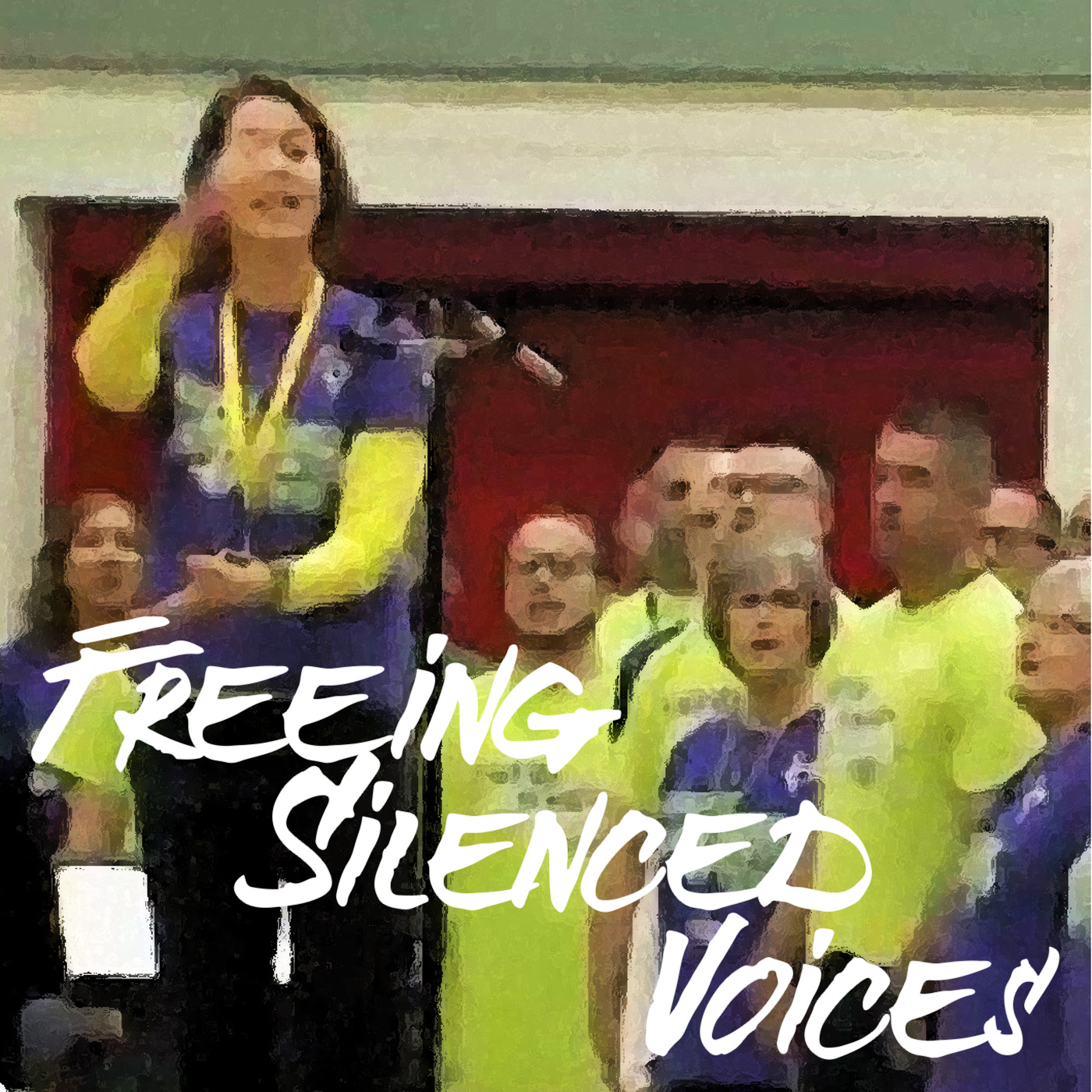
Episode 19: Mary Cohen - Freeing Silenced VoicesThreshold Questions and Delicious QuotesHow can singing a song help change the mind and the heart? ...the thing about singing that's really valuable for me at least is it's embodied. We're using our breath. We're using our voice. We're using our ears. We're feeling the vibrations in our bodies. So being able to do that with other people is super- it can be powerful. One of the students in the peace building class last spring shared such an insightful comment. She said, if you're in there singing together with your eyes closed, we don't know which voice is going to be walking out of the [00:31:00] prison at the end of the rehearsal, in which voices be staying in the prison.What is ubuntu, and how does it relate to prison choir work?Ubuntu Is that beautiful concept from South Africa, meaning a lot of things, a person as a person through other people. Desmond Tutu defined it as, "my humanity is inextricably bound with your humanity". ...But we need to know who we are and be at peace with ourselves in order to step forward and find our sense of common humanity with others...you can only imagine a choir has songs with lyrics and some of those lyrics may resonate with one person and not so much with someone else, particularly if it's songs that have some kind of a religious connection. However, if we [00:12:00] follow deeply the idea of Ubuntu, we ideally can sing these songs because we're looking at our relationship with the larger communal body when we're singing together.What do the Oakdale Prison, the Soweto Gospel Choir, and the TV show Friends have in common?I found a song called How Shall We Come Together by ... Maggie Wheeler. Do you know Maggie? ... on the TV show Friends, Maggie played the role of Janice. The character that would go "oh my God", that's Maggie! ...So, I contact Maggie completely out of the blue to ask permission to use her song. And after a series of conversations, Maggie's like "Mary, you want to use my song in a prison with the Soweto gospel choir? I'm coming to Iowa".How can a prison choir contribute to prison abolition, to excarceration?You know, we have 3,144 different stories of prison growth, one for every County. So this imagination that the abolition thinkers are requiring of us needs to [00:34:00] happen at a very local level, and the way that I've tried to apply it through the building class I've started, and through the work we do with the choir is that local space of creating the healing needs to happen internally, each person developing a sense of inner peace building. That's the project, the primary project we do in this class, and in the Oakdale Choir, we've actually done it these 10 years through the writing exchange changes where the choir members write reflective components and they share it with one another and that broadens their awareness of what people are experiencing, what their stories are related to each choir season, the songs we're doing, the original songs that have been created.TranscriptBill Cleveland: [00:00:00] I'm curious, is there something more to singing than just voices moving the melody and the words out into the world? Can the simple act of singing a song together, turn a deeply feared "other" into an "us"? Mary Cohen thinks so, actually, she knows, so because she's been doing just that for 11 years at Iowa's Oakdale Prison.This is Change the Story, Change the World, a chronicle of art and community transformation. I'm Bill Cleveland.As you're probably aware the us has one of the world's highest COVID death rates. Sadly, we also bear the distinction of the highest per capita prisoner rate, by far, leaving Turkmenistan, Russia, and China in the dust. The enormity of our prison population, we have a little over 4% of the globe's people in 25% of its prisoners, [00:01:00] make the hidden in plain sight, “what prison problem," attitude of many Americans, hard to fathom.But not really, because when you look a little harder and check out which communities are most effected by mass incarceration, the undeniable fact is the two thirds of the us prison population are people of color. In Iowa. Where the population is 90% Caucasian. Their per capita incarceration rate for blacks is nine times that of whites.If there ever was a perfect storm for building an us versus them society, well, that's it. Mary Cohen knows this and has dedicated herself to helping heal this horrible wound. This is no mean task, of course. So, it's a good thing that she's a dynamo, and takes her work inside very seriously as a musician, as an educator and as a scholar. Suffice it to say her prison work is not a side gig. But as daunting as it is, [00:02:00] it's not a heavy lift either. This is because, in addition to being a talented artist, she's a joyful force of nature. But don't take my word for it because she tells it best.Part One: Finding UbuntoHello, HelloMary Cohen: here I am. I'm here. I how's Bill today?BC: Doing good. Good.MC: [00:02:27] By the way, I'll show you one little picture since I'm changing my backdrop. This is what the Oakdale choir looks like. So, we have the purple shirts are the outside singers, green shirts inside singers, and this is a concert we had in the prison gym back when we got together and sang, in the same room.Hi. how are you today?BC: [00:02:54] Well, it used to be, that was a pro forma question. These days it's a [00:03:00] book, Mary, thank you for doing this. I really appreciate it. And so our goal here is just to add your story to the other stories that are being collected in the growing basket of Change the Story, Change the World.So, I'm going to begin by asking you the simple question that often is complicated, and that is what is it you do in the world?MC: [00:03:28] That is a simple and complicated question. I think I'm evolving in my answer to that question all the time, especially now. A simple answer might be connecting people and allowing people to express themselves.BC: [00:03:44] And, connection. By what means, Mary?MC: [00:03:48] Great question. So, connection through group singing, movement, self-expression, song writing, writing exchanges; sometimes as simple [00:04:00] as I know, 'person a' in Ireland doing this activity, and I know this 'person who's basically is in Canada now. They both are so similar. I think they should meet each other, and I'll send an introductory email. I love doing that kind of thing, and I feel like I'm doing that quite a lot.The larger connection, to be super specific to career is I'm working on a book. The current draft of the book title is Freeing Silenced Voices: Music Making in US Prisons Many times, when people hear about the idea of music in prisons, the default thought is, "Oh, great. A program inside a prison. A program to help people who are incarcerated deal with their time". And maybe that is part of what we're doing as Beth said, when you interviewed Beth, we are about transforming the broader society. So when I say connection, it's connecting people who are not in prison to realize we have more in common with people in prison, [00:05:00] than not in common. So how can we do that? Good question. I don't know. we're trying.BC: [00:05:06] But that picture you showed, which had yellow and purple t-shirts, which designated people from the outside and people from the inside, which is unique in a lot of the work that happens in prison. Art making, as a way for people inside and outside to find common ground. Often, it's an outside instructor or teacher and everybody else is an insider. Talk a little bit about that connective tissue that you build in that choir space?Absolutely!MC: [00:05:41] First of all, I want to give credit to amazing woman named Elvira Voth. At age 70. Elvira began the East Hills singers in 1995, and in 2002, I was reading the Sunday arts page in Kansas City on notice that the East Hill singers were performing a few miles from my house. And I went to one at a Lutheran [00:06:00] church just out of curiosity, I had friends involved arts in prisons in Kansas. And what she does is she had a group of outside volunteers come the day of the concert to meet a group of men in custody at the Lansing minimum security prison in Kansas. To see the two groups together and think about the philosophy and the general idea of a group of people that have been accused of committing a crime, singing in unison and harmony with people from that community was just... [it] really blew me away. When I decided to earn my PhD at the university of Kansas from 2003 to seven, I spent a lot of time in prison, literally and figuratively examining her project. So coming to the University of Kansas and researching to prepare to start the Oakdale choir, I followed her model.So to get back to your question, what is it about that connectivity? It was amazing Bill, the first three weeks of the [00:07:00] project in 2009, when the choir began we've always had a reflective writing exchange in addition to singing together and songwriting together. Three...
Embed this episode
What this episode covers
Can the simple act of singing a song together, turn a deeply feared "other" into a trusted "us"? Mary Cohen thinks so, actually, she knows, so because she's been doing just that for 11 years at Iowa's Oakdale Prison.
Ready to play
19: Mary Cohen Brings Art & Social Change “Inside” & “Prisoners” & “Outsiders” Became One Choir
No transcript for this episode yet
Similar Episodes
No similar episodes found.
Similar Podcasts
No similar podcasts found.