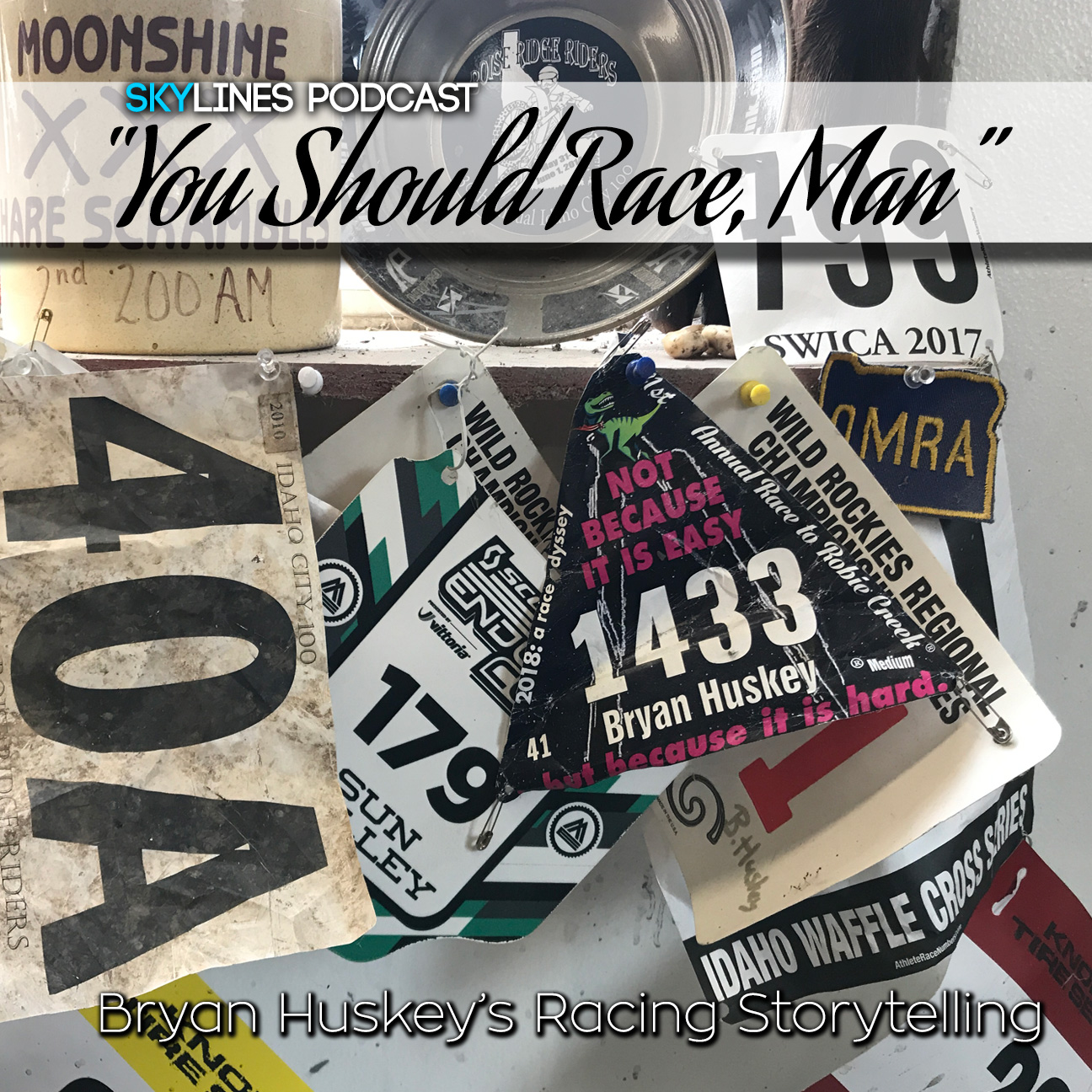
Alright, a quick heads up that this is part 2 from the previous episode, Racing Inspiration in an app called Strava if you wanted to hear that one first for a little context to this story. Okay, part 2 of this is called You Should Race, man. If you've never raced in one form or another, I think you should. Once in your life, pick something and race it.
Practice, plan, train, prepare mentally and physically. Give your mind and body a chance to feel primal and perform something at its absolute hardest. But do it for fun. Sure, racing is not for everybody.
But if you've ever been halfway curious how you'd stack up in the pine derby or a marathon, pick something. Learn the nuances of the craft, set your mind to it and get to work. For me, racing provides fantastic spice to life as well as all around fitness, excitement and a feeling of youth. Training for an event brings a great sense of being and purpose to the daily grind, especially when you're committed to an event that scares you.
If you're like me and at certain times of the year wonder to yourself just what are you looking forward to and nothing comes to mind, you know that feeling sucks. Or how about when you bump into a friend who asks what you've been up to and all you can scratch up is the pathetic standard, oh, just you know, super busy with work. Yeah, that's pretty lame too. But when you're committed to a race or have one recently under your belt, there's something real to talk about to describe.
Show your life amounts to more than droning on as Citizen X stalled midway through the American dream. I say all this not to be critical of anyone, but to describe how I feel life can be. And a great solution that I've found in addition to the most important things in life that really make us tick is racing. It makes me feel alive and I'll bet this would work for you too.
Setting goals is really fun. And fuel my imagination of what upcoming adventures and outcomes will involve. I like to set expectations carefully with plenty of caution to keep things realistic so as not to bust any bubbles in the preparation process. This often means starting early with lots of time to ride a gradual ramp up the progress chart.
Benchmarks are fun to keep track of too, looking back at where I was at the same date the year before and keeping tabs on how I can make gains for the upcoming season. All these things are no brainers when it comes to health benefits, physical and mental. By mental, I mean of course the positive vibes of achieving progress, but also the proven effect of endorphins and chemical responses within the body from exercise. That shit is real.
With all this combined, training and prepping for an event brings a fantastic spark and energy to life that can pull me through the doldrums of winter depression or the maddening stresses of work life. I've enjoyed competition in a variety of forms, from ski racing, track in high school, cross country and multi sport events to bicycle racing of all kinds such as downhill, hill climb, and duro, short track, cross country, cycle cross, then of course motocross, a rene cross, desert, flat track and enduro motorcycle racing. And finally, a variety of distance races from 5k to half marathon and even a few triathlons. Each of these disciplines are specialized and I've participated in these events for a variety of reasons, maybe out of curiosity, maybe as a personal challenge to myself, or maybe because it's something I feel truly competitive at and wish to push myself to the absolute performance limits.
Regardless, all these examples represent things that make up my life and the character of who I am today. Also, who I hope to be in the future as I build this resume of experience and camaraderie with others. Taking a place on a starting line is a risk. It's a very real way of making yourself vulnerable to who and what you are really capable of and your willingness to expose that.
To me, the bravest thing a person can do is make themselves vulnerable. And the individuals struggling at the back of the pack, those who find themselves exponentially defeated by race leaders are in a way the bravest. Being in last place can humiliate. It has the potential to break a person's spirit.
Although more often than not, I think it actually bolsters that person's drive from motivation, pride and self respect. I've been there. It's tough to be that dude in last place. You know, in the heat of racing, you don't really care.
And in retrospect, those bad results fade much faster than the ones you're proud of. I survived and shrugged it off, and for the times I've taken a place on podium boxes, that wide span of experiences has made top finishes all the more delicious and meaningful. A whole other area that training is a factor in my life is actually for hunting. The ability to trek far into the mountains on foot and move quickly as required to maneuver around big game animals is a physical endeavor in itself.
By my own solitary nature, I'm quite keen of solo hunting. It's something like racing, I guess, meaning that there is an element of choosing your own strategy, pace and tempo throughout each hunt. I don't always pack in a camp and stay overnight, but regardless, I wear a large pack with everything needed to stay fed, watered and alive, should I ever be out there for more than one day at a time. My pack also contains everything needed to take a big game animal apart in the field and pack it out one piece at a time.
This process, a field dressing a critter, can be physically demanding alone. Loads and excess of 100 pounds and double digit distances are part of most every backcountry harvest. And taking a big game animal out alone is a physical monster. Some I can recall mark the most daunting of lifetime endeavors, on par with the most grueling long distance races.
And these hunts bring with them a tremendous sense of accomplishment. Man, some of those packouts have been brutal. In August of each summer, I'm shooting my bow several times a week, if not daily, and well into the transition from mountain biking to trail running. The Strava app I described in my previous episode includes running metrics and category, and I enjoy digging into the development of my running legs and the analytics of my fitness and cardio capabilities.
And once again, the recording and review of my efforts become strong and incentive to maintain a committed schedule and earn that ramp in graphs and numbers that bring with a sense of confidence and mental toughness. And this becomes an advantage that I take with me into each big game season. Hunting like this is the third leg that makes up my favorite endeavors. Two-wheeled tangos, specific forms of fishing, and backcountry hunting are the primary drivers of my recreational aspirations.
And with the kind of hunting I choose, being physically fit and prepared makes a night and day difference in the enjoyability and the potential outcomes of this effort. So although it's nothing like organized racing or competition, hunting season has always in a way become like another race series that I train for and look forward to, with my hard work and preparation to see what it can deliver. I'll tell you, there are few feelings that can match the primal fear and nerves that come with that thing called a starting line. The start is majorly front loaded, meaning that sometimes for weeks in advance, butterflies can turn in my stomach.
As the start of any event nears, it's a mix of anticipation, anxiety, expectations and adventure that swirl together. The beauty, however, is that as soon as that starting line is crossed, all those conflicting emotions evaporate. In competition mode, all energy and focus drive the mission at hand. It's an incredible relief just to get that starting line behind you.
And once that other line is crossed, the finish, a double whammy of physical and emotional release makes life feel very big in the best ways imaginable. My old man was a runner. He didn't really look like one. He and I both pretty much fit our namesake descriptions.
But a bit thicker than many would expect a runner to be, he was a tremendous athlete, with countless triathlons, marathons, trail and even ultra marathons under his belt. He didn't begin running and entering races until his mid 30s, but my memories of childhood are filled with times that we would travel as a family to spectate and support him and races across the Northwest. Up to the age of 67, competing in races build my dad's calendar, and training for these events made him whole when other parts of his life had fallen apart. His final day was in fact spent training, cycling from home into the mountains for a trail run before a free-cax event on his ride back took his life.
I was in fourth grade I think when dad was training for the Portland Marathon and suggested that I start running with him. He and I did a lot of things together, so this made sense that I began tangging along on runs too. I'd head out with him along the scenic Obie Riley Road between Bend and Tumla Oregon. I'd try and make it a mile or two out, then reverse course back home.
Over time, I could make it out and back without stopping. And as October and the race neared, my dad suggested with enthusiasm, you should race. If you enter the short race at the Portland Marathon, I can't recall if it was a 5 or a 10k, will get you a pair of Nike Air Max. These were the first-generation Nike Air running shoes that I'd lusted over in magazine ads and I wanted a pair so bad.
So with grimacing pain, I began regular training with my dad, and I hated it. There was nothing fun about running, it just hurt. But the taste of competition had already been introduced via BMX and motorcycle racing, and its unique flavor of satisfaction that came with putting myself to the test was revived. Pondering how I could place against kids my age in this race, my racing spirit was formerly instilled.
By the 5th grade, I'd reached the point I could consistently compete in 10k, a very common distance for foot races. So we began entering several races around Central Oregon each year. One I'll never forget was called the John McAdams Memorial, which took place in the postcard town of Sisters, among the towering Ponderosa Pines beneath the peaks of the Three Sisters' Wilderness. The final mile or so of the course was a straight stretch of road that led into a municipal park on the edge of town.
I could see a steady stream of runners ahead of me, from somewhere deep within a surge of adrenaline pumped through my body. The tempo of my feet beating the road quickened like a rock ballad building energy. Like race horses rounding the final turn, my pace kicked into a sprint too fast to know if it could be sustained all the way to the finish. I seemed to lose control of my breathing as my lungs hit redline.
I began passing runners, 2, 3, 4 random adult runners slid backward through my peripheral vision on my right side. Nearing the last half mile or so, the familiar form of my dad was the next runner ahead of me. At the pace of an absolute sprint, I quickly reeled him in, and with some innate reasoning, I coasted up to his side, slowing to his pace, almost as if simply reaching him was my goal, my race, my winning finish. I felt overwhelmed with bride to be out his side in a real race, a benchmark feeling of maturity, and a threshold of coming of age.
With great thrill and gasping breath, we acknowledged this and had abrupt words and smiles. He gasped if I could run faster to go. Go, Brian, go, he said, and doing as my dad told me, I shifted down and resumed my kick to the finish. A distance runner's final sprint is a display of sheer agony.
For me, it's an absolute push, a draining of the tank that dips the needle way past empty. It's a surge that takes over the whole body. Pain is too acute of feeling to be acknowledged. It's a fury, a frenzy, a numbing blur, arms and legs moving as fast as possible, an absolute climax of emotional and physical boundaries.
Ahead of me, the string of countless runners led to the finish, although far enough I had to be only tiny figures on the horizon. My head tilted back and I attacked the gap separating us. I gave everything I could to catch another racer before the finish. Moments later it was clear that I was gaining on more runners, and I began overtaking racers, even groups at a time.
Over the deafening noise of feet pounding, lungs pumping and rushing air, I could hear from far in the distance behind me my dad yelling, go Brian, go. Everyone could hear. Everyone knew I was coming. As if my dad's cheers were gusting like a powerful wind, waves of an ocean propelling me into the next stage of life.
No longer a kid, but now into some other part of life I was not expecting to enter that day. Tears streamed from the corners of my eyes, straight back to my ears as I flew over the finish line. I felt like a champion. I felt like my dad made me that champion.
From late December of 2017, I decided to go for a run in the trails, for no particular reason other than feeling fat, soft and worthless. I had an exercise since my last cycle cross race in November, and was surprised to actually feel pretty decent jogging the single track trails in the Boise foothills. In fact, I felt good enough to commit myself to an extra loop that was going to put the total distance of this run well over 10 miles. And I do a lot of thinking and dreaming on runs, for the simple reason that it's boring as hell.
There's really nothing to do while running, except think. In fact, I'd recently come to the conclusion that running was a unique discipline because it required practically zero skill. No practice, technique, bravery or talent is required to be a runner, even a really good runner. Compared to all the other things in life I devote myself to, running is fundamentally basic.
It just hurts. Once an individual's body is fit, which of course takes a ton of work to achieve, competitive running is basically a pain contest, who's trained to the most, avoided injury and has the highest pain threshold. Now, of course, there are nuances to top level running that hardcore runners would rightfully challenge me about here. But all kidding aside, this is a conversation that I often joke with myself about while running.
It got me thinking about running as a kid, and the race as I'd done with my old man, and how little I actually enjoyed running. Well, he was a true distance runner. I'd never done anything beyond a 10k. Hell, this run that I was on now was going to be one of the longest runs I could think of.
The thought of running 26.2 miles in a marathon just blew my mind. I wondered if I could ever do that. I wondered if I'd ever want to. Maybe a half marathon I pondered beneath my sweaty fleece cap as I neared the trailhead where I parked.
Maybe a roby I thought to myself. I hadn't entered a running race in ages, decades in fact, like more than two decades, but I'd been running a lot in recent years as part of general training for other things. I really didn't have much interest in running as a competitive element, although my calendar did have a big open chunk from December to April. And there's this race here in Boise called the Race to Robie Creek, a half marathon with a reputation as one of the hardest races in the Northwest.
Hard because it's all up and down and pretty steep. It's the kind of race that a lot of folks are just stoked to finish. It's the kind of race that my dad would have loved. I should try and finish Robie, I sat under my breath as drops of sweat pelted the frozen gravel around my clapped out running shoes.
With surprising certainty, I began my Robie Creek training campaign that day, speculating that if I could manage three runs a week over the next few months, I should be primed to give this sucker a whirl. A good buddy Matt had already done the race in the past, so it was a suspicious excitement. I went so far as to make the statement that I was going to race Robie Creek. The idea felt novel to me, and setting a course of training to get me up and over the top of the Boise Ridge and back down the other side, filled the span of months with much enjoyed sense of accomplishment and purpose.
Training was far from easy, it was brutal in fact. In six weeks before the race, I developed searing pain in my hip socket. I'd reached a point of running 20 to 30 miles a week, and that was enough for my duck-footed wonky gait to get my spine and pelvis all out of whack. Some specialized therapy and a trip to the local running store to get fitted for shoes got me back on track in the nick of time, although my training had suffered a huge gap in the weeks leading up to the race, totally upending my hopes and expectations for my finish.
Early on in my training, simply finishing the race was my goal. As I built up a solid base however, I reached a point where I could consistently run the half marathon distance of 13.1 miles without stopping, so I knew I could cover the distance. The challenge however, would be doing so while including the 2000 sum off feet of climbing and then descending without exploding on the way up or cramping into a wadded ball of agony on the way down. But my confidence peaked at a point where I'd hoped to finish in the top half of the cap entry of 2000 racers, so all I had to do was place in the top 1000.
The race kicks off near downtown Boise with substantial fanfare. And as the course makes its way up the steep city streets and through the foothill neighborhoods, the curbs were lined with cheering spectators, shenanigans of all kinds, costumes, boomboxes, pumping out the beastie boys, jello shots, you name it. Jogging in the 70th or so percent of the pack at this point, I felt like a plastic bottle bobbing in a sea of color. There was so much chatting, laughing, people watching and general bullshitting going on that we practically floated up a few miles.
Not much longer however, the pavement ended and the arterial forest service road took a steep grade that quickly changed the chatter to labored breathing as the pack sorted itself out. Those who were out for a social jog slash walk and those who were focused on running the race were easy to tell apart. Being that I had my dad in mind and his devotion to finishing races with his best effort, I fell into this latter category. My objective for this race was initially just to finish.
Even after feeling pretty good during training, I upped the ante to the top half of all finishers. But after losing a bunch of training time to the hip injury and the final weeks before the race, I fell back to simply finishing as a worthy goal. In fact, I didn't run at all leading up to the race, opting to simply rest and hope I didn't destroy my hip socket during the race. As we began to hit the real grade of the course a few miles in, a lot of people started walking.
Miles later, as the climb was really serious, I noticed a trend I found interesting. Runners would shoot past me at a much quicker pace, but then not far later, they'd walk and I'd pass them back. They'd pass me again and this routine would continue. I found it strange, as in all the running I've ever done, stopping and walking totally breaks my rhythm.
I stiffen up and feel like hell. Plus, it just seemed dumb to me. I mean, if you're running so fast that you have to stop and walk, what's the point? It came clear to me that nearly everyone around me was doing this and it was weird, it annoyed me.
My new goal now was to simply avoid stopping and walking. The red-adert road was very steep, six or so miles into the race at this point. We'd climb generally 2,000 feet above the city and the weather that day was spectacular. It was hot as hell, actually, and the sun beaked down on us like weary travelers crossing a desert.
Even in the steepest places, I stiffened my resolve and kept a hop in my step and a tempo to my stride to maintain a run and not relenting to walk. I was passing people at a steady pace now, although a few of the walking leapfroggers were still in the mix. Pretty soon, I could tell we were nearing the top, as more and more spectators began to appear along the road and I could hear cheering in the distance. A dremel and spiked my heart rate as I topped over a steep section over a steep section and I could see an aid station, banners and a clock marking the summit.
I kept my gaze down on the ground in front of me, one laboring stride at a time I told myself. I was feeling great overall and held on to hope that my time reaching the summit would represent that I was on track to make my goal. I didn't let myself look at the time until I was actually there, and as I topped over the summit and glanced over at the large digital clock, I was ultra stoked to see that my time was way better than I ever would have dreamt it to be. I was over the top now, at the halfway point of the race and it was all downhill to the finish, not to mention that the backside of the Boise Ridge is thick, dark and shady old-growth timber, a soothing cool comfort compared to the blistering shadeless exposure of the climb up.
I focused on relaxation, on breathing, on lengthening my stride, flowing and letting gravity and momentum carry me down the winding gravel road. Everyone was running fast, really fast. I was passing a few people, but for the most part the entire field was moving at a strikingly fast pace. Some of the walkers I'd overtaken on the climb up were flying past me now like I was standing still and I was honestly running up as fast as I could downhill.
It blew my mind how some people could move at such a speed yet look fairly normal and warm. I mean, if I was to increase my tempo much at all, I'd look like some bloody character in a horror movie with a grizzly bear swiping at my heels. A few miles later the downhill grade flattened out and the over-rev tempo that I'd been carrying was taking its toll. My hip was beginning to ache.
The bottoms of my feet were revealing hot spots that burned badly. I wasn't sweating much anymore and my shoulders were sagging. I knew what was happening. I was bonking.
Thirst, hunger, dizziness and overall weakness were beginning to consume my body and mind. I kept dialing back my pace with a conscious awareness to save energy, slow down and make it to the finish I told myself. Runners I'd passed miles earlier began passing me. People who might worked so hard to target far ahead then reel them in one step at a time and passed, boosting my confidence and race position time after time in the first half of the race.
But now with the road nearly flat, less and less shade once again, each step felt like a major lift. My neck and back were so incredibly tight and hurt badly. I'd look up where as high as I could, stretch my arms out wide and try to loosen up my tight aching body. Man, this was getting ugly.
But unlike nearly anyone else I'd been running with at this point, I'd yet to stop. Even here on the flats it seemed like everyone was stopping and walking, then blasting past me only to walk again. I held onto my race, to my resolve to run this entire bitch. I was after all, running this race in honor of my dad.
And I knew that he would push through to keep running. He'd done races twice, even three times as long as this. I kept repeating that in my head. And another thing that kept repeating in my head was the disbelief and what the runners around me looked like.
Now, I know gladiator, never been mistaken for a professional athlete of any kind. But I know what I've accomplished, competition-wise, and I know that I'm not exactly a slouch. And what was blowing my mind in this race more than any that I've ever done was what the kind of people looked like that I would have passed on the street and never in a million years guessed that they could run a block, much less Robie Creek. And these people are ahead of me, or passing me, or right here with me.
At any rate, men and women, old or fat, very young teens, you name it. People that looked nothing like athletes were smacking my ideas of what athletes looked like into oblivion. And it was so awesome to see, to feel proud for someone else who you now share an understanding and a bond with. All of us were running together, each suffering in a different way, each carrying our own stories of why we were out there, who has inspired us to be there over the years, and now how we're all comrades.
That's a beauty of racing that spans all forms. I think racing unites individuals in a kinship. And for people like myself, who are loners in a sense, individual athletes, find for some reason preferred satisfaction in doing things that challenge us personally. And it's a bond that I think can change lives, can make a broken person feel whole, can unite the weak and the strong with an identity that only racers share.
I certainly understand why my dad was a racer, a competitive spirit, for many reasons, I think. And like me, he was probably just born this way, although he didn't seem to discover the rewards of competition until adulthood. I'm so glad that he found it when he did, from dirt bikes to running shoes, and I consider myself incredibly fortunate that he brought me along with him. For months, I'd imagine what this race would feel like if I'd be able to finish what my time and class place would be in the best and worst case scenarios.
As anti-climactic as it was, since deciding to run this race in honor of my old man, I wondered the entire time if in the final stretch, as the finish line came into sight, if I'd hear my dad cheering for me. I wondered if that gust of wind would carry me over the finish line in a surge passing other runners ahead of me in the process. And you know, as I write this, I think that like so many memories we each hold onto of those we've loved in our past and think of each day, sometimes it's better just to stick with what our imagination wonders. I think it's better that way, because running is after all, boring as hell, and just a good opportunity to think, wonder, and dream.
And racing is an opportunity to make all those things your own reality. I'm Brian Husky, thank you for listening and coming along.