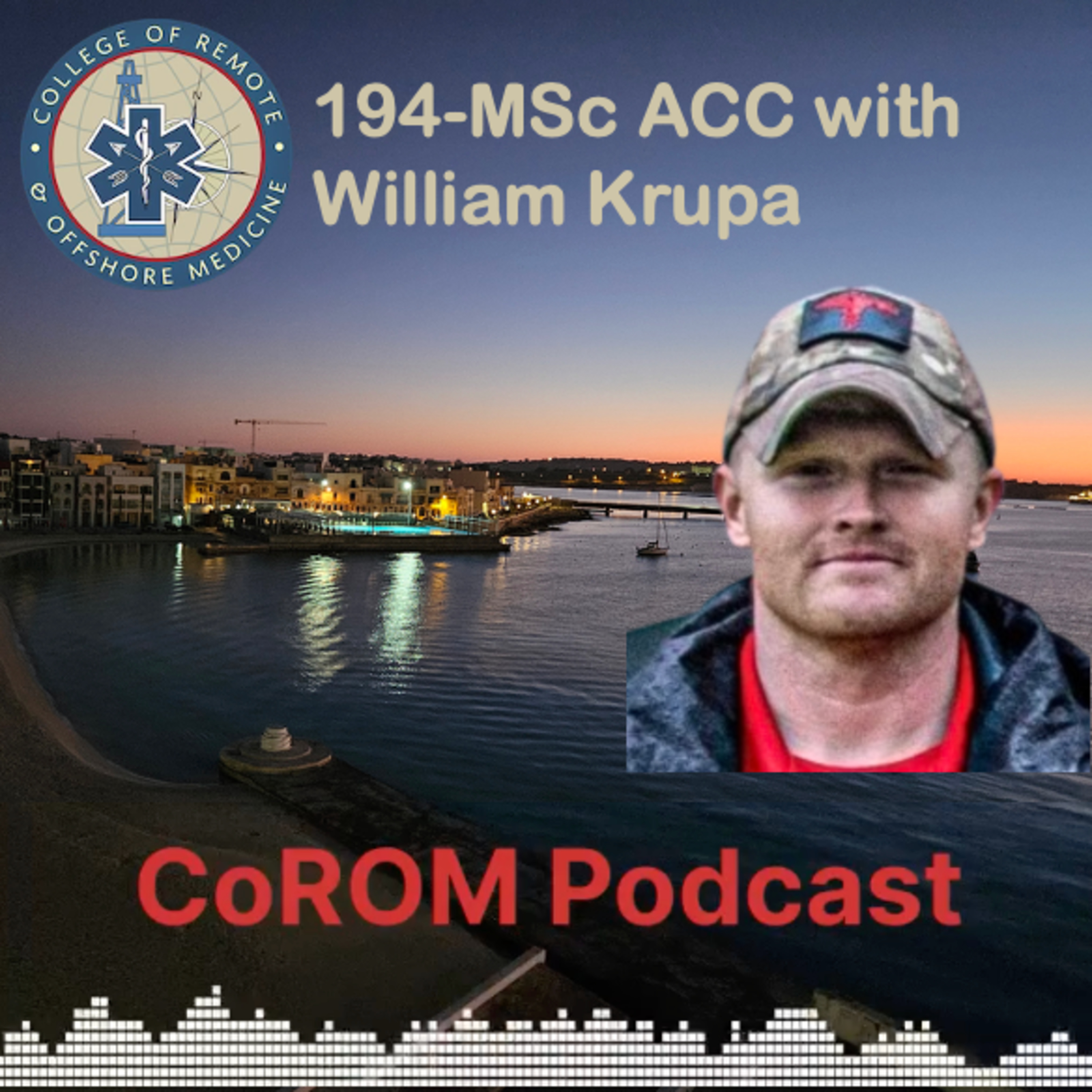
194-MScACC graduate William Krupa episode artwork

EPISODE · May 8, 2026 · 35 MIN

194-MScACC graduate William Krupa

from CoROM cast. Wilderness, Austere, Remote and Resource-limited Medicine. · host College of Remote and Offshore Medicine

This week, Aebhric O'Kelly is joined by William Krupa, who recently graduated from the MSc Austere Critical Care programme. They discuss wilderness medicine, tactical medicine education, prolonged field care, and his experience completing the MSc in Austere Critical Care at the College of Remote and Offshore Medicine Foundation.William shares his journey from infantry soldier to paramedic educator, discusses teaching Wilderness First Responder (WFR) programmes, reflects on attending the Medicine in the Mediterranean Conference in Malta, and provides an overview of his MSc thesis on austere mechanical ventilation using portable oxygen concentrators and closed-circuit systems.This episode explores how austere medicine education can reinvigorate clinicians, improve critical thinking, and bridge the gap between theory and operational practice. Chapters00:00 – Introduction to the episode and guest welcome00:41 – William’s current work in paramedicine, wilderness medicine, and tactical medicine education01:20 – Military background and transition into medicine02:30 – Repeating EMT training after military service03:53 – Why repeated teaching improves clinicians and educators05:07 – The value of teaching Wilderness First Responder (WFR) courses07:22 – Deep dives into improvised medicine during longer wilderness courses07:55 – The history of CoROM and how WFR led to degree programmes09:33 – William’s first trip to Malta for APUS and ICARE10:20 – Scenario-based learning and hands-on education at CoROM11:34 – The realism of the ICARE moulage and burn simulations14:05 – Medicine in the Mediterranean Conference experience14:51 – Ukraine battlefield medicine workshop and WPC certification15:40 – Graduation and earning the MSc in Austere Critical Care16:14 – Publishing research and future doctoral plans17:18 – Why William chose the MSc in Austere Critical Care19:23 – What makes CoROM different from other critical care programmes22:16 – Mentorship from MD-PhD faculty and practical education26:08 – William’s MSc thesis on austere mechanical ventilation27:39 – Using oxygen concentrators and closed-circuit systems in austere care29:28 – Research discussion: dual oxygen concentrators and FiO₂ optimisation31:15 – Challenges during the MSc programme33:32 – How the MSc changed William’s clinical practice34:44 – Suggestions for future development of the MSc programme36:47 – Teaching WFR in Utah with Black Swan and Human Path39:01 – Achieving Fellowship of the Academy of Wilderness Medicine (FAWM)41:08 – Why wilderness fellowships carry professional value43:46 – Advice for new medics entering austere medicine45:11 – Closing remarks and congratulations Key Topics • Wilderness medicine education • WMS FAWM • Tactical medicine and TC3 instruction • Prolonged Field Care (PFC) • Austere Critical Care education • Scenario-based simulation training • Improvised medicine • Mechanical ventilation in austere environments • Oxygen conservation strategies • Wilderness medicine fellowships • Medical education mentorship • International austere medicine collaboration Key Takeaways• Scenario-based education improves retention and operational performance. • Wilderness medicine often reignites clinicians’ passion for medicine. • Austere medicine requires adaptability rather than dependence on resources. • International collaboration broadens clinical understanding and perspective. • Practical mentorship from operational clinicians is critical in advanced education. • Mechanical ventilation in austere environments may be feasible with low-resource systems. • Long-form wilderness courses allow deeper exploration of improvised medicine concepts. • Continuous learning is essential for clinicians operating in remote and austere environments.

This week, Aebhric O'Kelly is joined by William Krupa, who recently graduated from the MSc Austere Critical Care programme. They discuss wilderness medicine, tactical medicine education, prolonged field care, and his experience completing the MSc in Austere Critical Care at the College of Remote and Offshore Medicine Foundation.William shares his journey from infantry soldier to paramedic educator, discusses teaching Wilderness First Responder (WFR) programmes, reflects on attending the Medicine in the Mediterranean Conference in Malta, and provides an overview of his MSc thesis on austere mechanical ventilation using portable oxygen concentrators and closed-circuit systems.This episode explores how austere medicine education can reinvigorate clinicians, improve critical thinking, and bridge the gap between theory and operational practice. Chapters00:00 – Introduction to the episode and guest welcome00:41 – William’s current work in paramedicine, wilderness medicine, and tactical medicine education01:20 – Military background and transition into medicine02:30 – Repeating EMT training after military service03:53 – Why repeated teaching improves clinicians and educators05:07 – The value of teaching Wilderness First Responder (WFR) courses07:22 – Deep dives into improvised medicine during longer wilderness courses07:55 – The history of CoROM and how WFR led to degree programmes09:33 – William’s first trip to Malta for APUS and ICARE10:20 – Scenario-based learning and hands-on education at CoROM11:34 – The realism of the ICARE moulage and burn simulations14:05 – Medicine in the Mediterranean Conference experience14:51 – Ukraine battlefield medicine workshop and WPC certification15:40 – Graduation and earning the MSc in Austere Critical Care16:14 – Publishing research and future doctoral plans17:18 – Why William chose the MSc in Austere Critical Care19:23 – What makes CoROM different from other critical care programmes22:16 – Mentorship from MD-PhD faculty and practical education26:08 – William’s MSc thesis on austere mechanical ventilation27:39 – Using oxygen concentrators and closed-circuit systems in austere care29:28 – Research discussion: dual oxygen concentrators and FiO₂ optimisation31:15 – Challenges during the MSc programme33:32 – How the MSc changed William’s clinical practice34:44 – Suggestions for future development of the MSc programme36:47 – Teaching WFR in Utah with Black Swan and Human Path39:01 – Achieving Fellowship of the Academy of Wilderness Medicine (FAWM)41:08 – Why wilderness fellowships carry professional value43:46 – Advice for new medics entering austere medicine45:11 – Closing remarks and congratulations Key Topics • Wilderness medicine education • WMS FAWM • Tactical medicine and TC3 instruction • Prolonged Field Care (PFC) • Austere Critical Care education • Scenario-based simulation training • Improvised medicine • Mechanical ventilation in austere environments • Oxygen conservation strategies • Wilderness medicine fellowships • Medical education mentorship • International austere medicine collaboration Key Takeaways• Scenario-based education improves retention and operational performance. • Wilderness medicine often reignites clinicians’ passion for medicine. • Austere medicine requires adaptability rather than dependence on resources. • International collaboration broadens clinical understanding and perspective. • Practical mentorship from operational clinicians is critical in advanced education. • Mechanical ventilation in austere environments may be feasible with low-resource systems. • Long-form wilderness courses allow deeper exploration of improvised medicine concepts. • Continuous learning is essential for clinicians operating in remote and austere environments.

NOW PLAYING

194-MScACC graduate William Krupa

0:00 35:12

No transcript for this episode yet

We transcribe on demand. Request one and we'll notify you when it's ready — usually under 10 minutes.

MG Show MG Show The MG Show, hosted by Jeffrey Pedersen and Shannon Townsend, is a leading alternative media platform dedicated to uncovering the truth behind today’s most pressing political issues. Launched in 2019, the show has grown exponentially, offering unfiltered insights, comprehensive research, and real-time analysis. With a commitment to independent journalism and factual integrity, the MG Show empowers its audience with knowledge and encourages active participation in the political discourse. Breaking News Show | eTurboNews Juergen Thomas Steinmetz News is relevant to the global travel and tourism industry, human rights and global issues.Breaking news when it happens and only from the source. Eat to Live Jenna Fuhrman, Dr. Fuhrman Our health is our most precious gift and smart nutrition can change your life. Each month, join Dr. Fuhrman and his daughter, Jenna Fuhrman as they discuss important topics in the world of nutrition. Eat to Live will change the way you eat and think about food. French Your Way Jessica: Native French teacher founder of French Your Way Boost your French listening skills and test your comprehension with this one of a kind series of podcasts. Get the chance to listen to a real conversation between native speakers talking at normal speed AND customise your learning experience through carefully designed sets of questions (2 levels of difficulty) available for download at www.frenchvoicespodcast.com. All interviews also come with the transcript. French teacher Jessica interviews native speakers of French from around the world who share a bit of their life and passion. Where else would you meet in one same place a French yoga teacher based in Melbourne, a soap manufacturer from Provence, or a couple cycling around the world?

Frequently Asked Questions

How long is this episode of CoROM cast. Wilderness, Austere, Remote and Resource-limited Medicine.?

This episode is 35 minutes long.

When was this CoROM cast. Wilderness, Austere, Remote and Resource-limited Medicine. episode published?

This episode was published on May 8, 2026.

What is this episode about?

This week, Aebhric O'Kelly is joined by William Krupa, who recently graduated from the MSc Austere Critical Care programme. They discuss wilderness medicine, tactical medicine education, prolonged field care, and his experience completing the MSc in...

Can I download this CoROM cast. Wilderness, Austere, Remote and Resource-limited Medicine. episode?

Yes, you can download this episode by clicking the download button on the episode player, or subscribe to the podcast in your preferred podcast app for automatic downloads.
URL copied to clipboard!