
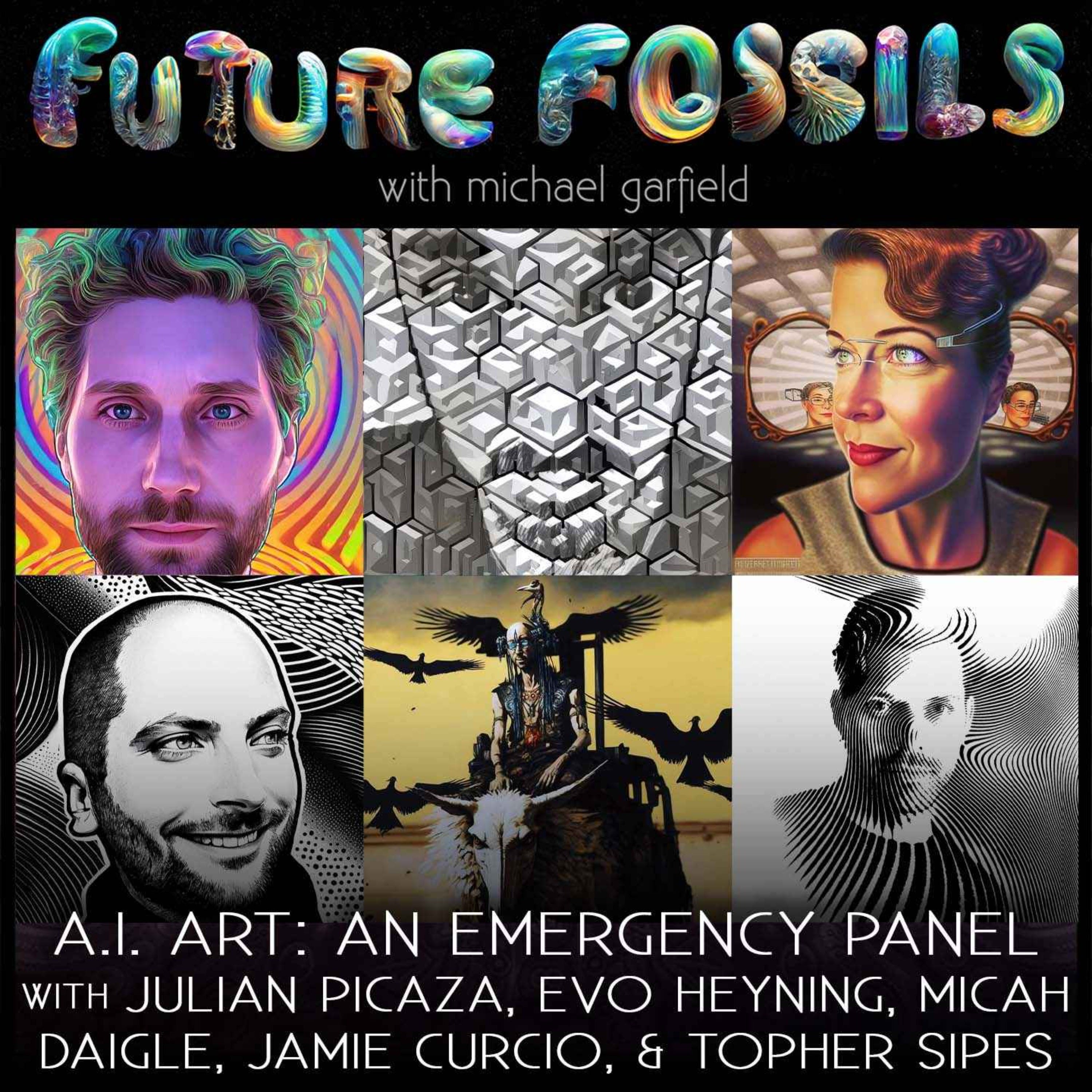
Greetings, future fossils! This is Michael Garfield welcoming you back to the podcast that explores our place in time, and wow! Is this ever a culminating moment? I'm getting tired of hearing myself say it, but for those of you who don't already know, in 2017, I authored a science fiction story, an oral history of the end of reality, about the proliferation of artificial intelligence-assisted media production, and what it would do to us, how it would change our processes of social epistemology, what we regard as truth, and then reaching back even further, my SA, the Evolution of Surveillance, about how human technology, co-evolution, can be understood as an arms race that stretches back over 500 million years, and the evolution of new sensation, cognition, and the jamming of those systems.
So, well, anyway, here we are at December 2022, and if you're listening to this, you already have an opinion about whether you feel that the proliferation of new tools like mid-journey, and lensa, and chat GPT are good or bad. It felt really important to me to host a kind of emergency congress about this topic with some of my artist friends, and I hope you enjoy this unedited, six-way, sense-making session. But before we dive in, I want to thank new Patreon supporter Andre Silva, and the folks who have purchased my music since the last episode, Shoshishan, Cody Thomas-Koyak, and Jeff Hanson, and the folks who have bought my art as well. Although, as I will explain later in this episode, I'm starting to wonder why I even bother, but yes, yes.
There are so many ways that you can support what's going on here, and the best is patreon.com slash Michael Garfield, or michaelgarfield.substack.com, if you don't particularly like being inundated with all of my new projects in a piecemeal fashion, but prefer a digested form. Okay, so with all that said, holidays ahead, here we are in the Ragnarok of our creative epoch. It's my great honor to have Julian Picasa, Tofersipes, Evo Haining, Mike Adegel, Jamie Cursio on the show, to discuss the adaptation of artists to our rapidly evolving technological milieu. Enjoy.
All right, wow, this is amazing that I have all of you here. I'm very, very pleased to have all of you join me for this special emergency roundtable. I feel like we're at Rivendell, the Internet Rivendell, and I am agent Elrond, and I'm saying that something very dark is gathering on the horizon, and we need to form a council and a fellowship to discuss this. But then again, it's a beautiful, effler essence, wonderful thing, too, so this confusing.
So what I would like to do is just go around and have all of you briefly introduce yourselves, and in so doing, talk about the ways that your history as an artist, and the ways that you're using, artificial, and so forth. The ways that you're using artificial intelligence in your artwork now, starting with Evo, and then I will, I don't know if everyone's showing up in the same grid that I have, so probably not. So I will pick after that. Yeah.
All right, so hi, I am Evo Haining. I am in Los Angeles today. I've been a creator, producer for about 25 years. I've been an artist for 40.
I started in painting in pastels, and I started writing stories about our relationships with AI about 20 years ago. I wrote a series 15 years ago, and I started developing that for virtual worlds in the metaverse around 2005, 6, 7. And today I create and generate a cross concept development work for clients, commissions, and my own work. And I have a design that I have a gallery where we take art from throughout time, like antiques and vintage, and then we make new art and we put those things side by side.
So that's called Reality Craft in Oakland. Julian, because you're the one that got me into mid-journey in the first place, you know, which you might, I don't know how you might feel like I regret doing that. But anyway, no, you know, I do regrets in this life and exposing the creative intelligence people around me to new tools and technologies will never rank among them. However, you know, I've on several occasions kind of worried about the long-term impacts that I have on people's lives because I definitely, I like to take people beyond the pale a bit out into the unknown.
And different people handle that differently. Some people handle it really well and others freeze up. But I think it's important, you know, to do that to kind of walk out into the unknown on a regular basis and remind ourselves how much we don't know. So I'm really happy to have, you know, helped bring you into this.
In terms of who I am and my background, I am, say, a creative technologist. I have a background in the arts and in the film industry, but it was mostly technology that kind of was at the core of my activities. So about 10 years ago, I found myself as a visual effects supervisor who was really curious about industrial design and automation and got into things like CNC, you know, and laser cutting digital fabrication and blockchain about 10 years ago. And so really, I'm somebody who's enjoyed the privilege of leading an interest-driven life and I've mostly been exploring different creative applications of technology all over again at this point and I continue.
So, you know, diving in, I started with creating things with AI back at the same 2016. While the machine learning was still present, I wasn't doing much generative work with it until it was a Google drops deep dream out there for everyone to play with. And all of a sudden, there was all this fun style transfer stuff popping up. So I started training some of those and experimenting with what was possible.
And these days, I've been doing all sorts of things, but versus creative projects, what I'm really doing is I'm just seeing what the limits of the tool are. Half the time, I'm experimenting to see like, what does this thing do? And in the process, I create a number of things. I make up projects to test its capacities.
I do that with every tool I use. But I don't think we've even begun to find the limits of these things. So I don't even want to define what I'm doing too much yet other than exploring and experimenting. Oh, the fingers, right.
Fingers. Right. Yeah. We can get hands down and some eyes to stop crossing.
I would say, okay, I think we can do that. Until then, it's all speculative. James. Well, hands are still hard to draw as a visual artist, whether or not using technology.
So it probably will be a little while. Now we're all kind of eclectic here. So I've been transmedia artists, musician and writer for anti-cannet, but I guess about 20 years involved in a bunch of different media startups. The first one was basically my friends at I had a college starting our thing and then I took off for a little while surprisingly.
So technology has always been a part of my artistic process. I came into music production right when digital became a thing. And the same as so much visual art. And before Photoshop was really good, well adopted, I had kind of collaging and visual art by the old fashioned way as two different kind of tracks.
And then once Photoshop and else great, I became part of it mostly folks really, they gradually started to tell together, you know, and my process kind of integrated both those things in terms of like photobatching and that stuff. And then also like traditional painting and mixed media. I kind of see it always like a means to an end. So visualization apps like mid-journey seem somewhat familiar to me in a way, although of course what they're, you know, the results that are starting to be produced are seem like years beyond other generative processes.
But it feels very familiar to me in a way that it seems like some other artists don't necessarily have that experience of sort of like, oh, I know what to do with this. At this stage, I mean, like you're saying, like it's happening, it's moving so fast that it's very hard to predict where it'll be even three months down the road, you know, because it's the one in experimental phase. Tova? My old friend?
So I've been drawing for as long as I can remember and I'm really inspired by cartoons and animation, comics growing up. And then I studied graphic design and illustration at university and was doing fabrication design for theme parks and children's playgrounds for a while, which is what kind of introduced me to the 3D space and thinking more spatially. And then for a while, I was very much into environmental interpretation. And since today I have a lot of environmental conservation oriented work around that time, I also got into performance work.
I used to be a musician, but then I sort of integrated that understanding into using sort of visual instruments. So, you know, using a digital drawing by a contractor or a touch screen and later VR to project onto musicians, dancers, and stages, et cetera. And then more recently, art directing VR experiences that are sort of in the digital therapeutic realm. Also very much inspired, influenced by various types of flow arts of movement and dance and treating the page or the screen like a dance floor improvising and using paradolea to kind of find forms in the chaos.
And so, and then also almost two decades of like pretty dedicated dream work and a dream documentation as well. So, using AI image generation, actually with the exception of like a few social media stories, I actually haven't published like any posts of what I've been doing with it because it's been part of a larger process that is sort of behind the scenes. And it's never necessarily the end image, but it's actually part of an iterative process for bringing things along the way. I'll leave it at that.
That leaves us with you, Micah. You're kind of an outlier here. And I appreciate that. I think.
In a way. In the sense that, you know, I don't see you as a working professional artist, like you are a very playful multimedia exploratory type person, but you're somebody that seems like these new tools have really just allowed you to just step forward and rock out in a way that has completely astonished me and so many other people and really separates. In my mind, there's like a breakwater point between this and the stuff you were doing before. I don't know.
But I mean, here I am commenting on you before you know. I don't know if you introduce yourself. Sure. Well, it's interesting to know how you experienced me.
Yeah, my relationship to the label artist has been complicated. I like everyone else here has been creating stuff like compulsively since I was a kid. I think it started actually for me when I was four years old and I broke my leg and I was in the hospital for the first few months of school. So all the kids were like meeting friends and like doing like social school things and the only thing I had to do was read and draw.
And I remember I created this like a storybook and illustrated a storybook of a boy who broke his leg at the time. I didn't know I was doing like art therapy on myself, but I was. And like from that point on, I just always use art primarily as like an introverted processing tool. And it wasn't necessarily something that was like for other people.
And I would like often get like in trouble in class because I'd be drawing instead of paying attention to teacher. Yeah, and at a certain point I feel like my art got good enough to start sharing it and I became like known as an artist in school. And I like, you know, I got like this acrylic of like most artistic and I thought that I was going to be an artist. Like that's where it seemed my life was going.
I wasn't able to get into like a good art school. So I went to a state college and the art program sucked. And I basically like flunked out of my art classes because I found them all really boring. And at the time our philosophy program was really awesome.
It happened to assemble into a philosophy course and got really interested in like the ethics of emerging technology and AI. And brain computer interfacing was like the first version of that was like being developed at that time. So I kind of like made a break with art. Like I stopped drawing for probably like 10 years.
And it was like such a big part of my life. But I kind of like went into this like philosophical activist channel of my life. And I became an activist and I like worked on non-profits for a long time. But then this like created part of me like kept getting tapped into as I was working on that stuff.
And I essentially became like a full-time designer. design or I have a design practice. And I would say a professional artist at this point, but my art is through design, brand design. I do a variety of things within creative professional label.
But now with AI, it's kind of like the emerging of all these interests. And I'm just fascinated by it. And there's a lot more that I can share about my relationship to it. But yeah, I feel like I've never had the patience.
I've always been kind of ADHD. So I've never had the patience for all of the ideas that I have in my head. A billion ideas. And I grab one.
And if I can't get it finished within 24 hours, I'm on the next one. And so I have a trail of unfinished projects. And I think that the most exciting thing to me about the AI stuff is the ability to churn out new ideas and get from idea to finished products within less than an hour rather than taking weeks and then getting up on it. So that's me.
Yeah. And to that point, I guess I should be careful about how I talked about people. But for instance, I no longer think of myself as a professional artist in that just in case I don't know who's going to listen to this. But my first contract, actually, to do art was to come up with mock-ups for horizontal format, ad placements for Disney MGM Studios' twice-an-terror of terror.
Because this is a vertical elevator drop ride that apparently no one at Disney, including the imagineering, could figure out how to represent this on a billboard or a bus. And so my father, who was working at Disney at the time, said, I bit my son can because he draws all the time. And I gave them a four-panel thing. And they used all four panels.
And my dad gave me 120 bucks. And that's what started this. Meaning, both the idea that I could make art for money and also the recognition that I'm going to be horribly exploited by corporations. Because obviously, it's probably worth 120 bucks, even in 1994.
But for 13 years after college, I was just piecemealing a career of live painting and music performance and public speaking and scientific illustration and contract illustration for whoever would have me merchandise design. And that's what brought me into the orbit of all of you, point people in my room. I met while I decided I was just going to hit you right out of Burning Man backpack around San Francisco for a couple of weeks in 2008. And I met you at the couch surfing mixer there, Troy Dayton.
And Topher, I met at the outside festival in Texas. So now I work in science communication. And I have family in those days are behind me. And the only way I can paint now is if I have a child with me painting, often not on the same canvas.
So the only way I can make music is like waiting until they're asleep and then using my headphones and ingesting things that I shouldn't, to keep me up later than I should be. So that I can carve out this time alone. And so the AI stuff has been really interesting for me because I feel that, one, I really sympathize with you in that the ADHD thing, I feel like working in social media has destroyed my single pointed focus. Like it has made me this sort of like Avilow Kittis Vara of juggling nine million things and feeling like I can legitimately track two conversations at the same time, but at the same time also having to have a multifocal sort of life in that respect in order to get anything done.
And then the other part is just it's a matter of time and not being, you know, just, we're like, I think that the umbrella of this whole conversation is that this was the year that it really felt like that moment to get to, you know, I'll go about this, that moment in Pirates of the Caribbean, when you know you're about to go over the waterfall, you know, and you can feel it, you can feel the front of the boat is tipping and I feel like that's where we are as technologically as a species right now. We are like, yeah, yeah. So I mean, it's like, we're no longer trying to steer away from the falls. Now we're asking, you know, do we hold onto the boat?
Do we need parachutes? Do we learn to fly? You know, what the fuck is this all about? And so that's the question I have for all of you really, and you all just can just, whoever, you know, popcorn this, but like how in your own lives, and then maybe like, how do you see generally people responding to this stuff, you know, like how do you see people adapting to it?
And then maybe also how do you see people not adapting to it? Like how do you see it like ruining people too? And so that, you know, we're the potholes that we need to drive around. Can I interject here?
Cause I have some thoughts about what you were just saying before you posed that question, they kind of segue well into it. They might help frame it. So I found I could really relate to both Micah and Mike and yourself, Michael, when you were kind of, you know, negotiating with the word artist or professional artist or designer, and I found myself trading back and forth between those two taxonomic, like little, like, which pigeonhole do I put myself in for somebody? Because I'm really in both, I'm really in many.
I'm also that many armed double-kit-tushavara. And so people want me to have that very simple business card title, and I've never been that, and I don't want to deny myself any of them. I mean, I barely play music ever anymore, and I'm not getting at my musicians title. That's my religion, that's my truest sacred spiritual connection.
Even if nobody ever hears me play another note of music again, or I never touch other music, I was a music instrument. I will still be a musician. I'm not getting up that credential. So, you know, taxonomy matters because I've seen, in terms of what potholes that people have hit, I've seen at least two places where the naming and phrasing around certain things has confused the public, and I deal in a lot of my work with the public becoming confused already about technology platforms that I work with because they're poorly understood by the general public.
So like, when, in 2016, when we all started making 2017, you know, like, Style Transfer, Neural Network-based artwork, nobody was calling it AIR. Nobody used the term AIR at all. We were trying to come up, or like, is it neural art? I don't know what I'm doing.
I'm making images using this cool algorithm to do style transfer, but it definitely wasn't called AIR. And I've seen people respond badly to the term art being used because they're like robots can't make art, right? And they think there's just a basic flaw there that's called, you shouldn't even call it art because of the term that's a robot there. And then they say AI, and that's another taxonomic issue because most of the general public, when they hear the term AI, they're thinking AGI, they're thinking artificial general intelligence, a thinking machine, they're not thinking like a machine learning algorithm, which is basically most software these days, like, we're getting mass halfway, we're ML, machine learning is in everything.
So even calling it AI is confusing to the public because they think there's another consciousness there, and there isn't, we're not implying that's, we should like take AI out of the taxonomy because people think that that means there's a thinking robot and there is not, there's no sending a robot involved, you know? So that's my first offering. So Julia, I prefer to use generative arts, for example, or other terms that aren't AI art. I'm curious what other language the rest of you use that help to maybe de-nistify, but also clarify how your artistic and creative and curatorial and directorial AI informs your process now.
Jennifer, definitely is a good one, you said a lot, but I've been trying to do a specialization app more specifically talking about mid-journey or state of diffusion or any of those things because there's a thing you gave and I think it will react a little bit differently if it was like, you know, I'm creating a visualization app but I created it with AI and it's like, oh, turn it here, you know, it's not take a world, you know? It's very interesting. They're like, I use not just finance and make art. Right.
It's confusing. I tend towards generative art as well, that's my preferred term, but I like throwing some of the other technical terms in there because they're accurate, even if they haven't stuck. Like image synthesis is a perfectly accurate term, technically, to use for this, and I like saying diffusion, I want people to know this is diffusion. I like to mention latent space, nobody's talking about latent space, and latent space was like the major pivotal point of this generation.
It was how they use latent space, everything else in natural language processing and in diffusion were not that new, but the way they used it and the way they used latent space specifically is what was so new this time around. And where it's like style transfer have been done throughout our history. And so that can be a leveler for people to understand why style transfer modes and schools have become popular throughout time, and that this may be just another school of art away. You know, impressionism, they were called impressionism as sort of a derogatory term at the time.
Right? So there's ways in which these sort of schools of art form generatively, and they have these emergent qualities the same way where it springs down. I'm using AI personally, and I think it's mostly because I'm just coming from a brand strategy background. There's a certain acceptance of just like, that's the brand now.
Like there's no kind of putting that back in the bottle. So, you know, I tend to, I think where, I don't think that we can put AI back in the bottle, but I think that where the battle lines are right now around branding this stuff is around art, and around is it like AI assisted art? Is the AI assisting me as the artist, or is the AI the artist, and I'm nearly assisting it? I think that's the main debate right now.
And- Would people be less kind of up in arms if we said I'm using AI for design? Design- Yeah, I mean, I kind of, I do use those words for two very distinct purposes. Like to me art is a loosening process, and design is a tightening process, or converting process. Design is about meeting needs through like, well-designed products or brands, or there's a strategy to it, let's say.
Like design always has an outcome that you want, whereas art is like, this thing is coming through me, and I don't know what it wants to be, but I'm just gonna allow it to be, you know? And I think those are two different processes. And people, like some people are artists, and are definitely not designers. I know plenty of those folks.
Some people, some of my design peers are not artists at all. They don't know where to start, if they're not given some kind of like goal, or need or something. And then there are people who kind of cross the chasm. So one thing I didn't mention in my intro is that I'm now using generative AI art in my design practice, which is interesting, and it is very different than what I'm doing with my weird AI art experiments.
It's, yeah, I could go into more of how that looks different, but I think it's actually pretty distinct. So that's- Yeah, that's relatable. You actually had a thread about that specific distinction a couple months ago on Facebook. And if you can pick up the link up, I'll post that in the show.
Talking about art versus design, and the dilating versus constricting sort of piece of it. Which I think they're the, one of the people like the lights on my shoulder in this conversation. It's the first person I was able to wrangle into a conversation on AI art about this stuff. I was Jeff Martell when I had Jim Rotten invited me on the show, and I said, well, you can't have me on the show without, without, without, without Jeff, because Jeff wrote this amazing book, Art and the Age of Artifice, or reclaiming Art and the Age of Artifice, in which he makes a very similar kind of distinction, it rhymes with your own distinction, a lot.
Where he's saying that, you know, that Artifice is basically the use of technique to achieve a desired result in the mind of the- And it's interesting how that syncs up with someone who I asked to talk about these things with, but I have not heard back from, perhaps unsurprisingly, who's Alex Gray, who's book The Mission of Art, really changed the way that I make up, changed the way that I think about what I do when I, as a creator, in that Alex was saying, well, you know, you have this imprint, this like holographic signature of yourself, you know, that is put into the work, and then it's transmitted, like, you know, Buddhist sets, like a direct transmission into the, whoever beholds the work. And so, you know, in a way, like, even unintentionally, you are creating a kind of singular experience in someone who, you know, even unwiggly, I remember Robert Vanosse said something, you know, maybe, you know, 13 years ago, in an interview on reality sandwich back when it was still, you know, like, let's just talk about this, you know, saying that, you know, he felt that even if no one had ever had no idea what he was working with, had not had a psychedelic experience, that his work was kind of dangerous, because it was going to induce in them something transformative. And so, you know, it's interesting, you know, to think, maybe this, this is not where I expected this conversation to go, but like, it does kind of make me wonder about, even JF will say that this is not a strict binary, you know, because obviously, whatever we intend for something that we create to be, it's gonna find affordances or people, like, William Gibson said, the street finds its own uses, right? You know, like, people will take it up and repurpose it for unintended, you know, stuff.
And so, yeah, like, and then the same is, the same is true for like, you know, even like the bioaccum of La Fé post-human turn on design, which is that, you know, like even with design, we don't really, you know, where does the intention for a design come from? You know, it's almost a critique of free will in that, like, it's, you know, we are just sort of the interference pattern of environmental and what. It's to be a process of back and forth. I mean, if you're working with yourself, like, a loaner of room, at least, mentally, I feel like it's very much a sort of process of being, you know, putting yourself in different perspectives and playing your role with different people, if there's nothing else to work with, I like working with collaborators in different mediums, but if I don't have to collaborate with myself, right?
I think, I mean, that is the way I think about it, although of course, I thought this guy's better not to think about it, I just have to get his own, because I act with like, cloud formation and crystallization or something like that in the natural process that you're participating in, so exactly. And a fascinating one. I mean, when I think about what ultimately these diffusion clouds are, they're like mathematical averages, you know, really impossible to anticipate in many respects. So I'm with you on the cloud formation or crystallization, they're definitely a different kind of math than we're used to seeing.
So it's hard to talk about them in a frame that is really coherent. I mean, even photobatching or any of the ways we've interacted digitally with images in the past, they really fall short of what's going on here. And I feel like I have to get long-winded with the public to try and put an accurate picture in their mind of what's happening behind the scenes or under the hood. And that's why I think that taxonomy, you know, is so important, you know, is how do we talk about the tools we're using and what they are, because it's hard for, you know, it's hard for people to understand what's happening under the hood with most modern technology products.
So you really do need to frame very carefully for them. And when the public, you know, imagination gets captured by something and we end up with everybody's calling it AI art and we have to deal with the fact that more than 50% of the people that hear that term, they're going to think that there's a consciousness there. They think when you say AI, they think the sci-fi concept of AI, they think how, you know, make me so, make me a painting, please, how? And that's just not what's happening.
So I don't know. There are also the things that make sense that like, that the corporations that are, like, obviously they have corporations actually research like, but like, the perspective is that there are these giant corporations that are already very involved in this process and they aren't doing, they're testing a lot of the corporations right now. But there isn't the offering yet. So the reason like, it's kind of like, I mean, I think it's important to look at the way you're getting to that a little bit, but like, it's kind of jumping the kind of little bit to talk about human machine, you know, the empire that's already like trying to destroy art, but AI, you know, it's like, you know, it's like a research lab with other people, it opensource projects, you know, it happens in the C offering but it's still like in a business world, it's not, you know, people are kind of still in early testing, just pretty to think about.
And it's paired programming. We've done paired programming for decades. Now we are just doing human AI paired programming in chat, in video, in imagery, across the board, having our tools, you know, sort of effectively trained to work with us, it makes us all better ideally. Not every tool is trying to do that, but if you're working well to create the tool that you need to do the work you're creating, you know, like refining your artist brushes or your sculptor tools the same way an artisan would have done their outline.
I love the, not just the fluidity, but the way in which each of us has learned to sort of shape our toolkit to work with our vision and to work with the kinds of things that we want to be generating and creating, even forward, even if it's at the edge of open source, or at the edge of what tooling is currently providing, you know, we're learning to bring all these tools together, maybe experiment and try new things, and then invite other people to participate in that process. I think some of you are really great at getting a ball rolling or like playing a great jazz riff that everyone else wants to riff on. And that's the joy, the riffing, right? The jazz of it is exciting.
Yeah, and some of you are afraid of the way where you can actually work as a group or your boss in the situation, like it's back and forth, you know, doing the job skills, they're under the same idea, like the same shared chat space or whatever, which is really pretty cool. Well, I've formed a couple of lines and doing galleries for the same reason, right? Inviting people into play together, or to do concept work together, or just exploring, trying new things together too. Pover?
Yeah, there's a frame and I've been using a lot lately as language driven image generation, because when I think of, let's say, generative art by itself, I mean, for a while, I've been using something like Blender, say, and using the node system in there to do generative work, but it's a very different process than a journey or a journey or something, or even other types of other types of non-digital, non-machine learning algorithm-based types of generative work, like a harmonograph, you know, having a pendulum with a pencil and just like letting it go and then it'll generate forms. And so that including the language into that, I think helps to clarify that. I like that and I'm also, I'm excited about increasingly but not being the primary prompt. Like, you know, I've been using image prompts in my mid-journey creations and now increasingly photobashing and like just creating sketches, or like doing a quick photobash as an input of something that I wanna see, and then using the very, very minimal stylistic, like where it's not.
And I'm so excited about the day where I can draw on my iPad and it starts to fill it out. Like, you know, I'm just, I'm just sketching and I'm just talking to the AI and I'm saying, hey, can you shade this in a black and white half tone motif or something and as I draw it, you know, my one-size performance. Yes. What was that?
What was that? Have you used Vizcom? I don't think so, but there are so many tools right now. I mean, I have to- Yeah, the IZ-COM, that's something that's being used in, for example, automobile and product design industry where you doodle and you can also have a text prompt and it will, you know, generate like more complete renders in real time.
Son of a bitch. Yeah. This is exactly what you were just talking about. Yeah.
Like, this is the problem with this, like, this is the world, again, another William Gibson thing is like the future is already here. It's distributed unevenly. It's just like, you know, all of us think, it's like there's broad A frontier, but it's this end dimensional manifold and we're just like, oh, oh, that thing, oh, it's here now, which is the thing that like, and so, I mean, maybe this is actually a more pressing question because, you know, somebody actually posted this precise question to the Future Palsal Facebook group, which to me suggests that they've never actually listened to a live recording of one of my shows because every time I play song lifelines away, I talk about the idea that like, you're gonna be dreaming with a headband on and you're gonna wake up with your dreams 3D printed in the room with you. So you're gonna have to like, you know, to offer.
I mean, to your dream practice specifically, and I hope that we wanted to get a one-on-one and we had a whole episode with you about this stuff. But like, you know, the notion that, like, in Michael Kriton's Totally Underappreciated Novels Sphere, where like everyone develops these powers to just manifest whatever they're thinking, and then at the end of the novel, they decide that they're, they don't like it, and that they're going to manifest the reality in which they forget that they have these powers and their brains don't do this anymore. And I think that, you know, like, this is, I mean, it's sort of like Wonder Woman 1984, which I brought up in the panel I did with EFF Austin, or a few episodes ago, where it's like, you know, there is a line where our ability to create things, just by thinking about them immediately and to have them become physical objects, like there has to be a threshold, like there has to be either like a firewall, so that we're not just like ideating, suicide, and then accidentally killing ourselves, or there has to be, you know, there has to be some sort of economic constraint. That's a bit of a big red button this word.
Yeah, right? Or like, oh yeah, that's the meme of the guy, which big red button do I push. So yeah, and so this is, you know, that's an interesting question opposed to you all, which is sort of like, at what point do you actually find that it's no longer fun, right? Or like, you know, at what point does this become?
Because I need to bring this guy into the conversation, Steven Zapata, who's an illustrator on YouTube and Patreon and posted this very long critique of AI artwork that I will share in the show notes. And I think the most important of his critiques, in my opinion, is the critique that he made that rhymes with something, you know, the Herbert Simon said in 1971, they said, thanks to Richard Doyle for turning me on to this. I use it in my email signature, that's fine. He said, information consumes attention.
And so a world that is saturated with information is a world in which people are impoverished with their attention. And so, you know, Zapata's critique was that, it's going to become so easy to make art that no one will be able to actually get anyone to look at art. And I think that that's like, you know, it's already the case that, you know, we live in a world where social media, everyone is shouting and no one's really listening in a way, you know, or it's like, I mean. It's a question of the doctor that's the mother.
And to be fair, like what is it, 99% of people on social media are just lurking reading other people's posts. But like, at the same time, it really, it's obvious to everyone, I think, that the competition for attention has become the primary thing because it is the one thing that we don't know how to scale with digital media. And so, yeah, I'm just gonna like lay that out before you. And I hope you all will reform that.
I think there's a part that concerned I share as well. I think it's more about, you know, it'll increase the perception that art is easy. It'll make it easier, at least, make it easier to make a good argument about that is. But, you know, it'll make it seem easier and that'll have effects, it'll have downstream effects, certainly.
I don't think it'll make people want to stop looking at it. We still have our human history that hasn't happened. It'll start to be a first thing. You know, people say, okay, I know we're just from the African, I don't look at a thing.
But I think it's less that they would want to stop looking at it and more what we already see happening with, let's say, all the streaming networks, like when I was younger, the stories went to be revered. And now it feels like it all just kind of washes right off. It's like, you have this deluge of like a fire hose of media coming at you and it's all really high quality. The shows on all the streaming networks are great, you know, better than old TV quality.
And yet, you know, none of it really sticks. Like, and we've gotten even pickier about, you know, we're like, oh no, this particular load of the rings wasn't convincing enough in that particular game of thrones, I didn't like the wigs. And so we'll just throw the whole thing away, even though it was probably the most convincing, you know, period piece, anybody has seen for 10 years or whatever. And so, you know, it's, I experienced this.
I'm in Miami right now for our Basel. And I've said many years during our Basel, like the worst thing about our Basel is that it's too much great art at the same time. So you don't really have any time to just sit with one piece and be like, this is amazing, I'm gonna sit here. I remember doing that at the Louvre, you know, or places where they have these giant epic pieces of work and would just sit down and stare and have a special moment with that work.
And when you're completely saturated in an overwhelmed with media stimulation, you just don't have to bandwidth to do that with like, you might not even hear a song all the way through because you're busy. And you got to your destination, you don't have time to sit in your car and listen to the rest of the song. You gotta go. And so that's what I worry.
A lot of people will stop paying attention to art, but that it'll just be so everywhere, they'll start tuning it out even more by necessity. Yeah. I definitely respect that concern and I feel it as well. I'm just not just the deluge of art, but the deluge of information and everything that we're dealing with on the cusp of the singularity or whatever this is.
But I think it's not a bad problem. If the problem we're dealing with is that more people are creating art and the world is a more beautiful place. And it's the burning man problem, right? There's too many things to experience since you get overwhelmed and you're like, I only scratched the surface of everything that's out there.
But it's not a bad problem to have. You just have work on your own FOMO and your own filters and your own relationship to it. I think that's probably what I was really right about a lot of things. I'm not super concerned about this concern.
I'm concerned about owner who owns this stuff. Is it ethical for these for-profit private companies to be making huge loads of money off of data sets that have been grabbed by other artists? I don't think that's an easy answer, but I think that those questions are really important. So I think those are the things I'm concerned about.
It's all the stuff where we can't have nice things because capitalism, right? I would love to be living in a world where people are just creating art generating machines and that's filtering all of the amazing art is the hardest thing we have to deal with. But right now we have to deal with how art is gonna get paid. Because now what has happened to every other industry where those who have the tech to be able to automate it are basically scooping up all the value of money from that.
That's what now happens to art. And I worry about that a lot. I think it's, I was really impressed by Kevin Kelly's article about AI art in Wired. I think he made a lot of really good training decisions about how to talk about AI art, but I think he got this wrong.
I think that he kind of like handled it away and he's like, oh, it's not a big deal, but I'm deeply concerned about it. How many does that? That's like, you just said that. I just passed on this the last time I spoke with him.
Anyway, yeah, yeah. The guys are really complicated. I think they're exactly concerned about corporate ownership. But here's something that's hard to talk about because there's so many sort of sides to it.
I mean, one thing I do wonder oftentimes is, like I said, what corporations exactly are they concerned about right now? You know, in the versus corporate corporation we're about here. Right now, I mean, I've listened to the journeys, you know, like the over talks and I don't know them. That was amazing.
There's like the various things going on. I don't know about that. They seem to be like a three-small research group. They seem to make me have to like grow, but it's not like this big money that keeps being, you know?
In my experience, that's how every startup sounds. That's what I'm saying. It's like right now. I've realized that right now, we've done that with a half million dollars from the US.
Right, yeah. At a certain point, the company grows beyond the founder's ability to rescue it from the mall of the beast that is capitalism and all of the bad incentives and stuff, right? And so it doesn't really matter. For someone else, the founders are good people or bad people.
So I'm going to turn into a profit maximizing machine if it's set up in that way. And I do have friends that are working on this. I want to give a shout out to my friend Derek, who's working on a project called Purpose. And it's basically helping startup founders to create basically like the corporate structure that is in line with their values, the corporate structure and investment structure, so that it doesn't end up turning into a monster.
I don't actually know if that's possible, but at least people are working on it. But I think that that's where you solve these things. You don't solve them on the level of like the technology itself or having conversations about the technology. It's like, you've got to actually like fix the problem at the capitalism level.
Sure. I was trying to get started about like the sale of information is probably like one year, 10 years ago. You know, cookies and social media, everything else we can sell in our information for a long time. Does anyone else find it hard to hear James?
Sorry, Mark, you're quiet, but we'll fix it in post. OK. So the question, yeah, I want to double down on this with you all because I think that most of the time when I hear people talking about this stuff, the people that have the greatest problem with it fall into like, it seems to me one of either two camps. And actually, Mike, I'm totally going to link to your AI art, the nazure of people using AI art because I feel like they take all of us in this in some way.
But like, the people that generally fear change, and again, you brought them Kelly to Stuart Brand, who said, when progress happens too fast, then people call it change, and they ask it to stop. He said, at the clock of the long now. And I think that's accurate. Other people have said that technology is just whatever was invented basically like since you grew up.
And you don't recognize that all of the other, like the mountains of technologies that you're standing on. And you just think of that as just part of the human experience. But it's not in the same way that all of us think of the atmosphere that we breathe. It's just like this thing that's always been here.
But it hasn't been this way. It was fabricated by living organisms hundreds of millions of years ago. And so there was a time when you could go back to Earth and there were things living on Earth, but you'd have to wear a spacesuit. And so the question is not, how is that?
It's how fast is that happening? And are we within the window in which we can actually evolve to keep pace with it? Or is it beyond our ability to do so? So there's people with that concern.
But then there's this other thing which that generally people's fearing strangeness, fearing otherness. And I feel like those people, all of you have spoken earlier to that. And to how do we talk about this in a way that creates more affordances for people to understand that this isn't necessarily, at least in its current formulation, radically different from what has come before. But then there are these other people that are looking at it purely in terms of the creative economy.
And the thing that I think empowers me to just enjoy these tools, frankly, is the fact that I'm not making art for a living. I think that when I look at this, and I know basically all of us had this conversation in one form or another on social media at some point. But it seems as though you cannot talk about what a world saturated with AI art looks like. We have to another word of the rings references.
The orcs have penetrated Helps Deep at this point. There is we have finally reached the point that most people, even two or five years ago, never thought was going to happen. And so the whole question of what is the end point of automation? When we're talking about things like Milton Keynes and the 1930s say, economic cross-bred grandchildren, and people wanted automation to be this thing that liberated human beings into a life of leisure and creativity and exploration and like a sartreq style.
But one of the weird things about sartreq is that they don't adequately explain the post-scarcity economics of that whole situation. And so we see this, and we see that. And then the other fork in the road is the road, Cormac McCarthy. It's just like, told us it's desperate misery and despair.
And so, obviously, if an organism gets big enough, at some point, it can't just expect nutrients to diffuse through it passively. It needs to create a heart. It needs to pump blood. And so people like Ray and Arthur, back in his McKinsey essay in 2017, were saying that we absolutely need UBI, beyond a certain point with automation.
But it's like, how much of the organism has to die from asphyxiation before a heart will evolve? And can we evolve a heart fast enough? These are the kinds of questions that I have for you. And I'm curious what you all think about this stuff.
So I just had a conversation about you. It's about impossible to have a conversation about UBI. For that very reason. That's one of those things that is speculation, isn't it?
I mean, I was just reading a meme about an hour ago that Sophie Strand posted with a bunch of, and it was basically someone saying, we can't decolonize everything else. Something's just got to die or burn. And so I think, yes, what you were saying earlier that the future is already here is just not evenly distributed. I think a lot of really great things have become possible, are possible now, and have been going.
I don't think everyone's going to get to enjoy the progress. I don't think it's going to work for everyone. And I don't think it should. I think it's a better world that it works for everyone or that everyone has the same results.
I think diversity is ultimately messy. And that in order for this to move forward, which is not going to stop, we can't put the genie back in the bottle, there are going to be mistakes. There will be industries and things that will be disrupted that will have negative effects. And there will be disruptions that have positive effects.
It's not ever going to land in an all-black or all-white conclusion. Like the fork in the road is just more than one port, more than one road. And a lot of them are going to happen at the same time to different people in the same places. I know that's not much of an answer, because I'm kind of saying everything.
But I do think it's going to be like that. It's going to be a bit of a- a bad pot for as peripheral, like to call it, like just a bunch of things happening at the same time that don't really, they converge in ways that we would never be able to effectively anticipate. And we can just hope that we can respond to them effectively. There was some really interesting singularity fiction in a collection of short stories by Ken Liu recently that covered very extensively a lot of singularity stories and AI and transhumanism kind of cross over into the digital.
And you're not going to have one mass reaction. You're going to have a bunch of different reactions and a bunch of people dealing in different ways and changing their mind midstream, being like, no, I'm against it. I'm against it. Actually, OK, let's try it.
So it's, I don't know. I wish I could get ahead of it mentally. But I think I've stopped trying. I think I'm just trying to stay tuned.
It's moving so fast. Just stay on the support. Yeah, exactly. It can be that which wants to be both fluid and plural in the human.
So being able to create all of these personas and identities that let us play out, all of those creative ideas, that's very empowering in a place where you can't do that any other way. And we've seen this for the last 20 years, but we're seeing it show up in new ways. When I went to speak at the World Government, it's about identity and plurality and the rub between wanting to control this. It's command and control dynamics that are crumbling.
It's capitalism that's crumbling. And I'm OK with that. I'm OK with capitalism crumbling because everyone recognizes that they have creative power again. We know?
I'm OK with letting that old world die so that we can create something better from that. So if our visualization apps are concerned, I'm with you. I feel like my greater concerns about AI are in other fields than the arts. Like weapons systems, biotechnology, I feel like we're eating something, but I'm committed to my life to being an artist.
But nevertheless, compared to climate change, you're like all of these people. That sort of situation, it's just a thing. I'm a close to five. I mean, I'm a tough way to use our tools effectively to help simulate and then plan our cities effectively for climate before Miami is underwater.
Sure. Yeah, AI could help with that too. Yeah, so it has been hard to get people to fund those sorts of initiatives. I think up until this point, people couldn't see how AI was going to inform a process.
And I think that is the sort of title shift we've seen this year for people. But get it now. Yeah, some do. Some.
Now, I've got to admit that there's speaking of surfing, I think that's an app metaphor to like, surf the edge of this. And I also like, I surf between being a part of this and quote unquote designer, too, and working both of those spaces. And the other times, I definitely experience on and off. And I've been feeling it again recently, what I would call a novelty fatigue.
And I've been tracking a lot of this stuff for a while. And with a few exceptions, it's hard for me to really, at least at this point, really find other people's work extremely interesting and deep. Again, I'm exposing myself to a lot of different use cases, constantly. And there's a few things that are catching my attention.
But most of it is just like bouncing off of me. And it feels a little exhausting now that the rate at which the usage and accessibility of this is just happening more exponentially and seems to, that will continue to be the case. Whereas a total contrast to that, I remember going to a seismic in Houston, Texas. It's kind of like an immersive art installation, similar to Malmul.
And there was one piece that really got my attention there by a muralist, Erica Raven. And it was a long hallway, really tall mural. And the light, the LED lights were slowly shifting color very subtly. And there was this ambient music plane.
And she had painted it with inks, like different red and blue inks. And so certain inks would appear at times with the light and disappear with others. And then they would all come together, et cetera. Very slowly shifting.
And we just sat on that chair. And I mean, we were there for 20 minutes to half an hour fascinated by this image that was transforming before us. And again, I've been on and floored by different pieces of quote unquote AI-assisted work so far. But nothing has stopped me in my tracks to just like, gawk for half an hour.
And another thing that comes to mind that I haven't seen as much when it comes to critique is I've been feeling that there is a, I'm curious about what could be lost with the disincentivation of the process of creativity. And I'm speaking very much from personal experience here in regards to going into a flow state with the work. I approach drawing like a dance. It's a process of discovery.
And there are mistakes that are made along the way. And there are a lot of happy accidents that happen. But there is a big part about the process itself. And sometimes committing to that process, even if there's no knowledge of what that end product is going to be, unless it's a surprise, it's long and away.
And I've personally found a lot of meaning making it through that dance and that surfing of the creative process. I know that similar concerns have been voiced by David McKean and Android Jones about this as well in regards to the process of taking a walk. And we don't take a walk to the other place immediately. But there's this.
There's a meandering. There's discovery along the way. And not that it comes to art therapy. Not that AI can't be used for art therapy, but specifically the physiologically embodied process of engaging with a work, doesn't even need to be professional.
But I totally pride it. A concern I have is the disincentivization of people even wanting to learn how to draw and stumbling across something that could actually save their life or bring them to tears unexpectedly, because that's what it's done for me. So as a tangent, I just wanted to put that out there. I want to speak to that directly, because this week, you're just like, timestamp episode.
This is the week that everyone on Facebook was sharing their lenses selfies. And I went ahead and I made a bunch of my wife, which I knew I had a consent. And it was going to be a gift. So I trained the algorithm on specific batches, like one batch based on the first 10 years of a relationship.
And then one of just a few years right before she became a mother. And I'm going to do a third, which is like her as a mom. The most recent image of her. And it's interesting how different they are.
But at any rate, one of the things that I noticed was that very early in our relationship, and I still have this picture, I drew a pencil drawing of her sitting at a piano. And the process of referencing her and studying her face and really attending to her in that way, it was awesome and beautiful and inspiring to see all these images that were coughed up by this algorithm. But I definitely felt dissociated from exactly that thing. You're talking about the Dave McKean walk of like, this morning, my daughter asked me to draw her on her little dry erase board.
And so I realized I was drawing my daughter for the first time in the first three years. And this was the thing that I've fallen out of habit of doing, is actually life drawing and portraiture and drawing into spaces. And my wife said something when we were talking about this very obvious this morning. She said something to be effective of, she'll be like, her sis.
It's going to be a thing that like, it's a dying language. It's not that I took to bring Kevin Kelly back up in a good way. Kevin makes the point that the expanding space of technological possibility seems to, in general, preserve everything that has come before. I know you tell for you and I both know James Hermann Stroud and Texas, who naps flint.
The dude is practicing a million year old art form, still, and selling flint-napped goodies. And so that exists. But flint-napping was a thing that everyone knew someone who naps flint back in the day. And now, I know probably 100 people that are the same guy.
And that's flint. So yeah. Yeah. There's probably some left.
I can't agree with Kevin there. In general, with the exception of all of the ugly stuff that comes with the capitalism layer of progress and all of that stuff that we will never solve if we talk about it for hours and hours, setting that aside. Generally, I'm in favor of more progress the better, because it doesn't actually limit what we can do. It just increases the possibility space.
Yeah, I flew to Mexico a month ago. If I had had to walk here, I would have never made it. It would have taken me a really long time. I'm glad that I can be here now.
But I still take a walk every day, because a walk is good for my mental health. And there are things that you see on walks that you don't see in a car or an airplane. So I like the expanding possibility space, and I will continue to draw the old fashioned way. I do think that you're right that fewer people will learn to draw as a kid because of the technology.
And that is kind of sad. I think we need to mourn something any time. There's a new progress, right? There's something that is a trade off.
But overall, I would say, I am so excited for a five-year-old kid. The five-year-old me who had that idea of the story of the kid breaking his leg that was my art therapy when I was that age, that turning into my own personal Pixar movie that I share with my family and friends. That is so cool, and I can't wait for that. And yeah, there will be as many Pixar films as there are kids, and that's something to deal with.
But also, I think it'll be a long tail. There will always be some that burst through and tell a common story that resonates with everyone. And I hear you, Topher, on not seeing yet the stuff that moves you from this. And I think that's to be expected.
It took a while before someone used a camera to create Ansel Adams photographs or after the development of film, it took a while before. Kubrick came on the scene and did something super masterful with it, right? Not that Kubrick was the first or Adams was the first, but these are just examples of mice throws that didn't have their tool and then got their tool and then had to work in the community to figure out the best practices before they could become the mice or that they are. And I think that's what's happening right now.
We're all part of that process of figuring out what these tools can do. And I think within the next few years, I will be absolutely moved to tears by something that somebody creates with AI. And maybe one of us will be one of those people, maybe not. But I'm excited that so I didn't mention this, but this t-shirt is AI.
Right before I left on my trip, I custom printed a few AI designs to wear. And I love that I have a personalized piece of art that I made with the help of the stuff on my body. And so I don't need to be the Kubrick of AI as long as I'm scratching niche with it, if that makes sense. Yeah.
Exactly. I have a duffel bag that's my art and address that's my art. So when I travel and I'm going to give gifts now, it becomes this much more personal way of giving. So I've probably given out 30 files as gifts in the last week.
And now I have friends coming and asking for, hey, can we do a commission so that my friend can have this thing that's like a komodo or a puzzle? Or it's amazing what people are coming up with and seeing as things they want in their lives that might be practical, and not just part on the wall. Which makes me really happy. It's accessible.
It's not something that feels like fine art or that it's just for elite people. It's something that everyone can get around and use. It's also not all or nothing. I mean, personally, I mostly use currently to use AI as a comping tool or a thumbnail link, that sort of thing.
But it's not totally stumped up. I'm still painting. I'm still using my hands to paint. So I'm still giving that process.
It's just kind of fitting thumbnail and you'll have to give me one more option to look at. Can I ask you a question that we touched on just very briefly and passing? I think it deserves more attention, which is this larger problem that I've also heard from the audience. I think it's a very important thing to talk about in his critique that is about the difference, a huge difference, between a stable diffusion for visual art and dance diffusion for music.
And that difference is that stability AI, the organization, was very careful only to use music in the public domain to train that algorithm. And yet, the scraping of billions of images to train the visual algorithm was completely reckless and unbounded. And there's been anyone listening to this, I'm sure, has seen at least one artist who found out that their name actually pinged a totally obvious, like, oh, my work was used to train this thing. Mine was not, hilariously.
I feel like I was left out. Yes, no, it's not. Right. In some way, it's clear I've been trying immensely hard to do this.
And it's not delivering recognizable Michael Garfield stuff. So in a way that's kind of cool. But there's a blessing that occurs to falling through the cracks, right? Lack of visibility is good if you don't want to get caught committing a crime.
It's bad if you're trying to get welfare, right? And so these things, when I think about AI, and I've had this conversation with folks at SFI, actually, yeah, very recently I had this conversation about, you know, the question of consent in uploading, basically. Because there's this fantastic science fiction story, Lenna by, it's a pseudonymous author. But this was a story that inspired one of my favorite science fiction novels, The Trello Strass, which was largely about, you know, this question of unauthorized duplicates of people.
And this question of what happens if you're, you know, in Lenna, for people, Lenna is the, I forget her whole name, but the name of the Swedish model whose face was used for Kodachrome photo color testing. And she never consented to having her, this shot of her from like Playboy 1973 or whatever, duplicated indefinitely for this stuff. But now it's like that's the test kit that's being used for all this stuff. And similarly, like Gret Wreck-Kalski, Roger Dean, these people that are historically, you know, very averse to getting ripped off, and again, concerned about their livelihood as artists.
I mean, you know, it's funny to me that the Avatar II was coming out right, you know, in just a couple weeks and that there was a notorious lawsuit that Roger Dean leveled at James Cameron for ripping off like shot by shot his own album artwork for Yes and Journey for the Avatar films. And now people are like going into mid-journey and like making like, oh, I wanna do me as a Navi, you know? And so there's like this weird circularity to it all. But I mean, ultimately it does get, I mean, even if we don't get to the point like they did in Lenna, where you know, the duplicate of You Online has its own subjectivity and experience and you're creating a literal hell state for these uploads that are like having to, you know, wake up and find themselves disoriented as a digital software object over and over and over again.
There are these questions about, you know, how this is gonna change the way that we think about likeness rights. And like obviously the architectural property model now is deeply, deeply flawed. We talk about them on future fossils all the time. But where do you see the new equilibrium?
You've already said, we're gonna take this, we're gonna run with this in every possible direction. Okay, but their new norms have to emerge around this stuff. And new regulations are going to have to emerge around this. And everyone knows it.
So like where do you all see that flowing? Sir, I'm sorry, I was like something like a company like Disney, now looking to own the, you know, the rights to an artist, to an actor, to like, sorry, you know, where it's like a couple movies, it actually kind of like this idea, you know, where they own a digital version, just like this. You can go off and fuck off to the Y whatever, just do you think that like, you know, that digital version is gonna be acting in one screen, that's where I think it's starting up. That sort of issue.
So the movie, The Congress, for example. Yeah, absolutely. But I think we're gonna also end up with something more like where the music industry is, where you can have a hundred authors on one song. And as we begin to really look at the whole lineage of a body of work, you may have micropayments and a different way of dealing with attribution as well.
How much of that will end up in the metadata, I think is where a policy and the creative industry you're going to start to rub, especially in the coming years, it gets a sense that, you know, the policies of how attribution are dealt with are currently not standardized around the globe either. And the next decade is where most of that is going to be decided, not just in the EU, where data policies are much clearer about attribution. In the US, we just don't really have a clear lineage of attribution when it comes to metadata. I don't think metadata is gonna look the same a decade from now as it does now when it comes to tracking all of the creators that might have contributed to a process.
So this actually, you know, I mean, another Kevin Kelly thing that you talked about in the inevitable, which was this idea that we're gonna be able to have like garage automobile manufacturers, I mean, he didn't, I can't remember whether he did or did not explicitly invoke the blockchain. But Julian, you and I have talked about this, about the idea that we'll be able to just drop out a piece of a cool idea and rather than having to go through the whole process of patenting it, you'll just register it on some distributed ledger. And then, you know, the cool thing is like good actors can then trace this sort of like NFT style thinking and you get automatically redistribution of, you get automatically royalty payout anytime somebody took the fender that you said, oh, we're gonna put that on our startup car, you know, or whatever, but, and then about Holly Herndon, right, who did Holly Plus where she actually took a voice clone of herself and then decided she was gonna, so the Dow to manage the likeness rights for her own voice. And so other people, like she did this cool thing at Sonar Festival a couple years ago, but she had a mic and you can pass the mic around and people could sing and it sounds like Holly, you know, but you can't use it without getting an approval from the Dow.
And of course, that's nonsense. Piracy, you know, is this sort of interraticable force like viruses, viruses are just a fact of life. And so like it's naive to think that, you know, that that system is gonna solve this. They are just gonna keep going.
Yeah. I mean, I think it's one thing to enable better solutions or new, more digital age appropriate solutions. And it's another thing to think of those solutions as needing to be all encompassing in order to be valid. You know, a lot of the, let's say, blockchain or distributed ledger based solutions are really interesting and they open up models for sharing that physically, just they weren't possible before in the digital age, but they're not perfect.
They're far from perfect. You can still route around them and hack around them. You know, they don't penetrate into the physical world well enough that if you sold a car via NFT that would prevent the car from getting stolen or something. You know, it's, and so kind of like managing our expectations around the limits of these things can be helpful in thinking about their viability.
I think what you were talking about in terms of, you know, at shared attribution, like Evo was talking about and micro payments where somebody can download a car and print it in their garage, but each separate part was 3D modeled by different designers and they all get a micro payment payout for each individual part. It's very possible. There will still be people that hack a system like that. You know, I guess, I guess right now where so much is happening so fast that we can't actually get regulation out ahead of the technology development and they don't want to be the chilling effect.
They don't wanna get into the middle of it and stop the innovation and say, no, no, no, you can't, you can only build what we can regulate. And so like, it's gonna continue to stay ahead. And even for instance, let's say the most moral possible and most ethical AI library where it was 100% opt in and no artists were in it that did not completely opt in so that nobody could have any of those issues. That's not gonna put stable diffusion or mid-journey back in the model.
So that's often already out there in the wild. You can't make it go away just because you came up with a more ethical way of going about it. And it'll be hard for them to compete because the database will be smaller of artists that it's deriving from. And so then the now wild presensorship version would just still be a little better visually.
It's like five billion images. And some of them are completely random. They're not work at all. They're just stuff online.
But so I mean, I think there's definitely a more ethical way than the way we just launched all this or the world just launched all this stuff out. But I don't know that it's gonna be able to get out there and get ahead fast enough or get to level to neck and neck with what's out there fast enough that it will gain the lead. And so you have to accept that there's gonna be a legitimate marketplace where people are doing legitimate business on these platforms and then there's gonna be what people decided to hack and that's gonna be floating around all over the web too. It's all gonna have to coexist.
Yeah, I just posted in the chat, haveibentrange.com where you can search the line on database, a couple of the line databases to see what the images are in there. I agree with you Julian that I just don't hold out hope that policymakers and regulators are gonna get ahead of this stuff and this is a meta problem on all tech at this point, right? Like the meta problem being that like our system of governance selects for ideologues who are good at raising money and campaigning rather than selects for people who know what the fuck they're doing when it comes to regulating technology and stuff. So in that itself I think is a problem that will only get worse before it gets better, probably won't get better until like the US government collapses.
And then in my view, like I really think that things are going to get dire before we get a governance system that can actually deal with these things responsibly. And I would love to do on that. I would love to see our governance system somehow reinvent itself but just having worked in that world as long as I have, I'm pretty cynical. So all that said, I'm trying to take perspective of what is my own ethical relationship with this.
I can't rely on policymakers to house versus, I can check it because that's a much better solution than us all volunteering to be good people. But the way I'm making sense of it is basically if I make any money off of AI art and I am a big part of that was prompted by an artist's name, like the shirt. James Jean is one of my favorite artists and he was a major part of this prompt. If I started selling these shirts, I would voluntarily give him a cut.
I don't know what that cut would be. I figured that out. But I just feel like that's the only way that I can have the sense of integrity around this because I don't think it's the same as like, if I made this by saying like, do be drippy, colorful, teacher, whatever, then I don't know anybody. But I'm using somebody's name and it's their distinctive style behind that artist.
I feel like at that point, they deserve some of the value that was created. I mean, I can completely relate to that. But then I started asking myself, well, what if I've used eight or 10 names of very different artists and none of the results look like any of their bodies of work because I've matched in so many styles now that you could never recognize who that's supposed to look like. It's completely distinctive.
I've even been doing that with film styles lately, putting several of my favorite directors names. And once you put enough names in there, there's no way to formally credit anyone. It's just to mash up. It's like, it's not, there's nothing specifically James Jean or Joe LaRowski or about that image.
And it makes it more fun. Then I can just start saying, this is a point of departure for something new. It doesn't have to be a reference to the past. Like, yes, I use many elements of the past in it.
You know, anyway, I guess my bigger point is just that if I use one artist name, I would feel much more obliged to give a cut to that artist. Where if I've used many, I just feel less so exponentially as I add more artist names. And style, genre names, I don't feel I'm not a bunch to anyone. You know?
Yeah. I just don't use names unless there's a client on the other end that's asking me to. I mean, I chose to do that for my own work. But in our salons, we also, we like to challenge each other to think of another way around to get to the same style or look without using a proper name.
Just as a way to maybe get better or to just change the way we're approaching it. I don't know why I got away from using artist names, except that I was an artist agent. And being in that sort of gallery mode, I wanted to be sensitive to where some of the artists in my community didn't want to participate and really wanted to pull themselves away from it. So can you still have the same style generally, too, with what you have the name?
Yeah. Yeah. So a lot of myself looks like Joan Rousey, but I never used this name. And I have used names of those who are not living, but for the last three, four months, I've generally avoided, especially living people's names.
And that includes actors except for Pee-We-Herman, because we've been sitting like they are, and wanted it. So I was like, yeah, let's give Pee-We-Something. Yeah. Go ahead.
No, generally, I love the same inclination, where I tried for the 25,000 images I made in the past six months. Most of them, the vast majority, I did not use any names. But I made an exception. I have this funny, like break my own rule on purpose and break it all the way.
So the ones that I've used in artist names, I've used amounts of them, like just a pile. Because somehow that seems cleansing to me, where I'm like, it's all of these artists that they don't even share genres, and it's more about the curiosity of just cramming it all in there and the collision. So I'm kind of going both ways with it. I'm absolutely loving, though.
I bought a whole bunch of antiques at auction. And I am taking photographs of old Le Mauds, and hand-painted 1800s art, and using that as a British promise, because it's not in the model. And it's not on anyone else's copyright at this stage, but it's really fascinating where you get out of that. It strikes me that this conversation is veering right up close to another conversation, which is the question about the relationship between two parents and multi-parents child-raising.
And that people, cornbread, suburban, white-bread, suburban-American types tend to be like, oh, polyamory, well, who raises the kids? And Chris Ryan, who I've had on the show, talks a lot about other precedents in other cultures, where people find it completely natural to just treat children as the child of an entire village. But in those circumstances, what you have are people that are bound to one another, that are aware of their interdependence. And everyone has skin in the game, and everyone has stakes in these children.
And that's very different from circumstances where you're sort of just contributing to something right now, in a way, the criticism coming from artists that were, I mean, it strikes me that this is a situation akin to the stories that you hear from the UFO experience community, where people had, or the ex-files, where someone was abducted, and they had some weird pregnancy, or they had tissue removed from them in order to create a very hybrid offspring or something. And so, I don't know, you live in a scene that pays an extraordinary amount of attention to the sense, and maybe you're the right person to pop off on this line of thinking. But it strikes me that this is the math on these two things is very similar, and it speaks to this much deeper problem, which is our inability to reconcile the way that these tools that are designed in order to create greater convenience make less, we end up in a situation where we owe less to one another, or at least we act like we do. And so I'm curious what you all think about that.
I mean, I'm glad you brought up consent, because I do think that that is what makes the, I like where you went on that metaphor of a parent's end, and so forth, but I think that's the consent line is where the metaphor doesn't work, right? I'm not a parent, but one of my favorite things about being where I am, in basically any small, tropical town, you have packs of street dogs and baths, and I love animals, but I don't like that in Oakland, for instance, every dog is owned by a person and has a home, and you can speak in the home at night, and it's just, you know, in fact. Whereas here, I walk around my neighborhood, and I know all of the dogs, I don't know their names, I don't have collars, but I know all of them on site, I have a relationship with seven dogs and six cats in my neighborhood, and they just belong to the place and the community, which I love. It's just such a cool feeling that we're all, we're all feeding them, we're all taking care of them, we're all giving them pets as we go by, and I would love to see childuroring be more like that as well, which is obviously the way that humans did it for a very long period of time, before we put ourselves into boxes.
But yeah, the difference is consent, whereas James Jean did not consent to raise, you know, art values with me. James Jean created a kennel of art doggies and a business for many, many years, and now somebody has clipped open the gate and is stealing his puppies, and if I'm gonna be one of those people, I at least wanna be making sure that he gets some of the royalties from that. But I would also love to see our, in general, move away, like the more that we can move away from capitalism, the more that we can create things like basic income, and make our ability to survive, not connected to our need to create, because it seems like for all of us, it is a need, it's like, we get depressed and weird and sick if we don't produce something creative. And so I would love to decouple my need to create from my need to survive and pay rent, and the more that we can do that, I would love to raise, you know, art puppies with all of y'all, and not worry about like who gets the money for it, because it's just fun to pet the puppies.
So yeah, does that make sense? Yeah. It does. Yeah, perfectly, yeah.
It sounds, I would love that too. I'm also, I'd also be concerned about like, the unintended consequences of like the strings attached to a hypothetical UBI, and falling afoul of whatever authority distributes that, and that's not really a space that we've entered before. There's hints of that in like China's social credit system, and I think that's a very different conversation. It means testing for it to work, but of course, getting it without means testing is technically hard in the US for sure.
Yeah, I love it to work, but I'm concerned that, ethically doing it is gonna be challenging. I'm curious just by like a show of hands, who has read The Gift by Lewis Hyde? No? I can't remember that.