
If you ask people to tell you a story about a great trip or a great location they had, it's extremely unlikely that they will tell you of a trip that went exactly according to plan, even if they're a devotee of Disney holidays, I suspect that that's unlikely. And most of the time it's that space on certainty which creates this sense of possibility. And so, what this made me realize when I was reworking this book was that in a way, I'd fall into the mode of thinking that the uncertainty is, I think we struggled to cope with this as human beings, the thing that we kind of have a fault line in our brains about that, and we make all these mental back flips and these huge efforts to try and avoid it. And I think there's truth in that, I'm not saying that's not the case, but it's not the whole story.
There's this positive side, this necessary side to uncertainty, it's kind of where we live. And so, as I was thinking about these ideas again, I kind of reframed it for myself and it may not be a very visible shift to anyone else, but to me it's a big shift between saying, these are these ideas that scaffolding that the practices of information allow you are a way to just live right here right now in what you've got. Teddy Roosevelt, I think it was, you know, do what you can, where you are, with what you have. And of course, that's all we ever really have.
So there's something quite powerful about that. Greetings, future fossils and welcome back to episode 196 of the podcast that explores our place in time. Since 2016, this show has been an offering to help people understand how to navigate liminality and transition at an age of extraordinary uncertainty. It's a way of helping us process how to improvise, alone and together, in times when, as John Lennon put it, life is what happens while you're making other plans.
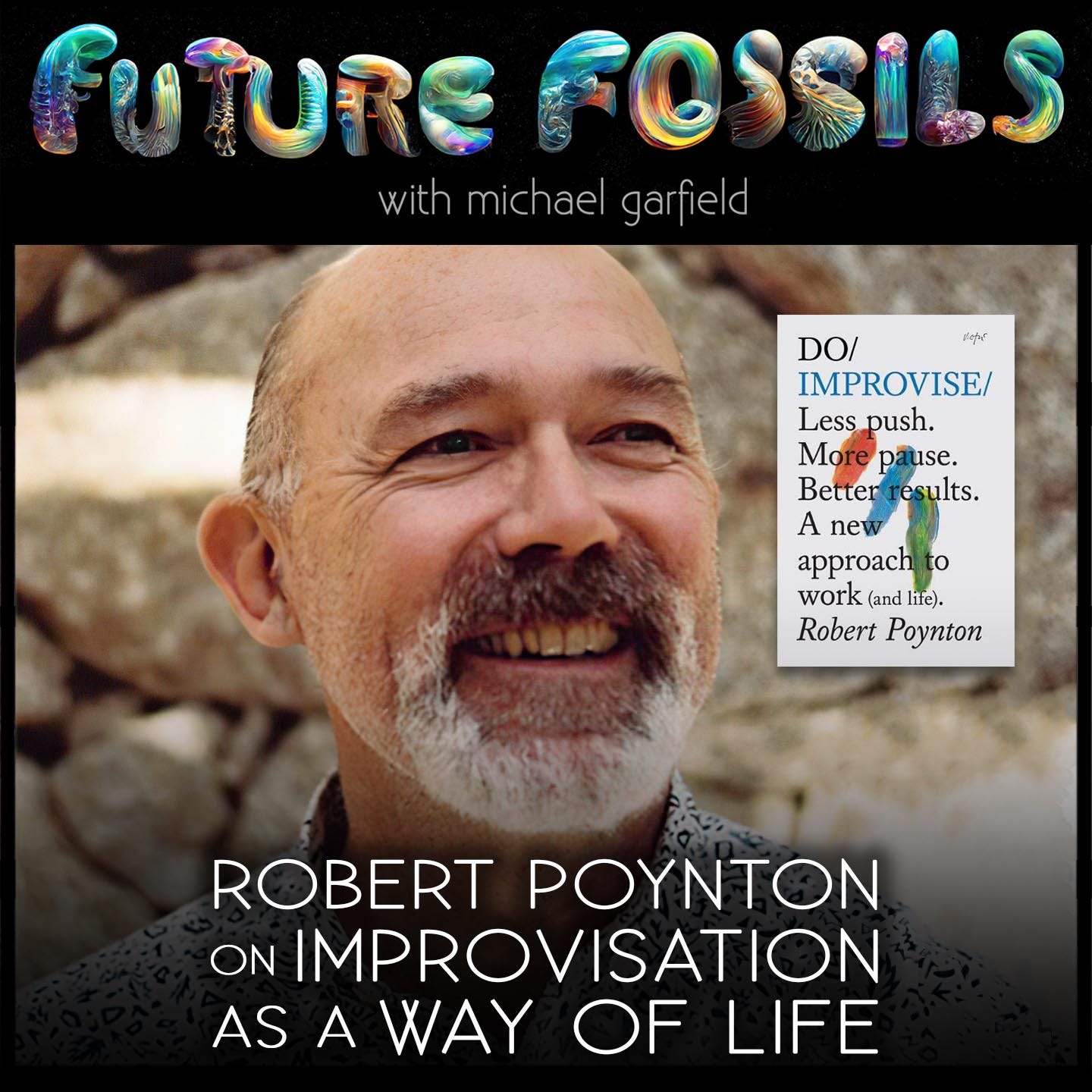
2022 in particular was a year that convinced me that the years I spent vagabonding around the country and professionally improvising were effectively a period of intensive preparation. And I mean, in some sense, it's always been on my mind that we're moving deeper and deeper into a world that rewards those who can flock, who can pilot a starship through an asteroid field, who can listen with their intuition and make sudden and spontaneous decisions that may only make sense in retrospect or may never make sense at all. But given the tempo of the changes that we have faced this year, I'm looking forward into 2023 and feeling very good about emphasizing improvisation to an even greater degree and placing an even larger emphasis on the importance of this work, even as the question of long-term planning comes into focus and asserts itself with even more urgency. So it is with great pleasure that I welcome you to the mind and heart, my friend Robert Pointen, whom I met through our mutual friend Chris Cutarna a few years ago, and who teaches improvisation to people in the business world and who wrote an absolutely poetic and beautiful book called Do Improvise that sells people you might consider square on the value of learning to depart from script, listen more deeply, make creative use of absolutely everything life throws us.
It's really a spiritual practice and I see Robert as a kind of Obi-Wan Kenobi in that regard, someone whom I listen to very closely when it comes to these things, and someone that I'm immensely grateful to know and grateful I get to share with you. But first, I want to thank everyone who continues to help me make this show possible. Conversations like these are not easy to fund because most funding demands some kind of clear understanding of the value that's actually being created here, a specific outcome, and embraced with the fundamental mystery of our reality, this sort of indirect philosophical opposition to that paradigm, at least on the first pass at the simplest level of analysis. Of course, if you go a little deeper, what could be more important in the biggest frame and on the longest timeline than learning to embody and enact evolutionary intelligence, which is the very paragon of improvisation, but I digress.
The point is, I want to thank everyone who is helping Future Fossils. Special thanks to the latest Patreon supporters, Jamie Curcio, who was my guest in our last episode, very excellent episode. Christian Smith, David Lowenfell, MC Otter, Aaron McCarty, Kaza, and Laura Cochran. Thank you all, and thanks to the other 251 Patreon supporters.
That puts us just over halfway to my goal for 2023 of 500 paid supporters, which by the way is still only one sixth of the number of active participants in the Future Fossils, patrons only, Facebook group. So everybody who is chipping in on this show every month, you are not only helping me, but you are also subsidizing the 90 plus percent of free writers who benefit from the very active and intelligent daily discussions going on in that forum. So I thank you not only as a proxy for my children, but as a proxy for the herd of cats that makes the conversations that we facilitate here about so much more than is simply going on in these episodes. It means the world to me that I and they have your support.
Lastly, thanks also to everyone who has been reviewing and rating this show on Apple Podcasts. Ultimately, as much as I don't like this, the success of a podcast is a numbers game. So every little thing that everyone's been doing to make this show more visible, deeply appreciated. It's a ton of work, including work put in on this very episode by my father-in-law, Kevin Taylor, big thanks to Kevin, and with that, I've kept you long enough.
Please kick back and enjoy this fabulous, soulful conversation with Robert Pointen. Tell me about your day. Morning, doing accounts. I'm back here in Spain.
I came back from Oxford on Friday. My wife was away, well, she was with me on Friday and went away, and my son sleeps in the one who's here. So I spent the morning doing something I've been meaning to do for a long time. And a friend of mine talks about having bookkeeping mind.
And it's a bigger point, actually. It's also about how if you can catch yourself in the right mood to be doing the thing that you need to be doing, then everything flows. And I deliberately chose to do it on a Sunday because I really hate doing my accounts. I'm really hard to concentrate.
And it's not a big thing. I don't have very many accounts, but somehow it assumes this huge scope in my head. And the other thing I find difficult about it is when I do that, I never have to be on cover of things I haven't looked at or try and download this invoice, requires me checking this thing, and then I have to refer back to a bank account. So it opens all these, not Pandora's boxes, but Pandora's windows, perhaps.
And yet today it felt like that's okay. That's what we're doing here this morning. And so as always happens when I can find the right state of mind, I settled into it and quite enjoyed it, actually, and did quite finish, but that's okay. And then back in my lunch, and we cooked and she and I and Pablo had lunch outside, which is still possible here.
And then it rained for 10 minutes, which is a delight always. You live in a drive out of the world. I'm sure you can connect with that. You say that to English people and they're like, yeah, what?
So yeah, it's been the day so far. Interesting. So again, with the morning light in the evening light, after this, I'm going to work on my taxes. So we're not the different.
Yeah, death of taxes, eh? Yeah. Indeed, indeed, in fact, actually, I should just not to make this episode about this at all, but as a token of appreciation to my friend, Adam Allen-Boss, who runs Nightlight Astrology and recently made comments about the aspects being especially about learning to lose or die gracefully this couple months, not just a seasonal thing. We have an opportunity to watch presumably inflation and geopolitically complicated things unfold and just be at peace with the unbuckling of it all.
But that is not what I have come to speak to you today about, because your publishers so generously sent me this book and I love it. And it's interesting, because as a career improviser, you showed me how to think about improvisation in a completely different way. And that's what I want to explore with people today. So first, Rob, points in how do you introduce yourself to strangers, most of whom are probably very intelligent, creative, not your typical audience?
They, I imagine, are, because this is a two-way conversation, right? They are the listeners that we're intensely aware of right now are brilliant and interested in you. But yes, exquisitely strange and mischievous people. Yeah, I kind of, by way of introduction, I don't find the conventional categories or labels very helpful.
So I think it's interesting to talk about, as I look back over my life, what my intention has been, that's kind of an intention that I give to make sense to something afterwards, rather than perhaps being the intention I held at the time, and then a little bit about kind of the nature of the things I do. So I think, you know, one of my intentions is also being to explore how things happen. I think it's just kind of a simple snap. And the role of kind of playfulness or a kind of mischievous spirit, if you like, within that.
And I kind of built on a conviction that there's got to be a, there's got to be an easier way than just pushing. First thing I did myself to left university was join an ad agency, because it kind of seemed like fun. And because it's like, well, we're going to be producing ideas and where do those come from and how do they come about? So I think that's always been kind of at the core of it.
And what I actually do, I think, where I think about it now is create spaces or bring groups of people together to have conversations or make discoveries or learn things that they wouldn't otherwise learn. So I'm kind of exposed to modern term would be like a experienced designer, but a curator of spaces online and in person. But with that same intention of having, having unexpected stuff happen, mostly kind of learning or discoveries. So yeah, that's how I think of myself, I guess these days.
How did you find that though? How did you find your way into it? If you did get to this in the book, I didn't get to that part. No, I don't really talk about that in the book.
I mean, to improvisation, I found myself like the way I find my way to everything kind of through serendipity, I suppose. And by being awake and alert to something, so that there is, it's not that there's nothing I do. I suppose my path through life has been driven as much by the rejection of things as by the embrace of them, if you like. And that's quite powerful saying, I know it's not this or I move away from something into a space where something else might happen.
So the path to understanding or tumbling across improvisation was fun enough, complexity theory. And I realized there's just recently, I was thinking about this very question, I realized, oh yeah, the first time the whole of the sciences of complexity came across my mind was in a presentation somebody gave about catastrophe theory. And then after that, it led to complexity. And then I got very interested in kind of felt like somebody learning a foreign language, you could understand a fair amount, but could just about order a beer in a bar, you know, it just kind of didn't really work for me.
And then I by chance came across a guy called Gary Hirsch, who I met by a t-shirt from because he's an artist as well. But as it happens, I'd just been doing a talk at Nike in somebody else's place, actually. And I've been given this very difficult brief where they said, well, you better be funny. And the only way I knew to be funny was to take bits of film.
I knew were funny. And so I took amongst other things, lots of bits of his lines. Anyway, so when I met this guy who's an artist to talk about t-shirt, he mentions by way of introduction, oh, I do improv theater as well. And I said, well, how does that work?
And in the very first blush, the very first few things he said, I could immediately see that this was the same set of patterns as what I'd been fumbling around with in a very amateur way through the kind of lens of the science of complexity. So we started to work together. And I think you were saying earlier about how it's a lifelong improviser, some of the stuff that you came across in the book helped you understand it. And that kind of makes sense, in a way, because there's a level of capacity and ability we have, which becomes unconscious.
So if you're a skilled and accomplished improviser in whichever artistic medium, you're probably just able to do it and not necessarily aware of how you do it. So myself as an outsider coming to it didn't have that facility. But also, what I was interested in was how'd you take and apply these ideas out with the theater, in particular. And so that kind of forces you to think about it consciously and to articulate things in a particular way that is kind of simple and approachable and playful and enjoyable for people who perhaps have no interest whatsoever in theater, but are curious about how they organize themselves or how things actually happen or how to deal with the mess that is everywhere.
I think that's a very, very big thing for me. This idea of my experience of being a human being, as always being a regular and regular and messy and serendipitous and joyful and painful in complicated ways. And I studied psychology and philosophy at university. And the psychology in particular at that time in that place did not speak to me in any way that connected with my experience of living a human life.
So I was kind of deeply depressed. It was an Augustan institution. So I assumed that there must be something wrong with me. And that was what initially driven the inquiry into complexity theory, because I always think of complexity as a kind of science of everyday life, the science of the messiness, the science of not the lab, not the controlled environment, but that which we experienced in all its glory.
And so when those kind of came together, there was a sort of extraordinary awakening for me. And I think it's that outside in us, which has also been another quality of my experience. I spent most of my life living in a country that's not the one I was born in. And I'm always kind of outside looking in and throwing and that kind of ability to see things in a world that you can't necessarily see if you're steeped in it and if you're skillful in it.
So yeah, that's kind of been the role I've played or the path I've tried and kind of translated, I suppose, in some respects. To your point about coming in through catastrophe theory, that you talk about how improvisation is normally regarded as a last resort is what you do when all else fails. It is often regarded as a sign of failure. As filmmaker David Keating says, in our industry, improvisation is a dirty word.
And then elsewhere, you also say life is a giddy torrent for which nobody has a script. The relationship with improvisation and complexity has always been there, I guess. It strikes me that in a symphony orchestra, there is no improvisation. Everyone's reading from the same music.
But if the music is changing fast enough, then you have to give up the pages and listen to each other. And at some point, then there's another bound where if you cross that bound, you cross into chaos and you might as well just be rolling dice or something, because you can't adequately predict. But that's inimitable human life. So to your point about this is where we live, the messy place in the middle there.
If you take Hooslines anyway or in Protheta, what you see people doing there, in some sense, it looks like magic. These people seem to be able to read each other's minds or to know what comes before it happens or to connect things in a way that must mean surely they knew what was going to happen. And what was really interesting to me about this was none of those things are true. That may be the apparent result, but people who are skilled on stage achieve those results by this practice of some very simple pieces of behavior, largely through what they pay attention to and how they pay attention and how they work and use what other people are giving.
And so what you have there is an example of sense and meaning. It's not chaotic. It's not random. Has this sort of magical lightness to it.
And I think I spent a long time thinking about and observing what is it people respond to in a theatre, in an improv audience or in a workshop for that matter. And they're rarely responding to something that's intrinsically funny. They're actually responding to the nature of the process. There is something so deeply pleasing about saying people not just work this way together, but be this way together to take and give and accept and connect that we express that pleasure through laughter because it's so joyful.
There's a different thing, something being joyful and something being funny. So that kind of apparent or seeming magic that is possible on the stage is in some ways an illusion because it doesn't happen through the things that we imagine are needed. And so the promise therefore when I first came across it was like, how do you do that? How can I get that in my everyday life?
How can I get this feeling of a flow? How can I get this feeling of effortless creation? And what is it that these people are doing on the stage, which for me is, I think of it as a laboratory. It's a place where you get to try stuff out and get feedback and invent language and notice what's going on that you can then take and use somewhere else.
And that's been the work and I'm still in it. It's not like I've kind of got this down. I've got a model, and as George Box famously said, all models are wrong and some of them are useful. And hopefully this is a useful one, which can enable you to kind of act as scaffolding that holds you in place while you interact with other people.
And that doesn't have to be in the theatre. That can be with your family at home. It could be at work. And the same promise I think of this seemingly effortless flow.
I mean, I qualify this to the effort there because it's not that no effort result required. It's not that anything goes. It's this much more interesting constraint in the world of effective improvisation. So it's seemingly effortless.
It's, let's say, a different kind of effort. It's a care and attention rather than a kind of pushing and a forcing, perhaps. And done well and done repeatedly. And by the way, it's very compassionate practice because you can forget to do it and start again any time you like I do that the whole time.
So it's not kind of something you have to be wedded to. You can pick it up and put it down as you see fit. But it can enable you to generate flow and create new ideas in this kind of graceful way. And the internal experience also doing is very different, I think, because there's a lightness to it.
And I don't mean the lightness of humour. I mean, the lightness of what I perceive as the way nature works, where things just kind of fit and connect and flow and the get each other and the dung beetle feeds off the excrement of another creature. Everybody will waste his food. That's the kind of dominant mood, I think, when an improvisational process is unfolding, fruitfully.
So yeah, I think that's always helped to be a great promise, that connects with what I said earlier about wanting to find ways where a kind of a way of life or where of work, which is kind of not easy necessarily, but where there is ease and where there is delight. Those are all the words that kind of come to me. And I think that we industry things. I think we think that control is a prerequisite when that might be an impossibility.
I mean, it depends exactly how you use that word, perhaps. But we lavish time and attention, trying to control things that always kind of beyond our grasp. Other people, for example, or small children or people that work for us are with us will never do what we want them to or what we expect them to and why should they in the same way that we don't for other people. So instead of seeing as that as a kind of failing or an error, then this way of thinking and working invites you to kind of, well, how can I take and use that?
And if I go back to the stage, that doesn't mean to say you've got no goal or intention or that, I could say anything goes far from it. Foro is in a theatre, this laboratory is, I think, still have an audience to please, an audience who can leave instantly or never come back or at least switch off in their minds invisibly. So very demanding circumstances. There's the very high demand.
And yet they can somehow work in a way that keeps people there and keeps engaging, keep on doing it. So that's that promise, I think, is one that's well worth pursuing. So in that, you reminded me that one of the fractal faculty members of the Santa Fe Institute, Stuart Firestein, biologist at Columbia University in New York, is writing a book and gave a talk earlier this year on uncertainty. I guess his first two books were Ignorance and Failure.
He really loves this stuff. He's arguing that uncertainty is the basis, actually, it's required for philosophical optimism because you have to assume that things can be different. Yeah, completely. There's an openness, there's a potential there.
And again, to get back to this catastrophe and disruption, you say, improvisers prepare, but they prepare a territory not a path. I find this very interesting because just earlier this week, I was listening to Weird Studies podcast. My friends Phil Ford and Jeff Martell, and they were talking about fantasy novels, like the Lord of the Rings, and how there are instances of world building that are what they call ergodic texts that are more about laying out the space and then allowing the space to populate itself rather than to drive the whole thing with a story where as science fiction is often accused, the characters are basically facades. They're plot points disguised as people.
And instead, you have this other thing. It's about there being two different strategies, but it's improvisation at different timescales, I would argue. We talk about the sixth day of creation, the ergodic texts of this world is one that might seem non-eargodic if you zoom out far enough. But at any rate, what I want to ask you about was this thing about the terrain to call in Lord of the Rings, not all who wander or lost, that the wandering is something that people do in the wake of a disruptive event.
And I'm curious about your work because as you note several times in the onboarding phase of this book, improvisation is seen often as something that happens when plans fail. And so it's not enshrined by society as it often reflects poorly on someone because we have our heads wrong about this. There's like shame or something involved. The bouquet here is one of being displaced or marginal or fugitive and the movement and the stuff like, oh, I just got a divorce.
I guess I'm just going to go backpacking around the world. These kinds of moments. I don't know. That's the riff.
Yeah. Well, there's plenty in there. So I think it's a very close friend of mine, Nick Barker, who once said to me, your work's really about recovering improvisation from the pejorative. And I thought that was a really interesting perspective.
And I agree with what you said there, that I think that we have our heads wrong about this. And I would add actually that I think many of the proponents of improvisation, many of whom care ardently about it and advocate it ceasily, also have their heads wrong about it because it's not that improvisation is any kind of replacement or answer or substitute for a planned or organized or structured way of thinking. It's that it's a necessary compliment. And so we need both.
The plan is never complete. There's always data we can't anticipate. And in the act of doing our plans, the data and the circumstance will change anyway. So that doesn't mean say you should give up planning, but it means to say that you should hold the plan lightly and understand its limitations and simultaneously understand the need for the capacity to adapt and respond creatively, which is another way of describing improvisation.
You kind of see this everywhere. So absolutely, we have our heads wrong. I thought that comment of Nick's was a kind of interesting one. I hadn't thought of it like that before myself.
But I do think you kind of need both so that the house I'm sitting in, which is in rural Spain, when we start building this house, I assumed, as it would make sense to do, and as most people would, that that was not about improvisation at all. How could you improvise or why would you improvise with an expensive, literally kind of material structure governed by complex and demanding regulation at every point of the process? But of course, in this factor way, I like you described, yes, that's all true and you do need to fulfill all of those plans. But along the way, the weather changes or the lens not quite where you thought it was or the materials don't arrive, or there's incompleteness in the plan.
And so what I discovered through this very kind of tangible process, a really important stage for me was this need for both. And that if you just had the plan, you would never finish anything. And if you never had a plan, you would never start anything. So we had to flex and respond to circumstances that we couldn't predict or control.
But in two modes as well, one is to solve problems, so the land slopes in a way that didn't show up in the original measurements that were made. And so then you have to find a way to adjust for that and make the structures to work. But on the other hand, there are unseen opportunities that weren't visible from the desk of the computer designer who was rendering the drawings. So the view from the scaffolding, which led to a piece of raised garden, for example.
And so there's this kind of symbiotic kind of relationship between the two. And I think the advocates of both, as a singular answer, are kind of mistaken or missing something. It's just that there are more people that in our society kind of just assume that the way to get things done or the way to do things well is to do ever more planning and be ever more structured. But you need this kind of, you need this interplay.
And so things have changed for me since then. I eat the book that you're holding there is the new edition of the book I originally wrote 10 years ago. And I think at the time I wrote that I was still slightly subject to that way of thinking myself. So that I'm not explicitly kind of implicit, I'm sort of offering these ideas from a civilization still as a way to get through the mess.
When I was rewriting it last year, now earlier this year, I suppose, I'd be an influenced, or let's say my thinking of being thrown into new relief by Margaret Heffernan and Bocosta with her where she talked about a thought experiment, I think suggested by Gugarendze about how if you could plan and know in advance of getting back to uncertainty here, if there were no uncertainty, and you knew exactly what you'd do for the rest of your life, day by day, you know, meal by meal, hour by hour, who you'd meet, what you'd talk to them about, all that kind of stuff, if you did have the complete thorough and total script for your life, then as she rather sweetly says, that would reduce life to the process of waiting for the train, that all of what we actually value or much of what we value most, let's say, in life, comes from that space of uncertainty. So it's in uncertainty, that creativity lies, obviously by definition, because if we already had the idea, then how would it be created, but also a sense of making a difference of agency and identity of joy and delight surprise, all of these things depend upon their being uncertainty. If you ask people to tell you a story about a great trip or a great location they had, it's extremely unlikely that they will tell you of a trip that went exactly according to plan, even if they're a devotee of Disney holidays, I suspect that that's unlikely. And most of the time it's that space of uncertainty which creates this sense of possibility, and so what this may be realized when I was reworking this book was that in a way, I'd fall into the mode of thinking that the uncertainty is a thing we struggle to cope with as human beings, a thing that we have a fault line in our brains about that, and we make all these mental back flips and these huge efforts to try and avoid it.
And I think there's truth in that, I'm not saying that's not the case, but it's not the whole story that there's this positive side, this necessary side to uncertainty, it's kind of where we live. And so as I was thinking about these ideas, again, I kind of reframed it for myself and it may not be a very visible shift to anyone else, but to me as a big shift between saying, oh, these are these ideas that scaffolding as I called it earlier, that the practices of information allow you are a way to just live right here right now in what you've got. Teddy Roosevelt, I think it was, you know, do what you can, where you are with what you have. And of course, that's all we ever really have.
So there's something quite powerful about that. And no, it's not necessarily just making it up or wing it. That's what was interesting to me in the first place. There is structure, there is pattern here, it's not random, it's not chaotic.
Improvisers do prepare, and what I meant by preparing a territory, not a path, is that you're not trying to force the world to submit to that narrow set of possibilities you yourself have defined in advance. You're open to all that is coming at you and able to act in advance of knowing what will come, but in a spirit or in a manner which is likely to bring about, perhaps unexpected, but fruitful kind of results to connect simple things together and make something new to give a very obvious example. And I think this is really interesting because I think if I offer a critique of the planned way of thinking about things, which is the extension of the kind of waiting for the train idea, you know, most of what's happened in my life, most of the work I've done, I couldn't possibly imagine. So I couldn't by definition have planned it because I couldn't have even imagined it was possible.
I couldn't have imagined it was possible to meet somebody like yourself at the Santa Institute and do the kinds of things we've done together and meet the people in common that we've met and be stimulated in the way that I have been by your work. I couldn't have imagined that. So yes, the human imagination is extraordinary thing, but it's also incredibly limited. And one could describe the act of planning as forcing yourself to only allow those possibilities you can imagine in advance.
And that's a very much more set of possibilities than those which actually exist. So it seems to me slightly perverse to want to do that. You know, I have people I've known but we all have, whose lives have panned out exactly as they thought and hoped. But in some cases that means that you are subject to the women's of a 19-year-old at university who's decided in advance what they're going to do.
And then the rest of your life is spent in achieving the goals that you've achieved. But as I am thinking a couple of people in particular, they didn't seem to be made very happy or satisfied or fulfilled or excited by delivering on the plan. You know, because again, there's something about our nature which is that as soon as we've reached somewhere, kind of the eyes lift and we look on somewhere else and it's about the journey, not the destination, all those cliches. So for me, yeah, this learning to see uncertainty as part of a source of joy as well as a source of difficulty.
And never was it us, I think if you look at all the great stories and the way that culture and science talk about everything, paradox is always there, isn't it? You've always got the yin and yang, you've always got the wave and the particle, you've always got these kind of pairs of paradoxical relationships kind of playing out. So it makes sense to me, I can't go any further than that, but it just intuitively makes sense to me that uncertainty is going to be both these things and that we somehow got completely hooked on one way of trying to deal with it, which is useful up to a point and then has massively diminishing returns. Fives down, you mentioned earlier, you know, the work on failure, you know, I have a distibate with other friends who work with improvisational ideas and in two ways that we tend to look at it.
One is there is no failure, every failure is also an opportunity. It can sound slightly polyanerish, but I just prefer not to use the term at all, I kind of just think about where everything is something you can take and use and fail to a success, a relative term which is local to time and place and all those then stories about the next day, everything changes anyway, so what looked like bad luck is now good luck and on it goes. Yeah, so I have to ask because it makes perfect sense what you do to me and yet reading your work and knowing that you are a fellow at the business school at Oxford and I think back on a conversation I had with my cousin, my father's brother's daughter in 2016, I think, and at the time she was living in Berlin and she was working for an ad agency that was advising the BMW group and she told me that BMW has a department of internal disruption and I said, my God, how can I get involved in that? How can I find without going to Berlin, a company that is wise enough to integrate in the way that was it you who said that everything that you see as other becomes fate?
At any rate, this notion of having levers, not ownership exactly, but of engagement, of participation, involvement, the ability to tango with uncertainty seems less so maybe than it was 20 years ago, but nonetheless still exceptionally rare and I'm just curious if this is just because of my woefully impoverished experiences as an adult of navigating these spaces, but it seems like what you do going into companies, big, estimable brands and doing this work, it just seems like the most important thing ever and yet for all the reasons that you've mentioned already, it seems like it's cutting against the script in a way or like one way of thinking about it's like a wizard is rarely welcome because a wizard showing up in your town means something magical is about to happen. So I'm curious about that particular piece of this, how natural it was. I mean I guess you came into this from business. So it's sure.
Yeah, so this is just kind of my temporal path in but I may come back to that but to kind of go straight to the core of the question, I think that what you see is that, so I agree that it's less rare than it was 20 years ago, that's about the time I've been doing it, but it's still very much in the minority very much goes against the grain and normally depends upon one or other of two things. So exceptional individuals who maybe in significant positions of kind of power influence or maybe budget holders, they may be looking after projects or even whole organizations where they just intuitively understand some of their stuff. So when they come across you however they do, there's a very quick meeting of mine and they can kind of connect with it. And so that's the one way it comes across that was how the work Oxford began through meeting one of those individuals I would say because in this sense the university and the business school is itself such a Leviathan.
So it's just one example more of these kind of big organizations. The university has a slight difference from corporate context. I always think of Oxford University as a coral reef. It's full of these kind of thousands of little niches that you can inhabit and most of the time you're sort of left your own devices if you're not upset too many people.
So it can tolerate quite a lot of not just ambiguity but contradiction actually. If you look within departments or disciplines, there are plenty of academics who completely disagree with each other about fundamental things in their field and the university is big enough to hold both of them. And of course I know I'm near an academic alone, a serious one. So I'm kind of on the lunatic fringe of the lunatic fringe.
But an organization like that has the capacity to allow for the liminal spaces, the edges, all that kind of stuff. But in business organizations, there's another couple of options. So there's sort of a scale of ways that you can engage with this work. Some of them are what you might call the prototheotrical.
And this is how it began for me. This is where the kind of my path in sort of began. It was easy in the earlier days or easier to get design companies or creative companies or as I would normally say companies that thought of themselves as creative to engage you in the spirit of all this will help us be more creative to some degree or to help with very obvious things like communication or presentation skills or things like that, which of course are the most trigger and the least interesting aspects of this work. So you can come through kind of through that door.
And then sometimes what you find is these, as I say, inspirational individuals who can really see that this is in many ways challenging very deeply the whole edifice of the way the corporation is structured and the way people think about it. And they are capable on occasion of carving out if you like sort of sub ecosystems, areas, bounded areas within which a different set of understandings and sometimes rules apply different relationships are able to be made. There are different flows of power and they'll often be the kind of clients that will work with you over a period of time and use this kind of work in many different ways to go way beyond the reasons that they may be using to their superiors or their budget holders to justify doing it. And you're kind of working as a sort of double agent actually.
Because I think 20 years in I have kind of reached a conclusion that a lot does need to collapse I think, you know, this edifice of structure and goals is so tightly bound that there is little room for genuine creativity. That's why qualified the description I gave a company is a moment ago as companies that think of themselves as creative to be truly creative. They have to ask bigger and deeper and far more far reaching questions than many of them are willing to ask. So I think that there needs to be some kind of collapse and regeneration.
I've become somewhat allergic to using it in the ways that I described earlier is kind of trivial and superficial because I think in a way it's just putting that day off. So there is quite a kind of revolutionary spirit I suppose in my mind and heart these days because yeah I think we really really need to redress the balance and I'm so anti it's just I think that I see it just really harming people. I think that people working ever harder for under ever more stress with ever retreating kind of rewards or with no rest with context they're not treated in the old days if you get you know it's going to accompany you'd be there and get gold watching that be that and that doesn't happen anymore. You know so I think it's painful on that on that level.
I think it doesn't do companies justice I think it's from a more vibrant creative generative value making ways of being working that would actually help companies make if that's what they're really interested in more money as well. And of course making more money is perhaps the least interesting things companies do. They could make a lot more meaning if they thought that things differently. And then I think on a planetary level this way of kind of controlling and extracting and squeezing and pushing is not solely but is maybe of course maybe an effect of the kind of damage we're doing on a planetary level.
So that's all bit pompous and grandiose but it's kind of how things connect together for me. So the remora on the shark of that question is how do you actually sell this to an organization because it seems like an easier sell now than it was for all the reasons you said but like at the same time it's uncomfortable and yet something that I love about your book is that I need to connect your book to Stephen Nakmanovich's free play. Are you familiar with that one at all? I haven't read it.
I know another title well but I haven't read it. So Nakmanovich interesting weird five string violinist he's written another book the art of is that I'm working through right now. He's another one of these people that sees improvisation and composition as being one thing at two levels of granularity. Spoke a lot about the unrecorded Beethoven improvisations that legend has it made people weep in the audience.
Yeah there's just something so natural and sane about the way that you think about this stuff that it strikes me that it makes it less difficult to sell because you're just helping them exfoliate and unpack and be more of what they are. Exactly I think I mean that's the place increasingly I start and it just says an aside on the classical musical thing and many years ago I met a flautist a Danish flautist and I thought oh this is going to be interesting because she's going to completely disagree with everything I say about improvisation not at all. She and I close friends now and it's partly because it's exactly my understanding of it is it's just how you say is that a different level of magnification a classical musician who is playing with life is working in this way doesn't mean to say they're playing different notes but a different level of magnification beyond the level at which I or a non-professional classical musician here there are similar kind of dynamics going on and she could contrast that with people who as she jokingly calls it go to the factory which are the people who have day jobs in an orchestra who kind of phone it in a phone it in in a way that would meet a claim from even the classical music listening public but you know at her level of scrutiny there's a different thing going on so I think it's I think there's at least a suggestion there that these two levels or different levels you're talking about is still true in terms of kind of how you start that conversation yeah it's really interesting I think when I began I started by peeling to the obvious benefit oh you'll get more creative or here's how you become you know more effective at presenting or at fielding questions and answers I don't really do that anymore but there isn't some of the reasons I outlined earlier but also because I think it's this much more interesting way to do it which is absolutely connected to what you commented on there which is like we're already doing this all right this is not strange if you're a living human being you're improvising nobody has a script and so instead of making people wrong for what they're doing you can just sort of invite them to consider that there might be another string they can add to their boat so the simplest way I found to do it is really through three direct questions you just say to a group of people or this could be a rhetorical question in a in a conversation in email but that's what you say you just ask them are you improvising and normally it's people stop to think about it and almost always after a little bit of reflection they'll kind of go perhaps somewhat reluctantly they'll kind of go you well yeah I suppose you know not everything I do is pre-determined I mean if you do this it's depending on the context in which you do this you get kind of different speed of response and a different openness to it but even in a very stultifying kind of corporate suited environment it only takes a few seconds for everybody to kind of go yeah okay at which point I'll normally say something like well that's good because if you didn't put your hand up there if you didn't say yes that then you're dead so again you can use Levitin humor and then the second question I'll ask is and how important is that ability to and here I'll start to not use the word improvisation which is loaded for many people and understandably so you know how important is it in in your work or in your life to be able to flex adapt respond you know all those things and immediately people start to generate examples where they can see it's really important even if it's something like you know oh yeah when the client changes their mind then we have to improvise and then the third question is how much time or energy have you spent either in your schooling or in your education or in your continuous professional development how much time energy money or attention have you devoted to developing this ability to which with a few exceptions the answer is almost always zero or close to zero the few exceptions by the way tend to be people from the military which is itself interesting and then once you've got those three questions you come again great so here's this thing that you're doing already that actually turns out to be quite important that you haven't spent much time working on so should we work on it you know and that's kind of quite hard to argue with you know you've got to be really really convinced this is a you know that your time is better spent doing something else to say no to that and I think when you appeal to people in that way not by presenting not by being too in love with your own ideas or your own discipline but just by being invitational by observing that this is part of everyday life and just sort of naming that for them then it's a lot easier to come on board and to not be threatening this what I'm not suggesting this means you give up planning you know and there's tons of military examples I use which I'm slightly wary of because it feels some morbid but I think it is very interesting talking to us Navy Seals about this as I have or to s 15 pilots about how all this fits in in their world so yes when you present it not as an alternative in the military they say that no plans of eyes first contact with the enemy or the first casualty or is the plan or plans of proof that planning has been done which is a good thing to have if you're asking people to risk their life and limb and so this example is like you know military planners in combat anyway don't not plan they just plan faster they plan and interestingly they accept that the plan won't last very long but the point is not the plan and so then they're kind of again move adapt change get information in all that kind of stuff so you can furnish examples like that from unlikely fields that also open up people who think well I'm an accountant how could this possibly apply to me if it turns out well actually the military quite conversant with this we're thinking which by the way they think operates in seduction because sense and response is a very great contrast to command and control and you know that's something recognized established in the military world so I think at this point we've made it damn near an hour without actually explicating your advice which is as you say this the practice can be summed up in six words they are notice more let go use everything and I just want to thank you for bringing it all into such pristine focus I was thinking about expanding my awareness mindfulness and acceptation to be like co-opt that which lies around I have this thought that every idea is an acceptation every adaptation is an acceptation that we're not doing anything other than that constantly oh yeah it's like so beautiful to see it's like you're not writing math but you're writing in parsimonious code to me what seems like the prompt for all of evolutionary biology and everything else as well yeah I love the word use the word prompt I've not thought of it like that before but I think that's exactly what it is is a prompt so those statements or you can frame them as questions you know which some people prefer so you know what else could I notice or what am I noticing what could I let go of or what assumptions am I holding or you know what can I release and what have I got so that I could take and do something with those are prompts they're not in any sense kind of answers are formulae and I remember I was recently about where this model came from because it's very hard to dredge back in your memory but there is a particular moment I remember when it all kind of came together and love that used the word pristine at that point I think I was and there's plenty more things you could put on such a diagram and I think what I realized was actually simplicity is the most helpful thing here and instead of kind of feathering my own nest by saying well there's these first principles and then these other 16 and then these other things and building this kind of complex and probably hierarchical model and distinguishing between practices and principles just this idea of this kind of simple set of interlocking notions that act as prompts so that in any situation when stuck and even if you haven't done it for years if like I said earlier you've forgotten all about this you know and you're stuck or you're at a loss or you're confused or the opposite you're excited whatever you can say so what else what can I let go of here or if you don't feel like you've got anything you ask yourself what can I take and use and then you have to say well let me notice what I've got and so they all kind of flow into each other in a very elegant way when none of them is primary and that kind of simplicity and cleanliness I think kind of makes them remember thinking after I've developed for a while I wonder what's the next chapter is then I can thought there is no next chapter that's it you know that what provides the nextness the novelty if you like is the meeting a new context the naughty is is is infinite because in every context in every moment you can go back to the beginning start again ask yourself one or other of these questions whichever one comes to mind and so that to me seems tremendously powerful and I think on reflection I think I was influenced by again looking at the lab of the theatre and knowing by this stage quite well some quite accomplished performance and thinking well what are they actually doing and like I said earlier they're not perhaps very conscious of what they're doing but what certainly what they're not doing is they're not making elaborate plans they're not seeking to remember lots of things essentially they're doing something with their attention they're looking and noticing what they've got around them they are not categorizing things in an immediate and familiar way so the lights fail they don't see it as failure they see it as darkness so they got oh and they'll find a way to incorporate the darkness in the story that they're making which is the use everything piece and so when I wrote about this first I wrote another book before this one which was called Everything's An Offer which by the way is the three or four word version of the six words if that's too long so that sort of sums up all the practices if you like because to regard anything and everything that happens is an offer which means to improvise that something you can take and use has all the other ideas packed into it but when I wrote that first book I was really moved by the fact that five or six people took the trouble to write to me the book didn't have a very large audience so five or six people seemed like quite significant number to say that it helped them through a period of anxiety or depression or instability of quite serious kinds and that wasn't my intention at all so that's kind of like an audience member exacting my ideas about improvisation for use in a kind of you know for their own purposes in a moment of mental health crisis and one of them said it's not that your book is positive it's that it is constructive and I thought that was really interesting this idea that these practices help you to construct to build to move forward to take action rather than adding as it were a kind of valence of good or bad or feeling good or bad to anything which is kind of the complete opposite I think what people expect to be all happy clappy and all that kind of stuff and in some people's eyes it can be that but I don't think it's certainly that's not what it's about for me and I love your thought about everything's expectation I think that's probably right I'm going to think about that more but certainly with this kind of philosophy in mind anything and everything that happens is taken and used and rarely is it used in the way that would have been expected imagined or planned and yet often it will work out somehow better you know so they're literally examples I never forget weighing a game in a workshop at the site business called Oxford and I won't try and render all the details again but it came clear at one point that somebody hadn't understood the instructions that I'd issued they went to turn around and watch somebody and they didn't and so the whole thing got literally stuck and I was leaning against the wall of this room and I could feel the eyes of the 30 or so people in the room so look at me because I'm in a position of authority and they're like oh is this going right is this going well and I found myself moved forward off the wall I felt judgment kicking and I got old god I didn't do that very well this isn't working and all of that happens in a nanosecond and then I don't know what shifted but probably something emotional physical and it somehow occurred to me that I didn't have to do that that what was happening might be quite interesting that we might actually be able to use that and so I just lent back against the wall and kind of smiled and I could feel the whole room relax now they didn't know what was going to happen any more than I did but they were kind of looking at me and they're kind of like well he seems cool with it and of course what happened was the woman never turned round it was a sort of message passing game a series of physical message she never turned around to see what was the message she was meant to meant to pass the guy who was trying to pass it to got bored and kind of gave up and left and then somebody farther down the line just made something up and the game was completed in a spooky kind of way what person made up and they really hadn't been looking was pretty much like what the message had been and then and this is where it all starts to pay off the conversation we had then about communication and leadership and error was so much richer for the experience that we'd had than if everything had gone quote unquote in the way I'd expected according to plan and so that's another example of kind of live excitation like something really interesting happened I and the group took what happened and used it in a way that hadn't been expected and that's what keeps me doing this when these things happen I called them the jumping up and down moments for the simple reason that I get so excited by the fit almost in a sort of biological sense that sort of beauty of a perfect fit that I kind of literally jump up and down and I think that one of the proofs of when you see something that's kind of completely fitting not perfect but fitting I think that's often evidence that something has been improvised because it's so hard to make things fit there's a particular hallmark to it I think that you learn to recognize that you know and this goes back to what we sang earlier about the two mentalities that I think the mentality that if something fits really well it must be planned is almost completely wrong I think if something fits really beautifully it's almost certainly improvised or if it is planned or scripted it takes a huge amount of work I mean look how long it takes to write a movie script to make it seem natural normal and improvised in an everyday way if it's a realistic kind of series of dialogues between recognizable characters and that takes me back to my intention way back you know which is like if we can just get that if we can click into that way of being and working then all this kind of not just order but delight and beauty and novelty and value comes for free or comes along for the ride it's never quite free but it comes along and that kind of ferments and cements the relationships amongst the people because we're always doing this together it's never a solo creation and that is just the biggest rush ever speaking of the biggest rush ever there's this lovely passage here practice asks something different of you it encourages you to engage as a whole person not just a rational mind in an intuitive way it welcomes all of you to the game it recognizes and values information that is gathered via feel a lot of ascension posture and movement it generates sensuous knowledge not book learning it values speed responsiveness and fit over accuracy precision or regularity it gives precedence to creating a flow of ideas and energy rather than arriving at answers there's a living example of the scientific insight that the very simple behavior or rules can quickly generate creative complexity so again i'm just standing outside imagining in to this it strikes me that really what you're doing is basically almost budic in your interventions that you're getting into these places and saying with your silver tongue we're going to improve your bottom lines by paying more attention by being more in your body and i find that really beautiful and it shouldn't feel as mischievous or provocative as it does well it should i agree it shouldn't but i think it does because i think that this is still very remote and arcane territory for the vast majority of people in in organizations not just the corporate world but all organizations it's so far removed from the way we've been educated you know to me this is one of the blinds box you talked about young earlier you know the the the shadow side if you like of our success manipulation and control and physical material that goes all the way back to Newton and the enlightenment you know that we've come to mistake that capacity control as a kind of useful capacity we come to understand it as the way things are and i don't think that's true but it's been so successful at least one level and that's not to be sneezed at you know that's extraordinary what we as a society have been able to create but it creates the shadow side this blind spot where we think that that's the way things are that's the way to do things and so for those that are able to see it they realize how mischievous underneath the mischief there's quite a deep point some are oblivious to it what's hilarious of course i've also worked in Buddhist monasteries and this kind of work can be a challenge to them as well in fact the only place i've ever had to stop the game for fear of violence within a Buddhist monastery in California so that was really interesting to me and i think that's to do with you know outward forms you know institutions of any kind monasteries or otherwise can still kind of get locked into patterns and form that aren't sympathetic to it might kind of sound like they're spirited but they might actually be dead if you see what i mean so this can happen anyway in the same way that you can find groups of people in organizations who are kind of operating on a different plane you know in small groups perhaps so yeah so it is quite quite but it can and actually the reason i ended up working at it was tasahara i was working at one summer was through meeting Edward sp brown who i met in the uk on a cooking course and we kind of noticed some of the similarities in the language that is used so he was talking about acceptance in the Buddhist way of things and of course accepting to take offers as given is piece of the improv practice as well so there's a lot of connections to the sort of Buddhist way of thinking i kind of woven into this and i think some people some people spot that but you don't need to it's not necessary so i want to pay the orismen has due and carry us across the river to a question of time and of situating yourself in time and just ask from being someone who is thoroughly steeped you know the tea bag is one with the vessel and the water in all of this how do you experience time now how has years and years of engagement with this framing or deframing changed you and changed the way that you understand the passage of time and the structure of time yeah that's a really interesting question i think after i wrote that book i wrote a book about pause which is explicitly about time and our relationship to time and in the one did lead to the other it came about because what i started to notice is that skilled well people who came across my work would often say oh i couldn't do that because i can't think fast enough so there's this association and assumption that improvising well meant being able to think fast and i knew from my own experience but also from working with some very accomplished performance that that is not the case that's not how this works that's not what people do even on stage it might be thinking jim but not as we know it it's certainly not about cognition or cerebral stuff and so there's this big assumption that so i actually thought well i wonder if you could force some slowness into the process so i decided to kind of run on what would be an r and d workshop i guess a whole bunch of just friends in london you came along to see if we could introduce in spasm novice improvisers introduce a slowness of pausing into the exercises and games and uh it really didn't work it was incredibly clunky and stupid maybe because i wasn't very good at side coaching i don't know but what it did throw up was this conversation around pausing in particular and what is a pausing how long is a pausing how do you know when you're in one and is it the same as a million interesting questions and in the pub afterwards because you always have to go to the pub afterwards three people quite separately who hadn't spoken together didn't know each other came up to me and said when's the book coming out so that was a kind of invitation to write what became a book about pausing i'd actually finished the book about pausing before i noticed that the subtitle of doing improvises less push more pause uh you know a new and different approach to the life and work or something so clearly that kind of relationship was in there even if i wasn't perceiving it very clearly or being very quick on the uptake so how i think about it's fun you should mention this today because i woke up this morning and in that sort of sominal and dreamy state before coming fully awake i had a whole series of thoughts about this and i the phrase that captured it was time is swelling around me to me i think now time is decoupled from the dictates of the clock if you like that always open to and looking for those moments where it sort of deepens or extends i'm not really interested in squeezing it there's a lovely phrase from a German journalist called Stefan Klein which is if we give more life to our time we give more time to our lives and he doesn't mean more minutes although he may mean that too i don't know but just this idea that time is much more elastic and flexible than we realize and that in many ways it seems to me what we've done is subject ourselves to a sort of very mechanical interpretation of time and our devices and our technology reinforced that for us constantly i wrote blog post years ago called dictatorship of diaries it was an invitation to the tool makers of world to try and invent some form of timekeeping tool that wasn't a line chopped into bits because that's what they all are of different natures you know there's different ways of chopping a line into bits of different size bits of different coloured bits so for me this idea of time as being kind of loopy and baggy and elastic and not all the same is kind of how i think of an experience time and when i get stressed and feel like i've got too much to do and i find myself rushing around one of my mantras is there's time for everything which i often say out loud actually if i'm really stressed initially i don't say that i feel i am stressed i think what that does for me is remind me that time is as much in me as it is anywhere out there and to tie this back to improvisation there are examples i can think of where a group of people are making a story together out of order in a kind of improvise game and there might be a huge amount of stuff there it doesn't make sense and the whole thing is verging on that chaos you talked about earlier and then somebody just takes a moment and adds the word and in a particular place and suddenly it all makes sense so that addition of a tiny piece changes the sense of all the work we've done previously and the time it took and yet it took kind of no time so i don't know if that's an answer but that's what i was thinking about this morning as i woke up about time being swirling and looping and baggy rather than kind of tight and ticked and marked i love it i love it i want to ask one more question of you i mean frankly i feel like i could just play in this with you forever but the capstone here is about the future beings in the future how do you put it here you say in talking about communication as a two-way process as opposed to propaganda i really appreciated this many people misunderstand they conflate these but that there's a an active listening involved in speaking even to an invisible or in this case unborn audience and thinking about your work in time in dialogue with the unborn i'd love to hear you just reflect on that and maybe we can listen deeply enough to actually hear what they have to say to us wow uh yeah uh let's see i mean i think i would cherish the hope i think that in the future this period of constraint and tightness and it's not where i like very much but sort of effortful or efforting kind of squeezing you know that but in the thorns of time humans will find a way to kind of return to organic ways of being return is that has this work because i don't mean looping back in a circle hopefully it'll be helical but to a place where the example i like is you know if you think of a human in a stream of water perhaps quite a turbulent stream it's not sort of about swimming against the stream that feels like what we're doing now but that we find find ways to be an honor and cherish and develop in our education and our schooling and our workplaces in our families in our associations this kind of ability to kind of swim and duck and dive and move so we still got tension and freedom it's still banded the river has banks it's flowing in a particular direction but that will create a society where where we're able to reconnect with that sort of organic way of being that is so effective it's so extraordinarily fruitful and productive i think we barely begun to scratch the surface of this it's very recent news that we've all got an ecosystem in us which is completely unique if somewhat shared with our cohabitants called our microbiome i was reading an article in eon magazine recently that got me thinking about don't know wonder if the search for how the brain works is actually deeply flawed because maybe our whole brain function is as individual as our microbiome is it's very recent news to us and we understand very little about how forests talk to each other and send information as well as nutrients and that they're all symbolized with the microrisons that live on their roots and it just goes on and on and on and on and all of that is doing all of that without a plan so it's according to certain principles and there are patterns that we can spot and this under data we can analyze but i would hope for us that we are able to create a way of like i say living and working and playing which is much more harmonious and joyful you know and you know what if instead of everybody being a creative artist this will strike a good with you you know instead of having to paint hats and make music and release podcasts to make money we can create a society where actually there's a kind of a web of affluence that's available to everybody and people can make more of it if that's what they want to spend their time doing but that people are creative artists to be creative artists and they don't sell their wares in order to make a living because they're living already there for them or that we're somehow together i've got no idea how this works but that's to me what it feels like we could aspire to i'll never get actually i was many many years ago i saw one of the early star trek movies i think it's called first contact where the first scene was setting a forest and they lived in kind of like telly-tubby bunkers under the ground and wore fur coats and everything this was such a different vision of the future to a kind of blade round our glass and steel and a medium kind of future i was really struck by i can't remember anything about the rest of the movie that was our high-tech future i kind of returned to organics in a much more organic way and that we like the person swimming in the river it's not that we're just like early humans harvesting the beneficence of what nature had already provided that we're in this kind of dance of dialogue with the natural systems around us but in a way that is co-creative that would be the mega improvisation that we consciously engage in kind of acts of co-creation with the whole of the biological world and i can't help it go back to one of the phrases that's stuck with me most from any book i've ever read which is Kevin Kelly's out of control which i still find hard to believe was written in the early 90s where he says that when things get complicated enough or complex enough and we cross beyond billionics into what he calls zillionics the only logic that works is bio logic in other words biology and that the distinction between the born and the maid then starts to erode and so i suppose maybe i'm still just echoing Kevin but it seems to me that if you like the practice of improvisation or a way of making manifest and simple and useful and practical some of these kind of biological principles and so that if we could live more in accordance with those we could have this kind of future where we weren't in struggle or combat either with ourselves or with the world around us but we were in kind of constant creative executive flow how old are you i don't know if that even addressed your question but it was where my mind went oh no oh no that was that was for sure machary on top okay uh yeah that's it really what's it's important well just i mean i was teasing you as we began about you know you kind of had much sleep because we were when different times zones and you know we were communicating about email not that many hours ago and it's all been part of the same day for me but i was really enjoying the tired michael gafield um just the pausing and the thoughtfulness and the kind of i mean i'm attributing that to tiredness it may be just how you were choosing to be with me today i don't know but it felt very spacious and very relaxed and and and i really enjoyed that it's not normally how one feels in these conversations is certain for nse to them sometimes so thank you for that well thank you for your willingness to engage on this wavelength yeah joy and uh yeah thanks to nepcentia to chris katana as well for the original introduction and indeed yeah and uh well hope to have one day to meet you in person which is how am i going to get to spain i got a whole family to spain well we should uh you know we can figure that out you know often people say to me oh you know this whole your whole shtick does that mean you know i like having goals and i'm like well so do i i just uh there's nothing wrong with having a goal it's how you hold it and uh well certainly from my perspective that's that would be the idea of having you i wish i could show i'll send you a link actually to the drone film of the place if i haven't already because the place that we're lucky enough to have access to for these events is just mind-bending you'll enjoy this but it's it's old it's beautiful fine you know yeah we get that but i discovered on that many years ago that this property which my wife's family bought almost a century ago now actually of some impoverished aristocrats a few centuries before that it was bought by guy called Lorenthaleth Epeira who was recently enriched returning from the americans and it was be bought it at the request of his sister who needed provisions for her monastery and of course this places six kilometers south of the ancient city of avilla in spain and the sister in question was the great mystic saint tereza of avilla and so it turns out that this extraordinary woman had some of her extraordinary mystic visions in the vicinity if not on the property itself and so nobody really knows or cares about that but it entertains me because it makes me feel that there's a backdrop you know that i'm fascinated by what humans leave in places as well as what they respond to something to something in the place but also what has that left what fields however obscure you talk to me once about you know extraterrestrials being visitations from other times not other places you know and this is a kind of human version of that what if sentereza and her mysticism is still there in the ether perfect perfect perfect list is yeah thank you right well great so with you and uh let me know if you need anything else and um yeah we'll take a seat i hope thanks again for listening future fossils is an independent entirely listener supported program if you believe in the work that i'm doing and want to help see it thrive into the unimaginable future then avail yourself of all the backstage goodies at patreon.com slash michael garfield reach out to me personally at michael garfield on twitter or instagram and have a wonderful yawn