
EPISODE · Jul 21, 2020 · 24 MIN
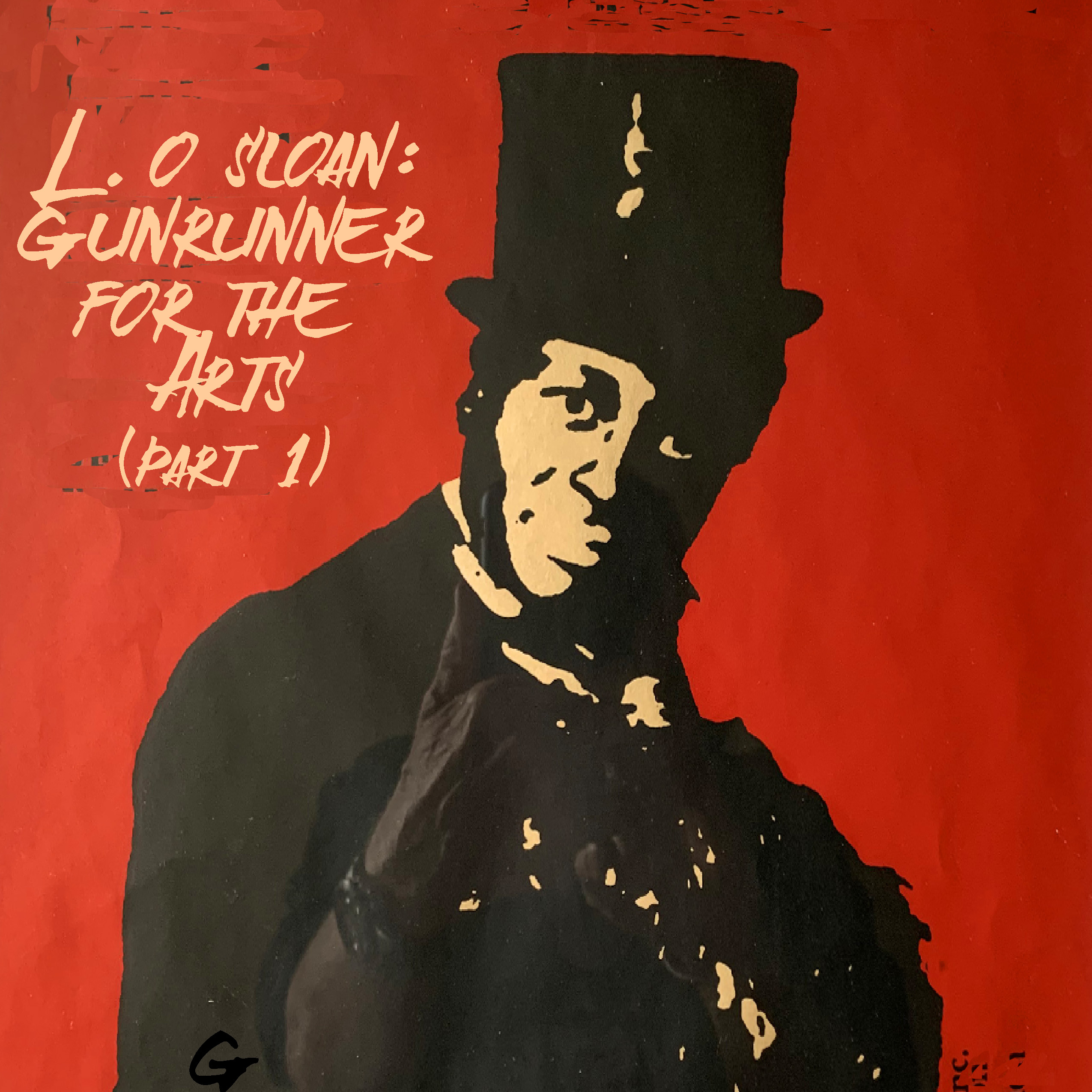
2: The Gunrunner for the Arts: L.O. Sloan’s Half-Century of Thriving as an Artist for Change (Part 1)
from ART IS CHANGE: Strategies & Skills for Activist Artists & Cultural Organizers
This week we'll meet activist/performer/impresario and historian Lenwood O. Sloan, a man whose extraordinary career has unfolded like a half century-long social change musical.THRESHOLD QUESTIONS AND DELICIOUS QUOTES?What defines a "gunrunner for the arts?""I try to take things that already exist, and through positioning and repositioning to create magic, you know, to motivate, but performance and visual art, literature and writing, film, you know, whatever medium is the best catalyst or elixir for the magic, but I'm a gun runner for the arts"? How does history become an art form?"Well, you know, everything has a history, and everything has a story, and it's the human person that is the juice that brings the linear, sequential, chronological history, and oral tradition of storytelling together into art. It's not what happened in 1864, 1791, or 2018 you know. It's who were the people? What does it mean to you? What relevance does it have for your story today?"?What can the historic struggles for the passage of the 15th and 19th amendments to the U.S. Constitution teach us as we navigate the Covid Universe?"You know African American women, 1918 to 1920, who were trying to not only support to vote for women but to find a place for themselves and that they were doing that against the landscape of the 1918 flu. They were doing it in a pandemic year. You know, they were doing it with their men coming back from World War One having segregation in their communities. They, they were doing it on the eve of a national election of 1920, and they were doing it on the eve of the 1920 Census."?Monuments have often been used to distort and obscure our complex history. How can a monument reveal and celebrate these buried stories? "So I felt that it was essential that we do something old and big and exciting between the primary and the national election to call African Americans and women through the vote, and I felt that we needed to do something Bill that was not about ribbon cutting or confetti, but that we needed to do something bold and audacious"TRANSCRIPTEpisode 2—Leni Sloan: A Gunrunner for the ArtsBill Cleveland: Leni Sloan's father was an iron worker in Pittsburgh, Pennsylvania. He made his mark scaling and helping to erect the tallest buildings in that city's newly soaring post World War Two skyline. When he wasn't climbing iron, Leni's dad would wander local fields lovingly netting butterflies for his precious collection. When Leni was a teenager, his dad took a fall on the job that put him in a wheelchair for the rest of his life. When I met Leni in the late 1970s, he described a play he was working on. A tribute to his father called Wheels and Butterflies, which, in turn inspired me to make this song.From the Center for the Study of Art and Community, this is Change the Story Change the World, a chronicle of art and transformation. I'm Bill Cleveland.When I was a kid, I fell in love with the 1930s movie musicals that would often appear on late-night TV. I'm not sure what it was that attracted me. I suppose their airy predictability was reassuring, a little romance, a little drama all wrapped up in a comforting embrace of those inevitably over the top song and dance numbers."Hey, kids, listen up. I'm going to write a show for us, and we could put it on right here."Now, my friend Leni Sloan grew up watching those old TV shows too, and like me, he took them to heart.The first time I saw, Leni was on a Sacramento stage, starring in a musical played also written and directed called the Wake. The Wake also had a provocative subtitle, three black, and three white refined Jubilee minstrels. It had been commissioned by San Francisco's de Young Museum as a part of the 1976 us bicentennial celebration. The production I saw was in the middle of a three-year World Tour. The story was set in the backstage dressing room at the Ziegfeld Follies, where the ghosts of six famous minstrels, three black and three white from the past, were gathered for a week to lament the death of Bert Williams the last and arguably the greatest black minstrel. As the play unfolded, the minstrels sang and cakewalk, and argued the hundred- and 50-year story of minstrelsy. Looking back, the show was a quintessential Leni Sloan production, combining music, dance, and drama with a heavy dose of long-forgotten and often painful history. It was both a tribute to a great musical tradition and a condemnation of the brutal racism that helped define it.In this week's episode of Change the Story, Change the World, we'll explore the life and times of activist/performer/impresario and historian Lenwood O. Sloan, a man whose extraordinary career has unfolded like a half century-long social change musical. Some see Leni as an artistic shapeshifter. I just think of him as a creative dynamo.However you characterize him, he's certainly done a lot as a dancer with Alvin Ailey and the Joffrey Ballet; as an arts leader at the San Francisco Arts Commission, California Arts Council and the National Endowment for the Arts; as a manager of cultural tourism initiatives in Pennsylvania and California and Louisiana: as a contributor to numerous award-winning television productions; and as a producer, director and performer of dozens of performance works, including Voodoo Macbeth, the Creole Mass, Her Talking Drum, Sweet Saturday Night and the show where we met, The Wake. [AN1]Our conversation took place at the end of April 2020, a couple of months into this surreal strangeness of what I've come to refer to as Planet COVID.So, I'm happy to be here talking to my friend and colleague, Leni Sloan. Let me start by saying thanks in advance for what I'm sure is going to be a great conversation. I'd like to start by scratching into your history a bit, given the many years we've known each other, I don't know that I've ever asked you, how do you define you work?Leni Sloan: Well, as you well know, my nom de plume and my book is catalytic agent. So, my work is to be glue or yeast or baking soda or to cause things to come together and bond and bind them when they're not, so I have used whatever art form necessary. My spirit is as a dancer. For almost 40 years, when people said, "What do you do? I would say, “I am a dancer.”I've come across at 1906 definition of magic, and The Webster's dictionary in 1906 says that magic is the manipulation of ordinary things in extraordinary ways. And so now I refer to myself as a magician. I try to take things that already exist, and through positioning and repositioning to create magic, you know, to motivate, but performance and visual art, literature and writing, film, you know, whatever medium is the best catalyst or elixir for the magic, but I'm a gun runner for the arts. It's really, I really amBill Cleveland: I really can't argue with that, but Leni, Tell me, how did you come to that? You know, as a young person growing up. How did you become this creative gunrunner catalytic healer troublemaker using art to ask hard questions and, and, move mountains?Leni Sloan: I've always wanted to be a dancer. There was an elderly lady that lived across the street from my parents named Mrs. Jones, and she would call my mother up, and she'd say, your son is at it again, you know. We lived on a hill with 27 steps to the house, and I had seen I'll [AN2] Build a Stairway to Paradise. Whenever I had to take the garbage down the steps, I would go dance up and down the stairs. My grandparents were religious about watching Lawrence Welk, and I would see these guys dancing Lark Well, I was like, "You can make a living dancing. You mean, they actually pay?" Of course, I always wanted to be Fred Astaire or Gene Kelly, depending upon which movie.I chose early to be a dancer and an artist. My parents said, "No, you're going to be a historian". And so, you know, well, Cleveland, that I am a dance historian, you know? (laughter) …Yeah. I think that I finally found the amalgamation between work, history and performing arts, in the looking at social systems and social periods and trying to glean from them. Now,Bill Cleveland: I'm a student of history too. I really do believe that if you don't know your history, you're very likely to repeat it, particularly the bad parts. As Leni points out. In the second part of our interview in Episode Three, that's happening right now in 2021 of the so-called pillars of democracy is that an informed citizenry is necessary for good government. It's not just a nice thing or an ideal thing. It's essential for our experiment in self-governing to function. Otherwise, it doesn't work, so being well informed about what has happened in the democracy laboratory before we put on our lab coats is pretty basic. But for most of us what passes for history in school is just a gray moment in the schedule when the minute hands on the clock on the wall seemed to go backward.Somehow, though, after his parental course correction from performing arts to history, Leni Sloan not only fell in love with history, he also found a way to expand his universe to include not only his first love dance and theater, but also the added mission of changing the world. Needless to say, I was curious about how that all came together.Leni Sloan: When I was in high school, we had...
Embed this episode
Ready to play
2: The Gunrunner for the Arts: L.O. Sloan’s Half-Century of Thriving as an Artist for Change (Part 1)
No transcript for this episode yet
Similar Episodes
No similar episodes found.
Similar Podcasts
No similar podcasts found.