
EPISODE · Mar 29, 2022 · 1H 35M
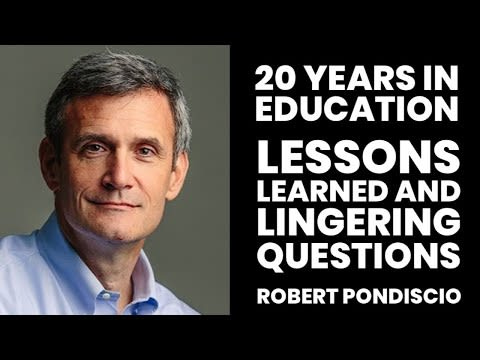
20 Years in Education: Lessons Learned, and Lingering Questions
from The Reason We Learn · host The Reason We Learn
Robert Pondiscio is someone I’ve followed, and admired, for years. The author of How the Other Half Learns, he has been a consistent voice of reason in the public school reform, and education press for going on twenty years. His commitment to understanding, and advocating, for what works, especially where literacy is concerned, is what I admire most about him, and we talked a lot about his views on literacy in this interview.An on-again, off-again Elementary school teacher himself, he talked about his time in the classroom, how he got there (it wasn’t his intention originally to become a teacher), and what he’s passionate about as he approaches his milestone anniversary of working in the field of education. I will confess, I approached this interview with some trepidation; as many of you know, I am a government compulsory school abolitionist. That means I have almost no hope we can reform the current system. Robert not only has more hope than I do, he is a supporter of public schooling, and believes it not only will always exist, but that it must. I wasn’t sure how our conversation would go when we came to that topic, but I’m pleased to say, as you will hear, Robert opened my eyes to my own blindspots where this subject is concerned, and I’m grateful.One thing you can count on from me is a commitment to empiricism; I am very opinionated, and not shy about sharing those opinions, but I’m also open to new information, and have no trouble admitting when that new information reveals I was either wrong about, or misunderstanding a topic or situation. It’s a matter of personal pride and integrity to admit that Robert made me realize while reform will be extraordinarily difficult, and may well (as I predict) involve decentralizing the system, and decoupling it from federal purview, abolishing it completely is probably as much of a utopian fantasy as the goals of the “woke” educators he and I challenged in this conversation.Robert and I are both big E.D. Hirsch fans, and for those of you who are unfamiliar with Hirsch, let me commend to your reading (as a companion to this video and podcast), his book How to Educate a Citizen: the Power of Shared Knowledge to Unify a Nation. My Locals community and I read this book for our bookclub, and had a great discussion about the importance of knowledge-based, or content-based curriculum, and how the current (for the past 30 years and counting actually) trend of relying on student-led and inquiry approaches, has contributed significantly to the poor outcomes we are seeing.Another thing Robert and I discussed at length is the problems we have in our schools with the teaching of reading, especially reading comprehension. His thoughts on that alone will likely alarm, and motivate most parents to become more vocal, and involved in their child’s education. We agreed, if schools did nothing else but effectively taught kids to read proficiently, with comprehension, we’d already have improved education in America 100%.It wasn’t all serious; there were lots of funny moments in this discussion too, like when Robert and I discussed our mutual revulsion for “uptalk” and “vocal fry!”Finally, Robert shared his thoughts on teacher education, what he thinks is wrong with it, and why he worries about the future of public education because of the direction it’s taking. I so enjoyed this conversation, and we hope to have follow-up about early childhood education sometime soon as well!Follow Robert @rpondiscio 0:04 Welcome, introductions.9:09 What’s going on with reading?14:37 “Reading is not a skill…we are unaware of the verbal water we are swimming in.”16:01 The importance of knowing stuff: “Hirsch was right.”19:47 This is how language works23:14 “Do you want to change the world for children, or do you want to prepare children for the world?”29:43 “We have a moral obligation to get kids invested in something; if they’re not feeling bought in, excited and engaged in the world, then we’ve failed.”45:42 Teachers: “It’s not about you!” We need a teacher code of ethics.51:02 The culture of education.57:43 A crisis of trust.1:07:52 “Choice is a meaningless construct when you live in rural America.”1:19:35 “In my perfect world…”1:24:47 “You go to school with the teachers you have, not the teachers you wish you had…You have to make this job doable with the men and women you have.”1:30:26 “We will know that we are serious about education when most of our energy goes to early childhood education….It’s easier to keep up than catch up.”Join The Reason We Learn Locals Community for homeschool-specific resources, access to LIVE Zoom calls each week, and two private live shows per week created for subs, based on your questions and requests! Get full access to The Reason We Learn at thereasonwelearn.substack.com/subscribe--- Support this podcast: https://podcasters.spotify.com/pod/show/debf/support Get full access to The Reason We Learn at thereasonwelearn.substack.com/subscribe
Embed this episode
Ready to play
20 Years in Education: Lessons Learned, and Lingering Questions
No transcript for this episode yet
Similar Episodes
No similar episodes found.
Similar Podcasts
No similar podcasts found.