Hello and welcome to Classical Stuff You Should Know. This is the podcast. It's a podcast about classical stuff. Old books, old thoughts, old philosophy.
And today, we're going to talk about words, specifically the market words. I hate this so much. What they're worth. It pains me.
What are the words worth, Graham? Like the pun pains me, the voice pains me. I just... I've listened to a bad baseball play-by-play.
That's what I was shooting for. You nailed it. Good job. Did you introduce the podcast?
Oh, you did. Yes. Did you black out for those 30 seconds? I did.
I didn't say who we were. I cringed so hard that I, like, curled in on myself. Fine. Again, I won't talk in the podcast anymore.
AJ is the one talking right now. I'm Thomas, and Graham is the one who forgot my name. You forgot my name in the last episode. You forgot my name right now.
What is happening? Do I exist? You're nailing it. This is going great.
Sweet, guys. Quit. Graham, what you got? Wow.
Happy episode 200 also. What? This is 200th episode. I hate this so much.
Oh, my word. That can't be our intro. That's the intro. No, that's the intro.
This is the perfect classical stuff. This has to be an Easter egg. Can't we have this as an Easter egg? Keep it going.
Happy 200, everyone. Happy 200. Win, win, win. You all keep downloading these episodes, and we keep recording them.
Hello, everyone. All right. Graham, I think you're leading this episode. Yes, so today we are going to be talking about a poet named Will...
Oh, my word. Wordsworth. Named William Wordsworth. Oh, my words.
Wordsworth. Yeah, talking about romantic poetry, and it was going to be a bit of a serious topic, but I guess... You can still do a serious topic. You got to let me know when you're going to go serious with it, so I can switch up my intro.
You would do the exact same intro. I would probably do this 100%. Yeah. So I want to talk about sort of two poems that Wordsworth wrote.
So Wordsworth is a romantic poet. We've talked about romanticism on the podcast before. We've done a whole episode on the concept of sort of romantic deep joy. Many, many, many podcasts ago.
And a couple podcasts we're talking about Satan as a bit of a romantic hero in Paradise Lost and how the romantics interpreted older works in order to sort of fit their... I don't know if you want to call it romanticism and ethos or fit into their sort of worldview. But I kind of wanted to read two poems of Wordsworth because in it, the first poem, it's called Tintern Abbey. I don't know if I'm gonna read the whole poem.
It's pretty long. I'll probably be part of it. And it's Wordsworth as a young man talking about how to deal with the disappointment of life as you grow older. I mean, that's one element.
The whole poem is about a lot of stuff, but that's the sort of one element that he leaves. And then another poem that he wrote a little later in his life called Elegiac Stanzas, where he also is talking about how to deal with the disappointment of life, but has a very different portrayal of it. And I kind of want to... He sort of uses two metaphors, one in each poem to talk about how one deals with sort of the difficulties that life can throw your way.
Either like the sort of the mundane difficulties of just sort of disappointment and boredom, and then also the big serious difficulties that you can have in life, like the death of loved ones and that kind of stuff. And I wanted to sort of frame these things, and I want to ask you guys, which one you think is the better course of action to adopt. If you needed to adopt a point of view of how you were going to sort of think about the difficulties of life, which one do you think is the more appropriate action? You write a takedown piece for Vice.
That's right. That's a great idea. You write a takedown piece for Vice. Yeah, like if I'm having something unfortunate happen, I'm gonna take him down.
I'm gonna write an article about it. It's not that you're going to take down yourself, though, because it's like the misery of your own life. Well, you know, if somebody else... Like a miscreant ticket or something.
Oh, yeah. I'm going to expose you. You found the police, right? Yeah.
What is Wordsworth talking about with his own disappointment, right? Kind of. He's talking about his own disappointments, but he's also talking about the disappointment that kind of growing up, aging and not having the world be filled with magic is one of his big problems. So let me phrase Tintern Abbey, because Tintern Abbey kind of shows the romantic problem, which I know we talked about in earlier episodes.
And so let me sort of phrase how Wordsworth talks about the romantic problem. So Tintern Abbey is a poem about Wordsworth going back to a place that he went to when he was a young man. Like both of these poems are going to deal with memories of previous happy times. And he's going back to a place that he was at years ago, five years.
And when he was there, he had that sort of deep joy moment, this moment of perfect peace and calmness, where nature seemed to open up to him, and he had this transcendent experience of beauty. So Wordsworth had this when he was young. And then he's come back to Tintern Abbey, and it's not happening. He's come back, same kind of day, same kind of like temperature, sitting on the same spot, and he's not having this transcendent moment of beauty.
It's just sort of not there. And he's writing this poem to his sister, telling her about the fact that when you're young, you have these transcendent moments of beauty. And then when you're older, you don't have them, but we can take comfort in the fact that we've had them. And if we can kind of enshrine those moments in our memory and build up, he says, build up a mansion for them, then they can sort of sustain us through life.
That's sort of what he's talking about in Tintern Abbey. AJ, you're already looking skeptical. Live in the past. Yeah, exactly.
It's almost like where we get the word romanticizing, to romanticize something. Jeez Louise, that's rough. Yeah. So I'm kind of debating whether you want me to read.
I mean, the thing is like. Is it long? It's three pages of a poem. It'll probably take like three minutes.
We did three pages for La Partee, so I feel like you should do three pages now because the next one's not that long. The next one's not that long. Plus, let's do it. And the thing is, it's like he puts his ideas and it's sprinkled out through the whole poem.
I kind of feel like if I don't read the whole thing, I'm going to end up reading the vast majority of it trying to summarize it. Just read it. Okay, I'll just read it. Okay.
Buckle up for some poetry, listener. This is kind of nice for the 200th episode. So Tintern Abbey. Five years have passed.
Five summers with the length of five long winters. And again, I hear these waters rolling from their mountain springs with a soft inland murmur. Once again, do I behold these steep and lofty cliffs that on a wild secluded scene impress thoughts of more deep seclusion and connect the landscape with the quiet of the sky. The day is come when I again repose here under this dark sycamore and view these plots of cottage ground, these orchard tufts, which at this season with their unripe fruits are clad in one green hue and lose themselves mid groves and copses.
Once again, I see these hedgerows, hardly hedgerows, little lines of sportive wood run wild. These pastoral farms green to the very door and wreaths of smoke send up in silence from among the trees. With some uncertain notice as might seem a vagrant dwellers in the houseless woods or some hermit's cave, where by his fire, the hermit sits alone. These beauteous forms through a long absence have not been to me as is a landscape to a blind man's eye, but oft in lonely rooms and mids the din of towns and cities, I have owed to them in hours of weariness, sensations sweet, felt in the blood and felt along the heart and passing even into my pure mind with tranquil restoration.
Feelings too of unremembered pleasure, such perhaps as have no slight or trivial influence on that best portion of a good man's life, his little nameless unremembered acts of kindness and of love. Nor less, I trust, to them I have owed another gift of aspect more sublime, that blessed mood in which the heavy and the weary weight of all this unintelligible world is lightened, that serene and blessed mood in which the affections gently lead us on until the breath of this corporeal frame and even the motion of our human blood almost suspended, we are laid to a sleep in body and become a living soul. While with an eye made quiet by the power of harmony and the deep power of joy, we see into the life of things. If this be but a vain belief, yet oh how often darkness amid the many shapes of joyless daylight, when the fretful stir unprofitable and the fever of the world have hung upon the beatings of my heart, how often in spirit have I turned to thee, oh sylvan Y, thou wanderer through the woods, how often has my spirit If I should be where I no more can hear thy voice, nor catch from thy wild eyes these gleams of past existence, wilt thou then forget that on the banks of this delightful stream we stood together?
And that I, so long a worshipper of nature, hither came unwearied in that service? Rather say with warmer love, oh, with far deeper zeal of holier love, nor wilt thou then forget that after many wanderings, many years of absence, these steep woods and lofty cliffs and this green pastoral landscape were to me more dear both for themselves and for thy sake. Okay, so there's this poem. Like I said, there's a lot going on.
Yeah, can you give me like a quick bird's eye view? So a quick bird's eye view is he is basically building up almost like this philosophy of dealing with life, saying that the moments of beauty that we've had can be, if we can remember them, if we can build up a storehouse of them in our minds, so it's almost like Happy Gilmore's happy place, right? Go to your happy place. If we can have the happy place and do the job of constructing them in our minds, then, he says, whatever life will throw at you, he says, will not work.
So he says, where it says, he says, when these wild ecstasies, so these moments of like joy of being young and experiencing all these wonderful things, when these wild ecstasies shall be matured into a sober pleasure, when thy mind shall be a mansion for all lovely forms, thy memory be as a dwelling place, then if solitude or fear or pain or grief should be thy portion, remember these things. So he's basically saying like, build up the storehouse of experiences of beauty and they will almost refine you to a place where the crappiness of life doesn't affect you. Is that, do you think that's fair from what you guys heard? Sure.
And I guess for the first question for that is, A, does he have a point? Or does this come across as naive? This is the question I ask my 10th graders. Does he have a point?
Can those moments, do the high moments, the pleasurable moments of life, be moments of being profoundly influenced by beauty, do they have, as he says, no slight or trivial influence on that best portions of a good man's life? Or do you think that he's being naive and this is just, well, like you were saying, romanticizing the past? Thomas? AJ.
Thomas. Your thoughts? Sure, do you want to go first? We got, we got this all day.
We could. Join us on episode 200, here we go. Episode 200, everybody. Let's name everyone on this podcast.
All right, so what, to me it sounds, sounds like the Stoics. They're going, they get to the same place, but through different avenues. He wants to be in a place unassailable by pain, right? I mean, it's where Buddha is also trying to get you, right?
A place that where you're not feeling all the vicissitudes of life. I like the way the Stoics do it better. They want to get to a place of personal virtue where the outside things, if you have a good perspective of them, don't necessarily matter. That seems far more unassailable to me, although maybe not completely healthy, right?
We did talk about how there are times it should be emotional. To this, where if you're, you know, if your family dies, me thinking of that time I sat in a field isn't going to be a good balm for that. But, I mean, maybe it's even profounder, because he ends the poem by saying the fact that also, sister, that I shared this with you, right, these steep woods and lofty cliffs and this green pastoral landscape were more dear both for themselves and for thy sake. So the fact that you too have experienced this moment of beauty, and he's also saying the fact that you, sister, seem to have had as much a profound effect by this beautiful scene that I has, that I have, makes me realize, makes me sort of enjoy this place more.
Right? Like, you loved Whitworth. You were years at Whitworth, right? And if one of our students graduated and also loved Whitworth and came back and told you how much he loved Whitworth, like, Wordsworth is saying that makes him love Whitworth even more because someone else saw what I saw and had a moving experience there that I had.
Sure, I would love the heck out of it. I still don't feel like this is going to sustain me in my future years. Yeah, yeah. Why not?
The time is gone. Maybe it's just me. I'm seven. I'm a forward-looking person.
I like to think about the future. I like to think about new ideas and new projects and not necessarily hang on to the past. I'm not sure it's healthy. Then, do moments of beauty have any kind of formative benefit for people?
Yeah, I think, sorry, my computer keeps on turning on weird. I think the place they fit into life is not as a hedge against sorrow. Yeah. I think the place they fit into life is where you have a healthy attitude about the things around you.
I think love for nature is part of a healthy attitude towards life. I think enjoying things with people that you love are also part of a healthy attitude towards life. Where I get hung up is where he wants to use that as a hedge against the bad things that are coming down the road. Yeah, he calls it, he calls the memory of these beautiful moments, the nurse, the guide, the guardian of my heart and soul.
So if you think about each of those things individually, the nurse, the thing that's going to bring me back from sickness, the guide, the thing that's going to, like, put me on the way, the guardian of my heart, the thing that's going to keep me from the bad stuff. That's a lot of jobs to put on some good experiences in nature. Not just experiences, but I don't think it's just like experience. I mean, nature is the vehicle through which he had the experience of beauty.
So I think we can open it up to not just... Just beauty? I cried on mountain, but that he's saying that moments of experiences of transcendental beauty are important for the almost like emotional development of people insofar, maybe because they are going to be, like he claims, to be sort of hedges against the crappiness of life. Yeah, that's the way I think he's spot on that if you're taking the expanded definition of what those moments of beauty are, think of you, I think, AJ, your episode on the praise of folly is one that I like a lot.
And I think there's an overlap here between those two of there are lots of things in life we wouldn't do if we didn't have some folly. And in the same way, we're, like, overwhelmed by a desire for beauty to pursue love or to take big risks in our lives. And sometimes we can get off track from pursuing those things. And so we almost have to have that memory of what was first special about this relationship or what did I love about this business or think of, like, old friendships, like having those old memories together is what maintains a friendship even when you move to different cities.
So beauty can't do everything. And of course, romantics have their excesses. But there's just something so powerful in that those moments of beauty break through rationality or break through some other barrier. And that's what makes them something to hold on to.
You don't have the emotional experience of the birth of your first child every day. But to have that memory of I love this child so much. And this was a moment that really showed it. You have to carry that with you or else you lose something.
And for the poet or for Wordsworth, you need to do the work of doing your best to enshrine that feeling or that sentiment or that experience into something concrete. So for a poet, it's a poem. For a musician, it's a piece of music, trying to capture the feeling so that you can go back to it and try to coax the feeling back out. Not on demand, but you know what I mean?
You can write down the story and have a short story. You can take a picture, paint a picture or something like that. So even I love, like, so then you're surrounding yourselves with those things of beauty that mean something to you. That's so great.
So on the one hand, I'm sympathetic to the idea. On the other hand, I mean, AJ's point, I can go to a cynical place where I remember I was talking to somebody, what their job was or what their foundation was doing, was they were trying to, like, put beautiful pieces of art into, like, cancer wards and, like, hospices and places where people are dying and experiencing real difficulties. And their mentality was, well, beauty is an end in and of itself. And putting these beautiful things in there sort of raising the quality of life, of the life of the people that they have who are sort of are dying.
And like I said, there's sort of two sides to me. One side that says, like, that's actually a noble thing. And there's other side that's like that. Like, wouldn't you just rather not?
Wouldn't you rather focus on the material difficulty, which is the illness? And I don't know. I that beauty is not going to save you. But then on the other hand, like wordsworth has a point where he's like, you'd rather have it than not.
That's the, you'd rather have the cure than not. So then, okay, it's all, these are two separate tracks. Yeah, exactly. Because it's not like the, the funding that puts pieces of art in a hospital is nowhere near the beauty, truth, and goodness, and sort of cordon them off from one another, and then are confused as to why it can't do all of the work of what truth, beauty, and goodness purport to be able to do.
But Wordsworth thinks it can't do all that. Wordsworth does think he can do it, at least in Tintern Abbey. Right, I guess we'll see what the next one is. And so I want to read to you is his book, his next poem, Elegiac Stanzas, which he wrote like 15 years later.
It's not a huge amount of time, but some sort of tragedy has happened. I think his sister, who he was talking about in this poem, died. I think that's who the elegy is for. Elegy is a poem one reads at a funeral, right?
Is that correct? Elegies are poems you read at a funeral. Eulogies are speeches you read at a funeral. A poem of serious reflection typically a lament for the dead.
Yeah, okay, cool. So an elegy. So he's writing Elegiac Stanzas. I think his sister's died.
He makes some sort of reference to a feeling of my loss will never be old. And so I don't really know what he's referring to, but regardless, he's making reference to the loss. All right, so if in Tintern Abbey, the first poem we read, if he is saying, if the image he's using is build a mansion in order to house your beautiful memories. So think about it as like a museum or a mansion.
Build a house, put your photo albums in there. Whenever you're sad, dip into those photo albums and they will have life and food for future years. Hang on to the house a bit. That's his image for sustenance, like emotional sustenance in the world, is the mansion, the mansion of memories.
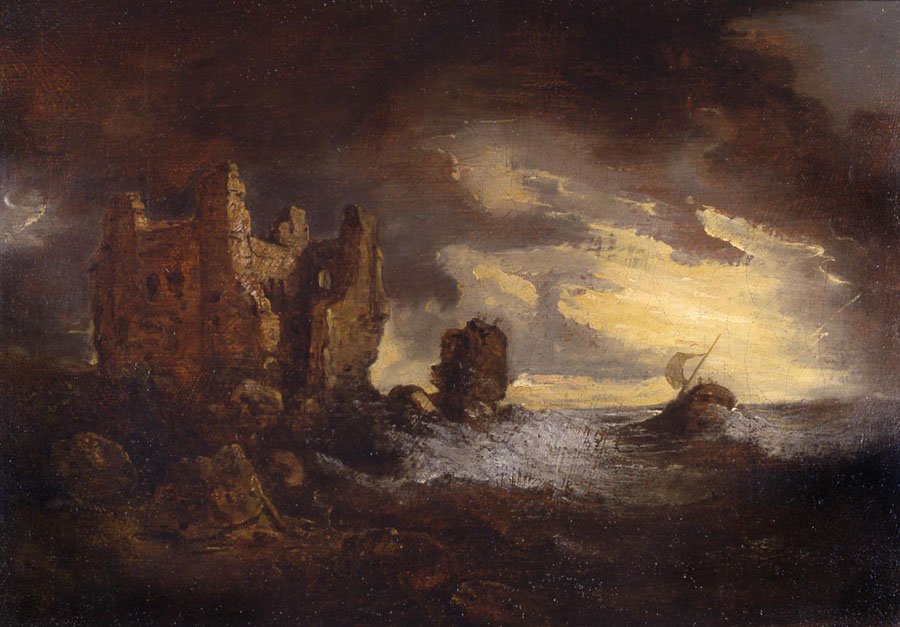
Okay, next one, Elegiac Stanzas. I'll read this one. It's shorter. So it says, suggested by a picture of Peel Castle in a storm, painted by Sir George Beaumont.
Sir George Beaumont was a painter and he painted this castle, Peel Castle, in a storm. And there's like this little sad boat off the coast, looks like it's about to get swamped by the storm. And the castle is being absolutely just rocked by wind and waves and rain. So, like a scary sort of picture of high passions, scary storm.
Wordsworth had spent a summer at Peel by this castle. And he says that when he was there, it was perfect, beautiful weather the whole time. So if someone were to stop him on the street and say, Have you ever been to Peel Castle? The image he has in his mind is like peaceful, beautiful, glassy sea and the tower there.
And Beaumont has painted it completely under a storm, being absolutely wrecked. You found the picture. Yeah. Okay.
Doesn't look like a good day. It does not look like a good day. That's looking rough. So here's Wordsworth reflecting on a painting of this castle getting stormed.
Storm the castle. Storm the castle. Nice. I was thy neighbor once, thou rugged pile.
For summer weeks I dwelt inside of thee. I saw thee every day, and all the while thy form was sleeping on a glassy sea. So pure the sky, so quiet was the air, so like, so very like, was day to day. When ere I looked, the high image still was there.
It trembled, but it never passed away. How perfect was the calm. It seemed no sleep, no mood, which season takes away or brings. I could have fancied that the mighty deep was even the gentlest of all gentle things.
Ah, then if mine had been the painter's hand to express what then I saw, and add the gleam, the light that never was on sea or land, the consecration and the poet's dream, I would have planted thee, thou hoary pile, amid how different from the world, how different from this. Beside a sea that could not cease to smile, on tranquil land beneath a sky of bliss. Thou shouldst have seemed a treasure house divine of peaceful years, a chronicle of heaven, of all the sunbeams that did ever shine. The very sweetness had to thee been given.
A picture had it been of lasting ease, Elysian quiet without toil or strife. No motion but the moving tide, a breeze or merely silent nature's breathing life. Such in the fine illusion of my heart, such picture would I at that time have made. And seen the soul of truth in every part, a steadfast peace that might not be betrayed.
So once it would have been, t is so no more. I have submitted to new control. A power is gone with which nothing can restore. A deep distress hath humanized my soul.
Not for a moment could I now behold a smiling sea and be what I have been. The feeling of my loss will ne'er be old. This which I know I speak with mind serene. Then Beaumont, friend, who would have been the friend if he had lived, of him whom I deplore, this work of thine I blame not, but commend.
This sea in anger and that dismal shore. Oh, t is a passionate work, yet wise and well. Well chosen is the spirit that is here. That hulk which labors in the deadly swell, this rueful sky, this pageantry of fear.
And this huge castle, standing here sublime. I love to see the look with which it braves. Caused me unfeeling armor of old time. The lightning, the fierce wind, and trampling waves.
Farewell, farewell, the heart that lives alone. Housed in a dream, a distance from the kind. Such happiness, wherever it be known, is to be pitied, for it is surely blind. But welcome, fortitude, and patient cheer.
And frequent sights of what is to be borne. Such sights or worse, as are before me here. Not without hope we suffer, and we mourn. Okay, well I'm into that one.
So completely different image. So what's the image, Henneberg? So he's remembering a time when he was at the castle. And he's like, Man, if I would have painted that a bit so nice, but I like this one better.
And why does he like this one better? Because he says the soul that is locked up in a house. Where is it? Farewell, farewell, the heart that lives alone.
Yeah, where is it? It's the second last stanza. Farewell, farewell, the heart that lives alone. Housed in a dream, a distance from the kind.
Yeah, so if you are there looking at beautiful things all day. And there's no toil and no work, and you're just in heaven. That's not what reality is, right? You're not in a good place.
Yeah. Much better to, like, know what is coming and yet have fortitude and hope for it. So he says, old Wordsworth, old Wordsworth, if he could paint, which he can't. He can only paint with words.
So he said if old Wordsworth was going to paint this castle, he would have painted peaceful castle, calm sea, beautiful sunshine, peace, calm happiness from my memory, from my experience. I experienced peace and goodness at Peel Castle, and I would have wanted to enshrine that forever. And then I see a picture of the same place getting absolutely wrecked by nature. And he said his first reaction was like, oh, why, why paint it this way?
Why do this? Why not paint a happy picture? And then he says, no, new Wordsworth is cool with the castle. New Wordsworth looks at the castle and says, yes, that is what we're supposed to be.
A basically the tower in the storm. I love to look at this. What does he say? I love to see the look with which it braves.
Caused me unfeeling armor of old time, the lightning, the fierce wind, and the trampling waves. So he looks at it and he says, yes, old Wordsworth would have done this. Tis so no more, and he says, a deep distress hath humanized my soul. Wordsworth says, something has happened that has caused me to realize that you can't sort of dwell in the happy past.
What you need to be is strong towers. But... Isn't he just being edgy? Yes, kind of.
Explain. Like, so he's saying that, like, there can be no happiness now. Yeah. And because I understand he's gone through a tragedy, and I don't want to downplay that.
But to say that because of a tragedy, all that life has to offer is, like, the misery, difficult times, and hard times. And the only response to that is to harden oneself to be prepared for the buffeting of the winds and the rain. Just seems like he's swung so wildly. Yeah, what kind of armor does he say you have to be in?
Old time. Unfeeling armor of old time. So there's almost like a... What's up?
Been through it. Right, but as opposed to the first poem, which is that we should stir up the right emotions. We should store up these old emotions that we have to kind of uncork them every once in a while to taste and remind ourselves. We now have to remove the feeling in that...
I don't think he's saying this. We need art that reinforces that we should not be feeling. Yeah. Old Wordsworth, so Tintern Abbey Wordsworth says, we need to stay soft in feeling and, like, receptive to the memories of beauty.
And mean people can say mean things, but they'll bounce right off us because we have that mansion of memories. Because I'm thinking about an orchard. Yeah, but new There was something to it. There was something to what he said.
And so this is kind of what I'm trying to tease out. Like, where does he go? Where does romanticism go wrong with this? Because I believe we're on episode 200.
I believe around episode 100, maybe even or before Asher was born, we three talked about doing a walking tour of England. We were going to go do the, what's it called? The Cotswolds. We're going to do the Cotswolds.
And my wife and Thomas, your wife, we're going to go to Bath and go to the spa. And we're going to do a walking tour and we all begged it up. And then you had to go have a kid. Sorry about that.
No, I'm just kidding. And COVID happened. Um, but like, you know, you think of this and you're like, those kinds of experiences. Yeah.
Are these, these beautiful moments that you can go back to and, and when you're sitting around years later being like, oh, that was such a good idea. That was so fun. You're having beers. You're talking about this time.
There doesn't seem, there doesn't seem to be something wrong with that. But there is something about building it up into this edifice of everything that Wordsworth is doing that takes it to that place of, of where, yeah, I think you said it well, where it's like, you're putting a load on it that it can't bear. Yeah. Yeah.
I don't know if this gets at the general question, but I think about this with having children that you'll have some people who like love specific points in the life of a child. They love when the kids are babies and like, oh, babies are great. And they're cute and cuddly. Well, then they grow out of that because kids always grow up.
And your kid is begging you for a phone and gossiping about his friends. Yeah. But so there has to be that balance between, yes, you enjoy the memories, but you also have to love the person as they are right now. And that's, you know, like that's the, that's what you want something of both where yes, you either appreciate or proud of the choices you made in the past, but also you are living a good life now.
Yes. And I think that is the important takeaway is both of these things. Wordsworth is wanting to use. Wordsworth is like, has a relationship with his memory in a way that is, that he's trying to use as a crutch or as a bomb or as a BALM bomb as a or as a nurse.
Right. And so then that raises the question, okay, if I Graham presenting this, I'm thinking that, that both of those methods are not good. Romanticizing, living in the mansion of your memories or armoring yourself into the tower of solitude. But I think both of those things aren't right.
Then what ought our relationship with our memories be? And what I guess utility do they have for our present life for, for us now? We don't, do we forget them? Do we move on?
Do we like not think about them? Because like only, only the moment matters or do we build up narratives about where we came from? I think about, you know, you don't spend too long in a Christian context until someone says, Hey, what's your testimony? How does God work in your life?
And then you're presented with this really strange, difficult situation of saying like, how do I summarize 30 years of experience to talk about a thread of God moving to bring me to some sort of point of confession? Right. Like that's a hard, our relationship with our past and our relationship with our memories is a difficult thing. And so, yeah, so maybe this is, this isn't a very pointed question, but it's like, what should our relationship to our past selves be?
So what's the healthy way? What's the healthy thing? Anyway, it's a hard question. I think one of the things I always try to remember when I'm thinking about the past is that the past lends a rosy gloss to everything, right?
Just like we look at old pictures of hikes that we took with our family. Well, what you're not remembering is that your little sister complained the whole time that you guys ran out of water halfway through, that your legs were tired and that you had, you know, finals the next day or whatever it was. And, but you look at this picture and you think, oh, what a wonderful day that was, right? You will have those.
Sure. But I think I try to keep a healthy skepticism to the way that I remember, remember my past. Well, tell, tell us why you deleted Facebook. I always, I always think about this example as like a good example.
I have lots of reasons. Which one are you thinking? Oh, the one you said when you moved to Austin, you decided to delete Facebook because if you didn't, you would have stayed mentally. Your heart would have stayed in Spokane.
You would have like kept in those relationships digitally. And that felt somehow anemic or wrong or unhealthy. Or it would have, it would have stripped my passion for here. For here.
Exactly. Yes. And so, um, yeah. And maybe, maybe this other piece of the example for Facebook will help.
One of the other reasons I gave it up is because it was a facsimile for, for friendships. So say I wanted to interact with you, right? Well, instead of going and talking to you right down the hall, I could get on your Facebook, look at your pictures, maybe type a little thing and then I'm done. Fart fart wiggle wiggle.
But even if, especially if I didn't type anything, if I just looked at all your pictures, well, I've gotten my fill of Graham, but you haven't gotten your fill of me. Right. And the friendship is actually slowly starving because I'm getting a little bit of you, but there's no real friendship there. And so that's what it feels like is he's trying to return to his experience of a nature that has partially existed for him.
You're getting my best angles though. That's true. I am. But I'm also getting a curated version of you.
That's not you. Right. Yeah. And so he's doing that almost with nature.
The whole never nature, never betrayed the heart of a man who loved her. Tell that to the guy who got eaten by a shark or like drowned or got struck by lightning. Of course, of course she does. And so what I try to do is cultivate an attitude where, like, again, it's a creator, not created.
Right. So if beauty is an outflowing of the divine, well, beauty should lead me to think about and appreciate the divine and the divine will never leave. And, and I can have really good attitudes about experiences that are even rough. Like maybe I get caught in the rain with my family when I'm on the way home.
We haven't eaten lunch. I got to be really angry about it or I can laugh about it. Right. And I think trying to be like, oh, I need to go back to a memory of nature.
I have that will make me forget the ills of this day is living in the past and it's not having a good attitude for the now. I don't think just because we've grown up with it, I don't think we realize how much the photograph and the ability to take a video really does feed into the kind of thing that Wordsworth is talking about. Like he's saying the best I can do is try to capture this in a poem and that doesn't really work. And we try, you know, want to capture everything in a photograph and it also doesn't really work.
Like you can't keep the same feeling that you had when you say, oh man, I really, you know, someone get the camera and take a picture of this kind of thing. That kind of impulse, that desire to keep the ephemeral time from moving on. I think wanting to keep that thing alive is a pretty destabilizing thing because you can't do it. And it's, and uh, so the only experience that's going to engender is either like some kind of anxiety or, or um, or just sort of profound disappointment and disillusionment that like time slipping away.
Well, your memory can keep it. Like I can keep that feeling in my memory, but memory is a liar. That's why you always say it. You can never go back, right?
You never go back. Your memory is a liar. And then over time, the you've, what you have is now the story you tell as opposed to the actual memory. It's the same problem we've talked about when we talked about how do you tell history, right?
How do you tell your own history? You have the same problem that Herodotus has. He was the same problem that anybody has when they're telling history. What is the signal?
What is the noise? Um, yeah. And it's, it's, it's not as straightforward. Yeah.
It's the romantic age that we live in is one that I think the only, it leads you in one of two directions. Despondency, like Wordsworth sort of being bombarded that he can't, that he sort of, um, or looking back and thinking, wow, I was a naive kid back then and now I'm going to like toughen up and like, you know, sequester myself in this unfeeling tower. That's as much a terminus to romanticism as I think kind of like spinning off into, into some kind of like unwound sadness. Like someone who's just totally living in the past and nothing is great.
Like uncle Rico in uh in Napoleon Dynamite. Right. Um, and so for those who don't get the reference, he's living in the past. He's living in the past.
So then yeah. Then the big question I think is,