
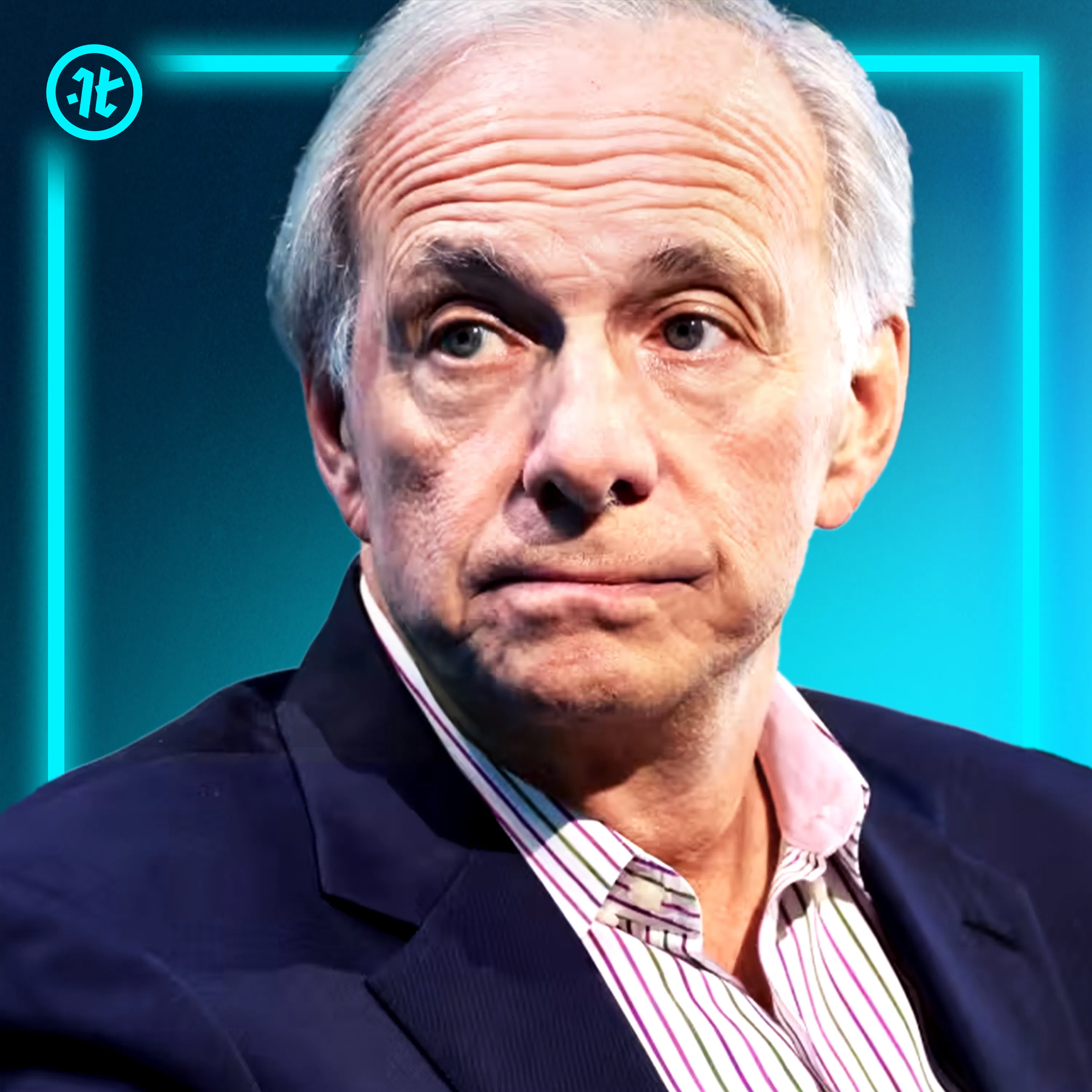
Welcome aboard V-Rail. Please sit and enjoy. Please sit and sip. Play.
Post. Takes. View. And enjoy.
V-Rail. Love the way. Ray Dalio. Every time I sit down with him, I'm struck by his ability to lay out exactly what we need to know to stay prepared.
His insights this time go beyond theory. They are a real roadmap for navigating what's next. So without further ado, I bring you the legend, Ray Dalio. To me, the economy is like a chessboard.
Once you see where all the pieces are, you can get a sense of where you are in the game and what is most likely to happen next in the near term. As you look at the set piece right now of a right-wing populist leader coming into being elected, where do you think the economy goes from here? Everything that happens has causes to make it happen, and so it's like a machine. And so there are five major forces that work together to determine how this thing works.
The change in world order. The world order is changing. Those five forces are, first, a money-credit, money-debt force. In other words, the way that works is you get credit.
That's buying power. It produces debt. You have to pay it back. But the buying produces economic output.
So there's that cycle. You have too much debt. You have a problem. And you have to go through an adjustment process.
There's mechanics to that. The second one that you're talking about is the internal order and disorder changing domestic order. And as you point out, traditionally, there's the left and the right, and that's Democrats and Republicans. And there are times when they're very, very different, and they're fighting to win at all costs.
And that can be disruptive, and how that works is important. The third one is the international order. There's a system of how countries operate with each other. That's the order.
And there's a dynamic for that. Number four is acts of nature. Droughts, floods, and pandemics are a force, a big force. Nature is a big force.
And so climate change and so on is important. And number five is technology. Man's inventiveness that produces technologies, they have an effect, and they all interact. So what you've done, and you brought us back to what is the most consequential development of that second force, this internal order and disorder.
Fortunately, we had a situation where there's a fairly clear mandate, and they were not arguing about the elections. So we've had an orderly transition of power from the left, the Democrats, and so on, to a rather hard right. And so what does that represent, is your question. That represents two important forces.
I'll save them, give the headlines, and then go below that. But first, reforms, internal reforms, to reform the government and to reform the country in certain ways that I'll get into in a second. And second, internationally, for the preparation for war, doesn't mean we're going to have war, but to be prepared for war, and to have a type of war with the rising power, China, and then its allies, China, Russia, Iran, and North Korea are considered that other side. You're going to see the country run, and the government run, a lot more like a capitalist business, in which, imagine a new leader comes in, and you have an old company that's not doing so well.
Maybe that's IBM or Boeing or something. And they're coming in, and they're doing a renovation. And so you're going to see technologies be used, you're going to see a game plan develop to make the government run in a more efficient and cost-efficient way, and you're going to see what we call an industrial policy, which is a policy for the country, the business, to operate that, rather than a purely free market economy. In other words, it'll have direction.
You're going to see deregulation, you're going to see changes in legislation, you're going to see an emphasis for it to be productive and to be effective, with an eye on what that means internationally and the competition. For example, in technology, you either win the technology war or you lose the technology war. The technology war means if you win it, you win it economically. Well, the winner is we'll win it economically and we'll win it militarily so that internationally we have that same competition.
That changes the role of the United States. We have an America first policy, okay, no longer the world order as it was. The world order as it was after World War II was that how do we work with each other in those countries? What are the rules and establishing a rule-based, what we would say also a moral-driven type of world order, in which there are multinational organizations such as the United Nations, the World Bank, the World Trade Organization, the IMF, and all those organizations operating by a set of rules.
That's obsolete now. We now have an America first policy in which then other countries then are increasingly pressured to be with us or against us. And now you're seeing this line up in preparation for what side are you on. So that is the change that we're going to see.
And we are in the process of developing. How disruptive do you think this change is going to be to a potential international conflict? Is this going to see a rise in bricks where that really becomes a threat to the U.S. dollar?
Or do you think that there's a way to do this well where tensions settle down? You're going to have more strong-armed conflict, a much more muscular power and testing of powers and getting around that. You're going to have much less following the United States. It wasn't long ago that the United States only had to hint at some countries what it wanted.
And they would get the message. And they'd probably pretty much fall in line because that was the order and also the power of the United States. Now that's no longer the case. And so you're going to see a more fragmented policy in which most countries are interested in what's good for them and how do they pursue that.
So you're going to see some countries align with one side or the other. And most countries in the world not align and do deals. And so that will be a much more fragmented type of policy. So, yes, bricks will rise.
Bricks countries, which are, let's call them the non-aligned countries, generally speaking, although part of that is China and Russia. That's part of the bricks part of that. But it is the non-U.S. dominated, non-G7, non-European countries that are creating this alternative.
Now, what that will be is they are not all in agreement with everything, but they do think they have one thing in common, and that is to get out from under the American system or to be controlled by the United States. So that lends itself to doing those things that will reduce their control, such as developing an alternative medium of exchange and perhaps an alternative storeholder wealth. I don't think they're going to develop an alternative storeholder wealth, but I do think we have our storeholder wealth, which is treasury bonds or bonds. We're going to have problems with that.
So, anyway, it is that alternative organization that is not the U.S. dominated world order that also, by the way, constitutes about 85 percent of the world's population and now counts. Yeah. And so you're going to see a shift in that direction.
The idea of the United States dominating and being so controlling is no longer going to be the case. It'll be a power. It'll certainly be a great power. But it's the BRICS, each pursuing their own interest in deals in a more independent way.
They do not. The world sees it differently. The United States sees it in the way I just described. In other words, there's internal.
How do I control the internal? And then how do I deal in an America first policy with the outside world? Most of the world says, I want to get involved in your fights and your arguments. I don't care what you want.
You're pursuing your self-interest. And instead, I have my own developmental issues, and I'm not going to follow in the same way. That's the characterization of what it is like in the world. All right.
This is a really classic pattern. So what does this mean for us in the U.S.? We've got a leader now that is going to be very muscular, going to be aggressive, sort of metaphorically, anyway, slapping people around and saying this is how we're going to do it. He's threatened to do 20 percent across the board tariffs.
How does that play out domestically? Does it isolate us from the rest of the world and end up putting us in a position where we can no longer export our inflation and that becomes a dramatic problem for our debt and the value of the dollar? Or is this the posture that needs to be struck right now so that we can re-solidify, bring manufacturing back on board, get the dollar strong? How does this play out?
Think of it as operating as two different systems. And so you're going to have two different technologies in the world, for example. There's going to be a China-based technology. It's going to be an American-based technology.
And there'll be two separate technologies. And the technology is how they're handling their economy? No, I'm referring just to, you know, this, AI, all of those technologies because they are a threat to each other. And nobody wants to trust what's in here.
And they need self-sufficiency. If you're in a war, you can't be dependent on parts or things that are going to come in from other places that could be shut off. So you're going to have this, you're going to see a lot more conflict and you're going to see a lot more economic independence. That is going to undermine efficiency but benefit self-sufficiency.
OK, so the goal is in 2030 to have 20 percent of the key chips be able to be produced within the United States. But think about that. They're being produced in Taiwan, which has this geopolitical thing going on. And that's a scary thought.
So you're going to see that. You're going to see then the support in an industrial policy for enabling that. So there'll be protectionism. There will be tariffs.
Certainly those ideas, that stuff coming in will make it more expensive because you no longer could go to the world supermarket and buy whatever is most cost-effective for you. But it will at the same time develop those industries. This was very much like Germany after World War I or Japan. This is very much, you know, a policy that is a more autocratic, controlling the economy, directing it to be self-sufficient with protectionism and so on.
So that will be stimulating to those businesses. We have a number of businesses which are not their national championship champions, but they may not be the most efficient. And so you will see the desire to bring in capabilities from other countries, producing chips. Boeing has a problem.
The main, you know, where are we going to get it? So you will see foreigners coming to produce within the United States. But it was going to be much more focused within the United States to make it more capable, more profitable and more independent. So that's what that piece is going to look like.
Quick break, but do not go anywhere. You're not going to want to miss what's coming up. We'll be right back with more from Ray Dalio. Let's talk about the most powerful force in wealth building, compounding.
There's a reason people talk about this forever. You put an asset to work, it generates more of itself. Over time, the curve bends way in your favor. Every serious wealth builder knows how compounding works.
Most gold owners, though, have completely opted out of it. Monetary Metals changes that equation. They've built a way for your gold to earn yield paid not in dollars, but in more physical gold. Up to 4% per year, more ounces, stacking every single month, compounding in one of the only assets that can't be printed, inflated, or debased.
And storage and insurance are included, by the way, so hidden fees don't eat your yield. The average person is passively absorbing inflation. This is how you compound your way out of it. Click the link in the show notes or visit monetary-metals.com slash impact to learn more.
This is a paid advertisement. Let's talk about money you're leaving on the table. Every time you pay full price for a health product out of pocket, you could be missing out on 30% savings. There are over 40 million HSA accounts in the U.S.
holding $159 billion in pre-tax dollars. That's where TruMed comes in. TruMed helps qualified customers use pre-tax HSA dollars on health products that can qualify as medical expenses under IRS guidelines. You complete a health survey.
TruMed handles the documentation and the purchase. And you can save an average of 30% on products like 8Sleep, Peloton, AG1, and others that studies show can treat or reverse many common chronic conditions. Stop paying full price for products your HSA was billed for. Go to TruMed.com slash impact and check out what things you want that may qualify.
It takes just a couple of minutes. TruMed is for qualified customers only. HSA, FSA, tax savings vary. Let's talk about the worst investment most guys make on repeat.
Cheat clothes. You buy them, they look fine. But six months later, they're pilling, shrinking, or just falling apart. So you replace them.
You do it again and again. You're spending more over time and you never actually have anything worth keeping or wearing for that matter. That's the whole model behind twins. I've got one of their 100% Pima cotton tees and the quality is immediately obvious from the second you pick them up.
They're soft, well-constructed, the kind of thing that holds up over time. And that is the point. Refresh your everyday with luxury you'll actually use. Head to quince.com slash impact pod for free shipping on your order and 365 day returns.
Now available in Canada too. That's quince. Q-U-I-N-C-E dot com slash impact pod for free shipping and 365 day returns. Quince.com slash impact pod.
All right, let's pick up where we left off. Okay, so to me, the vote recently was the revenge of the working class. It was people saying that my wages have not gone up in real terms since I think the 1980s. They're feeling that they, I think, that the average person, if they don't believe that their child's future is going to be better than their present, that you run into this anger, frustration, and people lashing out.
So given that that's the setup internally, as we begin to do in America First policy, as we begin to make things more expensive by putting on tariffs, even though I get the long-term play of we need to prepare for it, a war that may or may not come, but we have to be ready for it. And so we're going to do things that increase the cost of goods, but make us more resilient. How is that populace going to respond? Are they going to get more pissed in the short term?
Because it's like, hey, you're actually making things worse. I think it depends. I will make the argument for what those who are creating this and behind this would say. I think they would say, first of all, that the tariffs can raise a lot of money and they can raise a lot more money than wealth taxes, for example, or some of the other taxes.
And so they have two benefits. They will bring in tax money and they will create a protected environment. And if we and so, yes, that'll mean higher goods prices. But if you take that tax revenue and, you know, in a sense, taxes are a type of inflation.
If you raise taxes, it's a type of inflation on people. OK, and that might not be in the consumer price index, but it's taking money out of the pockets of people in the form of taxes, too. So they would then say that what we will do is we are going to improve productivity in the United States by these operations. We're going to enable, but we also are going to improve productivity.
And so those improvements in productivity will help to offset the higher cost of tariffs because money moves around that way. So if I can get a dollar out of a tariff or I can get a dollar out of taxes, I have to think, where am I going to get the most dollars and what is getting it mean in terms of taxes and what am I going to do with that dollar? And so there's a belief that by running the country like a company, in a sense, to be able to make it productive and to by supporting that, we will get self-sufficiency, we'll get greater security and we'll get greater productivity, which will make the country better than if it's operating highly inefficiently depending on imported goods to be cheap. Fair.
So let me ask you from the economic side of this, modern monetary theory would say print more money and give them more resources. Why doesn't MMT work in reality? It doesn't work in reality because there is it's a very basic thing. There's a debtor and creditor.
OK, the creditor has savings. And so in saving, they want to receive a return on their money. And if that money does not provide them with a real return, they'll put it into something else, gold, something else and so on. So you have to have interest rates that are high enough so that the creditor gets a good return, but not so high that it breaks the back of the debtor.
And when you have a lot of that debt and so on that balancing act, because one man's debts and another man's assets, you have that balancing act that becomes more difficult. When you print money, you do not make productivity. You just make more money. Money doesn't have any value.
OK, the more money you make, it's OK. Double the amount of money. Wouldn't it be wonderful if we just double the amount of money and then have benefits from it? But it doesn't give you anything, really.
OK, it's only productivity that gives you something. So the idea that I'll print more money and give it away is a transfer of wealth, essentially, from that undermines proper lending of money because that balance has to be taken care of. Are you wastefully producing the money or are you productively producing the money in the cost like anything else? Make it free.
OK, and you're not going to have it well handled. It's going to produce more inflation. So and if you are in a position where you make interest rates not high enough for the predator and not that balance, then what you're going to have is inflation. You're going to have that money coming up.
And worse than just a new supply of money is that people won't want to hold the dead instruments that they're holding, because the way that storeholder wealth is when you hold a bond, you get this money that everybody's printing and it's going to go down in value. OK, and you don't want that. You'd rather hold it in some things that are going to hold their value. And that's basic.
OK, this this is so fascinating. Very helpful. This is actually beginning to clarify my thinking on this moment. You've talked about there needs to be a Manhattan project for the economy that you want to get the smartest people that the U.S.
can get their hands on and sit them down and give them the grand task of I think what you're referring to is the beautiful deleveraging that we have so much debt. There's so much inflation that we have got to find a way to tame this. What would the Manhattan project look like? What would be the state goal?
What I would have liked best is the recognition that the majority of the people have to be behind policies. You need reforms. You definitely need reforms. You need broad based reforms that includes things that have not been mentioned in this plan, such as education.
The most important thing that you need, I believe, is quality education that provides broad based skills and also teaches civility so the country operates well and creates. But anyway, whatever. So that we have we cannot simply get there if we don't have a policy that is that everybody believes in that you work towards. So my idea of the Manhattan project was to get the most skilled people from both sides, not the extremes, but the extremes frighten me because you have a war between one set of extremes and another set of extremes.
It's not going to be good. And you can't neglect a population that is going to perhaps be neglected by these types of policies. Capitalism will not do it all. So as a result, my Manhattan project was working, making bipartisan.
What I would have preferred is a is a bipartisan cabinet, by way of example, to be able to bring together the smartest and the best. And then you engineer how do you create the reforms and you get the majority of people behind it. So that's what I meant by that type of Manhattan project. But we are going down this path.
And, you know, many people believe that this is the path, just like people believe that the other path, the democratic path would have been a different path. So we're on this path and we hope that that path is successful in making those renovations to be able to raise productivity. We certainly need renovations. And if it delivers, then people will be happy.
I am worried about the areas that they won't deliver, but that's always part of it. And this is the plan. And so we, you know, everybody can argue about the plan so much so that you can't execute a plan. Okay, this is the plan.
And, you know, I hope they do well. You are having in the particular appointments that you're having is non-compromisers. You are having extremely loyal and black and white of strong people who will not compromise much about anything. And so that's what's going to happen over that administration.
And in order for them to achieve their goals, they're going to have to prioritize. There are a number of things they want to do. The first hundred days of an administration is very important in terms of what's accomplished. And certainly the first two years is critical because there are midterm elections and everything can change depending on how that goes.
And so you're going to have to see prioritization of things. How much, what are we going to do in immigration? What are you going to do in trade and tariffs? What are you going to do in technology?
What are you going to do in energy policies and industrial policies, capital markets, deregulation? All of those things are on their list. They're going to have to now, these aspirations are going to hit the realities and come in conflict with those realities. Laws will have to be changed.
And to change laws is complicated and so on. But there's a determination that some of these things, most of those things have to be done in that period of time. So I think you're going to see very forceful actions during that period of time and prioritization. You said that there were certainly things you were worried about.
We'll see how they play out. What are your biggest worries? What could the non-compromisers get wrong that would be very problematic? I think they could overdo things in a way where the thinking of some parts of the population who are left behind and are not benefiting from that could be important.
I think that they're forgetting about education, for example. I think the most important thing to reform is to affect children at a young age to be able to be a good character and good capability. And I'm seeing that education is not going to be pursued. And I think that there can be such an alienation of the other side that, you know, that that becomes a problem in the longer run.
So, but I understand that perspective, you know, and that they have to make those decisions and get them through. And that's what a renovation looks like. If you would take a company, how do you renovate a company? You might cut back a lot on the workforce.
You might create lots of disruptions to get that company in good shape. And that's basically what the attempt is going to be by people who think who have done those things and are inclined to do those things. So the people part of it, the establishing a minimum standard, let's say, of education and civility. You know, I'm very much exposed to the poor, underprivileged people.
I'm in Connecticut. My wife works to try to help those who are living in school districts and areas where there's gangs, there's poverty, there's terrible education, there's it's environment that if I was to live in those environments, I would be a revolutionary. And, you know, how do you establish that foundation that nobody falls below, that there's a certain level of sin? How do you deal with that?
I don't think that that's going to be well dealt with. But, you know, tough choices are going to have to be made. And those are the choices that the new leaders are pursuing. And so I've answered your question about what I think some of the risks are.
Time for a short pause, but stick around. You're not going to want to miss what's up next with my man, Ray Dalio. And we're back. All right.
So if Elon and Vivek come in and start hacking and slashing away the government and reducing either size of the department or eliminating departments altogether, do you think that would be recessionary or is that going to free up human capital to go into the private sector? I think the key is whether it improves productivity or worsens productivity. It's how that's done. For example, if you introduce, it has consequences, but let's just imagine you introduce technologies, you get rid of a bureaucracy that stands in the way of progress.
I'm not painting the good one and so on. And so it's like a company that all of a sudden doesn't have a bureaucracy, doesn't have waste and has technologically advances and it produces things more efficiently. That is good for the company. The country as a whole did that, but that would be good.
But it still creates a situation where what are you going to do with the people who are useless or nearly useless? What are you going to do with those? So it hasn't answered that question. If it is not working that way and not effectively done, it'll be disruptive without those benefits.
So I think, you know, I admire, maybe it's not exactly the way that I would do it, but I admire the attempt to make that kind of revolution, them believing that that is the best way to do it. And I can tweak it, but I would say productivity per person, broad-based productivity is the most important. They are emphasizing productivity. I'm not so sure that they're emphasizing broad-based productivity because broad-based productivity means that each person is productive and then that productivity gives them their income.
So the broad-based part of it is of concern to me, but productivity is a good thing. And so it's worth their drive. Okay. Broad-based productivity, is there any way to get to that other than educating the young?
Like, is there a way to take the adult who now is going to be wildly disrupted if they're a government employee, they get ousted from their job, they have to find their way in the public markets. Do you think you just sort of have to set that aside and like focus on the youth? Or do you think there is a way to get current adults broadly productive? You have to, and that's what I worry about not being adequately tended to.
You have to deal with that population. So let's, the question is, is there a way? But before we get to a way, I would say you must find a way because if you make a lot of useless people, you're going to have your, the same kind of problems and worst problem with all of those useful people, not good for them. And they're going to be disruptive to the society.
So you must find the way. And I worry that there's not enough attention to being given to that issue of finding the way. So now, can you, I'm not an expert on jobs programs, you know, and how that works. And I'm not a big believer that the government is the best, most creative ways of, you know, government efficiency is a Nazi moron.
So when you, you know, would you like your whole government to work the way the department of motor vehicles works? You know, it's, it's a problem. So, so how you do that, is not, is being neglected. And I think that's a basis of a problem.
So, and young people, yes, that's being neglected. How you do that at a young age. And I'm saying you have to teach them two things. You have to educate them the skills.
We have measures in the world called like PISA scores. Where's the United States for the average school? We have 60% of the population has below a sixth grade reading level. You have to improve that education.
And you also, not just in the formal education, you have to teach civility, how people can come out and work well together to be productive. And those are the areas that are being neglected, in my opinion. Okay. So before we go down the education path, talk to me about the, so this group that is potentially going to get disaffected, if we start reducing the size of the government, focusing on efficiency, we know that we have to deal with that population.
Let me give you a terrible idea, just spitballing here. And you tell me how we potentially make this good. And heard you're not a jobs expert. However, when we look at economic policies that are likely to create opportunities in the private sector that they can be absorbed in, because I'm making the base assumption that the private sector is going to be far more efficient with human capital than the government.
So I buy into the idea that if you release them from the inefficiency of the government. job, as long as there's proper incentive in the private sector to onboard them, you could really make use of them. Would something like leveraging tariffs instead of income tax, is that like an absurd idea and we're never going to be able to get rid of income tax? Or is that the kind of thing that could be so stimulative that we could then absorb those people into the private market?
Well, you're talking about two things, where you get the money from and then what you do with the money. So where you get the money from, tariffs, as I mentioned, if that money that you get from tariffs is used to raise productivity better than taxes, that's a good thing. What do you do with the money? The question still remains though, what is the plan to do with those people?
Let's say artificial intelligence will replace a lot of people. People get upset about the Chinese imports and the Chinese imports are less impactful in jobs than technology. And they're also giving you a cheaper product that has some benefit because you can more cost effectively get it. When you have technology replacing jobs, that can make the items more cost effective, but it also can disrupt jobs.
And so we still come back to your question of what is the plan for those people of any age later or earlier? What is the plan to do with them? And who is going to execute that plan? That's what's missing.
And there are no easy answers. Does the government do it? Well, the government is not very efficient in doing things. And what does that mean?
But anyway, the government won't do it. So we have those consequences as a result of this. And we just have to realize that that's, that would be the type of thing that if I was saying a Manhattan project, it would be that kind of examination of what is the plan for those people. What I'm trying to put my finger on is there's a euphoria in the markets since Trump was elected.
There's a sense of, I'm going to guess, this is my read of the situation, that people are looking at this and they're saying, okay, here is somebody that's pro-business. They're going to be deregulating. They're going to be reducing the scope of the government. If anything, they're going to reduce taxes.
And so people are saying, okay, now there's going to be massive investments into businesses. That's going to make the stock market go up. They're also pro-crypto. So there's going to be more innovation on that side as well.
And so you see Bitcoin is mooning. You see the stock market is going up. Now, I don't know if that's pure optimism or if mixed into that is a belief that Trump is also going to continue to print money, continue to deficit spend. And so they also need a place to sock away their assets.
So I'm not quite sure what the best way to read this is, but if it's the first one, and this is just optimism, there's going to be deregulation, reduction in taxes, massive investments in the business, that feels like a very hopeful signal when you think about people losing government jobs and needing a place to go into the public markets. Do you think that's a misread? I think everything that you said up until the last part is perceived, and I agree with that kind of assessment. So what I mean is there'll be less taxes.
It's more capitalist. It's good for the markets. There'll be more efficiencies. It's all of the things that you said, but it still doesn't, and there'll be, by the way, both of your scenarios, there'll be more, there can be deficits.
It'll be monetized by the Federal Reserve, and one way or another, they'll control the interest rates, but they'll print more money in order to do that, and there'll be things happening. Okay, you've done a good summary. It still doesn't tell me how that's going to deal with those people. Okay, so the only thing I have for you at this point is something very vague, which is if private sector is stimulated, then more jobs, and therefore anybody leaving the government sector that wants a job is more likely to have that opportunity.
I don't think so. I don't think so. I think there's the government, people leaving, and then there's the vast majority of the population who are being disrupted for other reasons, such as technology having efficiencies. In both cases, you're going to have technologies increasingly replacing people.
Now, you're going to break the world into two types, by and large. There's about 3 million people who account for most of the benefits of the new technologies, the unicorns and such. It's a wonderful environment. If you go to the great American schools that are these rarefied environments where you're among the brightest, and you learn, and you come out, and you get jobs, or a lot of the people, and half of the people are immigrants who are very talented from different countries, and 3 million people, about half of which are immigrants, are really doing amazing technology work, and creating unicorns, and so on.
And that's a country of 333 million people. So how we broaden that, there will be those who invent the technologies that do very well, and then there will be a lot of people who will be disrupted. And they're not going to be able to just go from a government job, in which they're operating a certain way, into the workforce. And, you know, okay, what's my background?
Government bureaucrat. Okay, now I'm, you know, a 52-year-old government bureaucrat looking for a job. I don't think that there's going to be, you know, a great job market for that, those people. And that's the government part, and then there's the others who will also be disrupted.
So there needs to be, there needs to be attention paid to this. Okay, there needs to be attention paid to this. Fortunately, fortunately, the government is not great at this, because also, you know, it's like the private, the private sector wants efficient people, not people who are like that, by and large. And the government is not good at disconnecting themselves with the companies.
They can train a lot of people, you can spend a whole career being trained in this program and this program, and never end up being productive. So that's a problem. That is a problem. So in my darker moments, where I'm just being blunt with myself, the thing I would say is, anybody that is unable to make themselves productive in the private sector, you just have to give up on.
Like, your only other option is every kind of social safety net. Once the social safety net gets put in place, then people are groomed to find a place in the social safety net, instead of being groomed to find a place in a productive workforce. I don't see a way around, other than slowly finding a way to let the markets decide who has value and who doesn't. And it sounds gross to say, but I don't see a way around that.
Do you? Like, is there a lesson we can learn from Singapore, or has Lee Kuan Yew solved this problem? I just don't know. Yes, yes, yes, yes.
The answer, the answer start with how you educate your young people. When they get older, and they're ingrained, and they don't have the capabilities, or they don't have the civility, you have people who are very difficult to make useful. And it's roughly a 10-year cycle. 10 years is not very long.
But having excellent education, establishing a bottom, so that everybody, I think the most important thing to change and improve a society is to have an education system that the majority of the people can have a bottom in their conditions to be educated, and to live in a civil environment, that is the lesson not only in Singapore, but it's a lesson throughout history in all places. Think about you, and those around you, and the generation of raising children. Think about how you were raised, and raising children. The most important thing is raise your children well.
Okay, the children, they learn these things in early life. They learn their approach to life, and an early age. And so they're not only to get the skills, but they get the approach. You know, ethics, behavior in the society, not to, if you're raising children in an environment where there are guns, and shooting, and drugs, and stealing, and you make your money because you do those things, and then they grow up, it's very difficult.
So I do believe that the lesson of these places is that you should make those things go well, rather than deal with them going poorly. Why does America have a hard time imparting its values from one generation to the next? There are a few reasons. First, each value comes from the particular parents that have the biggest influence on those values.
And we are living in a society in which there's competitiveness also determines the resources that you're living in. And we have a society in which, by the Constitution, education, formal education, is a state issue, and then it comes down to a tax district issue within the state. So what you have is a situation where if you don't have the parents, and you're in that environment, let's say, for example, I live in Greenwich, Connecticut, and the public school system, I think the average per student expenditure is $28,000. In Bridgeport, Connecticut, which is 10 minutes up the road, and they don't have money, the average expenditure is something like $14,000 in school.
And then they need more money, because it's not just the amount for education, but if you buy them a computer, you have to buy them a computer. School doesn't provide that. So some get computers, and some don't get computers, and such things. And they're living in an environment where there's drugs and shooting and all of those things.
And that's a more traumatic environment. So performing that is more difficult and expensive. You have those two different kinds of environments. So who are your parents?
How do they raise you? Do you have the education and the civility? Do you have those resources? These are the fundamentals and the basics.
So the answer, why don't we learn? Your question was, why don't we do that? Why don't we learn? Well, that parent who is now maybe drug addicted at 14 or 15 years old becomes the parent.
What kind of parent are they going to be? So you have this spiral that worsens. My wife, who deals with this issue, sponsored an examination in the state of Connecticut and looked at, you know, who are they and what are the costs? And it was BCG.
She hired BCG to do the study and did this examination. And it showed that besides this human tragedy, as I say, in the state of Connecticut, 22% of the high school students have either dropped out of high school or are failing classes with absentee rates of greater than 25% in the state, which is always number one, two or three richest state in the country. Okay. Because of that, that has created almost a plague that has then caused crime and incarceration.
They're spending $700 million a year on incarceration. Okay. So it's been shown that it is so cost effective that if you didn't even care for the people and you were just saying, what is it costing the society? It's costing the society a huge amount of money that if you fix this thing, if you would deal with those things, then all you would do have a fair society for education and so on, but you'd save money and you have a more civil environment.
So that in that environment, there's greater safety, better community. People want to be there. So that's a reality. So that is, so I'm just trying to answer your question.
If your parent was one of those parents, you'd be raised that way. Yeah. I've seen this problem up close. So as somebody who's in manufacturing and long personal story is why I spent so much time in the inner cities.
But to me, it seems pretty blatantly not to be a money problem. It is an ideas problem. The problem is to your point, the place you get your ideas from your parents, your parents got bad ideas and it becomes a self-fulfilling prophecy. Zooming on education.
So the hope would be that kids walk into school as a kindergartner and we start educating them well. We're not doing that currently. The department of education is coming under increasing scrutiny. What are your thoughts about the principles that make, and I don't want to put words in your mouth for me.
I look at that and I go, if you have a system where you can't fire people that are underperforming, if you have a system where you don't hold people accountable to KPIs, of course, that system is going to derange. But you have to fundamentally make it to the best and the brightest, make it to the top, that they get paid a competitive wage that attracts high caliber talent and not just people that have a big heart. What do you think is, how would you actually, I would say everything that you've said is true, but there's much too much emphasis on that relative as being the problem relative to the fact that the amount of, there are teachers, many, many wonderful teachers who are, are having to be in these environments and are under, under-resourced, um, not appreciated. They're going through, they take money out of their own pockets to try to give things that, you know, they're not in some of these schools, adequate, basic things like pencils, and they'll take money out of their own pockets.
So we pour money into the system, would it solve it? Sorry? If we pour money into the system, would it solve the problem? Um, we're dealing, no, I think you need both.
Okay. Um, uh, you, when you're describing it, you're describing it as a one dimensional problem. Okay. Meaning as I hear you that there were lousy teachers, you're not holding the KPIs and so on.
And I'm agreeing that that's true, but to characterize that as a one dimensional problem and not deal with the other part of the problem is a mistake in my opinion. And that other part of the problem, for example, in COVID, there were 60,000 students who would not get computers. That would mean that they would not get education. Okay.
Okay. So, uh, wait, fortunately we have the resources. We bought the computers, but if we didn't buy the computers and get the computers, connectivity, they don't have connectivity. So when you're dealing with the other part of that issue, which is that deprivation, $14,000 versus $28,000 in an environment like that, if you yourself were in there and you were a teacher, I know people who are wonderful teachers who are in those environments and so on.
You have no idea how hard it is because of those things. So when you ask me, um, with pouring money into it, the help, let me say with, um, pouring money into some things like basics, like, okay, every child has this basic set of circumstances. If you take the good teachers who are. doing an excellent job and you distinguish them from the bad teachers and they are doing an excellent job, you will have a better system, a better education system.
I'm not the guy to fix the education system. I'm not telling you, but I'm just saying that when I look at it up close, it's not as simple as sort of saying that, you know, there are bad teachers. And so what you do is you have to let me ask you. I'm hearing you.
I agree with you on that, but you cannot ignore this other part of it, which is the starvation of resources and the general environment that they're living in. Food. I mean, the kids come to school to get the food because they don't have enough at home in their various ways. These are issues.
You know, I agree. And in my own defense, I was merely trying to set you up to give your take versus giving my whole take. But where I come at it from is you have a system where even if you pour money into it, I don't think it's going, even though I agree with you that you want parity across the board. But if you look at some of the things that are going on with the charter schools, they don't come in and solve the problem through money.
They come in and solve the problem through a value system and the value system alignment of discipline, focus, hard work, expectation. We agree on something. No, no, I merely wanted to put forward that I agree with you. It's not as simple as I think the problem is.
So now we agree on that point. And now let's go back and step back and say that won't happen. Okay. So we can, I think we're in agreement or we could debate the question of what should be done, but now let's step back.
And when we're talking about the changes that are taking place, we have to recognize that not that won't happen. Anyway, dark, sad, depressing, but this conversation, if I'm understanding it is to look at the pros and cons of the, of what's happening. The pros are, you're going to take on reform and you're going to, you know, and, and, and that can have a lot of beneficial effects in a lot of different ways. And then the con is what we can do all the time, but that is not going to happen.
There'll be no changes and material improvements of taking that thing that we're talking about, taking that on to make that better education. Then that's going to be a con. I'm not moralistically doing this. I'm not idealistically doing it.
I'm just analytically doing it. Okay. And that's what it looks like, right? Ray, I cannot tell you how much I cherish my time with you.
I know you have a new initiative going on. I would love you to tell me and my community a little bit more about it. Well, I think you're, it's, it's not a new initiative, but I'll tell you, I think you're speaking about, um, the, um, charitable gifts. Okay.
So the specific name is Tisbess. Okay. Tisbess is a vehicle. Let me, let me describe this about 20 years ago.
Um, I didn't like typical giving at Christmas because people waste so much, you know, they buy the junk that they give us Christmas gifts and so on. Um, the amount of giving of candy at Christmas is greater than the amounts of money, the annual budgets of the American Heart Association, American Cancer Society, and Habitat for Humanity combined. Okay. Because somebody's got to give candy and it becomes decadent and so on.
And so it occurred to me about 20 years ago, more than 20 years ago, that if I know that you're charitable and that I would, if I gave you a donation to your favorite charity, that, um, that you'd appreciate that as a gift, not my favorite charity, your favorite charity, and that you would appreciate that as a gift. And we together could give that. And, and the benefits of that is it goes to those who were excited to have it go to, um, if you're not charitable, it's not a good gift, but if you are charitable and it also makes the holiday spirit more in keeping with the holiday spirit, and it's a whole lot easier shopping to do. And, uh, and it's tax deductible too.
So, I mean, like it's got a lot of benefits. So, um, anyway, um, so I, I gave a lot of those out and 20 years ago, I started a campaign for how to do that for individuals and companies, because I found out it was great. And then when I did that, um, it, it caught on. And, um, so 20 years ago, I started to initiate that about five years ago.
Um, I found this organization TisBest and TisBest, it makes that really easy. I used to send out checks. They were basically blind, blind checks that they would fill in who descended to. But this now organization is fantastic because it has all the charities you can imagine on it.
You put that in, they will do all the work and get it out there. So five years ago, I started to do that. And as you know, very well, because you've been also helpful in this regard, uh, that what happens is, um, um, what we do is we introduce that to people. So, um, every year, um, a few of my friends and I, um, want to give that experience out to people.
And the way we do that is we give away money. Um, it could be, uh, we figure out every year, maybe it's a million dollars, maybe it's a few million dollars, um, to people for that purpose. In other words, you can go sign up and you yourself can get the money to go to your charity, or you can take that and give it to somebody else to go to their charity charity. And so it doesn't cost you a nine.
You just go through that experience. And we've done this. Um, we're going to do this again this year. Um, by the way, the money for the charity goes in about five minutes.
So people want to pay attention and they pay attention to it because even though it's a significant amount of money goes very, very quickly. And, uh, that experience has turned people on and turn companies on to doing that practice. So I want to bring it to attention that this is a great way for holiday shopping in many, many ways. It's a great way for holiday shopping for the recipient who is a charitable person.
I love it. Ray, thank you for sharing that with us and sharing your time to talk about this, uh, very fascinating economic moment. As always, thank you for joining me, man. I appreciate it.
Huh? It's always a pleasure. You're a force for good. Thank you.
Oh man. Same to you, Ray. All right. Take care.
All right, everybody. If you haven't already, be sure to subscribe and until next time, my friends, be legendary. Take care, please. Let's talk about a pattern that is guaranteed to be killing your progress.
You know what you need to do. You need consistent nutrition. We all do. You need vitamins, probiotics, greens.
We all know that we should be doing more of it. When your morning gets chaotic, you skip it. When you travel, you skip it. When your routine breaks, everything tends to break.
And that inconsistency compounds against you every single day. AG1 is designed to solve the execution problem. One scoop, eight ounces of water, and you're done. You're getting 75 plus ingredients, vitamins and minerals, pre and probiotics, nutrient-dense superfoods, everything that used to require six, seven different supplements, and perfect planning now happens in one drink that takes about 30 seconds to make.
Right now, AG1 is giving you $87 worth of free gifts with your first subscription. You get a welcome kit, travel packs, vitamin D3 plus K2, and flavor samples. Click the link in the show notes or visit drinkag1.com slash impact to claim this offer.