
EPISODE · Feb 7, 2026 · 31 MIN
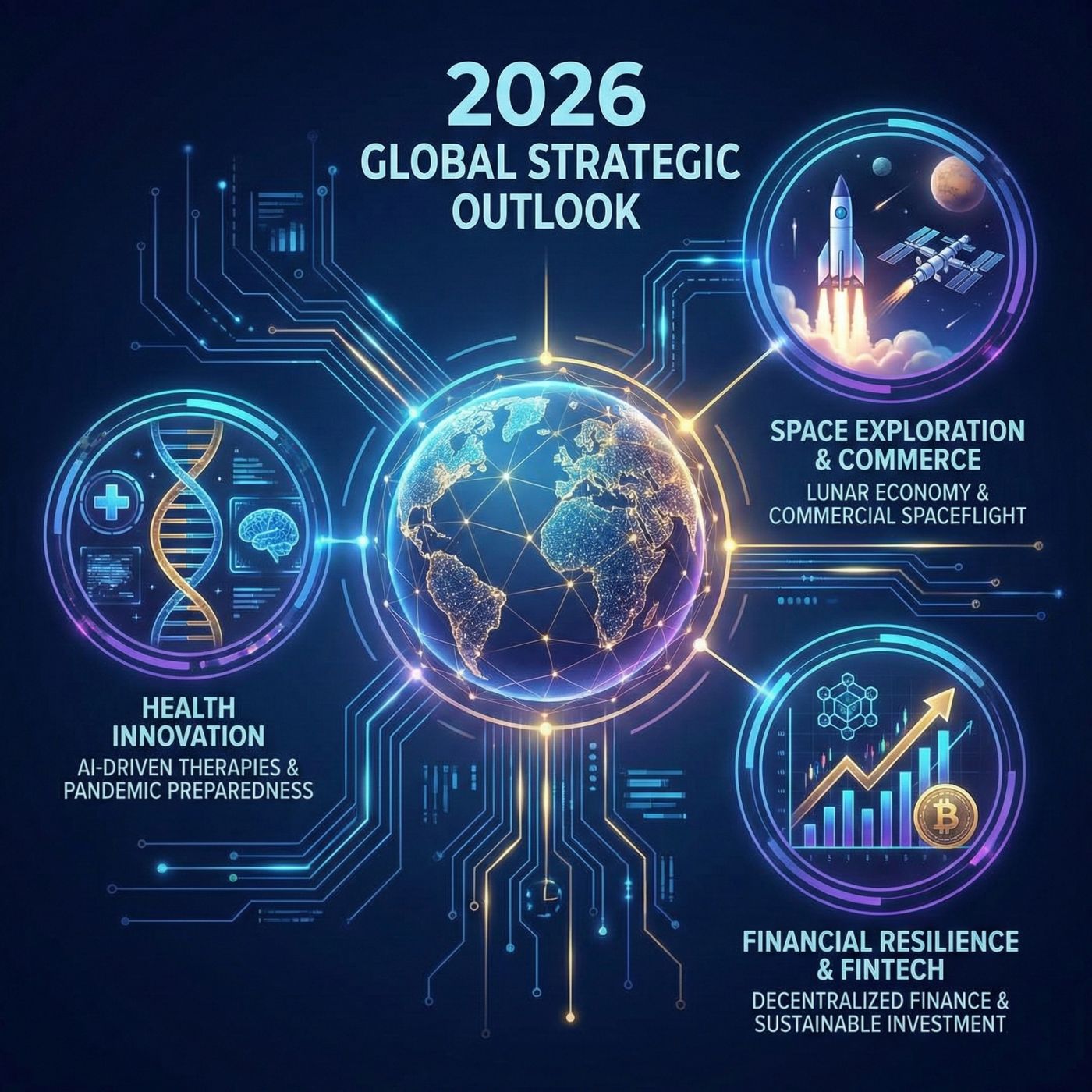
2026 Global Strategic Outlook: Health, Space, and Finance
from The World Between Us · host Norse Studio
The year 2026 is characterized as a pivotal era of transition, where artificial intelligence (AI) evolves from a trial-based tool into a collaborative partner, space exploration moves back toward crewed lunar missions, and the global economy demonstrates resilience despite mounting trade tensions.Global Economic and Trade DynamicsThe global economy is projected to grow by approximately 2.7% in 2026, a slight decline compared to 2025 levels and below the pre-pandemic average. While the post-pandemic recovery was the strongest in six decades, a sharp divergence persists: advanced economies have recovered robustly, while one in four developing countries remains poorer than before 2019. A major milestone in global trade is the signing of the EU-Mercosur Free Trade Agreement on January 17, 2026, which creates one of the world’s largest free trade zones encompassing over 700 million consumers. This agreement aims to eliminate or reduce tariffs on over 90% of bilateral trade, specifically benefiting industrial goods like cars and machinery while securing EU access to critical raw materials such as lithium and manganese. Simultaneously, Gulf monarchies are consolidating their roles as global middle powers and logistic hubs, engaging in high-level diplomacy with Washington, Beijing, and Moscow. However, their ambition for regional stability is hampered by resurging armed conflicts in the Middle East.Technological Innovation and AI IntegrationIn 2026, AI is no longer considered optional for organizations; it has shifted toward real-world impact and orchestration. Strategic trends include the rise of AI-native development platforms and multiagent systems, where modular AI agents collaborate on complex tasks to improve scalability and automation. Microsoft highlights the shift of AI becoming a "digital coworker," allowing small teams to handle massive data-crunching and content generation while humans focus on creative strategy. Software development is also being transformed by "repository intelligence," where AI understands the history and context of code libraries to catch errors early and automate fixes. Furthermore, 2026 marks an era where hybrid quantum computing begins to solve problems classical computers cannot, particularly in materials science and medicine.The Transformation of Global Health CareHealth systems are increasingly prioritizing revenue, workforce productivity, and care model transformation. A critical challenge is the aging population and the projected global shortage of 4.5 million nurses by 2030, which is forcing hospitals to adopt AI tools to boost clinical efficiency. Interestingly, there is a divergence in focus: 38% of non-US health systems are prioritizing preventive care and early detection, whereas US systems remain largely incentivized by fee-for-service models that emphasize volume over prevention. AI is also moving beyond research into real-world diagnostics; for instance, Microsoft's Diagnostic Orchestrator has demonstrated solved complex cases with 85.5% accuracy, significantly outperforming physician averages.Space Exploration and AstrophysicsThe year 2026 is a landmark for spaceflight, highlighted by the scheduled Artemis II mission in March, which will carry four astronauts around the Moon—the first crewed lunar flyby since the Apollo program. Other major scientific missions include the launch of the Nancy Grace Roman Space Telescope in September for exoplanet searches and the Pandora telescope to study exoplanetary atmospheres. In solar system exploration, the BepiColombo mission is expected to enter orbit around Mercury, and the Hera spacecraft will arrive at the Didymos asteroid system. However, the year has seen setbacks, such as the first-ever "controlled medical evacuation" from the ISS involving the Crew-11 mission in January. Hosted on Acast. See acast.com/privacy for more information.Become a supporter of this podcast: https://www.spreaker.com/podcast/the-world-between-us--6886561/support.
Embed this episode
NOW PLAYING
2026 Global Strategic Outlook: Health, Space, and Finance
No transcript for this episode yet
Similar Episodes
No similar episodes found.
Similar Podcasts
No similar podcasts found.