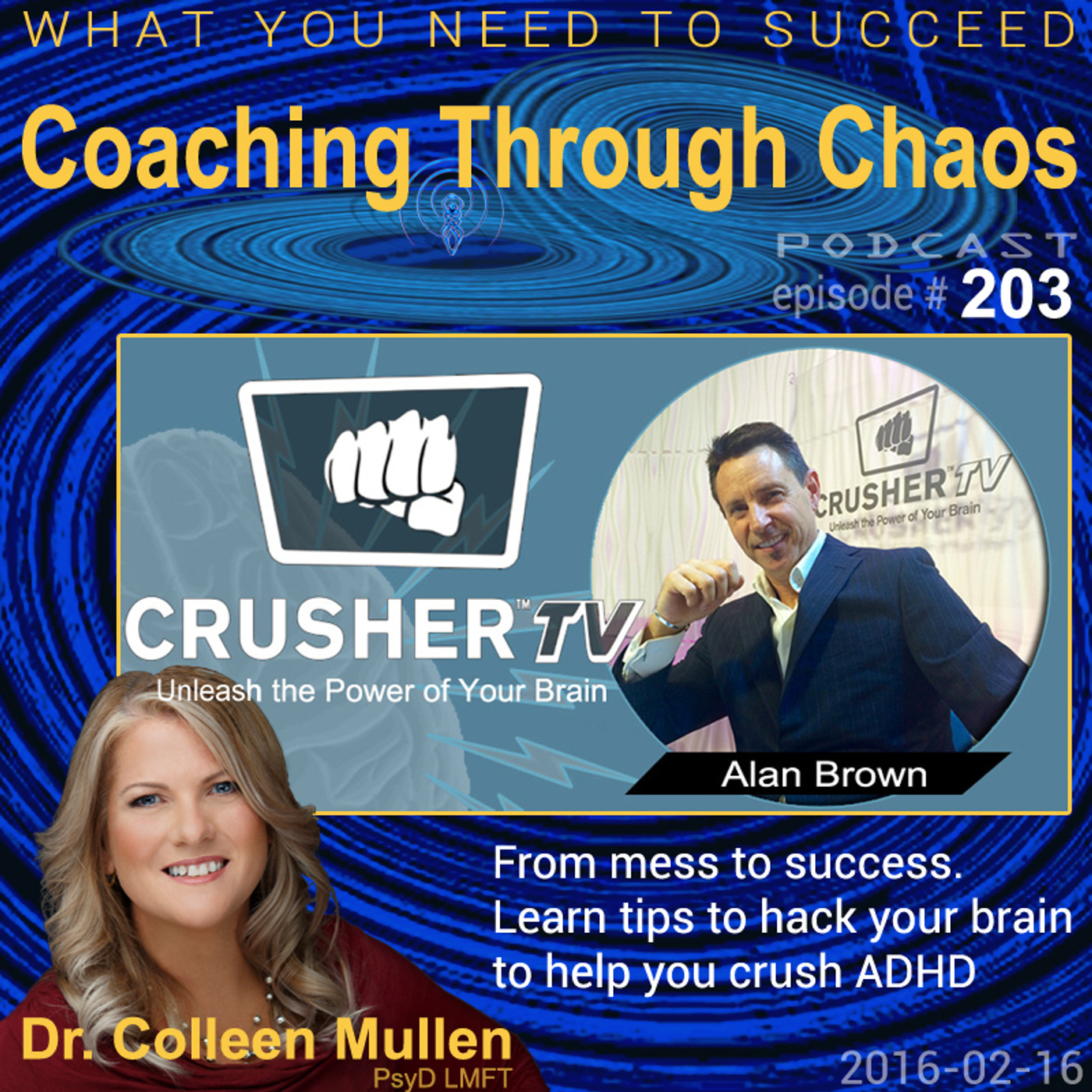
Welcome to the podcast edition of Coaching Through Chaos, bringing you what you need to succeed. Now, here is your host, Dr. Colleen Mullen. Hi, and welcome back to the Coaching Through Chaos podcast. Dr. Colleen Mullen here, licensed marriage and family therapist in San Diego. My guests and I discuss all sorts of life management topics here at the Coaching Through Chaos podcast, and today we're talking brain hacks and ADD, or attention deficit disorder. In my work as a therapist, I've worked with hundreds of kids and families in which someone has a diagnosis of ADD or ADHD, which has hyperactivity thrown into the diagnosis. In general terms, these people have a deficit in being able to focus. This can leave them looking like they can't read very well. They might need to read something several times in order to remember it.
They often look like they don't listen very well to others and that they don't finish projects or can't sit still. Heck, in our age of instant gadget gratification, I think many of us struggle with these symptoms. I know I sure do on certain days. My guest today dedicates his life work to helping people improve their ability to focus, become more efficient and productive, and worry less, among other things. All great skills, whether you have a formal diagnosis of ADD or not. He presents hope for people who have really fallen victim to their own symptoms.
My guest today is Alan Brown. He has transformed his life in a truly resilient way and now helps others. He's going to tell us about how getting a diagnosis of ADHD at 35 years old opened up a whole new way of looking at how he functioned in the world. This was actually quite a relief for him, and he's going to tell us all about that. He's currently the host of Crusher TV, which is an online educational series focused at helping people be more productive and has a great video series called ADD Crusher. I met Alan a few months ago when I had the pleasure of being a guest on Crusher TV. When I was interviewed by Alan, we talked about some of my personal favorite mind-calming skills.
I had a blast on that show, and I truly enjoyed my interview of Alan as well. So let's get right into the interview with Alan Brown, host of Crusher TV and also known as the ADD Crusher. I'm here with Alan Brown, the creator and host of Crusher TV. Alan calls himself a mess to success entrepreneur. We're going to hear about what that means to him and about Crusher TV and all sorts of other things regarding productivity, focusing, and ways people can hack their lives to be more successful.
Hi, Alan. Thanks for being with me on the Coaching Through Chaos podcast. It's great to be here with you. Thanks for having me. You're welcome. Alan, you call yourself a mess-to-success entrepreneur. What do you mean by that? And can you tell us a bit about your journey? Well, I think an important part of my journey has been that for many years I was undiagnosed with ADHD. I wasn't diagnosed until I was 36. And during my school years, I was underachieving. In my 20s, I was abusing alcohol and actually ended up a drug addict and engaged in some crime of various nature. I was a pretty big mess. And even after having gotten off the drugs at around the age of 30,
I still was struggling at work. I got a job in the advertising business after taking 10 years to get a four-year degree. And I was still kind of a mess because I just couldn't figure out why it was that I thought I was a pretty smart guy, but I was working real hard and I wasn't making much progress. But a few things happened that flipped a few switches and made some major changes in my life, and I've had quite a bit of success since then. So can you tell us a little bit about that? What were some of the things that led you to become more successful? Well, it's funny. I teach people how to get more out of their brains, how to hack their brains. I'll talk about exactly what I mean by that in a second.
And for many years, I did not have control of my brain. I was, in fact, a drug addict, as I mentioned. And it kind of all came to a head a little more than 20 years ago. And I was visiting my mother at Mount Sinai Hospital in New York. And she was in her last couple of months in her fight against ovarian cancer. And as was always the case, when I would visit her there at this time, I got a little edgy and itchy. After only about 10 minutes, I'd say, Mom, I'm so sorry. I got to go. I need to be somewhere. And she'd say, it's OK. Go do what you need to do. And what I needed to do was get up to Harlem to get my drugs. And I don't know what was different about this particular day, but.
I got home to my apartment in Jersey City, and the absurdity of what I'd been doing, the sadness, and the utter lack of control I had in my life just all kind of came crashing down on me. And I attempted suicide. It was a pretty lame attempt, I must say. I didn't have the nerve to kick the chair out from under me, as they say. But I'm glad of that. And that was the day that I just decided that I'm not only going to take back control of my brain, but I'm going to figure out how to make it work to its potential. And that began a journey of learning, developing, and curating different ways to hack your brain so that you can get more out of it. That's a wonderfully resilient story that you have. And thanks for going so personal with us.
Now you call yourself a productivity coach. Tell us what that's all about, about hacking the brain. What do you mean by that? Well, once I got a job in the advertising business, entry-level job, and I struggled for a good number of years, again, I was undiagnosed with ADHD. And I just couldn't figure out why I couldn't focus. I couldn't work at the same level as the people around me. But I began to develop what I call brain hacks, ways that I could focus in my brain, ways that I could kind of access creativity on demand. And these things that I learned, I learned from a number of different places like Deepak Chopra. He actually taught me in an audio book, how to quiet my mind.
But other sources, too. Dr. Stephen Covey is the Seven Habits of Highly Effective People. There's a lot of brain hacks in there. And what I mean by brain hack is we all know what a computer hacker is. That's someone who goes into someone else's system and throws a bunch of switches to gain some kind of advantage.
You may have heard of life hackers. Sure. Our listeners may have heard of Tim Ferriss, who's like the ultimate life hacker. He will go into a system and kind of take advantage of certain things so that you can learn to be a champion tango dancer in three weeks, or you can rent a really posh flat in Berlin for a month for 300 bucks. That's going into a system and switching things around or taking advantage of things for some life benefit. Well, brain hacking is simply going into your own brain and flipping some switches to make it work more efficiently, to open the door to action, and to get more stuff done with less effort and less stress. There are so many people out there that hacking is such a cultural term these days.
Why do you think it is that so many people get stuck and need this hacking? I think that's a great question. Why is it that the idea of hacking, it really has become such a big part of our popular culture? And I think it's because we're all crazy busy and we're all looking for ways to get things done faster. When I was growing up, and I'm sure when you were growing up, you didn't have the two paycheck family and the latchkey kids and all that.
And now people are just so busy. Everyone's working increasingly demanding jobs. And even being a parent is more demanding than it was, for instance, when I was a kid. My parents used to let us out of the house at 8 in the morning and said, all right, we'll see you at 6. Right. And we don't do that anymore. Right. So brain hacking, I think, is an opportunity for people, again, to get more stuff done with less effort. And when you think about some of the areas of productivity that people overlook, and particularly folks with ADHD and other LDs, it's the fact that they actually have a lot of control of what goes on up here in the brain.
much more controlled than they might think. The ADD-er, particularly the adult who has been a longtime sufferer, might think, well, you know, that's just the way it is. I just take eight hours to do anything, or I just procrastinate a lot. That's who I am. That's what I do. It's always been that way, and that's the way it's going to be. But there are ways to hack your brain to beat procrastination, to work more efficiently, and again, to get more stuff done with less effort. Alan, I'm curious. How has brain hacking worked for you? What's been the benefit that you found? Well, as I mentioned, I was undiagnosed with ADHD, and even after I cleaned myself up and got off the drugs, I was struggling in an entry-level job in the advertising business for about seven years.
I was busting my butt and I wasn't seeing the promotions that the people around me were getting. But around six, seven years into my career in advertising, I began to implement what I call brain hacks. These are ways to simply flip a switch in your mind to change the way you view something that kind of opens the door to action or to more clarity or to open the door to more creativity. And around this time, I was also diagnosed with ADHD. And then the light bulb really went off. Then I said, oh, wow, now I understand my brain. Now I understand that I was self-medicating, the drug addiction and the booze and all that. And I went from, I was 36 years old, and I went from making mid five figures as an account executive, which is pretty lowly at that age in the advertising business, to within two years, six figures, vice president, management director of the largest office of the biggest ad agency in the country at that time.
and employee of the year. Wow, that was quite the lead. And in my spare time, I co-founded a startup that a few years later was sold for eight figures. So just think about it. So that kind of wraps up my mess to success story. So I've seen both the absolute worst and the absolute best of what your brain can do. And Brain Hacks were a big part of my success. So you have really cemented yourself as an expert in Brain Hacks, and you certainly have benefited immensely from that. I think of people having themes when we have lots of people with some of the same problems. There's usually a theme that goes through that.
I wonder if there are two common themes you can tell us about that really kind of highlight why people have trouble focusing. I think two of the biggest ones are multitasking and worry. Multitasking, for instance, is something that we're all doing. Whether you have attention issues or not, we are all doing it. And this, what I mean, of course, is the fact that we are jumping between devices, we sit down to write that important email, and then we think, oh, you know what, let me just check my Twitter feed again real quick before I do that. Or first, let me just text back my friend that I was going to get back to, blah, blah, blah, blah, blah. And it's this butt first this, butt first that, and some wise person, I think it was Dr. Russell Barkley, called it the butt first syndrome. And we are all doing it, ADHD or not. And again, the gadgets become a big conspirator in this.
you end up getting a lot less work done than you think you're going to get done. And the research has shown over and over again that multitasking really makes you less and less efficient. So yeah, so multitasking is a real theme for a lot of people, if not everyone, in terms of their productivity and their ability to stay focused. Another really big theme is worry. And I know that you are a student of worry because you actually came on Crusher TV and talked about worry. That's right. And we gave some brain hacks on worrying. That's right. That's right. And that was neat. We spend 90% of our mental energy on worry. If we actually stop and listen to the voice up here, which is not really us, as you well know, it's mostly our ego that's chattering on. We will find that most of our thoughts have to do with worries about the past, worries about the future, and then a lot of petty judgments, which are sort of forms of worries.
Because you're comparing yourself to others and comparing other people to other people. So this eats up a lot of energy. And if you are spending your time worrying, you are not focused on the things that matter and the things you need to be getting done. That's right. I can't wait to hear some brain hacks in a few minutes when we get into that.
And what you do is productivity and ADD coaching. When people hear ADD, especially parents, they get so worried that medication is all of a sudden going to be handed out. And I know that that's not your field. You're not a doctor. I'm not asking you medical advice. But you do know a lot about ADD and getting around the symptoms. So can you talk about some alternative, how we call them, treatments for ADD? The very first thing I teach ADHD teens and adults, which is what the ADD Crusher videos are designed to help with, is diet, exercise, and sleep. These are what I call the brain feeders.
So many of our kids are walking around with carbohydrates and sugar in their tummies, and it's no wonder there's not much going on in their brain. I don't mean to say that they're not right, but you can't sustain mental energy and activity when you've got nothing but sugar and carbs in your stomach. You need protein. And in this country, unfortunately, a lot of people still think that a Cinnabon is a breakfast, and it is not, and it's deadly for particularly the ADHD brain. So definitely diet. Exercise also, we know, fires up the neurotransmitters that are the very ones that we with ADHD tend to be lacking in supply.
And then sleep, I could go on, of course, as you well know about how poor sleep is often diagnosed as ADHD and how poor sleep or not enough sleep exacerbates ADHD. So those are some areas where without worrying about medication, you can really help a child or teen or yourself for that matter overcome some of the effects of ADHD. The other big area, this is what we've been talking about, which is brain hacks, which is just the ability to flip some switches to change the way you view things, as I mentioned. And it can have a very powerful impact, even though they're very, very simple. I love it that you talk about treating the person from all aspects of their life, nutrition, diet, brain hacks, you know, how they think is going to help whether or not medication is there. Thank you for that. Now, the part that I can't wait to get to is what are some hacks that we can talk about? What can you share with us? I'd love it if you can give us three hacks that for the audience listening.
can tap right in and start making changes in how they're thinking. Sure. One of the first hacks I teach people, ADHD or not, is a food-based hack. You know, the gasoline for our brain is glucose. And so we get glucose from fruits and vegetables. And we are often getting our glucose from liquids, like fruit juices and smoothies and quote-unquote health drinks. And the problem with these is that they have stripped the glucose from their fiber. And when you strip the fiber away, the glucose doesn't last as long in your brain. It gets burned off much more quickly. So instead of getting your glucose from apple juice or...
heaven forbid, soft drinks, which are just useless and they kind of make it stupid, consider some dried fruits, either raisins or I use dried apricots, because then you're getting your glucose along with the original fiber of the fruit. And that, what it does is it extends the delivery curve of the mental energy. You can even better that when you throw in a handful of nuts, like almonds or walnuts, because the protein now adds to the fiber that further extends the delivery curve of the glucose and therefore the mental stamina. So there's a real simple brain hack that anybody can do. And I do it all day long when I'm working and it's not mealtime yet, but I'm a little bit worn down, a handful of nuts and one dried apricot and boom, you're right back on it. Another one is posture. These aren't very sexy, I realize, but posture is a really big thing. The second most watched TED talk in TED history is one by Amy Cuddy. She's a psychologist at Harvard Business School. And she has done research into posture and how it improves your mental clarity, your self-confidence, your mood, and how it reduces your stress. And so imagine in your mind's eye, Wonder Woman. How does she stand? Big and tall with her hands on her hips.
So does Superman, right? This is a classic power pose. And when you hold one of these power poses, there are several others, but this is the main one. When you hold a pose like that for just two minutes, your testosterone goes up, which everybody has, girls and guys both, and testosterone helps with mental clarity. Also, your cortisol production goes down by up to 25% when you hold one of these poses for just two minutes. So if you want a quick break and a quick refresh of your brain and your body and your mood, just stand up. You can do it when no one's looking.
Just stand up and hold that pose for two minutes and then grab yourself a handful of nuts and an apricot and you're going to be rocking it. That's great. I felt myself sitting up taller as you were giving us that hack. Do you have one more for us? Sure. You know, I mentioned multitasking before. And it really is this theme that we are all glomming onto because we think that we are more productive when we're, you know, I'm going to do a little bit of this, I'm going to do a little bit of that, I'm going to do a little bit of that. But then you find that the thing that you had sat down to do that your boss is waiting for isn't done at the end of the day because you've been jumping around. Well, here's the way out of this. And this is a classic brain hack because it's not an external output. It is actually a flip that you're going to switch in your brain.
And what you're going to do is when you decide that you need to write this tough email or you need to review this piece of research or you need to prepare for this difficult conference call that's coming up, you forcefully label that thing in your mind as this is what I'm doing now. I put a mental label on it. I know what my label looks like. It's blue with white letters. And when I sit down to do something, that label goes on it. Here's the key, though. You're still going to get interrupted. There's going to be that, oh, I got to text so-and-so back or, hey, my email bell just rang again. But those things in relation to the thing you've decided that you are doing right now are BS. Forgive my abbreviated French.
Those things are not important. If they're urgent, then fine. If your house is burning down, well, you should probably put out the fire. But 99.9 times out of 100, these things are just frivolous in relation to the thing you've decided to do. So what you do is you put another label on those as that's BS that I'm not doing now. Just by making this clarification, this distinction between what I've decided is the thing I'm going to do now and these other things that are inevitably going to come in and try and interrupt you.
You have hacked your brain to protect your mind's open window. Now, you being a wise person with regard to what happens in one's mind, you are likely to say, well, Alan, you know, there are important things that are going to pop up when I'm in the middle of trying to do this one thing. My boss may poke his head into my office or my subordinate may pop his head into my office and say this, that, or the other thing. But unless these things are urgent, you can still label those as important, but it's still not what I'm doing now. And you can say, you know what? Let's deal with that in about 20 minutes. I got to put 20 minutes on this thing. And you write a sticky that says, I will attend to that thing later. This one brain hack.
has probably had more to do with the success I've been able to achieve than any other single brain hack. And that's therefore my favorite one. It's the one I get the most emails on. When I go speak at conferences, it's the one that people walk up to me and say, Alan, thank you for that brain hack. And by the way, you're not what I'm doing now, so leave me alone. Yeah, I love it. I love that you're letting people know that it's not that they can't attend to other things or they can't attend to multiple things. It's just giving different priorities to the important stuff.
Absolutely. And you know what? You just reminded me actually of a hack that you taught me. And it goes back to worry, right? This is this other thing that we're doing. You talk about how it's important that we know we can make a choice and it's okay if we don't do it right now. And you taught me this great hack that you shared on the Crusher TV show about how when you are stuck in a state of worry, you can get out of that by simply saying to yourself, you know what? I don't have time right now to worry. So I'm going to schedule a time later to worry. And then literally you can schedule a time in your calendar to do worrying. And that's the same exact kind of thing. That's a powerful brain hack right there. And that one is one of my favorites and helps with my productivity when I need it.
And you just mentioned Crusher TV. Now, I'm sitting here live doing this interview with you in your Crusher TV studio. So let's talk about that. What is Crusher TV? And you also have a site called the ADD Crusher. Tell me about those two aspects of what you do and what people can find on Crusher TV. Well, the first thing that came along was ADD Crusher. And I mentioned before that I was diagnosed with ADHD kind of late in life. I was 36 years old. I was kind of a still struggling ad executive. And as soon as I was diagnosed, I was overjoyed because it explained so much. And I literally ran to the bookstore and I bought about five books on adult ADHD. And I get home and I open the first book and then I remembered.
Oh, that's right. I can't really read. That's right, because you have ADD. I'm a terrible reader. You're going to close it in five minutes. 30% of ADDers are dyslexic, and most of the other 70% have terrible reading comprehension. So I thought to myself, wow, I've just become aware of this huge world of ADDers. And there are 9 million adults in the U.S. alone with ADHD, not only about 15% of whom have been diagnosed. But why are there only books? Why aren't there interactive programs or videos? So a few years later, I created ADD Crusher videos. These are instructional videos and audios for teens and adults with ADHD. And those have been out for about five years now. And about a year ago...
I was listening to Dr. Ned Halliwell, who he and I were actually both presenting at the same conference in London, and he was talking about how most people who knock on his practice's door don't have ADHD. They have what he calls ADT, which is Attention Deficit Trait. They are not clinically ADHD, but they are still experiencing the same things. We were talking about multitasking and how we're all doing that. We're all worrying. We are all crazy busy. That's the title of actually a great book by Ned Halliwell.
And so it occurred to me that the world of brain hacks, which is mainly what I teach in ADD Crusher, really is important for everyone, anyone seeking greater productivity. So what I did is I created a TV show. It's an online weekly TV show. It's a membership model where members each week get to watch a TV show that... shares one or two powerful solutions for productivity, getting more stuff done with less effort and less stress. And we always have one guest expert on, such as yourself, who will come on and also share his or her one powerful solution for getting more stuff done. And I have seen multiple videos of yours and they're just fantastic. I love how you've produced them. They're really informative and also entertaining at the same time.
And you mentioned, though, that Crusher TV is a membership model. But really, everybody can afford to sign up for it. Isn't it just a dollar? Sure. It's a buck to try it. And you get a month for $1 to give it a try. If you come and try out Crusher TV and you like it, you get more than just a TV show. We have group coaching. We have an exclusive Facebook page where we share ideas and previews and additional content. And it's sort of a community. But if you like it, stick around. It's $14.99 a month. And you can also look into the ADD Crusher videos, which are on ADDcrusher.com. And again, those are designed for ADHD teens and adults. And they've won many awards, including the Innovative Program Award from Chad, which is a very prestigious award.
But you mentioned that you find the videos and Crusher TV episodes to be entertaining. And I think that's a really important observation because we know from research that the more engaged someone is, the more entertained, frankly, that someone is in a given piece of content, the more they'll retain it, they'll use it, and they'll be able to put it to good use. And that's why we didn't want to put out something that was very dry. We wanted to have fun. That's why the animations are there. And we put a lot of work into the editing and the colors and the graphics and all that because it's designed for an ADHD brain. But again, we're all ADT, as Dr. Halliwell puts it. And we all want to be entertained. And so give me information that is not just the plain broken down information.
but give it to me in a way that I'll actually want to watch it again. And they've been very helpful, and I've enjoyed being part of the Crusher TV community. How can everyone find out more about Crusher TV? What are your websites, and do you do Facebook or Twitter? Well, come to CrusherTV.com, and you can see a little intro video there at the top of the page. But also, if you scroll down the homepage, you'll see a section where we have very short previews of the upcoming episodes or previous episodes, and I'll give you a sense of what Crusher TV is about. But also follow us on Twitter, at RealCrusherTV. Some chump is out there with Crusher TV.
Isn't that something? But yeah, it's at real, R-E-A-L, Crusher TV on Twitter and follow us and you'll keep up with what we're doing. Great. And there'll be links to all of Alan's sites on the Coaching Through Chaos blog post that goes along with this episode. So I want to thank you, Alan Brown, host and creator of Crusher TV and the ADD Crusher. Thanks for being with me on the Coaching Through Chaos podcast. Good to be here. It's my pleasure. Thanks. You're listening to Coaching Through Chaos, your host, Dr. Colleen Muller, bringing you what you need to succeed.
Alan was a lot of fun to talk to and we'll put some links to his episode previews in the notes from today's show. For just a dollar for your first month of Crusher TV, you can watch all his previous episodes, join in the chat in his private Facebook group, and get some great productivity hacks to improve your life. You can't go wrong with that. And right here on the Coaching Through Chaos podcast, I bring you new episodes every other week. My guests will inspire, motivate, and empower you. Some of you have been letting me know how you feel by leaving me some fantastic interviews on iTunes. Each episode this season, I'm going to pick a review to read. So if you want to hear yours right on the air, well, I guess you better go write one. Today's review is from someone who didn't leave a name, just a little smiley face.
They said, I absolutely love the guests and conversations that take place on this show. I've listened to a few episodes already. Most recently, the Good Wolf, Bad Wolf episode. It's important for us to stay focused on self-care. I like that Colleen pays attention to that. I thoroughly enjoy the content. Well, thank you so much for that great review. The Good Wolf, Bad Wolf episode they're referring to features top podcaster Eric Zimmer, host of the One You Feed podcast, talking about his journey of resiliency. We will always have a link to all of season one in the show notes so you can catch up on episodes if you enjoy what you've heard today.
Now, leaving us a review is just one way to support the show. Another way to support us is to share the episode on your social media pages or with a friend that you think would benefit from it. We also have a new way to support us this season to help us manage our production costs. A few weeks ago, we launched a Patreon page. Now, that's a fundraising page for creative ventures. Dr. B and I are going to continue doing the show out of our love for it and our desire to bring people some great life management skills. But if you would like to financially support the show, you can make a monthly pledge starting as low as $1 per month. With all the different levels of support, there are different rewards that we came up with that we'll be sending your way.
Personally, I'm looking forward to sending out some Coaching Through Chaos t-shirts, and we'll certainly look forward to sending out some shout-outs on the show and some Skype sessions with some extra generous supporters. To support us this way, just go to patreon.com slash coachingthroughchaos. That's P-A-T-R-E-O-N dot com. Thank you so much for any donation you care to send. In upcoming weeks, we've got guests talking about how to stay zen while online dating, parenting coaching for first-timers, a hot new podcast to presenting insightful interviews on psychology, culture, and relationships, and of course, we've got our episodes coming up for those who serve.
So much is happening and we really appreciate all the support you've shown us here at the show. As always, I want to thank Dr. B for his audio creativity and his artwork and BennettSullivanMusic.com for my theme music. To connect with me between episodes, just say hi on Twitter. I'm at Dr. Colleen Mullen and on Facebook at Coaching Through Chaos. And remember, when you sign up for my mailing list, you'll get my free ebook with 100 tips for living a happier, healthier life. Okay, that's it for me. I hope you have a wonderful week. And if you've got chaos in your life, I hope you're finding your way through it. Take care.