
It's really weird. It's like a confident humbleness. It's a contradiction where you're confidently humble, but kind of like a Zen monk might have that kind of a thing where the humbleness gives you confidence in a certain sense. It gives you confidence because you're not having to prove whether you're right or wrong.
You're saying it's not so important. Greetings, future puzzles. We are obviously all in the thick of such a torrent of extraordinary transformation to change and wonder and mystery. And I cannot be more blessed than to have Kevin Kelly back on the show for the third time to talk with me about his new book.
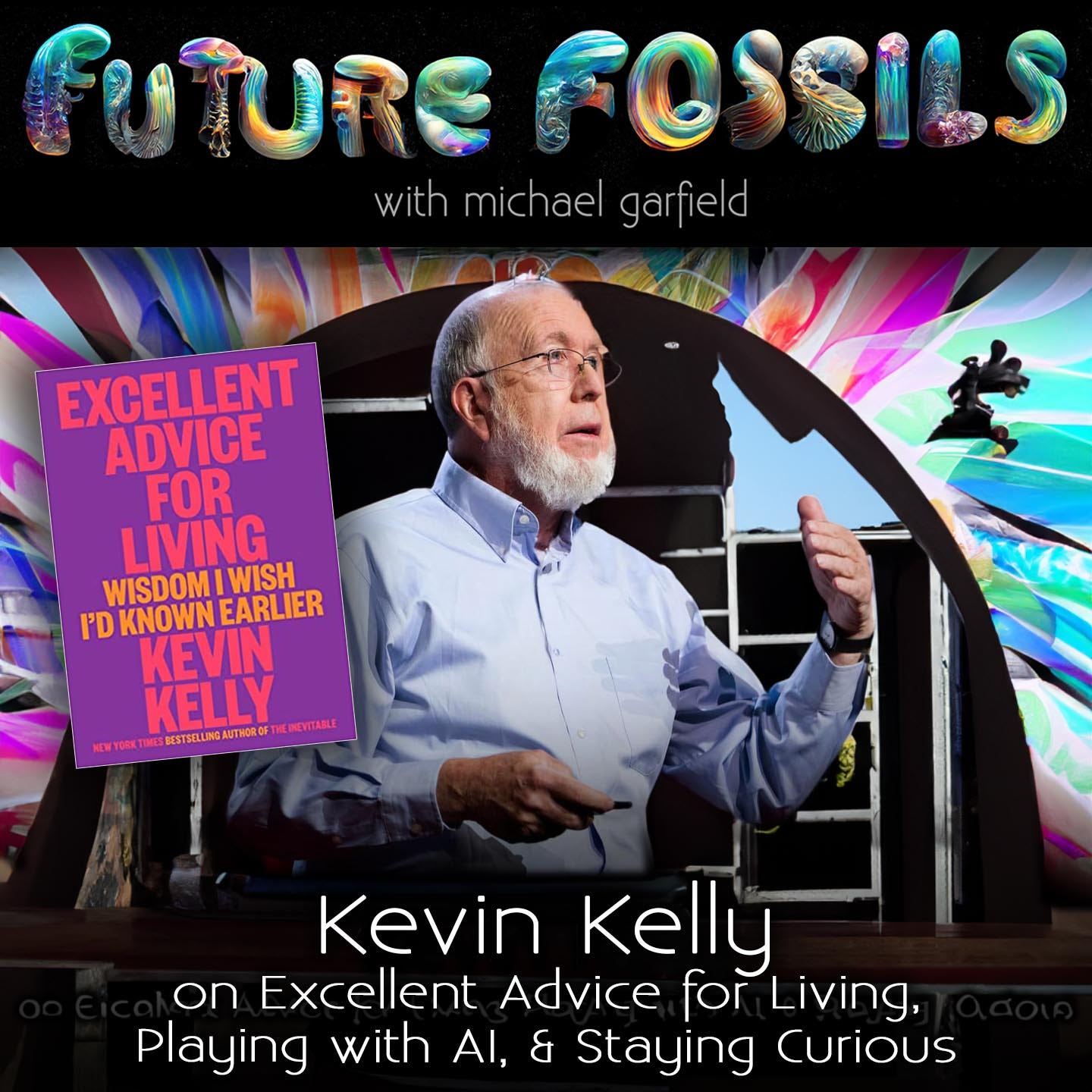
He is a Weisende elder, totally holding torch as far as I'm concerned. His book, Excellent Advice for Living Wisdom I Wish I'd Known Earlier is really quite a thing. And here we are talking about it in what I think you will find to be a punchy and deep and nutritious interaction that I hope will inspire consequential, long, slow, deep, anchored movement in your life. And with that, thank you for listening.
I really hope you're subscribing. I hope you're supporting the show. Everybody else who has been, you are dear and near to me. And I want to give a special shout out to DearNet for buying my music, Massey for becoming a Patreon supporter, Cody Kuiak, always, always buying music.
Nico for becoming a Patreon supporter, Amy Rose for buying music, radical Brettenster, full of it. David G. Therapy, John Roger Kirk, wow, thank you. And Alex Feldman, as always, slowed, and full of dismal for becoming a Patreon supporter.
You all are wonderful, everyone is wonderful. I hope you're in a good way. My suspicion is that you'll be in a better way after listening to this deep well of wisdom from Kevin Kelly, enjoy, thank you. Please continue to support me and my family and all of the creative projects, including this fire hose of AI music videos.
I've started putting out from my album, The Age of Reunion, which is a work of over a decade, and you can find all this stuff on YouTube. I think you'll enjoy it. And the Jurassic Book Club has begun. It's not too late to join in.
We're gonna have our second call on June 13th. And then in tandem with the Future Fossils Book Club for The Lost World, I will be hosting a series with Jeremy Johnson at Nure Learning, starting July 18th on Jurassic Worlding. And this will be a much, much more in-depth, more interactive, deeper, richer, and more intense, studious offering. I'll share more details about that soon, but it'll be really interesting to allow people to take more agency in this conversation that they have had to date.
Anyway, thank you very much. Here we go. There we go, yeah. That's better.
Hey, thanks for folding me in on this. This was a real treat of a book. Thank you. I'm so glad you enjoyed it.
Yeah, it's weird. It's like, some of these feels like I'm listening to myself. And then some of these really took me by surprise. And overall, this is definitely something that, we used to, you have the audacity to name a book, an excellent advice.
Then you think, all right, that's like a Ron Swanson putting the note cut to the chase, but really is quite a compendium. So I guess maybe the right place to start, and you've been on this twice already, but this is a different kind of conversation with you than we've had. The conversation would be about the backstory of this project. And let me just embed our whole conversation and this book in something else, which is you're on the board of long now.
And you're a parent, and I'm a parent. I mean, your kids are my age, but regardless. The sense of receiving wisdom and passing it on. And I'd love to hear where you are in all of this and what motivates to do this, and then we'll get into the book itself.
Thank you. It's always a pleasure to chat with you. I'm really delighted to be here to tell a little bit of story about how this began. I think of wisdom as an elevated perspective, aimed at maybe the true, good, and beautiful, and it's something good.
But it's the elevated perspective that we call wise, taking the longer view, which ties into the long now foundation, which is trying to promote long-term responsibility, long-term imagination. And I think part of what advice and gentler wisdom is, taking a longer view, elevating your perspective on things, understanding that setbacks can be overcome, all those kinds of things you get with long view, optimism, actually. So that's what I would say that I became interested in, was ways in which you could increase the good in the world by helping my kids and people around me shift their perspective to have a longer, wider perspective on things. And when you did that, I think it's easier to prosper, it's easier to be happy, it's easier to be content, it's easier to accomplish things.
So the wisdom component is tied in my eyes to that kind of bigger, wider, longer perspective. And then you've got this, each page is pithy. So at what point did you start collecting these? Yeah, so I have been collecting similar kind of quotes from other people on my life, because I liked the form factor.
I liked this little seed, this little mind grenade, this little compressed zip file that you would get in a really good quote that would say, yeah, that's true. And then it would surprise you a little bit, ideally. It would be a little shift in it. And you'd have something and then maybe it would be memorable.
And I was collecting them because I wanted to repeat them to myself. So I was writing these down. I was like, here's something that's important. I need reminding about it.
So I wanted it in a form that I could remind myself with it. And that reminding is really what these artists cause a lot of this advice is, I would say half of it has been channeled from the ancients, from the Stoics and the Bible and elsewhere. Who knows where they got it from? It's been their grandfathers.
And that is a bulk of it, put it into my own words, put it into a way that's in the vernacular, which is basically a tweet. And I've been writing those down all along. And then at some point I realized that I had other things to say practical stuff about if you're going to buy tools by the cheapest tool you pass it possibly can and earn your way up to the more expensive through using it. And you'll know what to buy.
That will contrary to what I heard growing up. But it's been borne out in other people like Adam Savage, who are tool users agree with this. So I started to write those down in hopes of conveying them to my kids, to whom we did not give them very much advice like this. We were trying to model the behavior rather than telling them because I don't think kids listen to their parents, what they say they listen to their pay attention to what they do, not what they say.
And I felt there was a value in having written down as a reminder, something they could remind themselves of it. And there were things I wished I had encountered. And so that was the other motivation, was trying to put down things that I wished I had heard, not just model, but I'd heard when I was younger. And I would once a year go through my brain thinking, what do I know?
And then I would try and take this complicated thing and reduce it down to a sense. And I would spend most of my time trying to eliminate words, restating them, trying to set up poetry, trying to compress it, trying to say it in a way that hadn't been said before, trying to say it as clear as possible, and yet not say everything because I was trying to reduce the words. That's where most of my time was spent was the compression part of this, getting down all that stuff so that it could be reduced to a sense. There was some in recent years that people don't actually remember books that remember the sentences in a book.
And so this is the book of sentences. The Bible without stories is also true. Most books of advice are filled with stories because story is the best way to convey anything, but not just a horrible storyteller. So I played to my strengths, which is writing telegraphic compressed my grenades.
And so I went all the way and I'm just going to have only pithy aphorisms and adages and maxims. And that's it. No stories. It's interesting because a lot of the stuff in this, I'm going to start zipping through and pulling up a couple of these.
A lot of this seems to undermine itself, which I have. I appreciate, like for instance, experience is overrated. Most breakthrough accomplishments were done by people doing them for the first time. Therefore, when hiring, hire for aptitude and attitude, and then train for skill.
My God, yes. OK, as someone who is my old friend, Chance Robertson, Texas, likes to say, is unemployed right now. I wish people took this more seriously. But like, besides that's beside the point, you're sitting here on the perch of experience and saying, this is overrated.
And then later, you say something about imagination. Let me see. Does the anecdote to fear? Although you and I have both spoken a lot about curiosity and fear as, let's see, yes.
Anything real begins with the fiction of what could be. Imagination is therefore the most potent force in the universe, and you can get better at it. It's the one skill in life that benefits from ignoring what everyone else knows. I've always said imagination is our greatest natural resource.
But then I was like, but you have to say, but you have to remember it. So actually, attention is our greatest natural resource. Sure. Yeah, but at any rate, to your point, to imagine does involve, I'm doing this.
OK, what do you think people should be doing? And people are like, I've received a lot of advice I've had to ignore lately. And that piece, that the one skill in life that benefits from ignoring what everyone else knows, it's a case that this book is doing what a good teacher should do, which is obviating itself in a way. OK.
Yeah. No, I think you should pay attention to advice. What are the pieces of advice in this book, by the way, is that when someone tells you that something is wrong, they're usually right. But when they tell you the solution to it, they're usually wrong.
So there's like the bits of advice that telling you that there's a problem, that you should be paying more attention to X or Y is useful, is necessary. That is good advice. But the solution to them is so specific to your everything that you may know, to the 98% of you that's invisible, to all the other things going on, that usually that people are going to be wrong about what is actually the solution, what works. And that's general, because we can always see the problems easier than we can see solutions.
And that's why there is more pessimism in there are optimists, because seeing the problems is easy and cheap, seeing solutions is difficult in deer. And so I do think there's different kinds of advice and devices that are pointing out something that's worth paying attention to can definitely be right. If they're suggesting solution, they're like most likely for yourself, they're most like you're wrong, so you can ignore it. I liked this one in particular because I find myself trespassing, not trespassing, but in liminal spaces, like finding out that somebody decided after they towed my car that they needed to put a no parking sign there, this kind of thing.
To move through a place you may not be permitted act like you belong there. I'd love to just let you riff on that for works for sure. Yeah, you just, I do a lot of talks and crashing another conference nearby was something I learned from Alvin Toffler, the great futurist. Hi.
You go to one conference and you then you crash the one next door because you'll learn all kinds of things about something you had no idea that you were even interested in. You probably aren't interested in it. That's another bit of advice is be curious about things you're not interested in. So I'm curious about things I'm not interested in.
And that's one of the best ways to do it was just to crash and walk in and just pretend that you're supposed to be there, that you're deserved to be there. And the less that you looked around, the less careful you were, the more nonchalant you were, the better. And that's true about crashing weddings, which I would do when I was photographing in Asia. So I just pretend that I'm the official photographer, either or not.
And I've seen that at work in plenty of other examples of people going into buildings or whatever, where they aren't supposed to be. But nobody will stop you if you are much forward or late and you've got to get somewhere. Yeah, I remember once I had brought my now wife to a music festival and she had a backstage pass. Yeah.
And somehow she got turned away from the dinner line at the artist's line backstage simply because she didn't feel like she belonged and they suspect they thought she was suspicious. You're like, you don't belong here. Yeah, you're clearly not here for the right reason. I was like, oh my God, Nicky, please.
But, okay, here's another one. And this is a big one. The foundation of maturity, just because it's not your fault, just because it's not your fault doesn't mean it's not your responsibility. Yeah.
So I would, I mean, that sends roots out in all kinds of directions. I'd love to hear you riff on that too. Yeah, this idea that I take it from being a homeowners, whatever it is, a tree falls on your property. You got a responsibility for dealing with it.
Just at that level. You can't just walk away from it and say it's not my fault. I don't deal with it. Or there's something happens at work where again, it could be someone who works with you or for you and they do something and it's actually your, the leader or the manager and now your responsibility.
So there's that level of it. There's also internally where beginning to be an accident or it could be something in your jeans that gives you something that's okay. I've been a good boy. I've been doing all the right things.
Now I have this thing. It's not my fault, but I'm responsible for it. And so there's often said in a different way, which is I think I say the elsewhere in the world, this idea that it's not what makes your life, what makes your character, it's not the things that happen to you. Because we have no control over that.
It's our responses to the things that happen to us. That's our story. That's what our life is. It's not what happens to us whether we were born into a household that has abandoned father who abandons us or we've got poverty or there's an uprising or there's something that happens to us.
We have no control over that. We have no, that's not our fault. But our responsibility to it is our reaction. We are responsible how we react and we are responsible for our life.
We're responsible for the consequences of the things that happen to us. The last time you came on the show, we were talking about your vanishing Asia. I remember once upon a time, 11 years ago when I was unconstitutionally searched in Texas and brought up on cannabis charges. I chose my lawyer on the basis that he struck me as someone who had read the Dao de Jing.
Here on page 66, you have this quote, your best response to an insult is you're probably right. Often they are. I love that this is this again, how to inherit a thing, how to carry it and pass it. The IKETO.
Yeah, it takes all the blow. It takes all the hate. It's just withered because yeah, you're right. What do I do about that?
Yeah, it's the word I want. This also goes to this other bit of advice about if you do screw up something, if you chastise yourself in front of the engraved, more harshly than they would, that can also suck a lot of the wind out of their ire and their anger because yeah, it was screwed up. I did the stupid thing. I cost you money.
It was, I hurt you. It's like if you own up, you if you fess up, you take that power and you are responsible for it, you shift the universe a little bit and you are again, you say you inherit that so that can actually sustain you and make it helping you go forward rather than being dragged by others. It's like more like you're taking control of the situation. You're owning up for it.
Maybe even more severely than what they would and then you're going forward. There's a little reverse of that in my advice for kids, which is preparing, which is we've found is have your kids involved in creating the punishments for any infractions in the family. And when they do that, those kids are going to be much stricter than we were, much harsher punishments, but they buy into it. They're into it.
They're, they're, they've been participated in this and they are going to be aware of it. And man, are we found it very effective in that is, okay, yeah, we have a little family thing. Okay. Here are the rules which we want to have consequences for.
What should the consequence be if you break it? What do you suggest? It's a very revealing conversation on children also then you say when a child asks an endless string of why questions the smartest reply is, I don't know. What do you think?
Which I love because okay, Louis C.K. has had that bit about why algorithm. I don't know. I'm sorry.
I would say the kid asks why this is why is the son and then at some point he's finally, I don't know. Is why? He's not that smart. Why?
My parents had me in the back of a car like a black and it's like he unravels himself entirely by just like supplanting himself to this. And I was like, I'm for it. I love serving the why. But in your case, this is cute because it really does.
It does exactly what we're talking about a moment ago in that it redirects the energy to the kid. And it says, all right, let's give you some agency here. Exactly. But let's see what you think.
And again, with this motif I'm noticing here is that in dispensing advice, you are also encouraging people to elicit their own intelligence. Yes. That's what I meant by seed. You unpack it.
You have a hint. These are hints. And you have to do some of the work of applying it to yourself. These are hints without the story.
So you need to write the story. I'm lazy. You write the story. I'll give you the hint.
I'll give you the prompt. But prompts, maybe the better word of the moment. These are prompts. So let's see.
This book has been out for how long now? A month? Not even a month. It was May 2nd.
So yeah, almost a month. Just about. Yeah. And in that time, how have people responded to this?
What's interesting is that in the course of conversation about it, usually we'll bring up some of their favorites. Like 2% or maybe 0% overlap in people's favorites. That was a complete surprise. Like the ones that you mentioned, nobody else has mentioned those.
Okay. So that was like a real joy was to have that breath that reached that happened because I did not expect that. It's a joy because the reason why, because I couldn't choose between all my children and I put them all in because I really stood behind them all. So that really made me happy.
But it was a surprise. I think the other, in terms of thinking of another thing I learned from this was I was unsure in the beginning about how effective the format was. But as I hoped and expected that kind of this collection of a kind of uncategorized set of little zip files, little aphorisms really did work through magic. And the same way worked on me.
I liked it because it was working on me. And there was another kind of confirmation from the days of Wired to go with what works for me. And that was confirmation about that. Trying all different arrangements like this.
There's something here about this working in its format of this sequence of a variety of these where your brain is this way got from Holworth Kellogg. There's enough on the page that your brain is doing some associative subconscious associative work between them. That is an kind of enjoyable thing that is hard to articulate. But there's something that happens when you jump for one to next.
It was like you're making kind of connections between them yourself and that worked. So that was another thing that I would say I got confirmed was this idea of doing it. And I got there by the way from another bit of advice in the book, which was prototype things. So I made different literal bound prototype books.
This is a little smaller format. Well, in my original ones had doodles in them. Some reason the publisher did not go with them. The Italians will go.
So I was prototyping this to test out it to work. And that is another confirmation that you want to prototype your way to greatness. Iterate many different versions. Keep building on it.
Try out as close as you can. The entire product go the whole way. You write the first draft of the entire book that you will throw away. You do different scratch versions of a song that you throw away.
You make a whole animatronics portion of a movie. These days they make a movie, not just with storyboards, but they go on to prototype it with animatronics. And they film it with the soundtrack, the whole thing, the whole movie. And they throw it away.
So that idea of prototyping the book, again, I got confirmation that works. It's funny that you say that this is a side, but it sounds like you and I have both watched maybe light and magic. Oh, yeah. Disney Plus talking about film tip and Dennis Mirren.
The project of the early stages of writing a book about how the digital has spilled out into the world and Jurassic Park seems so central to that. And that piece of, yeah, they were simultaneously having film tip, it run the stop motion dinosaur as while they were running a parallel skunk works. And of course, it's an affront to the people involved in that scheme when they're disrupted by their own internal mechanism. That's a very common thing in Hollywood, is all kinds of things are made and never use sets built and abandoned.
It's not uncommon to do that. And that's why they're great. That's how you make something great is you're willing to do that kind of a wastage. It's very inefficient, but that's inefficiently necessary for creativity.
You have to write words, you have to write tons and tons of words that you know could be thrown away and you have to be completely at ease with that of taking or photography books where you go the whole way and you do this assignment and they never use it or you don't use your own pictures, whatever. It's that wastage is a necessary part of great creativity. You have to be willing to. And part of where you can do that is you get the confidence by doing something on a regular basis so that you know that there's more that comes from it that gives you the kind of freedom to throw something away.
It's because I've done this often enough, you say to yourself, that I can make more of it when necessary. I'm not going to be precious about this stuff. It'll be expensive. We'll just consider that part of the budget and the psychological aspect of it is that we'll just produce more of it because we can always produce more.
Absolutely. Yeah. I came to that relatively late in my game. Yeah, exactly.
It took me a long time. It was like the idea of making a chair and they would make a prototype of a chair and then throw it away, go the whole way and finish it. That was like that was such a big deal just making the chair. So now I realize that's what I'm anticipating.
I'm going to go the whole way. I'll make something cardboard first and you make it in plywood and then make a drawing, cardboard plywood and then we'll make the final thing. That is how you get there. So that iterative thing, there are two of these that I want to hold in tandem here.
One is when you were young, have friends who are older, when you were older, have friends who are younger. I've always been, that's been my intuition from day one. I've always been the youngest guy in the room and now I'm starting to be older among younger and I'm loving it. And then there's also, you are only as young as the last time you changed your mind.
Now I want to go back to the inevitable. Now one of the things that you claim as inevitable over the coming decades that we're now actually living through and it's bearing out is that, and I think we perhaps discussed this in one of our earlier conversations is moving from placing a premium on answers to placing a premium on questions and a state of constant learning, life and long learning. And I look at you and I look at Stuart Brand and I look at anybody in long now, all the silver backs are strangely, they have a player attorney's thing going on. And so I'd love to speak to the maintenance of a childlike curiosity and awe and appreciation of this world and willingness to explore it.
I think there is something I learned from Stuart. There's a power in changing, being willing to change your mind, a power in searching for what you're wrong about, a power in admitting you're wrong, and a power in not caring too much whether you're right or wrong, not getting credit as well. So there's a humbleness that it's really weird. It's like a confident humbleness.
It's a contradiction where you're confidently humble, but kind of like a Zen monk might have that kind of a thing where you are, the humbleness gives you confidence in a certain sense. It gives you confidence because you're not having to prove whether you're right or wrong. You're saying it's not so important. And so yes, I've seen, we're seeing right now witnessing the forefront of this shift from answers to questions because we have these new ais that give answers.
And while they're still working on making them completely reliable, there's no doubt that they're going to be the answer machines. And it's astounding the kind of answers that they can give in a conversational interface, which is just remarkable. So like, why are you going to feel your head with those when you'll have them on your shoulder and anytime you need an answer, you get an answer. What we're finding out already, and this comes from my daily AI art, is the question.
So in a certain sense, you could say, I'm asking questions with AI to generate this art, and we're having a conversation, we're querying the world. And the really great stuff I see, I'm collecting some really great AI art. And it's like, they asked the right question. They asked the right question.
There's this one thing. I'm just the pope in the puffy white jacket. It was like, they asked the exact right question. Wasn't that brilliant?
So there's somebody else who's doing something in white puffy, which is they're doing these inflatable versions of landmark buildings in white puffy inflatables. And they're just utterly brilliant. And it was, you know, that question, it's not the prompt. It's the question that they're asking.
And that is something that's going to be hard for AI in the near term. I don't know where it's going to be, but a long term. But I would say for the near term, within your lifetime, we're still going to have a tremendous advantage in asking questions. Because we're going to be asking questions that we know that we care about, or that we're going to care more about these kind of questions.
AI couldn't theory, ask any possible question. You could just have it do it randomly. They don't, they're at the right questions. They aren't the questions that are meaningful, that matter.
And for the time being, we're going to be a lot better about the things that matter to us because we're us. So definitely think that we're seeing that shift happening right now. And being, like the child asking the why question, how do you get good asking questions? And I think there's a bunch, I have different definitions for good questions.
Like good question has some qualities. One quality is that it engenders other questions, other good questions. So it's like a pain reaction, a really good question should unleash another round of questions, good questions, which are at least more questions. So they should be able to start a question cascade, like the kids who ask the why.
And the second thing that good questions should do is also illuminate areas where we don't know where we're ignorant should open up new territories that don't exist. So a really good question will reveal whole new avenues of investigation, exploration, ignorance. And so that's, and that's again, something that AI is really good at is synthesizing what we know, between things we know, but they're not good on inventing whole new areas. There isn't because they're trained on what all humans know.
So they can only go within that space of plausible human knowledge. They can't really get out of that because they have, they've only been trained. They're auto complete on what we know. They're going way out of what we know.
They're incapable of it. They aren't going to answer the question of what's quantum gravity. They can't currently answer that question because we just don't have any clue. And so in that sense, a good question can help move us into that direction of areas that we don't know anything about that can bring us to new territory.
So there's a bunch of different qualities about what does a good question look like? I'm really glad that you went into that in such detail because actually I want to just read you something I was sharing on Twitter recently while I was trying to prompt mid-journey to give me a good dinosaur. For whatever reason, the body, the corpus, this is been trained on, has a much easier time with humans than it does with creatures like dinosaurs, which on the one hand have evolved in public understanding over a hundred years. But also, for some reason, they just can't get the basic vertebrate body plan down.
These things are going to be like six, eight legs or whatever. And I'm sitting watching people talk about this stuff. I just want to read you this thing because for me, the most interesting applications of text image synthesis are those that explore the gap between intent and results between expectations and model output. Play the game like a scientist.
You're using prompts to explore an opaque hyperspace with something like Sonar. There is no such thing as a failed experiment as long as you learn something and surprise is worth more than getting exactly what you anticipated. There are some people, some scientists are beginning to do that kind of computational or combinatorial search of the space to see what's inherent in making random prompts and seeing where they go, investigate or map out or survey, they call it the latent space. It is.
That's what Stephen Wolfram did back in the day with the cellular automata is you learn a lot about self-organizing systems by exploring combinatorial exhaustively all the possible outcomes that you would get from a cellular automata systematically. And so that's beginning to happen where people are using prompts based to, as I kind of imagine, a new territory that they're going to explore scientifically, programmatically, because we don't actually know how that works. I did have an epiphany the other week doing my mid-journey and valley stuff. And that is that the great breakthrough for these current crop of AIs is the conversational user interface.
So the fact that we can converse, have a conversation with them as the interface. So a lot of the capabilities of the AIIS are not new. They've been there for a couple of years. They can, they've been able to generate possible images for a while.
But the really big bang that's happened this year, everybody noticed is that we have a conversational interface. We can converse with them using these large language models. They're tethered. They're their input.
They're portal into these very complicated machines with a conversation which is so human, humans, we love having a conversation that we're doing right now, right? So all things being equal rather have a conversation that is the best way, it's one of our best interfaces. We've applied that to an AI. But here's the issue.
Here's the Piphany is that I was trying to, I'm doing art and I'm trying to get it to do some arts, some images that have in my mind. And I am realizing that I can't describe these into words that a lot of really great art, you cannot describe in words, which means that they're out of reach. Okay? So they can only produce images that are tethered to language.
So if you want to do art that transcends language, you can't use these generative models. Currently. But then we find the language. Then we learn it's like it's impossible for the economy to, like true novelty is illegible, to the economy, but then it's situated, it's registered and then it catches up.
It catches up. That's my advice. You're young, try to work on something where there's no name for what it is that you do. You're having language.
You can catch up. But there is still today a lot of art. You can take a great painting and there's parts of it that you won't be able to put into words that transcend. And that's not going to be captured or generated by AI because if it's in language prompt, we can expand that by having other interfaces, maybe like the new Photoshop where you can use images, you can modify, you can draw those begin to go beyond words.
There may be other things we can do, maybe telegraph, to tell pathically to connect with these so that we could sense things that are not rendered in an emotional state. But all I say is that right now, as it tastes is what I'm talking about today, right now, not that they can ever, but they cannot paint everything that I can imagine because I don't have the words for because they're bound by words, by language. These sets, generative image generators are bound to language and therefore for the time being, they're not going to be able to produce all the great art that the humans could working. I wonder, I'm getting biblically here, but I wonder if we look at Genesis as a kind of a mythos that transacts time rather than being at something that's ever present.
There's a naming that is always present and that maybe where we find ourselves in the, it certainly seems this way when you're filling out a kapture, right? What we're doing now, what humans are for the machines anyway, appears to be, we are providing nomenclature. We're tagging everything. Yeah, we name everything.
Yeah, we're applying language. It's possible that the AIs might have a language that they speak between themselves. Language is a kind of symbolic structuring. It's not, I don't think it's native to humans, we have computer languages and stuff, so it's only, and I don't think it's necessarily the power gun, I think it may be, that are intuition and other forms of cognition.
Maybe useful for things that language is not. I'm just saying that currently right now, these are bound by language, those are large language models, but it gives us a hint that there's still a long ways to go on AI models, okay? And I found it frustrating actually not being able to get the art that I wanted from these because I don't, because they're transcending art, I had my transcended language, I didn't have any words for it, but there's still plenty to do, there's still a lot, I still fun for me, there's still so much they can do that we can't do, but again, they're trained on all the humans, the best and the worst of humans. So it's the average human that they're producing, they're not, they're trained to be the most plausible rather than the most accurate.
So it's there's plausible human creation and getting it to do something outside of it is very difficult. But that's the famous thing, you can get an astronaut riding a horse, but it can't really make a horse riding an astronaut. It just has no, like what you're saying about the dinosaurs, it just does not been trained that way, that's a big leap for it, it doesn't want to go there. And that's just a simple thing, but what if you're trying to make event cubitism that never been invented before and person, something brand new that humans haven't done, it's not the engine to do that.
What is it about the astronaut riding a horse? I was actually, I was commissioned by my friends who own a dow in Wyoming, trying to create a blockchain based rocketry dow in Wyoming called Space Ranch, and they wanted me to make the NFTs for their membership and they wanted to, okay, a cowboy astronaut riding a horse and then it showed up, it showed up in promotional, not my images, but something very similar. And then you just brought it up and it's like, it became a meme, it became a meme because it's very early on, this was not even mid-journey, this was like Dali days before it was released. People who were playing around with it realized that completely unconventional things that worked against everything that humans normally paint or draw or talk about, that kind of unconventional arrangement was just so hard for it and that became the kind of meme where people were trying to get a picture of it.
And there were some props that you could use to force or nudge the AI to make that, but it was very complicated. And that's my experience, and by the way, working with these on a regular basis is that their interns, these AI's are just interns, their personal interns, and you don't want to release the intern, you have to check it, you have to work with it, and it's easier to get the interns to generate something, but to get them to obey you, to go where you're constantly nudging them and having to whisper to them and having to pretend that you are an expert, don't give me the kind of average human response, give me the expert response or pretend that you are a Salvador Dali and you're crazy and you're on acid and whatever it is, you're having to nudge them out of their comfort zone and they are comfortable with the average human response. They can do something that the average human would take years to do, and that seems super human, but they still are bound within the kind of average plausible human plausibility sphere. And so once you get out of what's plausible, it's really hard for them to do.
It's funny that you brought that up because obviously Hollywood writers strike and everything. People are complaining, they're not actually taking away our jobs, you're actually giving us more work because now we have to edit the stuff that's been produced by some high schooler writing. But anyway, no, this whole thing about going beyond, I remember, and I may have brought this up with you previously, but like one of the first conversations I ever heard with you on record was the conversation that you had with Ken Wilbur on AI, and you were talking about how people had it all sideways, that what really was interesting was the fact that these machine intelligences would be different from us, meaningfully different. And I'm just thinking again about other rant I went on recently about how people are asking what language model to write stories like Awaking Mind does, then declaring their own supremacy as creators when tools structured to work like the dreaming minds spit out what have always been described by the engineers as dreams rather than as coherent waking state.
And this brings us back to your book, because we went on a lovely tangent journey. There's no way to have a conversation in 2023 without talking about this. But you've got a couple of passages here. You'll learn a lot more.
If you ask people. How are you sleeping instead of how are you doing? And then the other one that I just a few pages before, if you can't tell what you desperately need, it's probably sweet. And so yeah, there's something there is something again that child adult human AI awake asleep.
I see in this year the promise and in this book, the encouragement of a panoply of states and awareness that intelligence is inherently eco systemic and that there are many kinds of minds that we need them all. And yes, this whole like just dope yourself on my Daffodil and stay awake forever. That's not the future of civilization. But it's much more like that Douglas Rushkoff idea when he was pointing to the cyclicity of the moons effects on human neurotransmitter release and how there are certain weeks of the month where you're more productive and certain weeks of the month where you're more gabby and so on.
So I'd love to just hear you speak to rhythm and to and to partiality and to multi perspectivalism. Yeah, I think you mentioned in passing this idea of the pluralism about AI is and that is an essential point that I'll just end with AI discussion as we move into this, which is that we have to always have double AIs in plural. There's hundreds if not thousands of varieties of them at all different levels of complexity from thumbs that are maybe not much different in kind of an animal mind to things that are weirdly superhuman like your calculator who's a genius in arithmetic but nothing else. And some of these AIs, most of them will be invisible to us.
We won't even know about the most of the AIs that work behind the scenes. That's a sign of success. And there'll be some that are outward facing that we interact with. Maybe with language conversation interface, but there are many of them, pluralism, and they're all will have different needs.
It's like we have machines in our world. They're not this one machine. It's many thousands of machines. So that plurality, I think, is very important that variety.
And the last bit of advice in my book is that the advice is here or not like rules. They're like hats, try one on. It doesn't fit. Try another on this idea that they're not they're aligned with the laws of the universe, but they're not the laws of the universe.
And I find seeking difference and otherness to be going back to your question about staying curious. One of the ways to stay curious, that's why I'm a huge believer in travel. I think we've talked about travel. I think it should be subsidized.
It's so important for the young, but that idea of confronting a different way of doing things and not just intellectually, but visually, just feeling it, just absorbing it, confronting it, not being able to escape from that difference. That is incredibly important. And I think it will keep you young. It's a great way to change your mind about something.
Go if you're having a disagreement with someone else and go there, meet the people, see why and inquire and ask questions about why something is the way it is. And that will keep you young. That's another way of playing with your assumptions, of questioning your own assumptions. And I would suggest that it didn't book.
The more sure you are about your assumptions, the more you need to question them, because you are an I am to and you as well, or undoubtedly wrong about something. 50 years, 100 years, our descendants will look back and they'll be embarrassed by things that we believed. And I don't know what they are, if I do, I work on them, but it's for sure there's going to be one. And so the question you might have is, what are you wrong about?
And that's, again, another way to stay young, so you can work on changing your mind. It's funny that you went straight to the last one. That was the next thing I was going to say, but instead of that, I will keep on with the staying young piece here. And I'll just end it with a prompt on this aphorism.
The chief prevention against getting old is to remain astonished. Terrence McKenna, of course, says that when he free-based DMT, the machine elves, said, don't give into astonishment. Don't give into it, really. Don't give into astonishment.
We're trying to tell you something, pay attention. Don't just be amazed. Focus. Focus.
And you make a lot of point of focus in this book as well. It's like, you can't buy more time. You can work on your focus. One of your statements.
Yeah, that's true about money in the end time. But Terrence, whom I had the privilege of knowing, I'm just trying to decompress that bit of wisdom. Don't be distracted by the astonishment. Yeah, I think if something is important happening, you do want to not be ambusled by the spectacle.
But I find actually the harder thing, the thing that's more often this is the astonishment itself. Maybe if you're getting firehosed with the universe with 5MEO, whatever it is, OK, don't succumb to the astonishment. But for most of us, I think we could use some more astonishment in our lives. As Scott mentioned, I think, C.K.
Lewis, and he was doing this a little bit about the airplane. He was wearing his hollow tube flying at 500 miles an hour through- Yes, like Conan O'Brien. And there's people complaining about the peanuts or whatever. It's like, we should just be astonished, amazed at what we have and what we're doing.
And I think, yeah, so I think staying young is to be astonished about this ride that we're having. And all the cool things that we're making and leaving plenty of room for the problems, they're not going to go away. We have to deal with them. But the problems are easy and cheap to see.
The solutions, the remedies, the new things, the breakthroughs, are incredibly difficult and more difficult to imagine. But unless we imagine them, we're not going to make them happen. And my bit of advice and parting to the viewers out there is try to imagine what you want and then believe it's possible. And that's, I think, the only way we're going to have a great future.
Yeah. Stay curious, my friend. Right, exactly. Thank you, Kevin.
It was a blast, a pleasure. Thank you for your great questions. I really enjoyed this. It was really fun.
Absolutely. Yeah, thanks for having me on your list of people to pitch every time you have a book. No problem. There's a book for those who want to see it.
Excellent advice for the- Oh, by the way, I really wanted to call it pretty good advice. But a friend of mine actually written, use that title for the book. Just recently, so I couldn't use it. That's a pretty good advice to work better.
Yeah. This one will- There's going to be a trove of them under the clock of the long now. Exactly. The archaeologists will discover it.
All right. Take care. Take care. A note in parting, I will be in Boulder, Colorado on June 9th.
Playing at the Junkyard Social Club. We're going to do a live future fossils taping with Ryan Madsen, co-founder of the Junkyard Social Club and the original co-founder of future fossils itself. Evan Snyder is going to join me for a live taping. We're going to have a delicious triologue.
And then I'm going to play music and then we're going to have a huge jam of just extraordinary musicians. There's- I have so many tricks up my sleeve for this show. If you're in Boulder on June 9th, oh my god, please come out for this. And then I will be back in Colorado again for the maps, secular science conference.
That's June 18th through the 24th. I will be around the conference itself as June 19th through the 23rd. And I will be representing a unified studio, Mitch Schultz and Shanta Stevens, folks who did the DMT The Spirit molecule film if you saw that, as well as Michael Everett and Josiah Jordan's project, Sinematics Sometics, which is extremely exciting, light-sound, transformative experience machine with LEDs and binaural audio and a vest with a subwoofer. Oh man, thank you to the T-Fairy for helping push this one through the birth now, as it were.
And lastly, oh, stay tuned for the next episode. We're just going to come real quick with Jeanne Joyce of the Society Library. This one is incredibly cool. I'm excited to share it with you.
Go check out the Society Library and get yourself hyped up. And then yeah, thanks. And that's that. I love you.
Thank you. Be a good ancestor.