
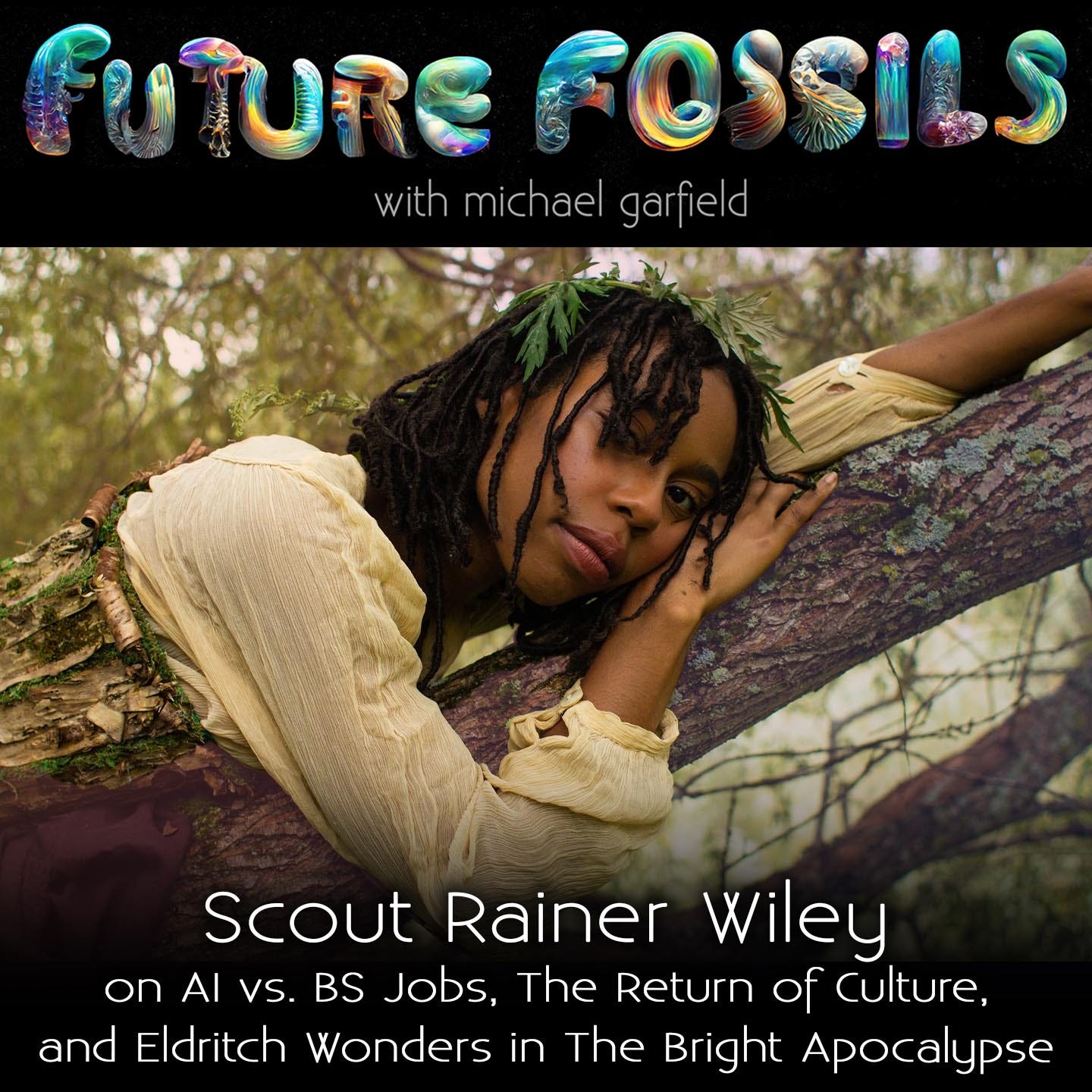
I argue that we should be romanticizing all of our experiences. It doesn't necessarily mean we have to seek out suffering or venerate suffering as like, this is the thing we should be striving towards. We should be just like allowing ourselves to have experiences and use these storytelling psychotechnologies that we've inherited to make them not suck, to make them, you know, experience the eldritch wonder. Oh, yeah.
Maybe we shouldn't be fighting so that the kids can study art. Maybe we should be studying art and fighting. And then our kids can learn martial arts instead of actual war. Greetings, future fossils.
Welcome to episode 206 of the podcast that explores our place in time. I am Michael Garfield, and this week I am delighted to welcome back onto the show Scout Wily, a good friend of mine who describes themselves as a theory artist and a ritual magic practitioner from Brooklyn, New York, who's writing explores the relationship between phenomenology, esoteric spirituality, ontology, culture, and art. I like Scout because we can be ridiculous together. And this episode on first pass files under the occasional Michael and friend just get silly on air.
But Scout, who hosts and produces the oscillators stone podcast and has a spectacular sub stack under the same name, is also someone who thinks very carefully and astutely about changes in culture and has an extraordinary capacity for reading the zeitgeist like tea leaves. So I'd like to offer this conversation up as an appropriately multivalent exploration of something that's really at the front of a lot of people's minds right now as we're watching the screen actors guilds and writers guilds strikes in Hollywood opposing their oppression by film companies that want, for instance, likeness rights in perpetuity after they scan someone and then re-summon those actors' apparitions in one algorithmically generated media spectacle after another. Those of you who have been listening to me wax on the phenomenon of generative AI now for some time will know that my hope in facilitating these conversations is to bring crucial nuance to the question of what it is that we stand to gain and lose in the transition to new technological and sociocultural platforms for human experience. If you go back to episode 195 in the roundtable that we had on text image generative AI artwork, then you know that I have great concern about making sure that people that are trapped inside of late capitalism are fairly compensated for their labor.
But at the same time, feel deeply uncomfortable with the proposition that some kind of idetic perfect memory for the accounting of intellectual property should start in 2023 and ignore the informational contributions of all that has come before, especially when creativity, be it through human artifice or be it through the instantiation of genetic code in carbon-based organisms, depends incredibly on everything that we have inherited and where we decide to place the boundaries around the self and what it owns, has everything to do with what are ultimately provisional and, frankly, dubious models of what constitutes one thing versus another thing in space or time, models that we could argue over until the cows come home and then on into the night until our fatigued brains decide we've waxed on long enough and dissolve the selves that emerge as automatically as a mid-journey image back into the dreamless sleep of the ground of being. And that's kind of what it feels like we're doing right now at the scale of all of human civilization, so as intense as I know the stakes are in how we redraw the map lines around all of these ideas, my instinct is to have a good laugh about it with a wonderful artist who brings great humor and humility to every conversation in which I see them participate. This is a swap cast we recorded as guests on each other's shows, so I completely ignore normal host guest conversational decorum. If you decide you like this conversation so good you want to hear it twice, go check it out on the oscillator's stone.
Also go back in time to episode 179, her first appearance on the show, which was an equally delightful procession. But before we dive into this fun rap scout, I want to give my deep thanks to everyone who has started supporting this show and my work and my extension, my wife and kids on Patreon and sub stack. New members Arnold, David Koenig, Matt Gebrenia, Nick Kahn, Paul Kennedy, Siddharth Mosib, Mike Logue, Jonathan Waller, you and a few hundred other people are holding this show afloat right now amidst the perfect storm of 2023. I deeply, deeply appreciate everyone's help, financial and otherwise, rating, reviewing, sharing the show, it means a lot.
And out of my gratitude, I am ramping the schedule of publication back up to weekly. I have an enormous number of amazing interviews to share with you over the next few weeks, including a panel I facilitated for Samantha Sweetwater at the Psychedelic Science Conference, a three hour conversation with visionary filmmaker Ken Adams, a delightful romp into techno shamanism with Lehman Pascal, an exploration on the evolution of consciousness and technology with documentarian Mitch Schultz and culture hacker Shanta Stevens, and new art and music and essays and book clubs. I mean, I'm firing on all cylinders right now, so thank you all for being the additional ring on my stamina wheel, allowing me to paraglighter coast from one looming precipice to another on the open world adventure game that is our life together. And if that's still not enough for you, then just a heads up that on August 1st, I will be starting a six week web course on the science and philosophy of the Jurassic Park franchise with Jeremy Johnson at neurolearning.com, and I am extremely excited to kibbitz with all of you good people who are signing up for the course.
This is my first time going into full on professor mode, and I'm really, really looking forward to the watch alongs and the asynchronous group chats and unpacking a truly extensive and eclectic reading and viewing list with everyone who signs up. If you're interested in this kind of shenanigans, please go to nuarelearning.com and pay whatever you can. It's a sliding scale thing now, thanks to Jeremy's understanding of the difficult financial situations. Most people are in this year.
We're really trying to gear this toward the best possible discussions and helping us get the word out about this course and getting some last minute paid sign ups is worth as much as signing up yourself. This is a collective research initiative, and I'm really looking forward to working with you all, regardless of your economic station. That said, now is the time. If you've been on the fence, go to patreon.com.com or microguardfield.substack.com and start shipping in a few bucks a month or more, and avail yourself to the absurdly deep archives of previously exclusive stuff I have made available.
Thus ends the advertisements because I rebel against the attention economy and refuse to host them on my show. That's more. I am very excited to reintroduce Scout Wiley to future fossils and to everyone listening. Enjoy this conversation and then dip into our Discord server to talk about it if you are so moved.
Thanks, and I'll see you next week. All right, we were talking about thanking Johnny Depp for his service to the cultural body by giving us Jack Sparrow and his screen depiction of Hunter S. Thompson. And Edward Scissorhands.
And Edward Scissorhands and many other things, but acknowledging that celebrity does something to people that makes them weird and difficult and that maybe we shouldn't force human beings to be cultural icons in that way and that AI will liberate us. Like they're funny because the screen actors guild is saying, you know, don't take our jobs. But I'm thinking like, you know that Ben Affleck meme where he's like standing there smoking his ass. Yeah, he's like, you know, what if no one had to put up with that shit, you know?
My feelings on this as a person who knows nothing about AI or screen actors guilds is surprisingly complex. And so it sounds like you're coming from a very anti-work philosophy and a very pro-anti-work, very pro-anti-work. But work is like, I don't think people are able to really, I'm a very, this is, this is a, okay, I like to in my personal life, decouple work from capitalism because like needing to do something in order to survive takes the joy out of it. Like when a want to becomes a have to, you're in a living hell and there's just no point to that.
And so I think, you know, when people are standing up for their job, people should be standing up for their jobs within the context of a system that exploits their labor and then makes that labor the only way that they can eat. So of course, like it's, it's kind of a weird philosophically. I'm on the side of both the anti-work. We should just get rid of fucking jobs.
And like in order for this kind of like AI liberating us thing to be true, a lot of other things would also have to be true. Like we don't have to work in order to eat. We just have like, there's no such thing as resource scarcity. Like so many things would need to be in place before AI becomes a liberatory tool is just like my very gentle fragile take on it.
And in terms of Johnny Depp, I think we were actually talking about like how Johnny Depp has claimed this like sliver of Native American or indigenous American blood. And we were just kind of like, but why though? Well, so that he can do the, was it Chanel or whatever he was doing these like advertising campaigns where he was dressed up like, you know, was completely off base. Oh, yeah.
All right. I forgot the, like I just knew he did it. Oh, I mean, he was Tonto, right? Like they did the whole.
Yeah, no, that's no good. So it doesn't count. Sorry. Right.
So I was talking about with my friend, my old friend, Tristan Gulliford, who I haven't seen in years, I haven't seen some, I'd become a parent. He was in town this weekend visiting his brother. We were hanging out and he, and I were talking about this and he's like, yeah, you know, I have a hard time. Like I understand when people complain about AI art, he's like, what I want is for them to show me who it actually has harmed and how.
And I was like, yeah, see the, it's not a victimless crime. It's a perfect crime because you know that the crime has happened, but you can't exactly say to whom or how much or by like, you know, it's one of these things that it's like, it's a speculative crime. It's, I think it's a crime based on concepts and ideas that humans have generated and are used to slash have like kind of their, their already fragile livelihoods are resting upon these, these concepts. And so in order for, and I completely, like, again, I don't think it's a perfect crime.
I think it's a really good way of putting it because like people are being hurt by this, that like we're also hurt by the other systems in basically the exact same way. So maybe it's not like the, like the tech that's the problem with the way that the tech is being employed and who the tech benefits. And before we think about like whether or not AI will save or ruin the world, we need to like look at these like fundamental underlying structures that fuck the same people over over and over and over first. I don't know.
That's just me. Yeah. Over. Absolutely.
Absolutely the case. And you know, I just want to hold on. I want to dig back through my Twitter history. Stephanie Lapp shared something the other day that was completely on point.
I want to share it with you. I don't know if you've probably seen this already. You're one of three people that I've actually there to eat. So I'm not okay.
All right. Let's see here. Yeah. Tire screen.
Yes, that's what I want here. Here. Can you see this? I kind of fairly are though and render us useless and I for one am stoked.
I hate jobs. I had a job once and everyone there talked in weird voices. Hey, I was going to 86 all of that, but we'll still need money. That is why I'm asking the government to step up and make sure we're breaded.
A small payment plan or small P P of 10 G a month for every citizen so we can party and look hot and enjoy our free time. Now we can't afford to just sit back and have AI bus through and not have a plan. We got to make sure people have food and houses so we can party and rage in peace. So instruct AI to pay all of us and then you dudes can retire gracefully before you get replaced and we'll see you at the beach.
The bonfires will be epic. Everybody will be hot. Martin Luther King. Thank you.
The guy in the back though, he was like, yeah, man. Yeah, I'm with you. I support you. It was so good.
Oh, man. Yeah. I approached it like Keanu Reeves. He was like, we got it before we before AI takes over.
We got to be excellent to each other. So that would be party on, dude. I mean, that will always be, you know, because I've been telling people since, I don't know what, 2010 or something, 2009, maybe they got to surf the singularity. I myself am not a surfer.
So I should probably shut up. But like in spirit, I am a surfer and I was born in Los Angeles. The, you know, so there's that. And I really do think that there is something that despite the, I'm sure Eric Davis has something really erudite to say about this being visionary Californian.
But there is something about learning to encounter the waves and to work with, you know, like surfing is a martial art. And you know, I think that that's what I'm trying to impress on people. I feel right now more than anything is that the entanglement that we're in with our technologies, whether we choose to be or not is also a martial art and that that's a really helpful framing with which to bring a certain kind of discipline and embodied stance to these things that are incredibly powerful. And we don't have, you know, total control over them, but we can ride them somewhere, you know, may not be where we thought we were going.
Yeah. I mean, humans have been doing that exact shit for basically since humans have been humans and maybe even before we were humans. You know, I mean, I just, I like the idea of the neo-animistic, just approaching the world through not even through neo-animistic belief or animistic belief, but through neo-animistic practice where like me just remember what it was like instinctually to be in a context where everything is too complex for us to be able to fathom or analyze, but we still have to find a way to be in relationship with it. And so we come up with these stories that don't necessarily always make sense, but they, they're accurate, even though they don't make sense.
And you know, I mean, whether I like it or not, I'm dependent upon my technology. I co-regulate with my phone and it's basically like cuddles me to sleep every night and kisses me good morning every day. It's not a wet kiss yet though. We don't have an existence.
Yeah, yeah, yeah. We're just friends with benefits. It's really not that serious. I don't want to put any pressure on things, you know, but I mean, it's not, it's, I really don't like the idea of like the internet is not a real place because, you know, that's like saying the mind is not a real place.
We live inside the mind at all times. And I don't mean that in a pan psychic way. I mean that in like a almost just a metaphor, but like I'm not fully copying out and saying that it's not also like physically real, like most of our experiences are mental in some way. And I remember reading this and by reading the study, I mean like reading half the study because I just can't stand the language that most studies are written in.
So I tend to just read like the abstract and the conclusion of the call it a blind day. But it's not a problem with methods. That's for that. Intellectual integrity is so 2001.
But study was saying that, oh God, what was the study saying? No, come back to me. Come back to me. It's gone.
Never mind. It was saying that when you lose your phone, you lose your mind. Thank you. That's exactly, thank you.
What would I do without you when you're impeccable memory? It's pecable these days. It's the last year or so. Yeah.
Yeah. Oh man. Okay. So on the downside, since we recorded, there's so much that I wanted to talk to you about that I'm now like, oh no, I don't know if I could say that on the record.
Well, we'll have another chance. Yeah. No, that's true. And I mean, yeah, no, I, we may as well just keep going with it.
So I have a, I want to back it up a few minutes and take the other fork because when I was thinking about all this stuff, yeah, there's like a work thing about AI and labor. And look, I mean, I watched Star Trek. I watched the ready room. Okay.
How excited these people are to be in the franchise, they grew up loving and like, Anson Mount gets to play Captain Pike now, and he's like a child. He's so into it. And you know, these people, like all of them have just grown up with this thing and they're surrounded by adulation and it feels so good and they're part of a tribe and it's like, I'm not trying to take that away from them, you know? But on the other hand, there's this thing, like, we lived in a really weird bubble and this is my riff that I want to hear you comment on.
So like we live in a, we live at the tail of a really weird bubble. We're watching it pop right now where, you know, before recorded music and before we're the cinema, you could be an actor or you could be a musician and you were as, you know, word might spread about you, but like you're playing to your town or you're on tour. You know, my dad was actually a traveling actor. He was in a stage production of the music man when he was like a child, like he was a little, a little trumpet boy.
But like there's this Hollywood superstar effect or like the Instagram effect where like I get on my phone now and I look at a 12 year old in Korea who's playing guitar better than I ever will and I'm just like, why? And then the bar is an Austin that supposedly Austin is a music town. They can't sell enough beer to stay open because they could be condos. But even before that, they were like, well, you know, we could hire a musician or we could just play Spotify, you know.
And so there's a, there's something that happens in the scale and the globalization and the flattening of things that, you know, the humans get forced out and, you know, people are not sitting around a piano singing songs together anymore. Rogers Bacon on sub stack issued a musical heresy that actually recorded music was problematic. And I think it's an interesting argument. You know, I think I've been thinking about that, but it's like, it's about this, it's about a return to scale.
Look, you could still, you could still have what you're trying to get by participating in the church of Star Trek in like a local, like, like the way that Wizards of the Coast works with like D&D and Magic the Gathering, right? Where there are game nights and like, you know, you could like, I don't know, Star Trek could send out scripts to everyone or could allow you. I mean, this is where it's going, right? You could allow you to be your own thing.
And then you and your friends have this new social component of like, oh, how were you in Starfleet? And that's like a, you still get that tribal participation. You still get, you know, loved and appreciated by your village. And it's not this other thing, which is like suddenly people are like stalking you and making threats on your family and all the other things that come with celebrity and also celebrities don't warp politics.
You know, like there's like, you don't have people that are getting so big that like, you know, Elon Musk and Trump are like Godzilla and King Kong, you know, on Twitter and they're just, it's like, we're just hoping that they'll go away. So yeah, that's my rant. So paradoxically, I feel like things get so big that they just, they have to get small again. Like we're not humans are funny because I think we've like been playing God for so long that like you and I were born into the lie that we can play God or that like we're not just playing God, we're being God.
And like, I just, you know, I, okay, I'm about to open the can of worms that we refer to as metamodernism. So like my understanding of metamodernism, it's not complexity related at all, actually. It's like, it's when as term originally emerged, it was describing this need to return to like individual personal felt realities, felt experiences that like we are, we are kind of clinging to because the previous paradigms that kind of successfully erased them. And so people in the culture, at least in Western culture right now are kind of saying, like, well, fuck, no, like I, my tiny human life matters and like that's what I want to focus on.
And it's kind of like an effect of this, this big amplified like monster of like the, this technology that, you know, go burn and put it really well with a song, do you like a bit of everything all the time? People are so overwhelmed that, you know, our physical bodies literally can't be have to like kind of build or we evolve to like limit superfluous information. Yes, even folks like myself with ADHD reach a limit or like, oh no, can't do all the things like can't read the entirety of Wikipedia in one night. And you know, so even though I think this like huge, you know, cultish kind of celebrity worship thing has happened that's pretty terrible.
And I also think it's unsustainable. And so I'm like, against it, I'm not worried about it, if that makes sense. Like I think, you know, this is the, you're kind of, I feel like what you're speaking to is the importance of scenes of local scenes. And I've been part of a local scene here.
I've been a part of a couple of local scenes here in Brooklyn. And yeah, people do sit around if I think piano, if they're drunk enough and sing songs together, I remember I went camping with some friends and I just picked up a guitar and started playing my name as Jonas and everybody was just saying, I know, right? Easy song for people who are unfamiliar. I tried picking that one up.
Yeah. Oh, no, the picking pattern is impossible for me as someone who can like barely then strong, but yeah, I know this is my friend Max who I mean, I guess I may as well go ahead and plug Max is like a hardcore music fan since he was like in diapers, basically. And so like, yeah, Max Docker wild people look him up. Yeah, and he he played it well, even though she was kind of twisted.
And it was a beautiful moment that happened almost six or seven years ago that I still remember and the scenes will do that scenes will force you to to become more embodied in the face of increasingly dissociative world. And so, you know, my question, I guess I'll bounce this back to you. How do we really anchor these scenes and sustain them because like one way in which scenes continuously suffer is, you know, the bar can't sell enough beer and the bar is the hub. It's where the people go to hear the musicians and talk and all of that stuff.
You know, if we don't have these little safe houses, like most of the places that I played open mics close down over either before the right before the pandemic or because of the pandemic. And so, you know, it feels like a lot of scenesters are constantly having to be nomadic in a way that really doesn't allow these cultural shifts that we need to be happening to happen. Because I do think cultural shifts happen at like more of a local level. And there's this sort of accumulating effect that happens.
I'm shut up now. All good. I do the same as you know. So, listen, listen, yeah, listen, you talk about this.
It just makes me think of may it rest in peace forever more the Beethill books and comics in Orlando, Florida, where I picked up Magic the Gathering as like a 10 year old. And that store and the game store in Kansas City, when I was in high school, that also it was also a used bookstore. Like they always had to be something and games and they got they got shuttered because you know, the real estate keeps going up. I don't know.
Here in Santa Fe, there's this thing before COVID, there were 5,000 people in need of affordable housing and 5,000 properties sitting vacant most of the year because they were used as second homes. And it's like, okay, so we've rigged this whole like captured economy thing for boomers where they get to just like metastasize across properties, you know, and have like a whole portfolio of land that they can, you know, have their little like fiefdoms. And I'm not exactly as a mortgage paying adult. I'm not exactly looking forward to the collapse of real estate.
But yes, I am. Because what's going to happen is what happened in Berlin and what is happening in Detroit, which is a reclamation of all of this space, suddenly you've inherited enormous amounts of infrastructure and it's up to whoever keeps place best to actually run with it. And then people will be grateful to you that you're like a professional high grade regenerative squatter, you know. So like, I mean, the the overpopulation thing, okay, we're done with that.
Now we're all worried about fertility, cook, crash, and the fact that, you know, the elderly are going to have nobody but robots to take care of them or, you know, climate, refugee, migrant labor, right? So that's the that's the new thing. And that just means that, you know, before too long, all of this is going to be cheap as hell. I don't know how long what 20 years max max.
Hopefully sooner. Right. Like, I mean, I'm always surprised by how long the apocalypse takes. You know, like I thought this was all said and done 11 years ago.
Like I was a 2012 guy and I admit this and I'm I'm only slightly embarrassed about it because if you zoom out far enough, the geological record makes no distinction. You know, you're looking at like minus one and plus one on an asymptotic sigmoidal curves. So like fuck it. But like, but yeah, that's I barely understand these math jokes.
And keep them. Because it's when you go from one phase up through an inflection point and then you looks like it's going vertical that that singularity hockey stick, but then it stabilizes because you hit some limit that you didn't acknowledge existed like people's attention or just in time to play chains. That's another thing. You talk about my kids are screaming.
I'm sure you can hear that. I did hear screaming and hopefully there, you know, it's playful screaming and dad help. There's a nail in my toe. That would suck.
Yeah. Okay. That's a really concise way of phrasing what I was kind of trying to say when I said after a certain point, this overly complex should is unsustainable. And you're seeing a lot of that in like the, you know, the wider, even the global, the way in which the art movements are kind of these independent scenes are kind of converging on this general sensibility of like life might be ending with its precious.
I know I'm following a writer on Facebook called Elroy Craig. And I'm saying that as if it's a Welsh word because I've been doing, I'm on like a 20 day streak and do a lingo right now. And so all the CHs sound like to me when I read them. Anyway, Elroy Craig.
He's like a micro fiction horror writer on Facebook who recently posted something that I want to read to you. Let me just pull it up. It kind of perfectly captures the sensibility that I feel people have around the apocalypse right now. I try to make, try to, I mean myself and people that I think are cool.
I don't mean everyone. Damn, it's like taking forever to load. Okay. Now we're good.
Oh, okay. So initially he wrote something a little bit, a little bit more doomer, but then it was a little optimistic towards the end and then he wrote a follow up. I'll read both. So the first one says, today someone told me that they're planning to retire to Phoenix, but he guess what?
Things will not exist by the time you're that old. Oh, buddy. Guess what? Things will not exist by the time you're that old.
Phoenix and retirement are only two litany of things you are now assured of as eternal that will be destroyed, degraded or decimated by the time you're hitting the big six five. It must be nice to believe in a world that has a future. We should probably see about making one someday. And then the follow up says to make up for thoughts like the earlier one, I'm being relentlessly positive today.
I just told my artist that she's a consistent joy to work with. I told a dude outside of Costco that I liked his shirt. I did like his shirt. I did like a weird, vaporwave, Hawaiian kind of thing.
I just called Snug Cord to tell her I love her and I forgive her for her and her boyfriend's not getting it at first. When I told the archaic and heated to joke later, I'm going to sites down tiny business lesbians yard. I bought I bought low some cat's paw bill, a little todural looking ceramic statue. Don't know what it signifies.
Just want to clutter his desk. The world is dying. I'm not. I'm the sparkle of steel in the dark.
I am the glint off gods red, white, gleaming teeth. I am a fallen angel and a rising ape. I may despair, but I will not lay down. I will accept defeat, but I will not give up.
We're not going to make it, but that was never the point. The point is the week. Oof. Right?
Yeah. Okay. I'm going to read you this one since we're going right into the vein. Let's see here.
I'll play a recording of this song at the end of the podcast so people can hear it, but I'll just read you the words right now. Cool. I wrote this last year because Santa Fe had epic, epic forest fires to either side of it. I had friends that lost their homes.
And then it had like 100 year flooding in the same year. It was it was a gorgeous year. It was like after like after the couple like a month or two that we was like not safe to go outside because of the smoke. It was so green and lush and beautiful and everything was just like, yeah, let's go.
But I also had friends whose like their homes were built on a Royos and they the bridges got washed out or like their trucks were destroyed and like all this stuff. So anyway, that's where this is coming from. And I've always had this thing my wife and I have always this has been something I've been working through a lot lately and it's emotionally complicated for me because I feel like I've seen all of this coming for a very long time before I had any reason to believe it was legitimate. And since really early in our relationship, we're talking maybe 15 years ago or more, I have identified with August coats painting, the Tempe, Tempe, I'm not how you say French, the tempest, it's a pair of young lovers running away from a storm carrying their picnic blanket as a drape on them to try and protect them from the storm.
And I was like, that's us. And so this is the song. I got love for each one of us. Hey, too bad.
It's apocalypse. We will just make the most of this and prepare our kids for a planet that'll help to heal. Don't skip before the big reveal. I know it's a lot to feel, but I'm with you and we'll be all right in luminous night fires and floods, riots and wars.
None of it comes in between us and we'll keep on singing freedom bells ringing. I know you're thinking in spirals, but love, none of it comes in between us. It was easier once back when things were flush, but now we expend all we make on a ratchet trend and it's veering close to a future I'd rather not have to leave to those we've got, but no matter how cold or hot I will hold you and we'll be all right in luminous night fires and floods, riots and wars, none of it comes in between us and we'll keep on singing freedom bells ringing. I know you're thinking in spirals, but love, none of it comes in between us.
I never get to do that on the show. So thank you for bearing with us. Yeah, no, of course, that was really cool. And I wish that I didn't have to pee so bad because I want to respond to it while it's still like the wound is still fresh.
Okay, go. All right. All right. Still wounded?
No, I took my phone to the bathroom with me, so I successfully dissociated through all all emotions I may have been having while I was peeing. But now that you reminded me, yes. Good, good, yes. Join me.
Yeah. Well, anything that doesn't like hit in that exact way doesn't feel real to me. I mean, I was raised by Duma or Afrocentric hippies who won being Afrocentric hippies, they already believe and have experienced that the world is against them and that they have to like survive through apocalyptic circumstances because I mean, they literally did it and then their grandparents did and blah, blah, blah, all the shit. At the same time, we are dealing with unprecedented nonsense that nobody really understands.
And then third, they're a little bit conspiratorily minded. So I was exposed to the idea that we might have a shadow government and we might be microgipped by 2020 when I was 11 years old. So there's something about the nature of my psyche that is expansive around the idea of imminent doom apocalypse, tragedy horror was kind of predisposed to that. It's very funny too because my mom and my dad is like very hardcore.
He really likes psychological thrillers and gory action movies and UFC fights. And my mom just can't handle those things. So I've been exposed to these kinds of things and I've also been exposed to what the fear of them can do. And I'm just looking for a way to, part of why I got interested in the practice of Bhutto is because it is this way of being able to eat the horror.
You know, actually yesterday it kind of came up with the concept of an eldritch wonder, which is like what I feel like you're dead. That's an angel squid. For me, that's my domestic agriculture was the eldritch wonder occasionally slipped into horror, but it's really about your stance. Again, but the surfing, it's like, are you going to get smacked by that wave or are you going to ride it?
And like really believe who was it that said an angel is, I mean, a demon is an angel denied? I don't know. One of the great 20th century psychologists. But like that, that the elder gender.
So important. Thank you. Yeah. And so it's just because eldritch implies horror, but it also it doesn't just imply horror because something can be horrible, but not necessarily eldritch.
But if something is just eldritch depends on if you are okay with a ghostly or otherworldly entity or force that might not have your best interest at heart. And again, humans experienced reality as being populated entirely with these kinds of beings for thousands of years. We know how to do it instinctually. We know how to even if we're doing it in a way where we don't really believe in them as most modern humans don't.
Do you not believe in Facebook people? Do you not believe in the bank? Like anyway, please continue. Anyway, please continue.
Right. Yeah. Yeah. Donald Trump is like in the flesh proof that hyper-object is to feel if climate change isn't doing it for you as like a primary example of hyper-object Donald Trump's whole all of this, whatever he's got going on.
The way that he just like walks, and I'm not praising him. All right. So don't fucking take me out of context. I know one of you out there would just love to do that.
But what do you motherfuckers chill out? No, no, no. His presence alone warps people's minds into thinking and believing, experiencing the world in a way that then has impact on the world, tangible impact on the world. I had a bad trip at the Maps Conference that maybe I will be more candid about later when the other party is involved who are all podcasters are willing to discuss.
But they did too. It was a weird thing. It was like we got into some sort of negative valence, tetra-grammaton, hellscape. And I was convinced, come on, folks, this is not my first rodeo.
I have seen people fall into this pit over and over and over and somehow I had invaded it until this year because I was away from my kids for two weeks. I had this trip and I thought I was the Antichrist and that I had imminentized the Escaton and that it was that I had done it. It was just me trying to be a good guy, but that like, God damn it, now you've brought upon the end of everything. But then I got home and I sobered up and I was like, wait a minute, no, Donald Trump is the Antichrist.
What was I thinking? No, I was no, no, no. Calm down, boy. Oh my God.
Oh, it's really hard to follow that. Michael, this is like a logistical question that's kind of interrupting the flow of this conversation, but fuck it, I've been reading to lose. Are we going to pot swap this or do you just want to, all right, cool. Yeah, because I'm really digging this and I want, I want, I want my, all 20 of my followers to.
Oh, yeah. No, let's go. There's no reason to have to duplicate labor, right? Isn't that the whole point?
Right. Yeah. Yeah, I agree. I agree.
Oh, man. I have earned my stripes. All right. I've spent calendar years sitting there hitting the same hotkey combinations and able to live to bring you this podcast.
And now a machine does it. And if the quality drops 10%, most of you don't care. So can you send me these on that machine? Because I have like this just this mountain of it's kind of like my clothes pile, which I've been slowly chipping away at for the past week.
And now I finally got it down to like 10, 10 close and articles of clothing in the clothes file. But I got like this closed pile of unedited podcasts that I have like voice dysphoria for those of you who don't know what voice dysphoria is. It's similar to the, you know, when you hear your voice recorded, you go, I don't like that. The amplified by like 400%.
So I just like avoid editing my own podcasts. And if I could have a machine do it, oh, if I could have a machine do it. I had such terrible voice dysphoria as a young songwriter and recordist. And it lasted for like 15 years.
And then like you just, it was like a cat allergy. Like I'm still living with my wife's cat. I'm allergic to cats. It's gotten better.
Just stick with it, Scout. You'll be okay. Yeah. But it is helpful.
I'm not a fan of my friends and I use a combination. I don't get anything from D script, but I do run things through clean voice AI and I have a relationship with them and they're great. And then also D script after that because the algorithms work slightly differently and combining them, you get a kind of stereoscopic image of your own foolishness and you can mitigate, you know, you can do things like you can show up to work in a subpar condition like I am today having we slept 15 minutes last night and then it will do the thing. But I want to again roll it back a little bit here because again with this whole, but my buddy Stuart Davis called Bright Apocalypse is the name of one of his albums.
So fucking genius. You know, it's like, you know, when everyone talks about the end of the world, it's like you're talking about with your parents, the end of whose world, right? It's not the end of the world. And in fact, plug for my neuro learning course, I'm doing starting with the classic part because there's a quote at the end of the first Jurassic Park book.
There's like when you know, Malcolm is in his morphine fugue. They don't really express that he's like completely loaded on morphine through most of the story in the movie. And he he's going on about, you know, John Hammond says something about how they're going to, you know, like science is going to destroy the world. And Malcolm just laughs at him and he's like, you think you can destroy the world, you know, like the A world is being destroyed right now, but it's the world of modernity.
And I actually went back and I reread this book recently for the kind of like appetizer course for this thing that we were doing in the Future Fuzzles book club. And it was so fascinating because he was sketching out Metamodernism in 1989. Yeah, that's you wouldn't be the first. There's OK, there's like records of there.
There's you can kind of trace some of the pop of the OK. Hello. I was in Garfield in Malcolm is just me snake. Hello, this is out.
I'm out. No, OK, anyway, hello. Please continue. Yeah, sure.
You get distracted by key faces by thinking a can manage. So you can there's evidence of Metamodernism is not a new thing. It's been around for at least 30 years. It's been relatively dominant and Metamodern fun facts.
But you can find evidence of what one friend of mine, Greg Denver, he's been studying this stuff for more than half of my life, actually. And he calls these things proto-Metamodern where like they pop up in something in the 80s. And you know, the earliest, I think people, the consensus in academia is that the earliest Metamodern thing is show up in the 1990s. So 89 is not that far off.
And I'm a little bit I'm a little bit unsurprised. But anyway, please go on, please continue. Because what you're saying is way more interesting than categorization in my Oh, no, no, no, no, no, I was also context because honestly, like I only met Daniel Gert's last week, like this whole Metamodern thing kind of sidelined me while I was off gallivanting at festivals and then hanging out at SFI and stuff and like it's a fascinating government. He gets creative with the way he uses the term Metamodernism.
But you know, like, really, really, truly, you know, I was just seeing it as that's a conversation for another time. But the point is that, you know, when I think about all of this, and I think about, you know, who stands to lose and who stands to gain and how scary it is. Okay, let me tell you, you know, you're talking about having, you know, having ancestors who have lived through the apocalypse. You know, the reason why indigenous and Black sci-fi is so interesting is because yeah, the apocalypse is already in the past of these authors, right?
And so they're coming at it from a completely different angle where it's like, you know, they're not just casting the future is William Gibson's future is distributed unevenly into like, what if Africa happened in America? You know, it's like, you know, what if we were poor? So it's like, but then there's this other thing, which I recognize because I can confirm that my dear local Jewish friend who's said her dinner, I went two years ago, or pass over dinner was not listening to this. And so she won't mind me commenting on how strange it was that the, like, basically all Jewish, and now I kind of understand why my dad was like, non-practicing Jewish, because it's like, it's all the Jewish rituals I've been a part of are basically like a re-invocation of historical trauma.
Like, they're all just like, and then we got screwed by these people. And we may do with almost nothing miraculously until such time as we took over Hollywood and we're still getting screwed. And it's like, well, yeah, because you keep cutting up your babies. Come on.
I am only capable of speaking this because of being. Being a Jewish comedian. That's how Jewish comedians roll. It just gets self-abuse.
Right. Where did it come from? Right. And that's the point.
And so like, I've been another characteristic of this day's long vortex of darkness. I got into it at the maps conference was I was working on this painting. You can see here behind me of this sort of actually, I can't really see it. Well, it's a, it's a philosopher in prayer.
It's a remote transcendental object with parts in its eyes, like an emoji. And it's, it's looking up just, you know, like aspiring to be more. But the point is I identified with this and most people, that's fine. You know, obviously.
OK, so a woman came up to me while I was working on this painting at the maps conference, she starts talking about losing her house in a fire. My mom lost her house in a mortgage foreclosure in 2009 and she calls it the fire and, you know, we, we started talking about the Phoenix and the dragon, which has been this, this image that for me has always been about me and my wife. And, you know, she starts saying all this stuff that brings to mind, you know, this like this question of like, oh, it looks like it's ascending, but it's also being like, it's also getting sucked down into death and despair and darkness. And it's happening at the same time.
You can't tell whether you're coming or going. You know, you can't tell whether you're rising or falling. And I was, you know, I was thinking about, she also brought up all the stuff about, you know, like the molten color of the painting and like reminding her of volcanic eruptions. And I was thinking about how I've been trying to get my family out of this country since 2000, before I really even had a family.
2008, I've been worried about the Yellowstone Supervolcano. And now we live in the shadow of the Hamas volcano. And it's just like, you know, like, this is gonna bust, folks. Like it's gonna bust.
And yet I can't convince anybody to move to Australia because our extended families live here. Anybody have any of my wife? Not probably not safer than living next to a fucking house. It's problematic in different ways, right?
But at any rate, the, I was having this conversation with her and in my sort of vulnerable state, still reeling from what I had experienced the night before. Like, it seemed like all of my music and songs and everything, it swirled together. And I realized that everything had been a premonition of this, this thing where like, they're these famous, famous archaeological specimen, the lovers of Valdero, which is like a couple that were buried in each other's embrace. And then there's another famous fossil of the fighting dinosaurs, which was a Velociraptor and a protoceratops that were buried by a sand slide and died fighting each other with a claws in each other's bellies used those fossils as an analogy to my now wife's parents when we had been going through at that point, almost a decade of really, really rocky relationship.
And I was like, you know, it doesn't matter what happens in the second act. All that matters is what happens in the last shot of the film, right? All that matters is what happens when you're fossilized. And I just had this weird, freaky thing.
And I'm saying this and I can't believe I'm saying this because this is like, but I just had the sense that, oh my God, like what if I, this whole time, what I've been experiencing is the knowledge that we're all going to die in this enormous cataclysm that's going to surprise everybody because, you know, everyone's worried about AI and Trump and foreigners and climate change. Nobody's really worried about the fact that the solar plasma connection to the earth is like, create, you know, like leading to a pull shift and it's going to like pop all the volcanoes, you know, or some crap like that. And I mean, I am way out on a perch here, right? Like psycho, woo land.
But the point was, hold on a second. Yeah. That was the worst possible moment. You were on such a role.
That is just my family is incredibly communicative. Oh, my family doesn't let me know until they've come back from the hospital. So, you know, talk about, make your mother wear a Jewish. Okay.
So, but the point is like, if folks have been watching strange new worlds, then they know that this is a show that's all about a guy who knows that he's going to suffer an inescapable, horrific, life-altering, tragic experience. And it's just about what he can do before that thing. It's all about making the most of his life and benefiting as many beings as he can before that thing. And I just like, I saw a straight, perfectly down the barrel of that thing.
And then also, and this is the point I've rented great length here. And yet also, I can't help but remember that I come from a melange of displaced peoples and that maybe what I'm actually carrying around in that I am casting into the future is some like past life of something that I'm sensing in the Akash, like something that's like, you know, like maybe somehow tuned my brain to the radio station that picks up on that velociraptor that died in that volcanic explosion, you know, and that I'm just like paying it forward by concretizing it into the future destination of my own timeline. God only knows. But I say this as a caution to people because, you know, here it's a loop it back to the first thing in AI, they don't care if you're saying terminators or no terminators, you know, Twitter still says terminators are trending.
So congratulations, you've just attached the Twitter to 3D printers and now you're printing terminators because you're so afraid of them. It's what Doug Rushkoff called instant technological karma. I really like that. So I mean, this is the question to you.
Thank you for allowing whatever the hell that was, 20 minutes of context. It was like 15. Do you think that you can see outside of the Titanic going down? Do you think you can see the rafts?
Like, do you think you can see like life going on? So again, with this kind of like, you know, your Jewish and Irish and a bunch of other things and even the like English and you is probably the English peasant and not the English Lord, I can see it in your eyes. And myself, African American and I mean, actually more identifies Caribbean because Caribbean's are just like a cluster of all of the people that weren't wanted in the first world countries and got shipped off or, you know, the people who got shipped in to do all the labor for free and then they just kind of co-mingled and became people like me. And so there's, yeah, yeah, there's a lot of that sort of carrying forward pain and projecting it into the future.
But I also think that if that's kind of your reality all the time, and you don't want to go like the survival of life instinct thing does kick in, I think, for a lot of people. And I think this idea of like, I so recently I wrote the last article I wrote for the oscillator stone was called, well, maybe I don't want to feel better. And it's about this bullshit thing we do where we somehow think that happiness and joy have to like outweigh pain in order for life to be valid. And basically saying 50 50, 50 within 60 40, like 40% joy is better than 10% joy.
And 50% joy is definitely better than 40% joy. And so, you know, people who have, you know, are carrying these ancestral traumas are also carrying these ancestral gifts and like your capacity to even look at that velociraptor who died in the fucking volcano, whatever, and not repress it, to have to be enamored with it, to find beauty in it. Like you wouldn't be talking about it if you didn't find something beautiful about a horrendous death by fire. And then being fossilized and like your, there's a romance to that that is also pragmatic.
I'm literally stealing my term from Timothais Vermeilin, a pragmatic ideal is a sort of like, there's beauty in this suffering and it's the suffering itself. It's not what we project onto it to stop seeing the suffering. It literally lives in there. And so we can tune our fine, tune our attention to experience it that way.
And I kind of push back in this article, I push back against the idea that we shouldn't romanticize things like mental illness. Bro, if you're mentally ill, what choice did you have? I'm going to just suffer like it's you're inevitably going to suffer as an mentally ill person. That's like what it means to be mentally ill.
And I would argue that's also what it means to be human. Maybe non-mentally ill humans, if they exist, I don't know, sounds fake, but okay. Maybe not these serious neurotypicals everyone's been talking about. I've never seen one.
I've never seen one. I've got 2.4 children. Yeah, the point for child is neuro-atypical. The other 2 might be normal.
The one that's only point for a child, something's going on there. So think that these people, you know, they suffer too. Maybe they suffer slightly less than someone who's got like PTSD or what have you. But and it's like, yes, we can, we should be willing to heal.
But in order to heal, it requires slogging through those goddamn trenches and it sucks. And if you don't romanticize it, you're going to have a rough time. So, you know, I argue that we should be romanticizing all of our experiences. It doesn't necessarily mean we have to like seek out suffering or venerate suffering as like, this is the thing we should be striving towards.
We should be just like allowing ourselves to have experiences and use these storytelling psychotechnologies that we've inherited to make them not suck, to make them, you know, experience the eldritch wonder. Oh, yeah. I'm going to lose all points I had in the eyes of whomever has managed to listen this far. They're both people, you know, the people that bulk at UFOs and psychedelics and stuff, like, how did you even get here?
Except possibly sideways through my former employer, in which case, welcome. And I thank you for sticking through because I promise this is the same rigorous person that you heard on the other show. But I'm off the institutional leash now, you know, I come out of the closet with this stuff because again, it's like, the clock is up, folks. Like what?
Why not just be honest with each other about what's going on? The important thing is avoid premature ontological closure, right? Like the important thing is not to just like assume that the first story you obtain about what you have experienced is the correct hypothesis. But I can't form or rigorous hypotheses about this weird phenomenology without data sharing, right?
So there's that. OK. All of that stuff said everything you just said calls to mind one of my favorite scenes in a music video. So whatever respect for me you had as an interlocutor of science has been is gone.
And then whatever respect you may have had for me, a culturally refined psychonaut is about to be gone when I tell you that one of my favorite scenes from a music video ever is the scene in Taylor Swift's blank space, where she is tearing apart the mansion of her former lover and she's got mascara running down her face and spider webs. And she looks up at the camera as she's knifing the portraits on the wall and she smiles. And she's just like, it's this like manic, gleaming sunlight that beams through the thunder clouds of the rest of the song. You know, I don't have an argument with my friends about it years ago because I was like, no, this is actually really, really empowering.
This is a beautiful thing to show young women like this, that you can. OK, loser, she actually kind of enjoy it. Yeah. What generation of women was actually like, let's just dial back a little bit.
What generation of women was given that message? Right. This one. Yeah, this is the age of the manic-pixie dream girl.
I mean, Taylor Swift is really popular right now, I think, for part partially for that reason, Mitsky is really popular right now, I think, for that, for that reason. Harley Quinn. Harley Quinn, another example that I... Queen's Gambit.
Oh, I haven't seen it. Yeah. It's the age of the Autisticoated Twink and the Manic Pixie Dream Girl. That's what we're working with.
But please continue, I think. No, that's it, right? OK, here you are. This is your moment, right?
So yes, yeah, yeah. I think Taylor Swift's on to something. I don't really like know her that well. I still, my idea of Taylor Swift is still, you know, you belong with me.
That's the last Taylor Swift song I've heard. But, you know, she's got a cult. And that brings her full circle, doesn't it? It does.
And maybe this is a good place to explore, right? OK, so if not for Weird Studies podcast, I would not know about Victoria Nelson and her book, The Secret Life of Puppets and her thesis that modern Fanship has created a secular container into which religion can pour itself for the modern era. Oh, absolutely. I have you ever been on Tumblr?
Right, right. And so, you know, so like, what am I? I am a pastor in the Church of Jurassic Park, I guess. But like Jesus saved me from your followers, right?
Because like any time I talk about, you know, teaching science and philosophy of Jurassic Park in the Jurassic Park, Facebook groups, forget it. You know, these people just all they care about are the toys, you know? But, you know, so Star Trek, at least those people are interested in philosophy, you know, but then half of them actually unironically want the sort of unification under a fascist utopian modern regime, you know, that's basically just, you know, like space, militaristic, fully audited luxury, gay space, but we're talking about this with Daniel and Tom and Mark in that episode that will probably be out by the time this is out. That like, I think, you know, the I love seeing how messed up people get about the last couple series that Star Trek has put out because they're not just rolling with this notion that, you know, the Federation of Planets is inviolable and that Starfleet is immaculate because it's like, oh, right, you know, since 1967, we've learned about complex systems and, you know, we understand the ineradicable bullshit of institutions and here we are, you know?
So it's completely fair to talk about these liberties and these sociocultural victories as something that has to be won again and again and again and again. You know, like, can't ever just, you can't become complacent. You can't just assume and it's funny because I mean, just like flip this on his head. That's what Jim Rutt is basically saying when he's bitching about how millennials abuse the word trauma, you know, because he's saying like that whole John Adams thing about, you know, like we fought so that you could study politics so that your kids could study art, you know, but then the kids who studied art don't understand war and so war happens and it's the fourth turning, you know, generational dynamics thing.
That's the one I want to leave you to riff on. Yeah, I think there's some true. Gee, thanks. Out of my depth here.
I think there's some truth to that, but I want to push back a little bit on its kind of implied linearity. I mean, the kids who like myself had artists, parents and it's both a privilege and a curse because like, you know, trauma is not just this thing that happens to you. You can also inherit it. And in some ways that's worse because you don't have a thing to point to go, this is why I'm like this.
You just have depression and everyone thinks that you're stupid because you don't have a reason to have it. So there's something about that kind of like I inherit, but I still feel displaced. Like I have no origin point. Like maybe we shouldn't be fighting so that the kids can study art.
Maybe we should be studying art and fighting and then our kids can learn martial arts instead of actual war. And you know, why are we protecting? You know, I speaking of Jim Rutt, I like to make fun of him internally sometimes as like, you know, okay, boomer, but like, I think he's he's makes like a good, I think this is a really good point to that people dismiss with okay boomer. I think I've seen Jim Rutt make, which is that we like younger generations have been like, what are you protecting them from life?
Like, why are you doing that? And then kind of shitting on them for not being prepared for certain things. Yeah, dude, you didn't prepare me. You know, so it's like, I do think that I was raised in a generation that was smothered in some ways, but was also experimented on in other ways.
And you know, I've been watching a lot of documentaries for research on a fiction project I'm doing, which is set in the Edwardian era in an alternate universe. So I'm doing a lot of research for the Edwardian period. And you have, you know, I watched Edwardians in color and it was this woman watching another woman and the woman was building a lamp and this woman is making like a penny per hour or something ridiculous, you know, and like, but she's, you know, she's like, she's doing the skilled manual labor and she's building this lamp by hand and she looked at the camera and she smiles at the camera and she's so intimate with the process of working. And that is something that I feel like, you know, later generations were kind of robbed of that and then blamed for being robbed of it.
I do think that there's this need to engage directly with life that we don't, you know, the digital age people haven't had as much. You know, I wish I knew I wish I knew how to hunt. I wish I knew how to like, you know, gut a fish or something practical like that. And I do, you know, plan to invest in those skills, but invest.
I have to now pay somebody to teach me how to do this thing that I'll probably know how to do but not really need to do, at least until the collapse finally happens. Whereas like the people who initially came up with these methods did it because they needed to, not because it was like a fun thing that they wanted to do in order to feel really cool and really skilled. It's just like mundane, everyday, intimate practice with reality, you know, kind of going a little bit unhinged here, but bear with me. I do think, you know, no, actually, I think I'm done.
I think that's where that's. OK, so I have to end this on a picker D third, if you will picker D third. I learned this term from my violist wife. It's when the piece it was imposed on pieces of classical music at a time when it was considered in poor taste to end in a minor key.
And so you'll be like, you end on what feels like optimistic. No, right, you know, because again, it's whatever you walk out of the theater with is what you walk out of the theater with, right? Yeah. So unless it's American Psycho and then all you can think about is how the ATM has to be defeated at cat.
But so what I want to know is what in you, if anything, suspects that the kind of collapse that we're talking about is not at some moment in the future, but is a permanent vector within a set of complimentary flows within a system that has found ways to stabilize its own growth by growing into its decay and that we end up more like a rainforest where things are constantly dying and falling away, but that becomes the substrate, the food for what is also emerging at the same time. And so we don't it's not like we're risking you know, a biosphere or even human, you know, human beings or, you know, all of the things that we as children of late capitalism, you know, like maybe we actually do get out with a lot of what we've come to accept as what we've come to expect, you know, like maybe maybe it's better. So what does getting better look like for you, Scout? Yeah.
Well, I like this question because if I did want to get better or feel better, what have you for me? So OK, so I'm kind of stealing this from someone who doesn't want to be credited with it. So I'll just leave that part there. And you know, when you have a problem, you know, I think it's easy to assume that that problem is caused by another thing, right?
So you have a solution and all you have to do to have a solution is to know what the problem is. But I think we're in a situation where we're dealing with this really convoluted accumulation of effects from other causes that then become causes themselves that sort of end up in this wild dance. And in order to get better, you know, if you if you equate getting better with solving the problem, you're kind of fucked because it's really hard to figure out what the problem is in those kinds of circumstances. But in order to get better, you just need to take what's with you in any given moment and become a part of that, you know, you said something along the line to becoming of the forest where the decay then is feeding the growth as things are decaying.
You know, I think we have to be agentic about getting better. We have to be agentic about feeding the growth because people around my and your Adrian, I don't actually even know how much older you are than me, but in our kind of age range are more experiencing effects that we didn't cause. And so our job is to kind of filter filter all of that gunk and somehow not purify it so much as like just transform it into something more digestible, more, you know, you can't not all soils are created equal, right? You can plant a thing in rich soil and if it isn't the kind of plant that works well in rich soil, it's going to die.
So you have to kind of make sure that the foundation for the things that we want to create are in place. And I think that's ultimately I feel like that's my role in any case. It might not be everyone's role, but for me, that helps me feel better. That helps me the idea of other people in the future being better than how people are now makes me feel better, even if I might not be that kind of better.
I may not get to experience that piece, but I feel good contributing to it. So there's a little bit of tragic optimism for you. That's beautiful. Thank you.
My 15 minutes of sleep has caught up with me. Yeah, but I would love to thank you. For being such an awesome person and such a joy to talk with. And I highly recommend that people subscribe to you on sub stack and and to me, because I'm unemployed.
Yeah. Yeah, I'm not. Okay, Scout, Scout is the focus here. And to my already existing subscribers, I'm forever grateful to you and forever in your debt and constantly losing sleep over whether or not my content is good enough for you and subscribe to Michael Garfield.
You won't regret it. The next time you hear from us folks, Scout and I will be collaborators on a super awesome, currently secret project. Oh, you told them. Why did you tell them?
That's it. Have a good one. Bye. Oh, I know it's a lot to feel.
But I'm with you. And we'll be all right in luminous nights. Fires and floods. Riots and wars.
None of it comes in between us. We'll keep on singing our freedom bells ringing. I know you're thinking in the spirals, but none of it comes in between us. It's easier like when things were plush, but now we extend all we make of a ratchet trend.
And it's a very close to a future I'd rather not leave to those we beguire. But no matter how cold I will hold you. You'll be all right through the luminous night. Fires and floods.
Riots and wars. None of it comes in between us. We'll keep on singing our freedom bells ringing. I know you're thinking in the spirals, but none of it comes in between us.