
I really don't know anybody in my whole digital world. I don't know anybody that's made more art than I have. And almost none of it's been seen by anybody except myself. And I'd like to get that in a more approachable context.
One thing Terrence would say at every public event, at the end of it he'd say, look around you and notice and acknowledge the others, because these are the people that check you out at the grocery store that teach your kids at kindergarten. These are the people that you want to know because you wouldn't be in this room if you weren't interested in psychedelics. So I know we all have to whisper about it, but the more you do talk to one another, help each other make their music, help people get their book published. Do this stuff together but calls your community and you've been marginalized by brutality.
Don't let it in there. Do it, take it on and you'll be rewarded because he thinks nature rewards courage. Adubius concept but one that has inspired me occasionally. Greetings Future Fossils, welcome to episode 209 of the podcast that explores our place in time.
This is your host Michael Garfield, paleontologist futurist. It's funny, I had a friend tell me yesterday that he thought that paleontologist part was some kind of metaphor or joke or whatever. But no, for the first 22 years of my life, it was my single-minded preoccupation. And the show is inspired and framed for me by a very, very deeply ingrained commitment to digging, discovery, preservation, restoration, and engagement with deep time and our place in deep time.
But for most of my youth, I was kind of uninterested in human paleoanthropology, archeology, history, genealogy. The human scale wasn't doing it for me as much as imagining millions and millions of years, imagining a completely different biosphere than the one we inhabit. And then something happened to me in my 20s and early 30s where suddenly I began to understand the value of a much more proximal investigation of antiquity and of the recent past and what it will mean for me to be an ancestor. And a lot of that had to do with my encounters with my elders in the psychedelic community, folks I met through the festival scene, through Burning Man and the MAP Psychedelic Science conferences.
There was such an extraordinary wealth of story in these people. And so much of it was going untold or at least unrequarded for good reasons Diana Slattery talks about in her book, Xenolinguistics. The unspeakable is not just about the ineffable or the translinguistic, but about the taboo or the illegal. And a lot of these fascinating older people have these extraordinary stories that would have incriminated them.
So when you think about the drug war and the extraordinary loss of cultural depth and richness that comes when there are inhibitions on storytelling and on archival and on intergenerational transmission of knowledge, well, thank God things are changing at least somewhat, not just because of changes to the regulatory framework, but because people are getting bolder. I mean, just by comparison, you can see a lot of the older members of the government involved in the UFO UAP cover up. And at the end of their careers and feel like they have nothing to lose and everything to gain by coming clean about what they were involved in over the years. And I think something similar has been going on here.
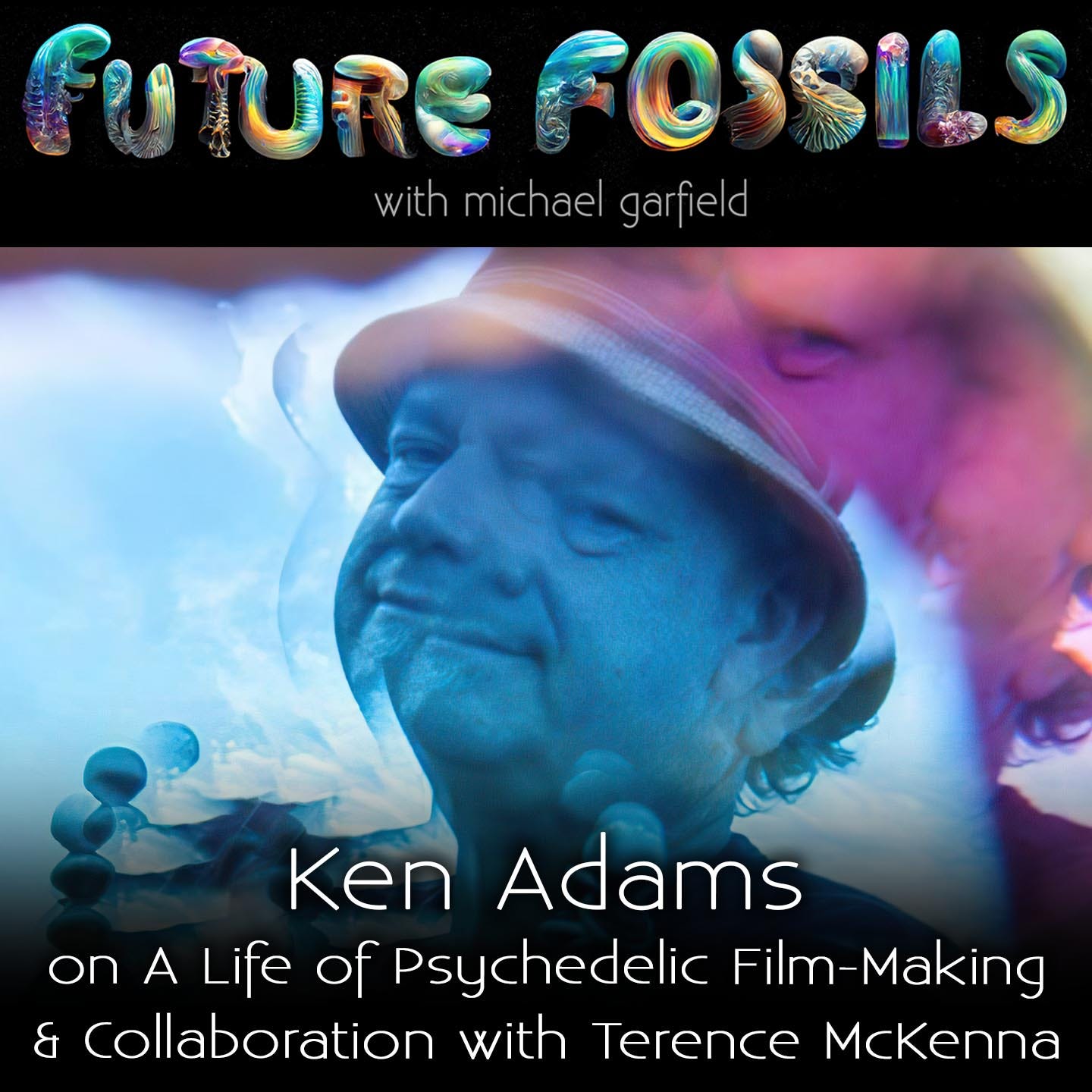
People are just tired of keeping secrets. And we're living through an extraordinary era of disclosure in a lot of different ways. So one of the first people that I was really, inspired to get into podcasting as a way of helping cement their stories in the public domain was my friend Ken Adams, an extraordinary experimental filmmaker documentarian, father, psychonaut, and new media pioneer with whom I feel a deep resonance in terms of personal process and commitment to the transformations of culture and society and in the mid-wiping of something strange, mysterious, and wonderful erupting into history. Ken was a close friend and colleague of the ethnobotanist and psychedelic philosopher Terrence McKenna.
And so in getting to know him and Bruce Damer, Brenda Knight, and Norman Katz, and several other Terrence's friends, I feel like I have healed somewhat my lifelong sense of spiritual homelessness by anchoring it in a lineage of bold explorers working in the psychedelic underground. And so I'm very, very excited to share Ken and Ken's stories with you today. Ken was up in Santa Fe for a screening of his 1993 film Alien Dreamtime, which he produced with Terrence at the Jean-Cock Toe Cinema. And I had the privilege of sitting up there on stage with him and Vince Katlubek, the co-founder and former CEO of Meow Wolf to discuss the historical import of this film.
Although I didn't feel like I had much to contribute after such a mind-blowing cinematic experience. Anyway, Ken is one of the first people I ever interviewed for anything back when I was the editor-in-chief of SoulPurpose.com. Three years before I even really started a proper podcast, but I've been really, really eager to get him on Future Fossils since the very beginning. And I have immense respect for him and his work.
And I think you should go to his Vimeo, LinkedIn, the show notes, and check out our upon our of totally amazing, interesting video experiments. And also just as a note of historical context and framing, this was the 30th anniversary of the release of Alien Dreamtime. It was also the 30th anniversary of Jurassic Park. In the same month, there's something really, really strange and interesting going on about the advent of digital filmmaking in June of 1993.
And that transition is something that I just explored at length in my neuro-learning course on the science and philosophy of Jurassic Park. If you would like to access the recordings and my talks from that class, then I'm going to be making them available soon to the top couple tiers of Patreon supporters, as well as the long, long overdue ebook for my first essay collection, as well as the album I've been working on and finally just completed after 15 years. So really, there has never been a better time to sign up and support my show, especially in this awkward interregnum between grownup jobs that I've been living in for most of the year, which is why I want to issue special thanks to everyone who bought my recent live album of electric guitar music, performed live at the Psychedelic Science Conference, everyone who has been supporting the show on Patreon and sub-stack, and new patrons, Joshua Sacks, and Gilberto Vendromine. And lastly, the folks at newanautics.org, a nonprofit dedicated to envelope pushing scientific research, including extended state DMT trials and satellite-based archeology, I'm joining their advisory board, and I am excited to be establishing a partnership with newanautics.org.
And part of that partnership is that I'm going to be featuring other key members of their advisory board and team on future fossils in the months to come, as anyone who has listened to the show for a while knows, my favorite kind of Psychedelic Science is the kind that actually uses Psychedelics as an instrument, the conversation on future fossils about that goes at least as far back as episode 88 with Dennis McKenna, which I highly recommend. And it's really something that's only becoming possible in the public sphere right now. So yes, a very exciting time, but all of these advances have and long histories, and it feels like the faster things move, the more that these histories are occluded by the eruption of the novelty volcano in which we live. So again, I'm very, very grateful and pleased, not only to call Ken Adams, my friend, but to provide this totally unprecedented and exclusive interview.
Thanks, everyone, for listening. Thank you for your support. Enjoy this fascinating, bizarre, profound, soulful conversation. And of course, please subscribe, review, and rate the show.
Thank you. Let's do it. Ken Adams, who even are you? I know so much about you, but I don't know even more.
All right, tell me your story. Tell me where you were. Where were you born? Who were your parents?
What was your childhood? I went the early early. I was born one morning when the sun didn't shine. I looked at my boss.
He said, get back online. I shoveled four terabytes of number four code. My boss man said, bless your soul. So I went into technology early.
That's what you mean. Give me a city. So I was born in Monroe, Louisiana. My dad was a scientist engineer.
My mom was a cajun, a life-loving person. Weird things happened. Almost blew up the planet for some trouble in Cuba. And that night I started being very interested in how to save the planet because it appeared obvious to me in 1962 that the adults had gotten us into a mess.
And that the solutions would have to come from a different generation. So when psychedelics finally came around, meaning for me, Jimi Hendrix and Beatles. It was clear to me that it would be an invaluable asset in trying to figure out all these challenges that we were facing. And I became an adult when I was 12 years old because of watching Kennedy on TV telling us to get ready on your bomb shelters because we had some disagreements with these people called Cubans and Russians.
So first chance I got, I was really interested in psychedelics and had been doing them for pretty much my whole adult life. Wait, so since what age? Oh, for the psychedelics, probably very mild use, like just recreational mushroom use because you could just pick mushrooms out of the fields in Louisiana. And it was a way to get high without having to spend a lot of money.
But it wasn't a psychedelic thing. It was just the kind of buzz thing. And it wasn't until I was in grad school that I really ran into a guy that was a former player with the Brotherhood Eternal Love, who were a bunch of people that got together to make massive amounts of psychedelics, LSD in particular, in order to help bring the Vietnam War to an end. So a lot of that stuff was done just for the sake of doing it.
And this guy that I was in my graduate program at University of Texas, Austin, was an ex-member of this thing. And he had gone beyond the statutes of limitation and was writing a dissertation about LSD and distribution networks and this kind of stuff. And he gave me a bunch of really amazingly clean, beautiful LSD and said, you know, have some nice music and, you know, don't eat this and this, but don't eat that. And I just jumped in and I like went for, I mean, I did a lot of LSD and peyote and mushrooms, of course, and for years, and it was just a beatific kind of thing.
It was just blessings. There was no, it wasn't blurs, it wasn't a blessing, and of course it was only a blessing. And that led me into trying to figure out how to give this kind of piece of the puzzle into the discussion about how to manage the end of our times and the beginning of new times. And it seemed like you could scale up with things like LSD a lot more than I could with poetry or something, you know.
And I also was raised in a technical family where I knew when computers came around, I would want to be involved with them some way. So I coincided with my work as an artist and I started doing psychedelic art on computers and with computers, not just that, but that's what took up most of the time. So wait, you went to grad school for what now? Sociology and anthropology, no, it was writing.
At UT Austin? Yeah. And they told me to forget the word psychedelic or just go somewhere else. So I was trying to write a dissertation.
What year was that? I wanted to make a disclaimer right away here. I think we ought to conduct this with the attitude that might I say is unreliable and I'm an unreliable narrative with a fact-free epistemology. Fair.
I guess I left Austin, left graduate school in 1980 and moved to San Francisco and got involved with the art world there and the psychedelic world and some of the same people that I'd been hearing about for years through these networks. They were just there and going to the same parties and events and stuff that I was. So I got really involved in that part of it for a while. And it led really directly to meeting Terrence McKenna.
And that really, that experience is the biggest hash mark in my whole life besides myself and my kids. And it just interrupted my life in a really wonderful way and challenged me to have faith in some pretty miraculous things that are around psychedelics. If you're looking at them from a spiritual point of view and a creative point of view, psychedelics are unbelievably wonderful and reveals. The first time I did LSD, I remember thinking, well, at least now I know there is a heaven.
And if I need to, I can get back to that heaven. It's not going to require any particular intervention by an angry desert warlord, anything like that. It was just deciding to do it. And then you explored it with your friends and your lovers.
And it was a very exciting time because wasn't any history yet about LSD. There really was very little about any kind of psychedelics that you could actually get and read. So people learned by becoming friends with people that were also interested in these subjects. And the other people started finding each other in different ways, even after the kind of weird suppression, that weird horrifying suppression during some of those years and the Reagan years and the Bush years, people were going to jail and stuff.
Friends of ours just got out of jail. And they don't talk about that very much. But it took a lot of courage for people to stay engaged and do risky things to make psychedelia available to people that otherwise wouldn't be able to find it. And that was very exciting.
And leads to the art stuff and all that kind of thing. I want to ask you about meeting Terrence. I was living in the Lower East Side in New York. And it was really a very wild period.
The parks were full of people living in the parks, rastafarians, crazy people, punk rockers, tourists that got lost. It was a very active outdoor scene going around. And the movement of the expressionist was full blast. And I'm living there doing a bunch of things with other people that are involved in psychedelics and art.
And some pretty real mainstream, very famous artists, people that I got to work with just make a living. And one day I'm in the only organic grocery store in the Lower East Side. And I hear this guy on the speaker with a very funny voice talking about psychedelics in a completely intelligent way. And without any apologetic element to it at all.
And I just sat down on the floor and this grocery store to wait until the program was over to find out who was this guy. And it was Terrence McKenna being interviewed by Ralph Metzner, an OG psychedelic guy from the Harvard days. And I don't even remember what he talked about. He just talked reasonably about psychedelics without fear and being intimidated.
And I went home and I told my lover, I'm going to wrap things up here and move to California and try to find this guy. And I'd really like for you to come with me. And we basically took two or three months to get there. I go to one of my favorite friends in that psychedelic underworld that I was talking about.
And we tell him what's been happening. And I've got this new computer. I got a grant to get a computer with him to do experimental media. But I had never made any experimental media.
So I was like, I had this big, nice computer, some new tools. And I go to this guy. And I said, you have any idea how to find Terrence McKenna, even though his name. And he got a big grin on his face, like a coyote grin.
And he tapped his pad of paper next to his old school phone. This is before answering machines for a lot of people. And there was one phone number written in pencil on his pad and nothing else. And he just tapped it again.
And I said, that's literally his phone number. And he just tapped it again and said, call it right now. And I called in and I won't go into details. But I immediately got him touched like within two minutes.
I got him touched with Terrence. And he was at Esseland Institute. We talked for a few minutes. And he asked me if I wanted to drive down there and meet him and talk about doing some work together.
Because we were both excited about computers and obviously psychedelics. And I drove down there with my lover and met them there. He was there with his family and doing this big weekend seminar thing. We smoked a bunch of pot under a tree when he was wearing weird bug eyes and glasses.
And at the end of it, he said, you guys are the only people I know that are on a computer like this yet. And you don't have any money. And you're having all the way from New York to meet me. You just move to where I live.
So it makes it a lot easier for us to get rolling. And we were like, OK, sure. That was where you live. And we moved right in the redwoods and near a place called Occidental in Northern California in a little tiny place called Camp Meeker.
That used to be a summer camp. It hit its own swimming hole. And it was surrounded with redwood trees. And all the houses looked like hobbit houses.
And it was really funny and really wonderful. And we were only like a few hundred yards from Terrence's house. So we just started working together with the computer stuff. Because literally nobody knew how to even use these computers.
There weren't any YouTube videos. There was no place to go for solid information, except passing it around among individuals. And we just started immediately doing videos and trying to figure out a way to coordinate all this prosumer's safe with tapes and trying to mix it into the digital realm. And it was interesting.
This movie, the Alien Dream time movie, was made that way. And with very first generation computer graphics that you could manipulate and also have in video, which led to us making Alien Dream time and a bunch of other stuff. I don't understand the transition from analog to digital as deeply as I would like. It's a miserable story.
You used to have to have this wind pulse called the house signal to do video. And it would coordinate all these machines, which were tape machines. They'd have to all rewind and unison and then start back up again and synchronize. And then it would kick in.
And if you didn't get it right, you had to do it over. But not worse than that. If you wanted to change something at the beginning of a videotape where you noticed a mistake, it fucked up everything after it. There was no digital tape editing yet at all.
I was like a beta tester for a premiere in that period. And it was very arduous to make video. It wasn't much fun. So you had to mix these pulse signals with every camera and deck in the system for it to record everything at the same time.
It was insanely black magic kind of stuff. You could get an interference signal and just lose a whole night of work. But you could hear something in the background going, meh, meh. And not have heard it on the audio.
It didn't happen on the other side of your earphones. So it was a very puzzling time. And the rave scene was starting when everybody new computers were going to be part of that. And I had a wealthy patron that gave me a really expensive projector.
And nobody had a projector much less, a really good one. So I was invited to do a lot of the very first raves in America as a video projectionist. And I was already bald and silver-haired. And like the very beginning of this stuff, like the late 80s.
And I still do that. And that's been a long time. So I've just gotten borled with it and just meshed by it and felt a lot of faith in the capacities of psychedelics in general to open not just healing from trauma type things, but also open doors of creativity and imagination that enriched our entire culture. And I'm still thinking that's a very basic principle.
That anything you can do that really brings nuance and beauty and mystery into the world, even if nobody but you sees it, you've made the world a better place. And that's what I try to do. I really don't put much energy into anything else except making digital psychedelic art and hanging out with a few people I love. I want to talk with you about the first screening of Alien Dream Time.
That's kind of interesting. The event was in 93. And we raised a little bit of money to go into an editing studio and took a few months because we were having to work in off hours and stuff. And the first time I'm pretty sure anybody saw it, we were visiting Austin and my family in Houston.
And we had a copy of it on a high eight digital high eight tape. It's a small tape format and completely obscure at this point. But we realized we had a copy of a really rough copy of the movie. And so we went to the movie theater, the Adobe theater, I think, or Adobe theater in Austin.
It's next to the campus. And it was Christmas holiday. And we just walked on off the street literally. We had a baby, a one year old baby with us.
My son, Zephan. And we walked up to the thing, went to the office. And we talked to this guy. It was the programming guy for the theater.
And he said, well, it's Christmas. There's not a lot of students around. So I'll rent you the theater for a week if you want to rent it. And I said, yeah, what's it called?
And it was a number that we started to have. And I went down to Quack and Bush Coffee Shop to find somebody that looked like they might know what a rave was to pass out flyers and stuff for us. And the first night we were there, there were like 200 people that were turned away. There wasn't enough space in the theater.
And I made more money that night than I needed to pay for the whole week of the rental. So from that night, everything was just gravy. And we were people that like worked for an hourly wage in a museum carrying boxes. So it was like an amazing revelation that there was a possibility of making a living, doing really serious psychedelic work.
And so we showed it like seven times in Austin from this one little tape. And then we went back to San Francisco and we went to a place called The Roxy, which is a really cool old vintage theater that's been there forever. And the Midnight movie, the one with the people at the mansion full of weird people, it's a funny comedy. I know you guys know what I'm talking about.
Anyway, they were doing, for the first time they were a Midnight movie screening kind of a big jole or no, it's a comedy. And it's like Dr. Frankenfurter and Rocky Horror Picture Show. They were like making money every Saturday night, hardcore all over the place.
So I just went in and said, why don't we do a month of like Saturday night, midnight screenings that won't cost you anything. And if we make some money, we'll just split it, okay. And they were like, yeah, let's try it. And it was again the same thing.
I made so much money compared to what I had to do to earn a living. It was like, well, yeah, follow this out. This is just the beginning. Yes, it is San Francisco.
It's not someplace in Delaware or Michigan or Iowa. It's the heart of psychedelia. So you're gonna get some response there about anything that you put a little risk into and take some chances. Being on the edge is very valued in that scene.
And it was definitely considered on the edge when we started screening it, which is real obvious. It was great. It also was one of the first movies to go viral on YouTube before they switched to MOV and they were still doing Flash format. An SEO guy from Google sat with me one day with Alan Watts.
And he started digging through the SEO data stuff and he goes, dude, you've had over three million downloads. You are in a group of less than 100 videos in YouTube's history at the time, which was very short. And we don't understand it. And I was like, I don't understand it either, but I wish I got a dollar for each of those.
Or a quarter or a dime or even just thank you. But we get a lot of thanks, you know, got a lot of that. It is interesting how he has profused the psychedelic space. I think he kind of re-valorized it.
I think he brought back dignity, encourage, and principle to it to where it had just been kicked into the gutter by the authoritarians that were running the government and treating people really brutally for having psychedelics on their persons. And I think he just had the courage to stand up and say, look, this is bullshit. We need all this stuff we can get. It's the house's own fire.
You know, it's like it's a miracle. What do they call it? A good Samaritan clause when you realize this, you got to do something. You know, you have to do something.
If you really look at the world and what's happening around you, we both felt obliged to do something about it. And we talked a lot about tilting history. It's about what you can do when you're only a few people. You gather in another community of other like-minded communities like the festival world.
And you start spreading ideas. And you don't let them just get pushed into the sand. You have to stand up for it at times. And it's been a big part of the last 30 years.
So how long were you in regular communication? Four or five years. Like when we were really working sometimes several days a week. And we lived really close.
And we were involved with each other's families. And you know, parents didn't go to many events that he wasn't speaking at or something. And he didn't party very much. And we were able to tease him out a little, to go out and talk to people that were into a new version of psychedelia that's coming mostly from England, which became the rave scene.
And he just thought that sounds impossible. In fact, the first time I went to Terrence's house when we were talking about doing some experimental videos. And he and his wife, Kat, were there. And it's just chatting up the possibilities.
And I said, well, maybe you guys have some like some favorite musical soundtrack stuff like that you might associate with the work and all. And we could use that. And they said, oh, yeah, we've got something great. And they went and they got this big old box.
And it was everything in the box was a different set from the Grateful Dead, a set tape, everything. And I said, well, is this all Grateful Dead music? And they said, yeah, every one of them. And I was like, do you have any other records or anything like that that you're kind of like fond of?
I'm not really. We just listened to the Grateful Dead. And also, Terrence used to walk around in Birkenstocks with white bell bottoms and Hawaiian shirts more than once. And he should have been arrested.
It was such a fashion violation. Sometimes there'd be some people thought he was just being funny, but it wasn't. It was like he was still sort of this hippie geek in his own way. I mean, that honestly sounds like very, very comfortable wardrobe.
Yeah, I know. I can understand that. But when you're on a foggy night in San Francisco and you're like having to look over your shoulder and stuff, he stood out. What would we just say?
I mean, are we talking about a man out of time? Because there's this piece about this, which is at the time wave, right? And the Creode, the landscape of time and possibility. And he saw it my own encounter with psychedelics.
I saw both of my kids before they were born. I've had multiple times. I had a whole relationship with my kids before they were born. I understand that.
How did he orient himself? How did he process being displaced in that way? Like seeing the thing being like up on the perch. One thing that he said more than once was the worst part of being Terrence McKenna, was being Terrence McKenna.
And that the expectations around him were so confining, both because they appealed to your ego constantly, but also because they were rarely up to speed on whatever he happened to really be thinking about at any given time. So he could test out ideas. But it was also, you really had to kind of deal with the fact that once he became a bit of a celebrity, people really expected things from him that weren't reasonable. They were celebrity problems and stuff.
And I think he would have loved to have been able to manage his dharma on a more private level. At some levels, he was sort of an elitist. When we would talk about whether or not we should be headed toward a universal psychedelia or an elitist psychedelia. And it was a pretty regular discussion among the circle of those intellectuals and stuff in California and Northern California in particular about which way to go with that, because people were still being put in prison and their families being blown up by being engaged with it.
And for quite a while there, there was almost no action going on in the psychedelic realm, except for some very clandestine projects built around LSD being manufactured offshore and all sorts of things. So that was definitely a consistent underground during all those years, but it shrunk down very, very much. And one thing, Terrence would say, at every public event, at the end of it, he'd say, look around you and notice and acknowledge the others, because these are the people that check you out at the grocery store that, you know, teach your kids at kindergarten, these are the people that you wanna know because you wouldn't be in this room if you weren't interested in psychedelics. So I know we all have to whisper about it, but the more you do talk to one another, help each other, make their music, help people get their book published.
Do this stuff together because you're a community and you've been marginalized by brutality. Don't let it in there. Do it, take it on and you'll be rewarded because he thinks nature rewards courage. Adubias concept, but one that has inspired me occasionally.
What do you think that's dubious? Well, cause I know a lot of shitty stuff that's happened and I think not in any absolutes since all that, but I'm kind of equally mystified by the horror of the world as I am, by the wonder of the world. And I have to play a very, I have to prompt myself toward one direction and not the other because getting dark for too long leads to bad stuff. It's the great sadness and loneliness of a particular kind.
I mean, it certainly seems to be the case though that many, many, many people have said that the gods meet you halfway. Terence was pretty clear on that. And I don't know, it comes up now because I think about us living in, we're totally spoiling the plot here, but here we are. This is it.
I mean, I think he would have felt very validated. Yeah, I think he pretty much always felt validated, but yeah. I think a lot of confidence in himself. I think he would have felt validated that the world is as trippy as it is now and that more or less, so okay, so I'm gonna invoke my friend Tristan Gulliford who was Daniel Pinchbeck's first hire for Evolver back when it was a magazine.
What was his opinion? Tristan Gulliford, he lives up in Durango. I met him in Boulder, I met him in Daniel at the same time. And Tristan and I have been locked in this debate since forever, about 2012.
He's like, ha ha, obviously didn't happen. I feel so stupid, how could I have been so stupid to have cleaved these people? And I look at it and I'm like, I don't know what you thought you were expecting, but we're talking about geological time. And we're talking about an inflection point on a sigmoidal curve, where you're talking about phase transition from one thing to the next thing.
And I remain convinced and am so more everyday that Terrence was right in that 2012 marked a kind of node on the other side of which things have just continued to get accelerating weird. And they were already accelerating weird, but it happened that, you know, this is a real, I've gone through this in all sorts of angles. Terrence was, as he says in the movie, we're gonna see tomorrow, he says you can use the calendar for a sledgehammer, just use the Mayan calendar as a way to focus all this possibility and stuff, not because he thought it was inevitably true in any sense at all, but he thought it was strategically very valuable to create this mythology around a single date and attract all this energy and attention and controversy. And then no matter what else happens, there'll be thousands, if not millions of people around the globe tripping their balls off, falling in love and pregnant each other, all sorts of stuff.
They'll have revelations, they'll think they saw this or that. So no matter what happens, it happens. But on the same time, Terrence, we spent a lot of time before that point deciding what would be the pivot point in time. And he decided that the explosion of the first nuclear bomb should be the fulcrum of which all the other math worked on.
But a way before it got to be something significant, he knew full and well because his friends told him, mathematically, this is just a puppet show. It's like not real mathematically. And he was like, who cares? If everybody listened to the story of the leprechauns, you know, and he was just like, he didn't care about the facticity at that level.
He saw it as a strategic opportunity. And I kept saying, look what you really ought to be doing. Instead of acting like the world's gonna end, it's saying I'm gonna have a 2013 art festival. And I'm gonna have a conceptual thing that's out there in the internet and the beginning of all that stuff and talk about perseverance, you know, instead of like people trying to apocalypse it into a tragedy somehow.
Yeah. So we're way together. Were you there? I mean, where were like seven of us at it?
Blanco and it got down to 17 degrees. I remember going to the freezer at Blanco to open it up and getting inside cause it was only 32 degrees. It was like this feels like an oven right now. You're talking about the Winter Solstice of 2012?
That was it? Yeah. Were you there? No, I, when her solstice of 2012 was, I was living in Austin, Nicky was living in Boulder, but she was moving, she was leaving Boulder.
And she was gonna test it out in Austin. And so she was driving back, but there was a freak snow storm and then she had car problems. So she got stranded in, it's a town in West Kansas, where they invented the helicopter. Goodland, goodland Kansas.
And, Goodland. Yeah, 1940. And she and I were there because my friend Lonnie Gordon, circus performer and aerial fabric artist that used to do work with me tandem while I was playing music, she was gonna go back up to Boulder. And I was like, can you get me a ride?
We met in Lawrence, Kansas. She hooked me and grabbed me and she tossed me over there. And we were in hotel room, just like a motel. 521 AM, I remember this on the solstice of 2012.
I remember, we took acid the night. That was a lot of other people. But it was funny because I was like, we were probably the only people tripping in like a hundred mile radius. Like where we were.
And I was like, this is why, this is, I was like, what a strange circumstance is that we ended up here. You know, I was like, but that's where it needed to be. So there was, like, it was like her car had to break down so that there was even coverage, you know. That's just total woo woo woo.
I try not to give in to the total woo woo woo. I definitely indulge in a lot of. Oh, come on, you said you were trans-facticity. I am.
See, I can contradict myself with a clear mind. It's okay. Speaking of which, like if you listen to the two nights in Alien Dream Time in full, which we drew out a single program out of video was, there are critical elements in the movie where Tyrant says, and the last same moment, our civilization ever knew was, and then he'll just pick something out of the past. And then every time I heard him give this talk, it was a different thing.
And it was like, you know, he just, he said the story is much more important than the facts. And that's just the way it is. And this is Irish. He's totally fucking Irish.
He like does this moment in Alien Dream Time. No one imagines where he's talking about a book on fairies that we have both read and how it was the last book of the fairy religion that really released. And he just stops for a moment and pauses and looks down with his eyes closed. And then he comes back up and he's got this elfish prankster face.
And he says, you must have the second sight, or else it is no use to you. And then he kind of gives this crazy ass grand. And then looks down again and comes back up in his sarcastic, smart ass intellectual place, which is where he's known most of his time. And God, he was fun to talk to about anything.
So you wanted him to talk. So let's talk about his death. So I'm sitting in a video studio, the site of Austin, working very, very late on a project after hours, so I could afford the after hours part. And really late at night, I had done all this editing and I was going to have to let it render on the computer before I could go home.
So I set it off to render and there was a boom box. Somebody had left behind. And I thought, well, I'm going to look for that guy coast to coast guy and see if he's got anything interesting. You know what I'm talking about?
The art, Art Bell and the guy that came after him. I think it was the second. It was George Norrie. We could find out, but again, facts are so slow.
So I'm sitting there and I've really only listened to maybe three or four of these programs, but I know it's on late at night and a strong signal and it might just divert me from falling asleep. And I dial in, he's talking to some hippie intellectual guy about something totally woo. And he cuts to commercial. And when he comes back, he says we've received some really unfortunate news that our good friend, Terrence McKenna, is in a hospital in Hawaii right now.
And we're sending friends of ours over there to see what they can find out. But we're going to terminate the rest of the program. We're going to spend the rest of the program doing prayerful, mindfulness of Terrence needing our help. And that's how I found out.
I can fucking real time and the studio in a situation where I can't even remember a single time I ever like pulled out a boombox to listen to Art Bell or George and Glory was named as anyway. So that's how I found out. And then a good friend of ours was living in the big island where Terrence was in the hospital. And he went down and ended up sitting in the emergency room for several hours and got some of the first news that he had a really terrible brain tumor.
And it was the same kind of cancer that my mother died from, my grandfather died from, my best friend Nick West died from, and one other soul. I mean, I can't recall immediately off the top. And they always call it a very rare form of cancer. That's a crock of shit.
So it would seem, I mean, I'm curious. I don't remember if it was you who figured this for me, but I definitely heard from someone that the man had a huge satellite antenna, a dish on his house in Hawaii. I've heard people question whether he had just irradiated himself. There was nothing unusual sized when I was there, but there were many years afters.
And he looked into getting a line of sight connection that was basically a military type laser connection to the internet because there was no way to be on the internet in Hawaii, on the mountain at all. So after we left, we went there to consider living there on the property with my partner and our kid. And there was just no economy in Hawaii. At the time, everything was closed and closed up.
And there weren't even tourists. And there was just no way to do any computer work on the internet. So we came back to the mainland. But after we left, he might have looked into something that I don't even know about.
I mean, having internet was very important. And even if it cost a lot of money and gave you a cancer story in the background, you might engage in it, especially like Terence. You really would love to be aware of the world. And the internet brings the world to your little papaya head in the jungle.
That's pretty cool. Yeah. They have walls. They didn't even have walls in the places they live because you just didn't need them.
They just had netting. It was wonderful. I really wish I would have been able to stay there for a year or two at least. But that's, you know, that take it all in to absorb everything.
I don't know. It strikes me that it's all part of a sort of holographic portrait of, you know, for instance, I think about like the transmutation of trauma and how catfish eating the shit. No, I don't know. You'll have to explain.
What do you mean we're catfish eating the shit? You know, like that. Over shit eaters. Yeah.
It's just like, you know, shit eating and grand off your face. It's like everybody absorbs so much in their life. And I, you know, that's it's been amped up to me. We live through very high anxiety time right now.
Well, so, OK, so and then after that, you kept making movies. You kept doing it. Yeah. Let's go.
What happened? Like, how did you? You know, I, um, I knew where I was in this historical moment of the very beginning of digital arts and digital everything. And I had a very clear view of what the implications were.
An interesting story connected to this was when I first got my computer to make this stuff on this Amiga computer. I was living in the Lower East Side and on the sixth floor walk up. And I wanted to take a bunch of LSD and go into my computer and groove with the vibe of the Silicon the way they did in Tron, except with a lot more class. And we had this mandala thing that came with the computer and you could just sit in front of it and very effectively send you into altered states.
So I ate a bunch of acid and sat in front of this computer. It was brand new and very exotic and turned on the mandala. And instantly I'm like, wow, I'm in, I'm in Silicon universe and not my universe, but their universe. And they are they, they're not it.
And they gave me this really serious kind of talk into and said, look, your species is wrecking it for all the other species. And that'll only go on so far. And if you're deliberately accelerating the growth of this crystalline aspect of the planet, which has become silicon, but it's still the same silicon that you wear around your neck and the quartz crystal and, you know, this kind of thing. And they said very explicit, me too, explicit as you could be.
If you continue to work for the benefit of the planet and the preservation of life on the planet, we'll always find you a way out of any dead ends you come to with the silicon part of the opportunity. And explicitly, like if you're working on something and you come to a creative dead end, just take your hand off the mouse, breathe a few times and maybe say home a few times and then ask us to be present and do your thing. And I've been doing that for well over 30 years and it still works. If I'm stuck in a place where I don't feel any juice, I close my eyes.
I like maybe even put my fingertips on my laptop pad and just vibe with it for a minute and say I need some encouragement here. And they always show me how to do something that I've never done before. And most of those things, once I did them, once I never did them again and I couldn't do them again, I have no idea how to make those things again because they took many, many layers of iterations and just clues. What's taking my attention?
What's asking for more? What's telling me less? And working within that realm was like amazing. I mean, we don't really even have room to talk about things that are that weird and miraculous, but psychedelic people experience them quite often.
Very often. Just a little loop out to ask, what do you make of they? What do you, what do you, because Terrence obviously went off on all kinds of lengthy and eloquent confabulations about what kind of entities he thought he was encountering. And what about you?
Did you ever make up your mind about it? I could go on to some lengthy irrational conjectures. Kindly. Well, it depends on what I've actually had a few, I'm sure you're talking about anomalous entities and stuff.
I kind of am, to me, it's almost confusing that people that commit so much time and energy to the issue of are there other entities that are non-human. I don't have to quote Terrence. It's like anybody that's done enough DMT knows that there are all sorts of other entities. Some of them are incredibly brilliant and it would be insulting to consider that they are somehow a projection of myself.
That would be like thinking that because the Beatles are on TV that that's me being that talented or some shit. It's not the same thing, they're entities and they have will and they have temptation and they have guidance and they have healing if you're needing healing different ones. So for me, I'd have been a world where there are just accountable number of encounters with non-human entities. I literally honestly consider myself more than human.
I consider myself to be a person that has alien elements in my current life form. I also firmly believe as a fact free and doercer of the weird that I live in a universe with multiple time streams and that sometimes they converge and sometimes they're really so close to each other that I can't tell which ones the present one that I'm supposed to be attending to. So I'm pretty far out there. I'm not looking for data.
I'm trying to make interesting stories. I'm trying to encourage people that are overwhelmed by the weird shit and that's not happy shit. Serving the common good is the only thing that matters much to me and that extends to the planet and life in general, life beyond the planet. And I feel like that's what I'm here for.
I've had these really high dose LSD experiences when I was back into that mode and I got this messaging very predictably. With my lover, we would do Stonfic sex to go to other realms and one of them was very repeatable and involved this kind of interesting cohort of entities which we were among. And they were voluntarily being seeded into the earth orb of things happening randomly in order to help this transition away from self annihilation and destruction and brutality that we find ourselves in now. And ever since the atomic bomb dropped, the alarm's been going off in our heads that this is not a good way to go.
And we need all this stuff to conjure up more imaginative solutions and more willful involvement with the love of the whole, like I love humanity. I love my kids special and I love my friends special, but I also love humanity. I'm like, it breaks my heart to think there's even a vague chance of destroying all the insane levels of beauty and kindness and charity and tenderness and making love and listening to good music and just on and on and on and on and on, all these miracles that we walk our way around all the time with barely even knowing that they're a miracle because we're so accustomed to it, but they are. They're all miracles.
All that stuff is insanely, crazily weird when you stop and think about we can share this conversation. We can share some music from some other century. And the same time, we're all one thing. There's only one thing.
There can only be reality. And if there's weirdness in the world, even if it's just me and you that think we're weird, no, the world itself is weird. Reality itself is necessarily weird. It's not going to generate enough differentials, delta zones with just following the rules.
You need to have people that are willfully abandoning the expectations laid on them by rationality and churches and other institutions of darkness. Excelsior! Oh, my Jesus or anyone else. So, OK, wait a minute.
Thank you, first of all. That was Olay. I didn't see that coming. I guess now's a good time to stick.
Do we need to take a potty break or? I could take a pea break. But I don't want to ask my consultant. Am I getting myself into trouble?
No. At this point, we took a short break. And I recorded a second part of this conversation on my smartphone, but that phone was destroyed. So sorry.
I'll just use this opportunity to say that if you are thirsty for more of my conversations with Ken Adams after listening to this, then go check out the 2013 prologue to this conversation that I've linked in the show notes. Thanks again. And here we go. OK, I want to tell a story about something that happened to me and abruptly changed my life again.
And it involves an experience with Terence McKenna many years after his death. And I can't be precise about this stuff. I literally don't have the memory coordination to do this with any accuracy. And it makes things too slow.
But I was out on a camping trip. He said a cat do a censoring moment. I was out on a camping trip in Colorado, I mean, yeah, in Colorado. It was my family.
And we were camping at sort of high altitude and a little bit off-grale. And I had a new, cool, high-definition camera. And we had a cool fire. And I got down on my knees while wearing a baseball cap and my glasses and was taking footage of the fireplace, which is something I'd done dozens of times.
And while I was down there, there was a pop in the fire and a cinder somehow flew over the edge of my glasses and landed on the iris of my right eye and basically fried it off. And like a second, it was like turned into little chunks of charcoal. And it was insanely painful and freaky. I'm an artist.
And I realized I had just lost my sight very quickly and instantly almost. And we had to wait till dawn because the drive out of the place we were at was too dangerous to try to drive at night. And we went to a hospital and they told me we can't do anything. They wouldn't even give me fucking like Advil.
And they said, but there's a guy in town in Colorado Springs, not Colorado Springs, and the town where the university is on the north side of Denver for Collins. And there happened to be a guy there that was doing, among other things, he was an eye surgeon and he was doing stem cell research, rejuvenating damaged eyes. And they said, we can call him and see if he has time to see you. And the guy immediately sent back send this guy over.
And he explained this technique to me when we got together early in the morning and gave me pain relief on my eye instantly so I could actually be somewhat intelligible about what was being happening. And he told me if I could meditate and I said, yeah, and he said, well, I'm going to leave you alone for a while. And when you're comfortable, we can come back in and do this, but you're going to have to be conscious and you're going to have to look to the left and look to the right when I'm literally scraping out pieces of carbonized tissue from your eye. And then we will scrape back to where the stem cells hopefully are.
And if it goes OK, you'll need to go someplace and get a room. There's quite a room as you can. As dark as possible and you'll have to send your family away for a baby up to a week before you should be talking or using facial muscles in any way. And it'll be best to meditate and fast in a dark, silent room.
So after the surgery, I did exactly that. And after two or three days of being in the darkness and meditating, I was hallucinating wildly in very unexpected directions, like around medieval things and things that was very perplexing in some ways, but also expected because I had read about people like being in isolation and stuff. And I knew that at some point, hallucinations would start. So we go through the period.
I go back into the doctor and he's like totally flipped out. He said, I've only done two of these and only one of those was successful and yours is already better than the people, the person that was a success is still not nearly as rejuvenated as your lens is. He said you can go out camping again, but wear a pirate patch over your eye and don't get near a fire or any showers or water, don't get in the river. And then come back in like three days and let's see what's happening after that.
So I go back out with my family camping again. And I'm very nostalgic because I'm afraid I might lose my sight and I might not be able to be this person I wanted to be and love being this visual art. So it was a kind of emotionally very high cute, well prompted thing. Plus I went around and took pictures of people getting ready in their tents with their lights flashing against the outside of tents in that intrusive way.
And I got my kids to go in and do these things. And so I was in this kind of slightly melancholy mind space. My kids are really happy that I seem like I'm going to be OK. Everything seems like it's pretty groovy.
We go to sleep that night. And in the middle of the night, in a place that's not a dream and it's not like tripping. And the only really other thing there at the beginning is Terence McKenna. And he's communicating with me and very directly saying, I'm like, I'm talking to you.
I'm communicating with you from beyond the veil. And yeah, I'm in this interim phase where I'm not completely out of this realm. And we should have a really great conversation. And the first thing we need to do is make up a simulation of reality that we both feel comfortable in.
But that has a lot of fog in the background. So you don't have to worry about details emerging and shit. And it was this really funny technical kind of conversation that set up in today's language, a series of visual prompts and stuff to have this conversation, much like Jodie Foster had in contact with her father, so to speak, that was actually the alien trying to represent a thing that she could understand and deal with and have an appropriate conversation. And so we started talking about all sorts of things.
And this experience lasted what would be at least an hour in normal time, just in terms of languaging and making jokes and things. And some of the most fascinating things that he told me, and it was a stack, he said, we were both interested in something they called statistical improbable phrases that was something Amazon used to attach to certain books. And it was just something we thought was funny because you had anything statistically improbable that shows up out of context, usually looked pretty funny. And we would send them to each other or we would look for notice them when we were looking at books and stuff.
And so he said, here's a group of statistically improbable phrases. And when you hear them in the normal world, when you hear them spoken by somebody, they will always absolutely be either a benefactor or a collaborator on this movie, I'm going to try to talk you into making. And I was like, well, let's talk about that first. And he's like, well, you're the only guy left that has any footage of me that nobody's seen.
You're the only guy that actually made an intelligent project based on my thinking during that lifetime period. And you kind of walked away and took care of the family and got that kind of thing going, but the house is on fire and we really need you at your station making art. And I hope you make this already movie about me. And we would laugh about it.
It was very personable. And there were a few helpers in this scene, like that there was a middle-aged woman that was kind of matrally and friendly. And Terrence would have to turn his attention to something because he was transiting to the other world. And he had other like helpers, too, he'd be helpers helping him move things and get things in order.
And then this woman would reiterate whatever we had just talked about so that I would have a better chance of remembering it. And she told me that's exactly what I'm here for. I'm going to tell you what he just talked about. So you'll have more recall over what's going on during this thing.
And it just kept going on and on and on. And too long of a thing to go too much further with. But it became like an ontological crisis. I came up a little lee, I get to say it.
And in the next few days, I was camping with my kids out, like in Yellowstone. And every time we would go out, somebody in a bookstore, at a campfire, at a geyser, somebody would walk up to me out of fucking nowhere and start a conversation. And at some point say, my old friend Terrence McKenna made this necklace I'm wearing. And I'm like, oh my god.
And so everywhere I went for a couple of weeks, and my kids were witness to this, people from out of nowhere would come up and start talking to me about Terrence. And it just blew my mind. I knew, oh my god, I have to go home and stop what I'm doing and get on this project. And literally when we got home finally, after the camping adventure and all these things just piled up, the first night I got home, everybody's fed, they're in bed asleep.
I go to my computer and immediately start making my ideas. I'm going to immediately start taking my private art stuff off my computer that I use for my job and separating it from the business stuff so that I can just isolate my work and make a copy of it. And when I turn on my computer, in the very center of the screen, in the very center of the desktop was one folder. And it said Terrence McKenna audio samples.
And I hadn't seen these things in like at least 10 years. I had no reason to see them. I didn't even know I had them. And all of a sudden there's 12 of them in a folder.
I click on the very first one and I'm having chills right now because it was so intensely weird. Terrence's voice comes out and says, I'm speaking to you from the imagination. The imagination, the imagination, the realm of shaman and the realm of the dead. And he goes on this thing, just like basically, just like fulfilling part of the things he promised.
I'll make this easy as I can. You know, I'll facilitate this project getting done and making this movie. And that 12 audio samples basically became the basis of the movie I made called Imagineetrics. So I think I've told you this before.
Maybe not. I can't remember if I've said this on the podcast for it or not, but when I was living with my wife in Phoenix in 2009, and there was another dream that Terrence actually came down into a war between the living and the dead. And this was... He talked about the collages of souls, but I think he saw that as a symbiotic type thing.
I don't know, the very famous, the same as history. He appeared in this way to me in this dream as the eruption of a non-duality from the future, working backwards and saying that the black and white of it was... It's yin-yang. Yeah.
He's like, the war was over. And even further the war was a mistake. And the original sin was the original prohibition on plants. And not knowledge was innocent.
It was a courageous step to take. So from the beginning of our narratives as a culture, we've been hassling people that tried to take their spiritual experiences into their own hands and other people telling them what they need to believe and how they need to act. That's been ingrained in our culture from the beginning. And it's very important that we figure out how to like peek out from under that now that we understand that there's essentially every indigenous culture known in history has plants and other essential substances to be able to enter these other realms.
And that's crucial to get back at. You know, when you like about dreaming about Terrence, when this stuff was still pretty fresh, I ran into a bread-owned reality sandwich where somebody was raving about Terrence being a CIA agent because he once said the mushrooms were the CIA of the cosmos. They turned it into a giant conspiracy thing. But in the thread where these other people, and they were like three or four in the space of maybe a hundred other responses, but they all basically said, I was out camping one night doing a bunch of mushrooms and I had an encounter with dead Terrence.
And I was like, well, whoa, this isn't, this is interesting, what the fuck's going on? And I'm pretty fascinated by that one element of it. And the reason I wanted to bring the whole story up in part, not that reason is a really good motivation or anything, but at any rate, my excuse for bringing it up is in part is to remind people that there are all these traditions where there is life after death. And I'm a pretty skeptical person and don't really sign up for anything specific and careful to avoid the responsibility.
But for all practical purposes, I can pretty much testify there's life after death. And that life is not something of torment and torture, but of adventure and delight. And it's like, wow, you learn all this stuff here on this really weird limited physical plane where we have to pay rent and justify our existence and the stuff. But beyond that is this other realm that we come from and return to that's realm of spiritual freedom and acknowledgement and creativity.
And it's much more than just falling into some placid heaven or something. It's another state of creativity. And this gets very, very rich, very quick when you actually let death be something like a, it's unlike initiation back into somewhere where you already know, but that you've been out attached with necessarily in order to be a proper human being. You have to be in a state of ignorance and figure things out.
That's the challenge. And if you figure out parts of it, you still get bits of heaven. You don't have to figure it all out. I don't think I've ever known anybody to figure it out even most of it.
But everybody I have known that's not enough psychedelics are praying or meditating or tantric sex. Those that there's more to it than running to your job every day and hoping to not lose your job so that you don't have a place to live or sleep. That's just so much full of shit. We need to really be out of that grow up humans and get rid of that.
Put greed at the bottom of the list and put caring for people at the top of the list. Make water a sacred right to every living creature. Make it illegal to own where we can get started at this. We can get going at it.
We already have brilliant people thinking through it. But we can't keep being cruel and being a bunch of rich assholes taking everything they want from the system while there are people without legs, begging for money in Austin, Texas, next to the big, the New Elan Musk village that he's building. It's just not OK. Being greedy is trash in the whole family, but also the whole planet.
And I'm totally devoted to putting it into that stuff. Culture over profit. Culture over profit. Yeah.
There's some danger in that because there are pretty crazy cultures out there as we're finding out. But still the overall general thing is men working out with language and images and music. That's a lot better than more. A whole lot better and much more efficient.
Again, I think that we've been kind of conned into chasing things that are unhealthy for the whole planet simply because greed has become the sort of the surrogate for any kind of moral purpose in the world you measure your value by how much you have. And if you can get into outer space ahead of your rival, that's just so disturbing to me when there's people that really need help, really need loving care, and need to be free of the terror of being impoverished. It's a nightmare all over the country, all over the world. We need to stop it.
And we can, in my humble opinion. Not so humble. I want to scale it down. I want to scale it down to, we met at some point.
Where do you think we met? It's tricky when it was at a very active period. You and I and our friends were running from festival to festival and just jumping on a car and going someplace. And it was mind-blowing in so many ways.
And I really can remember the episode I told you about earlier about being in a dome during a dust storm and just very intense festival in the desert. But other than that, I'm not sure where I, exactly where a place meeting, maybe right outside, maybe, maybe the beginning of the, what was the spore group? I don't know when, what was it called? Yeah, Evolver's spore groups.
We might have met at Jordan's house. I met him there that night. And I met a couple other people that were later in the circle we were all sharing for a while there. And I'm not sure.
It's, again, facts are so slow. I mean, you know, he's just listening. It's up onto the story. Yeah.