
Every single thing is designed to create an artificial vacuum in our sense of worthiness in order to be able to propagate its consumerist virus. And this is just one example, right? We just take the connection between the health of the individual and the health of the culture. When we've gone to the environment, it's pretty obvious.
We're not drinking water that is clean, it's very difficult to be healthy. But more often than not, because of the highly focused obsession on the individual. As only arena in which transformation and growth can happen, we tend to ignore that the individual is actually in constant dialogue with community, with society, with culture, with environment, in a big part of what I do through killing from healing. It's trying to actually not only visualize but create a visceral experience for people to understand, right?
Hey, nobody can be fully happy and healthy unless the structures that we have it are happy and healthy. Unless everybody else is to some degree happy and healthy because otherwise it's just endless vortex of self-absorption that is not really providing answers, but really just diminishing from our capacity to actually act in the world. So to answer your first question, that is a measure. At some point, each person has to be able to say, Hey, enough with the self-absorption, enough with the endless pursuit for my own personal healing and my own personal happiness in my own personal.
Now it's time for me to actually look out and see what is it in my immediate surrounding, what is it in my corner of the world that I can actually work actively to make it a little bit better for everybody else. This is kind of a very basic insight that every spiritual tradition that is worth anything will have as a leading principle. If you really want to be happy and healthy, you need to be a service to something greater than yourself, which seems to be like one of the things that oftentimes are missed in kind of this neo-liberal healing culture vibe. Greetings, future fossils.
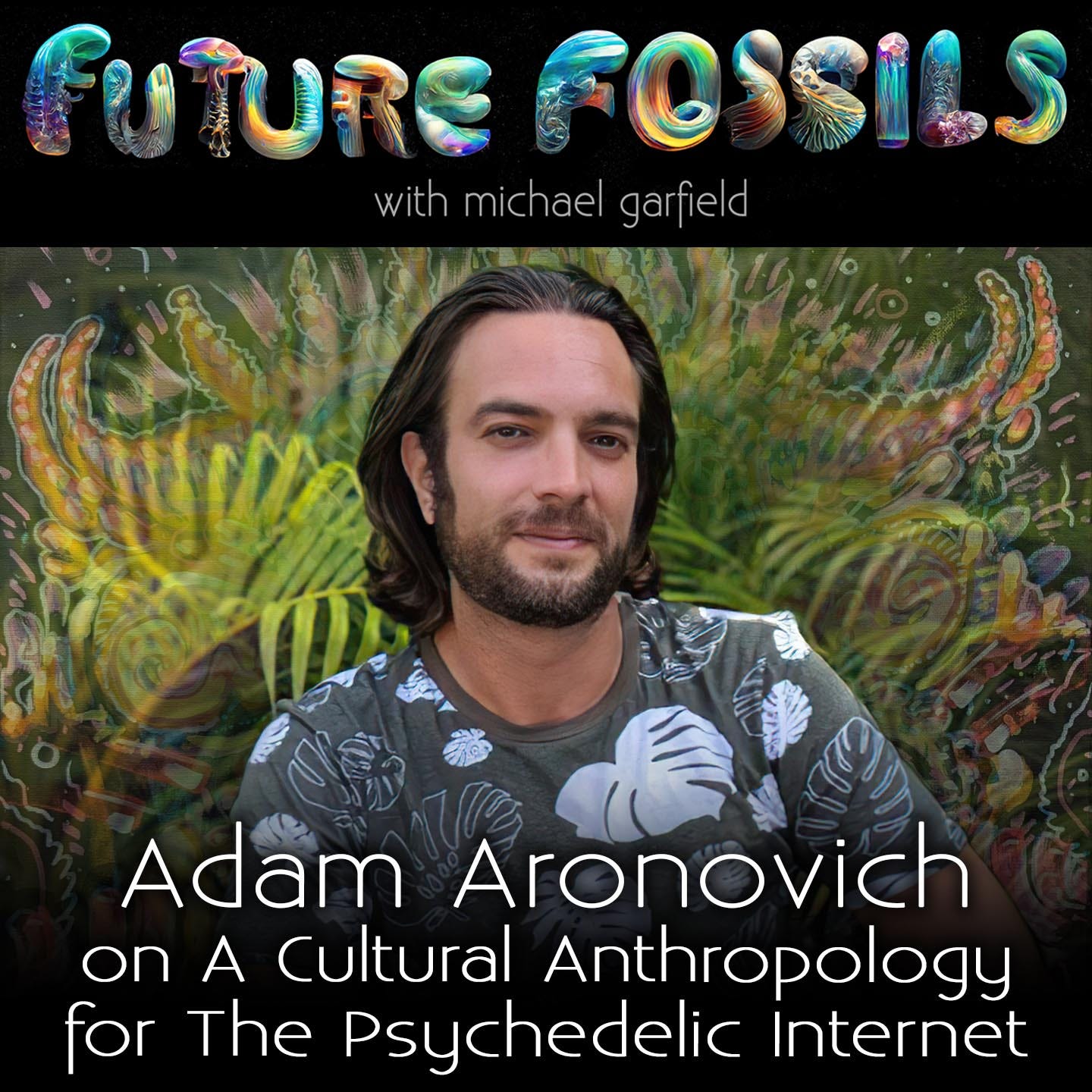
This is Michael Garfield. Welcomeing you to episode 211 of the podcast that explores our place in time. I don't have to tell you that these are weird times. I mean, this is really just a perfect episode to be releasing on Halloween and the veil between roles is thin because this conversation about the thinning veil between the physical and the virtual, the organic and the machinic, the self and the cosmos may be counted among the deepest conversations I've had on this show.
Adam Arunovic is a singular intellect, a fascinating person, someone who brings as much heart to his rending analyses of culture as he does his head. So I invite you to do the same and get your gut involved. Be a full-bodied person listening to this episode. You'll be better for it.
We go deep and you need all your resources to go to sleep. But before we do, I want to give my profound thanks to everyone who has been supporting this show on Patreon, more sub-stack, everyone who has been buying my artwork, my music. I spent an insane amount at the grocery store today. I know you did too.
And here we are keeping it together together. I'd like to give a special shout to Nick Kwan, Elizabeth Kennedy, Ian Benoit, Hopo Rassali, Bobby LeVinsky for being the latest to enter or re-enter up or re-up. I hope you all like me giving shouts because I like giving shouts. This is a community enterprise.
Let's make it so. Before we begin, is there anything you want to specifically focus on today? Or do we just wander around like two fools in a wood? What is your game plan?
Do you have a general idea where you want to go? Yeah, I do. So in 2017, I wrote a science fiction short called an oral history of the end of reality about deep fix and about what they were going to do to society when nobody could tell what the hell was going on anymore. And I've just really appreciated the stuff that you've been sharing to Instagram recently.
Like you're, I think in my eyes, you are one of the more important and tuned in and hilarious cultural anthropologists of the digital era that I'm aware of right now. And I don't know. There is this. It's been interesting because what seems like an account that started is just a way of making fun of your friends, basically has become this juggernaut of the curation of oddities and really like pointed reflection about how strange people's strategies for adapting to this world have become.
And so that's where I'd like to go with this. Maybe like where we would start is by just talking about your personal history and what you are and got you invested in this culture and its scenes. Then we can take it from there. Sure.
Great. Sounds good. That sounds like a great story. I would like to send it my way.
I'd be happy to read it. I will. Yeah, yeah, yeah, for sure. I'll post it in the notes to this call also.
Great. So yeah, so tell me a little bit about your backstory then. Yeah, my backstory. I think it's hard to pick where to start, what I imagine as many stories in our particular circle start.
I need a bunch of mushrooms. That got to let me through. This is my early twenties. At some point in my early twenties I got acquainted with psychedelic experiences.
And obviously I came to experience what I now term an unto epistemic re-enchantment. You know, like that capacity that psychedelics have to really elicit that deep questioning of the assumptions that we have about what the world is, how we acquire information about the world, what channels are available to us in order to make sense of the world and so forth. But let me get pretty standard in trying out different substances experiencing a whole lot of ego inflation going deep into a messianic stage somewhere around my mid late twenties where Now I see it all the time. Almost everybody who gets into rabbit hole of awareness development, self development, psychedelic and so on.
It's prone to getting to connect the stage of messianic ego inflation where at least for me is taking on my own experience. Like I started like really thinking that I had answers to the problems of the world and that I had to educate and pass it on to everybody else. I got really deep into conspiracy rabbit holes for a few years. I like spending a lot of time on YouTube watching a lot of ships on every conceivable conspiracy link topic.
I think nowadays in the last three or four years there has been a lot of awareness about this marriage. Like on holy alliance between conspiracy culture and Western neo-liberal spirituality or neo-spirit. That is a whole podcast that came to light in the last few years. A lot of people like realizing that actually this is a thing and it's a thing that has been going on for a long time.
And that is exactly like the scene that I was in for a very long time. Like really deep into conspiracy epistemics. I think it's something that probably worth just making a distinction because sometimes when people create decisive conspiracy theories, it's like a tricky territory. Like I'm not necessarily saying, never saying conspiracy, conspiracy is don't exist.
Every person that can't believe in conspiracy is like these guys that deliver whatever. Actually, what I call is conspiracy epistemics. Which is like a lens of making sense of the world and historical events and everything that happens exclusively through the lens of established conspiracy culture. Which is something very common.
I think when it comes to the nuance of what happens and just exclusively always describing things that happen through nefarious, shadowy players, puppeteering, whatever happens. It's very common, right? Deep into the conspiracy while by for many years and trying to figure out how to make sense of this world that I was living in. Making the story short just to bring it down to the present days.
Before the pandemic, I spent almost four and a half, almost five years in the Peruvian Muslim rainforest. I was doing my doctoral field work and also working at the same time in the Niawasca retreat center. One of the better known bigger names in the Niawasca world. We had a couple of research collaborations with two well established research groups in the second of the scene.
And also basically doing the field work for my own doctoral dissertation. And part of that work was interviewing people after they had the Niawasca workshops. So I got to talk other than just facilitating the retreats themselves, which of course is a massive amount of experience. But actually interviewing probably two hundred, two hundred and fifty people after they finished their workshop and asking them, what was it about their once-gavit retreat that was particularly beneficial or helpful for them.
I got to understand that these narratives, these stories, these courses that are very much rooted in conspiracy and conspiracy. And oftentimes the first most important framework through which people make sense of their experiences and the world at large. It's not exclusively one of the main ones at least, like also like theoretical culture and drama reductionist, and also different phenomena that I highlight through the work that I do on the page. And there was a moment which for me I think was a watershed moment during the early days of the pandemic where things just went haywire.
I think that was a moment where a lot of people in our circles were like the pressure and tension about rapid changing world and like a global event that was very difficult to make sense of. Like really brought out like all the conspiratorial epistemics in full force. And I saw a lot of people that I deeply cared a lot about, people that were friends, people that were acquaintances, colleagues of mine, like going deeper and deeper and deeper into conspiracy epistemics was a primary lens through which they saw everything, completely bypassing nuance and complexity and also so different input that might have been useful as opposed to just like that particular conspiratorial framework. And that's not just an abstract thing for me because I have been that person in the past.
I know very well what that means. Like looking at the world through that lens being so deep into the conspiratorial right hole is very difficult to see the world in a different way. And in this particular instance, as a pandemic hit, like this such a very deeply intense like really close friend, like really first degree family members that started right, like going into these things. And of course we all we know how these things unfolded like Trump getting into the QAnon, Wagon and like the insurrection in the US and just like transcending the sense of breaking the fourth wall as it were.
And like this thing escaping the fringes of like conspiracy, spiritual torture and like really reaching the mainstream in a really magnificent, overwhelming way. And now it's coming right like boomers, like make fun of boomers on Facebook for living everything that they see past on Facebook. But this is like a thing like it transcended the pandemic and like was a breaking like a watershed moment where all these conspiracy culture, new age, spiritual culture escaped the confines of a very specific subculture and became really mainstream in a very significant way. But I was like the moment where I felt it was necessary to start gathering these experiences, contextualizing them in some sort of like relatively solid critique like drawing really from established sociological, anthropological, psychological theory, not only talking out of my ass.
And maybe I think to some extent people navigate its times of chaos and extreme uncertainty in a way that perhaps isn't as destructive and sociopatical as full on conspiratorial capture. And healing from healing was born. The real, the most honest answer that happened when people asked me like, what is the origin of healing from healing? It really was a way for me to process my own emotions.
I guess to project my own shadow into a wider movement, my own frustration, my own anger, my own disenchantment with new age spirituality and the psychedelic world as a subset of the wider, what I term healing culture. So healing culture is an analytic framework that I use to talk about this confluence of many things, including psychedelics, but also conspiracy culture, new age spirituality, therapy culture, the increasing pathologization and medicalization of human experiences and all of the things that entails. But yeah, it's like just a way to vent my own frustrations and my own anger. And surprisingly for me, it just got on like very quickly.
Like people were very quick to relate to it and it just grew very fast. It's like a constant point of reflection for me because I never expected it to become what it has become now. Not that it's a huge thing nowadays. It's not a very old project.
It's a year and a half old, maybe 18 months with significant pauses in between where I just don't have the capacity to engage with it. But it has good engagement, it has a good reach, people like it. I think there's both, like a lot of people that like really like it and resonate with it and like a lot of people that really hate it and think it's a horrible thing. And I get both perspectives.
Like I don't have, I don't have it figured out. I think the most honest thing that I can say is that I don't really have a plan for it. It's just, it keeps unfolding in a particular way. In the beginning it was just me costing a funny meme and then operating on a caption about a topic that I thought would be interesting.
And then as time went by, it evolved into more of a crowd-surfing enterprise where, just because it grew so much and people were contacting me so much, I get probably 100 to 100 messages and emails and DMs every day. It's very difficult for me to keep track of these things. But most of these things are content, right? The people send my way because they think it would be appropriate for some sort of topic or some sort of character.
So I have to sort through and sift through all the things that people send me. It's also like, just like the temperature, right? What is it that people are interested in? What are the things that people want to see featured?
What are the things that people want to talk about? What are the things people want to have conversations about? And then putting that out there. It's evolving very fast from just a one person's take on different things.
There's a more crowdsource compilation of things that people in the sphere find useful. One of the things that oftentimes people might assume when they're new, they just jump into the page is that I might be just an external person looking in and hating on this culture, just criticizing something that I don't fully understand. But I think the vast majority of the people that follow that page and engage with it on a day-to-day basis are actually people that are very deep within this community. It's not a kind of thing that is just like external voyeurists looking, peeping into something that I don't fully understand.
And actually this is a very deep, intimate, visceral, and therefore that comes from the bowels of healing culture and manifests in that way. I think I'm kind of speaking for a long time, so I'm just going to shut up for a moment and re-calivate. That's great. I have a lot of questions or prompts based on everything you just said.
Three and choose your own adventure here, but we'll get to both of these in whatever order you want. The first is a question about, I love just the context of healing from healing as somebody who I haven't spent nearly as much time in Iowa's circle as you have. But one of the things that became very swiftly apparent to me was that when I did a check, I cased the room, and it seemed like a lot of the folks that were involved in this space were, I would say, chronic rather than acute in this, in that they had come to identify as people that were doing really the work that would never end. That when you see yourself as healing not only your own trauma, but the trauma of every generation that has come before you.
And I have been that very weekend in 2014, I'm thinking back on specifically was a weekend in which I felt in ceremony as though I could feel the pain of every mother who had ever sent a child off the dying war. And I had an experience at the Mass Conference, unrelated to Iowa's, but I had an experience at the Mass Conference this year where I felt like I was connecting to the trauma, the dinosaurs experience when they died from the meteor. And that was like unprocessed trauma that was still living in the body of this planet. And it's like when you're dealing with stuff that is so immense and so impossible for what happens is that people don't get on with their lives, right?
Like they're like sucked into this vortex where the question you really have to confront the question of when is it enough? Like how much can you take on as a person and what is appropriate? And I think that this kind of relates to other problems. This is the tie-in I want to make to the other question here, which is in your case, that question might be phrased as like when did you decide that enough was enough for you?
And how did you get out of this space that you were talking about yourself being in? And then the other piece is that I spend a lot of time lately investigating scaling laws, the way that the properties and the dynamics of things change as the scale at which they occur is as we zoom out or zoom in. Like the work that Jeffrey West did with Brian and Quest and Jim Brown on how Miles and an elephant have the same number of heartbeats. Their lives are very different lengths, but they both have about 1.5 billion heartbeats over the course of their lives.
And the fact that a whale is so much or an elephant is so much larger means that gets proportionately more cancer. It has to sleep less. There are these properties that change. And the economy is one of these things that like as the economy grows, it becomes more and more like more and more intricate and difficult to understand.
So we're living in by living online, we're living in immediate ecology that is so much bigger than the horizon within which we were required to process information and understand social relationships and make sense of things for like the entire history of human species. And there have this moment similar to previous moments. I've talked a lot about the way that the internet is causing an epistemic crisis in a way that's very similar to the printing press or your information. Jamie Stanstone has essay, Apocalypse Occult and the 30 Years War is something I bring up a lot on the show.
I'll link to in the show notes. I'll link to here for you also in the chat. But he, let's see, what I think about with all of this stuff is that so when we're having trouble making sense of what is real or what is merely an illusion, it's a kind of a related question to how can one person ever expect to process these profound, insane things. And insane, fathomless things like mass extinctions or like the epigenetic trauma of your entire ethnicity or whatever.
And we end up in these sort of wormholes where we can't, like we don't know how to live online with one another. And so this is the other piece, right? Which is that you spend a lot of time recently on the issue of NPCs or non-player characters. And there is something about, maybe it's going to take, maybe we need to start with some exposition into the way that you think about trauma in order to understand this.
But one of the characteristic trauma is dissociation. And one of the characteristics of living in the digital era is that we are in a kind of a Marxist way alienated from the means of production, from the way that facts are constructed, from the way that narratives are formed, from one another, from the people we meet online. And so there's this weird phenomenon going on now that the synthesis of artificial look like photorealistic media or audio or video stuff is concerned that people are encountering other people online and they're not just dehumanizing them in the way that we were grown up used to people being dehumanized. They're dehumanizing them in the sense that they don't even believe that they're actual human beings.
They think that this person is a video game, like a sprite. Yeah, this is a piece of software that they're interacting with rather than human being. And one of the weirdest things about it is that the response to this phenomenon is that people are stepping into this character. William Irwin Thompson, the historian, has this great essay called the Borg War Borghes that I'll link to you here in which he says it right here in the beginning of this essay.
It is a paradox of the work of artificial intelligence that in order to grant consciousness to machines, the engineers first labored to subtract it from humans as they worked a force upon philosophy. A character or a consciousness in the digital switches of weights and gates and neural nets. As a character, character goes into public circulation with the help of the media, it becomes an acceptable counterfeit currency and the humanistic philosopher of mind soon finds himself replaced by the robotics scientist. So there's this weird phenomenon that a lot of people have observed in the digital era where our machines are becoming more and more lifelike and our human nature is being recognized.
You've all heard, he has talked about this a lot as well in the emergent religion of Silicon Valley where the modern liberal human being is no longer a sort of atomic agent self-authoring their own destiny, a rational actor, but is a bundle of evolutionary algorithms that can be controlled as the terminal unit of social engineering like we saw in the 2016 election with Cambridge Analytica. People are basically, people are being treated as robots and robots are being treated as people and people are treating each other as robots. And so the extreme here is in this fantastic documentary by Rodney Ashir called A Glitch in the Matrix where he examines the cultural impact of the film The Matrix as you mentioned a moment ago. And the way that a lot of the mass shootings that we're seeing which are of course connected to these kind of conspiratorial phenomena, these sort of viral memes that are circulating around that like authors like Doug Rushkoff talked about, Frack La Noia as a way like people are desperate to make sense of things.
And so they cling to these concealing and all embracing narratives. But the absolute conspiratorial narrative in some respects is solipsism is the notion that you're the only real person in the room. And so in Rodney Ashir's documentary you hear this thing about how so many of the mass shootings or just other violent criminal acts in the last 20 years have been by people who were traumatized and ended up believing that they could inflict violence on other people with no consequences. Because there's no impunity because there's no one to punish them because none of these people are real.
So that's a lot to chew on but take as much time as you want to sift your way through that and some kind of walk us through all of that and how you understand these things and why you see the NPC phenomenon is so important, how you relate it to trauma, how you've made sense of these things in your own life. Yeah, great. So let me see if I can run a comment thread amongst all of those things because there were many different topics. We're talking about something that in the philosophy of mine is called cognitive closure, which is this idea that in the same way that we don't expect dogs to do, we don't expect cats to stick for languages.
Then there really isn't anything encoded within humanity that says that we should be and must be able to comprehend the ultimate secrets of the universe. So the cognitive closure argument says that perhaps there is a limit to how much we can make sense of the deeper mysteries and when it comes to metaphysics, when it comes to ontology, when it comes to things that keep philosophers up at night, we tend to assume that as humans it's just a matter of finding the right answer or thinking about something for some sort of dialectical process where we bounce back and forth between opposing theories and eventually we would come up to the ultimate answer. But in reality, a cognitive closure, a component of maybe humans, maybe our nervous system is just not developed enough to be able to provide us with answers to this ultimate mystery of existence. But I think that something is very difficult for people to accept.
It's very difficult for a lot of us to say, hey, you know what, maybe the mystery has value for the psychoping of the materials we're having to obsess at or having certainty, which is a second part of it. And I think that's one of the reasons I think why we're living in such chaotic times from an epistemic perspective because I guess entropy accelerates, completely to some extent, civilization collapses and we're living in really durable and times when it comes to social structures and the seemingly reversible demise of our life support systems when it comes to the environment that sustains us, I think it's very important for people to be able to have certainty about things, even if that means rotating towards really absurd and oftentimes destructive things. I think it starts with by asking about the matter of when enough healing is enough healing or when doing something enough is enough. And this is something that is really at the basis in many ways of the things that I do.
It has been at the basis of the classes that I teach and the communications that I put out. And when I do this, I am still working with retreat centers and all sorts of different capacities. Like right now I do work for a place in Mexico where I direct the integration part of it and I teach classes. And one of the things that I often always say to the group, the baseline of the communications that I put out for the groups is something along the lines of there is a limit to how much personal individual healing and growth is.
And so I believe while healing and growth we can do. Before that becomes actually counterproductive and oftentimes pathological. And that is something that I have seen from a personal experience and also lived in my personal experience but mostly seen in a very significant way. When I'm living in the Amazon rainforest being in a center that specializes in ayahuasca retreats.
I'm not speaking so much to the people that actually come to the retreats and they spend two weeks or 10 days drinking ayahuasca. But actually the people that are more embedded within this lifestyle, people that work in places like this, people that make their own identity and life about that particular thing. And I feel like really absurd things like, oh, I was like 400 times and I'm like, really? I don't really see, I wouldn't say that person.
For my knowledge of you, I don't really think that has maybe a much better person or the kind of benefit that you might think it's actually the biggest assholes that I've met in my life. Some of those people, they really attached to their identity as doing the work. Doing the work is tough. Sometimes I say doing the work is a new moral imperative for the awakened classes.
We have to do the work, we have to awaken. These guys never end in search for the awakening or the transcendental thing that's going to finally fully heal me. People get really stuck in that right hole. Often times we talk about healing, we talk about personal growth.
Drawing back to the roots of present healing culture, which was a lot from near spirituality, but also the human potential movement, large awareness groups, such as landmark and so forth. That really had created this idea that life is an onion. What life should be, a life live, a life of purpose, a life of awareness, a life of consciousness. It is a constant pursuit for peeling the layers of that onion in this endless pursuit, getting to the juicy center that is never actually rich.
There's always going to be more layers to peel from that onion. People really, I have in my life been in that loop for a few years. Where's the next ceremony? Where's the next group showing?
Where's the next activity? Where's the next workshop? Where's the next training that I'm going to do? Where's the next thing that I'm going to do?
I'm going to finally put me over the line in this particular thing and show me all the things that happened to me when I was a child. It made me the way that I do. All kind of this trauma reduction is a very prominent healing culture nowadays. I mean, the medicine space is in particular.
I mean, like Peter LeBlanc, Governor of Bessel Van der Cold, flavored way of like every adult dysfunction is exclusively the result of bad things that happened to us when we were children. And that's how black hole that you can never gravitate out of if you really get so into it. Because again, the layers of the onion are endless. So going back to water orientation, I think would be more useful.
And then something like communicate to all my groups and have done so for many years. It is important to have the capacity for introspection. I think it's one of the great gifts of psychedelics in particular, but also to different spiritual technologies or psychological technologies. So psychospheric approaches in general is that they do allow us to look at ourselves from magnifying lens from a somewhat detached perspective where we can actually contemplate who we are and why we are the way that we are in a way that is not necessarily available or accessible to us in the day to day.
Psychotics are many things. One of the things that they are also like studies, I used to call them or still calls them non-specific amplifiers, right? Like they amplify whatever is there so we can actually have a good look and a good assessment of what is it. So yeah, they are great for that.
And I think it's very commendable and a great thing for people to be able to do that. Hey, I want to know myself. The Oracle, the Delphi, the ancient Greece, I noticed that I don't know myself. I know yourself, I think it's one of the guiding forces that every person that wants to seek knowledge, wants to seek awareness, wants to seek answers, wants to know themselves better.
And psychedelics, I think, are one of the most important, important, beautiful things that we have for the pursuit of self-knowledge. But also, we are constantly interacting with the cultural narratives and the stories that are dominant, the things that are in the ether. And the more for the genetic field of how we orient ourselves in making sense of those experiences. And inevitably, those things are not separated from the cultural side guys in general of our dominant culture, the socioeconomic system.
One of the dominant features of modernity, is this neoliberal hyper focus on the self. The individual as the main unit of agency, of intentionality, of analysis, but like Margaret Thatcher, very famously back in the early days of neoliberal policy, right? Like she said, something along the lines of society is an abstraction. The only thing that exists is the individual and everything has just an abstraction.
By the way, Amazonian ontologies can take that into and put that under head. Like the core of Amazonian ontologies is precisely the opposite. So the individuals are an abstraction. The only thing that exists is relationships.
The only thing that exists is that endless network of interdependent relationships, in which individuals are just nodes, but don't fully exist outside of that network of interdependent relationships. But anyway, back to the thing. The stories that we tell about who we are, what is our place in the world, what is our place in the world, what is healing about, what is growth about, are always going to be dominated by the ruling ideas, the narratives that we tell each other what these things are. And you can see that.
You can go to any, but I'm not going to say any, but you can go to the web pages, for example, of any second-legritary of any practitioner that is offering healing modalities and under-connecting the umbrella of the modern entities. The primary purpose of psychedelics is to help you work through your childhood trauma. But the primary purpose of psychedelics is to help you and individual, to heal the things that happen in your life, grow as a very rarely really any address of that embeddedness, that interdependence. Like the fact that individuals are constantly in dialogue with community, with society, with culture, with environment, but that kind of larger, more expanded embodiment.
It's actually becoming more known or at least more experienced nowadays, but actually what embodiment means, it's not just encapsulated by my particular body, but actually embodiment in a territorialized way. Like embodiment in a group of community, in a body in the land that I'm steward of and so on and so forth. So the stories that we have today, just bringing that back, the stories that we have today are stories that very much prime for self-absorption, they very much prime for self-indulgence, they very much prime not using this world very lightly, but they very much prime for a certain degree of narcissism, if we don't keep those impulses in check. Because if we don't, then what ends up happening is exactly what you described.
And again, there's always going to be more layers of the only two pillars, always going to be another trauma to heal from, there's always going to be another thing that I need to heal from, there's always going to be another thing that I need to grow into. And then the spiritual marketplace is an endless, offers an endless array of opportunities for people to remain stuck in that vortex forever and ever. There's always going to be another war, there's always going to be another ceremony, there's always going to be another everything. And yes, over time, and it's something that I experienced in myself and others, over time, if people are not able to escape, like an auditational pool of that neoliberal hyper-indivitalistic narrative, then it will derive a certain degree of narcissistic experiences, a certain degree of self-absorption, a certain degree of the passion.
A certain degree of detachment, right, from that connectedness between the individual and the world at large, it becomes pathological. It becomes like really something that, unfortunately, is very common and also unfortunately is very difficult to escape from, because once a person is stuck in that self-absorbed pseudo-narcissistic experience of themselves in relation to the world, then any criticism, any reflection tends to be weaponized. You're just saying that to me because you haven't done your own work. We're just saying that because you're projecting on me your own insecurities, you're projecting on me your own lack of healing.
So we weaponized a lot of psychological and psychiatric vernacular. This is what pop psychology is, one of the main components of healing culture, one of the pillars upon which healing culture stands to pop psychology, which is not only the reduction of useful concepts in clinical practice and theory, into names that would result in reducing them into empty, catchy buzzwords that are useful for dictok engagement, but not very useful for actually understanding oneself better. Also, weaponizing of those concepts, weaponizing things, every person you don't like is an narcissist, which is why I said before, I'm not using this word lightly, it's tricky word to use in any context, because it's highly weaponized. All of my excess are narcissists because they didn't love me the way that I wanted to be loved.
This person hurt me, it's not only a selfish asshole, which by the way, plenty of people are selfish assholes, other than their narcissists. So we're weaponizing a lot of these kinds of psychological vernacular, and then that gets used as a way to deflect any criticism when we get really deep into... This is one of the features that is most difficult to deal with environments like this one. The place that I work with had a culture that had institutionalized like this weaponized vernacular to deflect any possible criticism of structural things that were real.
But anything that you would say, maybe these things can be better, or maybe no, that's just you, because you haven't done your work, because you haven't died to the North, because you haven't done enough medicine, because you haven't really worked with your shadows. And this is unfortunately one of the most annoying and common deflections in the medicine world in the New Age Spirit to have seen at large. Anything will be reflected back at you, like it's your problem, because other people are never at fault, structures are always healthy. Hyper-individualism on steroids, anything that you see that you might be judging or critical of is just a reflection of your own lack of wholeness.
That's just something that points out to where you need to heal as an individual. And yeah, sometimes it's true, but more often than not actually, it's just an easy quote out of really addressing structural issues. So I think that would say to the people that I work with, just bringing some closure to that long rant. Yeah, it's important to keep an eye, maybe an eye and a half, inwards, as we do this work.
Right, our introspection is important, contemplation, increasing our capacity to be honest with ourselves or our own things where we still need to grow. But all those things are great, but maybe one eye, maybe one and a half eyes, but also a half eye outwards. Right, and we're also at the same time as we're healing and growing and doing the things that we need to do to better people, right, that we're not losing track. That actually the vast majority of human suffering comes from structural violence, right, from structures and not ideal for humans to thrive in, whether it's economic inequality or in the U.S.
I think nowadays you guys are having a moment of reckoning with all sorts of different things that is very polarizing in terms of not only class, race and privilege and other things. And this is a whole other kind of fish that maybe we don't want to get into. But this idea that actually the health of individuals is intrinsically connected to the health of the community, to the health of the society, to the health of the culture. One of the most common things that people come to me with when I work with people, like, hey, I really want to feel better about myself.
I like I like self-confidence, I don't feel it, I'm good enough. It's like a ubiquitous, very universal experience. And these have to think, why is it that a lot of people in the West have this issue with not feeling good enough, there's not successful enough that they're imposter. They're both receiving rampant everywhere.
Everybody is lacking self-love. Everybody is lacking self-confidence. Like, where is this coming from? But then, like, every time I come to the U.S., like, I come very often, my wife is American and sometimes walking on the U.S., it's just like a more extreme example.
This is a lot of the world nowadays, but it's very difficult to walk in the streets of any major American city without being bombarded with messaging. A thousand times a minute, whether it's from billboards or the radio or television or fucking phones, like, every single advertisement that we receive is basically designed to do one thing, which is to undermine our sense of wholeness, because that's how consumerism operates. You can't sell ships that people don't want or need to people that are feeling secure, confident, whole, satisfied, content. Like, the first task of consumerism is to cheat away at people's sense of wholeness.
So you can look at the billboards and say, hey, you're never going to be as happy and as beautiful as those two women on the billboard drinking like a glass of wine, and you're never going to be successful at this person that is driving a macerade. Every single thing is designed to create an artificial vacuum in our sense of wholeness in order to be able to propagate this consumerism's virus. This is just one example, right, we illustrate the connection between the health of the individual and the health of the culture. When we come to the environment, it's pretty obvious.
We're not drinking water that is clean, it's very difficult to be healthy. But more often than not, because of the highly focused obsession on the individual. As only arena in which transformation and growth can happen, we tend to ignore that the individual is actually in constant dialogue with community, with society, with culture, with environment, in a big part of what I do through healing from healing. We're trying to actually not only be entities that populate the life of people in Amazon, and then other people came with a sword with a violin set for now on all of that is void, all of that is invalid, and then you have to subscribe to these ideas of materials, the neutrality with God in the sky that dictates how things should be.
And also, people were like, fuck that, we like our version much better than yours. We don't want to subscribe to that. And then of course, they were brutalized into submission and evangelized against their will through mass impacts of violence. But what the church said in order to justify the violence was any rational person who comes across the word of God, who is shown the Bible, right, if they're rational and fully human, then they will strive to our ideas because that's the only rational thing to do.
And they said, if you come across people who reject the word of God, the only meaningful response to that will be, well, then they're not fully human, right? They're animals. They are less than humans because they're not able to receive the gospel. They're not really to be evangelized as any other Russian being would be because this is the absolute truth, and it just requires a certain degree of humanity to be able to proceed.
There's another example to bring back the point that this idea of NPCs being so rampant, not only with conspiracy circle, not only with new spirituality, but spreading out more into the side guys of the internet culture is exactly one of the ways in which people in this era of post truth and epistemic chaos and complete lack of compass to make sense of the world in a meaningful way. I'm really able to say, you know what, your life experience is different than mine and hence you must be a non-playable character because you are led by an algorithm, you're not making your own choices, you're not thinking by yourselves because if you were thinking by yourself, then inevitably you would come up to the same conclusions that I have made a full human in this world. And if you don't do that, then that must mean that you're an NPC. So there's a twist here.
If you have time for one more question. Yeah. For me, the twist is about the fact that you've shared a lot of utterly surreal clips from TikTok where people can be gifted these little food items and so on. They're like micro payments, essentially in the form of emoji that people can toss at someone doing a live stream.
If you imagine a lot of people listening to the show are familiar with this phenomenon, but I avoided TikTok like the plague, weird pool of stuff that I'm still able to maintain a kind of an ironic distance from an anthropological ethnographic sense. Anyway, it's your investigation about the way that not only are people responding to one another as NPCs out of this kind of failure to understand bounded rationality. Okay, let me just give you a little quick side to our here into a former colleague, Simon DeDeo at Carnegie Mellon, who has written about, and I interviewed him on Complexity Podcast a few years ago, about the way that people use different heuristics to determine what they believe is a satisfying explanatory framework. And some people want something parsimonious.
They want the simplest possible explanation. They want the universe in an equation on a t-shirt. And then other people, these conspiracy mindsets, is one in which on the other end of the spectrum, you have people that want an explanatory framework that answers all of these seemingly unconnected phenomena. Right?
This is actually, his science proceeds through major paradigmatic revolutions through conciliants. People like James Clerk Maxwell recognize that electromagnetism is actually one thing instead of electricity and magnetism being two different phenomena. Right? But those people are in the sciences are held in check by people that are seeking the simplest viable explanation.
And a healthy sort of epistemic ecosystem is one in which both of these species are regularly interacting. If you have people that only abide by the simplest possible explanation, then they regard the scientific revolutionaries as kooks. And if you have the scientific revolutionary mindset, refuses to anchor itself in ground itself in simpler explanations, then this is the argument you always hear between conspiracy theorists and everyone else. Like Occam's razor would have it that 9-11 was not an inside job because it was just like left.
At any rate, the other side of this thing that you're describing is, again, that we don't just dehumanize other people, but we do actually live in a world in which due to these structural situations. But you look at the history of colonialism and there was a lot of people just accepting that they were going to be displaced and that they were going to have to adopt the culture of their invaders and so on as a strategy for survival. And this is what I'm seeing in this phenomenon on TikTok where people are pretending to be NPCs that you can feed with these micropayment tokens because it's only fans. It's like they're accepting their own dehumanization as a strategy for making a living in the apocalyptic boil of late capitalism.
And this is just want to end this conversation with you with some reflections on the psychedelic science conference where you and I both attended this thing and part of what you're this overall portrait and study that you're doing of the way that acceleration is capitalism, commodifies and co-ops and appropriates things that I have been trying to make sense of my own inheritance as the son of a universal studios and Walt Disney employee of a career amusement park travel industry guy who really believed and I think earnestly felt as though the work that they were doing in these large entertainment media companies was providing people with meaningful stories and memorable experiences and that Disney is the happiest place on earth. And yet if you go to Disney, it's just like parents fighting with their kids because they've saved up money all year to have a wonderful time and the kids don't want to be there and everybody's hot and beer costs 10 bucks and like it's this it's it's beblam. And something like that felt like it was going on for me, the maps conference where thank God so many of the friends that I met in the festival world 10 or 15 years ago have matured into people that are doing really important work to as peer support or integration counseling or they're helping people with somatic therapy or they're helped they have stepped up into this space as it has matured as the weird has turned pro and this underground has come above board and has been legalized or at least decriminalized and so people can operate publicly in this way within this space. And so I'm talking about a moment ago, the question of what we want or what we're willing to attempt is largely constrained, not only by our own will, by the non negotiable variables of our environment and struck me that suddenly I didn't want to be a part of this anymore.
And maybe this is like my hipster thing speaking out that now that there's billions of dollars in this space and like everybody wants a piece of it, then it's not a lot of the most interesting people I know in the psychedelic culture like Eric Davis and Bruce Damer were in Ken Adams were not there this year because they felt marginalized by the scene and everybody's like Shane Moss who were central in the maps conference in previous years, no one inside the organization that they were speaking with knew who they were anymore that like this thing had grown so rapidly that it was it was unnavigable on site there were no maps at maps and people didn't know how to get around people didn't know where to find the cultural offices that were being made by like thousands and thousands of hours of donated labor and I just felt oh God what am I saying that just it just struck me that this relates to like what I saw when the bastion of psychedelic journalism reality sandwich was co-opted by Delic Corporation as soon as there's as money in the opportunity. I think this is true of everyone involved because there are still a lot of it's like the CIA or something it's like there are still a lot of good people caught up in the cog works of this thing that are trying to do good work within the government within the legal system within but it's become this thing where we're in the belly of the Leviathan and we're forced to make compromises about the way that we express and the way that we relate. And I see this this is a very cyberpunk theme right to keep circling around the matrix and the way that like in order to tangle with in order to fight the machine you have to become the machine again so I'm like I just I don't know you don't have to unpack that particular angle on it, but it's just like watching all of the potential in the innocent. The potential in the innocence of a child who then goes to school and gets bullied and realizes that they have to play the game in order to not be like punished by the school system and you just watch this this beautiful thing become like distorted and I lose something even as like we were all waiting and praying for this to happen and now that it's happening it's not fun anymore for the people I know.
And so I feel like I yeah I'm just and I feel that way about the maturation of the web and all of these technologies that you know folks like again to the motto 2000 Ken Goughman are you serious and Doug Rushkoff and Doug is really talks a lot about this about how the world is going to be in the world. And so I thought about this about how the world that they were all looking forward to in the 1990s is here not they don't want it anymore. Okay, never mind like the back out this is not we missed something about the way that these things have to come into being with a system in which everything is economically legible and therefore operable with enough to be speculated on by financial instruments and so on. I'm being someone who myself who found myself in a room with six other psychedelic podcast or Michaels at the maps conference you've got the meme set of the people you're going to run into at the conference and there's that guy who's talking about ontology on his podcast and supporting patreon and all this stuff.
That's the other piece of this to which is no matter how original I want to be right like neo it's actually your neo number seven like you're a demographic object like your statistical phenomenon that can be predicted and manipulated and understood and there's this thing going on right now around all of this about. Oh yeah you're priceless original unique snowflake just like everyone else that makes me wonder if my emotional response to this is in some way as substanceless and as the way that in the 19th century people responded with visceral repulsion to evolutionary theory because they saw an attack on the ontology of the human as like a fixed category. That suddenly the floor had dropped out from under them and they were they weren't this like special divine protected class of being. And so yeah it's now that we're in this brave new world and is this kind of John Keats question about have we unwoven the rainbow and does that is that more magical that we have this deeper understanding and that we've expanded the horizon of mystery in new ways or have we lost something really precious that we can't regain.
Am I just am I just being a sort of neurotic Jew here worrying about this first should I just take the pill and embrace the next layer of eschatological unfolding I don't know love to hear your thoughts on. I feel you. I totally feel you. I think there's definitely for me and I imagine for you showing yourself yourself.
There's definitely a part of it which is that below the forgotten fruit. Yeah like I think there was a moment in time where psychedelics were still highly criminalized and still are in some places right. But it's not only other criminalization of it was like the social acceptance part of. I think there was at least when I got into the scene in the early 2000s right this was something that was still very secretive very taboo very legal and I think that plays out with many of the things that we were talking about earlier in the sense of that sense of ego inflation because then you know it comes out also with a flavor of not only the forgiveness of the knowledge right like I did the shrooms which is something that everybody else is afraid of I don't want to take my parents because I don't know what they're going to say I had to hide it because then I got like this incredible insight Hey maybe all the anti drug propaganda that I absorbed throughout all my teenage years not only was bullshit but actually that he was a source of truth that is only available to those workers ages enough to see through the bullshit.
It's not only the forbidden fruit part of it which I think like just as human nature like everything that is for the end we also always be more appealing in many ways more tasty right in other sense but also the part of it I think there is a good reason why philosophical traditions and initiative traditions always were veiled and available only to initiate right because there was a moment where you want to make sure that whoever has experiences is mature enough and has the right structures to make sense of experiences in a way that is beneficial for them and beneficial for the communities. I think like my experience of doing much of the first time doing LSD in a trans-festival like in a wasca in a shady apartment in north of Eastwood for the first time it wasn't only about that thing it wasn't about the forbidden fruit and tapping into a forbidden source of knowledge and so on and it was also not really having any structure to us experiences not really knowing how to make sense of them not only have integration called the massive buzzword in all of the psychedelic scene everybody to this integration that how do we make sure that people integrating this experience and hey that's just not going to happen precisely because we don't have the right structure so go to the rainforest drink I was I have this massive piece of news and awakening and so forth but today's after like sitting in traffic in LA and everything is too evaporating thing because we can't really leave up to the realizations or insights that we have to experience this if we go back today right life like it would necessitate that we actually create structures that are much more affable to be able to live in the ways that we are shown that life is also different things but more to the point for freedom fruit for the knowledge I think now we are in a point in time where not only these things are not a boy anymore and they're more socially accepted and there's actually more structures that make that a little bit less but also like the narratives change like the stories that we tell about what these things are have changed like one of the things that really worry me no worries about what is really make me I don't know what the world is but example right I think that the hyper focus on medicalization and psychologicalization of psychoanalyx is not an ideal thing at all I think I understand maps like maps always tell you the same story like food in the dark policy we're going to run you know MDMA through the scientific epistemics validating this repeat is deep but that's not the end goal the end goal is just provide a foot and torso people can understand the psychedelics in general and drugs in general can have therapeutic value and normalize use of drugs you know whether sense or so but the strategy of hyper medicalizing hyper-therapizing hyper-psychologizing experiences in many ways is also like really instrumental to the kinds of experiences and the range of experiences and sense making people will do from these experiences like living in the rainforesting Peru for a long time coming to understand what I was is and what I was like me not only that but the massive central component of storytelling right of narrative in the potential outcome and then you know moving from that in the sense making and making the people do from their experiences is crucial but it's crucial but people come to the retreat already with a very crystallized experience of what I was is right because they read that in the website or I was the retreat center they hear about that in conferences such as the one in maps they hear in the podcast what is it that people are in towards when they was when they do their experiences and nowadays and for a while already right like the main story that we have with psychedelics my friend my friend Brian James has a good term for because it's trauma that is very prominent and very central in modern days in which the primary value and most important thing that you can do with psychedelics is to work on your trauma so people come to the I was the retreat and you know already from the website already from the things that I heard before from communications that they got through the email from you know what the facilitators share that with the facilitators in the first few days of the retreat share like what are you here for what is I was before you're gonna be working on each other and you know I was this particularly was suited to show to maybe help you remember things that you cannot have access to this idea of recovered memories which is an incredibly important thing to do with this is a really problematic thing at the base that has ranged for decades in actual modern in actual mainstream psychology about whether recovered memories are even a thing like we have gone through satanic panics that were horrible social contagion instances that were based on the idea of recovered memories right if you just use the right tools to tap into the subconscious that you will come up with things that you have repressed and suppressed that actually happened this is like the pattern butter nowadays of ayahuasca work right from at the end base approach that has become very wise for the other of ayahuasca circles is like you drink ayahuasca because you want to tap into those repressed memories or maybe things that are just not as a thing that happened to you throughout childhood I got it like really absurd situations during my time working there when I was facilitating that retreat for a person let's say you have five or seven ceremonies around the retreat and that person would have experiences that are by any standards like powerful meaningful experiences like experiences that maybe transpersonal experiences with the experiences of psychic surgery maybe experiences of like strong social connectedness to other people in their lives like reconnecting in their experiences with our brother like meaningful shit and they would have a few experiences and a reminder that the ceremony and processing was ceremonies were like and then we come to the end of the workshop we do the closing circle right and people are sharing what was the workshop like for them what they got from the experience and we come to that same person who just had a series of five mind blowing experiences of epistemic enchantment of social connectedness whatever we want to experience but what they shared during that circles like oh like I'm disappointed because I didn't get what I came here to get how can you be disappointed if you just share with me throughout the last week or this incredible amazing life during experiences and we'll be like yeah but I didn't tap into my childhood trauma like understood I was under the impression that I came here to work on my childhood trauma because I'm under the impression that my childhood trauma is only source of all of my adult dysfunctions and I really need to tap into the childhood trauma in order to be able to be able to be able to be a person because my depression my anxiety my patients everything that is wrong with me in the present day is traceable back to my childhood experiences and I was going to help me do it and he didn't so I had all of these incredible experiences right like this range of metaphysical transpersonal social experiences and I disappointed because I didn't tap into my childhood so I think there's a whole generation of people that didn't grow up like UNID I don't know exactly what your origin story is but I imagine something similar right at first my psychedelics in trans festivals nature with my friends in a context where I didn't really have a particular narrative in mind of why I'm doing what I'm doing it was just like an open and exploratory curiosity recreational right like the way that we demonize it recreational nowadays is insane to me right the whole generation of modern trauma based psycho notes right that would be like like psychedelics are only for healing right if you're doing psychedelics in a festival if you're listening to music if you're doing it using them wrong like the absurdity of such a statement that you're using them wrong is so mind blowing it's so sad you have to enforce that though whether you believe or not because you can't be seen as somehow breaking the covenant that you've made with the regulatory framework in which you're allowed to work as a therapist and surreal yeah yeah I think not a I think that's the thing that is really discouraging to me is that I think one of the greatest strength of neoliberal liberalism in general I think in general, I think, always has been to be able to absorb every potentially revolutionary or disruptive thing in the world, ways of technology or an ideology, and absorb it to sanitize it and then using, for its own purposes. And sadly, as a bottom line, I think what you're feeling, what a lot of people are feeling is that psychedelics have become from a potentially civilization changing revolutionary subversive tool that can steer humanity in a different direction. There was a hope that we had when we understood the magnitude of transformation, both individual, was collective, that psychedelics have, and then seeing them embedded within the structures where today, I said, you know what, psychedelics have been detailed, decalod, sanitized, and completely subservient to power.
And that's a shame. When you have something so powerful now that has been rendered completely subservient to power, completely monetized, hygienized, and commodified, I don't think that's the only thing that's gonna happen. I think people are still gonna party. People are still gonna do drugs in the forest and go to festivals and have incredible experiences with their friends and explore their sexuality and expanded state of awareness.
But I think we do need to some extent, maybe, still work forward. I call it like the revival of the recreation, or like the reawakening, the recreation in that sense, which I think is gonna be very important, that we actually are able to tap into the whole range of incredible things that psychedelics can be, and plant medicines can be good for us, opposed to like just a very narrow hypertherapized, hyperpsychologized medicalized perspective of it, which, useful, but that's not it. At least that's not the whole of it. Thanks, man.
Just parting. I'm curious to know where else your attention is right now. Obviously, this thing is an extraordinary public good. Your Instagram account, but it also exists on someone else's platform.
And the way that we're watching things happen to Twitter and all this, like, there's no guarantee in an age of chronic displacement and the ground falling out from below us that this is going to persist, in any way, outside of the internet archive. So what else, you've got a kid. So there's that, where else do you see this work taking you, or what else has your attention right now, or does this thing become a coffee table book at some point because I would buy it? Yeah, where else is, what else has your attention, and what else are you working on, and where do you wanna direct us?
Yeah. Right now I'm very limited in scope, because I'm in the last stages of finishing my actual doctoral dissertation, which is like birthing a baby in itself. So I have a pretty much in February or January that I'm gonna be reoccupied with that. Everything else is on destruction.
Even the Instagram account, I'm using to procrastinate the things that I should really be doing, which is finishing my PhD. Between the Instagram account and writing up your PhD and raising a toilet, I imagine you can relate. It's already almost three full-time jobs. And I have also my private practice working with people.
I also work for a retreat center here in Mexico, where I'm the director of Therapeutics and Integration. I work with maybe 14, 15 people a week and live group activities, depending on how much time I have. Each class do workshops. I do try as much as I can to keep in touch with the actual working with people.
I think that's always been the thing that allows me to keep sane. I don't wanna give that up. I do try to make space, as much as I can, either working with people one-on-one or teaching classes, living group activities. Like being in, one-on-a-day, but at least a few days, every month, actually being in contact with groups with people and working with things is always the thing that allows me to keep around.
And more importantly, to keep my cynicism in check. I think getting from healing by itself would be very easy for me to just go fully into the cynicism and criticism and skepticism, which is maybe one of my natural tendencies, but actually I do have my work in the transformation, healing space that also allows me to be periodically reminded that actually things are powerful and people do benefit. And as much shit we wanna talk and as much there is room for improvement and as much as we definitely need better stories for orienting this work. Like people do have massive experiences of healing and transformation.
It's a positive thing, 100%. Those are the things that I, between that writing of these Instagram and family does what at the moment. But yeah, thinking about me, I'm definitely a focus on the works. I already have in touch with a couple of different agents.
That's definitely gonna happen. I'm not quite sure yet what's gonna be the difference between the PhD and the more popular book. I think it's probably gonna be a little bit of a, my dissertation is actually, I feel it's medical anthropology and communications. And from the get go, my idea was always with blessing from my supervisors was always to write and it's not a field that is for popular consumption.
I never felt called to write like great technical jargon only for people in the ivory towers, but my idea from the very beginning was to make something that is enjoyable, I mean, I've also made it to be read by many person. And that's what it's gonna be. So I imagine like book deals will follow from that perhaps taking some parts of it and perhaps also making it a little bit more visual, not only with the text in the demographic account but also maybe with means and a little bit more of a journey through these ideas, through multi-media approach. Yeah.
Awesome. Any final thoughts? You wanna slap on us no matter how non-sequitur? No man, I think thank you for having me.
I appreciate that more people. Well, I think to have these conversations, I know some of these things can be triggering and some of these things can be confrontational, some of these things can, I don't know, I think it's important. I think like one of the things I do try to communicate relatively often in my page and this is important to remind myself and other people is like, by the end of the day, this is my culture, this is my tribe. I even though I wanna try, sometimes separate myself, new age culture, new spirituality, conspiracy thing.
But in the day, like when I think about the complex of ideas, the complex of orientations, the people that are part of these environments, like this is more or less my extended tribe, both virtual and also a potential. So it's never been about destroying something but about making something better. It's like more of a labor of love, like trying to find creative ways to, and for me that's humor as a main vehicle, but like using humor in creative ways to bring people's attention to parts of our cultures and some cultures that I feel are lacking can be better. The main thing still remains, so probably you can relate to a lot from your own perspective and orientation.
Like we need better stories, we need better narratives, we need a new mythology that can orient people in a new way to the ones that we have right now, which are very reductive, consumerist based and yeah, just no idea for really bringing out the potential, the real potential, that these two technologies and ideas can have. Awesome, thanks so much for being on the show. Yeah, my pleasure, thank you for having me. Thank you for listening.
Future Fossils is a listener-supported podcast. If you like it, please double down. Rate, review, subscribe. Propose yourself as a sponsor.
Stay tuned for the return of Patreon Community Calls coming soon, and have a most wonderful Eon.