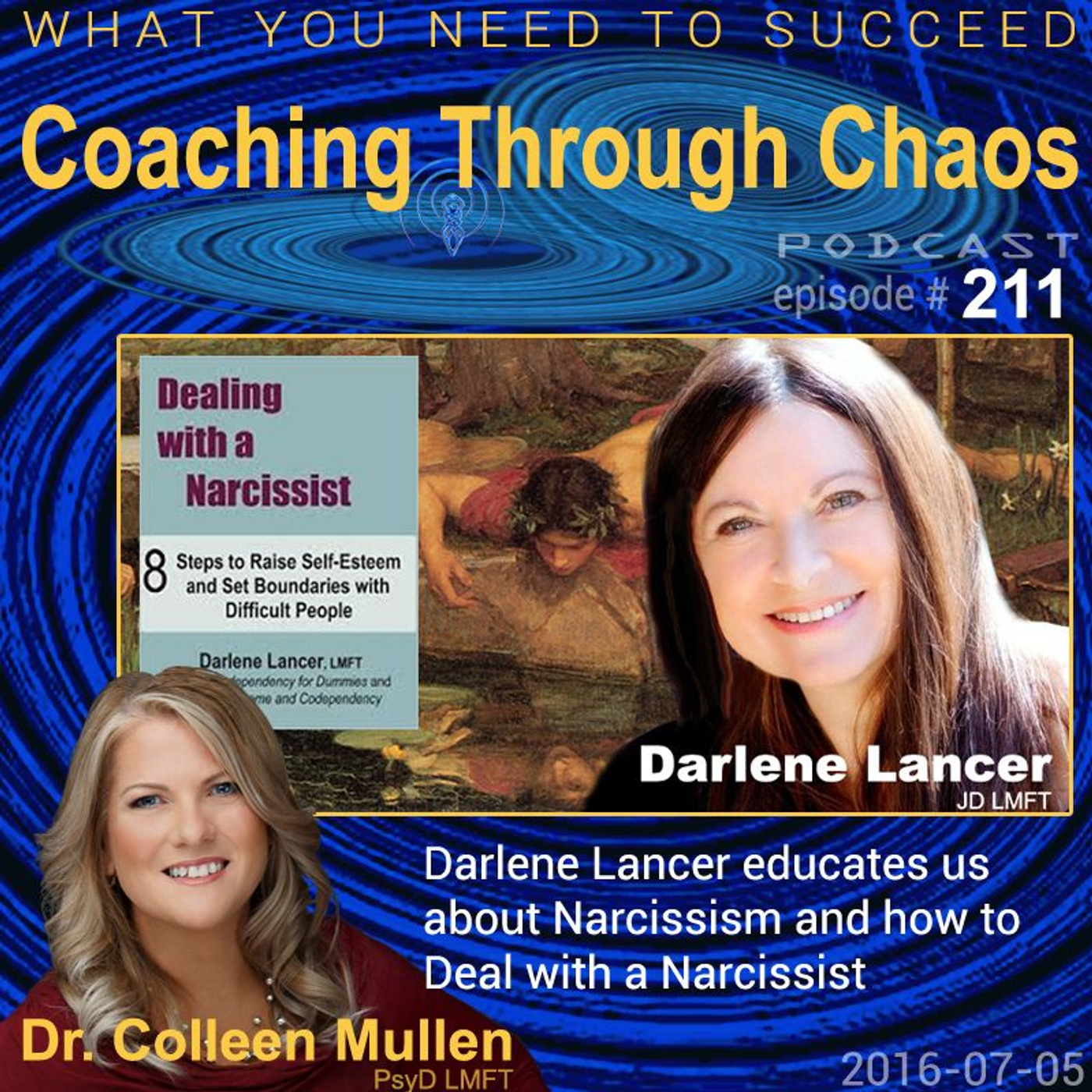
Welcome to the podcast edition of Coaching Through Chaos, bringing you what you need to succeed. Now, here is your host, Dr. Colleen Mullen. Have you ever dated someone or even gotten into a serious relationship with someone that left you feeling like you could never satisfy them? Or when you argued, they maneuvered you into feeling that everything was your fault? Well, today we're going to discuss how to navigate a relationship with a narcissist. Yes, that's right, a narcissist. My guest today is therapist Darlene Lancer. And I, of course, am your host, Dr. Colleen Mullen. And as always, I'm bringing you interviews with guests who will inspire, motivate, and empower you.
You know, narcissism seems to be a trendy term tossed around in the media today, primarily due to our selfie, look at me, social media-driven culture. And yes, true narcissists do want the world to see them as fabulous, but they take it to an entirely different level than our selfie generation. A true clinically narcissistic person not only wants the world to recognize them for their greatness, but they also embody the following traits. Extreme selfishness, a grandiose sense of their talents, a craving for admiration, self-centeredness, and the people they're involved with feel manipulated. On the other hand, they can also be very charismatic.
There are many politicians, business owners, and TV personalities that we could say have narcissistic traits. This interview will take us past the popular narcissism talked about in the selfie generation and popular culture, and we will get into the nitty-gritty of how to recognize a true narcissistic partner, how to maneuver yourself in that relationship, and how to get your emotional needs met in healthy ways. Her latest book is Dealing with a Narcissist, Eight Steps to Raise Self-Esteem and Set Boundaries with Difficult People. Darlene was last here in Season 1, educating us about codependent relationships, and it's been one of our most popular episodes to date. Please welcome returning guest, Darlene Lancer.
You're listening to Coaching Through Chaos, your host, Dr. Colleen Muller, bringing you what you need to succeed. Darlene, thanks for being back with me on the Coaching Through Chaos podcast. It's great to talk to you again. It's a privilege, and I love sharing my information with your audience, and I appreciate the invitation. Oh, well, you're very welcome. And I'm thrilled to have you here because we're talking to you today about your newest book, Dealing with a Narcissist, Eight Steps to Improve Self-Esteem and Set Boundaries in Difficult Relationships.
We hear the term narcissist thrown around a lot today. It's a lot of popular culture talk about narcissists that, and this group is narcissistic. Can you tell us the story of where the term actually comes from in case people don't know the origin of it? Well, the story revolves around the handsome hunter Narcissus and a beautiful forest nymph Echo. And Echo had a habit of talking too much, and the goddess Juno punished her. And the punishment was that she could only repeat the last words of others. She could never say anything original of herself. Meanwhile, this handsome hunter Narcissus...
All the women loved him because he was so handsome, and yet he broke the hearts of many women, and he was very aloof. He had such arrogance and pride that he would hold women in disdain, those who adored him. So one day he was in the woods hunting with his friends, and he became separated from them. And he was calling out to his friends to find out where they were. Meanwhile, Echo saw him, and she was overtaken by his beauty and just had a crush on him immediately.
And so when Narcissus starts calling out to his friends, he says, is anyone there? And Echo now thinks this is her opportunity to get his attention because she's very shy. And she says, is anyone there? Because she can only repeat him. He hears her voice and he says, come here. And then she says, come here. So she rushes towards him. And he is so disgusted by her, he just says.
Hands off. He says, may I die before you enjoy my body? Ouch. She's just humiliated and rejected, and she flees and hides in the woods. Nevertheless, she still pines for him, and she watches him, and her love for him grows. And the goddess Nemesis, you've heard of someone as your nemesis. Well, the goddess Nemesis, she's a goddess of revenge, and she saw this, and she decided to punish Narcissus, and she put a spell on him. And from then on, when he'd walk over to the water, and he'd see his own reflection, and love overtook him. He finally had met someone worthy of his love.
And he became so absorbed in gazing at his own beautiful image in the water that he didn't even realize that it was actually himself. He met his match. Yeah, finally. Meanwhile, Echo is just humiliated and ashamed, but her obsession just grows and grows. And she watches him and she yearns for him. And as the years pass, her youth and beauty decay, and she's pining away for him for the unattainable object of her desire. And so this story, for me, epitomizes the dilemma of a narcissistic relationship.
Because the narcissist is consumed with himself and the unattainable object of his desire. He can never get filled. And she, too, is planning for attention from him. Of course, the genders could be reversed. But she can never get love from the unattainable object of her desire. In the story, he eventually commits suicide, consumed by his impossible love. Eventually, he realizes it's himself. And so when he dies, there's just a flower narcissist in his place. And Echo just wastes away. And all this lust of her is her echoing voice.
Wow. I can't wait to hear as we get into the interview how this translates into modern day for people who get into relationships with narcissistic people. And before we go there, your previous books are on codependency. Can you talk about how working with people with codependent traits led you to exploring relationships with narcissists? Well, it's interesting and it was surprising to me because typically you think of codependence in relationships with addicts. Of course, that is not the definition of codependency. It's widely accepted now that it could be with anyone.
It doesn't have to be an addict and it's not dependent on the relationship. It's a problem within the self. But I started having more and more clients contact me who were not involved with an addict, but were involved with a narcissist. And I would help them transform that relationship or some left. So when they started overcoming their codependency, the relationship dynamic changed because I work systemically and I believe that in a relationship, the dynamics take two. In fact, my belief is that narcissists are codependent also. So when you say the narcissist and the codependent, in my mind, they're both codependent.
But sometimes I use that just to differentiate the partner of the narcissist when I'm speaking. Darlene, just in case someone hasn't listened to our previous episode on codependency or read your books or knows the term, can you clarify the short version of what are we talking about when we say someone is codependent in a relationship? Well, a codependent person is unable to access their innate feelings and needs. And instead, their thoughts and their behavior revolve around another person or if they're an addict, a substance, or it could be a process addiction like sex. work or shopping. And so everything revolves around that process outside themselves. And because of that, their inner self becomes more and more empty. This process starts in childhood. So the gap between who they are and getting their needs filled becomes wider and wider because instead of looking inside, they're looking outside. Great. Thank you for that explanation. That was perfect. I know that the term narcissist is not one size fits all. Can you talk a bit about the different subtypes along the continuum of narcissism? Okay. Well, first of all, people don't usually think of someone who's maybe shy or generous as a narcissist. And that's...
type that's called a closet narcissist. Usually you think of the extroverted narcissist, like Donald Trump, for instance, or Madonna. But psychoanalyst James Masterson identified a closet narcissist, and they have a more deflated, inadequate self-perception. I should add that all narcissists suffer from shame, and that's why they need constant affirmation. But it's usually unconscious. They're not that aware of it, and they certainly wouldn't admit to that. But they all have this inner emptiness and depression underneath. But this subtype, it's more conscious with them. They're also called introverted narcissists.
And on the surface, they can be hard to identify because they may seem humble, anxious, shy. But they still get their gratification through others. But they may feel more distrustful. They'll take things personally. I mean, this is typical of a narcissist anyway. They'll feel unappreciated, misunderstood. Right. The presentation, though, is someone who is different than, as you say, Donald Trump or Madonna, where those are public figures that we can recognize as like, OK, I get it, that they're a narcissist. This person looks much more hidden. Right. They may even devalue themselves. But secretly, they still dream of greatness and wonder why people don't appreciate them. And they can still expect special treatment.
But it might be not because they think they're so great, but because they feel victimized. So it's kind of the flip side. It might be a philanthropist or someone in the clergy who seems to be very giving and helping others, and yet they act moralistic and self-righteous, and then they feel like a resentful martyr for all their giving. Then there's an amorous narcissist. Oh, that sounds interesting. Like the Don Juan or Mata Hari. And they use charm and seduction to lure in their conquest. And they keep needing new conquests to boost their ego. So as soon as they've conquered or the lust is fulfilled or the romance fades, then they need someone else to boost their ego. There's someone who's a very elitist. And they're always trying to climb the social or corporate ladder. And they're very competitive. They think nothing of trampling over others. And then there's something called a compensatory narcissist.
And they just live in this imaginary world where they're in center stage and they seek admiration for all their further fabricated or exaggerated accomplishments. Wow. Some addicts are narcissists, but addiction can make a person behave self-centeredly. So sometimes when they get abstinent or sober, they're more humble and less selfish. But addiction is marked by obsession and compulsive behavior. It's crazy. It takes precedence over anybody else.
They may or may not be narcissists. Right. Just a side note then on that is that some addicts can present that way, but they may not be once they get over the addiction. You know, it's so interesting, all these different types of narcissists. And you mentioned Donald Trump and Madonna, and those are two very big popular figures. Are there other people through history or popular culture that you could identify as narcissistic people? Well, some people have identified Margaret Thatcher and Steve Jobs, Picasso, Joan Crawford, certainly the roles Joan Crawford played. Certainly. Typical of that. I don't know about her personal life.
And then people that are abused women, I mean, that's not a requirement, but that might be a telltale sign like Bill Cosby, for instance, and maybe even brag about it or not feel any guilt about it. Kanye West has been identified as one. O.J. Simpson would be a good example. Okay, so there is a lot of people out there, and it makes sense certainly that a lot of the people that you're mentioning are from the entertainment or the arts world because the narcissist needs approval and needs admiration. Yes, actually a study was done that showed that there's a higher percentage of narcissists in the entertainment field than otherwise.
Well, that would make a lot of sense. I would think you need to crave the admiration. And I don't think necessarily that's always a bad thing. No, because we're not saying that narcissists are all necessarily bad. I know you named some people that certainly have done very bad things. But in general, narcissists are difficult. They're not necessarily bad. Is that correct? Well, two things. First of all, we all have narcissistic traits, and it exists on a continuum. So when I say narcissist, I'm talking about clinically diagnosed narcissistic personality disorder.
And there's only like one or two percent of the population is that way. And it's more males than females, although people say that now that more women are narcissistic, it's on the rise. The core trait is the lack of empathy, needing admiration for others, of thinking that they're special and unique. Again, this is not the closet narcissist who may present a little bit differently, although they still have to have five of the characteristics that they may exploit or take advantage of others. They think others are envious of him or her and that they have an attitude of arrogance and they require excessive admiration.
They have this grandiose sense of self-importance and feeling entitled in special, favorable treatment. So those are just some of the traits that narcissists have. And usually they want to be around high-status people because they think they're special, so they should only associate with the best people that are rich or only go to the best doctor or that sort of thing. The most famous, it might not even be that good, but like the most famous doctor. I see. Going for that. They want to be in that league. In that league and the reputation and associated with the quote unquote great people. You know, if your listeners are interested, I did a blog a couple months ago called Realism, Trumpisms, and Grandiosity, something like that. It's like the illusion of grandiosity. And I go through examples from Donald Trump's life with quotations. I mean, I'm not saying he's a narcissist or not, but from his own words, I give examples of how that shows narcissism or exemplifies those characteristics. That's great. We will definitely put a link to that in the blog that goes with today's episode.
Now, moving on just slightly, at the end of the book, you've got some narcissistic personality surveys. Are these meant for people to diagnose themselves or their partner or friends? Well, this isn't a real clinical diagnosis. This is just a tool that people can use to see where they fall on a scale. The authors of that quiz were promoting the idea that narcissism is on a scale, and they would say that codependency is on the low end, your typical codependent that doesn't have self-worth, and then someone, an extreme narcissist, who is arrogant. Now, to me, a narcissist has low self-worth, too.
It's just not conscious. So it's all projected onto others. They devalue others or they look down on others. They criticize others. And it's a reflection of how they feel inside. So by taking this quiz, you can see where you fall on that scale. And then healthy narcissism and healthy self-esteem would be somewhere in the middle. Okay. It would be healthy pride versus too little pride or too much pride.
Okay. Do we know what causes narcissism and can it be prevented? Well, it goes back to parenting, although there's research that's inconclusive, but there's thinking that there's a genetic component. So it has to do with often abusive parenting where there's insufficient maternal nurturing or the primary caretaker. So, I mean, narcissists, we can have compassion for them because they're bearing the scars of childhood, just as other codependents, and their parents were not empathic with them.
They didn't model empathy. So their capacity to empathize was stunted. And then another psychoanalyst, Otto Kornberg, emphasized that his belief that the parents had veiled aggression. So either they were harsh or they envied, they had hatred or indifference towards their child. Lots of criticism. They may have been domineering, exploitive, manipulative. Now, not all children of those kinds of parents become narcissists.
You know, it's a mystery sort of like why some do and some don't. Right. It's that whole nature and nurture combined dilemma. In my book on conch and shame, I talk about how codependency evolved. And there's a very lengthy chapter on the causes. And I talk about three personality types. And these, of course, are just generalities. People are usually a mixture. And first you have the stereotypical accommodator, codependent. And then you have the master who believes that he'll be safe and loved by being powerful. And then you have someone who kind of withdraws into their own world.
And you could see often masters and accommodators choose each other in relationships. And they learn these styles in order to cope with a dysfunctional family and not getting really healthy marrying and love. And so they take on these personalities and it becomes who they are as they mature and how they function in the world. Yeah. In the book, Dealing with a Narcissist, you detail a couple of key characteristics of relationships with narcissists. For those that are listening, what would those key characteristics be? It would often stem from a relationship with someone who has developed this master identity.
that he needs to be in control, he needs to be powerful, who is ashamed. There's this shame underneath of vulnerability, and anything that appears weak, showing any sign of failure or vulnerability, that is all just held in disdain by a narcissist. That's like the worst thing, asking a narcissist to show their feelings. That's the last thing they want to do. or to reveal that they made mistakes, take ownership and responsibility for themselves. And then you have the opposite, actually like their shadow, would be the accommodator, someone who typically would self-sacrifice their needs. And the accommodator idealizes love, being unselfish, being attentive, being good, and underneath they both feel undeserving of receiving love. And so the accommodator usually doesn't like to be in a position of power because they think that that's not nice, they won't be liked.
They want to be loved and liked more than anything, too, rather than being powerful. I mean, they both want to be liked. But to a narcissist, the best way to be accepted is to have power over people. to be safe. And for an accommodator, it's if someone loves them, then they feel lovable. So that's just kind of how they hook up. And the accommodator then will take a subordinate role and they will idealize the narcissist who embodies all of their disowned parts. They admire their boldness. They admire that they're the center of attention because they feel too shy. They admire their directness, their power. Sometimes they might even feel interesting. I'll tell a personal story. I went out with a man once who insulted. It was like a first date and we went to a restaurant and it was very insulting to the hostess.
And I just got a chill in my body. And I just, you know, thought this is not someone I want to go out with again. And I just couldn't be silent. And I said to this man, I said, well, you're showing me another side of you because he didn't act that way before. And he said, well, some women like it, which I was shocked. But he said they feel protected. Well, obviously, you are not the accommodator. So that says this kind of validates what he said, validates. I think some women are drawn to that they feel.
Well, he can tell someone off. I'll feel safe with him. Yeah. So this is probably going to be a very subjective answer, but can a person have a healthy relationship with a narcissist? I mean, if an accommodator gets together with a master, can they see themselves in a healthy relationship or will they eventually just feel totally empty? Well, usually people, they may both feel frustrated. I mean, the narcissist is empty to begin with. And I mean, there's emptiness underlying codependency that comes from the shame. So they're going to end up feeling either conflict. I mean, two narcissists can get in a relationship too.
I've had clients like that too, couples like that. It's very difficult because both are fighting to get their needs met and both feel unloved and unhappy. So I don't know whether they'd say it's healthy. They'd say it's painful. The less intimate the relationship is, the more likely it is that it'll look more normal. And if one person is willing to take a subordinate role, so if you know that this person needs to get their way or won't be empathic.
Well, sometimes, you know, you have to be careful because one of the things I talk about in my book is that sometimes you can't tell. It's not so easy. Not all narcissists are so extreme, like some of the examples I gave, where they stand out. A lot of narcissists are, and you said, maybe are they mean? Not necessarily.
They're not sociopaths. I mean, they could be malignant narcissists, so they're on that extreme scale where they're breaking the law. They just don't care about who they trample over. Even if we just took the two really popular figures that you named, Donald Trump and Madonna, I mean, Madonna doesn't have a reputation for being mean or uncaring of people. She just is out there with some outwardly narcissistic traits. But whereas Donald Trump then takes the stance of, I would take it he would be in that master position of needing to feel powerful and needing to make other people feel bad. So the two different sides of the same coin there to show just the outward differences.
So the relationships are not necessarily healthy, but people, though, might be listening to this and going, oh my gosh, I totally recognize my relationship. Your book actually is to help people have healthier relationships with themselves so that they can have healthier relationships in general. Sometimes that means staying. Sometimes that means leaving. And you detail eight steps for setting healthy boundaries and improving one's own self-esteem. I'm going to ask you just about a few of those. Can you talk about the idea first of detaching with love, what that means? Well, the first step is to realize who you're dealing with.
So if you have expectations that you're going to change the narcissist or that he or she is suddenly going to care about your feelings, that may change over time. And this is one of the things I was going to say is also is that a lot of times you may, and narcissists may act like they're caring, but you get this queasy feeling that you don't really know whether you're being sincere because many narcissists learn to be appropriate. And they'll say all the right things about, oh, that must feel terrible. And, oh, I'm so sorry that happened and, or compliment you. But you really.
always questioning whether it's sincere. So then you may be disappointed when you really need them and they're just, you know, they're not there for you. So knowing what you're dealing with and then accepting, detaching is part of that. So it means there's a saying, Q-tip, quit taking things personally. So once you really understand the narcissist, and I go into great detail about how to do that, then you don't react as much. And you can be empathic for the fact that they didn't choose to be this way. They have cognitive deficit. You know, would you be, if someone had Tourette's and they were swearing at you?
Would you take that personally or would you realize that it is a disorder? Right. They can't help themselves. That's right. And it'll lower your expectations. So you learn to be empathic and detach, lower your expectations. And if you follow these steps, actually, and I give some criteria to evaluate whether there's hope for your relationship to improve. And many relationships do improve by learning to respond in different ways, by changing your reactions to the narcissist. Right. Can you talk about that a little bit? I mean, obviously, I can get where you'd go with that.
Talk about what that would look like. Change your reaction. So you're used to your partner being in that master position and kind of saying things that make you feel demeaned. Even if they're not flat out mean statements to you, they just leave you feeling like your partner isn't able to care for you in the way that you want. How do you change your reaction? Well, first of all, you need to start observing your reaction. What is your usual way of coping with this? When your partner makes demands on you, you just placate. You just go along with it. You know, the motto of the partner is usually not to make waves. They'll just self-sacrifice, go along, hide their true feelings.
Repress their anger in order just to keep the peace because they don't want to trigger a narcissistic rage. Because when a narcissist feels that their self is threatened, it's not just anger. They can just blow up and be very cruel and go into a rage. You want to avoid that. But placating is the worst way actually to deal with abuse. You want to confront it. So in ways that I describe in my book, you don't want to blame. So if you start to criticize or blame the narcissist, that's not going to go anywhere either because they're very sensitive to criticism. And right away, they'll attack you back. And then you find yourself offending yourself.
And defending yourself just gives the other person all the power. So, for instance, if you play an abuser, it invites more abuse. If you're just silent, that gives them a green light, too. If you go into a shame attack, you just might withdraw and just feel terrible and start blaming yourself. So these are some common reactions. Instead, what you want to learn to do is really think about what you need and how you're going to say it. I have a lot of scripts in my book to give you a format of how to compose yourself. But first, you need to detach and not take this personally.
And then approach your partner with constructive feedback. So the bottom line is you want to educate them to their impact on you because they've been getting away with this for a long time. And their parents, when they were raised, they didn't have an impact. Their own self wasn't mirrored. So you have to teach them. It's like teaching a child, you know, when you put me down like that, it makes me want to pull away from you. So then whatever it is that your partner wants, whether it's sex or you to go to their events or something, it makes me not want to do that.
But however, and then you show them the positive. But when you, you know, for instance, the other day when you helped me do such and such, it made me want to reciprocate. And so you're giving them constant positive and negative feedback in a nonjudgmental, nonaccusatory way. Just stating the facts from your perspective. Yes, and you have to emphasize it. You know, for this relationship to work, it has to be a two-way street. And setting boundaries is very important. I have a blog on my website, 10 Reasons Why Boundaries Don't Work. And it's because people tell me all the time, well, I've been setting boundaries. I said, don't do that, over and over.
They don't have consequences. My last question is going to be about a couple of your other steps, about nurturing yourself and becoming autonomous. Why are those so important when you're in a relationship with a narcissist? Well, of course, it's important in every relationship to nurture yourself because a relationship is not going to bring you happiness, ultimate happiness, like a lot of people, especially codependents, think. And there'll be times when you can't get your needs met or you're both feeling needy. And so that usually is a recipe for disaster.
So you have to be able to comfort yourself. And of course, it's especially true with someone who's not going to be available, emotionally available to you. As I said, a narcissist loathes sharing feelings, being vulnerable. They come first. So there'll be many times when you need them where you're not going to be there. So how do you, learning to comfort yourself. And also you won't feel like a victim. You'll become more accepting. When you meet your own needs, then you're less reactive. So instead of licking your wounds and feeling so hurt, you know, go to a quota meeting.
Go out dancing. Go have a good time. Don't rely on that narcissist to validate that you're lovable. Write yourself a love letter. Do things that honor yourself. Validate your own needs and feelings. And the more you do this, the more that you can maintain a relationship. There may be many good reasons to stay in a relationship. The narcissist, aside from financial support or raising a family, you may enjoy their intellect, their communication, their lifestyle. It can be very fun to be around and charming. Certainly.
Thank you so much, Darlene. This has been a tremendous amount of information on this topic of narcissism. Let's tell everybody your website again and where they can find the book. And of course, again, all links will be on coachingthroughchaos.com today in the blog that goes with this episode. So Darlene, what is your website? It's www.whatiscodependency.com. All one word. Very good. And you are a therapist up in Santa Monica. So people can also, if they're in that area, certainly, and they've connected with this, you are seeing people in private practice up there as well. Yes.
and I also coach people internationally. Wonderful. And the books are available on my website. They're also, I have two books, Codependency for Dummies and Conquering Shame and Codependency. And I have six eBooks and they're all available on Amazon and Barnes & Noble. You can also get the eBooks on Smashwords and there's links. You can also get them on my website. Gosh, I think I work a lot and then I hear all the things that you're doing and I just don't know where you find the time. But Darlene Lancer, thank you so much for being with us today on the show. Well, thank you for inviting me.
You're listening to Coaching Through Chaos, your host, Dr. Colleen Mullen, bringing you what you need to succeed. Darlene, thank you for such an informative interview. Culturally, here in the U.S., I think we get fixated on something like the quote-unquote selfie generation and then inadvertently mislabel an entire generation of people as narcissists, when really a true narcissistic person is much more complex and difficult to deal with than someone vying for attention on social media. I'll put links to Darlene's website and her books in today's blog post, as well as links to some interesting articles on both the selfie generation and narcissism. Next up on the Coaching Through Chaos podcast, we've got Xander Keg. Xander is the subject of the upcoming documentary, Xanderology.
which chronicles his life of transitions, not only of his transition from female to male, but also through several difficult transitions, starting with medical problems at birth. Xander is a fascinating guy, and I can't wait for you to hear that episode. Now, in case you didn't know, I recently launched a monthly podcast with fellow therapist and podcaster, Courtney Calkins. You can catch Shrink to Shrink's new episodes the last day of each month. It's like Siskel and Ebert, but with a psychological twist. Currently, we've completed episodes covering the movies Inside Out, Gone Girl, Trainwreck, The Martian, and this month we just launched Creed. Join us to explore the psychological themes of popular movies.
As always, I want to thank Dr. B for my behind-the-scenes production and BennettSullivanMusic.com for my theme music. To stay connected between episodes, you can say hi to me on Twitter. I'm at Dr. Colleen Mullen. And on Facebook, you can find the Coaching Through Chaos podcast. And of course, you can sign up for my mailing list at CoachingThroughChaos.com. When you sign up for the mailing list, you'll receive a free copy of my e-book, Five Ways. It's 100 Tips for Living a Happier, Healthier Life. Okay, that's it for me. I'm actually signing off today from Chicago, where I'm attending the Podcast Movement Conference. I'm looking forward to a few days filled with learning from and connecting with other podcasters.
So until next time, I hope life is treating you well. And if you've got chaos in your life, I hope you're finding your way through it. Take care.