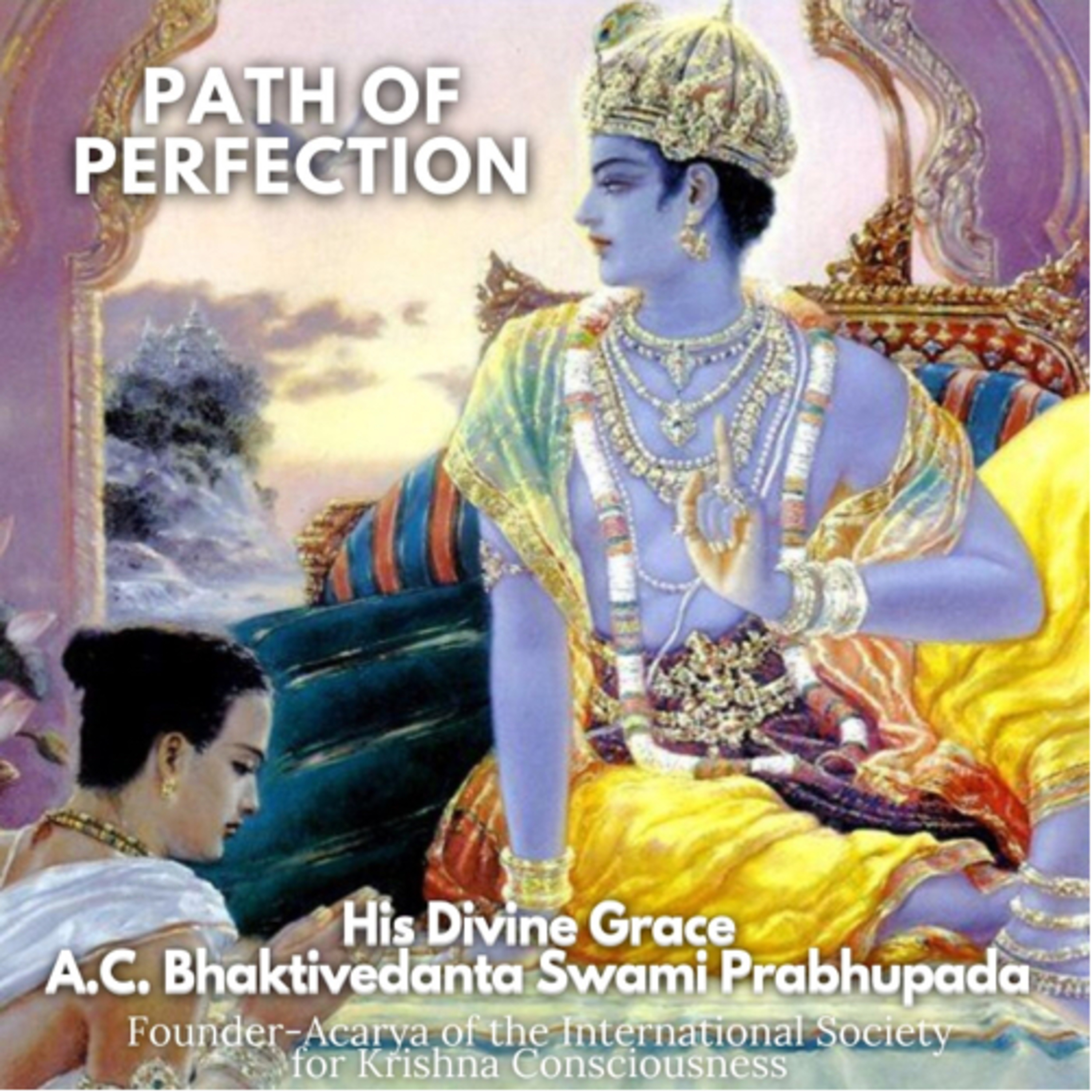
216 - God Can Have His Cake & Eat It (“Path of Perfection” Chapter 3) episode artwork

EPISODE · Mar 13, 2021 · 22 MIN

216 - God Can Have His Cake & Eat It (“Path of Perfection” Chapter 3)

from Sravanam Diaries · host Sulalita Devi Dasi

How is it possible to understand Him? Sevonmukhe hi jihvādau. By training and purifying our senses, we may come to understand and see God. Presently we are attempting to understand God with impure, imperfect senses. It is like someone with cataracts trying to see. Just because one has cataracts, he should not conclude that there is nothing to be seen. Similarly, we cannot presently conceive of God’s form, but once our cataracts are removed, we can see. According to the Brahma-saṁhitā (5.38), premāñjana-cchurita-bhakti-vilocanena santaḥ sadaiva hṛdayeṣu vilokayanti: “The devotees whose eyes are anointed with the ointment of love of God can see God within their hearts twenty-four hours a day.” Purification of the senses is what is required; then we can understand the name, form, qualities, and pastimes of God. Then we’ll be able to see God everywhere and in everything. These matters are discussed thoroughly in the Vedic literatures. For instance, it is said that although God has no hands or legs, He can accept whatever we offer (apāṇi-pādo javano gṛhītā). It is also stated that although God has neither eyes nor ears, He can see and hear everything. These are apparent contradictions, but they are meant to teach us an important lesson. When we speak of seeing, we think of material vision. Due to our material conception, we think that the eyes of God must be like ours. Therefore, in order to remove these material conceptions, the Vedic literatures say that God has no hands, legs, eyes, ears, etc. God has eyes, but His vision is infinite. He can see in darkness, and He can see everywhere at once; therefore He has different eyes. Similarly, God has ears and can hear. He may be in His kingdom, millions and millions of miles away, but He can hear us whispering, because He is sitting within. We cannot avoid God’s seeing, hearing, or touching. patraṁ puṣpaṁ phalaṁ toyaṁ yo me bhaktyā prayacchati tad ahaṁ bhakty-upahṛtam aśnāmi prayatātmanaḥ “If one offers Me with love and devotion a leaf, a flower, fruit, or water, I will accept it.” (Bhagavad-gītā 9.26) If God does not have senses, how can He accept and eat the offerings that are presented to Him? According to ritual, we are offering Kṛṣṇa food daily, and we can see that the taste of this food is immediately changed. This is a practical example. God eats, but because He is full, He does not eat like us. If I offer you a plate of food, you will eat it, and it will be finished. God is not hungry, but He eats, and at the same time, He leaves the food as it is, and thus it is transformed into prasāda, His mercy. Pūrṇasya pūrṇam ādāya pūrṇam evāvaśiṣyate. God is full, yet He accepts all the food that we offer. Still, the food remains as it is. He can eat with His eyes. As stated in Brahma-saṁhitā, aṅgāni yasya sakalendriya-vṛttimanti: “Every sense of the Lord’s body has all the potencies of the other senses.” Although we can see with our eyes, we cannot eat with our eyes. The senses of God, however, being infinite, are different. Simply by looking at the food that is offered to Him, He eats it. read with us: biglink.to/pathofperfection & check out our website for the catalogue of all the books we’ve read so far www.sravanamdiaries.com

Episode metadata supplied by the publisher feed · Published Mar 13, 2021

How is it possible to understand Him? Sevonmukhe hi jihvādau. By training and purifying our senses, we may come to understand and see God. Presently we are attempting to understand God with impure, imperfect senses. It is like someone with cataracts trying to see. Just because one has cataracts, he should not conclude that there is nothing to be seen. Similarly, we cannot presently conceive of God’s form, but once our cataracts are removed, we can see. According to the Brahma-saṁhitā (5.38), premāñjana-cchurita-bhakti-vilocanena santaḥ sadaiva hṛdayeṣu vilokayanti: “The devotees whose eyes are anointed with the ointment of love of God can see God within their hearts twenty-four hours a day.” Purification of the senses is what is required; then we can understand the name, form, qualities, and pastimes of God. Then we’ll be able to see God everywhere and in everything. These matters are discussed thoroughly in the Vedic literatures. For instance, it is said that although God has no hands or legs, He can accept whatever we offer (apāṇi-pādo javano gṛhītā). It is also stated that although God has neither eyes nor ears, He can see and hear everything. These are apparent contradictions, but they are meant to teach us an important lesson. When we speak of seeing, we think of material vision. Due to our material conception, we think that the eyes of God must be like ours. Therefore, in order to remove these material conceptions, the Vedic literatures say that God has no hands, legs, eyes, ears, etc. God has eyes, but His vision is infinite. He can see in darkness, and He can see everywhere at once; therefore He has different eyes. Similarly, God has ears and can hear. He may be in His kingdom, millions and millions of miles away, but He can hear us whispering, because He is sitting within. We cannot avoid God’s seeing, hearing, or touching. patraṁ puṣpaṁ phalaṁ toyaṁ yo me bhaktyā prayacchati tad ahaṁ bhakty-upahṛtam aśnāmi prayatātmanaḥ “If one offers Me with love and devotion a leaf, a flower, fruit, or water, I will accept it.” (Bhagavad-gītā 9.26) If God does not have senses, how can He accept and eat the offerings that are presented to Him? According to ritual, we are offering Kṛṣṇa food daily, and we can see that the taste of this food is immediately changed. This is a practical example. God eats, but because He is full, He does not eat like us. If I offer you a plate of food, you will eat it, and it will be finished. God is not hungry, but He eats, and at the same time, He leaves the food as it is, and thus it is transformed into prasāda, His mercy. Pūrṇasya pūrṇam ādāya pūrṇam evāvaśiṣyate. God is full, yet He accepts all the food that we offer. Still, the food remains as it is. He can eat with His eyes. As stated in Brahma-saṁhitā, aṅgāni yasya sakalendriya-vṛttimanti: “Every sense of the Lord’s body has all the potencies of the other senses.” Although we can see with our eyes, we cannot eat with our eyes. The senses of God, however, being infinite, are different. Simply by looking at the food that is offered to Him, He eats it. read with us: biglink.to/pathofperfection & check out our website for the catalogue of all the books we’ve read so far www.sravanamdiaries.com

PodParley-generated summary based on available episode metadata and transcript content.

NOW PLAYING

216 - God Can Have His Cake & Eat It (“Path of Perfection” Chapter 3)

0:00 22:37

No transcript for this episode yet

We transcribe on demand. Request one and we'll notify you when it's ready — usually under 10 minutes.

The (R)EV Diaries - EVs in Rural America Electric Cars - Electric Vehicles Ben Jones Electric Vehicles are everywhere. All major car manufacturers, from the highest-end performance brands to the lowest-end utilitarian family wagons, are working to produce an EV option for the marketplace. Battery capacity breakthroughs and concept cars shrouded in secrecy dominate the news. Here in America, public charging infrastructure is popping up… in big cities where consumers are realizing they can electrify their commute and save 70% on fuel costs. But what about small-town America? Ben Jones, an electrical engineer for an distribution cooperative in southeastern Kentucky believes so. He’s been exposed to EVs and charging infrastructure projects for his utility. Ben believes that EVs need to be in every town and the right combination of battery range and charging options make electric cars very attractive to rural inhabitants. But that was not always the case. The EV Diaries chronicle Ben’s conversion from skeptic to being a self-appointed EV ambassador. He talks about h THE VAMPIRE DIARIES Himanshi Naruka Hey guys, I just finished watching the show "The Vampire Diaries", I just loved it 😍 So now I have decided to read the books and take you all with me through this reading journey. ❤️ The Honey Badger Diaries Aaron van Wirdum in lockdown As coronavirus sweeps the globe......civil liberties are threatened......physical cash is abandoned......money printers go brrr......and bitcoin is halvening. My Ukrainian Heritage : Laryssa Ahimsa Media Laryssa Menkova shares a series of diaries exploring her Ukrainian Heritage. Throughout this series, Laryssa reflects on parts of her parents’ lives fleeing from Russia and settling in Ukraine, her travels in Ukraine, and her feelings about being a child of immigrant Ukrainian parents, set against the current realities of Russia’s invasion on Ukraine.

Frequently Asked Questions

How long is this episode of Sravanam Diaries?

This episode is 22 minutes long.

When was this Sravanam Diaries episode published?

This episode was published on March 13, 2021.

What is this episode about?

How is it possible to understand Him? Sevonmukhe hi jihvādau. By training and purifying our senses, we may come to understand and see God. Presently we are attempting to understand God with impure, imperfect senses. It is like someone with cataracts...

Can I download this Sravanam Diaries episode?

Yes, you can download this episode by clicking the download button on the episode player, or subscribe to the podcast in your preferred podcast app for automatic downloads.
URL copied to clipboard!