
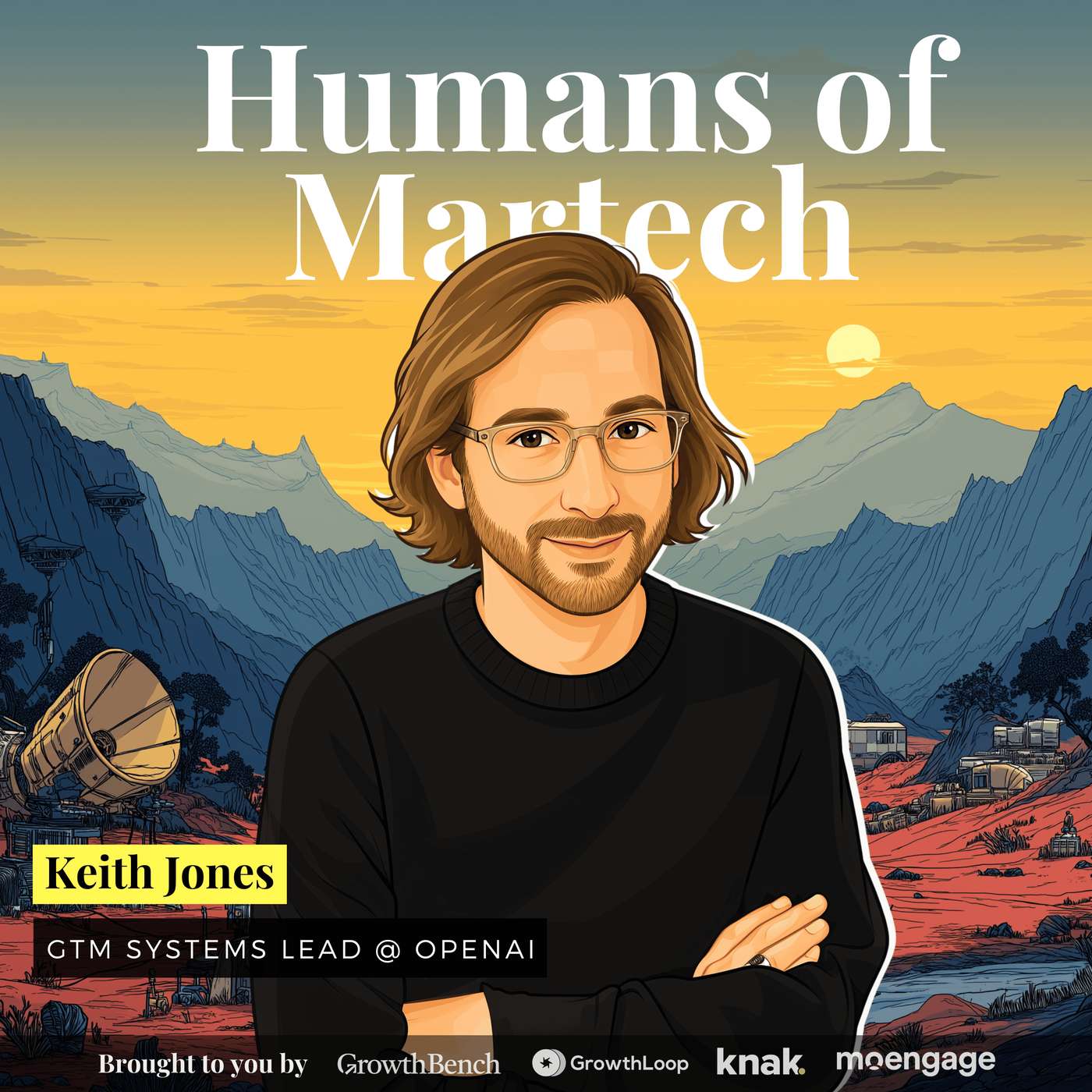
EPISODE · Jun 16, 2026 · 1H 2M
224: Keith Jones: How OpenAI’s GTM leader structures teams and spots standout candidates
from Humans of Martech · host Phil Gamache
What's up everyone, today we have the pleasure of sitting down with Keith Jones, Head of GTM Systems at OpenAI.Summary: Keith's GTM systems team at OpenAI got split across 2 orgs, ran into the most wildly practical cost center problem imaginable, and ended up proving exactly why distributed systems teams at high-velocity companies don't work. In this episode, he walks through the full restructuring journey, explains why "be close to the money" now means be close to the budget rather than the revenue motion, and breaks down Symphony and harness engineering — the open-source agentic code orchestration tools his team built to ship production-ready GTM changes without going to the nth degree of "write this Apex class." He also has a filter for separating human candidates from AI-generated applications that is simple, specific, and immediately usable. If you run a GTM systems team, build one, or just want to understand what operating at 10x growth actually requires, this one is worth your time.About Keith JonesKeith Jones is the Head of GTM Systems at OpenAI, where he leads the team responsible for the tools, platforms, and technical infrastructure behind the company's go-to-market motion. He began his career across sales ops and marketing ops roles before joining Mural, where he built and led the GTM Systems function. He later served as Senior Director and Analyst at Gartner, covering revenue technology, before moving to OpenAI. Keith joins this episode as a technologist and practitioner; the views and opinions he expresses are his own and do not represent OpenAI.What Separates GTM Ops from GTM SystemsThe naming debate in martech ops has been running so long it's almost a genre. Marketing ops, revenue ops, GTM ops, GTM systems — the titles keep multiplying and nobody agrees on where one ends and the other begins. If you're in this function, you've had the conversation. In job interviews. In org design meetings. In budget justifications. It goes nowhere, and it keeps happening.Keith has a more useful framing. When he first came on the show, he drew a clean line. GTM ops handles process design, training, and the frontline support that keeps the humans in your GTM org running. GTM systems owns the tools, the technical infrastructure, the back-end work: Salesforce, integrations, scaling, the stack. That line still holds. But he's added something that makes it more useful than a job description.They're the ones in the room with every sales segment leader, every functional head, absorbing what the business actually needs and translating it into something buildable. Without that translation layer, a systems team is guessing. And guessing at OpenAI's pace doesn't go well.At OpenAI, both functions have kept evolving alongside the company. Denise Dresser came in as CRO with a complete vision for reshaping the go-to-market org. B2B marketing got folded in. The company launched ads. The org changed repeatedly and fast. Through all of it, the underlying logic held: GTM ops partners with the business, GTM systems delivers what that partnership requires.As for the labels, Keith's position is that they're the wrong thing to anchor on. At OpenAI, the specific titles of marketing ops or rev ops matter less than who owns the stakeholder work and who owns the technical delivery. The names on the teams are almost secondary. The friction comes from not having clarity on which team does which job and what flows between them. Most organizations that treat these two functions as interchangeable tend to find out why that's a problem the hard way.The clean requirements that GTM ops provides to GTM systems aren't a process nicety. They're what keeps a systems team from building the wrong thing at the wrong pace.Key takeaway: Draw a line in your own org between who owns stakeholder requirements and who owns technical delivery. If one person or team is carrying both, something is consistently slipping. Establish a regular meeting rhythm where GTM ops and GTM systems leaders hash through priorities together, and treat that handoff as seriously as any technical dependency.The Cost Center Problem That Reunited OpenAI's GTM Systems TeamOpenAI's GTM systems team didn't move under finance because someone had a grand theory about org design. They moved because of a cost center problem. And the cost center problem showed up in the most unglamorous way possible: headcount.The original case for moving was practical. Keith's team needed to accelerate a set of deep financial integrations — Salesforce data flowing into ERP systems, billing pipelines, downstream finance reporting. The work required close collaboration with the finance function. The initial plan was a wholesale move. What the org settled on instead was a compromise: split the team. Some engineers stayed under go-to-market. The rest moved into what OpenAI calls Enterprise Platform Technology (EPT), the org that reports to the CFO. On paper, the logic held. In practice, the friction started almost immediately.Two separate cost centers sharing an overlapping team create problems that don't announce themselves upfront. They surface sideways:2 separate budget owners with different priorities pulling the same engineers in different directions, Shared consulting firms split across orgs, with different teams allocating the same people to different workstreams, Tooling budgets that required negotiation across reporting lines rather than a single decision, Headcount competing directly against a new CRO's vision for building out the go-to-market orgThat last one is what forced the decision. Denise Dresser joined as CRO after budgets were already set, bringing a complete vision for reshaping the go-to-market org and the headcount requirements to execute it. Keith found himself competing against her priorities for resources from the same finite pool. Not by design. Just by the math of 2 leaders sharing one budget.The conversation was brief. Dresser knew Keith's team would keep supporting go-to-market regardless of which org they sat in. She knew she could hold him accountable. But she couldn't justify choosing between revenue-generating hires and systems resources from the same budget line when the answer was that obvious.The reunified structure looks different from what existed before. Keith now has a peer leading quote-to-cash and revenue-adjacent systems. Keith owns top-of-funnel data enrichment, pre- and post-sale workflow, and the support systems org. The org got flatter, the division of responsibility got cleaner, and the cost center competition disappeared.How GTM Systems and GTM Ops Stay Aligned After the SplitGTM ops stayed under the go-to-market umbrella when GTM systems moved to EPT. The obvious question: how do they stay connected? Keith's answer is a biweekly meeting he calls the most productive hour on his calendar. Six to seven people in the room from both sides of the new org boundary:Keith and his peer leading go-to-market systems, The manager running all of Enterprise Platform Technology, including people systems, supply chain, and revenue systems, The most senior leaders from growth, go-to-market ops, and rev opsNo prep deck. No pre-circulated agenda. Everyone spends 5 to 10 minutes writing down their top of minds — what's keeping them up at night, what's shifted, what needs cross-functional attention. Then the group talks through it. Where do the priorities overlap? Where are they diverging? Which teams need to be working together on something they're currently doing separately?It's not a status meeting. It's a priority alignment session with people who have the authority to act on what comes out of it.The distributed period was hard. It was also clarifying. The experience exposed exactly which parts o...
What this episode covers
What's up everyone, today we have the pleasure of sitting down with Keith Jones, Head of GTM Systems at OpenAI.Summary: Keith's GTM systems team at OpenAI got split across 2 orgs, ran into the most wildly practical cost center problem imaginable, and ended up proving exactly why distributed systems teams at high-velocity companies don't work. In this episode, he walks through the full restructuring journey, explains why "be close to the money" now means be close to the budget rather than the revenue motion, and breaks down Symphony and harness engineering — the open-source agentic code orchestration tools his team built to ship production-ready GTM changes without going to the nth degree of "write this Apex class." He also has a filter for separating human candidates from AI-generated applications that is simple, specific, and immediately usable. If you run a GTM systems team, build one, or just want to understand what operating at 10x growth actually requires, this one is worth your time.About Keith JonesKeith Jones is the Head of GTM Systems at OpenAI, where he leads the team responsible for the tools, platforms, and technical infrastructure behind the company's go-to-market motion. He began his career across sales ops and marketing ops roles before joining Mural, where he built and led the GTM Systems function. He later served as Senior Director and Analyst at Gartner, covering revenue technology, before moving to OpenAI. Keith joins this episode as a technologist and practitioner; the views and opinions he expresses are his own and do not represent OpenAI.What Separates GTM Ops from GTM SystemsThe naming debate in martech ops has been running so long it's almost a genre. Marketing ops, revenue ops, GTM ops, GTM systems — the titles keep multiplying and nobody agrees on where one ends and the other begins. If you're in this function, you've had the conversation. In job interviews. In org design meetings. In budget justifications. It goes nowhere, and it keeps happening.Keith has a more useful framing. When he first came on the show, he drew a clean line. GTM ops handles process design, training, and the frontline support that keeps the humans in your GTM org running. GTM systems owns the tools, the technical infrastructure, the back-end work: Salesforce, integrations, scaling, the stack. That line still holds. But he's added something that makes it more useful than a job description.They're the ones in the room with every sales segment leader, every functional head, absorbing what the business actually needs and translating it into something buildable. Without that translation layer, a systems team is guessing. And guessing at OpenAI's pace doesn't go well.At OpenAI, both functions have kept evolving alongside the company. Denise Dresser came in as CRO with a complete vision for reshaping the go-to-market org. B2B marketing got folded in. The company launched ads. The org changed repeatedly and fast. Through all of it, the underlying logic held: GTM ops partners with the business, GTM systems delivers what that partnership requires.As for the labels, Keith's position is that they're the wrong thing to anchor on. At OpenAI, the specific titles of marketing ops or rev ops matter less than who owns the stakeholder work and who owns the technical delivery. The names on the teams are almost secondary. The friction comes from not having clarity on which team does which job and what flows between them. Most organizations that treat these two functions as interchangeable tend to find out why that's a problem the hard way.The clean requirements that GTM ops provides to GTM systems aren't a process nicety. They're what keeps a systems team from building the wrong thing at the wrong pace.Key takeaway: Draw a line in your own org between who owns stakeholder requirements and who owns technical delivery. If one person or team is carrying both, something is consistently slipping. Establish a regular meeting rhythm where GTM ops and GTM systems leaders hash through priorities together, and treat that handoff as seriously as any technical dependency.The Cost Center Problem That Reunited OpenAI's GTM Systems TeamOpenAI's GTM systems team didn't move under finance because someone had a grand theory about org design. They moved because of a cost center problem. And the cost center problem showed up in the most unglamorous way possible: headcount.The original case for moving was practical. Keith's team needed to accelerate a set of deep financial integrations — Salesforce data flowing into ERP systems, billing pipelines, downstream finance reporting. The work required close collaboration with the finance function. The initial plan was a wholesale move. What the org settled on instead was a compromise: split the team. Some engineers stayed under go-to-market. The rest moved into what OpenAI calls Enterprise Platform Technology (EPT), the org that reports to the CFO. On paper, the logic held. In practice, the friction started almost immediately.Two separate cost centers sharing an overlapping team create problems that don't announce themselves upfront. They surface sideways:2 separate budget owners with different priorities pulling the same engineers in different directions, Shared consulting firms split across orgs, with different teams allocating the same people to different workstreams, Tooling budgets that required negotiation across reporting lines rather than a single decision, Headcount competing directly against a new CRO's vision for building out the go-to-market orgThat last one is what forced the decision. Denise Dresser joined as CRO after budgets were already set, bringing a complete vision for reshaping the go-to-market org and the headcount requirements to execute it. Keith found himself competing against her priorities for resources from the same finite pool. Not by design. Just by the math of 2 leaders sharing one budget.The conversation was brief. Dresser knew Keith's team would keep supporting go-to-market regardless of which org they sat in. She knew she could hold him accountable. But she couldn't justify choosing between revenue-generating hires and systems resources from the same budget line when the answer was that obvious.The reunified structure looks different from what existed before. Keith now has a peer leading quote-to-cash and revenue-adjacent systems. Keith owns top-of-funnel data enrichment, pre- and post-sale workflow, and the support systems org. The org got flatter, the division of responsibility got cleaner, and the cost center competition disappeared.How GTM Systems and GTM Ops Stay Aligned After the SplitGTM ops stayed under the go-to-market umbrella when GTM systems moved to EPT. The obvious question: how do they stay connected? Keith's answer is a biweekly meeting he calls the most productive hour on his calendar. Six to seven people in the room from both sides of the new org boundary:Keith and his peer leading go-to-market systems, The manager running all of Enterprise Platform Technology, including people systems, supply chain, and revenue systems, The most senior leaders from growth, go-to-market ops, and rev opsNo prep deck. No pre-circulated agenda. Everyone spends 5 to 10 minutes writing down their top of minds — what's keeping them up at night, what's shifted, what needs cross-functional attention. Then the group talks through it. Where do the priorities overlap? Where are they diverging? Which teams need to be working together on something they're currently doing separately?It's not a status meeting. It's a priority alignment session with people who have the authority to act on what comes out of it.The distributed period was hard. It was also clarifying. The experience exposed exactly which parts o...
NOW PLAYING
224: Keith Jones: How OpenAI’s GTM leader structures teams and spots standout candidates
No transcript for this episode yet
Similar Episodes
Mar 26, 2026 ·1m
Mar 19, 2026 ·34m
Feb 18, 2026 ·11m
Feb 11, 2026 ·45m