
EPISODE · Jun 23, 2026 · 1H 2M
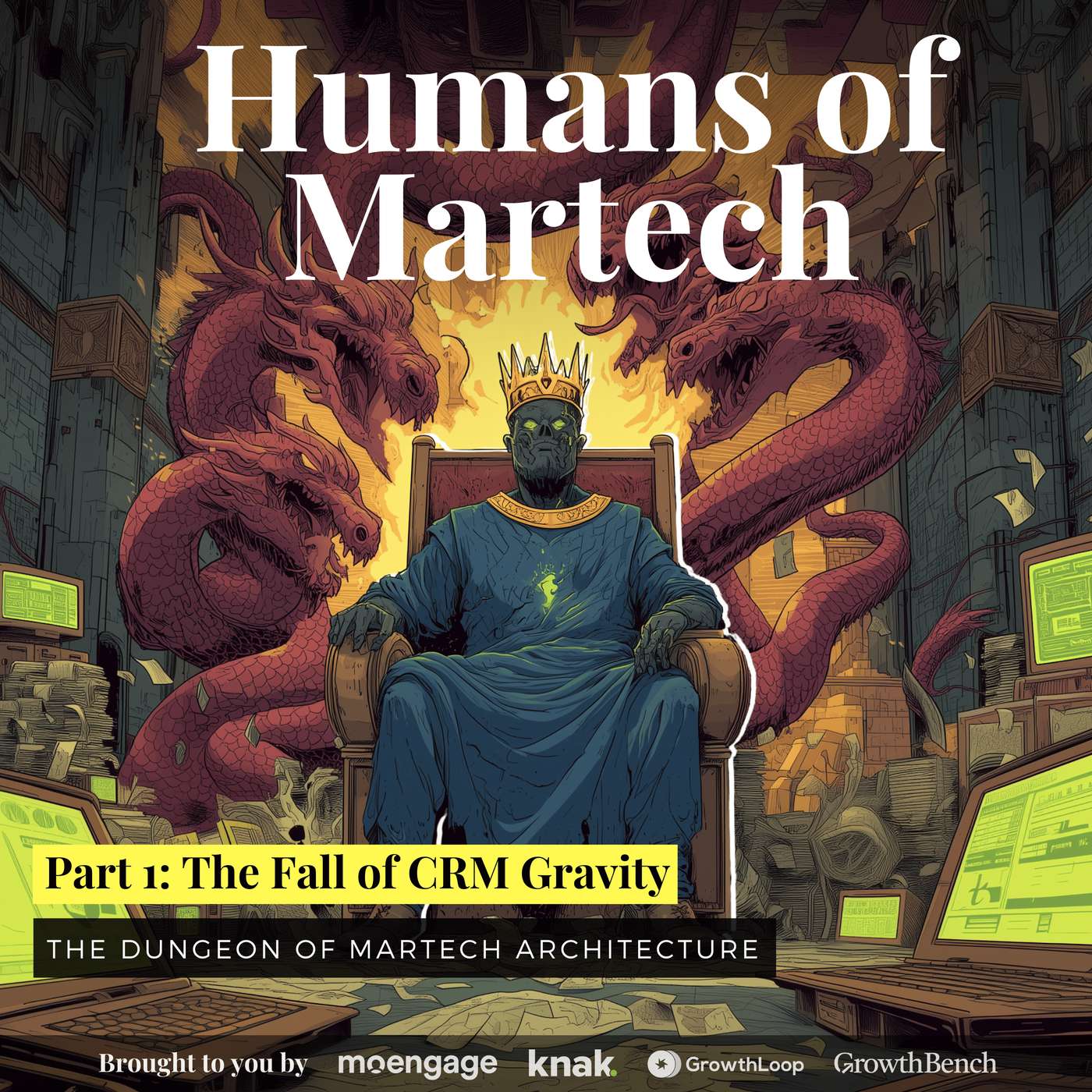
225: The Fall of CRM gravity (The Dungeon of martech architecture, part 1)
from Humans of Martech · host Phil Gamache
What’s up folks, welcome to our 4 part series of Crawling THROUGH THE DUNGEON OF MARTECH ARCHITECTUREYou’ve arrived at Part1 : The Fall of CRM Gravity (00:00) - Intro (00:57) - In This Episode (01:31) - Sponsor: MoEngage (02:28) - Sponsor: Knak (04:53) - FLOOR 1: Why the CRM Lost Its Authority (06:09) - Why Every Team Moved Into the CRM (And How It Lost Its Authority) (13:57) - Why Sharing CRM Data Always Breaks It (18:02) - Why CRM Gravity Outlasts the Technical Argument (24:04) - BOSS BATTLE: The False Truth King (25:44) - Sponsor: GrowthLoop (26:48) - Sponsor: GrowthBench (34:56) - Why Centralizing Data Only to Copy It Out Defeats the Purpose (39:31) - BOSS BATTLE: The Export Hydra (40:53) - How to Move to a Warehouse-Native Architecture (46:36) - How to Achieve Portable Audiences (56:52) - How CLI/MCP Servers Are Changing Marketing Stack Integration ---------------------------------------------------------------------------OPENING---------------------------------------------------------------------------Welcome to the descent into the Dungeon of Martech Architecture, a 4-part journey through the unhinged and constantly expanding world of marketing technology.As a massive sci-fi fan currently reading the Dungeon Crawler Carl books, I have used their level-by-level progression as the direct inspiration for this 'dungeon crawl' analogy, and while you don’t need to know the books to enjoy the journey, those who do will recognize some of the gaming lore and achievement-style rewards woven into our descent. This will be educational and helpful for anyone that works and builds martech, and hopefully it’s also a bit fun. Without a doubt though, it will be weird. Here is your quick guide to the floors ahead:Episode 1: CRM GravityYou’ll conquer the source of truth and discover that the data warehouse replaces the CRM with portable audiences.Episode 2: The Eye of ContextYou’ll learn why AI fails without shared meaning, why context engineering is the layer between data and agent authority, and why the industry built the wrong kind of meaning infrastructure in 2012.Episode 3: The Correlation MasqueradeYou’ll escape the correlation trap and build the causal memory layer that separates agents that optimize correctly from agents that confidently scale the wrong behavior.Episode 4: The Dispatch TowerYou’ll tackle the governance chaos of 30 vendors all claiming authority, and confront the interface decision that most organizations already made without realizing it.Let’s start our descent.---Be honest: when was the last time you pulled up a number in your CRM and actually trusted it? like… no second-guessing, no “that feels a bit off”… just total confidence?Maybe you didn’t really have time to double check the logic behind the number and you were too excited to share the positive results. So you forwarded it to a peer. Or maybe you’ve been in that meeting… 2 people arguing over a number, both pull it up in the same CRM, and somehow get 2 completely different answers… and no one can explain which one’s actually right.We’ve all been there, we’ve felt it. That dark, creeping dread. When “which number is right?” gets answered with “well… it depends who built the report,”. They know it. You know it. The CRM admin knows it. Everyone in the room knows it. You don’t have a source of truth… just a CRM that’s turned into a dumping ground of lost updates that have slowly compounded into competing versions of reality.Call it counterfeit truth or data mirage… I call it bad data. Data that has the appearance of authority without the actual authority behind it. It's everywhere in the modern marketing stack. And the CRM is often where it starts.That’s where our first boss is hiding. ---------------------------------------------------------------------------FLOOR 1: Why the CRM Lost Its Authority---------------------------------------------------------------------------If you’re in B2B or B2C the first floor looks a bit different but only because of terminology. In B2B the 2 cornerstone platforms are the CRM and the MAP: the Customer Relationship Management software and the Marketing Automation Platform. Sales works in the former, marketing works in the latter, ops is stuck making the two talk to each other.In B2C though, for some reason you all decided that the MAP is actually called a CRM and the B2B version of the CRM isn’t really needed because there’s often no sales team, instead it’s a customer support or product led motion.In both scenarios though the same thing happens to that central platform. It gets inherited by teams that weren't its original audience. It accumulates data it wasn't designed to hold. And it becomes the unofficial source of truth for the whole business without anyone explicitly deciding that was a good idea.Why Every Team Moved Into the CRM (And How It Lost Its Authority)So how did we get here? CRMs were built for one job: tracking the sales motion. Contacts, deals, stages, activity logs. They were good at that job. Then marketing moved in. Marketers ruin everything. But leadership is worse. Leadership started pulling board metrics from the CRM. Then the product team added usage data. Then we added ABM and account signals, and we had to push that data somewhere. Then AI interactions needed a home.What a mess.Everyone needed a record of the customer, and the CRM was already there. It’s literally called the Customer Relationship Manager. So it became the shared folder everyone saved their customer work into, even though it was designed for a very specific kind of work.The problem is that once data is stored in a CRM, it starts reflecting the team that works there. Sales edits the contact. Marketing overwrites a field. Customer success adds a note. Each edit is local logic applied to what everyone assumes is shared truth. The data looks official but you know deep down that the authority behind it belongs to whoever edited it last.Meg Gowell, Head of Marketing at Elly.ai and former Head of Marketing at Typeform crossed over from a Salesforce-first organization to one where the warehouse had already taken over:MEG GOWELL, Episode 155“The tricky part of our tech stack is that I’m used to Salesforce or HubSpot being the single source of truth. Here, our core business is represented more in the data warehouse than anywhere else, and Salesforce supports the sales-led part of the business.Understanding how those data pieces come together is something I’m still working through. I’ve only been here three and a half or four months, and it’s tricky. The biggest challenge is figuring out how the self-serve and sales-led motions fit together. In PLG, they have to serve one another. If your tech stack doesn’t support that, it becomes really hard.We run into questions like: do we have all the right data points in the right places for people to act on them? Do we know everything we need to know? I’ve really experienced how important the underlying data structure is, and how important consistency across tools is.In the past, there was this wide spectrum. In one area, we had a very advanced multi-touch attribution system. In another area, it was very basic reporting. So there was this weird mix of super deep and super surface-level, but without an underlying structure that fully worked.I think that happens to a lot of companies when they’re growing fast. You take opportunities where you see them, and you move quickly. Now we’re taking a step back and saying: we really ...
What this episode covers
What’s up folks, welcome to our 4 part series of Crawling THROUGH THE DUNGEON OF MARTECH ARCHITECTUREYou’ve arrived at Part1 : The Fall of CRM Gravity (00:00) - Intro (00:57) - In This Episode (01:31) - Sponsor: MoEngage (02:28) - Sponsor: Knak (04:53) - FLOOR 1: Why the CRM Lost Its Authority (06:09) - Why Every Team Moved Into the CRM (And How It Lost Its Authority) (13:57) - Why Sharing CRM Data Always Breaks It (18:02) - Why CRM Gravity Outlasts the Technical Argument (24:04) - BOSS BATTLE: The False Truth King (25:44) - Sponsor: GrowthLoop (26:48) - Sponsor: GrowthBench (34:56) - Why Centralizing Data Only to Copy It Out Defeats the Purpose (39:31) - BOSS BATTLE: The Export Hydra (40:53) - How to Move to a Warehouse-Native Architecture (46:36) - How to Achieve Portable Audiences (56:52) - How CLI/MCP Servers Are Changing Marketing Stack Integration ---------------------------------------------------------------------------OPENING---------------------------------------------------------------------------Welcome to the descent into the Dungeon of Martech Architecture, a 4-part journey through the unhinged and constantly expanding world of marketing technology.As a massive sci-fi fan currently reading the Dungeon Crawler Carl books, I have used their level-by-level progression as the direct inspiration for this 'dungeon crawl' analogy, and while you don’t need to know the books to enjoy the journey, those who do will recognize some of the gaming lore and achievement-style rewards woven into our descent. This will be educational and helpful for anyone that works and builds martech, and hopefully it’s also a bit fun. Without a doubt though, it will be weird. Here is your quick guide to the floors ahead:Episode 1: CRM GravityYou’ll conquer the source of truth and discover that the data warehouse replaces the CRM with portable audiences.Episode 2: The Eye of ContextYou’ll learn why AI fails without shared meaning, why context engineering is the layer between data and agent authority, and why the industry built the wrong kind of meaning infrastructure in 2012.Episode 3: The Correlation MasqueradeYou’ll escape the correlation trap and build the causal memory layer that separates agents that optimize correctly from agents that confidently scale the wrong behavior.Episode 4: The Dispatch TowerYou’ll tackle the governance chaos of 30 vendors all claiming authority, and confront the interface decision that most organizations already made without realizing it.Let’s start our descent.---Be honest: when was the last time you pulled up a number in your CRM and actually trusted it? like… no second-guessing, no “that feels a bit off”… just total confidence?Maybe you didn’t really have time to double check the logic behind the number and you were too excited to share the positive results. So you forwarded it to a peer. Or maybe you’ve been in that meeting… 2 people arguing over a number, both pull it up in the same CRM, and somehow get 2 completely different answers… and no one can explain which one’s actually right.We’ve all been there, we’ve felt it. That dark, creeping dread. When “which number is right?” gets answered with “well… it depends who built the report,”. They know it. You know it. The CRM admin knows it. Everyone in the room knows it. You don’t have a source of truth… just a CRM that’s turned into a dumping ground of lost updates that have slowly compounded into competing versions of reality.Call it counterfeit truth or data mirage… I call it bad data. Data that has the appearance of authority without the actual authority behind it. It's everywhere in the modern marketing stack. And the CRM is often where it starts.That’s where our first boss is hiding. ---------------------------------------------------------------------------FLOOR 1: Why the CRM Lost Its Authority---------------------------------------------------------------------------If you’re in B2B or B2C the first floor looks a bit different but only because of terminology. In B2B the 2 cornerstone platforms are the CRM and the MAP: the Customer Relationship Management software and the Marketing Automation Platform. Sales works in the former, marketing works in the latter, ops is stuck making the two talk to each other.In B2C though, for some reason you all decided that the MAP is actually called a CRM and the B2B version of the CRM isn’t really needed because there’s often no sales team, instead it’s a customer support or product led motion.In both scenarios though the same thing happens to that central platform. It gets inherited by teams that weren't its original audience. It accumulates data it wasn't designed to hold. And it becomes the unofficial source of truth for the whole business without anyone explicitly deciding that was a good idea.Why Every Team Moved Into the CRM (And How It Lost Its Authority)So how did we get here? CRMs were built for one job: tracking the sales motion. Contacts, deals, stages, activity logs. They were good at that job. Then marketing moved in. Marketers ruin everything. But leadership is worse. Leadership started pulling board metrics from the CRM. Then the product team added usage data. Then we added ABM and account signals, and we had to push that data somewhere. Then AI interactions needed a home.What a mess.Everyone needed a record of the customer, and the CRM was already there. It’s literally called the Customer Relationship Manager. So it became the shared folder everyone saved their customer work into, even though it was designed for a very specific kind of work.The problem is that once data is stored in a CRM, it starts reflecting the team that works there. Sales edits the contact. Marketing overwrites a field. Customer success adds a note. Each edit is local logic applied to what everyone assumes is shared truth. The data looks official but you know deep down that the authority behind it belongs to whoever edited it last.Meg Gowell, Head of Marketing at Elly.ai and former Head of Marketing at Typeform crossed over from a Salesforce-first organization to one where the warehouse had already taken over:MEG GOWELL, Episode 155“The tricky part of our tech stack is that I’m used to Salesforce or HubSpot being the single source of truth. Here, our core business is represented more in the data warehouse than anywhere else, and Salesforce supports the sales-led part of the business.Understanding how those data pieces come together is something I’m still working through. I’ve only been here three and a half or four months, and it’s tricky. The biggest challenge is figuring out how the self-serve and sales-led motions fit together. In PLG, they have to serve one another. If your tech stack doesn’t support that, it becomes really hard.We run into questions like: do we have all the right data points in the right places for people to act on them? Do we know everything we need to know? I’ve really experienced how important the underlying data structure is, and how important consistency across tools is.In the past, there was this wide spectrum. In one area, we had a very advanced multi-touch attribution system. In another area, it was very basic reporting. So there was this weird mix of super deep and super surface-level, but without an underlying structure that fully worked.I think that happens to a lot of companies when they’re growing fast. You take opportunities where you see them, and you move quickly. Now we’re taking a step back and saying: we really ...
NOW PLAYING
225: The Fall of CRM gravity (The Dungeon of martech architecture, part 1)
No transcript for this episode yet
Similar Episodes
Mar 26, 2026 ·1m
Mar 19, 2026 ·34m
Feb 18, 2026 ·11m
Feb 11, 2026 ·45m