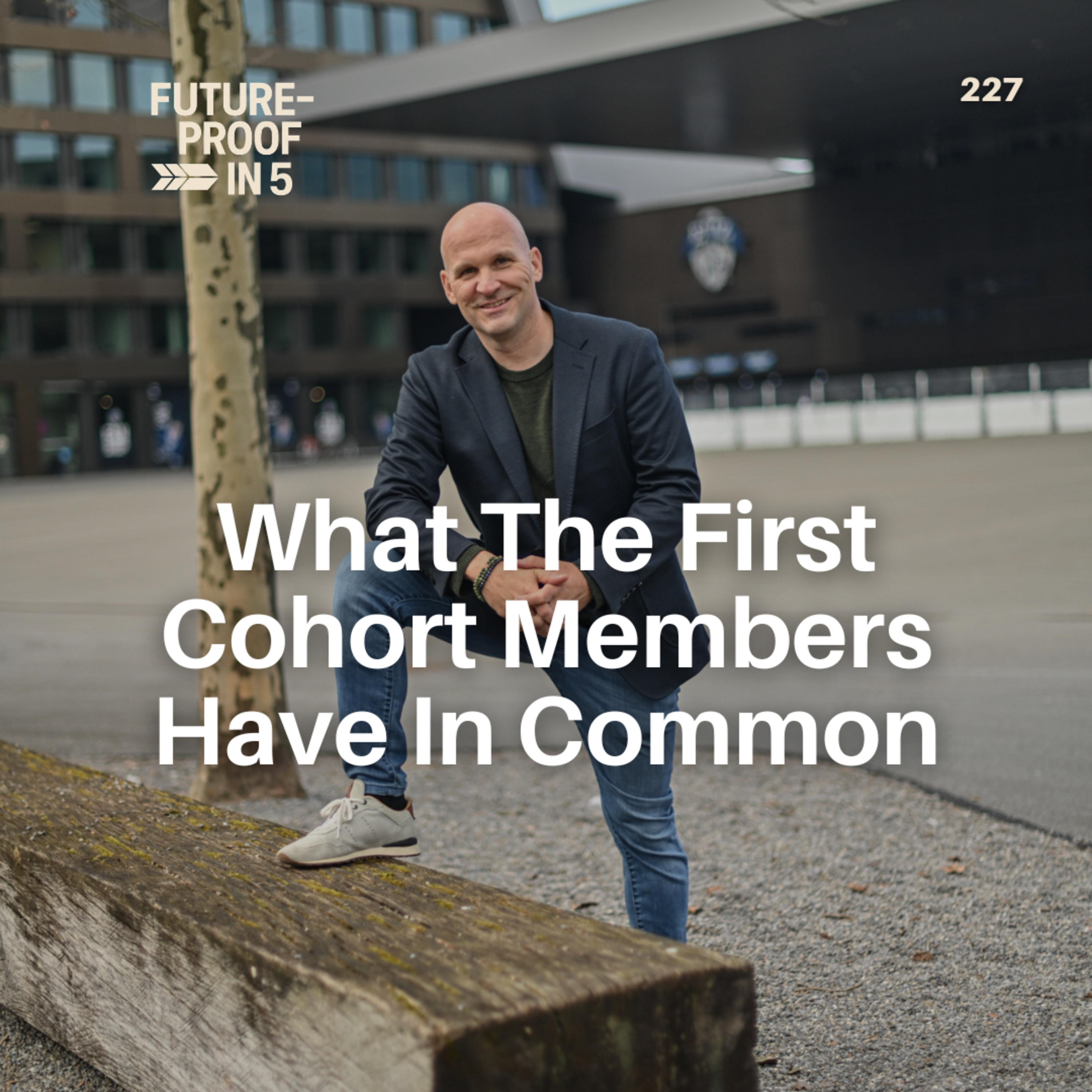
227- What The First Cohort Members Have In Common episode artwork

EPISODE · Mar 4, 2026 · 1 MIN

227- What The First Cohort Members Have In Common

from Future Proof in 5 by Marco Grüter · host Marco Grueter

Most founders think their next problem is growth. It isn’t.In this episode, we look at a powerful message from one of the first confirmed Executive Lab participants. Nine years in business. Four million in revenue. And more trapped than at 500K.That sentence alone exposes a structural truth many founders avoid: Revenue solves survival. Architecture solves freedom.The Hidden PatternThe first cohort members don’t lack intelligence, drive, or market validation. They have already proven they can sell. They have built teams. They have implemented systems.Yet they share three structural challenges:Complexity Compounding: Every solution added layers. More people created more coordination. More tools created more overhead. More revenue increased dependency on the founder.Founder-Centric Design: The business still runs through them. Decisions, relationships, problem-solving, culture, and often sales. Growth increased in importance instead of reducing it.Tactical Thinking Instead of Architectural Thinking: They optimized inside a flawed structure. They added management layers, new processes, and more KPIs without redesigning the underlying operating model.The result? Scale without liberation.Growth vs. ArchitectureThe episode challenges a core assumption in entrepreneurship: that scale automatically creates freedom.It does not.If your company is not designed to operate independently of you, every new client, employee, and system increases fragility.This is why the real problem for experienced founders is rarely marketing, hiring, or revenue strategy. It is a structural design.Architecture determines:How decisions flowHow accountability is distributedHow value is created without founder involvementHow transferable is the company truly isWithout this foundation, growth amplifies stress.Revenue vs. FreedomThe first cohort members have figured out revenue. What they have not fully solved is:Durability: Can the company withstand volatility without founder intervention?Transferability: Could someone else run it successfully?Value creation: Is it an asset or a sophisticated self-employment model?These are the three pillars of a Future-Proof Business.The moment a founder realizes, “My issue isn’t scale, it’s architecture,” everything changes.From Expansion to RedesignThis episode reframes the conversation:Stop asking, “How do I grow faster?”Start asking, “How do I redesign this so it works without me?”That shift moves you from operator to architect.It moves you from reactive scaling to intentional design. And it separates businesses that look successful from businesses that are truly valuable.If you recognize yourself in the pattern described in this episode, you are not behind. You are simply at the architectural inflection point every serious founder eventually faces.The question is not whether you can grow. The question is whether you can design something that lasts.Highlights:00:00 A Founder’s Wake-Up Call: $4M Revenue, Still Trapped00:21 Why “More” Makes It Worse: Team, Systems, and Complexity00:36 The Real Issue Isn’t Scale—It’s Business Architecture00:45 Introducing Executive Lab: Revenue Without Losing Freedom00:53 Start Date + Where to ApplyLinks:Website: https://www.marcogrueter.com/LinkedIn: https://www.linkedin.com/in/marcogrueter/

Most founders think their next problem is growth. It isn’t.In this episode, we look at a powerful message from one of the first confirmed Executive Lab participants. Nine years in business. Four million in revenue. And more trapped than at 500K.That sentence alone exposes a structural truth many founders avoid: Revenue solves survival. Architecture solves freedom.The Hidden PatternThe first cohort members don’t lack intelligence, drive, or market validation. They have already proven they can sell. They have built teams. They have implemented systems.Yet they share three structural challenges:Complexity Compounding: Every solution added layers. More people created more coordination. More tools created more overhead. More revenue increased dependency on the founder.Founder-Centric Design: The business still runs through them. Decisions, relationships, problem-solving, culture, and often sales. Growth increased in importance instead of reducing it.Tactical Thinking Instead of Architectural Thinking: They optimized inside a flawed structure. They added management layers, new processes, and more KPIs without redesigning the underlying operating model.The result? Scale without liberation.Growth vs. ArchitectureThe episode challenges a core assumption in entrepreneurship: that scale automatically creates freedom.It does not.If your company is not designed to operate independently of you, every new client, employee, and system increases fragility.This is why the real problem for experienced founders is rarely marketing, hiring, or revenue strategy. It is a structural design.Architecture determines:How decisions flowHow accountability is distributedHow value is created without founder involvementHow transferable is the company truly isWithout this foundation, growth amplifies stress.Revenue vs. FreedomThe first cohort members have figured out revenue. What they have not fully solved is:Durability: Can the company withstand volatility without founder intervention?Transferability: Could someone else run it successfully?Value creation: Is it an asset or a sophisticated self-employment model?These are the three pillars of a Future-Proof Business.The moment a founder realizes, “My issue isn’t scale, it’s architecture,” everything changes.From Expansion to RedesignThis episode reframes the conversation:Stop asking, “How do I grow faster?”Start asking, “How do I redesign this so it works without me?”That shift moves you from operator to architect.It moves you from reactive scaling to intentional design. And it separates businesses that look successful from businesses that are truly valuable.If you recognize yourself in the pattern described in this episode, you are not behind. You are simply at the architectural inflection point every serious founder eventually faces.The question is not whether you can grow. The question is whether you can design something that lasts.Highlights:00:00 A Founder’s Wake-Up Call: $4M Revenue, Still Trapped00:21 Why “More” Makes It Worse: Team, Systems, and Complexity00:36 The Real Issue Isn’t Scale—It’s Business Architecture00:45 Introducing Executive Lab: Revenue Without Losing Freedom00:53 Start Date + Where to ApplyLinks:Website: https://www.marcogrueter.com/LinkedIn: https://www.linkedin.com/in/marcogrueter/

NOW PLAYING

227- What The First Cohort Members Have In Common

0:00 1:00

No transcript for this episode yet

We transcribe on demand. Request one and we'll notify you when it's ready — usually under 10 minutes.

MG Show MG Show The MG Show, hosted by Jeffrey Pedersen and Shannon Townsend, is a leading alternative media platform dedicated to uncovering the truth behind today’s most pressing political issues. Launched in 2019, the show has grown exponentially, offering unfiltered insights, comprehensive research, and real-time analysis. With a commitment to independent journalism and factual integrity, the MG Show empowers its audience with knowledge and encourages active participation in the political discourse. Eat to Live Jenna Fuhrman, Dr. Fuhrman Our health is our most precious gift and smart nutrition can change your life. Each month, join Dr. Fuhrman and his daughter, Jenna Fuhrman as they discuss important topics in the world of nutrition. Eat to Live will change the way you eat and think about food. French Your Way Jessica: Native French teacher founder of French Your Way Boost your French listening skills and test your comprehension with this one of a kind series of podcasts. Get the chance to listen to a real conversation between native speakers talking at normal speed AND customise your learning experience through carefully designed sets of questions (2 levels of difficulty) available for download at www.frenchvoicespodcast.com. All interviews also come with the transcript. French teacher Jessica interviews native speakers of French from around the world who share a bit of their life and passion. Where else would you meet in one same place a French yoga teacher based in Melbourne, a soap manufacturer from Provence, or a couple cycling around the world? That Hoarder: Overcome Compulsive Hoarding That Hoarder Hoarding disorder is stigmatised and people who hoard feel vast amounts of shame. This podcast began life as an audio diary, an anonymous outlet for somebody with this weird condition. That Hoarder speaks about her experiences living with compulsive hoarding, she interviews therapists, academics, researchers, children of hoarders, professional organisers and influencers, and she shares insight and tips for others with the problem. Listened to by people who hoard as well as those who love them and those who work with them, Overcome Compulsive Hoarding with That Hoarder aims to shatter the stigma, share the truth and speak openly and honestly to improve lives.

Frequently Asked Questions

How long is this episode of Future Proof in 5 by Marco Grüter?

This episode is 1 minute long.

When was this Future Proof in 5 by Marco Grüter episode published?

This episode was published on March 4, 2026.

What is this episode about?

Most founders think their next problem is growth. It isn’t.In this episode, we look at a powerful message from one of the first confirmed Executive Lab participants. Nine years in business. Four million in revenue. And more trapped than at 500K.That...

Can I download this Future Proof in 5 by Marco Grüter episode?

Yes, you can download this episode by clicking the download button on the episode player, or subscribe to the podcast in your preferred podcast app for automatic downloads.
URL copied to clipboard!