Okay, when I sell my business, I want the best tax and investment advice. I want to help my kids, and I want to give back to the community. Ooh, then it's the vacation of a lifetime. I wonder if my head of office has a forever center. An IG Private Wealth advisor creates the clarity you need with plans that harmonize your business, your family, and your dreams. Get financial advice that puts you at the center. Find your advisor at IGPrivateWealth.com. Markets, speculation, and risk. This is the Chat with Traders podcast, hosted by Aaron Fifield.
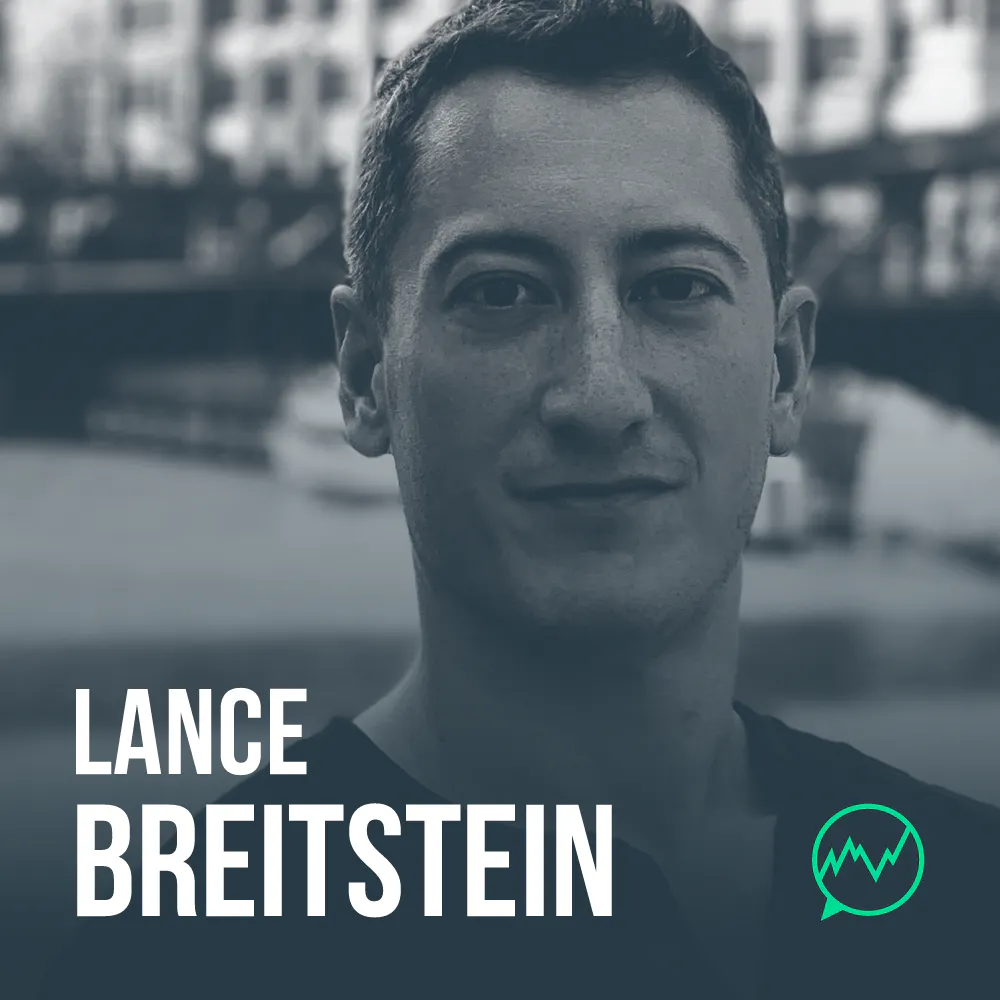
Ladies, gents, I get the feeling this episode is about to be a new favourite for some of you. Welcome to episode 228 featuring Lance Breitstein. Lance was a senior trader at proprietary trading firm Trillium and manager of the Chicago office, a secondary location from its headquarters in New York. He has trained, mentored and refined dozens of top discretionary intraday traders, while arguably being Trillium's best trader in the firm's history. This episode was recorded in 2019 prior to Lance going on to set the firm's all-time P&L record with landslide wins as top trader in both 2020 and 2021 after consecutive eight-figure years. At the beginning of this year though, 2022, Lance resigned from Trillium so he could better focus on alternative growth opportunities and philanthropy.
His resignation also means that we are now able to release this interview after having withheld it at the firm's request. So it's important to note that this podcast solely reflects the views of Lance and is not representative of Trillium's views. Now, before pressing record on this interview, I asked Lance how long did I have him for? He told me he'd blocked out about two and a half hours and I laughed as I was sure that we wouldn't need that long. But sure enough, without any trouble, we went on to speak for over two hours. Therefore, I've decided to split our conversation into two parts here. This is, of course, part one and part two will be released in the coming weeks. So please make sure you subscribe to Chat With Traders wherever you're listening now. That way you won't miss it when it drops and follow me on Twitter too for updates at Chat With Traders.
You may also like to note there will be a part three at some point in the near future as Lance and I have already planned to do another episode to fill the gap between when we recorded this to now. So in this first part, you'll hear Lance speak about his slow start and early development. And one bit that I found particularly interesting was hearing about how he seriously considered giving up on trading. He also goes on to speak about trading around capitulations. Now, although Lance trades various strategies and plays, he's become very good at understanding this market phenomenon.
There's also plenty more packed in, but we're going to get right to it. This man is an absolute weapon, and I'm certain this episode will motivate you to do better. Clear any distractions, get in the zone, listen from beginning to end. Here is Lance Brightstein. Obviously, I know you as the trader you are today, but I know you had quite a long learning curve, so I'm very interested to find out more about that. Just before we go into that too far, just to put some perspective around this, how long have you been trading for today?
Sure. So I believe we're into my ninth year at this point. Okay. Nine years. And it's all been short-term equity trading. Okay. So you never experimented with any other products or any other styles? That's just the first thing you came across?
Yeah, maybe in college I've fooled around with options here and there. I've done some futures on my own and definitely tinkered here and there. But as far as professional career, it's been all focused on just discretionary short-term equity trading. Okay. And those nine years, have they been as a prop trader or were there a couple of years prior to going into prop trading where you were just trading a retail account?
So all prop trading, all with Trillium, where I'm one of those rare people where in college, probably even maybe by my sophomore or junior year, I had never known anything about stocks, but I somehow started to read about it. And the more I read, the more I was like, wow, this is really what I want to do. Kind of the qualities that allows you to excel. I think I have this. And kind of the ethos of the job really lined up for me. And so pretty much right out of college, I worked for Trillium and I've been there ever since, which I think becomes more and more rare these days when people tend to really hop around a lot with careers of all kinds.
Did you have, like going into professional trading, was that something you had intended on doing while you were at college? Or did you have something else in mind and this just sort of came up? I think originally going to school, I knew I wanted to do business for probably no special reason other than it sounded interesting and exciting. And maybe the beginning years, I would have been open to entrepreneurship or maybe accounting or maybe finance or maybe this or that. I can't even tell you the name of the book. Maybe it was something, the little book to stock market investing, something like that. I picked up some book knowing pretty much nothing about the stock market. I'm like, whoa, this sounds kind of cool. How can you take money and just compound it into more money? If you're going to learn a good skill, that seems like the skill to know. And the more I read, I just became a vacuum where it just got me more and more interested and more and more passionate that what the career offered was something I was interested in. And so probably even by my junior and senior year, I was very, very gung-ho. This is what I want. This is what I'm going to go for.
Okay. Well, maybe we should talk about your first 12 months once you recruited out of college and you started at the firm. What did that look like? Sure. So, and I think this is interesting enough, even how I started the way I started is we had a little satellite office in Princeton, New Jersey. And the main office, the main trading floor to this day is in New York City. We've got over a hundred traders on that floor. I'd imagine it's one of the largest prop trading floors.
out there just because the industry is pretty small at this point. And our top trader at the time, who had been top trader for probably 10 years, he had kids and he was tired of the city life. So he opened this little satellite office. And fresh out of school, almost everybody wants to work in New York City. They want the Big Apple. They want the excitement. They want Wall Street. And so our top trader is out in Princeton, and he was willing to take on and train two guys that year. And to me, in my mind, the opportunity to train under
the best trader at the firm and the most winningest I mean to this day from from even 10 years later or so knowing the industry he still might be one of the most winningest day traders I've ever met probably by even a long shot still and so for me to know that that opportunity existed it was no questions asked I want to apply to work in that office I want to work under this guy I don't care about this the city I don't care about the social life all I want to do is give myself the best shot at this job and And incredibly to me, not that many people had applied. Everybody wanted to be in Manhattan. And so from the very start, I had that one track mindset where it was, I don't care about that stuff. I don't care about the glamour of Wall Street. I just care about making it. And so I started at this small, it was almost like a cupboard of an office. The exact opposite of what you think of is this huge glamorous trading floor. It was just me, another guy that started with me and our boss training us.
And essentially, I was living in Princeton, New Jersey. I knew nobody down there. It's not much of a party town. Like, yes, they have the college, but if you're a young professional, you're just alone out there. It's a lot of families. And most people probably would have been driven nuts by it. But for me, that was even more perfect because that just meant I had no distractions. I wasn't distracted by going out, drinking on the weekends. I wasn't distracted by the appeal of trying new restaurants and bars and all sorts of things. For me, it was just that one track obsession of like, let me sacrifice and do everything I can for these first couple of years just to try and...
make it over that learning curve. How helpful was that? Obviously, everyone, as soon as they hear that you were able to train under this guy who's still considered to this day to be just an incredible day trader, maybe one of the best who you've ever met. How much were you able to take on from that? And how helpful was that exercise? That's something I think a lot, think about a lot is what would I have been like under a different trainer? And the truth is you never know. And really what I attribute, certainly what I attribute to him really comes down to two things. First of all, at least at our firm, you get really close mentorship with that
that trainer set up. So he was the person essentially sharing his system with me, why he did what he did. And he was largely essentially just a technical trader. Pure technical analysis and the level of attention and detail that he put into the job because he learned from scratch. He learned within the firm, but he had no mentor like he was himself to me. So much that he was trading through and his system was developed through his own hard work. And I remember even he would just have notebooks upon notebooks upon notebooks of printed out charts. And these charts would be dissected to the smallest detail. He would number all the bars and he would write up the details and the implications of all these nuances. And so at the least...
I have him to thank for a lot of the basics of my lens, because today I do all sorts of trading, but it's all from the lens of technical analysis as well. And all my trades are structured that way. And I view that as essentially the psychology of what what the market is saying about a stock. And so that was beneficial in that I was learning from a big time Michael Jordan. I was just learning his system and seeing it firsthand. But then.
I think also maybe even more important because the reality is within Trillium, everybody has edge and tons of other trainers have edge. But what was very unique was I was essentially sitting next to one of the largest day traders in the industry. And you could see the traits that made him so great. And even simple basic things like if you were up $2,000, you weren't up $2,000. You were just up two. If you had 50,000 shares, it wasn't 50,000. It was just 50. We were thinking in thousands. He would really make sure to train the mind.
without those limiting beliefs. He had the mindset, if somebody else can do it, why can't you? Why can't you get this size? Why can't you be the whale in the market? And even all those, I think probably by the time I started training under him, he must have been maybe 10 years in or so himself, I guess about where I am now. And he still just had that respect for the market, that passion, and was still trying to just say to himself, okay, what can I do better? What can I do with downtime and when it's slow? How can I better things?
Just seeing a freedom of limiting beliefs and seeing the person next to you get size and being able to see somebody make as much money as he did and just say, hey, why can't I be like that? That is almost the most valuable aspect, I think, to a lot of training and the benefit of having that mentorship type training. Do you put it down to like this experience and working under this trader? Is that where, because I know you as a person today, you're very focused on improvement, growth mindset, getting better and better each day. Did you have that mentality to some degree before mentoring under this trader or is he largely responsible for pushing that onto you? I think I always had that mindset to some degree. I was always...
And especially as I've been doing this for a while, I definitely like trading in stocks. But I think my ultimate passion might actually be just self-improvement and kind of optimizing and refining the system that is your own life. And right now, really, you know, I spend so much free time just constantly reading the latest books, the latest literature. It's kind of been like my lifelong obsession. So I would say it always was there. But he definitely.
applied a lot of it to the to the realm of the stock market and and just knowing like the way he would he would systemize different things where if you were to take different plays he would really systemize what is one extreme look like so when is the most just just very basic systemizations for example obviously like liquidity is way better than illiquidity as far as trading goes and if If you're trying to get size in something, a large market cap, more liquid stock is obviously going to be more safe than a lower market cap, illiquid stock. And the same way of using these extremes to really apply to different trades and different chart patterns, he definitely had dissected a lot of that pretty well. So it was really taking that interest and I guess seeing how it can get applied so well to stocks and just trading in general. And I guess the question I was trying to ask you before, but I couldn't really get it out properly, is those first 12 months or however long it was,
Were you profitable fairly quickly because you had access to this particular trader? Like his trading ability, did that rub off on you? Ah, so that's, yeah, that's a good question. I was one of the slowest learners in my class. I did not have a profitable month for my whole first year of trading. Not even close, I don't think. And incredibly enough, despite having access to this learning environment, for various reasons, I was a slow learner. I think naturally, I'm much more of a thinker and more reflective. I'm not good at quick decision making, which is essentially the opposite of day trading and certainly the stuff I do now. And I think it just took me so long to really refine and also learning under him.
was also in a way just drinking out of a fire hose, where here was some guy that was doing so many strategies and processing so many factors and so many nuances, that in order to build up profitable edge at those strategies and incorporate all that, it just took a lot of time. And what was interesting along that path was, and I'm sure much of this was to his frustration, but I was, I intellectually understood everything. The psychology of what he was teaching me made sense, the technical analysis of it all made sense. But... actually executing in real time it just it was just the endless struggle for me and where i think i took things from a learning perspective to the next level and where i think my kind of uniqueness is whereas he had systemized trading i kind of became an expert in almost like meta learning and how to go about learning. And I really took his system and broke down, hey, what's the most effective way for me to learn all this? And once I started systemizing the learning process and thinking about, okay, what's the easiest money out there? Not necessarily the biggest, not necessarily the best money, but what's the easiest layup? What's the most replicable pattern? What's the most replicable play that I've seen a couple of times? Where can I really build my chops on something very, very easy? And once I started systemizing how to go about learning and improving, that's when I really, really took off and things got pretty parabolic for me pretty quickly.
Okay. And how far into your trading career do you think that was? So let me think. So I, I probably, so I was negative every single month for the first year. I then had a couple positive months over the next six months, but then going into that second year milestone. So around the 24 month mark, that's where things started to pick up and I hit my a hundred K milestone. So in our firm.
The 100K milestone, which is net PML, is when they really kind of say, hey, you're no longer a rookie. You're all grown up in our eyes. You're now a man. Little boy became a man. And so it took me two years for that. Now, here's the crazy part. If it took me two years to hit that 100K, within probably two or three months after that, I hit my 200K. And even I think by the end of that calendar year, I was probably putting up 100K months where it really just did scale so quickly for me because I almost equate it to the poker table where...
If you have the fundamentals down and if you've kind of gained edge and you're doing things well, with that edge, adding size and scaling can actually be one of the easiest and fastest parts as long as you kind of stay consistent with strategy. And so for me, it was one of those things where once I built that confidence and got that positive feedback loop, I just took off from there and I never stopped working and I never looked back. Okay, when I sell my business, I want the best tax and investment advice. I want to help my kids and I want to give back to the community. Then it's the vacation of a lifetime.
I wonder if my out-of-office has a forever center. An IG Private Wealth advisor creates the clarity you need with plans that harmonize your business, your family, and your dreams. Get financial advice that puts you at the center. Find your advisor at igprivatewealth.com. Would you contribute some of that rapid growth in P&L to your own confidence as well? As soon as you hit that 100K, it was almost like, or maybe not as soon as you hit the 100K on that day, but as things started to build up, you felt like you became more confident in your own trading ability. Did that play a factor in it or not so much?
Oh, 100%. And I think a lot of people always ask, was there some magic moment or was there some turning point? And some people do have that moment, but it wasn't for me. I think for me, it was each day when you try and improve each day and be that little bit better, you make some small changes. So maybe on one day you avoid that little loss you would have taken. And maybe that next day you're like, oh, I recognize this. You know, last time I made a hundred bucks in this. Now I'm going to try to make 200 or 300. And it's that the aggregation of all those small little changes you make over time that eventually lead to, hey, rather than having a negative $100 day, I made $300 today. And that positive feedback then compounds where then you say to yourself, hey, like.
I remember this pattern and this setup. I made $200 last time. This was great. This was killer. You know what? I'm feeling ballsy today. I'm going to try to size it and really try to make $300. Once you get that confidence, and I think it's true to almost any domain that when you build through small wins, it really does snowball. And then the beauty of sitting next to my trainer was...
You might be getting 200 shares, then the next time you get 400. But then once you start doing it consistently and doing it well, you're looking at the guy right next to you. And when you're popping your chest out because you have 500 shares, the guy next to you is one of the biggest traders on the street. And he has 50,000 shares. And you say to yourself, fuck, I've got so much room to go. I should have really had 1,000. And that really just catapulted things so much quicker when you're sitting next to something like that. And you just see the depth and how far you can take things to the extreme.
And, you know, again, even with online poker, if you start winning it at the $1, $2 table, going to the 510, then the 1020 and the 5100, you can really do that ramp so quickly, especially in trading, because the players don't really get any better. You're playing against the same players, but you're just adding more size. So it's almost easier than in poker to ramp that up, you know, accounting for a slippage and whatnot. That's the only factor. Now, I feel like we might be getting a little bit away from this, but I just want to go back a step because...
When we had spoken prior to this conversation we're having right now, you had mentioned to me that there was a point where you had considered quitting and giving up on becoming a trader. Can you tell us about that moment? Yeah, I definitely started over that. And so essentially for me, back then at our firm, the salary was a measly 26 grand, which is barely enough to keep the roof over your head. I had student loans. I didn't really have...
other sources of money to help fund my living and I think after a certain amount of time you start to ask yourself like hey like I really love this job but I'm putting all this effort into it and I'm not really seeing the light at the end of the tunnel and and you start to have that doubt and start to question yourself and ask can I do this do I have what it takes and it gets a little bit scary because you don't know if you're gonna make it out the other side and that's especially with retail traders I think that's what can be so dangerous and so tough is how much time and money do you invest into into your passion and The reality is life has an opportunity cost. I turned down a job at a top bulge bracket bank, sales and trading. I would have been in New York City earning six figures a year right out of school. Life would have been great. And there I was just alone in Princeton, just blood, sweat, and tears, putting every hour of every day and just every breath and thought into trading. And after a year, when you're at the back of the class and you're saying to yourself,
man, like maybe like my heart's in the right place, but I just don't have what it takes. And I think, I think it's a rational, real conversation. You know, you gotta be, you gotta be a nut job at some point to just not question things when, when you don't see any results. And when you put, I've never worked like that before. And I've never, I've never struggled like I did. School came easy to me. Any struggles in school, if I just studied a bit, I'd ace all the exams. And if I, whatever the case may be, I had never really.
hit a brick wall like that where I was just towards the back of the class at something. And so sure enough, I was reaching out to my contacts and I was interviewing at other places. I think I interviewed at like D.E. Shaw and some other firm I don't remember. And thank God those places didn't give me a job. Thank God I botched the interview somewhere because that would have been the worst mistake of my life had I left. And so many people do ask, like, when do you give up? And I think the big differentiator with myself was even though...
I was not making P&L. I intellectually understood things and I was still making progress. I was just making progress at a slow pace. And as one of my favorite books, Atomic Habits, would say, it's like that boiling pot of water. You might be applying all this energy and all this heat and that water is heating up, but it's only until it really reaches that breaking point where it starts to boil and you can't really see that underneath the surface. So I think sometimes you just need to go by the fact of, is this what I love? And do I at least see enough progress and set very small, discrete goals? And it was one of those things where, as I was interviewing,
In the spring of that next year, I was speaking to some of the other guys in my group, some of my other friends. I was like, what do you think? And a couple guys were like, trust me, just stick with it. I can tell you get it. I can tell you get it. It's going to be a big mistake if you leave. Like maybe just set some time stops. Hey, maybe if I don't do X by the second year, I'm going to be out. Or if I don't have a couple positive months by two years in, I'm going to be out. And so I think somewhere I started to, I was definitely on the ledge where I was interviewing and I was setting that stopper. It's like, hey, if two years in, I don't have some positive months and some glimmers.
As much as it will break my heart, I got to go. And sure enough, in that spring while I was interviewing, there was this technical pattern that my boss just loves. It's kind of like, it was just essentially an exhaustion gap. And he's super nuanced about which ones he gets involved in. And this was one of those like just once a year, twice a year plays where the pattern was so perfect. And pretty much it was something I'd seen a couple times. And I just piggybacked with my boss. And I understood the pattern. I saw the pattern. And that was the first time where I really executed for size.
And I think a normal day for me, a good day, a good day was probably one grand. And I think I maybe put up like 11 grand that day. And I just said, holy shit, like I can do this. Like I really can do this. Even if this only happens a couple times a year, I can add size to this and I can replicate and do this. And that if there was any turning moment for me, I guess it was that trade where.
it was good enough and it was slow enough that I could process and I could connect the dots. And I just knew like this, this is a really good setup. And I just put the size behind it. And I just knew like, Lance, you might not have that much time left. Like this might be one of the best things you see in your limited months left. And if you love this, like now's the time to just swing hard. And that really did buy me a lot of breathing room for sure. Do you think if those two years had come and you hadn't put up a few positive months, as you mentioned, that you would have left? Yeah, I think I would have had to because...
I love trading, but you can also scratch that itch at other jobs. And I think there was a very real fear where you have retail traders or other traders or all sorts of people or even entrepreneurs, because I was also interested in entrepreneurship, where you see people with massive opportunity costs sinking in their time and money. And you need to stop, much like any trade. A trade is a decision of risk and reward. It's a very dynamic calculation, right? The risk is always changing. Your opportunity cost is always changing that potential reward. But most importantly, the probability of success is always changing. And so when I started that job, my probability of success, you know, it's biased. Every single person, when we start with the class of 25 people, every single one of them knows the odds of success. And every single one of them thinks by definition of them being there, they're going to be the one that succeeds. But mathematically, it's impossible. And so I was one of those people, too, that said, oh, look, yeah, I know everyone fails, but I'm different. I'm going to work harder. I'm going to be more competitive.
I'm as smart as anybody. And it was one of those things where over time, when you have zero positive months, your internally assessed probability of success has got to be going down. And I think I was definitely getting close to that point where, hey, my probability of success is so low that I don't think the risk outweighs the rewards. And there was a huge social cost in that I was just sacrificing all my time and energy. I wasn't having fun outside of work. I wasn't making friends. I wasn't living in a city. I had student loan debt. My family definitely needed money and needed help.
Um, so I was, yeah, I was probably as close to pulling the trigger as, as you could have been. And, um, yeah, it's, it's just honestly a miracle that things panned out well enough to, to go from, from where I was to where I am now. Yeah. Luck, call it luck, hard work, the mixture of the above, but yeah, it was things worked out well for how they did. It's very interesting to hear about this because it's something we don't really talk about much actually and I'm just thinking back to previous episodes and I can't even really think about when we've talked about when is it the right decision to give up on trading because often we think about throwing in the towel as often like accepting failure, accepting defeat, walking away. So it's interesting to hear how you deal with these thoughts and how you managed it.
Yeah, and I think it's a huge issue that whether it's entrepreneurship or trading, you just have such major selection bias. By definition, anybody on your podcast is one of the 0.1% that has succeeded at one of the most competitive, difficult industries in existence. And the voices that aren't heard, whether in this or in entrepreneurship, are the other 999 out of 1,000 people that might have blown their savings or might have wasted years upon years or might have gone into debt chasing after their entrepreneurship dream or their trading dream. I don't know if most people are aware of how that selection bias, how real it is. It was something I definitely was aware of as being somebody that just loves behavioral psychology and took the behavioral psychology classes in school and stuff. I knew that one of the most basic biases is people themselves don't think they're affected by biases. If you ask somebody, did you overestimate your probability of success?
at t equals zero, everybody will be like, hell no, of course I'm not overestimating my chance of success. This is truly what I think. But like I said, if say four out of 25 might make it, you have 25 people saying that they're going to be those four. So it's always something to be mindful of, that our weak, feeble human minds just aren't good at processing. And I think the other thing that's interesting is with the length of the learning curve, you can tell a candidate, now that I interview and I oversee and I train people, you can tell a candidate, so explicitly the learning curve will be 18 to 24 months you can say the learning the failure rate will be x the learning curve will be y and no matter how many times they say oh yeah got it totally totally understood yeah totally i'm gonna give it two years perfect when people are in the trenches and and not having positive months and they're frustrated and they're losing they're making the same mistake and you get that jerk off lance being like come on man like that's the same mistake like we got to improve like how can we do better with this and and you're putting in that effort and you're not seeing that improvement
that two year learning curve seems so intangible and so far off. But when you're in the trenches at month nine or month 12 or month 13, you start banging your head against the wall and you start saying like, holy shit, like I know what I signed up for, but man, I didn't think it would be like this just because it is so intangible to see what frustration can build over that time. And nobody truly grasps that they're going to be that person struggling. They're going to be, even if you win and even if you make it, it's going to be a struggle. Trading is never easy, no matter who you are. It's never easy.
You mentioned biases there and it just made me think of this episode I did quite a while ago. It must have been a couple of years back. And it was called, You Don't Know How Wrong You Are. And it was all about different biases, which our human minds can be vulnerable to. So if someone is interested in that, I'll put a link to that in the show notes. Yeah, there's also been, what's her name? I think Annie Dukes is her name. She was like the poker player and she wrote Thinking and Bets. That's another really great book that touches on the same subject. Okay, okay. Yeah, I've not read that.
Yeah, that's a good one. I mean, that behavioral finance stuff and just behavioral psychology is so fascinating to me. Now, Lance, we have a mutual friend and whenever your name comes up, it's normally followed by the capitulation trader. So I've become to know you as this gun trader who goes after capitulations and does a great job of making money from them. So I'd love to just sort of dig into this a little bit and find out a bit more. First thing, how did you come to discover you had a talent for trading capitulations?
And also, what is a capitulation, just for anyone who might not be aware of the terminology? Sure. So I would define capitulation just as a real flush out or like a panic or vice versa to the upside, a real euphoric. You can have an upside or a downside capitulation. It's just anything that really flushes out one way or the other. So a lot of my strategy in this came, of course, just from my trainer. And it was something he specialized in. And so what makes capitulation so, so interesting is, and this will get a little bit conceptual, but
it's very hard to necessarily know what will trend because there's essentially two things. You can either go with the trend or you can go and do mean reversion. In my view, as far as the prop world, if you're not making markets, you're not doing some weird quant strategy, if you're essentially a discretionary human day trader, you either need to be going with the trend and systemizing why do trends occur, where do they occur, how do you structure the trade, how do you identify these patterns, or the other option, and I know this is simplifying, it's not just these two areas, but trend following or then. mean reversion, when things aren't trending but are reverting back towards some form of previous equilibrium. And it's very, very hard to know with any asset class what might trend. You need to be very proactive to identify that. But a capitulation, when something really panics or really, really flushes out, you don't need to be figuring out ahead of time what that's going to happen. So for example, if you asked me when Bitcoin was sitting around $300, $400 for all those years, if you asked me, is this going to trend to $20,000 for Bitcoin or whatever it did, I would have had no freaking clue. And I don't think anybody would have had any clue. And yeah, people might have had a view, but to tell you that they can be confident that this was going to trend to $20,000.
uh they're just they're just lying and so trends are hard to identify ahead of time with with high confidence but when that started to go euphoric um or even taking the dot-com bubble or any of these bubbles or even any of these crashes a lot of the beauty of capitulation is you have a lot of qualities that are all the same. And so capitulation will be an extremely rapid exponential change in price over time. Capitulation will have huge volume and huge turnover. There will be a huge recycling of just where the average price is. If the average price for many years in Bitcoin had been $300, when all of a sudden we go so euphoric and everyday Bitcoin's everywhere and every single person on the street, people that have never had any interest are trying to figure out how to buy Bitcoin, all of a sudden you have the original believers that own it from $300 doing massive, massive, massive volume turnover at $22,000 or $20,000 or whatever it was.
And now, all of a sudden, the average price of the weak hands, it isn't $300 anymore or $1,000 or $3,000 or $5,000. All of a sudden, you get such a massive volume turnover that the average price is $20,000 per Bitcoin, and it's all in weak hands. It's people that aren't true believers. It's people like your 74-year-old grandmother selling her home to buy Bitcoins, thinking, oh, I'm going to become a Bitcoin billionaire by the age of 76. So while it's hard to predict, and it's just a fact, nobody could have predicted that that was going to occur with certainty. But when it does occur, you can identify those qualities and be reactive. You know, I didn't need to predict that Bitcoin would go euphoric, but I can then spot those qualities as it's happening. So that's what I think the beauty of capitulation is, is whether it's the dot-com bubble or a panic in an individual stock or a sector, you can be reactive and go to where the puck is. You know, I don't need to know what the trend will be.
or what the asset class or what the ticker or what the sector is going to trend your panic and then flush out. But when it does, you can move there. That is why I think, especially having our technical analysis lens, it makes us so effective because we can apply our system, our lens of viewing price action and price over time and apply it to virtually anything. So if there's a chart of Bitcoin or there's a chart of oil or there's a chart for XYZ widget company or Apple or gold or silver, if those capitulate and have a huge volume flush out, I can jump to that and trade it in the same way in the same system because the technical analysis is simply just a way of showing that psychology and price over time is such just a very powerful.
It's just such a very powerful measure. You know, if you spend weeks or months with investors or day traders paying one price for this, then with no fundamental change, all of a sudden they're paying a grossly different price. Yeah, it's probably worth paying some attention to. And I think what made me so good at it was especially now bring this all in back to stock specifics is, again, going back to a lot of the nuances. And I guess not really probably hide anything too secret, but like, or at least expose anything too secret. But obviously, the more boring something is, the more appealing that is. Yeah, Bitcoin, nobody really knows what the price of a Bitcoin should be. It's essentially a social construct. I can't tell you what the intrinsic value is. But for example, if something like...
So let's move into something like oil. Oil at least has an intrinsic use. So, yeah, the market might disagree on the price of oil. But at the end of the day, there's still a physical purpose for oil where refiners need to buy it. And there are end products that will eventually tie that in some way to the intrinsic price. And so when you move too far away from that price and then go too quickly, the more boring, the more the less the volatility of an instrument normally is, the more you can kind of say with confidence, hey, like this move is a little bit crazy. You know, imagine or take that even to to some of the volatility in.
in 30-year treasuries this year. And even if it was in March or April or something, that was definitely a very capitulatory-esque move to the upside, where everybody all of a sudden was afraid of deflation and slowing economy, and everybody all of a sudden was buying bonds. And a bond is something where you can calculate the value. It's much more intrinsic. You know at the end of those 30 years, you're going to be getting your $100 principal back, your $1,000 principal. And so really systemizing those nuances and being able to say like,
okay, something more boring that's panicking is better. Or being able to say like, hey, Apple is a much more safe panic than this stage one biotech that nobody knows anything about. If Apple, say at $200 per share, were to go to $100 per share, I'd imagine Uncle Buffett would be sitting there on the bid. So if I buy it 100 bucks, he'd be willing to buy it 120, 130, 140, 150. And that can't be said for that sketchy illiquid stage one biotech. And so that thinking and that systemization of taking those extremes is a lot of how we kind of build.
any of our plays or any of our strategies by using just that systemization of all those nuances. And that can even be applied to what is the best stock chart? You know, what is the best intraday chart look like? What is the best daily chart look like? What is the best capitulation on the level two box look like? So all those factors are ways you can start to really systemize these plays. OK, when I sell my business, I want the best tax and investment advice. I want to help the kids and I want to give back to the community. Then it's the vacation of a lifetime. I wonder if my out of office has a forever center.
So these few examples which you've referred to here, it sounds as though most of these are on like sort of zooming out, looking at the overall bigger picture of where this stock or this product is traded. Maybe on a daily or even a weekly chart, these things might be identifiable. But the capitulation trades which you're going after, are these mostly happening on an intraday timeframe? Yes. So that's also the beauty of technical analysis is essentially all the concepts apply across all timeframes, in my personal opinion. And so the same way that Apple most likely will be less volatile over the course of a year, it should also be less volatile on a monthly chart or a daily chart or an intraday chart. And so what we do is we'll apply all these concepts at the intraday level. I guess you may have already kind of gone over this, but just so we're clear.
And maybe on an intranet basis, how do you differentiate a seal down versus a capitulation? Like what do you need to see to separate the two? Sure. And so I probably won't want to go into too much detail, but I think certainly like the more signs of just pure... just pure panic, the better, right? Because essentially when you're doing mean reversion or when you're buying into any panic, you're essentially assuming, hey, people are scared and that emotion or that maybe people are forced to liquidate or maybe people are panicking or maybe stops are going off. All these factors can contribute to the severity of a panic. And obviously something, if Apple goes from
$200 to $199 over the course of a day, that's not much of a panic. But if Apple goes from say $300 to $295 or $290 in the course of five minutes or six minutes and a trillion dollar company essentially loses 4% of its enterprise value in a few minutes, that's more what we're talking about. And the question is then, when you get, how can you start to find indicators and measures and systemize and structure how you judge the severity of that move? And then, of course, you not only need to identify like, whoa, this is capitulatory, like this is a huge flush out, you know, whether it's volume or price over time, regardless of all those variables, you still need to know how to structure it safely in your system. Because if you buy Apple at $290, thinking, oh, my God, Apple just moved 3%. Uncle Buffett, come bail me out, baby. And all of a sudden, next minute later, Apple's at 280. You might be the one capitulating next because it's so far past your stop. So I think the question is, how do you identify these traits and these qualities that signal to you an inefficient price and a panic and emotion and whatnot? But then also, how do you structure that within a system that works for you?
Obviously, I don't want to pry too much. I understand you're already sharing a lot with us. I guess one of the interesting things about these types of plays is that what you're really doing is you're standing up in front of a lot of aggressive selling and having the confidence to buy something. I mean, where does that confidence come from? How are you able to step up? What's the point where you are willing to get involved? Sure. So that's actually a great question. And that also times into when do you know you're wrong and when do you know you need to get out?
Probably one of probably my trainer's biggest weakness was there were also times where he didn't leave flexibility to be wrong. You know, where sometimes when you're the whale, you don't have, you know, if you're the whale and you're wrong, then you're about to get run over. And that's when risk management needs to come into play. And so that I think implicit in that question is almost where the edge comes from, because most of the amateurs in these moves, most of these people are panicking and it is scary. And that effectively is the emotional edge.
That emotional fortitude to say, no, this is crazy. This is a little bit nuts. That is exactly where the edge comes from. So with enough training and enough experience, when you've gone through these, and I can't stress enough the importance of repetition. And so much of what I do to get better at anything is get the reps in and process everything. Because you can prepare for almost anything in life. Yeah, any given situation will have different nuances. It will be a different ticker, a different intraday, a different daily chart, a different box. So it will always be differences, but it will always rhyme as well. And there will always be analogies you can make. And by seeing enough reps, you start to have...
the training and override your emotions. When you're six months into the job or a year into the job, when you buy into that panic, you have that knot in your stomach and your P&L is going down. And even then, you're only down $100, down $200. It's nothing back then. And you feel it in your stomach and you say, holy shit, what did I do? I'm wrong. What's going on?
With enough training, though, you build that confidence where, you know, when you feel that in your stomach, you start when you feel that not in your stomach, you start licking your lips because, you know, hey, if I'm the whale in this and if I feel that not and I'm scared to death, guess what? That average fund manager, that average chump on the street, they are shitting their pants right now. And that's going to be really, really good for me. And so I think implicit in that scariness is the opportunity that can make you so, so confident. The bigger and more severe the panic or the euphoria, whether it's dotcom bubble or Bitcoin or whatever you want to call it.
If you have the experience to back your action and you know this is actually crazy and this is irrational, that's how you have that confidence. And obviously you start small, but over time you can use those indicators and even emotional indicators. Unlike a computer, a computer can't feel fear. And sometimes feeling that fear is a huge advantage because when you know yourself as a professional, especially as you build more experience and more reps than other people on the street, you know that, hey, I'm happy. I enjoy this feeling. I enjoy this panic because I know.
Uh, that's, what's giving me this edge because everyone else is, if I'm scared, they're more scared. So I'm, I'm going to, I'm going to like this a lot in the end. Um, of course that all always needs to overlap with, with the proper risk management, but getting those reps in and understanding, even just understanding conceptually that buying into that panic, that that essentially is your edge gives you the confidence to know, like, this isn't supposed to feel good. This isn't supposed to feel right. And by the nature.
of the job that's almost what makes you the professional is you know that hey this doesn't feel comfortable for anybody but i'm the pro and i'm going to uh perform in this situation as a result does that kind of like address that yeah 100 absolutely that was a brilliant answer do you feel as though this is would you consider this to be a high risk trade considering some of the other opportunities that a reasonably professional day trader may go after standing up in front of capitulations is that Would you categorize that as a high risk type of trade? Because I presume often in situations like this, liquidity, especially like bids behind you, if there's a capitulation to the downside, often thin out, which extends these capitulations and the rapidness of these moves. You're stepping in buying a lot of size. If you don't time this right and you're getting in at the wrong point and you have to bail on that position, that's just going to extend this move even further to the downside. I know that plays in with the risk management and that type of thing. But yeah, do you consider this to be a high risk type of play?
So I'm going to answer that with a great quote from my trainer. Sometimes it is safest to be risky. And I think that is a very, very powerful saying. If something is so, so, so scary that nobody wants to step in front of it, I would argue that stepping in front of it is one of the safest things you can ever do, potentially. I mean, take, for example, not that I was trading during the height of the panic, but there's times, and we'll see this in the market today, there can be times when there's a very boring security, and maybe even it's a preferred debt-type security with even a calculatable value, or maybe it's a closed-end fund, a closed-end fund with a set net asset value, where in theory they could liquidate themselves, get that asset value, and distribute it to the shareholders.
Some of these things might panic. And so I would turn that question back to you. And let's say the price of, not the price, but the intrinsic value of a stock is $10. The intrinsic value, not the price. And that stock goes from $10 to $9.
Then, so your reward is a dollar. Now let's take the extreme and say it goes to $5. You know, oh my God, is this going bankrupt? But the intrinsic value, people are just panicking. Intrinsic value is still $10. At $5, your reward is actually a whopping 100%. You can make $5 while risking also $5 if it goes to zero. But now let's say this, and this is all just hypothetical, of course, but let's say this is a rip your face off panic. Holy crap, I bought it at five. Oh my God, it's still going down. I must be wrong. Maybe this thing is going to zero after all. So all of a sudden you can now buy the same security at $1.
A lot of people will define buying at one dollar as extremely risky because it's so volatile. The stock price went from 10 to nine to five. Now we're at one. Oh, my God, it's so volatile. It's so risky. Oh, no, no. But actually buying at one dollar is the safest investment you could ever make. Your potential reward is now nine dollars. You can make nine hundred percent return and your risk is only one dollar. So at the peak of that panic, when things are truly capitulating.
risk is actually the least. Your reward is highest at peak panic and your risk of there being an incremental seller at peak panic is so low. And the probability of at least some type of bounce approaches nearly 100% eventually. And so... So volatility is actually maximized. But I would argue that risk is actually minimized. And it's actually the safest thing you can do, if that kind of makes sense. And I think that's almost one of the ultimate paradoxes of some of this stuff. And I think that's why some of the true value investors, like a Howard Marks or a Warren Buffett, the most famous wealth compounders of our time, really, I think that's why they're so great is because, yeah, they're on a different time frame. They're not an intraday trader. They're obviously long-term value investors. But they recognize that at peak panics when everyone's scared and things are most volatile.
It's true that volatility is peak, but that's when they want to buy. That's the safest time. You know, it's not safe to buy things that are just sitting at elevated levels. It's not safe to buy in 2007. It's not safe to buy in 2008. It's safe to buy at the peak of the fall 2008 when things are going for pennies on a dollar and you have secured debt trading for pennies on a dollar and you have stuff not even related to the financial sector trading for pennies on a dollar. So everything's capitulating, but that's the safest opportunity to buy anything of the last two decades, essentially, if that really gets to the heart of it, I think.
Just in your example, then you spoke about intrinsic value of a stock. I mean, where does that intrinsic value actually come from? Sure. So let's even bring that back to day trading world, because I guess that's what we really care about. And intrinsic value, we'll never know. As a day trader, I'm the last person ever from being an analyst. I don't care much about any fundamental analysis whatsoever. I'll try to know the basics, but I'm only an inch deep on a mile wide.
It's not so important to know the intrinsic value because nobody really knows the intrinsic value of much of anything But in day trading world what there can be or in any trading world is there can be equilibrium and consolidation and acceptance of price and so let's take the market for Corvettes if all of a sudden You know, Corvettes trade for $50,000, $50,000. And for the last seven days, Corvettes have sold for $50,000 and we have 10,000 data points. You can graph that on a chart and essentially you have an equilibrium. So if all of a sudden I'm able to buy a Corvette with nothing wrong with it and all of a sudden there's no fundamental news about the Corvette I'm buying, then if I can get it for $45,000 or $43,000, that's at a discount and I want to do that. And I don't know the true intrinsic value, but I do know where the market's agreed upon for a long while. And the same way where Warren Buffett himself can't give you a value of Apple.
But if Apple's traded at $300 for the last five hours or five days or five months, then all of a sudden, two minutes later, I can buy Apple at $2.95. Guess what? I'm buying Apple at a percent and a half discount, all things being held equal. And we have a very clear equilibrium. So that's the type of thing that will interest me. Okay. Gotcha. Gotcha. Lance, I think a good question to ask you around these trades, just before we move on to something else, would be, what have you intentionally done to get better at these trades? Obviously, these trades, I'm sure, make up a big percentage of your P&L at the end of the year.
and it's something that you've really tried to develop and improve on, what are the things you've intentionally done to get there? Sure. And I think this kind of goes back to my obsession with meta-learning, maybe just the art of how can I go about efficiently getting better. And I think a lot of what the literature tells us is you really want to have deliberate practice, deliberate reflection, and systematically go about each part of the job building reps. So the example I always give my trainees is there's going to be the person that...
You know, if you take two traders, one trader sits in the seat during market hours and say that during the course of the week, they put in 50 hours. You can have another trader that puts in 50 hours, but it's not just about the hours, right? It's about the quality of those. Who's the person that's just sitting brainless typing up tickers all day, you know, looking at charts, but not really doing any deep reflection. That's going to be way, way, way different from the trader spending those same hours, but is going to the right stock selection and is studying those stocks in depth and writing them up in depth. And those couple of great plays a day, you need to really systemize those. And maybe you need to rewatch tape or maybe you need to.
Systemize the pros of the trade. Systemize the cons of the trade. Find analogies to what other trades it reminds you of. It's going to be such a different learning factor when you're the person... doing all those factors and incorporating all those different types of learning versus the person that's just the body in the chair. So I think with anything, the best example is if you were to take two people trying to learn basketball, and they've done these studies before, and you'd have them take 10 free throw shots. The person that takes 10 shots and doesn't reflect, he doesn't really get that much better that quickly. But if you have somebody take 10 shots, and after each shot, he writes down how he missed, oh, I went left, or oh, I was a little bit short, I went right. The person that writes down where their shot missed,
and then tries to make corrective action with the next shot, the rate of learning is just exponentially higher. And so those same concepts I try to apply to learning the trades. And even with my trainees, I try to make their... their learning as optimal as possible, which really comes down to studying the best opportunities, the easiest opportunities, making it as realistic for them to practice them again and again and again. If it's a slow week, for example, you might only get maybe three or four good plays to study. But if you build a database of great plays that have occurred in the past, you don't need to be limited to those three or four plays per week. You can restudy and even visualize and mentally rehearse trading 40 or 50 plays, and you're effectively getting 10 times the reps per week as somebody else. So I'm one of those people where with my trainees,
It's not about just your time at the seat. Time in the seat counts, but we want to be as productive as possible, getting the most reps on the most important plays. And that's something that I think is applicable to really any area of proficiency that you're trying to develop. Maybe we can go into this a little more because the basketball analogy was interesting. But I think in markets...
You've reached the end of this episode of Chat with Traders, but rest assured, there are more episodes loaded with real market insight and zero hype on the way soon. So to stay updated with each great new release, subscribe to the podcast on iTunes, and we'd love it if you'd leave a rating and review. We'll catch you next time on Chat with Traders.