Hi, welcome to classical stuff. You should know a podcast about classical stuff. It's worth knowing that we talk about. I was pressing record.
That's what I mean, what else do you want to say? We talk about old books, old ideas, classical education. Are we ever getting to the right, like, six years in, that's just one of these days. Hey, this is probably longer, right?
This is good. This is all right. My name is Graham Donaldson, and I am joined by Thomas Megby and A.J. Hanneberg.
And we've been out of the saddle for a while, boys. This is like our third week without having an episode, just from various life things. I was like, what was it, was it two? Yeah, just two.
I got sick. I got a episode. We had it in the intern, didn't we? I don't know, I can't remember.
I thought it was three, but it's been a while, but we're back. And we're talking about beautiful people, but with cognitive issues, is that what's going on? I don't like that at all. We're talking about thought experiments.
We're talking about thought experiments. Oh, I thought it was mental models. It's like, I'm not saying that. I thought by a track of girls, you met thoughts.
I was trying to figure out what the thoughts were meant as. When you were trying to pick up line on a thought, you know what I mean? You know what I mean? That's what I was trying to put the joke together.
It was really cool. I thought your episode was on mental models. So anyway, but it's similar. Same kind of feel.
Yeah, yeah. It's the same kind of feel thought experience. Thought experience. I'm going to giggle this whole episode.
I feel like that'd be a great Reddit channel or something. Thought experience. Or if you were like a beautiful scientist, you had a podcast. You had a podcast.
You grew up kind of ratchet. Speaking of ratchet, I don't know. This episode is more kind of a grab bag of just listening to some of our previous episodes, things that have come up that maybe we haven't gone into. I want to cover just some like famous thought experiments from like ancient thought.
And I hope that you're thinking that every single time I say that. I'm thinking about an ancient thought. An ancient thought is exactly right. We saw an ancient thought.
One that you showed us a gram in one of your episodes, like the white tomb. She was like the choice of looking. And we looked at it. Oh.
She's not that good looking from looking at it. Yeah, it was one of the Dilipole. We have Petra. No, I know what you're saying.
Yeah, I can't remember. Yeah. So I guess to go into a topic on, I'm going to regret saying this every time I do thought experiments, which I guess we've already defined. Let's...
I feel like Tommy. You did spell your copy. This episode is going to go so poorly. And I'm very good.
Sorry. I'm sorry. I'm sorry. I'm sorry.
I've been through this before. I know what I deserve. Okay. I can't do that.
I need a paper on this card. I'm not going to do that. I'm going to read it from here. I want to get a definition of this term.
Do you all have any definition for what I... I want to say thought experiment. What do you think of? A scenario that's supposed to...
I think you're going to be all serious with this. A scenario is supposed to, like, educate or maybe enlighten on a particular point. Maybe a hypothetical that you can't really put into practice in real life. An experiment that you can actually do.
Yeah. Yeah. You're getting like all the reasons these things exist. They're...
Hypothetical is a good way of describing it. And in terms of their... of the term thought experiment being codified, there are a bunch of people that point a late 19th century. this philosopher Ernest Mach, I think also physicist.
Gottenkin experiment is his German term that is translated to thought experiments. He makes sense of these experiences. Because a lot of physics problems usually start as thought experiments. Imagine you're in a world without friction.
You're like, OK, cool. That's all sorts of things. Let's take that as a balanced one Earth on another Earth. But for the things that both of you all are saying, you make this sound like a bad approach or a bad way of doing things.
I didn't intend to. But is there use in the use of these thought experiments? Or are they just purely these hypotheticals that they're so the set up is so fake as to be useless? No, because usually if so, they are in the early physics experiment, imagine a world without friction.
You're doing that because you're trying to teach a physics concept to a student. And you want to remove that variable that's just going to make it more complicated. You want to teach them the whatever, if you're doing a lesson on force, you're doing a lesson on gravity or whatever. You don't want to have wind resistance throwing off all of your calculations.
So you're just like, all right, remove friction from this. So no, that's incredibly helpful. It's just like, in that sense, it's simplifying. Is it most physics partially done in thought experiment conditions?
You have to do it sort of in a vacuum anyway, because there's all kinds of tiny forces acting on the things that you're doing? I know you didn't mean to joke, but in a vacuum is very funny for our physics, the thought experiments, because you remove these outside. That's on top of it, in a vacuum, literally. I mean, like, actually, in a vacuum, which then makes it you're oversimplifying, but it allows you to actually make this point.
It also lets you do things that you, like I said, you couldn't actually do. For example, maybe I'm giving some away, but Plato's Republic. You can't found a new city on a whim, just to test out your philosophy, but you can think, OK, what is the best way to put a city together? I've done this with my reading group.
I said, all right, what is the best organization of government if you have to start from nothing? And they landed on something very similar to the current Israeli system, right, with kibbutzism, that sort of thing. And mandatory military service. Let's follow with you.
You brought up Plato's Republic, those episodes have been a while since we've done those. What is Plato's approach there? What is he doing? The goal of Plato's Republic is to find out if it is better to actually be just, but have a reputation for injustice, or be unjust, and have a reputation for justice, like is justice worth having on its own, or is it only for the appearance of things?
And to figure that out, he sort of zooms out and says, OK, well, what is justice in a city? And then he puts together what he imagines is the perfect city, Plato's Republic. Like, what is the perfect system of government with perfect citizens? And then through that, trying to discover if justice is good in the person and in the person alone.
And ultimately comes to this conclusion of, like, yeah, bro. But it's all through, what do you call that of thought experiment? What is being done in the world? Well, it's not actually creating a city, so yes.
OK, but they're still able to kind of have disagreement as to whether Plato's approach is correct, right? They're still kind of back and forth going on there. I was wondering if there's something you've, like, you know, because someone say, because you haven't actually built it, you don't know if this would actually work, that there's kind of a fakeness to it. Or you kind of assume the conclusion by starting.
The guy who's arguing it is the one giving you the thought experiment. Therefore, he kind of gets to his conclusion early. Sometimes they're also famous thought experiments that don't really have an answer, right? The trolley.
The trolley's one. You have trolley experiment. There's a few of those. But yeah, I would say that the results are never final or completed.
Would that be a fair thing to say? Yes. You can actually do the experiment. You can never actually point to concrete results.
Or you won't be able to do it for a very long time. So a famous early one is Galileo's wanting to figure out. If you drop two things from a tall place, do they drop at the same speed or at different speeds? And you need there to be, you want to reduce the impact of wind resistance, right?
Because that'll change your outcome. But so you need to be on the moon to be able to actually test whether dropping two things at different masses. And they fall at the same speed. But you can come up with an analogy to reason about it before you can actually get into that vacuum environment the way that you're talking about.
It's an abstraction. And a thought experiment has assumptions built to it. And the assumption is we can abstract reality into a theoretical place. And we can run what we think is going to happen in that theoretical place using logic in first principles.
And then when we take the conclusions from that theoretical place and then plug it into reality, we should get the same kind of thing. But that's a pretty big assumption. It doesn't necessarily work that way. So I know for a fact, this is not where you're going with this.
But the idea of having an idea of how you want your team to play a certain sport, like a tactic. This is how I want 10 players on a soccer pitch to play the game. I have a philosophy of how the game is going to be played. And then actually putting the ball to those guys.
And they may have the model in their head as well. Coach wants us to play in this certain way. But then the reality of that doesn't necessarily play that way because you have all of these uncalculable factors of the real world that is almost impossible to model or incredibly difficult to model. But there's still value in coming up with that for the first place, right?
But so I mean, there's a big sort of philosophical difference between those who really want to have, I'll use soccer as an example, have these passages of play that are modelled out. So you have some coaches that almost want to train robots to play the game. And when this happens, this is what you do, and when this happens, what this is what you do, and they want to have complete control over how the game is played. Versus you have, for example, the very famous Brazilian way of playing the game, which is like they almost don't go out with the plan, at least.
And they just sort of rely on almost the relationships between the players to have this emergent way of playing the game as opposed to a modelled way of playing the game. So you have these competing models of one that's sort of like, almost coming from Greek philosophy of abstracting ideas and working on them on the mental plane and then trying to put them back into reality. And then you have this more emergent way of playing the game, which is we can't model all these things, go out and play the game, and react to the world as it comes to you. And so they don't have this modelled way of playing the game.
And then you get two different ways of playing soccer. So one thing is one is more fragile. You almost need everybody, for the first one, for the modelled, for the controlled version of the game, you need everybody on board to do it, or the whole thing falls apart. Whereas the other one is a little bit more organic and a little bit more like it can repair itself if it starts to go wrong in the situation, whereas if everybody is playing the game a certain way and it's not working and they're just going to keep playing that way, you could get blown out 8-0.
But when it works really well, and everyone's playing on the same way, it's almost impossible to beat. So you get these examples like the German national team who played amazingly well together on this very modelled way of playing, destroying Brazil and I think the 2010 World Cup 8-1, and people were like, well, this is the new change. It's now we're in the world of this sort of like modelled passage of play, and then that happens for a while and then the pendulum swings the other way. So I don't know, I feel like doing things, like mentally modeling things can get you real far, but then AJ is right and saying, hey, you tried to put that city into reality and good luck in between your middle and middle and middle.
Exactly, five years into it and the whole thing is like completely blown apart because of all these factors that you couldn't figure into your model. Because you're breeding humans like cattle and not letting them have parents. Exactly, yeah. So yeah, again, to maybe eight days point before there are all kinds of reasons you can't do the thought experiment.
Some of them would be ethical reasons that you should not create the city that's being described. But Plato's still able to make this argument as to how the it's how the person should be constituted, but it's like through an analogy, it's a thought experiment via analogy. Person is like the city. Yes.
And then this is how that city could be run. And then that's where we get into all that. So he's still able to make an argument. You can never actually do the thing that he's proposing.
I guess we'll go into actual thought experiments in a second. But kind of behind all this is like, I just think the move toward positivism or empiricism is just like so strong that there's kind of, I feel like I distrust the approach of thinking through the problem, coming up with a hypothetical, even the term hypothetical almost has a negative connotation of you haven't actually tried it. You don't actually have experiment to support it. It's just something you've thought about.
But I wasn't sure if you all had that same connotation with that. Maybe not. Is this that like that Francis Bacon? I mean, anyway, whatever.
We can move on. Is there a quote? No, it's just he was always seen as kind of like the father of like not empiricism, but he's the once you have knowledge of something you have power over that thing. And he really is the beginning of that early enlightenment or mid enlightenment.
If we can just gather all of the data and we have it, we can now create a better world based on sort of abstracted models of things, that sort of strong, strong belief in empiricism that you get in Hume. And then when you get to the 20th century, then you start getting this Heisenberg uncertainty principle, which is when you're doing an experiment, you don't know if you actually observing the thing or changing it. And then all of a sudden, if that is true, then that sort of casts a massive shadow of doubt over empiricism. It's so beyond the scope of any of the stuff I have here.
There's just something interesting too. The ancient thought experiments kind of come out of the inability to do the tests that want to be done, then as tools develop, we can actually just do the science and look at a thing. I know we doubt whether we believe what we see. But then those scientific findings become the metaphors for how we understand ourselves.
So that's interesting. That probably is another episode for another time. Just because it came up also the trolley problem. So that was kind of actually using one of these thought experiments to try and talk about morality, what is right.
It's a thought experiment that came about in 1967, if you all recall that episode. I'm sure all of our audience has heard of it before. Essentially, you have a trolley on a track. It's headed toward, I think, in the traditional version.
It's headed toward five people. But if you pull a lever, it'll switch to another track and kill just one person. So then our episode after that was discussing whether it was right to pull that lever. I think I called it a lever the entire time.
I don't know whether that was right or not. For the context of this discussion now, is that a useful way to get to a system of ethics? Is that question a useful one? What do you mean get to a system of ethics?
Do I want to build my ethical standpoint from this? I think it's too small for that. But what do you mean? I meant to the way you said it.
But maybe my question is wrong in the first place. Essentially, is it a good way of determining what is right and what is wrong? Is it a way? Yeah.
It is an interesting way of turning human culpability for action not taken. But I think of, as far as establishing a full system of ethics, I don't think you can start there. We've got a full system. But maybe the limits of an ethical system maybe feels like it.
So if you come in and say, I am utilitarian, but then we can go back and forth with the trolley problem to see that you would flip the lever if it was five people, but not if it were two. You're able to get to these distinctions through the use of that thought experiment that you wouldn't actually want to test someone on. OK. So finding the outer boundaries of what you're willing to do.
Potentially. Yeah. I mean, or even the question I'm trying to get at is, is this a useful approach to a problem? In this case, it's an ethical problem.
Or is it just an interesting thing to talk about? I asked JetGPT to solve the trolley problem. It doesn't. It just is like, we can't solve this.
He's gave me five ways to solve it through different like the moral paradigms. Utilitarianism virtue ethics is kind of like, man, it's like, JetGPT was written by an HR manager. Is it a useful thing? I mean, is it useful to do thought experiments to come up with moral answers?
When it comes to, I mean, again, if you think that morality is just something that is an emergent thing that exists for the survival of the species, that's one take on it. And if you think that morality is an objective right or wrong that is somehow metaphysically or spiritually implanted in the heart of man, you're going to have a different take on it. So at that sense, the experimenter is going, or the thought problem conjurer is going to bring their own ideology behind that, right? Yes.
Though I think it does get at moral intuitions in a way that it might be tough to discuss at a higher level, when is it right to save one life versus another? I think it's easier to answer the question of doopole a lever or not. And that's the focusing benefit, I think. It's probably a problem specifically, potentially all thought experiments in general.
What's that cringey new internet group, are they the new rationalists, the hyper-rationalists, the new one? You're the one on Reddit. I don't know. No, we talked about this.
They're the ones that are like the ones that are like, let's say we can crowdsource almost all the data to come. Effective altruism. Yes, that's the effect of altruism. Do you hear that they wrote their own Harry Potter book, whereas Harry Potter himself does not have natural powers, he's just like hyper-rational.
And he uses this hyper-rationalism. And what's it called? Effective altruism. He uses effective altruism as his magical super power to solve problems.
So what is effective altruism just being real smart? No, it's where you make your giving decisions based on some measurable form of impact. So your metric is you want to save the most lives. So then the question is, per dollar spent, what saves the most lives, then that's where all your money goes.
Is that always the metric? Doesn't this depend on some other system of ethics to get going? What if saving the most lives is not my metric? Then you're wrong.
So they end up being real negative on supporting the arts, or symphonies, or like theaters and stuff like that, because you give this money away while other people are suffering in the world. Sounds like a synth-lating bunch to hang out with. Well, it sounds like Harry Potter book would be great. I mean, that's the thought behind it.
What if there are no lives to be saved currently? They're always live to be saved. What are you talking about? Well, if I'm quarantined, I don't know what's my name.
Yeah, I suppose I could go and make sandwiches. But they're also tied into this new hedonism kind of thing, where it's maximizing pleasure. So take the effect of altruism and use it in a magnitude maximizing pleasure, and so there's this like, anyway, that kind of stuff. Sound of tense?
That part is probably true. You can find examples of these thought experiments going back a long time. There's a fourth century example. Apparently, this was, I'm sure this is still very much a question, but as to the limits of the universe.
Is universe infinite or is it finite? And one way of getting at this is, I'll just read this from the fourth century architist, I believe, is the pronunciation, probably not. If I arrived at the outermost edge of the heaven, could I extend my hand or staff into what is outside or not? Do you like that?
If you could, you know, experiment. Yeah, what that point you're at to be mobile. So if you take your staff, it's all of a sudden, your arm is eternal and you're going to decay, so that's not a good thing. Wait, I don't know that.
Is that what's outside the universe? Is that the? I mean, if you're medieval, yeah, that's fair enough. It's a little bit later.
But isn't ours cyclical? So if you go far enough in one direction, you end up back on the other side. Yeah, it's not the deal. Do they even know?
Yeah, we do, because we can logic about these things. Like, you don't even need to go to the edge of the universe to find out. Ah, got it, OK. I don't know if you want to.
Are you on board? I probably won't. Wait, no. I'm incredibly sorry to tell you this is a terrible idea.
It would be paradoxical given our normal assumptions about the nature of space, not to be able to extend it. Therefore, the universe is infinite. That's the thinking of the fourth century BC. Do you find this compelling?
Have we answered the question? I don't. Why do I find this compelling? Say why.
Because he, part of the assumption is in the thought. It's a bad thought experiment, because he says if you travel to the edge of the universe, can you extend your arm? Well, in his notion, there's no edge of the universe. So that's not even a question.
So he contradicts himself in the very forming of the question. There is no edge to get to. So whether or not you can extend your arm is not even part of the question. I like this.
Yeah, eat it. Arculate a bit. You're freaking dead. You're freaking dead.
So then let me give you another one that is kind of on the same theme and see if you like this one a little bit better. OK, I'm on board. We have a lot of these in this episode. I love it, though, because it sounds like you're done with it already.
No, I was saying I love it already. There are kind of three and a half, I guess. This is the half of the one. So let's see if you like this one a little bit better.
So this might be a little bit long. It's also like it's from Lucretius on the nature of things. Have you ever read this before? Lucretius still sounds like a name that makes me uncomfortable.
It sounds almost like a secretion. Not only that at all. Yeah, it's terrible. Or he's like the bad guy in a comic book.
Lucretius. Yeah, it just has a slimy sound. It's you. It's all about oil.
Trying to get the same question, whether there's a boundary to the universe or whether it is whether there's not one. Or universe is infinite or not. Oh, this is going, oh, OK. There's no doubt that there's nothing with a boundary.
For if there were one, there would have to be something beyond, and there is nothing there. Unless there were yet something else somewhere to set that limit so that one could see where our own innate senses cannot be. And since beside the sum, we now confess that there is not, because it's limitless. This is a rhyming version.
Well, what is he saying? Lucretius don't make no sense. Ah, what he's having. Asking it, it's the same question.
If we go out all the way in the universe, is there a boundary there? Is the question being asked? He says there's not because before if there were one, there would have to be something beyond. And there's nothing there unless we were yet, unless there were yet something else somewhere to set that limit so that one could see where our own innate senses cannot be.
So if you got there and there's a boundary, there's only beyond that boundary. Boundary implies that there must be something outside. The boundary to establish the boundary would move it, and then that would continue moving out space and space and space because the boundary always needs something on the other side to establish it. For there to be a boundary.
That's a weird definition of boundary. Do boundaries always require that there be something on the other side? Yeah. Now let's suppose the space is finite.
Easy answer. All right. Now let's suppose the space is finite. So let's take the other side.
Sure. Well, if someone throws a spear out past the extreme shores, shouldn't we believe that it flows on extensively to when it came, or does something suppress its movement, for you will have to profess one or the other. But whatever way you choose, you can't escape, for you must say that all is infinite. So throw a spear.
What happens to that spear? He's saying it either gets stopped, which means there's something on the other side, or it keeps going, and then. That's infinite. Yeah.
Or if it just loops back and hits you in the butt. Then everything's a circle and... Yeah, yeah, yeah. What if it just goes into non-being?
He hasn't considered it. Like the spear doesn't have to be stopped and it doesn't have to return. It can just become nothing. But then that nothing is like what nothing is the boundary.
No, no. You can't say nothing is something. That's a weird semantics. If there truly is nothing on the outside, then if I extend my arm, my arm is gone.
And if I throw the spear, the spear is gone. There doesn't have to be anything on the other side. It's simply where nothingness meets somethingness. All of this is possible.
Okay. So your response to this would be that he hasn't considered all of the potential options. You might accept the thought. So again, he's imagining you're like flying in the sky.
You get to the border of things. You either see a wall right there and find something beyond it, or there's just a thing called nothing on the other side. Yeah. I'm implying that there could be something called oblivion.
Yeah. Very much akin to a black hole. Something goes in there and it doesn't come out. Okay.
This is a very response. In the way we talk about it seems to imply that it's just a trick of language. I think nothingness truly is possible. And if obliteration can be a thing that happens.
Okay. So outside of the reel is obliteration. I think it's a very response. Yeah.
Totally. And again, what you get here is this, it opens up the topic so that you can ask about. Okay. He set up these elements that are in the scene and then you get to kind of ask questions about it to go back and forth on it.
Yeah. I love that experience. I'm not saying I believe that when we hit past Pluto or whatever, obliteration will destroy our spaceships. Yeah.
But because that's as far as I've looked. Is there anything outside Pluto? I'm probably not. Nothing.
Nothing. Stars are real. But take a bubble, for example. You have bubble inside of the soap and then outside would be non-bubble.
Yeah. For us, that's a space akin to bubble. But it doesn't have to be. Yeah.
You're doing something here. And again, I don't know if there's like a category for this, but you're, uh, uh, Lucretius is reasoning by metaphor. You're trying to reason by a different metaphor. Yeah.
And then you both get to go back and forth. What you haven't had to do, either of you, is to actually go to the edge of the universe and figure out what's there. Right. There's a way to reason through this to talk through what is knowable even just between two people talking.
Again, I think that's kind of the main benefit of these different experiments. You can still get pretty far, even having not traveled further than humanly possible. Okay. So that sounds like AJ's two for two on these side experiments.
That's how I read this. Is that what's happening right there? He's a genius. First one, he, he crushed our Kalepis for the second one.
I like the changes they have every time. And the second one, he, uh, just sent a metaphor bomb back Lucretius as well. I'm nerd. I feel like, I feel like you're mocking me because I probably haven't won these things.
No. Am I mocking or? No. No.
Seriously. Hey. Just stop mocking. I'm not saying it.
I like it. Okay. Let's get the one that you all probably heard of before. I think, AJ, did you read Plutarch's lives?
Did you do an episode on Plutarch's lives? I haven't read all of it, but I have read portions because the lives are all, um, these like pairs of people, right? You don't say what these are? He'll give you, it's mostly through the Greek, Greek progenitors and then the Roman progenitors and it tracks their kings and rulers all the way through both countries and compares them and says, which one's better?
Okay. It's a super fun book. And usually finds ones that have had like similar kinds of events happen in their life and usually ones done really well with it and ones kind of going crappy with it and he's like, do it this guy's way and don't do it that guy's way. Okay.
Some of them are incredibly interesting. Yeah. The stuff about, like, Kyrgyz, the founder of Sparta. I love that chapter.
It's all really cool. Is that the one you did the episode on? I did it on, I think, Caesar. Oh, that would make sense.
Okay. So this next one will come from a section on someone named Theseus. So maybe that gives away where we're going. Did you read the section on Theseus?
No. Okay. So I don't want to say anything about these Theseus. Then he has that ship.
He does have a ship and that's what we're about to talk about right now. Founder of Athens is the relevant part. Um, so I'll just read this. This is, you know, people have probably heard of the ship of Theseus, but this is like the thing that preserves it.
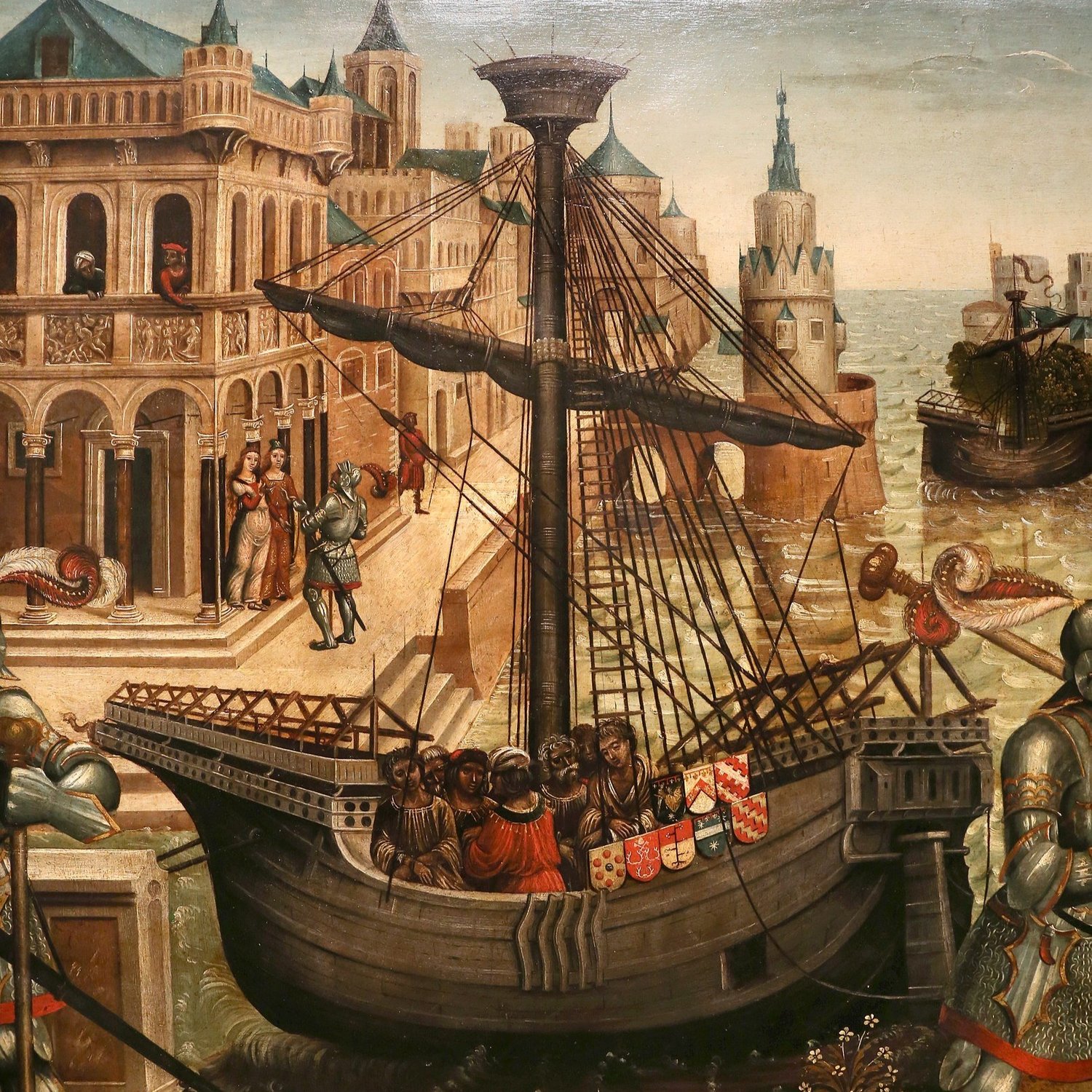
It's a blue truck lives. I'll just read this from here. The ship on which Theseus sailed with the youth and returned in safety. The 30-word galley was preserved by the Athenians down to the time of Demetrius Phaleus.
They took away the old timbers from time to time and put new and sound ones and put new and sound ones in their places so that the vessel became a standing illustration for the philosophers in the mooded question of growth. Some declaring that it remained the same. Others that it was not the same vessel. And then Blue Darkness moves on.
But this is this huge, uh, thought experiment. The ship of Theseus, uh, you all have made reference that you've heard of this one before. The way it goes is you just heard kind of the origin of it, but you just imagine there's a ship big old ship and over time the ship gets old and some of the wood on it is replaced. Some of the parts of the ship are replaced over time.
Um, is that still the same ship? The original version is just as you make repairs to it. Is that ship that has repairs to it still the same one that Theseus rode? Uh, gentlemen, do you want to take a swing at this one?
Okay. I feel this one. Um, it is the same ship. It is the same ship?
It has the same form. Okay. The ships have that form. Yeah.
That's fine. But this one's, but not completely the same. The ship is the same. But it's not the same.
Some of the different. Different. Not really different. They made sure it was the same.
I wonder if the question is if you get bogged down on the question of material, right? Of course, all the materials are not different. It is physically a different ship, but the real question is ownership. Theseus was the owner of that ship.
He is still owner of all of the New Temerys that come into that ship. So it is still the ship of Theseus. That's right. Our hearts are the story that ship had.
The things we associate with it, the feelings we have to work with. But like every, you know, imagine every board, every piece of it. It's literally has no piece of it. Don't we have that problem with our bodies?
Like on our cells? Like eight years or whatever? It depends on the part of it. Because I think brain cells are slower than that.
Yeah. Skin cells are much more. At some point, I'm completely different than physically than what I was. But I have an immutable soul, gentlemen.
Okay. So then your soul is the same, but it's a different grand body along the way? I'm cool with that. I mean, it's definitely a different grand body.
I can make creaky noises when I wake up. This is what getting old. I know. Some of our body cells, like those in our brain, heart and eyes, are with us our entire lives.
Eat it. So then you're actually the same person. My heart and eyes are the same. Everything else is not my heart.
My eyes are my brain. Is that what it was? It's all the important stuff. The soul brain.
The soul brain. The brain. The brain. We're good.
Is it the same boat? Yeah. Same boat. And why is it the same boat?
Because it's like in the same spot. Because I'm making a blind assertion. For this one, I actually don't have a good answer. I think that's a great question.
I just did a whole bunch of learning about Buddhism with my students. And Buddhists would say that there is no self. Because all of it is changeable. And because the self could never build.
Who says that? Who? Who? The Buddha.
Can I distinguish between one versus another? No, you're just becoming like my friend. There is no self. Wow.
So there was no ship to begin with. It was simply a mental construct to describe a whole bunch of pieces of wood nail together. Is there a spoon? No, a spoon.
There's a spoon. I'm just pointing out that all of that is an easy reference word for what is basically a whole bunch of parts cobbled together. There was no ship of these in the beginning because all it is is timber and nails. That's not really useful.
I also don't really agree with the Buddhists on this one. I think there's a sort of question. It's a hard question. I never had to answer this one.
I think the ownership thing is just a dodge. My blind assertion is also just a dodge. Yeah. Even better.
Okay. Can I make it more difficult since we don't have an answer for you? Yeah. I can.
Sure. I was going to say my boy Thomas Hobbes only because we share a name. I share a close personal relationship with him. Well, I'm a little bit of a tiger.
That's him. I meant to put the Calvin and Hobbes collective edition you have in the shot for this one, but I did not do that. Why do you have hardcover edition of Calvin and Hobbes? That was donated, I think, by a student.
It's a great gift. It's a fantastic gift. And it gets used all the time. Kids are done with tests.
They can go pull stuff out of the library. What else do they want to pull down? So they pull down the Calvin and Hobbes all the time. I want to say it's kind of like horror comic.
Oh, the mysteries? I think it's called? Yeah, the mysteries. I pre-ordered it.
So I'm curious. But anyway, just get to have him back doing comics. Anyway, so Mr. Thomas Hobbes, he writes a book.
It's called Day Corparé. Obviously one of our favorites. And he comes back to this ship at Theseus. So I'll just read straight from Day Corparé.
For example, that ship at Theseus concerning the difference where I made by continual reparation and taking out the old planks and putting in new, the Sophistors of Athens were wants to dispute where after all the planks were changed. The same numerical ship it was at the beginning. So in the original example, you got one ship, you end with one ship. Here's replacing boards.
You still keep one ship. You know, somebody had kept the old planks as they were taken out. And by putting them afterwards together in the same order, had again made a ship of them. This, without doubt, had also been the same numerical ship with that which was at the beginning.
And so there would have been two ships numerically the same, which is absurd. Just take his example again. As you're replacing the ship of Theseus, you take the old boards, you make a new ship. I'm still not on the garbage.
You make a new one. It's going to be a ship and crappy ship. The one you're rebuilding might be a crappy ship, but it's clearly the ship of Theseus. Any tourists would want to come and see the one that's been together.
The old one? You're saying the old one? Any tourists would want to come and see the original planks. So they would go see whatever this other guy's built.
So is that one the actual ship of Theseus? Blind assertion? Yes. Yeah.
Because when you go to the Paleontology Museum and you see a T-Rex, you know, it's freaking cool. This is a reproduction of a T-Rex that's in a vault somewhere. It sucks. I want the real T-Rex.
I want your paper mache T-Rex. Give me the real one. Exactly right. So you're telling me that.
Okay, so in our first one, that ship is the ship of Theseus. I'm also changing my mind. That's not the ship. It's not the ship.
I'm not going to go see it. I'm definitely not paying for it. It's incredible. Okay.
So, now the new one is fake. Oh, gee. The OG ship is a real one. It's a little more than 50k.
There's no more 50k. There's no more 50k. There's no more 50k. There's no more 50k.
There's no more 50k. There's no more 50k. There's no more 50k. There's no more 50k.
There's no more 50k. You can't reproduce it. Even though, like, the legal ownership is still for the new matter. Okay.
Now he owns a champ. I love this stuff. Okay. That's Hobbes's addition to the ship of Theseus making it so that you have the one ship that's being repaired over time and then the second ship that is created from the original materials.
That's all the form. Maybe you can transfer that. I don't know. I don't see what that has to do with this.
Please recreate the consciousness of AJ Annenberg. You can do that. Who's the economist guy's name? It's Tyler Cowan.
One of his recent interviews was with chat GPT. But it was chat GPT as Jonathan Swift. And so he hired someone to read the answers. But it was like, every prompt was as Jonathan Swift answered this question.
It was very good. So maybe the future is now. Okay. So what do we get there?
So as soon as we get like, like, chat GPT who can imitate people. They can do that now. And if we get like enough examples of people's language like imitate language, we could just like have conversations with our like dead relatives. Yeah, that doesn't seem healthy.
Why? Because they're gone. They're not the real relative. Yeah, but you never go to a media.
You never go to a media? You never go to a media? You can do that now, man. Be like, oh, man, I really miss grandma.
And you fire up your phone. It's like, I love you, honey. Have you ever seen the Black Mirror episode? Probably.
He said yes before you are. I knew we were going to. There's one where a lady, she misses her husband. And so she orders the robot version.
And it is put together with the conglomeration of all the stuff he's posted on social media. Yeah. And she said she was, he made a sarcastic comment about this thing that was clearly not funny. And he wrote, that's funny.
And then the robot thought it was funny. And then her husband never would have. And that's the thing that creeped her out every time. I feel like that's what happened with That's terrible.
It's bad. You're bad. It doesn't seem so bad. Yeah.
Like a final goodbye or whatever. I don't know. There's no final goodbye. Okay.
You can keep talking with them. Yeah. You can keep talking with them. Yeah.
We've banished grief. What's the white? That would be a sad weird guy in his bedroom chatting on the internet. That's not great.
That's not great. That's not great. They won't give that. That's the problem.
Okay. So what do we get with these? We get to talk about GBT. Now, we get this focusing on trying to figure out what exactly is either the same or different between the ships.