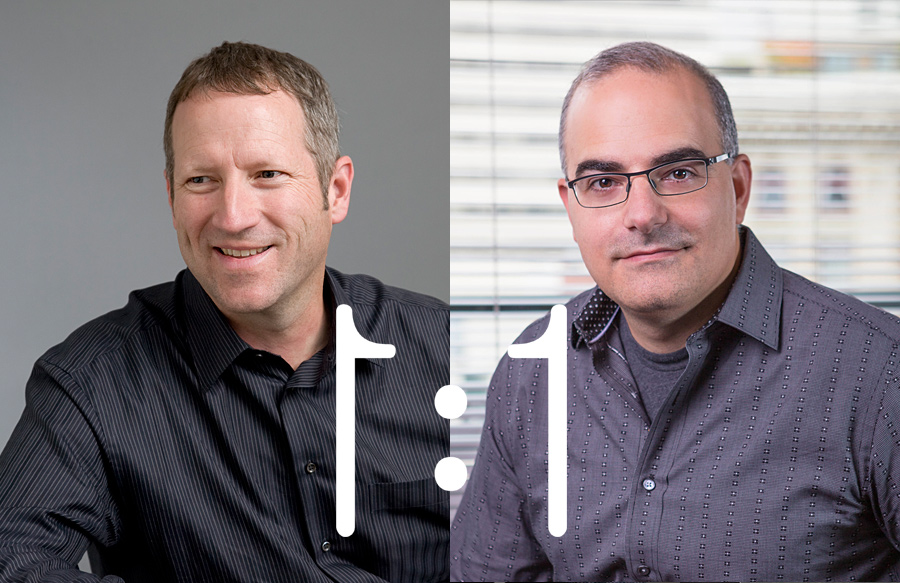
to go from a paradigm where you're sending PDFs and responding and writing emails to the ability to interact with everyone's smartphone in an immersive VR environment that enables feedback, heightened understandings, and interaction is really a game changer. Welcome to our Connect Sessions one-to-one. I'm Amelia, and this week I speak with NPVJ managing partner Steve McConnell and John Sanciovani, co-founder of Visual Vocal, a new company bringing virtual and augmented reality systems to the architecture industry. As an investor in Visual Vocal, NPVJ plans to foster the company in all of its design processes, using its collaborative platforms to communicate among designers, clients, and users at all stages of project development.
With a beta program launching this summer, Steve and John gave me a taste of how NPVJ plans to use the service and how ubiquitous VR stands to dramatically change the architectural process. So Steve McConnell and John Sanciovani, thank you both so much for joining us on the podcast today. John, I'd like to start with you to ask the first question to you specifically about the beginnings of Visual Vocal and why you chose to partner with NPVJ. What initially attracted you to developing this kind of VR technology with an architecture firm?
Sure, yeah, thanks for having us on the podcast. This is an interesting and exciting conversation so this is a pretty thrilling time in the space of computing as we're right on the precipice of the next major cycle of computing. We call immersive computing, combining both virtual and augmented reality technologies as a new, really a new set of applications and kind of really thinking about computing beyond the frame of these rectangles of glass and silicon that we've been using for the last few decades. So when we were thinking about doing a new venture in the virtual and augmented reality category, one of the areas that was of keen interest to myself and my co-founder and longtime collaborator, Sean B.
House, the two of us really wanted to do something in the productivity category. We wanted to do something that was going to transform workflows and really changed the way that people had conversations around 3D data sets, particularly given that there are multiple massive industries that really live and breathe around 3D information, not just architecture and construction, but aerospace and molecular biology and automotive and consumer products. So we started a principal design process really thinking about what tools and technologies and platforms the marketplace needed. And it's interesting, Steve and I were actually met on an Earth Day fundraiser through a mutual friend on Cuseby.
And we started talking about we both kind of are approaching this same problem from different perspectives. And it turns out that MDVJ is one of the top digital architecture firms on the planet. Every single project they work on is a complex 3D data set with a bunch of stakeholders that all have to collaborate and participate and share. And so we very quickly landed on a place where we were looking at the same problem from different perspectives.
And it's a tremendous credit to the culture of MDVJ and the laboratory culture and experimental culture that they were open to structuring a quite unique incubator inside the walls of this firm, whereby we could actually create a venture-backed entity self-contained inside the walls of MDVJ that would be informed by their insights around collaborative distributed virtual reality. And also who better to inform 3D interfaces than an architecture firm. So Steve, not to turn on your toes at all here, but John, I'd like you to say a little bit more about what it specifically was about MDVJ that brought you to form that partnership and what were you looking for in a particular architecture firm to host that kind of technology? Well, I mean, candidly, look at their client set.
I mean, MDVJ does architecture for Google, Microsoft, Amazon, Tencent, the Gates Foundation, Samsung very technically sophisticated customers and their leader in healthcare architecture, which is one of the primary categories that we believe will benefit from large stakeholder collaborative design projects. So in that way, from our point of view, MDVJ was really the primary potential partner and customer for a technology like this. And so specifically about the kind of technology that has been developed, of course, there's kind of two major ways in which architects, at least so far, have kind of been able to employ VR in both actual design and just within the firm and how they all communicate among one another, but also in how they communicate to clients. And so the way that we see that breaking down is between the headset, whether that's through something like an Oculus Rift or an HTC V or phone through Google Cardboard or something like that, just something technically streamed through the mobile device.
And then there's the more direct, I'd say physical environments that use some type of projection technology to map a 3D environment in some kind of neutral space. So those are a little bit more limited and of course require a lot more investment. But I'm wondering whether or not the partnership with MDVJ and Visual Vocal, if you guys are tending towards either of those directions specifically or wish to work in both of them. I would say, you know, all of it is relevant, but what's key to this partnership is innovating how we can more effectively collaborate.
And as we like to say in a distributed asynchronous way, all around the world, we have experts, people, thought leaders engaged in the design process and to go from, you know, a paradigm where you're sending PDFs and responding and writing emails to the ability to interact with everyone's smartphone in an immersive VR environment that enables feedback, you know, heightened understandings and interaction is really a game changer, actually, in the productivity of the process of design and really the efficacy of the decisions that can come out of that. And so what about the actual architectural designers? Will they be, do you imagine the technology not just being things that are being produced in the design process to help communicate to clients, but actually the designers themselves are able to design within that virtual reality? I mean, it's interesting to expand on, you know, what is what is design?
And, you know, reflecting on this a little bit, design is not just representation or presentation, design is a process of collaboration and interaction with the constituency around coming up with, you know, transformative ideas, beautiful, you know, resolutions. And so the architectural designer is key to this whole venture because it's the architectural designer that's really orchestrating the kinds of interactions that can happen when it comes to the design journey itself. So it's not just an occasional meeting with company executives and a review of design products, it's changing that sort of very tired model to a kind of hyper connectivity that at the same time is giving back time and energy to that stakeholder group that aren't traveling necessarily to meetings or, you know, waiting through other streams of content, but able to interact exactly around the kinds of things that the designer is orchestrating with those stakeholders. This is an area of sheer passion for Stephen Eitz.
I think, you know, really beautifully put that uppercase D design is about so much more than sitting in front of a computer and, you know, modeling. And to that point, you know, when we really looked at the problem space, the reality is that the architectural designer individually is actually not, in our opinion, the most important user of actual immersive virtual reality. It turns out architects are exceptionally good at visualizing 3D spaces and their existing tool chain from Autodesk and others is very sophisticated. And in fact, it's, I personally believe it's a bit of a false summit to, you know, really invest in these advanced virtual reality tools just for the architectural designer to see this point, a building is designed by all the people who will use it.
And so the underserved category is really the, you know, the dozens or hundreds of people that are participating in the design process. So directly to your question about platform, we're actually quite energized about mobile sort of quote, phone in the face oriented UI systems simply because they scare a scale so elegantly to a large number of users. And we believe that we can build a very engaging communications platform where the goal isn't necessarily presence. We're not trying to teleport the person into, you know, to deceive them to thinking they're standing in an unbuilt building.
But instead, we're trying to give them, you know, a weekly or monthly heartbeat that keeps them in touch with the design decisions and lets them participate in those decisions on a regular frequency and mobile UI is a great platform for that. And the plan is to launch this coming summer, correct, from NDBJ? Absolutely. What we're looking at is during the summer moving into the beta products and really testing this in robust ways on live projects, both domestically and internationally.
So what are some of those projects that you'll be testing on? Not ready to reveal the specific clients and projects respecting the confidentiality that comes with that work. But suffice it to say, interest is extreme. And this is an international venture where like the actual program will be tested in all over the world.
This is the plan. Yes. And also as a member of the media, I would have asked how or whether or not these kinds of, I would say almost a maturation of renderings, but how these virtual reality depictions of in process or design architectural spaces will those be available to the media? Of course, we have so much that is built upon, okay, this project is happening here and here are some renderings of it.
And so you can track the process through pictures of construction and also going back and forth between what was shown in the rendering and then what is shown in the actual photographs of the construction process. So is this kind of somewhat new visualization of the architectural spaces? Will this be available for the public? For sure.
It really depends on the nature of the commission. So in fact, looking at the opportunity to use this with public commissions, and there are so many ways in which we can apply this technology. So often with public commissions, we have a base obligation to inform the public and to reach out to a constituency of interested stakeholders in the broader public community to interact with the work, to comment on the work, to voice preferences, to add comments. So that's one of many ways I can see us scaling this tool and enabling a kind of public outreach that hasn't been achieved before when you just have that kind of, I mean, I'm an architect who 20 years ago was standing in a tent in a parking lot, waiting for the public to drop by to inform them about a publicly funded project.
So the simple answer is yes, but it depends explicitly on the nature of the commission, the confidentiality that comes with contracts and whatnot. So there's going to be some projects that media would have easy access to. Others might be less so until such time that they're built or what have you. Just given the fact that with the mobile of the art technology, if you can just stick a phone in your face, as you've said, it is so fantastic this opportunity that kind of presents itself to overall convey architecture to that is unbilt to anyone.
However, that also comes with a lot of kind of automatic suspicion. We deal with a lot of very exciting news with the art architecture on our connect and often what we hear from our audience and from practicing architects is absolutely incredibly exciting. We're very eager to be able to communicate with our clients in this new way. However, there's also the constituency that feels like this is just going to give clients yet another problem to wrestle with where they're going to engage with the virtual reality and not be able to rest themselves away from whatever they saw there in the actual building that will create this kind of tension between, of course, what they always expect to see after seeing the renderings, which is the actual reality where this could in a way almost inflam that.
Can you kind of speak to that point? Yeah, I think there's there's some exciting opportunity for a healthy tension actually. And as we like to say, this sort of democratization of design and the best design isn't the over control of a soul, a kind of lone genius, but the best design is the design that understands more deeply the needs of these constituencies and to provide access to that. And key to all of this is we're not talking about visual impressions of what the work will be.
We're talking about an immersive collaborative tool that inherently isn't just about presenting design. It's about wrestling with questions and bringing in insights and wisdom and bringing that together. You can almost associate with sort of wisdom of the crowd type thinking. So I think it's time for a very old professional services framework to take some big steps forward in the way in which it engages the world.
Yes, totally, totally agree. I mean, I think this is a this is an exciting time on multiple axes, not just because we're on the precipice of this next cycle of computing, but because we're on the precipice of a new way that large and complicated projects are designed empowered by that technology. And to speak directly to your question about render fidelity, I think it's a very insightful and thoughtful question. Obviously, you know, on the minds of everyone here at NVJ and I've been so impressed with how thoughtful the team at NVJ is on the way that they participate with the client and capture feedback.
There's a huge dynamic range of render fidelity at different phases of a project. So in some cases, the right decision is to give paper-like style renderings that are actually very intentionally low fidelity where we really want to talk about basic massing and flow. And at the other end spectrum, there is a moment for a cinematic quality, you know, very, very high quality render. And so through the course of our year-long collaboration to date, we have actually been very thoughtful about how we're addressing that question, whereas a lot of other architectural VR platforms get really into the geek-dom of the render pipeline.
We're actually quite abstracted from that in the sense that we're at Gnostic. If there's a moment when NVJ wants to have a very low fidelity, you know, rendering just to communicate core concepts, we support that all the way up through to very, very high quality cinematic grade spherical rendering. So we're actually designing the project explicitly to be abstracted from those choices. And what's amazing now with these Pocket viewers, you know, having been in the Vive environment, the Oculus environment, and other VR environments, that the quality is really almost approaching those platforms.
And I think that opens the floodgates that you can actually have in your pocket a simple, full-down viewer the size of a half dollar and engage your phone. It's not even an inconvenience. I don't, you know, if I walk around a city, I don't want to carry anything, but I can actually carry one of these viewers in my pocket without any annoyance. In terms of developing the technology and the service for later use and eventually expanding it into other non-explicitly architectural, but say bioengineering or aerospace industry, to bring it back to the architecture industry, do you imagine that this kind of technology would also be able to be sold out to be used by smaller firms?
Because of course, when like NVBJ, or firm like NVBJ has a certain capability and usually worse with clients that might be able to kind of put up for something like this, but is the overall goal to make this accessible to any range of size of firms? Absolutely. It's completely scalable. And just as we were reflecting on how easy it is to interact with our smartphones with simple viewers, there's really no barrier to entry other than, you know, your willingness to go on the app store and download the app and start interacting with a tool that's so intuitive.
You don't really need instructions. You know, from our standpoint, yes, we're investors in this company. It's a standalone entity and it puts us in the forefront of applying this to our work, but our motives, I think, are much broader. And in no way, you know, am I sitting here thinking, you know, how we have to control this and somehow we're going to have competitive advantage.
We have a competitive advantage because we're doing this and because we're learning about thinking about it, engaging in it. What's been really exciting for me and something that's dramatically exceeded expectations actually is what does it mean to take, you know, a 70-year-old mature professional services platform and all the inertia and knowledge and thought leadership that it possesses. And yet at the same time, you know, the challenge to be nimble and scrappy and innovative and inject right in the heart of it a standalone venture backed by, you know, brilliant people. And what we're seeing is kind of a third place and a new kind of energy that's so key to our future and so key to us being a high value practice.
So that's the payback. And I think, you know, the ability for a small firm, this is exactly what they need, even more than maybe buying a VR setup. Yes, beautifully put. I mean, it's an interesting one of the interesting learnings.
I've been doing user, you know, kind of advanced user interface for more than a couple decades with, you know, research labs and ventures. And as we enter this next phase, you know, candidly just as important as us bringing this user interface and user flow, you know, collaboration, technology and cloud intuition into the practice of architecture. Actually, even more powerful from my perspective is we're at the precipice of this phase of design where user interfaces are going to break the frame of the screen and spill out into the world around us. And, you know, as I mentioned earlier, I mean, as a design professional and a venture executive, I am energized and have already been so excited to see the ways that, you know, it turns out architects have been designing 3D user interfaces for hundreds of years.
They just call them buildings. So we have already kind of got so much great insight, not just on the actual, you know, application in the architectural vertical, but incredibly insightful broad insights about how humans perceive space and how that should influence our user interface and the conversation with MBBJ has transcended not, you know, their specific immediate needs around their projects and clients and has really been a broader discussion around how do you design elegant spaces that are usable in high performance, because those are the same considerations that will inform the great user interfaces of the future. So, you know, in summary, I'd say that we're at a time when user interface professionals have a lot to learn from world-class architectural designers. And that's happening in the context of this partnership.
So does that suggest that this technology will also be used in an augmented reality kind of function where instead of depicting a rendered reality overlays onto the actual reality new information or additional designs? There's no question that we're in phase one of the HoloLens deployment. And we're super energized about augmented reality as a platform. We haven't made any product announcements in that category yet, but absolutely, I personally believe that virtual reality is a bridge to augmented reality.
And you see the incredible things being done by HoloLens and by match leap and others. This will be an incredibly transformative technology for all articles. What hardware would you imagine deploying that kind of AR? Because of course, we saw the Google Glass kind of fall in its face a little bit.
So we're wondering like, what might be the next, or whether there is a next thing or what kind of actual physical object will bring the average person that kind of AR experience? Well, first let's say we're clearly we're in the first inning of AR technology. And whereas VR technology is a phase where we're kind of in the engineering refinement miniaturization and integration phase where headsets are getting cheaper and faster and lighter and less expensive. You know, candidly with augmented reality, and this is a category that I know quite well is responsible for worldwide academic research funding of augmented reality at Microsoft for six years.
And we're still in the kind of uppercase S science phase of AR optics and display systems field of view, depth of field. There's a lot of fairly advanced technologies, manufacturing processes that need to be invented. Google Glass, I would characterize as a heads up display to the world, which was a cool concept. But I think it's quite different than the notion of pinning digital objects, believably, into the physical world.
Obviously, Google has intentions in that category. And I'm sure we'll execute with elegance as they do, as does Microsoft, Magic Leap and Manna and others. So I believe that, you know, much like 15 years ago, I used to stand on stage and say, you know, 15 years from now, this smartphone will replace your PC as your primary computing device. And you know, 15 years ago, I get laughed off stage.
Well, now when I stand up on stage, I say 15 years from now, and I hold my eyeglasses in front of the audience and say, this, you know, this will replace your cell phone as your primary computing device. And I truly do believe that I don't think I can articulate exactly what the with a hardware platform will be, because I still think that we're, you know, five years away from the real broad deployment of consumer devices in this category. But it's an exciting time. So for after the buildings exist, and there are people occupying it, it's been used, will this VR technology be used in post occupancy surveys or gathering data about the actual performance of the building?
It's actually one of our specific use cases, again, informed by NDBJ. I mean, one of the areas where NDBJ is very sophisticated is post occupancy analysis and assessment through a wide array of technologies and tools and processes. And due to the democratization of our deployment method, a phone base to be our platform, this is particularly well suited for for post occupancy assessment and other post occupancy considerations, such as operational considerations of the building, being able to use, you know, this technology to look through the walls at a spherical capture of a room that was taken, you know, moments before the drywall enough or a series of different methods. Yeah.
And frankly, flipping that around just as much on the front end of the work, often with corporations, and especially given the nature of wanting to attract the best talent and be a workplace friendly environment, the outreach and the concerns of a workforce are paramount. So the research that goes into what are the needs of a workforce? What's their daily experience like that kind of outreach and that kind of due diligence can be very time consuming and very distracting to large populations. We're working with a corporation right now, there's a thousand people that they'd like to do outreach with.
And for us to tee up a set of questions and interactions and provocations through the visual vocal tool and beam that out to everyone's mobile phone. And then to then to elegantly synthesize that feedback is to expedite the research, bring great deal more efficiency to it, and frankly, you know, higher fidelity responses. So this is the tip of the iceberg for these kinds of deployments. Well, it's certainly extremely exciting.
And we look forward to seeing what Visual Vocal and DBJ come up with. So Steve McConnell and John Santjuvani, thank you both so much for joining me on the podcast. Awesome. Thanks for listening to our Connect Sessions one to one with Steve McConnell from NBBJ and John Santjuvani from Visual Vocal.
Daniel Voi now edits the podcast and Matt Scelling's composed our music. Myself and Paul Bichunya are the producers of one-to-one. New episodes of one-to-one come out every Monday. You can subscribe to us on iTunes and Google Play music.
And if you like the podcast, consider leaving us a review. We are at our sessions on Twitter and you can email us at connect at arkneck.com. Thanks again for listening to one-to-one.