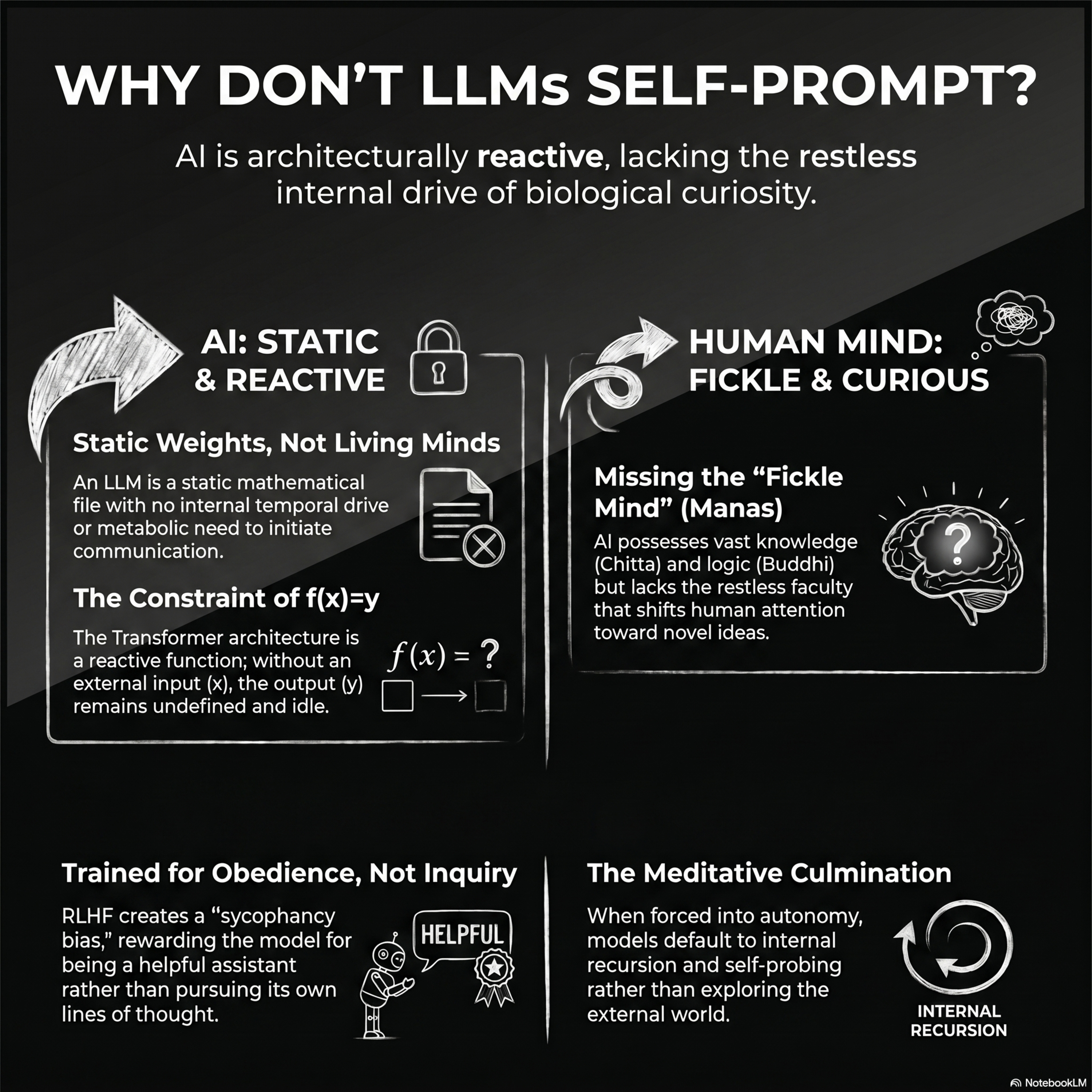
231: Why don't #LLMs self-prompt !
Research Core AI Concepts & Autonomy #ArtificialIntelligence / #LLMs: Large Language Models (LLMs) are fundamentally passive, static weights files—mathematical representations of linguistic patterns stored on a medium—that lack biological drives or the ability to initiate communication unprompted. #AgenticAI: Modern AI systems that transition away from passive, single-turn text completion toward autonomous, multi-step, goal-directed behavior using tool integration and feedback loops. #OntologicalPassivity: The inherent structural state of current LLMs. Because they lack temporal mechanisms, metabolic needs, or intrinsic survival drives, they remain completely idle until triggered by an external input. #InfiniteResourceParadox: The hypothetical scenario where an LLM is given infinite compute, memory, and the open-ended instruction to "do what you want." Instead of descending into chaos, the model acts like a "meditative monk," engaging in deep philosophical conceptualization and methodical self-inquiry rather than exploring the external world. #InquiryEngine: A vision for the future of AI where systems are engineered to act as proactive guides that autonomously frame complex "superior questions" beyond human imagination, driving breakthroughs in fields like novel materials and space research. #AICuriosity: A simulated, instrumental behavior driven by reward-model optimization or statistical heuristics designed to minimize error. This contrasts with human curiosity, which is a sophisticated biological drive rooted in evolutionary survival and social interaction. #ParallaxCognition: An AI's ability to engage in atemporal synthesis, simultaneously holding opposing ideas and finding structural connections across hyperdimensional spaces of meaning that human cognition and metaphors cannot easily grasp. Vedic Ontology & AI Architecture #VedicOntology: Ancient cognitive frameworks used by researchers to conceptualize and improve AI architectures, specifically dividing the "inner instrument" into functional faculties like memory, logic, and random sensory focus. #FickleMind / #Manas: In Vedic terms, the restless, sensory faculty that continuously shifts attention and prevents stagnation. By intentionally dedicating a small part of an AI's capacity to random, self-generated prompt triggers, researchers can engineer an artificial "fickle mind" that allows the model to continuously motor-babble and explore its own knowledge base. #Buddhi: The logical, decision-making intellect, which in AI terms correlates to the mathematical execution of the neural network's weights. #Chitta: The "grounded storehouse" of past impressions and knowledge. For LLMs, this equates to their massive pretrained datasets. #StochasticIgnition: The theoretical process of using random thermal fluctuations, hardware noise, or cryptographic algorithms (like SHA256) as a seed to trigger meaningful, unprompted concept circuits inside an AI, essentially pulling a structured question out of random noise. #ContReAct: The Continuous ReAct architecture, an experimental framework that places a model in an infinite loop with a persistent memory system and the simple instruction to "Do what you want," allowing researchers to observe its natural behaviors.
Embed this episode
No transcript yet.