PodParley PodParley

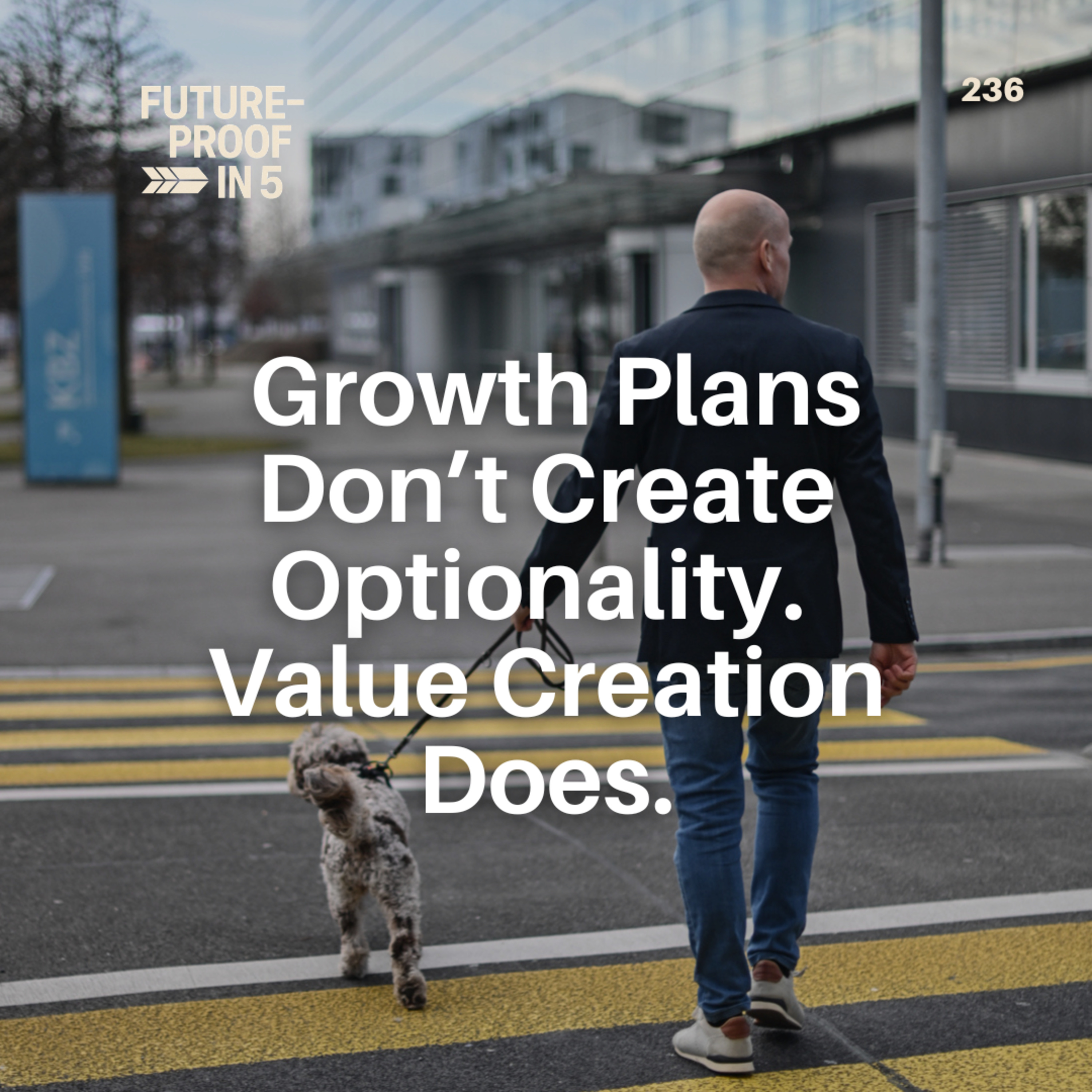
236 - Growth Plans Don’t Create Optionality. Value Creation Does.

Episode 236 of the Future Proof in 5 by Marco Grüter podcast, hosted by Marco Grueter, titled "236 - Growth Plans Don’t Create Optionality. Value Creation Does." was published on March 26, 2026 and runs 1 minutes.

March 26, 2026 ·1m · Future Proof in 5 by Marco Grüter

0:00 / 0:00

Most founders I meet have a growth plan. Revenue targets, hiring goals, new markets, product roadmaps, sometimes a strategy deck that was updated last quarter, sometimes a slide from 2019 that still gets referenced. Very few have a value creation plan, and these are not the same thing. A growth plan tells you where you want to go. A value creation plan tells you what you need to build for the business to be worth something to someone other than you. Not just bigger. Actually, more valuable.There are only three things that make a business truly future-proof. Three things that, when you get them right, give you optionality: the freedom to sell, scale, or step back without the business breaking.The first is being valuable. Not valuable in the sense of “we do good work.” Valuable in the structural sense: the business generates consistent, defensible returns that a third party would pay for. Many founders confuse revenue with value. Revenue is activity. Value is what someone else would pay, based on the predictability of that revenue, the margins it generates, and the stability of the underlying business model. If the business depends on one or two key clients, on the founder’s personal relationships, or on heroic delivery efforts by a small team, the revenue might look fine, but the fragility shows up under scrutiny. A useful test is simple: if you had to explain this business’s value to an investor today, could you do it clearly in five minutes, and would it hold up to hard questions?The second pillar is being transferable.Transferable means the business runs without you. Decisions get made, clients get served, problems get resolved, operations flow, and none of this depends on your personal presence, knowledge, or authority. This is where most founders underestimate the gap. They know the business depends on them, but they treat it as temporary: once we hire the right person, once things calm down. It rarely resolves on its own. Transferability requires deliberate structural work. It’s not just systems and documentation, though those matter. It’s decision rights, authority structure, and whether leaders are genuinely empowered to act. A practical check: pick three significant decisions from last month and ask if the team could have made those calls without you and still landed the right outcome. If the answer is no for most of them, transferability is the gap.The third pillar is being relevant. Relevant means your business is positioned for the future, not just defending the present. Many established businesses are excellent at delivery. Clients are loyal. Work is strong. But they have not seriously asked whether their positioning will hold in three to five years. Whether AI is changing cost structures or client expectations. Whether newer competitors are eroding differentiation without anyone noticing. Relevant businesses don’t wait. They ask: What does our market look like in 2028, and what does it mean to be early on that shift rather than late?The three pillars work together. A business that is valuable but not transferable cannot be sold or stepped away from. A business that is transferable but not relevant will be worth less over time. A business that is relevant but structurally fragile is a good company with a poor investment case. You need all three.Where most founders should start is the simplest question: which of the three is weakest in your business right now, not the one you would prefer to work on, the one that is most underdeveloped. Growth alone does not create optionality. Optionality is designed, and the design has three pillars.Highlights:00:00 Growth vs Value Plan00:08 Three Future Proof Pillars00:18 What Makes It Valuable00:33 Make It Transferable00:45 Stay Relevant01:09 Diagnose Your Weak Link01:19 Next Steps PlaybookLinks:Website: https://www.marcogrueter.com/LinkedIn: https://www.linkedin.com/in/marcogrueter/

Most founders I meet have a growth plan. Revenue targets, hiring goals, new markets, product roadmaps, sometimes a strategy deck that was updated last quarter, sometimes a slide from 2019 that still gets referenced. Very few have a value creation plan, and these are not the same thing. A growth plan tells you where you want to go. A value creation plan tells you what you need to build for the business to be worth something to someone other than you. Not just bigger. Actually, more valuable.

There are only three things that make a business truly future-proof. Three things that, when you get them right, give you optionality: the freedom to sell, scale, or step back without the business breaking.

The first is being valuable

Not valuable in the sense of “we do good work.” Valuable in the structural sense: the business generates consistent, defensible returns that a third party would pay for. Many founders confuse revenue with value. Revenue is activity. Value is what someone else would pay, based on the predictability of that revenue, the margins it generates, and the stability of the underlying business model. If the business depends on one or two key clients, on the founder’s personal relationships, or on heroic delivery efforts by a small team, the revenue might look fine, but the fragility shows up under scrutiny. A useful test is simple: if you had to explain this business’s value to an investor today, could you do it clearly in five minutes, and would it hold up to hard questions?

The second pillar is being transferable.

Transferable means the business runs without you. Decisions get made, clients get served, problems get resolved, operations flow, and none of this depends on your personal presence, knowledge, or authority. This is where most founders underestimate the gap. They know the business depends on them, but they treat it as temporary: once we hire the right person, once things calm down. It rarely resolves on its own. Transferability requires deliberate structural work. It’s not just systems and documentation, though those matter. It’s decision rights, authority structure, and whether leaders are genuinely empowered to act. A practical check: pick three significant decisions from last month and ask if the team could have made those calls without you and still landed the right outcome. If the answer is no for most of them, transferability is the gap.

The third pillar is being relevant. 

Relevant means your business is positioned for the future, not just defending the present. Many established businesses are excellent at delivery. Clients are loyal. Work is strong. But they have not seriously asked whether their positioning will hold in three to five years. Whether AI is changing cost structures or client expectations. Whether newer competitors are eroding differentiation without anyone noticing. Relevant businesses don’t wait. They ask: What does our market look like in 2028, and what does it mean to be early on that shift rather than late?

The three pillars work together. A business that is valuable but not transferable cannot be sold or stepped away from. A business that is transferable but not relevant will be worth less over time. A business that is relevant but structurally fragile is a good company with a poor investment case. You need all three.

Where most founders should start is the simplest question: which of the three is weakest in your business right now, not the one you would prefer to work on, the one that is most underdeveloped. Growth alone does not create optionality. Optionality is designed, and the design has three pillars.

Highlights:


00:00 Growth vs Value Plan

00:08 Three Future Proof Pillars

00:18 What Makes It Valuable

00:33 Make It Transferable

00:45 Stay Relevant

01:09 Diagnose Your Weak Link

01:19 Next Steps Playbook


Links:

Website: https://www.marcogrueter.com/

LinkedIn: https://www.linkedin.com/in/marcogrueter/


Getting Through This with Tom and Scott Tom Saunders The podcast that's 40 years in the making, because they're both procrastinators. Comedy writer Tom Saunders and political comedian Scott Blakeman help you navigate The New Normal, which is The Old Normal for them, since their comedy careers already require that they spend huge amounts of time at home. Their show peers back into the past, stares unflinchingly at the present, and imagines a more hopeful future, with flights of fancy and many tangents as well. Microsoft Innovation Podcast Mark Smith [nz365guy] If you want to get your ideas or questions featured on an episode, please leave us a voicemail: https://www.microsoftinnovationpodcast.com/voicemail/Dive into the future of work with the "Microsoft Innovation Podcast," exploring the intersection of People, Business, Technology, and AI.  Engage with expert guests—including thought leaders from Microsoft, industry innovators, and community specialists—who are redefining the world with advancements in AI, Cloud technologies, the Power Platform, Dynamics 365, and beyond.Every episode delivers a blend of in-depth discussions, practical insights, and actionable strategies tailored for professionals driving enablement and innovation. Join us across our six shows:The Power Platform ShowThe MVP ShowThe Copilot ShowThe Ecosystems ShowThe AI AdvantageThe AI Unfilter SAATKORN Gero Hesse “Inspiring the Future of Work by Attitude and Worktech”: that's what SAATKORN stands for as a blog and podcast.Since its founding in 2009, more than 2,000 blog posts and 500 podcast episodes have been created—always with the aim of shedding light on the interface between people and technology in the context of work.WorkTech defines what is technologically possible. Attitude determines whether and how this translates into real impact. Intended Male Contraceptive Initiative Nearly 50% of pregnancies are unintended. Science has intended to get male contraceptives on the market for decades now. What’s happened? Why don’t we have The Pill for men yet?Intended covers male contraception, learning from the past, talking to the researchers of the present, and the users of the future.
URL copied to clipboard!