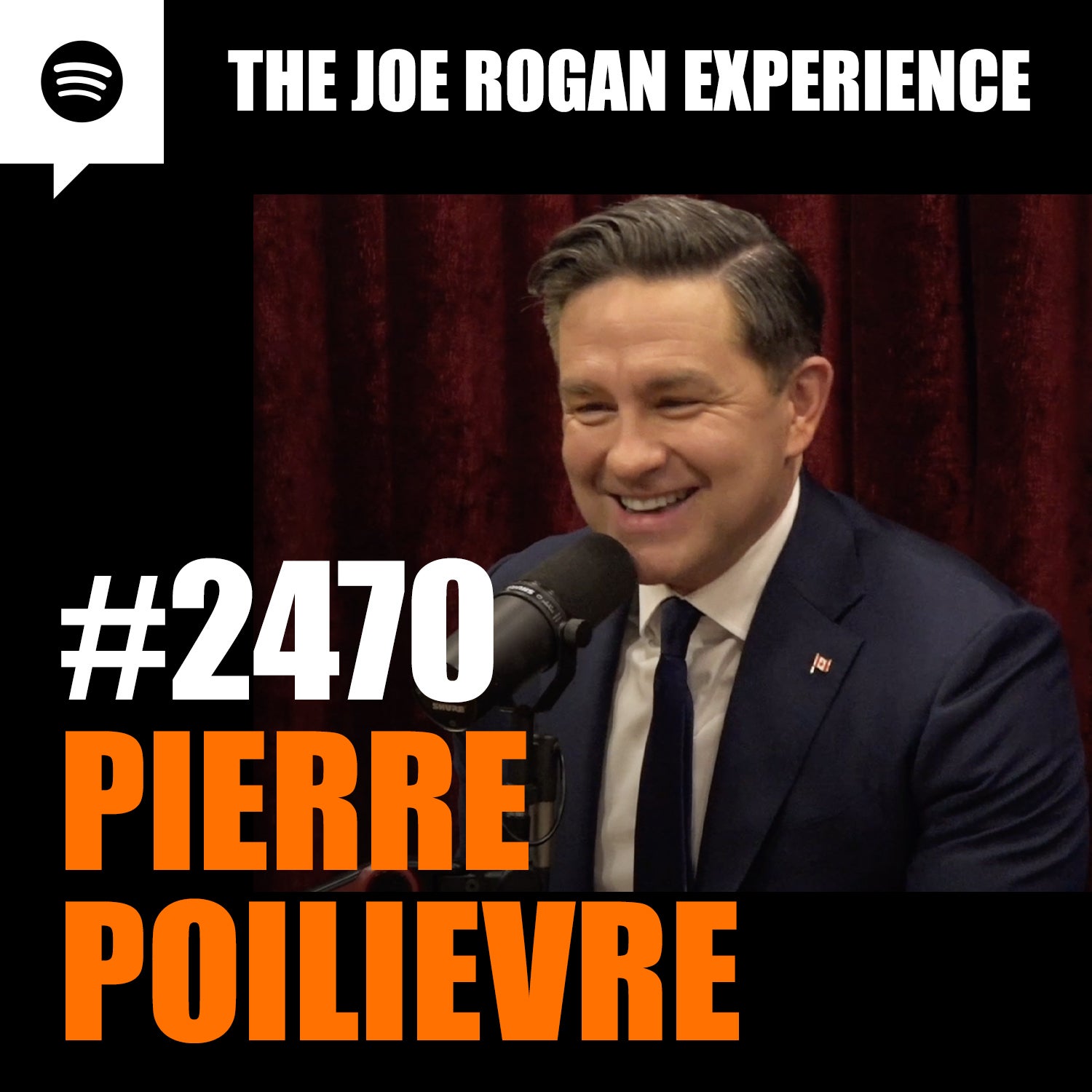
Go up and wind up! The Joe, Wilgen, experience. Train by day Joe, we'll get by night! All day!
Oh, sorry. Pleasure to meet you. It's great to be here. Thanks for having me.
Great to be back in Texas. I'm glad we finally did this. Yes, me too. I wanted to do it the first go around.
Yeah, I know. When I got the invitation, we were in the middle of the election, and we just don't leave the country during election campaigns. I get it. And the problem we've had is we can't get you to come to Canada.
And so we've actually hatched a full strategy to get you into Canada. We think it's going to do big things for our tourism numbers. So, do you mind if I present you with something right out of the gate? Sure.
This is from a gunsmith and machinist in Calgary, Alberta's name is Jay. And he's designed a... Look, a skeleton. Guess what the weight is?
70 pounds? 70 pounds? That's the weight you have. It says on the front here.
Jamie, it says here on the front. Jamie, pull it up. We've got, you see here, some other stuff for a stand. Oh, wow, that's really cool.
Look at this stand here. So, we've got, seeing is believing, which I think was the slogan of the first UFC that you were the commentator for. I think it was number 13? 12.
Number 12, right. And then we've got here your favorite quote from... What's his name? The Japanese?
Yes. And it says, if you know the way broadly, you will see it in everything. Yeah. So, that's here.
And then, Morse code, there's a thank you letter for you. You've got your flying saucer. Oh, wow. And we've got your logo here too.
So, but most important of all, we've got a subliminal message, which is, that Canadian Maple Leaf. Oh, cool. Every time you do a kettle bell swing, you do a snatch, you do a clean, you do a clean, you're gonna be seeing that Maple Leaf. And you're gonna be reminding yourself that you need to come back to Canada.
All right, all right, I bring that to you. There. Thank you very much. Very cool.
Is that the weight in me? We'll take it off. I saw your interview with Pavel. I'm a big kettlebell freak.
Oh, really? Yeah, absolutely. And I started researching him after you had him on. And I was trying to...
I love history. So I was thinking, why did the Russians come up with this? And it turns out they used it as a counterweight at the farmer markets. So they would say, you know, you come and you have to say, this is how much potatoes you're buying.
But instead of trying to do it by eyeball, they would put what is now kettlebell on one side of the scale and then the produce on the other. And then at the farmer's expeditions, you have these big Russian farmers who want to show how strong they were. So they would pick them up and do all kinds of displays with them. And then the Russian army took it on, the Soviet army took it on, and then that's where Pavel picked it up and then brought it over the Atlantic and introduced it to America.
Wow, that's crazy. So it was just accidental that they made this very functional tool for fitness? Yeah, it was just... you'd go to farmers' market, you want to buy some barley or some potatoes, but you don't know if you're actually getting the real weight.
So they'd have a scale, a balancing scale, and they'd put the kettlebell on one side and the produce on the other. And then you knew you got the right amount. And then of course they have these big farmers' farm fairs and they're showing off their horses and their cattle and stuff. And they'd want to do strength displays.
And then the farmers are throwing these things around and the Russian military picked it up. And then the Soviets of course took over and they took it on and then Pavel... I think he was a ballerussian though, if I'm not mistaken. I'm not mistaken.
And he brought it over to North America. But the ancient Chinese did it as well. Really? Yeah, the ancient Chinese, the Shaolin monks, they didn't do it with cast iron.
There's sort of a concrete block and they did for shrinks training as well. Oh, wow. Little history. Yeah, so I'm a big kettlebell freak.
I love it. And I really started to study what Pavel was teaching. I think he's an accreditation or something if I really take it. He's a strong first.
Yeah, that's his organization. And you have a whole program I think you do clean depress and then... Yeah, I do a bunch of different things. Squats with overhead, squat and all that.
It's a great functional tool just for your whole body. Right. It's really one of the best pieces of exercise equipment I think I've ever found. I think he calls it a cannonball on a handle.
And the thing I like about it is the... It's like a catapult. All of the lift is in that instant where it flips over your hand. Oh, so the original one's like, wow, that's crazy.
That's so interesting. So the handle was just to pick it up and carry it around. Yeah. That had real functional use.
Well, it's just amazing how good it is for a piece of exercise equipment that was accidentally designed that way. Absolutely. And I think it's far superior to a dumbbell exercise because there's no... A dumbbell, you've got a consistent lift, but that's not real life.
If you're in a fight or you have to pick something up heavy, it doesn't lift consistently. It's explosive in that small range. And when you're doing a snatch, by the time you get up to your shoulder, the thing's weightless. Because the catapult effect has taken over and now it's actually negative weight is lifting your hand up in there.
Right. But if you're in a fight or if you're in a wrestling match or you're trying to push really hard against a heavy object, it's all about explosive power. And that's what kettlebells give rather than just this sort of freeze and contract thing that you do with dumbbells. Have you always been a workout guy?
Yeah, look, I was big into sports and tell my mid-teens. I was on the wrestling team. I wasn't great. I was good, but I wasn't great.
Then I got a wicked tendinitis in my shoulder. And it ended my athleticism for four years. And that's how I got into politics. I was so bored.
I got home from school. I had nothing to do. So I took my toe my mother. Every time I thought I had a beat, I'd go in and I'd train and it would be full of inflammation.
No one could do anything about it. And so I was bored out of my mind. And I said to my mom, you go to these local meetings with the conservative association. Take me to that because I'm going crazy.
That's nuts. So what were you interested in when you first went there? We just didn't like the way things were running. What was it about that got you so curious?
Well, I grew up in a suburban neighborhood in South India Calgary. My folks were teachers. I was adopted. My mom was a 16-year-old.
She was obviously a single mom. She put me up for a dog in two school teachers. There was electricians and oil workers and police officers living on our street normal, hardworking good folks. And I always grew up with the impression they were getting screwed over.
And that the government didn't listen to people like them. They didn't listen to people who grew up on streets like ours. And living in Western Canada, there was a greater sense of that. We called it Western alienation at the time.
And there was this guy, kind of a quirky guy, but a really brilliant guy named Preston Manning. I saw this billboard of him and he had his stuff and said enough. And I said, yeah, I like that guy. So I got involved in politics.
And I started reading about different things. I read biography on Fido Castro. And then I read. Just said.
No, no, no, no, no, no. Is that a spear? Is that a spear? I had issues with Pierre Trudeau too.
It is a great conspiracy theory though. Well, it is a hell of a... I don't think it's a true one though. His dad is a spear.
His dad was very controversial. I grew up because he did a lot of damage to the oil sector and we're from oil country. And so that was one of the things that I felt kind of resentful about the national government. And one of the reasons I got involved is because the West deserved a fair deal.
And I read a lot of books like Milton Friedman, Capitalism Freedom, and I came to develop a philosophy based on just maximizing personal financial, religious freedom. Let people make their own decisions. And that animated me to get involved in politics and fight for that. And I've been doing it ever since.
This episode is brought to you by Squarespace. Once you've got a great name for your business, you need a great domain. And Squarespace makes it easy to lock in a domain. You just search the name, you want, buy it, and then you're ready to build.
No hidden fees, no weird upsells. Go to squarespace.com slash Rogan for a free trial. And when you are ready to launch, use the code Rogan to get 10% off your first purchase of a website or domain. That's a fascinating transition from wrestling and tendinitis.
Deeply involved in politics. Yeah, I mean, like, you know, your sports guy, if you had suffered an injury that took you out of Taekwondo when you were young and you simply couldn't compete at anything, you'd probably be looking for some other adventure. Yeah, we should have. Well, we're lucky that stem cells weren't around back then.
You never would have gotten into politics. That's right. I don't know if I would have won any awards. But yeah, that was how I got started.
And I got very active very quickly. I got my first internship making $600 a month when I was 16 or 17 years old. And take two trains in a bus and an hour and 45 minutes each way. But I was so thrilled.
My dad bought me a used suit and a used pair of shoes. And I thought this is so incredible. I'm an important guy. I wear dress shoes.
I wear a tie. Didn't matter that the tie was bought from some dead guy who's family had sold it to a used store. But that was my start. I loved it.
Well, I'm really excited to have you in here because I've seen you speak multiple times and you're a very reasonable, intelligent person that makes a lot of sense. And that is a rare thing in politics. And I love Canada. I just say I don't go up there anymore.
But it's because I think the government went horribly wrong over the last x amount of years. But the people are amazing. I've always said that Canada has like, it's like America with like 20% last assholes. Like every time I go up there, like people are so nice.
They're like the nicest people. I think that's part of what went wrong for Canada is that people are rule followers. And they're trusting and kind people. And this wolf in sheep's clothing snuck in and was pretending he was a sweet guy and passing all these crazy laws.
And just when we saw what happened with COVID with just what happened with the truckers and people's accounts getting shut down for donating to the truckers, the whole thing was so concerning. Because Canada was like a part of America almost. I mean, you're a different country, but it's like you usually be able to go over there with just a driver's license. It was like it was such a cool place.
I started going to the Montreal Comedy Festival in like 1993. I loved it up there. It's like one of my favorite places to get. Is it Mr.
Laughs? Yeah. Good. How's your French?
Not good. Okay. We'll work on that. We'll use some French.
I don't know any French words. My wife is learning French though. It's interesting. She's got this app that she's learning French.
But it's just an amazing place. It's a great country. And to see it go the way it's been going and sliding the way it's been happening over the last x amount of years. There's just so many things that concern me.
You know, one of the things that really concerns me is this assisted suicide thing. One in 20 deaths in Canada is now assisted suicide. That's insane. Well, listen, my view is that people should have the choice.
But the concern we have is the suggestion that it would be offered to kids or offered to people whose only condition is mental illness. Right. I don't agree with that. My concern as well.
Someone's got a terminal, like a good friend of mine, went to Oregon to end his life because he had ALO. Okay. But I mean, he was gone. I mean, he could barely talk at the end of his life.
His name is Michael Lair. He was a regular guest on Kill Tony. Great guy. Right.
And it was horrible. I mean, watching him fade away and he wanted to go out on his own terms. Right. So I went to Oregon for assisted suicide.
There's a place for it. Yeah. And I think in Canada, he did it for seasonal depression. I'm sure you're aware of that case.
Like, who allowed that to happen? Who didn't counsel this young guy? Who didn't give him a hug? Who didn't tell him about diet and exercise and changing your surroundings and your lifestyle and just do something to give you some hope and happiness?
Like, seasonal depression? Really? You're going to end your life, this beautiful life on this planet for seasonal depression? That's correct.
That's why we have to do more to give people hope when they're suffering with mental illness. Yes. You know, give people the sense that they can take back control of their lives. I think we do have to promote fitness more because it gives people, it turns them into a subject that controls their surroundings rather than an object being controlled.
It teaches people to, that hardship is temporary and that the aftermath is positive. And we have to give people, reinstil people with a sense of meaning when they're going through hardship rather than to say that it's all over. And you know, I think we have to, our system needs to be geared towards giving people all the best options to live on rather than just suggesting made as the easy, as the automatic path for the system to impose on people. So one of the things our party is pushing for is to make clear that public servants who are getting phone calls from people who are in need of help for something.
They shouldn't be offering that. They shouldn't be offering made. People can seek it out if they want. But when you're calling up saying I'm poor or I'm struggling or I'm having a mental illness or I've got an injury, we shouldn't have a government worker saying, well, consider made.
Well, the unfortunate thing is that any organization that gets formed wants to grow and you get financial incentives and then you hire more people and then it gets bigger and then what do you have to do? What do you have to keep doing what you're doing? What are you doing? You're killing people.
So you're going to kill more people because you're actually financially incentivized to put more people through this program and their lives. That's, it's very sad. I think we have to get to a point where people have the freedom to make their own decisions but they also have hope that there is an option for them. Do them a pathway.
You know, like the exercise thing is not just give them control of their life. It makes them happier. It's been studies that show it's much more effective than antidepressants. Absolutely.
Well, it's the first of all, it's the physiological side which affects the brain but it's also the sensation of discomfort that you push through knowing that you have to focus on the thing you have to do. And that I think it helps us in anything we're encountering whether you're going through a divorce or a bankruptcy or an injury or an illness if you know that pushing through to the other side because you've got a meaning there that can give people hope for better life. My favorite psychologist is Victor Frankl and he developed this Lagos treatment which was basically giving people a sense of meaning. He survived the Holocaust in the concentration camp because he had a sense of meaning that he wanted his book was stolen from him in the concentration camp about this theory and he wanted to live on so he could survive and write that book.
And then he found that in his teaching that it wasn't so much people circumstances that determined their happiness. It was whether they had a meaning in life and he tells this incredible story of a group therapy session where he had this very rich woman who was married to a very rich man and he had next to him another lady who was living in terrible poverty she'd lost his son and had a second severely disabled son. He said to both of them what will your life look like when you're 80 years old and you're on your deathbed and the wealthier lady said well I will look back and think that I had some fun and enjoyed the simple, the luxuries of being very wealthy and having an easy life that there wasn't a lot of meaning to it. And whereas the mother who was struggling with a disabled child and had lost another one said well I gave my first child a great life, a short one but a great one.
I struggled to give my disabled child a good dignified existence and I leave this world satisfied and happy that my life had purpose and meaning. And the lesson I take from that is that it is not about whether you have a gazillion dollars or whether your life is easy, it's whether you have some meaning to invest your life into and I think we have to infuse people's lives with meaning so that they can live a good life. Well that's a great message and I think that's one of the most important parts of being a leader is having a great message and having a great philosophy and having a great perspective. And I mean that's what disturbed me the most about when Trudeau was running the country that I didn't feel like.
He was manipulating people with politics and ideology and that it was just this weird slippery slope that people were falling down where they're losing rights and you're losing your ability to express yourself. And it just really disturbed me because I always felt that Canada was like one of the freest places and one of the most open minded places and it just I didn't understand how it could fall so quickly. We are a free country and we are a democracy and we have preserved that. My leader, this funny moment when Joe Biden came to Parliament Hale and I said Mr.
President of the time, here probably I'm the leader of his Majesty's loyal opposition. And he said loyal opposition. How can you be loyal and opposition at the same time? What the hell are you talking about?
And because you guys have a system based on the republic where ours is the British system and in our system that the opposition is an act of loyalty. That's what our system means. That if you are opposing the government, you're doing it out of loyalty to the good of the people. And our House of Commons, you have a half circle in your Congress.
We have two sides in our parliament. It's two and a half sort of length apart because they usually kill each other in the old English days. Because the opposition is to prosecute the hell out of the government. Make the mighty low.
The most powerful people in the country are supposed to tremble every time they walk in that place because every mistake they made, every abuse of power, every corruption they might have done can be exposed and in front of all eyes. So our system is really designed to constrain the power of government through what we call a parliament. Like I don't work for government. I work for Parliament.
Parliament works for the people. We call it the House of Commons because it's the House of the Commons people. It's green in there because they used to meet in the fields of England. And so I really view the world of our parliament to limit the power of government, to maximize the power of the people, make people bigger, stronger and more fulfilled by having the government nearly focus on the things it's supposed to do.
Roads, military, basic social safety net, borders, police, et cetera, but then leave people alone to live their lives. If I were to start a political party from scratch, it would be the mind-drowned down business party. You know, just get the government to do its job well, do four or five things really well and then let people live their lives. Well, that sounds very reasonable.
Yeah. I mean, anybody that doesn't go along with that, anybody that's opposed to that doesn't make sense. No, look, like I said, the way I grew up and everything I've seen ever since, when I talked to farmers or factory workers, electricians, I find they know just as much or more than the so-called experts I encounter on Parliament Hill. Like back during COVID, when all these governments were printing money and all the politicians and bankers said, oh, this is great.
Look at all this money we get to spend. I walk around communities and I'd have like mechanics say, you know, we're gonna have inflation. And I would say, yeah, it makes sense to me. And I'd go back to Parliament Hill and the experts would all say, no, this is not gonna be inflation.
And sure enough, all that money filtered into the economy, bid up all the goods we buy and everybody got smoked with higher prices. But the point is that it was the common people who don't study the stuff for a living, they don't read endless reports and studies who could just figure out that if there's money pouring into the economy that's not matched by goods and services, it's gonna bid up the cost of everything. So that's my experience in my ideology is the common guy knows how to make his own decisions. We need to empower him to do that.
Yeah, just to help people's lives. Exactly. So there's a narrative in America. And the narrative is that you were about to win and your party was about to win, but then Trump came along and said he was gonna turn Canada to the 51st state.
And everybody went crazy. Is that accurate? I wouldn't say they went crazy. I mean, it was like, they should be upset though.
What's crazy thing to say? It is a crazy thing to say. We're never gonna be the 51st state. We love Americans as neighbors and friends, but we want to be uniquely and we want to be sovereign as Canadians.
It's our country. It's where we grow up. You're a patriot. As an American, I'm a patriot as a Canadian.
It's where my grandfather arrived. It's where our collective ancestors put on military uniforms and sailed to fight wars. It's where our grandkids are gonna live. We're very proudly Canadian.
So we're never gonna be the 51st state. And I just wish you'd knock that shit off so that we can get back to talking about the things that we can do as two separate, but two separate countries that are actually friends. Did that really have that much of an effect up there? Like did people take him seriously?
I think at first everyone thought it was a joke because we've always had these jokes. Like one day we're gonna take over Vermont and Detroit should be part of Canada and all that stuff. But then he kept saying it and saying it. It became a lot of people got upset about it.
And I think understandably so. Understandably. Yeah. It's a crazy thing to say.
It's crazy. I talked to him for the phone about it. It was so funny. He was like, first I was joking, but then people were like, it's a good idea.
No, that's not a good idea. He's saying that. I can assure him of that. And the tariffs aren't a good idea either.
We should get the tariffs out because there's so much that we could be doing together. Because neighbors and partners, if we got rid of those tariffs. I think one of the biggest problems in America today, affordability, security. And we can help with both.
We knock the tariffs down. Let's look at affordability. We have the fourth biggest supply of oil anywhere on earth. You guys pay a huge price discount for our oil because we're effectively all our infrastructure to ship it is north-south and it's a very unique heavy oil.
So we accept, unfortunately, and for now, a price discount on the oil we send you, which can translate into more jobs and paychecks, but also lower energy price. You've got $5 a gallon right now in lots of places in America. So you're buying, I want to produce more so we can sell 2 million more barrels of Canadian oil into the US market. And then there's housing.
You've got huge housing pressures on young people. They can't afford a place to live. We're the biggest supplier of lumber for home building of any country that imports to the United States, exports to the United States. We've got very low cost, but high quality, soft lumber.
We could be shipping. Or the best selling truck in America for 45 years now is the Ford Series. It's aluminum. It's a military grade aluminum body.
You guys can't make enough aluminum here. You don't have enough box-site or electricity to convert it into aluminum. You get your aluminum from us. A tariff does not bring the production to America.
It raises the price of the aluminum and therefore the F-series truck. Get rid of that tariff. You lower the cost of an F-series truck for the miner in Appalachia or the electrician in Ohio. And that's just on the affordability side.
There's a lot we can do with our minerals to make the continent hell of a lot safer as well. So I think it's in America's interest to come towards a tariff-free deal and trade freely as friends. And that will be good for both of us. Have you had conversations with Trump about this?
No. I believe in the rule of one Prime Minister at a time. So I thought like hell to win. I didn't win.
So I've said, listen, I'll leave it to the Prime Minister to do the negotiating. And I've said, I'll support him anyway. I can't even in my visit down here, I'm sending a text message to tell him what's going on, to try and support his work, because we both want what's best for Canada. Where are your elections now?
When do you have the next elections? This is a strangely hard question to answer because we're in a weird system. Yeah, it's weird in comparison to ours. Yours are fixed, as you know.
Ours, we have technically fixed election dates, but the government can follow at any time. It's very simple. A rule is that if the opposition party is lined up and they can vote down the government, that is to say the majority of MPs and how say we've lost confidence in the government, the election is now. Or if the Prime Minister decides he wants an election, he can call it and the election is now.
But it has to be sometime in the next roughly three years. Oh, so you have a deadline? Where did that take place? Yeah, that's right.
But it could happen tomorrow. It wouldn't necessarily be tomorrow, but in the next few weeks, if there were a non-confidence vote and the government lost it, then they go to an election. So it's kind of like the British system. Interesting.
Oh, it is the British system, really. We adopted the British system almost identically. So when you're campaigning, essentially this is like a long game. You're just laying out your strategy, laying out what you would do to make Canada a better place.
Yeah. Well, we have two roles. So I said I'm the leader of the opposition, but I'm also Prime Minister in waiting. So the notion is that the Canadian people should not only have a government, but they should have an alternative.
And that alternative has two functions. Official opposition. It's actually called that. It's a proper noun of capital O, official capital O opposition, and also government in waiting.
So you have to be prosecuting the government. But you have to present to yourself to people in a way where they say, yeah, that guy or that team could actually be the government. So those are the dual roles that I have to carry out. Interesting.
How long have you been attempting to become Prime Minister for? How long has this been going on for? Almost exactly four years because I launched my campaign in February of 2022. Was this something that you would always have in the back of your mind?
I'd say in the back of my mind, but it wasn't something I was set on. Like I thought maybe, you know, when I'm in my 50s or 60s, I would try it. But I was in no rush to do that. How old do you know?
I'm now 46. And so what motivated you to do it? Well, you know, after COVID, as COVID was unfolding, it wasn't just the COVID policies themselves. It was the economic policies because I've been very focused on economics in my parliamentary career.
And I was seeing the size and cost of government, not just in Canada, but all around the world, growing so much and that inflation was just destroying the working class people and that it was going to get a lot worse. And so I ran on the platform of making Canada the freest country on earth. We had a tradition of freedom in Canada. Our one of our earliest prime ministers, Wilford Laurier, we asked what's handed as a nationality and he couldn't actually list an ethnicity or a religion because we were already mixed up even 100 years ago.
We had Scots and Irish and First Peoples. So we said, look, French, most of all, French and English and First Nations. So he said, Canada is free and freedom is its nationality. And I wanted to reinstate that idea.
I wanted it to be the freest country anywhere on earth. And so I ran on that platform and won the leadership and then ran in the last election and stayed on after that election. So that's kind of the last four years of my journey. And so the way your elections work now, so you're essentially just stating your case and going around and talking about what policies you would implement and how you would do things differently and just waiting to see how it all plays out.
We have our prime ministers different than the president. He's actually part of the legislative branch. So he comes in to the House of Commons and we debate multiple times a week. He and I, so it's not just, you know, in your system, the Republican Democrat holds like four debates right before the election in our system.
We're always debating. So he comes in, he's on one side. I come in on the other side and I ask him like six consecutive questions and he answers and we go back and forth. And that's called question period.
Then we have these committees where we prosecute and propose on finance, natural resources, healthcare, you name it. So we're constantly prosecuting the government, also proposing better ideas at the same time. So like the other day I proposed to bring back the auto pack between Canada and the US to have tariff free trade going both ways across the border. So that's an example of how I'm in a position actually offer solutions even though I'm not in the government and then hopefully government actually steals my ideas and I've been encouraging them to steal my ideas.
So what is this coffee by the way? Yes. Yeah. I'm a terrible caffeine addict.
Cheers. Cheers. Oh, and shout out to George St. Pierre for hooking this up.
Yes. George is a good man. He's the best. Great guy.
He, he said he's going to have me do some pad work with him at some point. Oh really? That's awesome. He's here all the time.
He's one of the best representatives of martial arts you could ever hope to meet. Scott humility. I remember he came to Parliament Hill years ago and I thought, geez, he's going to be, because he's, he had to be cocky and swagger but he was so down to earth. So much humility.
For what he's accomplished in MMA, I've introduced him to people and they have no idea who he is. Yeah. And then I go, that is one of the greatest fighters that ever walked the face of the earth. Absolutely.
No way. He's so nice. And that's the Canadian way though. Like it's soft spoken and gentle and kind but don't piss us off.
Yeah. That's where Trump fucked up. I wouldn't know what would happen if he didn't go along with that 51st century. I mean, that is the narrative in this country.
Like I said, if he didn't do that, then you would have won. Well, you never know. But I try not to cry over spilled milk. I focus on what I have to do and live in the present.
But this new guy, Malat, you follow him like Malat? Oh sure. I know. He's going to be fighting Winnipeg.
I think he's the next GSB. He's very good. You like him? Yeah, he's excellent.
He did a great job in Montreal. You saw him there. But you have been to many of us called a bunch of us fights. Is that right?
Yeah, he's excellent. Yeah, he's a, my body is his trainer. A crew out in Hamilton. He's a Hamilton steel town guy.
And we're hoping that he has a big win in Winnipeg. Well, you guys have one of the best gems in the world, Tristar in Montreal. Is that right? For us, a hobby.
There's maybe a handful of great masterminds in MMA as far as coaches. Right. And what's his... He's trained GSB.
Is this just when Karate or a kboxing? Oh, well, I mean, he's a true mixed martial artist, Black Belt and Jiu Jitsu, kickboxing. I mean, he can do everything. And Tristar is a place where a lot of people from America go up there for their camps.
Interesting. Off to drop in and see those guys. Nominal. I mean, like I said, GSB trained up there.
A lot of fighters trained up there. And he also had a great working relationship with a lot of people in America. So he would come down and they would exchange fighters back and forth and train with each other. Yeah.
Well, we have a great martial arts tradition in Canada. I don't know if you know Mike Miles. He brought Moitai from Thailand to Calgary, back in the 70s or 80s. And he still got a great gem there.
Do you know who Johnny Fterio is? Yeah, he's a buddy of mine. Oh, great model. Oh, no kid.
Oh, no kid. He was a hero of mine when I was a kid. Yeah, he's incredible. When I was kickboxing, he was like my idol.
Really? Does he know that? He bought his book. I started running stairs because of his book.
Right. He talked about how he increased his leg muscles and his kicking power. I remember that. He was in one of his documentaries or something.
He said his kicks weren't strong enough. So he would do stairs. But I went and trained at his dojo a few times. It's in South Ottawa.
He was incredible. He was one of the truly elite kickboxers of his time. He was a great boxer. Like I know he never competed as a boxer, but his hands were fantastic.
Well, that's really what separated him from a lot of other people. It was like his accuracy and his technique was pristine. He told me that he would spend hours studying the distances that your limbs would have to travel depending on how you moved. He was kind of like a scientist in the way he learned and studied.
And he was all about simplicity and removing anything unnecessary. I think Bruce Lee said that. He said simplicity, hack away unnecessary. And how do you, what's the shortest distance to hit the strike?
And he's got a great, he's a really good heart too. He has a jiu-jitsu club as well. And when I went in there, there was a blind fellow who was indigitsu. What you can do is blind person because it's so much about feel.
But with COVID, he couldn't do jiu-jitsu anymore because they've allowed that kind of close contact. And he found a way to train this guy with focus and it was blind. It was really incredible. It was incredible.
It was incredible amount of patience he had invested in making sure this young man could keep doing his physical activity throughout COVID. Wait a minute. So they allowed pad work, but they didn't allow jiu-jitsu? I don't know if it was a government policy or it was a policy at the gym because you're just so wrapped up and sweating.
I'll lead you this. The gyms in America, everybody just kept going. They kept going. They would put foil over the windows and hide or come through the back door.
A lot of the gyms in LA, that's what they did. They just plowed ahead. They figured out a way to not get in trouble. And some people did get caught and get in trouble.
Nothing ever came of it because it's pretty unconstitutional to tell people that they can't work out together. The government really didn't have the right to tell people that they couldn't do what they wanted to do. That was a legal thing that you can do. All of a sudden there's this mandate.
There's this law or rule being passed down or at least it's being promoted that you're not allowed to go to a gym and work out with other people. But those are the healthiest people. Those are the people that are least likely to get sick. This is crazy to say.
And you know if you're sick and if you just have a good gym with good people say, hey, don't show up if you're sick. Everybody should be okay. The people you should worry about the least. We need to have common sense again.
And too many governments in the Western world look on way too bossy. They're just looking for every excuse to boss people around. And that's what we have to push back again. It's EV mandates or excessive control of the internet or the massive increase in the cost of government, which is really like appropriating the private voluntary economy into the coercive government economy.
That's what we're seeing across Europe, in the UK, parts of the United States, as well as back home. So we need to reverse that trend and get people back in charge of their lives. Well, the narrative has always been that rights lost are never regained or very, very difficult to regain them. So how could you reverse that?
Well, you have to keep fighting. I mean, we did regain our rights after COVID and the people have to look at the history of it. Which rights did you regain? Well, all the mandates are gone now.
Of course. But those were ridiculous anyway. Yeah, they were ridiculous. And they also repeated business.
They ruined people's lives, social lives. But freedom has always had to be taken. Our tradition goes back to 1215 with the Magna Carta, the great charter. And most of the freedoms we have today were in that original document, right to a jury trial, no arrest without charge, no confiscation without compensation, no taxation without representation.
All comes from that one document, the Magna Carta. And it was because King John was taken aside by the Barons and they said, listen, pal, this is the choice. Either you sign this and follow it or we overthrow you. And as a result, we got the Magna Carta and all when you guys had your Boston Tea Party and said you can't tax our tea because we don't elect you, that was an appeal as English.
You were Englishman saying, I'm not, we're Englishman. We have the right not to be taxed unless we vote for it and we're going to throw you out otherwise. But that came out of the fields of running me in England in 1215. So it's a long march towards freedom and it's never actually done.
Like there's no permanent victories or defeats. You just have to keep going forward. So if you were elected, so you get in right now, what's one of the first things you would do? I would unblock our resources.
So we have the most resources of any country in the world per capita, bar none. We need to have to make it happen that we need to have the fastest permits anywhere in the world and the lowest taxes on producing those resources were the fourth in oil, the number of number one in uranium, number one in pot ash for fertilizer. We have the fifth biggest supplier of natural gas. We have the longest oceanic coastline.
We have 12 of NEDOs, sorry, we have 10 of 12 of NEDOs defined defense minerals. So you had that guy, Palmer Lucky on. I don't think he can make his stuff without Canadian minerals. Maybe I'm wrong, people correct me.
But like night vision technology, you need to have germanium for that. You need to have gallium to make semiconductors and radar. You need to have aluminum for armored vehicles and airplanes. You need cobalt for heat resistant alloys and fighter jets.
You need tungsten for armor piercing ammunition. We have it all. And what I want to do is unblock those resources, produce them in abundance for ourselves and our allies, make $200,000 paychecks for our trades workers, build up an enormous strategic stockpile of it so that we have tons of leverage in international relations. And if God forbid there is ever a global conflict, we would have all the resources necessary to win it.
But we need to get rid of a lot of laws that are blocking and replace them with laws that have fast permitting so that we can produce this stuff on scale very quickly. So is the concern, the environmental impact of extracting these things? Is that what's holding it up? That's the ostensible reason.
But I just think across western the western world, like Europe, UK, parts of the US and Canada, there's a problem with bureaucracy just growing way too big. The first nations in our country are incredibly forward looking. The Squamish built 6,000 units of housing on 10 acres of land. You can believe it.
In a town in a city of Vancouver where it's very hard to get a permit to do anything because it was their land. So they did it. They're trying to build an LNG liquefaction plant where they replaced an old dirty mills. They cleaned it up and put an LNG plant there.
But the federal government took a lot of time, 14 years to give them a permit. So we need to think like they're thinking, which is entrepreneurial, speed of business, get it done quickly. That's how you develop. We have this community in my district.
It's called Hardest East 600 People. They manage $100 billion of oil in a town of 600 people. Why is it there? Because their municipality offers a permit in one week with one page.
And I wanted to tell the story. So I called them and I said, can I have someone come into a video with me? And he said, we don't have anyone here. We don't have bureaucrats that can help you.
They're all out on their farms right now. They come in and they snap the permit and they go back to their farm. Well, that's why we have $100 billion of energy moving through the area, which is bigger than the GDP of many countries because they have fast permits. And that's what we need in Canada.
We need to be the fastest place to get things done. But don't you think you need some safeguards to protect the environment and how you balance that out? Protect it quickly. We can figure out what a web or project is damaging to the environment in weeks and months rather than decades.
Like there's nothing you're going to learn in year 14 of the review that you couldn't have learned in month 14. So there's ways to protect the environment. When the Germans, so when the Germans had to break their dependence on Russia after it invaded Ukraine, they approved an LNG import terminal in 60 days. They completed the whole damn thing in less than 200 days.
And guess what? No environmental problems. They got their engineers to sit down and figure out how to do it quickly. And that's the mentality that we need to get in Canada.
So what would you be able to do to bypass all this bureaucracy? How could that be done legally? Well you slim it down to one project, one environmental review instead of 20 or 30. You have a fixed timeline that the bureaucrats have to give an answer of six months rather than just as long as they want to drag it on for.
And the other thing I would do is study areas where they're perfectly situated to have a project like a pipeline or a mine or an LNG export terminal or a report expansion. And I would pre-permit it. I would say to our officials go in and study, make sure that the environmental aspects are all in good order. I will issue a pre-permit and then anybody who comes along and wants to build it as long as they follow the terms and act responsibly has a guaranteed permit before they even apply for it.
And I think we would have a roaring economy if we did that. That sounds awesome. But the great fear is that if you do have an impact on the environment, that impact is often permanent and it's devastating. And I've seen some of the oil extraction that they've done up in Alberta where you look at the area.
It looks like scorched earth. No, no, no, no, no. No, no, no. No, no, no, no.
It's the most responsible oil extraction in the world. But when you see these, what is that one area that often gets criticized? Fort Mac. They're open pit mines.
You open up mines. You take out the bitumen. You separate the sand from the oil. You make it less viscous by putting dillowint in it and you ship it off.
And then after the oil is done, they resurface it. And you would even know there was a mine there. And there's no impact to groundwater, no impact to the environment. I mean, there's an impact no matter what you do.
But at the end of the day, the people who live there are very healthy and very happy. And they're the strongest supporters of the expansion of the oil sands. It's incredible. Because economically it's incredible.
It's the best resource in the world. So it's like, there's no decline rate. You guys have shale here. You know, as the years go by, you get less and less out of a shale reservoir.
We have very little decline. We can keep producing and producing. We have what's called the in situ, where there's an entire oil sands operation under your feet. You could be out in a forest hunting.
You would even know that under your feet they're extracting it through a whole system of pipes where they inject just steam, steam vapor. That loosens up the oil. It sinks down. It goes into another pipe, comes up to the top.
And you can have beautiful, pristine nature. The bears, the deer, the bird. They don't even know that there's extraction happening under their feet. So we have the best industry, the most responsible industry anywhere in the world.
It's been a really disgusting PR campaign by extremist environmentalists and frankly, some of our competitors to try and make our industry look bad. But it's the best industry in the world. Yeah, they got me. I saw some videos on it.
I was like, oh my God, what are they doing to the ground? What are they doing to the earth? It looks horrible. It's all bullshit.
We have the... It looks horrible. But I mean, that's just a superficial look at it. I'll take you for two or in the old sense.
You'll be amazed. We have the best engineers in the world. And by the way, the First Nations people absolutely love it because it's lifting their people out of poverty. They're getting enormous job opportunities out of it.
One of our MPs is a former chief where they took 18% unemployment, brought it down to three, balanced their budget. Another one of my members of Parliament in Northern British Columbia negotiated a $40 billion LNG plant on the Heisler territory. It's completely eliminating poverty for the First Nations there. And by exporting clean Canadian natural gas, which we can liquefy 25% cheaper because it's cold as hell in Canada, they actually display sturdy coal overseas.
So instead of Asia burning coal, they're burning clean Canadian gas that's delivered by First Nations partnerships. So this is the best way to do it. It makes everybody richer and makes our entire continent better off. It seems so simple, the way you're laying it out.