26. Facing Off: From Botany Bay to Aotearoa episode artwork

EPISODE · Mar 25, 2025 · 37 MIN

26. Facing Off: From Botany Bay to Aotearoa

from History Lab

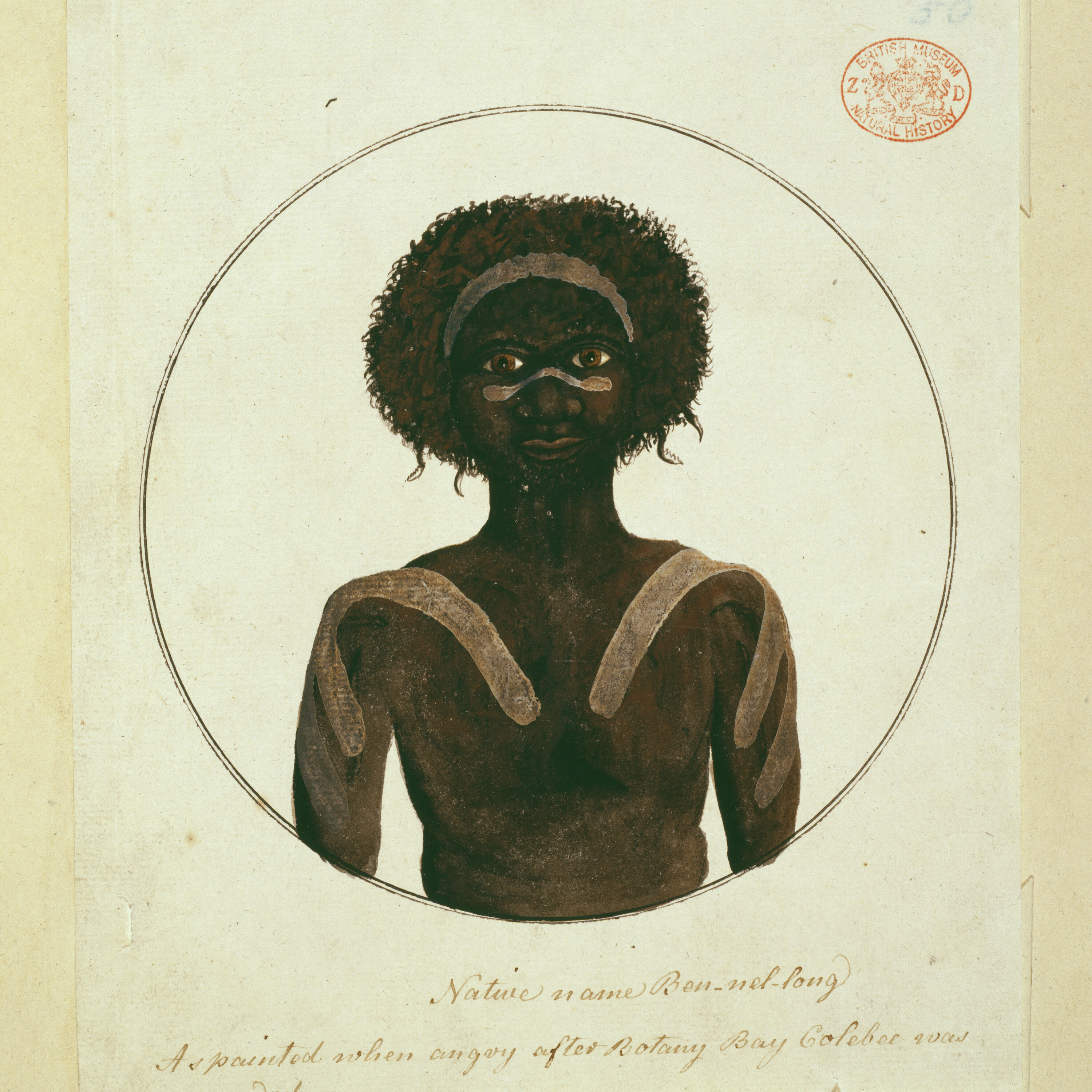
In this episode, historians Kate Fullagar and Mike McDonnell revisit Bennelong’s portraits to examine how colonial art encountered Indigenous identity. Indigenous scholar Jo Rey, a Dharug woman, challenges these depictions, questioning their accuracy and impact.  The conversation then expands to the Pacific, where Māori scholar Alice Te Punga Somerville discusses the story of Tupaia, a Polynesian navigator and artist who traveled with Captain Cook. His illustrations of first contact tell a different story—one of Indigenous agency, not just European discovery. What do we see when we look at these portraits today? And more importantly, what do they obscure? Join us on Unsettling Portraits to find out. Episode images Ben-nel-longBy the Port Jackson Painter, c. 1790. Watling, Thomas. Courtesy of the Natural History Museum, London.Ben-nil-long By James Neagle, 1798. Courtesy National Library of Australia. Australian Aborigines paddling bark canoes and spear fishing DRAWINGS, in Indian ink, illustrative of Capt. Cook's first voyage, 1768 -1770. This may record the fishing party observed by Joseph Banks at Botany Bay on 26 April 1770. By A. Buchan, John F. Miller, and others. Courtesy British Library. A Maori bartering a crayfish with an English naval officer DRAWINGS, in Indian ink, illustrative of Capt. Cook's first voyage, 1768 -1770, chiefly relating to Otaheite and New Zealand. By A. Buchan, John F. Miller, and others. Courtesy British Library. Guests Jo Rey is a Dharug scholar and Macquarie University Fellow for Indigenous Researchers in the Department of Indigenous Studies. Her research focuses on Dharug Ngurra/Country, which spans much of the Sydney metropolitan area, examining key cultural sites, including Shaw’s Creek Aboriginal Place and the Blacktown Native Institution. Building on her doctoral research on Dharug cultural continuity, her post-doctoral work explores Indigenous cultural agency through the concept of ‘Living Law’—a framework of sustainable relationality based on Recognition, Respect, Rights, Responsibility, and Reciprocity. Alice Te Punga Somerville (Māori – Te Āti Awa, Taranaki) , professor of English Language and Literatures at the University of British Columbia, is a poet, scholar, and irredentist whose work explores Indigenous connections, colonial histories, and the power of language. She is the author of Once Were Pacific: Māori Connections to Oceania, 250 Ways to Write an Essay about Captain Cook, and the poetry collection Always Italicise: How to Write While Colonised, each challenging dominant narratives and centering Indigenous perspectives. Credits Producers: Catherine Freyne and Helene Thomas.  Story Editor: Siobhan McHugh Sound Engineer: Martin Peralta  Additional production and editorial support: Jane Curtis, Britta Jorgensen and Celine Teo-Blockey Additional tile design and podcast artwork: Alexandra Morris Executive Producer: Sarah Gilbert To cite this episodeFullagar, K (researcher and host), Freyne, C (producer), McDonnell, M (researcher and host), Thomas, H (producer) (2025), 'Unsettling Portraits' Episode 2. In History Lab by Impact Studios, https://impactstudios.edu.au/podcasts/history-lab/s6/ and 10.5281/zenodo.15086322 

NOW PLAYING

26. Facing Off: From Botany Bay to Aotearoa

0:00 37:07

No transcript for this episode yet

We transcribe on demand. Request one and we'll notify you when it's ready — usually under 10 minutes.

The 48 Laws of Power by Robert Greene (Full Audiobook) Robert Greene Amoral, cunning, ruthless, and instructive, this multi-million-copy New York Times bestseller is the definitive manual for anyone interested in gaining, observing, or defending against ultimate control – from the author of The Laws of Human Nature.In the book that People magazine proclaimed “beguiling” and “fascinating,” Robert Greene and Joost Elffers have distilled three thousand years of the history of power into 48 essential laws by drawing from the philosophies of Machiavelli, Sun Tzu, and Carl Von Clausewitz and also from the lives of figures ranging from Henry Kissinger to P.T. Barnum.Some laws teach the need for prudence (“Law 1: Never Outshine the Master”), others teach the value of confidence (“Law 28: Enter Action with Boldness”), and many recommend absolute self-preservation (“Law 15: Crush Your Enemy Totally”). Every law, though, has one thing in common: an interest in t The Laura Ingraham Show Laura Ingraham The most-watched woman in the history of cable news brings her no-holds-barred political and cultural commentary to podcasting with The Laura Ingraham Show. A bestselling author, breast cancer survivor, and mother of three internationally adopted children, Laura was the most listened-to woman in talk radio before launching her own podcast. A trailblazer across media platforms, she brings a unique perspective to this twice-weekly show, drawing on her experience as a white-collar criminal defense litigator and a Supreme Court law clerk.New episodes drop twice a week—delivering the clarity, courage, and common sense America needs. Vampires of the Paper Flower Consortium Elizabeth Guizzetti Come for the evening, stay for eternity! Paper Flower Consortium is a podcast from the largest vampire coven in Seattle. Their stories are told by Loretta Fabron Onfoy, coven historian and librarian, in the hope that the modern vampire's way of life is not lost during the next great language transformation. Some tales in this anthology are horrific, some are droll, some are filled with misadventure--just like any eternal existence. Episodes sponsored by the Paper Flower Consortium's Business Community. The history is followed by questions from curious initiates. Want to ask Lady Loretta a question about vampirism? Have a topic you want to see discussed? Email [email protected] WW2 - the Key Questions, answered by Laurence Rees. Laurence Rees A former Head of BBC TV History programmes, Laurence has specialized in writing books and making television documentaries about World War Two, the Nazis and Stalinism for thirty years. He won a BAFTA and a Peabody for his TV series 'The Nazis: A Warning from History' and a British Book Award for his book on Auschwitz, which is also the world's best selling book on this notorious camp. His book 'the Holocaust: A New History' was described by the Times as 'exemplary' and by the Daily Telegraph as 'the best single volume account of the atrocity ever written'. Educated at Oxford University, for several years he was a visiting senior fellow at the London School of Economics, London University. He holds honorary doctorates from the University of Sheffield and the Open University. Professor Robert Service, of Oxford University, described Rees as 'one of the world's experts on the Second World War'. Sir Max Hastings wrote in the Sunday Times, in a review of Laurence Rees' 'World War Two: Behi

Frequently Asked Questions

How long is this episode of History Lab?

This episode is 37 minutes long.

When was this History Lab episode published?

This episode was published on March 25, 2025.

What is this episode about?

In this episode, historians Kate Fullagar and Mike McDonnell revisit Bennelong’s portraits to examine how colonial art encountered Indigenous identity. Indigenous scholar Jo Rey, a Dharug woman, challenges these depictions, questioning their...

Can I download this History Lab episode?

Yes, you can download this episode by clicking the download button on the episode player, or subscribe to the podcast in your preferred podcast app for automatic downloads.
URL copied to clipboard!