
EPISODE · Jan 17, 2026 · 21 MIN
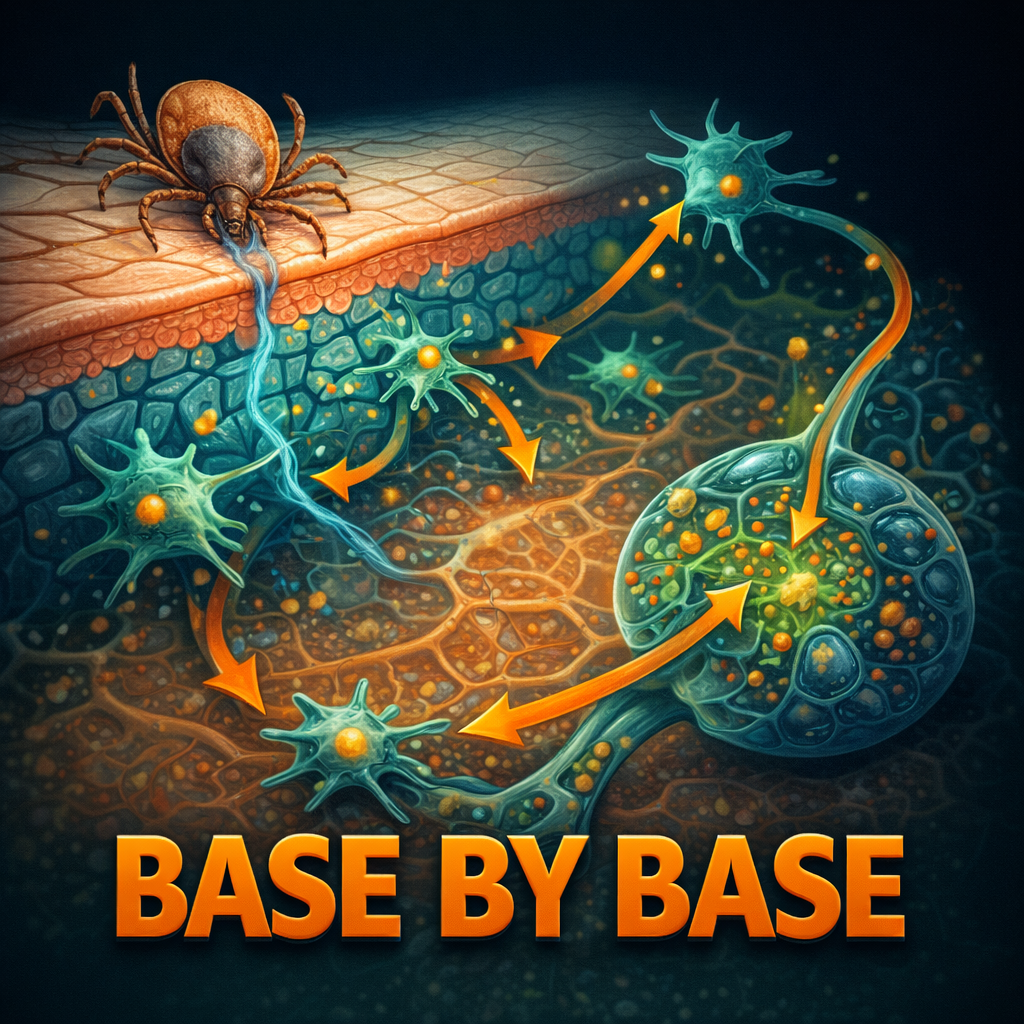
262: Human Langerhans cells reprogrammed by tick saliva (CXCR4/CCR7 migration and IDO1/IRF4 tolerance)
from Base by Base · host Gustavo Barra
Strobl et al., Nature Communications - Human epidermal Langerhans cells exposed to Ixodes ricinus tick saliva and Borrelia burgdorferi adopt a tolerogenic state with CXCR4/CCR7-driven emigration that impairs T cell priming. Key terms: Langerhans cells, tick saliva, Borrelia burgdorferi, CXCR4/CCR7 migration, immune tolerance. Study Highlights:The study uses clinical human tick bite biopsies, an ex vivo human skin tick bite model, in vitro monocyte- and CD34-derived Langerhans cells, immune spheroid cultures and single-cell RNA-sequencing of erythema migrans lesions, employing imaging, migration assays, co-cultures and scRNA-seq. Tick salivary gland extract (SGE) up-regulates CXCR4 and CCR7 on LCs, promotes emigration from the epidermis into dermis and lymphatic vessels, and reduces keratinocyte TGF-β consistent with migration. SGE and Borrelia burgdorferi drive up-regulation of tolerogenic transcription factors IDO1 and IRF4 while blunting immunogenic IRF1/NFκB programs, and SGE-primed LCs induce Treg and Th2 bias with reduced Tfh, Th17 and Th9 induction. Functionally, these changes dampen protective adaptive responses in lymphoid models and in patient lesions, which may reduce bacterial clearance and memory formation. Conclusion:Tick saliva reprograms human epidermal Langerhans cells to migrate to lymphatics and adopt a tolerogenic program that impairs protective T cell responses and may facilitate Borrelia transmission. Music:Enjoy the music based on this article at the end of the episode. Article title:Human epidermal Langerhans cells induce tolerance and hamper T cell function upon tick-borne pathogen transmission First author:Strobl Journal:Nature Communications DOI:10.1038/s41467-025-66821-6 Reference:Strobl, J., Kleissl, L., Eder, J., Conolly, S., Frey, T., Gail, L. M., Kopf, A., Weninger, S., Markowicz, M., Bartíková, P., Freystätter, C., Schmetterer, K., Strobl, H., Stockinger, H., Wijnveld, M. & Stary, G. Human epidermal Langerhans cells induce tolerance and hamper T cell function upon tick-borne pathogen transmission. Nature Communications. 2025. https://doi.org/10.1038/s41467-025-66821-6 License:This episode is based on an open-access article published under the Creative Commons Attribution 4.0 International License (CC BY 4.0) - https://creativecommons.org/licenses/by/4.0/ Support:Base by Base – Stripe donations: https://donate.stripe.com/7sY4gz71B2sN3RWac5gEg00 Official website https://basebybase.com On PaperCast Base by Base you’ll discover the latest in genomics, functional genomics, structural genomics, and proteomics. Episode link: https://basebybase.com/episodes/langerhans-tick-saliva-tolerance QC:This episode was checked against the original article PDF and publication metadata for the episode release published on 2026-01-17. QC Scope:- article metadata and core scientific claims from the narration- excludes analogies, intro/outro, and music- transcript coverage: Audited the scientific content conveyed in the transcript, focusing on LC migration (CXCR4/CCR7), tolerogenic programming (IDO1/IRF4), and T cell polarization in skin infection and ex vivo models, plus vaccine implications.- transcript topics: LC migration from epidermis to dermis/lymphatics via CXCR4/CCR7; Tolerogenic transcription factors IDO1 and IRF4 upregulation in LCs; Impact of Borrelia burgdorferi and Staphylococcus aureus on LC polarization; Ex vivo human skin tick bite model and single-cell RNA sequencing findings; Immune spheroid culture model and T cell polarization outcomes; Vaccine implications: targeting tick saliva to prevent transmission QC Summary:- factual score: 10/10- metadata score: 10/10- supported core claims: 7- claims flagged for review: 0- metadata checks passed: 4- m...
Embed this episode
NOW PLAYING
262: Human Langerhans cells reprogrammed by tick saliva (CXCR4/CCR7 migration and IDO1/IRF4 tolerance)
No transcript for this episode yet
Similar Episodes
Sep 23, 2025 ·40m
Similar Podcasts
No similar podcasts found.