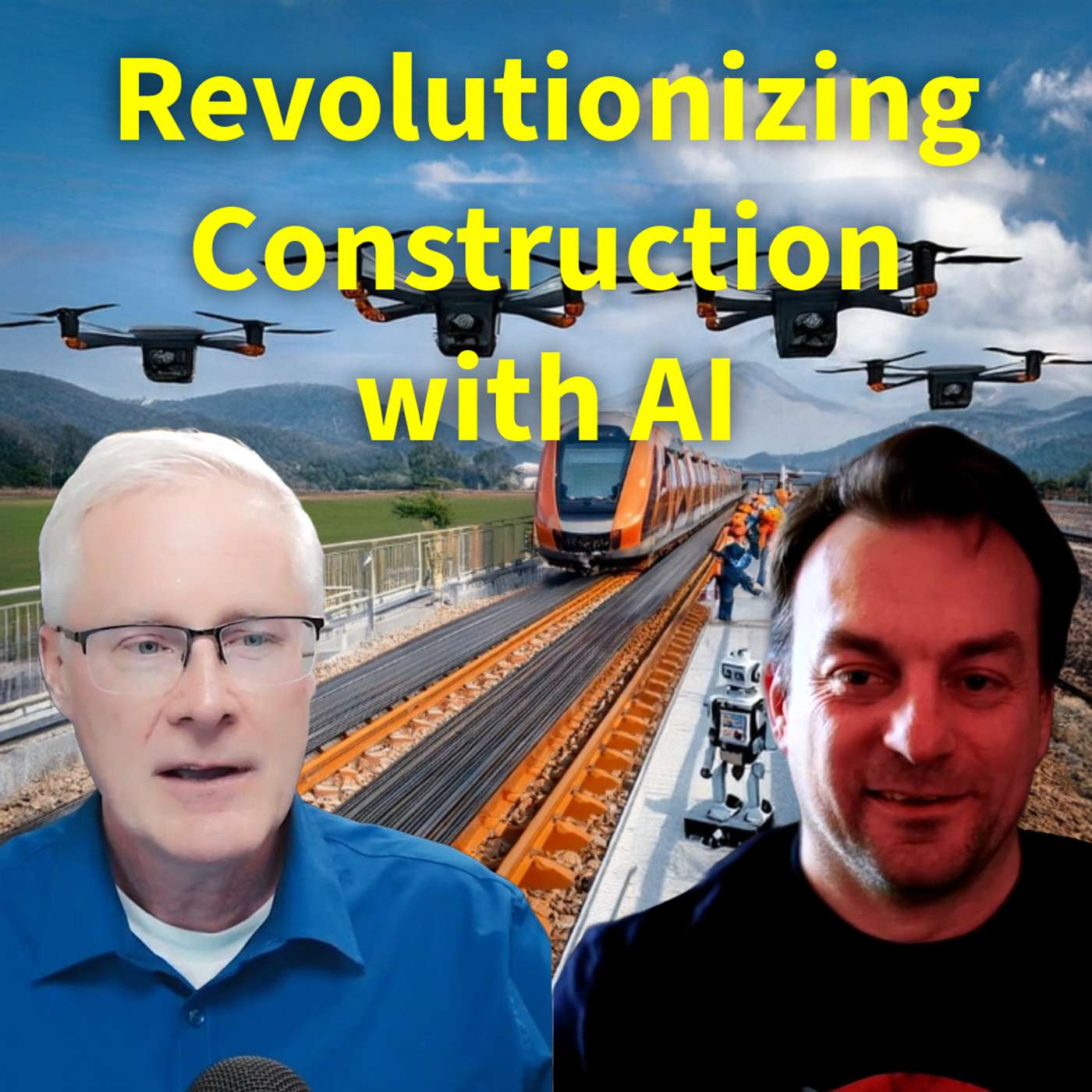
#262 Revolutionizing Construction with AI episode artwork

EPISODE · May 15, 2025 · 30 MIN

#262 Revolutionizing Construction with AI

from Embracing Digital Transformation · host Dr. Darren Pulsipher

Check out my new book AI Augmented Teams on Amazon or on my website paidar.ai/books.In this episode, Dr. Darren and Alan Mosca discuss the transformative role of AI in the construction industry. They explore Alan's journey from computer science to construction, the challenges faced in large projects, and how AI can help manage risks and improve decision-making. The discussion underscores the urgent need for cultural shifts in project management, highlighting the potential for AI to revolutionize the industry by enabling better forecasting and risk management strategies. ## Takeaways * AI is being leveraged to improve construction project outcomes. * Alan Mosca's background includes high-performance computing and machine learning. * Large construction projects often face significant delays and budget overruns. * Understanding project risks requires a narrative approach. * AI can help forecast uncertainties in construction projects. * Project managers need to adapt to new risk management strategies. * Cultural shifts are necessary for effective project management. * AI can generate multiple options for project execution. * The construction industry is evolving with AI technology. * Future projects may see improved timelines and reduced costs due to AI.Recent statistics reveal that around 80% of construction projects experience delays exceeding 50%. Despite the shocking nature of this data, it rarely stirs surprise among industry professionals. This phenomenon highlights a systemic issue within the construction sector, where expectations have gradually shifted to anticipate delays as a norm rather than an exception. However, with the rapid advancement of technology, particularly in the realm of artificial intelligence (AI), there are transformative opportunities on the horizon. These opportunities have the potential to not only rectify these longstanding challenges but also reshape the future of this industry, offering a beacon of hope for a more efficient and effective project management landscape. Understanding the Project Management LandscapeConstruction projects are inherently complex, involving an intricate web of interdependencies that often comprises tens of thousands of tasks linked in a linear sequence. If any single element falters, it can trigger a domino effect, leading to cascading delays and cost overruns. Traditional project management methods emphasize a static, deterministic approach, failing to account for the inherent uncertainty and variability of real-world execution.One of the challenges in the construction industry is the limited ability to forecast and quantify risks effectively. Unlike sectors such as finance, where quantitative analysis thrives, construction often transitions into qualitative storytelling when dealing with uncertainties. This difficulty in assessing risks not only complicates project planning but also contributes to a culture of low expectations regarding timelines and costs. Consequently, there is an urgent need to adapt project management practices that better integrate risk evaluation and mitigation strategies. The Role of AI in Mitigating RisksIncorporating AI into construction project management introduces a paradigm shift in how risks are assessed and managed. By leveraging machine learning algorithms that analyze historical project data, AI can generate predictive models that provide invaluable insights into potential project outcomes. These models help identify the most probable delays and their causes, allowing project managers to plan strategically for contingencies. This reassures us that AI is not just a tool, but a powerful ally in the battle against project delays and cost overruns.AI can also facilitate the exploration of various project pathways and scenarios. By simulating different decisions and interventions, managers can analyze a wide array of possible outcomes, ultimately aiding in decision-making processes. For instance, if a particular task, such as concrete delivery, is forecasted to be delayed, managers can assess alternative scheduling approaches or resource allocations in real time. This ability to model multiple outcomes empowers project managers to act proactively, rather than reactively, resulting in more efficient project execution. Building a Culture of Future-Oriented MindsetsThe implementation of AI does not merely automate existing processes; it prompts a cultural shift within organizations. A successful transition towards data-driven project management requires project managers to embrace a future-oriented mindset. Instead of merely tracking progress, they must consider how present decisions influence future outcomes in a landscape rife with uncertainties. This shift in perspective is not just a necessity but an opportunity for inspiration and motivation, as it opens up new possibilities for more efficient and effective project management.To facilitate this transition, organizations must invest in training and development for their project management teams. Developing skills in data analysis, risk assessment, and decision-making under uncertainty equips teams to leverage AI effectively. Additionally, fostering a culture that prioritizes collaboration and shared responsibility for project success aligns stakeholders around common goals, reducing the likelihood of internal politics that can complicate project execution. Bright FutureAs the construction industry grapples with the perpetual challenge of delays and cost overruns, the adoption of AI presents an opportunity for significant transformation. By leveraging advanced predictive analytics and simulation capabilities, organizations can revitalize their approach to project management, fostering a culture that embraces uncertainty rather than shying away from it. As these changes take hold, we may soon witness a notable shift in project outcomes, with timely and on-budget delivery becoming not just an aspiration but a reality.If you are interested in exploring these innovative approaches and how AI can enhance project management in construction, consider joining the conversation and consulting available online resources.

Check out my new book AI Augmented Teams on Amazon or on my website paidar.ai/books.In this episode, Dr. Darren and Alan Mosca discuss the transformative role of AI in the construction industry. They explore Alan's journey from computer science to construction, the challenges faced in large projects, and how AI can help manage risks and improve decision-making. The discussion underscores the urgent need for cultural shifts in project management, highlighting the potential for AI to revolutionize the industry by enabling better forecasting and risk management strategies. ## Takeaways * AI is being leveraged to improve construction project outcomes. * Alan Mosca's background includes high-performance computing and machine learning. * Large construction projects often face significant delays and budget overruns. * Understanding project risks requires a narrative approach. * AI can help forecast uncertainties in construction projects. * Project managers need to adapt to new risk management strategies. * Cultural shifts are necessary for effective project management. * AI can generate multiple options for project execution. * The construction industry is evolving with AI technology. * Future projects may see improved timelines and reduced costs due to AI.Recent statistics reveal that around 80% of construction projects experience delays exceeding 50%. Despite the shocking nature of this data, it rarely stirs surprise among industry professionals. This phenomenon highlights a systemic issue within the construction sector, where expectations have gradually shifted to anticipate delays as a norm rather than an exception. However, with the rapid advancement of technology, particularly in the realm of artificial intelligence (AI), there are transformative opportunities on the horizon. These opportunities have the potential to not only rectify these longstanding challenges but also reshape the future of this industry, offering a beacon of hope for a more efficient and effective project management landscape. Understanding the Project Management LandscapeConstruction projects are inherently complex, involving an intricate web of interdependencies that often comprises tens of thousands of tasks linked in a linear sequence. If any single element falters, it can trigger a domino effect, leading to cascading delays and cost overruns. Traditional project management methods emphasize a static, deterministic approach, failing to account for the inherent uncertainty and variability of real-world execution.One of the challenges in the construction industry is the limited ability to forecast and quantify risks effectively. Unlike sectors such as finance, where quantitative analysis thrives, construction often transitions into qualitative storytelling when dealing with uncertainties. This difficulty in assessing risks not only complicates project planning but also contributes to a culture of low expectations regarding timelines and costs. Consequently, there is an urgent need to adapt project management practices that better integrate risk evaluation and mitigation strategies. The Role of AI in Mitigating RisksIncorporating AI into construction project management introduces a paradigm shift in how risks are assessed and managed. By leveraging machine learning algorithms that analyze historical project data, AI can generate predictive models that provide invaluable insights into potential project outcomes. These models help identify the most probable delays and their causes, allowing project managers to plan strategically for contingencies. This reassures us that AI is not just a tool, but a powerful ally in the battle against project delays and cost overruns.AI can also facilitate the exploration of various project pathways and scenarios. By simulating different decisions and interventions, managers can analyze a wide array of possible outcomes, ultimately aiding in decision-making processes. For instance, if a particular task, such as concrete delivery, is forecasted to be delayed, managers can assess alternative scheduling approaches or resource allocations in real time. This ability to model multiple outcomes empowers project managers to act proactively, rather than reactively, resulting in more efficient project execution. Building a Culture of Future-Oriented MindsetsThe implementation of AI does not merely automate existing processes; it prompts a cultural shift within organizations. A successful transition towards data-driven project management requires project managers to embrace a future-oriented mindset. Instead of merely tracking progress, they must consider how present decisions influence future outcomes in a landscape rife with uncertainties. This shift in perspective is not just a necessity but an opportunity for inspiration and motivation, as it opens up new possibilities for more efficient and effective project management.To facilitate this transition, organizations must invest in training and development for their project management teams. Developing skills in data analysis, risk assessment, and decision-making under uncertainty equips teams to leverage AI effectively. Additionally, fostering a culture that prioritizes collaboration and shared responsibility for project success aligns stakeholders around common goals, reducing the likelihood of internal politics that can complicate project execution. Bright FutureAs the construction industry grapples with the perpetual challenge of delays and cost overruns, the adoption of AI presents an opportunity for significant transformation. By leveraging advanced predictive analytics and simulation capabilities, organizations can revitalize their approach to project management, fostering a culture that embraces uncertainty rather than shying away from it. As these changes take hold, we may soon witness a notable shift in project outcomes, with timely and on-budget delivery becoming not just an aspiration but a reality.If you are interested in exploring these innovative approaches and how AI can enhance project management in construction, consider joining the conversation and consulting available online resources.

NOW PLAYING

#262 Revolutionizing Construction with AI

0:00 30:35

No transcript for this episode yet

We transcribe on demand. Request one and we'll notify you when it's ready — usually under 10 minutes.

Solving for Change MOBIA Technology Innovations Solving for Change welcomes business and technology leaders to share stories of bold business transformation within complex organizations. In an era when technology and markets are changing around businesses, the key to staying competitive is to evolve in response to those changes.  MOBIA’s Mike Reeves and Marc LeBlanc investigate business transformation, deconstructing the challenges, ambitions, and market disruptions that drive companies to embark on transformation journeys, and exploring their unique approaches to achieving meaningful outcomes.  What sparks leaders to pursue business transformation? How do they overcome the challenges along the way? What are the keys to creating enduring change?  Through in-depth conversations with business and technology leaders, Mike and Marc answer these questions and explore how businesses evolve by pulling four key transformation levers: people, process, technology, and culture. Darknet Discussions Darknet Discussions Welcome to "Darknet Discussions," the podcast that gets into the shadows of the internet to bring you the most intriguing, enlightening, and sometimes unsettling stories from the dark web. Hosted by seasoned darknet aficionados, each episode of "Darknet Discussions" explores the intricate dynamics of darknet markets, cybersecurity threats, and the digital underworld. Join us as we interview experts, discuss the latest trends in cybercrime, and shed light on the technologies that operate beneath the surface of everyday internet use. Also, we occasionally go off on a tangent about something completely unrelated. The Digital Experience Show by Enonic Enonic All you need to know about digital strategy, digital experiences, and CMS are covered in this podcast. Powered by NotebookLM. Tips, News and Stories for Older Adults Esther C Kane CAPS, C.D.S. "Tips, News, and Stories for Older Adults" delivers weekly insights tailored for seniors. We bring you summaries of curated news, practical advice, and inspiring stories that matter to the 55+ community. From health and finance to technology and lifestyle, our content keeps you informed and engaged. Sourced from trusted outlets, each episode offers valuable information for navigating your golden years. Join us as we explore aging with positivity, wisdom, and engaging stories. Your perfect companion for staying active, learning, and embracing life's later chapters.

Frequently Asked Questions

How long is this episode of Embracing Digital Transformation?

This episode is 30 minutes long.

When was this Embracing Digital Transformation episode published?

This episode was published on May 15, 2025.

What is this episode about?

Check out my new book AI Augmented Teams on Amazon or on my website paidar.ai/books.In this episode, Dr. Darren and Alan Mosca discuss the transformative role of AI in the construction industry. They explore Alan's journey from computer science to...

Can I download this Embracing Digital Transformation episode?

Yes, you can download this episode by clicking the download button on the episode player, or subscribe to the podcast in your preferred podcast app for automatic downloads.
URL copied to clipboard!