
EPISODE · Jan 22, 2026 · 21 MIN
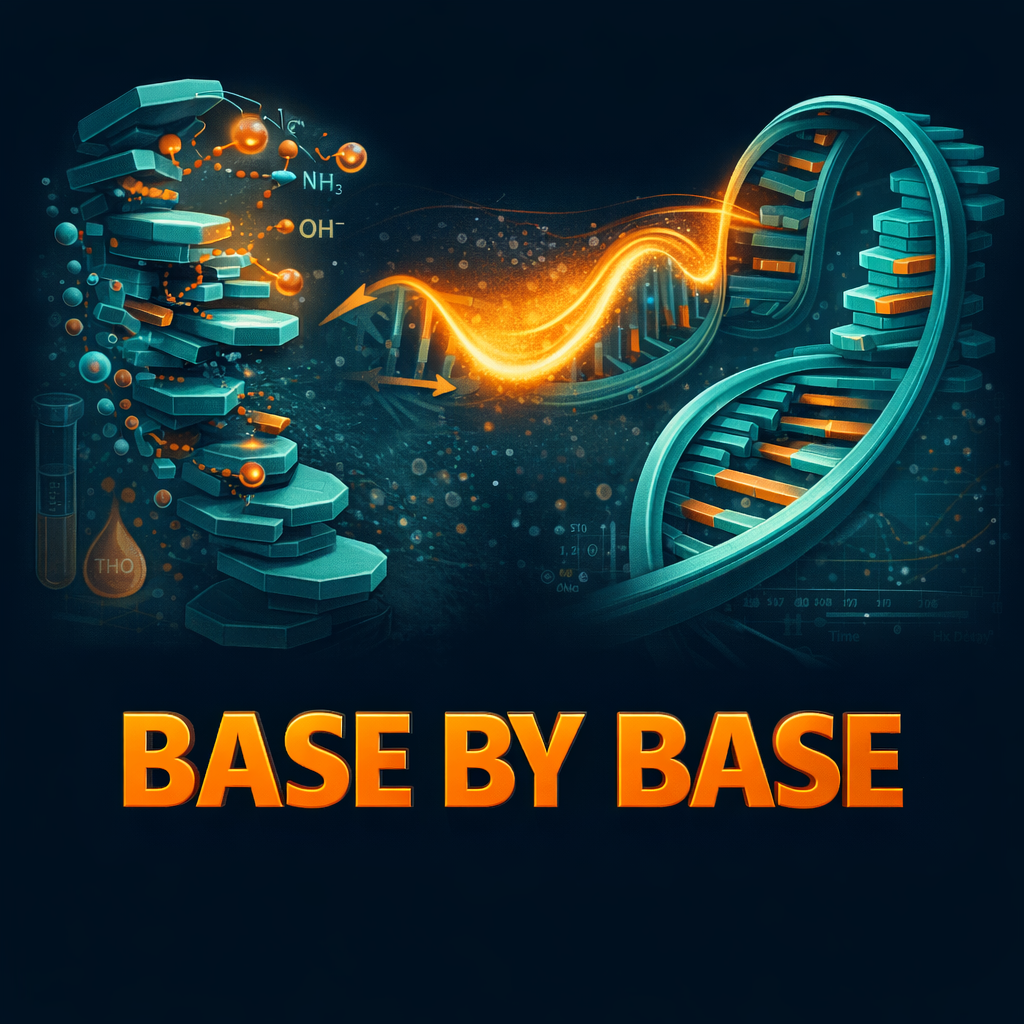
267: DNA base-pair opening modes and soliton-like loops revealed by hydrogen exchange
from Base by Base · host Gustavo Barra
Englander SW et al., Proc. Natl. Acad. Sci. U.S.A. 2026.123:e2520855122 - Hydrogen exchange (H-T and NMR H-H) on DNA and RNA reveals two distinct base-pair opening modes: single-base microsecond openings and multi-base millisecond soliton-like loops. Key terms: hydrogen exchange, DNA dynamics, base pair opening, soliton, H-T exchange. Study Highlights:Systems studied include long polynucleotides (DNA, duplex RNA, synthetic long duplexes) and short oligonucleotides; key methods are H-T (tritium) exchange, stopped-flow H-D, and NMR H-H (water relaxation) measurements. H-T exchange of long polymers reports opening-limited EX1 imino exchange with kop ~1/s, reclosing kcl ~20/s and Kop ~10^-2 consistent with multi-base open loops with ms lifetimes. NMR H-H on short oligos reports catalyzable EX2 behavior dominated by single base-pair openings with kcl ~10^6/s and Kop ~10^-6 and microsecond lifetimes. The selective detection implies short oligonucleotides cannot host extensive loops while multi-base soliton-like loops in polynucleotides could dynamically expose sequences for protein or nucleic acid recognition. Conclusion:Both H-T and NMR H-H exchange provide accurate but complementary views: long polynucleotides exhibit frequent multi-base, ms-lived open loops (Kop ~10^-2, kcl ~20/s) while short oligonucleotides reveal rare single-base, μs-lived openings (Kop ~10^-6, kcl ~10^6/s). QC:This episode was checked against the original article PDF and publication metadata for the episode release published on 2026-01-22. QC Scope:- article metadata and core scientific claims from the narration- excludes analogies, intro/outro, and music- transcript coverage: Audited transcript portions describing hydrogen exchange theory, EX1/EX2, the two base-pair opening modes, the soliton traveling loop hypothesis, length dependence, and biological implications as presented in the article.- transcript topics: Hydrogen exchange theory and Eigen proton-transfer foundations; H-T exchange in long polynucleotides (1000+ bp) and EX1 vs EX2 interpretation; H-H exchange by NMR in short oligonucleotides and its constraints; Two base-pair opening modes: single-base openings (EX1-dominated) and multi-base open loops (EX2-dominated); Soliton traveling loop hypothesis and migration along DNA; Length dependence reconciles datasets (native long DNA vs short oligonucleotides) QC Summary:- factual score: 10/10- metadata score: 10/10- supported core claims: 5- claims flagged for review: 0- metadata checks passed: 4- metadata issues found: 0 Metadata Audited:- article_doi- article_title- article_journal- license Factual Items Audited:- There are two base-pair opening modes: single-base openings detected by NMR on short oligonucleotides and multi-base open loops observed in long polynucleotides- HT (tritium) exchange reports ms-lived open loops with Kop ~ 10^-2 and kcl ~ 20 s^-1 in long polynucleotides, with open-state population Kop ~ 10^-2 (~1%)- HH-NMR exchange on short oligonucleotides reports μs-lived single-base openings with Kop ~ 10^-6 and very low open-state population- A traveling soliton-like loop mechanism is proposed to explain how open states migrate along DNA and expose sequences- Length of nucleic acid dictates which HX method observes which opening mode, reconciling historical discrepancies- Cryo-EM is proposed as a future method to visualize soliton-like waves and validate the hypothesis QC result: Pass. Chapters (00:00:00) - Papercast: The mystery of DNA(00:02:42) - Breaking down the mystery of DNA(00:03:26) - How does DNA open? The '(00:07:43) - DNA is Not Like Longer Strands(00:11:32) - The physics of DNA replication(00:16:10) - I'm 1% Open
Embed this episode
NOW PLAYING
267: DNA base-pair opening modes and soliton-like loops revealed by hydrogen exchange
No transcript for this episode yet
Similar Episodes
Feb 4, 2026 ·18m
Similar Podcasts
No similar podcasts found.