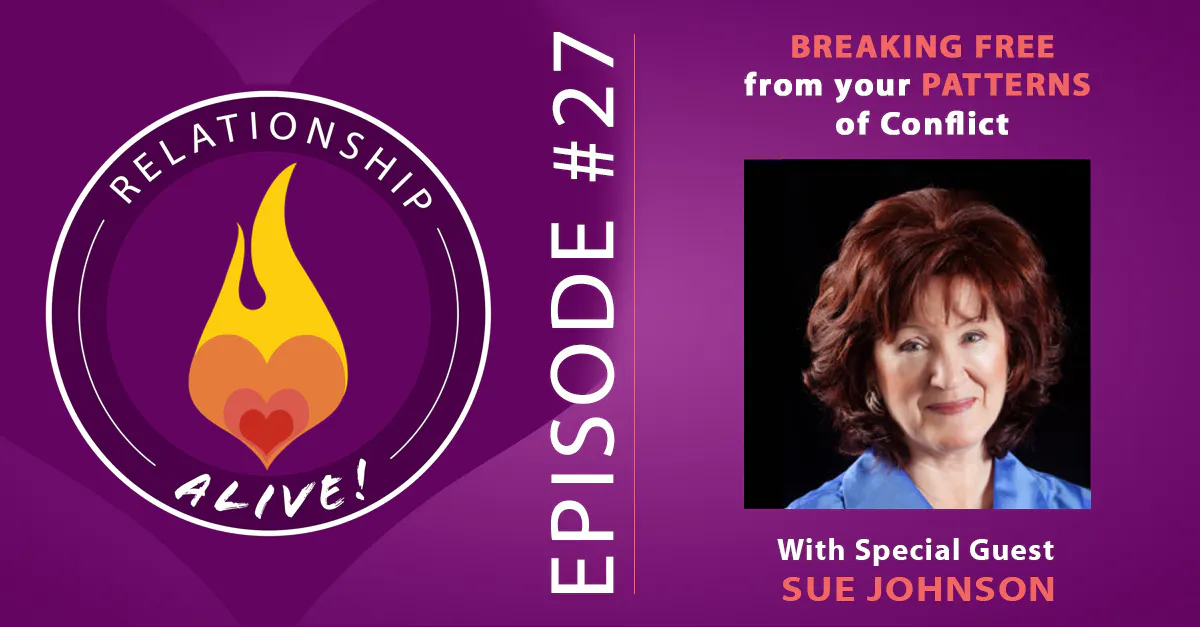
27: Breaking Free from Your Patterns of Conflict with Sue Johnson episode artwork

EPISODE · Feb 23, 2016 · 59 MIN

27: Breaking Free from Your Patterns of Conflict with Sue Johnson

from Relationship Alive! · host Neil Sattin

Have you ever had the feeling that you get into the same kind of conflict, over and over again, in your relationship? And when you recognize that, do you feel more free- like you are able to stop the pattern in its tracks and do something better? Or, are you left feeling powerless once the train has left the station? Well, it turns out there is one major source of all conflicts within a couple, and today we are going to talk about what that source is, and in very practical terms how to recognize it and break free of those repetitive patterns when they are happening. And, we will also have a helpful hint or two for those of us in relationships with children from past relationships. Today’s guest is Dr. Sue Johnson, renowned psychologist, researcher, teacher, and author of the book “Hold Me Tight- Seven Conversations for a Lifetime of Love”. She is a leading innovator in the field of couple’s therapy, and the primary developer of Emotionally Focused Couple’s Therapy (EFT), which has demonstrated effectiveness in over 25 years of peer reviewed clinical research. Get ready to learn even more how to apply attachment theory to your life in a way that will help you feel more grounded and secure in your relationship, and better able to take on the world! In this episode, Dr. Sue Johnson and I explore the following: Romantic love is an ancient wired in survival code- More and more research, and more and more couples, are helping to crack the code of love! We now know that you must go towards the emotions in order to understand the who, whys, hows, and whats of romantic love. Adult bonding and all the emotions involved in this is the key. So much of previous couple’s therapy and relationship advice has focused on skill acquisition and controlling cognitive thinking, but as most of us have experienced, skills usually go out the window in the face of enormously powerful emotions. Emotions are not byproducts of interactions, rather they are the music of the dance. Emotions organize our interactions. When you are lost, confused, stuck, remember Sue Johnson’s exclamation as she really looked into the research: “Oh my! This is ALL about attachment bonds!” And it is. Your mammalian brain is wired to perceive relationship threats as a matter of life or death, because in many ways they are. They key question in love from an attachment point of you is: Are you there for me? Can I rely on you to be there? Will you come when I call? A.R.E: Is there someone on this planet that you matter to so much to that they will be available, responsive, and engaged? Aka, A.R.E. If you have ever been surprised by the intensity of your emotional reactions in your relationship (sadness,  anger, devastation, the list goes on), think about it in relation to attachment and the core need we each have to trust that your partner will be there. A vision for what is actually possible in your relationship: From last 25 years of research, and from what couples share, we know that you CAN learn to understand this dance called love. Even if you have had negative relationships, and even if you are in a distressed relationship right now where you are actively hurting each other, you CAN learn to see patterns, the way you move with your partner, the way you trigger each other, step on each others feet, and push each other off balance. You can learn to help each other in moments of emotional disconnection when your brain freaks out because it says “I am all alone”. You can help learn to balance each other and create a secure base. You can look and say “Hey! We are caught in that thing again, where I can’t seem to connect with you and I get upset and so I start poking you so that you will turn towards me, but you feel that I am just trying to hurt you and that makes you run away, so...shall we not do that thing and sit and have tea instead?!” Every relationship has that thing, that pattern, argument, stuckness that you find yourself up against over and over again. Get creative and make names for it! Our spiral, the nothing, the tornado… Make it so that you you guys can recognize ways emotional disconnection manifests in your relationship (so you can help each other out of it!). A secure bond is the way we are meant to be! A secure bond is predictive of every kind of mental health, growth, and good mental processing you can imagine. We are born longing for this connection with a few loving others, and when you are in a secure place it is as if your whole system becomes available for collaboration. Without it our system becomes compromised. If you are spending 75% of your energy trying to prove to others that you're okay, worrying if other people will accept you, feeling alone, trying to persuade yourself that you don't need other people, or actually trying to please other people, then obviously it will cripple your growth and your ability to deal with stress. Homo Vinculums- Somehow in the 21st century we have forgotten just how important secure bonding is. We are homo vinculum- the one who bonds. We are social attaching bonding animals and our whole nervous system is wired for that! Understand your own homo vinculum-ness and you will understand why it is so natural to be terrified of rejection and abandonment. In fact, our brains respond to rejection in the exact same location, and in the exact same way as it processes physical pain. Hold me tight- We are social interpersonal beings that are designed to grow each other. Resilience comes from the ability to reach out when the dragon comes and hold hands with another human being. The best strategy for dealing with our vulnerableness is to ask for support, take in support, and turn to other people. This is especially true in our relationships! There are ways to share vulnerability and enter into emotions together in a way that pulls your partner towards you and leads to secure bonding. Remember that our partners can do things that no therapist can do, and that our intimate relationships are the most natural and potent places for growth. While there is always inner work that must be done (addressing triggers, looking at patterns, exploring wounds), it is in the safety and love from another that you can make sense of your emotions, learn to stay balanced, and learn to deal with panic. Demon dialogues- Demon dialogues are those negative patterns and traps oh-so-common in our relationships. Here are three categories: Find the bad guy- This is an attack attack pattern where both of you are pointing fingers, placing blame, and saying “this is your fault not mine”. You are giving the message that you would be “better even if I am by myself’ which is often not the case. Protest Polka- This is the most popular demon dialogue and is also known as demand/withdraw. It occurs when one of you is searching for connection and you begin to demand it. The demander pokes and pokes their partner to get a response, and the other partner begins to withdraw more and more, feeling like the more they get poked the more they want to run. This creates increased distance, tension, and dissonance. Freeze and Flee- This is a last resort/last ditch effort kind of pattern. It occurs when the couple becomes burnt out after hundreds of protest polka and find the bad guy interactions. It occurs when there is no clear solution and no other way to reconnect. Both partners become withdrawn and the relationship becomes a desert.     Invite yourself to think about your own relationships- Do any of these dialogues seem familiar? What patterns do you notice? Even the healthiest relationships have interactions like these, however because there are loads of other loving interactions mixed in, the ‘bad ones’ don’t become the central feature- and you are able to find ways to turn towards each other and reconnect. When you look closely together at your demon dialogues you will find the source-- either one or both of you are triggered and a raw spot has been exposed- you experienced a disconnection from your partner and you entered these dialogues in an effort, albeit ineffective, to repair connection. Revisit a rocky moment at a later point through the lens of attachment to better process and get to the source of your arguments. Although it may seem that couples fight about dishes, laundry, ex’s, schedules...underneath all arguments is the essential question “are you there for me?” Once you can understand how the fear of rejection and abandonment is a natural fear, you will be able to identify where you get stuck and will find productive ways to deal with moments of disconnection. Talking about your fears and vulnerability in a clear way will get you both out of that stuck place where you quickly become polarized and dangerous to each other. Deep in our bones we know this bonding dance. Even if you did not have secure attachments in childhood, we each have a deep instinctive propensity for bonding. You do know what you need to feel secure - you just need to be willing (and feel safe enough) to take the risk and as for what you know you need. Don’t make your partner guess! You can say things as direct as “Right now, babe, I need you to reassure me that you still want me!”, “Hey! Sweets! Can you please take a break and rub my feet for a few minutes I need some closeness if you are available”, “I need for you to tell me that I matter to you, and if you are too busy right now, then tell me will will do something together on the weekend”, or “This is scary for me to tell you, but I really do need you to reel me in right now because I am stuck behind this wall I built and I can’t quite get out”. People move into a new dance bit by bit when they feel confident enough to express and address their emotions. Is a secure connection the enemy of eroticism? Many have long questioned whether long term relationship stability leads to a lack of eroticism, and some have even stated it as a truth, but good news is that all the evidence points in the opposite direction! Evidence shows that a secure emotional connection helps you engage, explore, and become attuned to your partner, which is essential for intimacy. Passion is the longing for emotional connection twinned with the ability to attune and move together in synchrony and then go into erotic play. Extra tip: If you are in a blended family in which your relationship involves children from previous relationships, EFT is perfect for you too! At this point you may be overwhelmed by trying to balance the responsibility you feel for your children and their ruptured attachment, and the energy you need and want to put into growing your new relationship. You may be feeling like it can’t all happen at once! This is true, but the more you can work on your relationship the more you can turn as a team and parent (what are now) YOUR children in a way that makes them feel safe and connected. Focus in on the emotional realm of your partnership, learn together about the messages you send each other and why. You and your children will benefit from your increased sense of security and attunement. Resources For more research and videos on the science of bonding see Sue’s website: www.drsuejohnson.com Read her book: Hold Me Tight: Seven Conversations for a Lifetime of Love The Still Face Experiment: Dr. Edward Tronick www.neilsattin.com/sue Visit to download the show guide, or text “PASSION” to 33444 and follow the instructions to download the show guide to this episode with Sue Johnson - and to qualify to win a free copy of “Hold Me Tight”. Our Relationship Alive Community on Facebook Amazing intro/outro music graciously provided courtesy of: The Railsplitters - Check them Out

Have you ever had the feeling that you get into the same kind of conflict, over and over again, in your relationship? And when you recognize that, do you feel more free- like you are able to stop the pattern in its tracks and do something better? Or, are you left feeling powerless once the train has left the station? Well, it turns out there is one major source of all conflicts within a couple, and today we are going to talk about what that source is, and in very practical terms how to recognize it and break free of those repetitive patterns when they are happening. And, we will also have a helpful hint or two for those of us in relationships with children from past relationships. Today’s guest is Dr. Sue Johnson, renowned psychologist, researcher, teacher, and author of the book “Hold Me Tight- Seven Conversations for a Lifetime of Love”. She is a leading innovator in the field of couple’s therapy, and the primary developer of Emotionally Focused Couple’s Therapy (EFT), which has demonstrated effectiveness in over 25 years of peer reviewed clinical research. Get ready to learn even more how to apply attachment theory to your life in a way that will help you feel more grounded and secure in your relationship, and better able to take on the world! In this episode, Dr. Sue Johnson and I explore the following: Romantic love is an ancient wired in survival code- More and more research, and more and more couples, are helping to crack the code of love! We now know that you must go towards the emotions in order to understand the who, whys, hows, and whats of romantic love. Adult bonding and all the emotions involved in this is the key. So much of previous couple’s therapy and relationship advice has focused on skill acquisition and controlling cognitive thinking, but as most of us have experienced, skills usually go out the window in the face of enormously powerful emotions. Emotions are not byproducts of interactions, rather they are the music of the dance. Emotions organize our interactions. When you are lost, confused, stuck, remember Sue Johnson’s exclamation as she really looked into the research: “Oh my! This is ALL about attachment bonds!” And it is. Your mammalian brain is wired to perceive relationship threats as a matter of life or death, because in many ways they are. They key question in love from an attachment point of you is: Are you there for me? Can I rely on you to be there? Will you come when I call? A.R.E: Is there someone on this planet that you matter to so much to that they will be available, responsive, and engaged? Aka, A.R.E. If you have ever been surprised by the intensity of your emotional reactions in your relationship (sadness,  anger, devastation, the list goes on), think about it in relation to attachment and the core need we each have to trust that your partner will be there. A vision for what is actually possible in your relationship: From last 25 years of research, and from what couples share, we know that you CAN learn to understand this dance called love. Even if you have had negative relationships, and even if you are in a distressed relationship right now where you are actively hurting each other, you CAN learn to see patterns, the way you move with your partner, the way you trigger each other, step on each others feet, and push each other off balance. You can learn to help each other in moments of emotional disconnection when your brain freaks out because it says “I am all alone”. You can help learn to balance each other and create a secure base. You can look and say “Hey! We are caught in that thing again, where I can’t seem to connect with you and I get upset and so I start poking you so that you will turn towards me, but you feel that I am just trying to hurt you and that makes you run away, so...shall we not do that thing and sit and have tea instead?!” Every relationship has that thing, that pattern, argument, stuckness that you find yourself up against over and over again. Get creative and make names for it! Our spiral, the nothing, the tornado… Make it so that you you guys can recognize ways emotional disconnection manifests in your relationship (so you can help each other out of it!). A secure bond is the way we are meant to be! A secure bond is predictive of every kind of mental health, growth, and good mental processing you can imagine. We are born longing for this connection with a few loving others, and when you are in a secure place it is as if your whole system becomes available for collaboration. Without it our system becomes compromised. If you are spending 75% of your energy trying to prove to others that you're okay, worrying if other people will accept you, feeling alone, trying to persuade yourself that you don't need other people, or actually trying to please other people, then obviously it will cripple your growth and your ability to deal with stress. Homo Vinculums- Somehow in the 21st century we have forgotten just how important secure bonding is. We are homo vinculum- the one who bonds. We are social attaching bonding animals and our whole nervous system is wired for that! Understand your own homo vinculum-ness and you will understand why it is so natural to be terrified of rejection and abandonment. In fact, our brains respond to rejection in the exact same location, and in the exact same way as it processes physical pain. Hold me tight- We are social interpersonal beings that are designed to grow each other. Resilience comes from the ability to reach out when the dragon comes and hold hands with another human being. The best strategy for dealing with our vulnerableness is to ask for support, take in support, and turn to other people. This is especially true in our relationships! There are ways to share vulnerability and enter into emotions together in a way that pulls your partner towards you and leads to secure bonding. Remember that our partners can do things that no therapist can do, and that our intimate relationships are the most natural and potent places for growth. While there is always inner work that must be done (addressing triggers, looking at patterns, exploring wounds), it is in the safety and love from another that you can make sense of your emotions, learn to stay balanced, and learn to deal with panic. Demon dialogues- Demon dialogues are those negative patterns and traps oh-so-common in our relationships. Here are three categories: Find the bad guy- This is an attack attack pattern where both of you are pointing fingers, placing blame, and saying “this is your fault not mine”. You are giving the message that you would be “better even if I am by myself’ which is often not the case. Protest Polka- This is the most popular demon dialogue and is also known as demand/withdraw. It occurs when one of you is searching for connection and you begin to demand it. The demander pokes and pokes their partner to get a response, and the other partner begins to withdraw more and more, feeling like the more they get poked the more they want to run. This creates increased distance, tension, and dissonance. Freeze and Flee- This is a last resort/last ditch effort kind of pattern. It occurs when the couple becomes burnt out after hundreds of protest polka and find the bad guy interactions. It occurs when there is no clear solution and no other way to reconnect. Both partners become withdrawn and the relationship becomes a desert.     Invite yourself to think about your own relationships- Do any of these dialogues seem familiar? What patterns do you notice? Even the healthiest relationships have interactions like these, however because there are loads of other loving interactions mixed in, the ‘bad ones’ don’t become the central feature- and you are able to find ways to turn towards each other and reconnect. When you look closely together at your demon dialogues you will find the source-- either one or both of you are triggered and a raw spot has been exposed- you experienced a disconnection from your partner and you entered these dialogues in an effort, albeit ineffective, to repair connection. Revisit a rocky moment at a later point through the lens of attachment to better process and get to the source of your arguments. Although it may seem that couples fight about dishes, laundry, ex’s, schedules...underneath all arguments is the essential question “are you there for me?” Once you can understand how the fear of rejection and abandonment is a natural fear, you will be able to identify where you get stuck and will find productive ways to deal with moments of disconnection. Talking about your fears and vulnerability in a clear way will get you both out of that stuck place where you quickly become polarized and dangerous to each other. Deep in our bones we know this bonding dance. Even if you did not have secure attachments in childhood, we each have a deep instinctive propensity for bonding. You do know what you need to feel secure - you just need to be willing (and feel safe enough) to take the risk and as for what you know you need. Don’t make your partner guess! You can say things as direct as “Right now, babe, I need you to reassure me that you still want me!”, “Hey! Sweets! Can you please take a break and rub my feet for a few minutes I need some closeness if you are available”, “I need for you to tell me that I matter to you, and if you are too busy right now, then tell me will will do something together on the weekend”, or “This is scary for me to tell you, but I really do need you to reel me in right now because I am stuck behind this wall I built and I can’t quite get out”. People move into a new dance bit by bit when they feel confident enough to express and address their emotions. Is a secure connection the enemy of eroticism? Many have long questioned whether long term relationship stability leads to a lack of eroticism, and some have even stated it as a truth, but good news is that all the evidence points in the opposite direction! Evidence shows that a secure emotional connection helps you engage, explore, and become attuned to your partner, which is essential for intimacy. Passion is the longing for emotional connection twinned with the ability to attune and move together in synchrony and then go into erotic play. Extra tip: If you are in a blended family in which your relationship involves children from previous relationships, EFT is perfect for you too! At this point you may be overwhelmed by trying to balance the responsibility you feel for your children and their ruptured attachment, and the energy you need and want to put into growing your new relationship. You may be feeling like it can’t all happen at once! This is true, but the more you can work on your relationship the more you can turn as a team and parent (what are now) YOUR children in a way that makes them feel safe and connected. Focus in on the emotional realm of your partnership, learn together about the messages you send each other and why. You and your children will benefit from your increased sense of security and attunement. Resources For more research and videos on the science of bonding see Sue’s website: www.drsuejohnson.com Read her book: Hold Me Tight: Seven Conversations for a Lifetime of Love The Still Face Experiment: Dr. Edward Tronick www.neilsattin.com/sue Visit to download the show guide, or text “PASSION” to 33444 and follow the instructions to download the show guide to this episode with Sue Johnson - and to qualify to win a free copy of “Hold Me Tight”. Our Relationship Alive Community on Facebook Amazing intro/outro music graciously provided courtesy of: The Railsplitters - Check them Out

NOW PLAYING

27: Breaking Free from Your Patterns of Conflict with Sue Johnson

0:00 59:23

No transcript for this episode yet

We transcribe on demand. Request one and we'll notify you when it's ready — usually under 10 minutes.

LIGHTS, CAMERA, SMILE! Creatives Club Media Lights, Camera, Smile, is a podcast for anyone with a dream to share something with the world, out of the overflow of themselves - be it their mind, their heart, their personalities, and much more. Each of us are alive in this moment in time, with an innate ability to have ideas and create various things to benefit both ourselves and the people around us for a reason, and here, you will find the encouragement, the inspiration, and the motivation to do just that. Hosted by Cicily, founder of Creatives Club, she dives into various topics surrounding creativity and business. Exploring entrepreneurship for creatives in a corporate reality, sharing tips and tricks in a media centered company, answering questions regarding what a creative actually is are just a few of the things discussed on this podcast. Be encouraged to create for yourself as Cicily gets vulnerable by pivoting the camera to herself for the first time.To submit questions for Cicily to answer, or have her address certain t Tao Te Ching by Laozi (Author), Stephen Mitchell (Full Audiobook) Laozi Lao-tzu's Tao Te Ching, or Book of the Way, is the classic manual on the art of living, and one of the wonders of the world. In eighty-one brief chapters, the Tao Te Ching looks at the basic predicament of being alive and gives advice that imparts balance and perspective, a serene and generous spirit. This book is about wisdom in action. It teaches how to work for the good with the effortless skill that comes from being in accord with the Tao (the basic principle of the universe) and applies equally to good government and sexual love; to child rearing, business, and ecology.Stephen Mitchell's bestselling version has been widely acclaimed as a gift to contemporary culture. Psychos with Ryan Williams Ryan Williams This is a podcast on healthcare, trauma, and the future of mental health.On Psychos, Ryan welcomes storytellers, researchers, comedians, actors, teachers, writers, musicians to discuss their relationship with their health. Ryan's conversational interview style gives guests a place to discuss how they are connected to their health, which will be completely new to listeners. We also have a few breathwork classes, and some older episodes from Ryan's old Influencer Economy podcast. You can follow the podcast on iTunes, Spotify, Stitcher, or anywhere else you listen to podcasts. Celebration of Life Church Bozeman COLC It is our desire at Celebration of Life Church to reach into Bozeman and the entire Gallatin Valley with the Gospel of Jesus Christ and impact it for the Kingdom of God; to go beyond the four walls of the church and touch people in our community with the love of God; and to share the goodness of God in such a way that it will draw all men into a loving relationship with the One True Living God. We also desire to train up in the Word of God and encourage them to take the Gospel message to our community through various outreaches and evangelism. Enjoy our podcast and feel free to visit us.

Frequently Asked Questions

How long is this episode of Relationship Alive!?

This episode is 59 minutes long.

When was this Relationship Alive! episode published?

This episode was published on February 23, 2016.

What is this episode about?

Have you ever had the feeling that you get into the same kind of conflict, over and over again, in your relationship? And when you recognize that, do you feel more free- like you are able to stop the pattern in its tracks and do something better?...

Can I download this Relationship Alive! episode?

Yes, you can download this episode by clicking the download button on the episode player, or subscribe to the podcast in your preferred podcast app for automatic downloads.
URL copied to clipboard!