
EPISODE · Mar 19, 2026 · 1H 10M
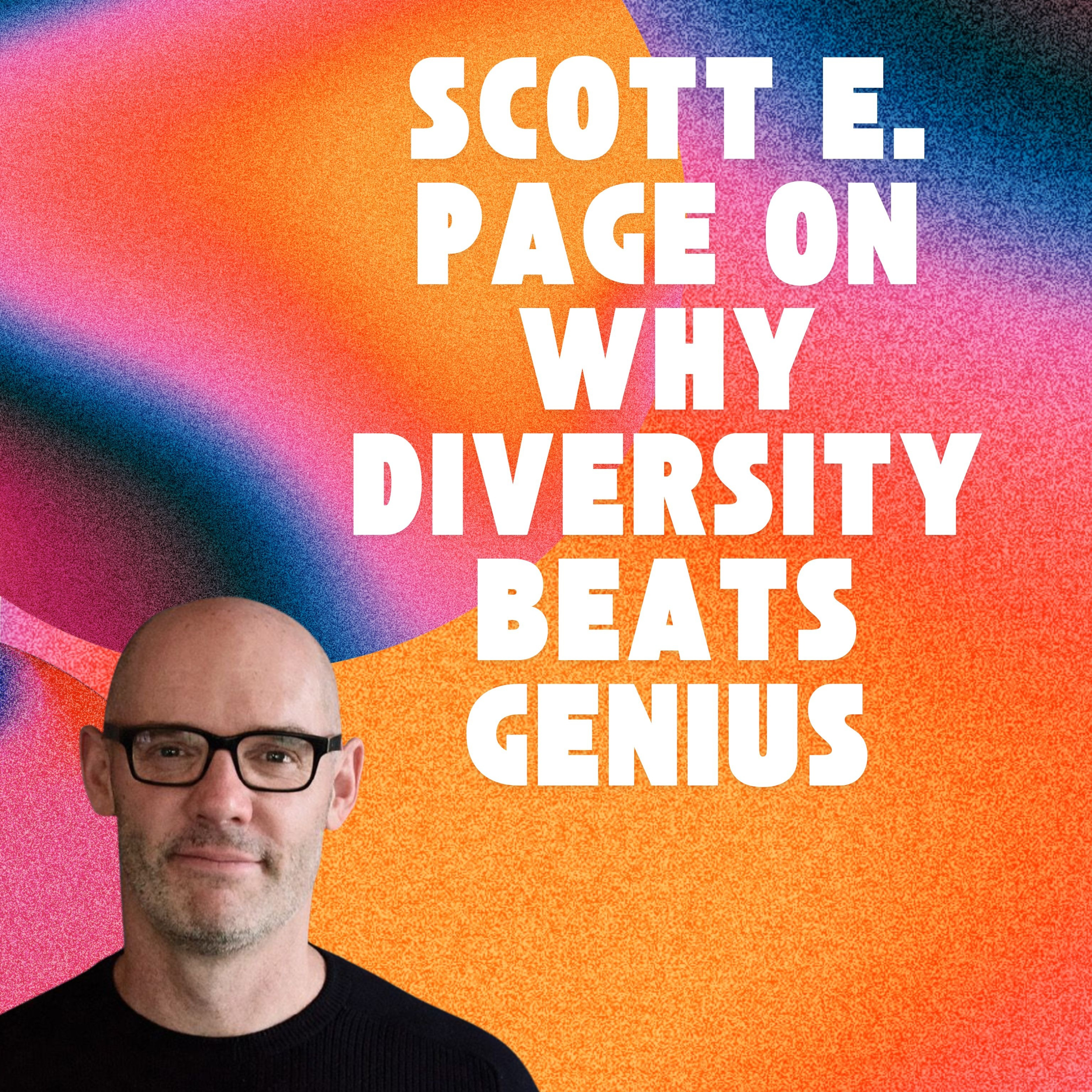
#28 – Scott Page: Why Diversity Beats Genius
from Scaling Theory · host Thibault Schrepel
Welcome back to scaling theory. My guest today is Scott E. Page, Distinguished University Professor of Complexity, Social Science, and Management at the University of Michigan, and an external faculty member at the Santa Fe Institute. He is an elected member of the National Academy of Sciences and the American Academy of Arts and Sciences, and a recipient of the Guggenheim Fellowship. His books include The Difference, Diversity and Complexity, The Diversity Bonus, and The Model Thinker.In this episode of Scaling Theory, Scott walks us through what complexity actually is. He unpacks the difference between complicated and genuinely complex systems, explains why cognitively diverse teams systematically outperform homogeneous ones on complex tasks, and what that means for how organizations scale. We also take up path dependence, the spillover effects of overlapping games across platform ecosystems, and where complexity tools have changed real decisions in practice. We close on the single open problem whose resolution would most reshape our understanding of social systems. As you will hear, Scott’s thinking is exceptionally clear. It is always a pleasure to talk with him and to listen to his insights. I hope you enjoy our discussion.You can follow me on X (@ProfSchrepel) and BlueSky (@ProfSchrepel).**BooksPage, S.E. (2007). The Difference: How the Power of Diversity Creates Better Groups, Firms, Schools, and Societies. Princeton University Press.Page, S.E. (2011). Diversity and Complexity. Princeton University Press (Primers in Complex Systems).Page, S.E. (2018). The Model Thinker: What You Need to Know to Make Data Work for You. Basic Books.Miller, J.H. and Page, S.E. (2007). Complex Adaptive Social Systems: An Introduction to Computational Models of Social Life. Princeton University Press.Peer-reviewed articlesHong, L. and Page, S.E. (2004). "Groups of diverse problem solvers can outperform groups of high-ability problem solvers." Proceedings of the National Academy of Sciences, 101(46): 16385–16389.Page, S.E. (2006). "Path Dependence." Quarterly Journal of Political Science, 1(1): 87–115.Page, S.E. (2007). "Type Interactions and the Rule of Six." Economic Theory, 30(2): 223–241.Bednar, J. and Page, S.E. (2007). "Can Game(s) Theory Explain Culture? The Emergence of Cultural Behavior Within Multiple Games." Rationality and Society, 19(1): 65–97.Bednar, J., Bramson, A., Jones-Rooy, A. and Page, S.E. (2010). "Emergent Cultural Signatures and Persistent Diversity: A Model of Conformity and Consistency." Rationality and Society, 22(4): 407–444.
Embed this episode
Ready to play
#28 – Scott Page: Why Diversity Beats Genius
No transcript for this episode yet
Similar Episodes
No similar episodes found.
Similar Podcasts
No similar podcasts found.