
EPISODE · Feb 24, 2026 · 21 MIN
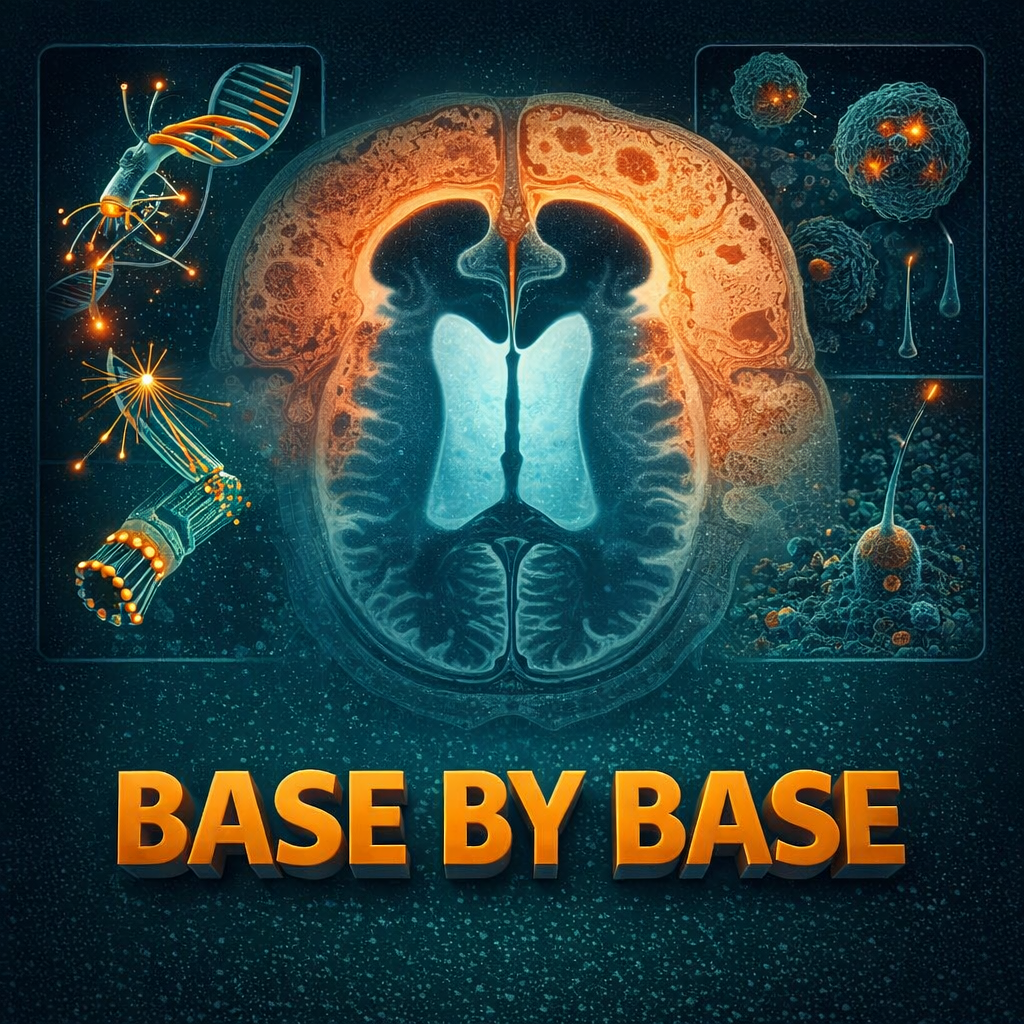
297: Bi-allelic FSD1L variants disrupt mitotic spindle and ciliogenesis in an L1-like neurodevelopmental disorder
from Base by Base · host Gustavo Barra
Serpieri V et al., The American Journal of Human Genetics, Corrected proof. doi:10.1016/j.ajhg.2026.01.014 - Bi-allelic FSD1L variants disrupt a microtubule-associated protein, causing hydrocephalus, corpus callosum defects and an L1 syndrome-like neurodevelopmental disorder in humans and models. Key terms: FSD1L, microtubules, ciliogenesis, hydrocephalus, iPSC neuronal differentiation. Study Highlights:Exome sequencing in eleven affected individuals (including five fetuses) identified bi-allelic FSD1L variants associated with hydrocephalus and corpus callosum defects. Using iPSC-derived neural progenitor differentiation, neurosphere assays, patient fibroblasts, immunohistochemistry, and in utero CRISPR-Cas9 mouse knockdown, the authors show that FSD1L localizes to mitotic spindle microtubules and to the transition zone/axoneme of the primary cilium. Patient NPCs fail to differentiate into premature neurons, undergo increased cell death, and form smaller disorganized neurospheres, while patient fibroblasts show abnormal spindles, reduced ciliogenesis and shorter cilia. Fsd1l repression in mouse embryos produced lateral ventricular dilation, functionally linking FSD1L to mitotic spindle assembly, ciliogenesis, neuronal differentiation and axon guidance. Conclusion:Bi-allelic pathogenic variants in FSD1L cause a neurodevelopmental syndrome overlapping L1 syndrome by disrupting a microtubule-associated protein required for mitotic spindle assembly, ciliogenesis, and neuronal differentiation. Music:Enjoy the music based on this article at the end of the episode. Article title:Bi-allelic variants in FSD1L cause a neurodevelopmental disorder overlapping with L1 syndrome First author:Serpieri V Journal:The American Journal of Human Genetics, Corrected proof. doi:10.1016/j.ajhg.2026.01.014 DOI:10.1016/j.ajhg.2026.01.014 Reference:Serpieri V., Vezain-Mouchard M., Orsi A., et al. Bi-allelic variants in FSD1L cause a neurodevelopmental disorder overlapping with L1 syndrome. The American Journal of Human Genetics. 113, 1–16 (March 5, 2026). https://doi.org/10.1016/j.ajhg.2026.01.014 License:This episode is based on an open-access article published under the Creative Commons Attribution 4.0 International License (CC BY 4.0) - https://creativecommons.org/licenses/by/4.0/ Support:Base by Base – Stripe donations: https://donate.stripe.com/7sY4gz71B2sN3RWac5gEg00 Official website https://basebybase.com On PaperCast Base by Base you’ll discover the latest in genomics, functional genomics, structural genomics, and proteomics. Episode link: https://basebybase.com/episodes/fsd1l-microtubule-ciliogenesis QC:This episode was checked against the original article PDF and publication metadata for the episode release published on 2026-02-24. QC Scope:- article metadata and core scientific claims from the narration- excludes analogies, intro/outro, and music- transcript coverage: Audited the transcript’s presentation of the AJHG 2026 FSD1L study’s main claims, cellular mechanisms, experimental models, and clinical implications as described in the article.- transcript topics: Clinical features resembling L1 syndrome; Gene discovery via exome sequencing and GeneMatcher; Autosomal recessive inheritance; FSD1L as a microtubule-associated protein localizing to mitotic spindle and primary cilium; iPSC-derived neural progenitor differentiation defects; Fibroblast spindle abnormalities and ciliogenesis defects QC Summary:- factual score: 10/10- metadata score: 10/10- supported core claims: 8- claims flagged for review: 0- metadata checks passed: 4- metadata issues found: 0 Metadata Audited:- article_doi- article_title- article_journal- license Factual Items Audited:- B... Chapters (00:00:20) - The genetic sleuths who solved a brain disease(00:03:50) - GeneMatch: The L1 Syndrome match(00:08:57) - FSD1L protein deficiency in the brain(00:11:26) - Why does L1 syndrome look so much like FSD1L(00:16:41) - Many single diseases are actually clusters of lookalikes, according to Bass(00:18:25) - A Story of Connections
Embed this episode
NOW PLAYING
297: Bi-allelic FSD1L variants disrupt mitotic spindle and ciliogenesis in an L1-like neurodevelopmental disorder
No transcript for this episode yet
Similar Episodes
No similar episodes found.
Similar Podcasts
No similar podcasts found.