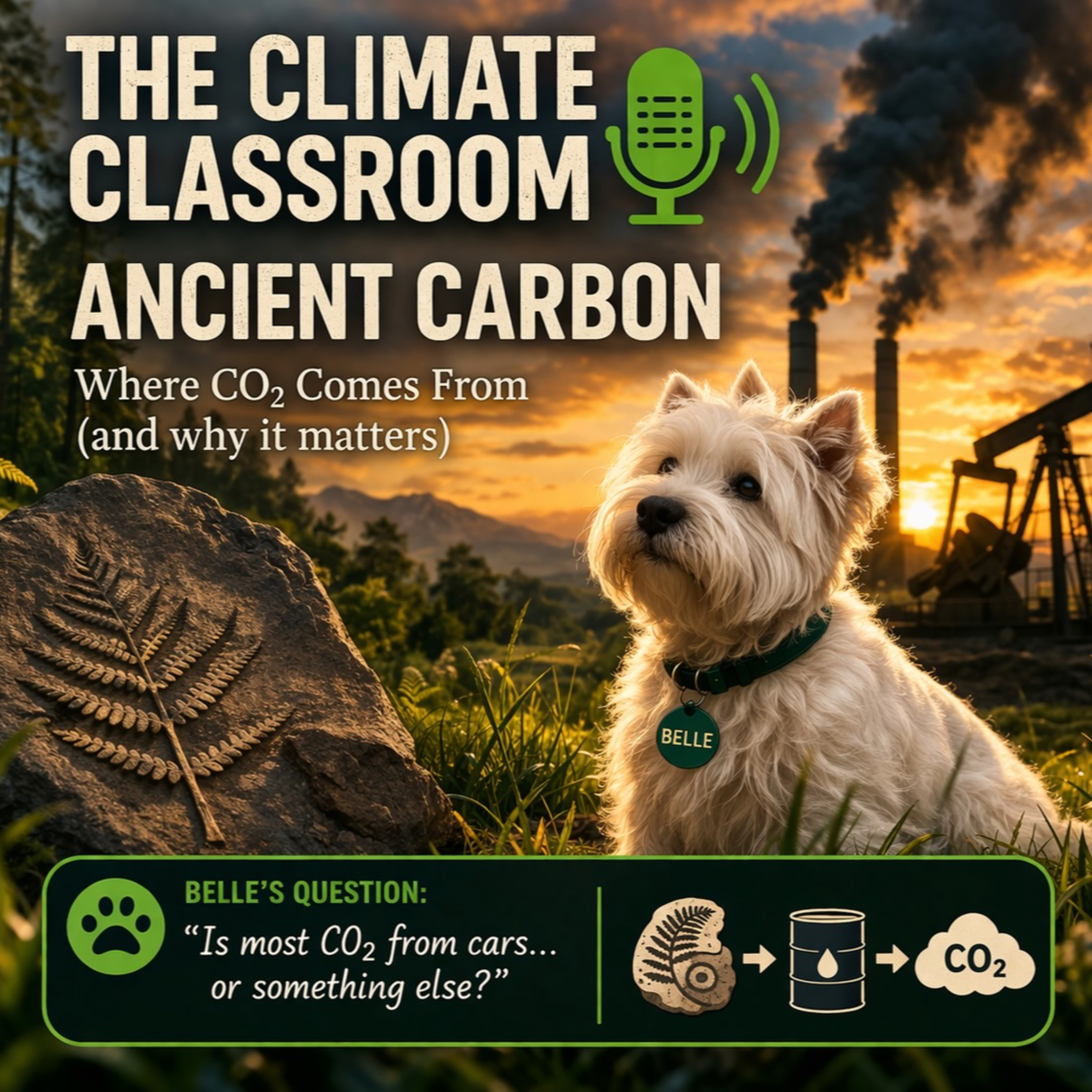
3: Ancient Carbon: Where CO₂ Comes From
from The Climate Classroom Hosted by theclimateclassroom.org
ANCIENT CARBON — WHERE CO₂ COMES FROM (AND WHY IT MATTERS) IF YOU REMEMBER ONE THING: Climate change isn’t about CO₂ being “bad” — it’s about adding extra ancient carbon faster than nature can remove it. When you’re stuck in a traffic jam, it’s easy to think: this must be what’s driving climate change. Cars do matter — but this episode shows why they’re only part of a much bigger carbon story that began hundreds of millions of years ago. 🐾 BELLE’S QUESTION “Is most CO₂ from cars… or something else?” ⸻ 🌍 THE BIG IDEA (EXPLAINED SIMPLY) CO₂ is part of nature. Plants take it in, animals breathe it out, and oceans swap it with the air. That natural carbon cycle leaves a thin greenhouse “blanket” that keeps Earth warm enough for life. The problem is extra CO₂. Coal, oil, and gas are made from ancient plants and sea life buried and transformed over millions of years. When we burn fossil fuels, we unlock that ancient carbon and release it into the atmosphere very fast — far faster than natural systems can absorb it again. That’s why CO₂ builds up, thickening Earth’s heat-trapping blanket. ⸻ 🌱 ONE BRIGHT THING People are starting to treat CO₂ as a material, not just a waste gas. Some companies inject captured CO₂ into fresh concrete, where it reacts and turns into a solid mineral — locking carbon away permanently while reducing the need for some cement. Others are even using captured CO₂ to grow real diamonds in laboratories, atom by atom. These ideas don’t replace cutting fossil fuel use — not even close — but they show carbon can be managed more intelligently. ⸻ 🏫 QUICK QUIZ (FOR FAMILIES & CLASSROOMS) • Fossil fuels are carbon from last year’s plants — or ancient life stored underground? • True or false: Cars are the only big source of CO₂. • Finish the sentence: Nature absorbs some CO₂, but if we turn the tap up too high, the level still ________. 🔔 FOLLOW & ASK BELLE If this helped, follow The Climate Classroom on Spotify or Apple Podcasts — so the next school-run episode arrives automatically. Got a question for Belle? Send it on Spotify, or at https://www.theclimateclassroom.org — with “the” at the start.————— READ MORE / FULL NOTES ————— 🎧 IN THIS EPISODE • CO₂ is a natural part of the carbon cycle • The natural greenhouse blanket keeps Earth from becoming a frozen snowball • Fossil fuels are ancient carbon from long-dead plants and marine life • Since the Industrial Revolution, humans have released that carbon extremely quickly • Major human CO₂ sources include: • Making electricity and heat • Transport • Industry (especially cement) • Deforestation and land clearing • Why CO₂ can build up even though nature absorbs some of what we emit 📚 SOURCES & FURTHER READING (WITH LINKS) Atmospheric CO₂ (the Keeling Curve) • NOAA — Mauna Loa CO₂ record (official long-term measurements): https://gml.noaa.gov/ccgg/trends/ Climate science assessments • IPCC — Sixth Assessment Report (AR6), Working Group I: https://www.ipcc.ch/report/ar6/wg1/ Global temperature records • World Meteorological Organization (WMO) — State of the Global Climate reports: https://public.wmo.int/en/our-mandate/climate/wmo-statement-state-of-global-climate Cement and industry emissions • International Energy Agency (IEA) — Cement and concrete sector emissions: https://www.iea.org/energy-system/industry/cement CO₂-mineralised concrete • Global Cement and Concrete Association — Carbonation and CO₂ curing overview: https://gccassociation.org/concretefuture/climate/ 🏫 FOR FAMILIES & CLASSROOMS (DISCUSSION PROMPTS) • Why does it matter that fossil fuels are millions of years old? • If nature absorbs CO₂, why can levels still rise? • Which analogy works best for you — a sink with a tap and drain, or putting extra blankets on the bed — and why? NEXT EPISODE: METHANE — THE SUPER-POWERED GREENHOUSE GAS 🐄 💨
Embed this episode
No transcript yet.