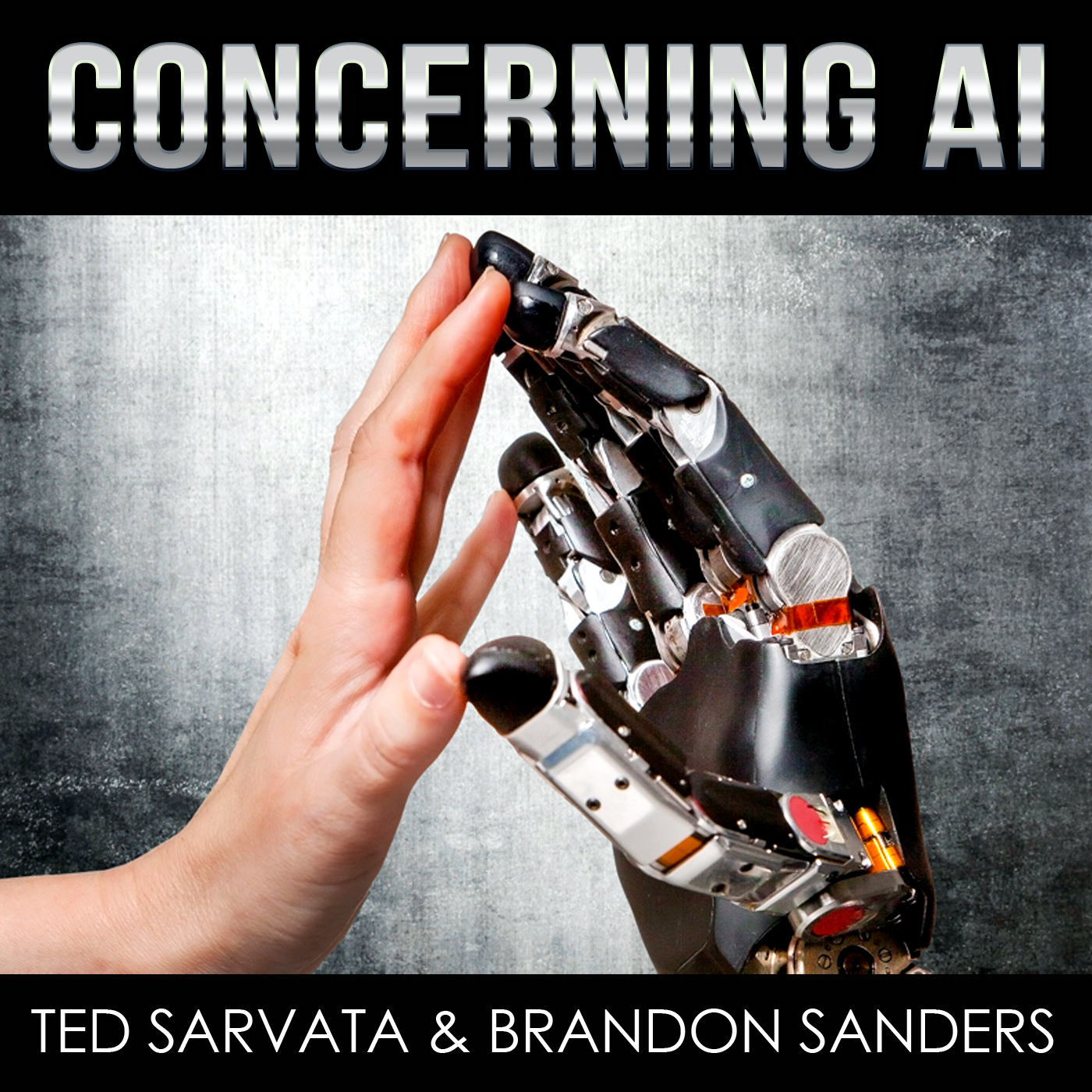
Hello, this is Ted, this is Brandon, and this is a podcast that may be called a friendly eye podcast, maybe. So, in the last episode, Brandon and I were talking about the possibility of an existential threat that artificial intelligence could be evil, maybe not a purpose, but it could be evil and it could wipe out humanity. And I really think it a lot this week about what's the difference between running away from something that's terrifying or running towards something that's really compelling and inspiring. So I thought we could talk about that this episode.
Yeah, it's interesting. I find that the fear is what has galvanized me to take this on more recently. But if you look at my previous drive, it's actually, I would characterize it as more in the positive camp, which is about increasing the diversity and complexity of life has been my main driver before, but that didn't lead me towards AI necessarily. Yeah, there's a lot that we could dig in on what that motivation is.
For me, all the years that I've been thinking about AI and the singularity and this idea that the exponential can take us to a place that we can't predict, I have thought about it in terms of evolving humanity towards immortality. Immortality. And I really thought that that sounded pretty awesome. Immortality, huh?
Yeah, it sounds crazy, but it's the logical end game of lots of different steps. One step would be life extension. We're adding to our life expectancy now. And every year we're adding more to our life expectancy than we were the year before.
And eventually before too long we're going to get to the place where every year we add more than one year to our life expectancy just for medical advances. Yeah, about 10 years ago, that was the main thing that was motivating me for a while. The idea of immortality. I would call it my own death anxiety partly.
And I'm still interested in that. Yeah, people just burst that off because immortality sounds crazy. That's never been, everybody dies. Like death and taxes, that's the thing.
Well, one of my favorite lines from Cosmos, Carl Sagan, is the secret of evolution is time and death. And so there's a part of me that questions whether that is a wonderful goal or not. I don't know. I'm not convinced that it wouldn't be that the creativity and diversity of what evolution has created couldn't happen through a different mechanism than natural selection through sexual reproduction and death.
I don't know. I think that the conscious evolution maybe is a could be the alternative. Right. And I also think that there are always things that we believe are not possible.
When you look back through human history and there were tons of things that we believed were not possible. And then over time many of those things have disappeared as being not possible. It was not possible to have human flight for one time. People wanted it, but it wasn't possible.
And then it was possible. And then it was not possible to have human space flight. And now it is possible. And there are all kinds of things like that.
So immortality definitely fits in that realm that it's not possible. And yet we've seen that we overcome things that are possible. Well, Ted, you're talking to the wrong guy here when you talk about what's possible or not possible. I think lots and lots of things are possible that have never been possible before.
But you're probably right that if I were talking to my parents or maybe I'm not giving them enough credit for exploring these kind of topics. But I certainly know there are people who don't think about it and who would dismiss it as crazy talk. So probably maybe the majority. I think that's probably right.
And so that brings me back to the premise of this episode which is does it... Is it more compelling? Does it create more possibility to be inspired rather than to be fearful? As we think about AI or think about anything else in the other existential existential crisis, we posited last episode that we believe this is the one that is more important and bigger or more potentially more catastrophic.
And we work on that few places last episode. Well, it's interesting. I think the way you frame something definitely can shape your behavior towards it. And self-filling prophecies and self-negating prophecies are examples of that kind of thing where the framing and the expectation shapes the behavior and a positive feedback loop that creates something that was different than what would have occurred.
So framing in a AI's dangerous way, does that create a self-fulfilling or self-negating prophecy? Yeah. How do we even think about that? I mean, that feels like a really important question.
And I feel equipped to even really think through that. Well, I think about Ray Kurtz file and that music video we looked at was him and some fake general and Alex Jones sort of a spoof, a rap video. And I thought it was a nice characterization of Ray, even though it is kind of a joke. But he's all about like, let's get this thing happening already.
You know, every day that we delay is more people dying unnecessarily, more of these terrible things happening, not wonderful things happening that are going to happen once mine's transcend. So I would say he's coming from that place already. It's going to be a good thing, the positive framing. And it seems to me that there are very few breaks or, wait, let's stop and think about this.
Let's go slow. Let's consider in the way he thinks about things. Well, right. Okay.
So he's a person who's not driven by fear. He's driven towards something that he sees as possible and likely he believes the outcome is going to be positive. So his prophecy is it's going to be, you know, it's going to be wonderful and it's driven some people to call the way he sees the world. What is it, the rapture of the nerds or something like that?
Right. It's kind of like heaven or atheist nerds. Yeah. And I've read his stuff and for years I really find him very compelling.
He addresses some of the criticisms and the possible dangers. And yet the way he addresses them, I feel like it's not complete. Now, my new way of thinking, my next step of thinking, I worry that he's missing something. Yeah.
Well, so we could consider why he thinks the way he thinks and decide whether that seems like credible to us personally. We could also look at some of the motivations, the things that might drive us personally towards a positive AI future. What do you think? Yeah.
I mean, I think that you brought up our families on the last episode and thinking about the singularity happening in our lifetime or in our lifetime of our children. It's like having children makes this conversation quite different. Because it's just me and I can sort of blow people's minds by saying, well, I don't plan on that. I plan on moving forever.
That's kind of a fun persona for me to put on. And now that I have kids, it's not so fun when I think about the potential dangers and the existential threat, what their lives could be like. If I'm just playing this role, like, oh, I'm the nerd guy who thinks it's going to be immortal. Isn't that funny?
It's interesting. The positive things that drive me towards the future have definitely received the fact that they've receded in their importance or their how compelling they are as I think about my kids. I still want positive things for my kids. But I think I'm more afraid of the negative outcomes for them.
Like, if they just lived a normal human life, then their kids had a normal human life. I could accept that. But if all of that, if that were destroyed, I would be really upset if they didn't achieve some beautiful future that I could envision in their lifetime. It doesn't hold the same upset for me.
This makes me want to look at the research on loss aversion versus whatever the opposite of that is. I think there's some psychological research that shows that human beings in general are more motivated by the fear of losing something. Yeah, I think so too. I agree with that.
I don't have that dip in my tongue or my finger. But that's a question we could maybe address in a future episode. I wonder if our listeners might want to think through some of these questions with us. Yeah, I bet you somebody could send us that a good trial or something like that that really articulates that.
Yeah. We have some other questions that we were thinking about before we started recording. One of them was what are some things we could run towards? If we do believe that it's better to run towards something than it is to run away and fear what could run towards?
The immortality is the one. We talked about that here. But I'd love to hear from people about what they think that we could be running towards. I can't help myself.
I want to say what I'm excited about. What are you excited about? I'm excited about running towards the diversification of life through the expansion into space. When us mammals and hominids in particular and land-based mammals see the Devonian move to the land as a huge, amazing moment in the evolution of life on Earth when all kinds of diversification and possibilities opened up.
I see that move into space and all kinds of opportunities opening up to be at least as awesome as that Devonian expansion was. Well, that sounds like a whole episode right there. I'd love to talk more about that and hear more about thoughts and what that could be like. Maybe that's one thing we do in this podcast is we have episodes devoted to some of these possibilities of things we can run towards.
That sounds exciting to me. Do you have any other questions for our listeners? Well, we kind of hinted at it or moved around it. But how does our framing of the AI question influence our behavior?
If I think it'll probably be evil versus if I think it'll probably be benevolent, how do things look different? How do we behave differently? Yeah, that's a great question. I'd love to hear from people.
We'll give you some weekend time contact with us once we know what that is. Perfect. I'm going to press it up unless you've got anything else to say. Great.