
EPISODE · May 6, 2026 · 47 MIN
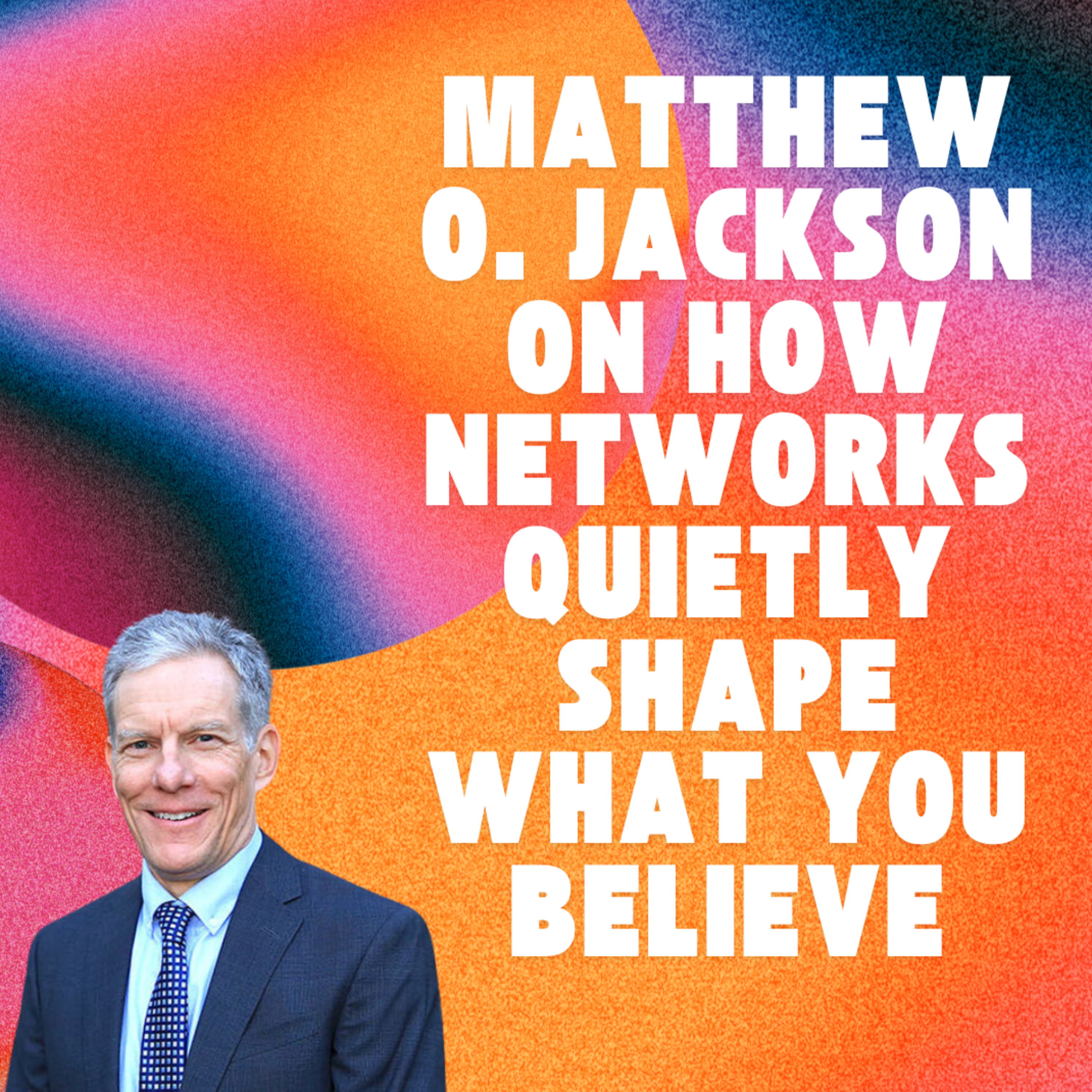
#30 – Matthew O. Jackson on How Networks Quietly Shape What You Believe
from Scaling Theory · host Thibault Schrepel
Welcome back to Scaling Theory. In this episode, I speak with Matthew O. Jackson, the William D. Eberle Professor of Economics at Stanford University and an external faculty member at the Santa Fe Institute. Matthew is one of the founders of the modern economics of networks and the author of The Human Network and Social and Economic Networks.We talk about the friendship paradox, why homophily slows how fast a society learns the truth but helps niche ideas catch fire, and the gossip study where villagers in southern India proved remarkably good at naming the most central spreaders in their community. We then turn to AI agents as a different species: Turing tests on LLMs, the steerability of agent personas through system prompts, and what to make of Moltbook, the social network for AI agents.By the end, you will know why telling students how much their peers actually drink reduces binge drinking more than warning them about the dangers of alcohol, why the same network can spread a virus quickly and a belief slowly, and why AI agents change their behavior when asked to explain it.Papers and works referenced in the conversationBooksThe Human Network: How Your Social Position Determines Your Power, Beliefs, and Behaviors — Matthew O. Jackson (Pantheon, 2019). https://web.stanford.edu/~jacksonm/books.htmlSocial and Economic Networks — Matthew O. Jackson (Princeton University Press, 2008). https://web.stanford.edu/~jacksonm/books.htmlPart I — The scaling of human networks"Diffusion and Contagion in Networks with Heterogeneous Agents and Homophily" — Matthew O. Jackson and Dunia López-Pintado, Network Science 1(1), 2013. https://arxiv.org/abs/1111.0073"How Homophily Affects the Speed of Learning and Best-Response Dynamics" — Benjamin Golub and Matthew O. Jackson, Quarterly Journal of Economics 127(3), 2012. https://web.stanford.edu/~jacksonm/homophily.pdf"Using Gossips to Spread Information: Theory and Evidence from Two Randomized Controlled Trials" — Abhijit Banerjee, Arun G. Chandrasekhar, Esther Duflo, and Matthew O. Jackson, Review of Economic Studies 86(6), 2019. https://academic.oup.com/restud/article/86/6/2453/5345571"Empathy and Well-Being Correlate with Centrality in Different Social Networks" — Sylvia A. Morelli, Desmond C. Ong, Rucha Makati, Matthew O. Jackson, and Jamil Zaki, PNAS 114(37), 2017. https://www.pnas.org/doi/10.1073/pnas.1702155114Part II — The scaling of AI agents"Inequality's Economic and Social Roots: The Role of Social Networks and Homophily" — Matthew O. Jackson, in Advances in Economics and Econometrics: Twelfth World Congress of the Econometric Society (Cambridge University Press, 2025). https://arxiv.org/abs/2506.13016"AI Behavioral Science" — Jackson, Mei, Wang, Xie, Yuan, Benzell, Brynjolfsson, Camerer, Evans, Jabarian, Kleinberg, Meng, Mullainathan, Ozdaglar, Pfeiffer, Tennenholtz, Willer, Yang, and Ye, arXiv 2509.13323, 2025. https://arxiv.org/abs/2509.13323"A Turing Test of Whether AI Chatbots Are Behaviorally Similar to Humans" — Qiaozhu Mei, Yutong Xie, Walter Yuan, and Matthew O. Jackson, PNAS 121(9), 2024. https://www.pnas.org/doi/10.1073/pnas.2313925121
Embed this episode
Ready to play
#30 – Matthew O. Jackson on How Networks Quietly Shape What You Believe
No transcript for this episode yet
Similar Episodes
No similar episodes found.
Similar Podcasts
No similar podcasts found.