#301 The Invisible Engine: Golf Shaft Dynamics and custom built shaft for you episode artwork

EPISODE · Jul 31, 2025 · 12 MIN

#301 The Invisible Engine: Golf Shaft Dynamics and custom built shaft for you

from Golf 247.eu: The Global Platform for Innovative Technologies and Teaching Concepts. · host Golf247.eu

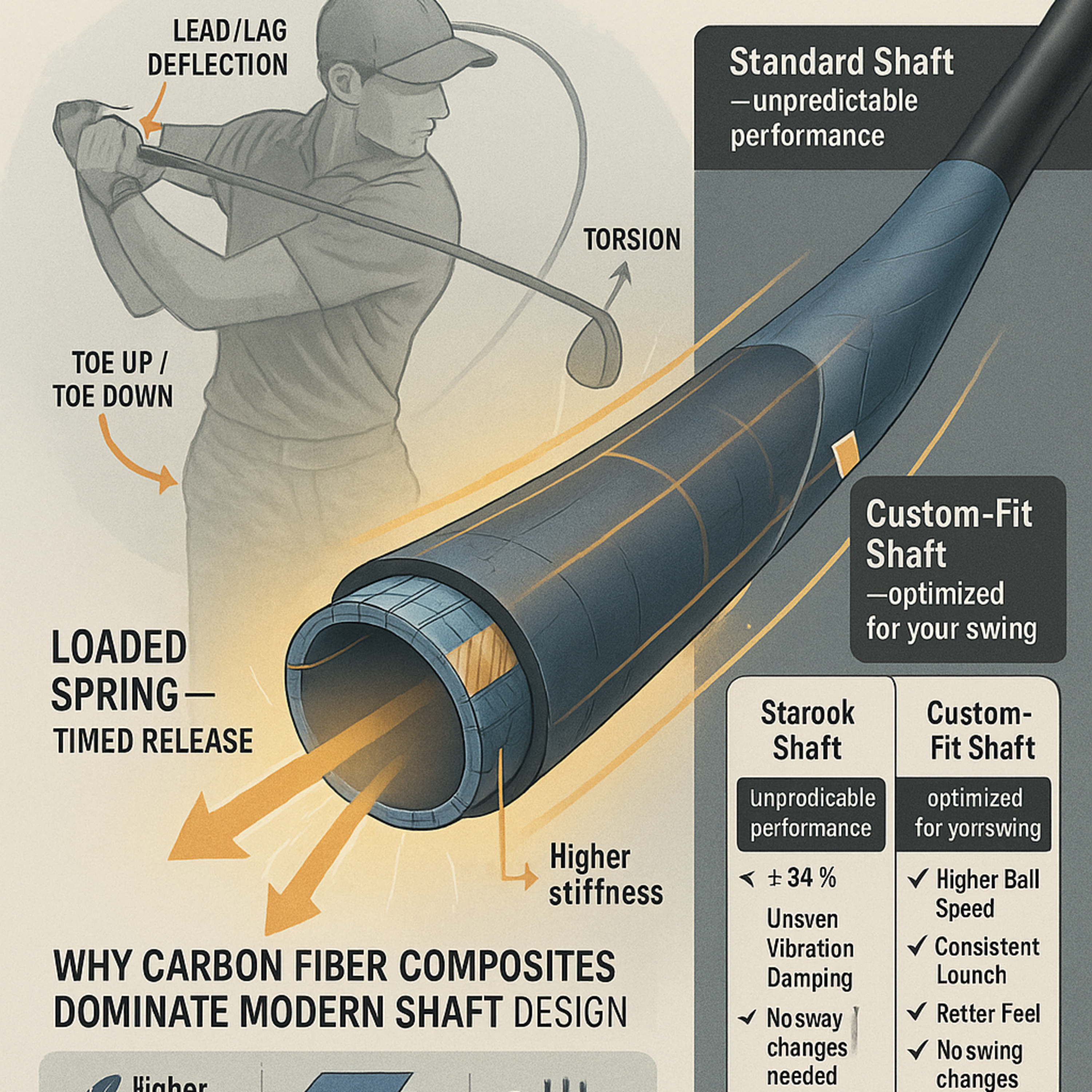
In the world of golf equipment, much attention is paid to clubheads, grooves, or spin rates—but it’s the shaft that often decides whether energy is transferred with precision or wasted in deflection. The shaft is the invisible engine of the golf swing: a biomechanical link that translates motion into measurable performance. And the more precisely it's matched to the player, the more it transforms consistency, speed, and feel.The Shaft as a Biomechanical EngineDuring every swing, the shaft deforms dynamically in three key ways:Lead/Lag Deflection – horizontal bending caused by clubhead inertia.Toe Up / Toe Down – vertical bending influenced by momentum and gravity.Torsion – twisting around its axis, impacting face angle at impact.These aren't flaws—they’re essential mechanics that store and release energy. A well-matched shaft behaves like a loaded spring, delivering a powerful and timely “kick” through the ball.Customization Through Composite ScienceModern carbon fiber composite shafts (CFCs) have replaced steel for one reason: precision. CFCs allow for custom fiber orientation and stacking sequences that fine-tune stiffness, torque, and damping.Henrik Jentsch’s research confirms:The fiber angle and layer sequence directly determine flex profile and energy return.Composite shafts offer superior vibration damping, improving feel and reducing dispersion.Custom shafts can be built to match a golfer’s unique swing style—rather than forcing the swing to adapt to a stock shaft.The Role of Kick Point and Energy TransferOne of the most critical variables is the kick point, or the primary bending zone.A low kick point promotes higher launch and more spin.A high kick point produces flatter flight with less spin.Even slight changes in kick point affect launch conditions and energy release. Henrik’s data shows that a well-fitted kick point ensures the stored energy is released at the precise moment of impact—translating to higher ball speeds and better trajectories.Why Standard Shafts Fall ShortHenrik’s testing uncovered major inconsistencies in “identical” shafts from leading manufacturers:Up to 34% variation in stiffnessFrequency deviations of up to 6%Manufacturing flaws like seams, resin-rich zones, and uneven damping across the shaft circumferenceThese flaws mean two shafts labeled “Stiff” can feel—and perform—entirely differently. Off-the-rack solutions simply cannot deliver the same reliability as a purpose-built shaft.A Custom Shaft Is a Performance NecessityA properly fitted shaft is more than an upgrade—it’s a cornerstone of performance. Tailored to a golfer’s tempo, transition, release pattern, and feel, it optimizes energy transfer, improves consistency, and enhances overall ball control—without changing the swing itself.Conclusion:The shaft is not just a connection between hands and clubhead—it’s a dynamic system that shapes every shot. Thanks to carbon composite technology and biomechanical understanding, we now have the tools to build shafts that don’t just fit—but elevate—the golfer. The invisible engine has never mattered more.If you're interested in learning more about how to get a custom-made shaft for yourself, please send me an email, and I’ll get in touch with you to explain the exact price and what information we need to develop the perfect shaft for you.www.Golf247.eu

In the world of golf equipment, much attention is paid to clubheads, grooves, or spin rates—but it’s the shaft that often decides whether energy is transferred with precision or wasted in deflection. The shaft is the invisible engine of the golf swing: a biomechanical link that translates motion into measurable performance. And the more precisely it's matched to the player, the more it transforms consistency, speed, and feel.The Shaft as a Biomechanical EngineDuring every swing, the shaft deforms dynamically in three key ways:Lead/Lag Deflection – horizontal bending caused by clubhead inertia.Toe Up / Toe Down – vertical bending influenced by momentum and gravity.Torsion – twisting around its axis, impacting face angle at impact.These aren't flaws—they’re essential mechanics that store and release energy. A well-matched shaft behaves like a loaded spring, delivering a powerful and timely “kick” through the ball.Customization Through Composite ScienceModern carbon fiber composite shafts (CFCs) have replaced steel for one reason: precision. CFCs allow for custom fiber orientation and stacking sequences that fine-tune stiffness, torque, and damping.Henrik Jentsch’s research confirms:The fiber angle and layer sequence directly determine flex profile and energy return.Composite shafts offer superior vibration damping, improving feel and reducing dispersion.Custom shafts can be built to match a golfer’s unique swing style—rather than forcing the swing to adapt to a stock shaft.The Role of Kick Point and Energy TransferOne of the most critical variables is the kick point, or the primary bending zone.A low kick point promotes higher launch and more spin.A high kick point produces flatter flight with less spin.Even slight changes in kick point affect launch conditions and energy release. Henrik’s data shows that a well-fitted kick point ensures the stored energy is released at the precise moment of impact—translating to higher ball speeds and better trajectories.Why Standard Shafts Fall ShortHenrik’s testing uncovered major inconsistencies in “identical” shafts from leading manufacturers:Up to 34% variation in stiffnessFrequency deviations of up to 6%Manufacturing flaws like seams, resin-rich zones, and uneven damping across the shaft circumferenceThese flaws mean two shafts labeled “Stiff” can feel—and perform—entirely differently. Off-the-rack solutions simply cannot deliver the same reliability as a purpose-built shaft.A Custom Shaft Is a Performance NecessityA properly fitted shaft is more than an upgrade—it’s a cornerstone of performance. Tailored to a golfer’s tempo, transition, release pattern, and feel, it optimizes energy transfer, improves consistency, and enhances overall ball control—without changing the swing itself.Conclusion:The shaft is not just a connection between hands and clubhead—it’s a dynamic system that shapes every shot. Thanks to carbon composite technology and biomechanical understanding, we now have the tools to build shafts that don’t just fit—but elevate—the golfer. The invisible engine has never mattered more.If you're interested in learning more about how to get a custom-made shaft for yourself, please send me an email, and I’ll get in touch with you to explain the exact price and what information we need to develop the perfect shaft for you.www.Golf247.eu

NOW PLAYING

#301 The Invisible Engine: Golf Shaft Dynamics and custom built shaft for you

0:00 12:20

No transcript for this episode yet

We transcribe on demand. Request one and we'll notify you when it's ready — usually under 10 minutes.

Frequently Asked Questions

How long is this episode of Golf 247.eu: The Global Platform for Innovative Technologies and Teaching Concepts.?

This episode is 12 minutes long.

When was this Golf 247.eu: The Global Platform for Innovative Technologies and Teaching Concepts. episode published?

This episode was published on July 31, 2025.

What is this episode about?

In the world of golf equipment, much attention is paid to clubheads, grooves, or spin rates—but it’s the shaft that often decides whether energy is transferred with precision or wasted in deflection. The shaft is the invisible engine of the golf...

Can I download this Golf 247.eu: The Global Platform for Innovative Technologies and Teaching Concepts. episode?

Yes, you can download this episode by clicking the download button on the episode player, or subscribe to the podcast in your preferred podcast app for automatic downloads.
URL copied to clipboard!