
EPISODE · Sep 22, 2021 · 1H 31M
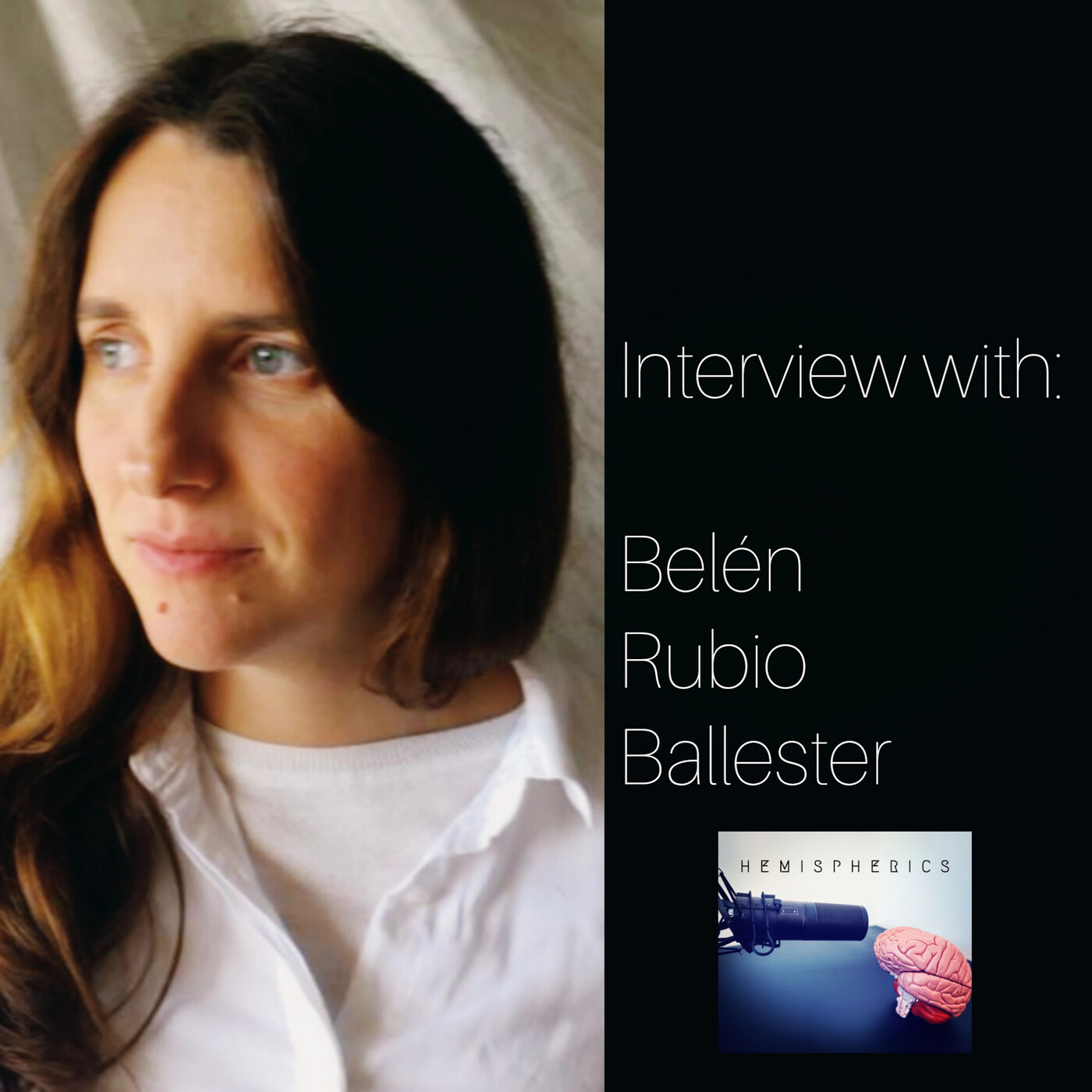
#31: Interview with Dr. Belén Rubio Ballester. Virtual reality, motor learning and principles of neurorehabilitation
from Hemispherics
In this episode, I interview Belén Rubio Ballester, postdoctoral researcher in the SPECS laboratory of the Instituto de Bioingeniería de Cataluña (IBEC). She has a degree in Audiovisual Communication and a PhD in Technologies for Neuroscience. She has been and is involved in different projects related to virtual reality, motor learning and learned non-use recovery model. Her work aims to identify the principles of recovery after brain injury and to develop innovative solutions based on technology for the management of different conditions. We start from her doctoral thesis on virtual reality and motor recovery, and she introduces key concepts in neurorehabilitation and specifically, in stroke: proportional recovery, recovery window, motor learning, learned disuse, error... In essence, Belén advocates for a principle-based neurorehabilitation. Episode references: (1) Belén Rubio's PhD Thesis (2015). VR-based rehabilitation strategies for functional motor recovery after stroke: individualization, reinforcement, and transfer (https://www.tdx.cat/handle/10803/392145#page=1). (2) Rubio-Ballester (2016). Counteracting learned non-use in chronic stroke patients with reinforcement-induced movement therapy (https://jneuroengrehab.biomedcentral.com/articles/10.1186/s12984-016-0178-x). (3) Rubio-Ballester (2012). A Wearable Bracelet Device for Promoting Arm Use in Stroke Patients (https://www.scitepress.org/Link.aspx?doi=10.5220/0005662300240031). (4) Rubio-Ballester (2015). Accelerating motor adaptation by virtual reality based modulation of error memories (https://ieeexplore.ieee.org/document/7281270). (5) Rubio-Ballester (2015). The visual amplification of goal-oriented movements counteracts acquired non-use in hemiparetic stroke patients (https://pubmed.ncbi.nlm.nih.gov/26055406/). (6) Maier (2019). Principles of Neurorehabilitation After Stroke Based on Motor Learning and Brain Plasticity Mechanisms (https://www.frontiersin.org/articles/10.3389/fnsys.2019.00074/full). (7) Maier (2019). Effect of Specific Over Nonspecific VR-Based Rehabilitation on Poststroke Motor Recovery: A Systematic Meta-analysis (https://pubmed.ncbi.nlm.nih.gov/30700224/). (8) Rubio-Ballester (2018). Revealing an extended critical window of recovery post-stroke (https://www.biorxiv.org/content/10.1101/458745v1). (9) Rubio-Ballester (2019). A critical time window for recovery extends beyond one-year post-stroke (https://pubmed.ncbi.nlm.nih.gov/31141442/). (10) Rubio-Ballester (2021). Relationship between intensity and recovery in post-stroke rehabilitation: a retrospective analysis (https://jnnp.bmj.com/content/early/2021/06/23/jnnp-2021-326948). This podcast is available at: Youtube → https://www.youtube.com/channel/UCG_bOtqshlQAcsjeVAGLjKQ Ivoox → https://www.ivoox.com/podcast-hemispherics_sq_f11035526_1.html Spotify → https://open.spotify.com/show/6nd69JiChOlITeToV7XnDf Apple Podcast → https://podcasts.apple.com/es/podcast/hemispherics/id1563368094 You can follow me on: Twitter → https: //twitter.com/JSanchez_PT Instagram → https://instagram.com/hemispherics
Embed this episode
NOW PLAYING
#31: Interview with Dr. Belén Rubio Ballester. Virtual reality, motor learning and principles of neurorehabilitation
No transcript for this episode yet
Similar Episodes
No similar episodes found.
Similar Podcasts
No similar podcasts found.