The NPR app cuts through the noise, bringing you local, national, and global coverage. No paywalls, no profits, no nonsense. Download it in your app store today. I still have more to learn.
And to do better, to balance diverse interests and listen to people from all walks of life. Just imagine for a second your partner or your spouse saying something like that to you like with that tone, like you would not feel reassured that they were really sorry. Okay so years ago I was interviewing this guy about something else completely and somehow we got into the subject of this whole apology business. And the guy is two daughters, they were both around 13 years old back then and he told me that whenever one of his daughters does something to the other and he tells them to apologize, you know, as their parent, usually the apology is fake. Proform a fake, the kid version of the politicians, non-apology apology.
And what do you do with that? Because how do you make somebody actually feel sorry for something they don't feel sorry for? You know, I mean there they are, you know, say you're sorry, say it like you mean it. And they don't mean it, they're not gonna, they don't yet have the empathy. You know, trying to explain to one of them, but the way your sister feels is they go through life, they share with you and then when you aren't generous with them, that makes them, you know, like if you're trying to explain it like this, you can see the look on there like this cold, steely look, you know, like I hear what you're saying, I hear your little fable, I'm just not buying it.
And I don't know, they do lip service too, they're kind of sigh and shrug and sort of in a sense allow that perhaps that's the case and then they take another shot at the apology. But as a parent, don't you feel like, well, okay, if I'm gonna get a lip service, at least I'm gonna get the lip service. At least they recognize the moral code. Even if you're heart's not in this, I want to watch you go through the motions. This is what people do, you know, when they really are sorry.
See, but that makes me feel more sympathetic to politicians or to this act which actually usually feels me with contempt. I feel like, well, at least the politician is pretending and acknowledging yes there is a moral code. Like they don't feel sorry, but they'll acknowledge that someone should feel sorry. And they'll be like, well, if that's what we're gonna get out of our politicians, well, okay, I guess, I guess, it's not what I want, but I can kind of live with that. I just want to jump in and say here, this conversation happened years ago, this was back in 2008, today's shows are rerun.
This was so long ago that we talked about this, the politicians actually still felt obliged to apologize when they screwed up. Sometimes anyway, like back when we recorded this, I remember Barack Obama had just apologized for summer market, they made about small town America, and here we, Clinton had just apologized for saying she flew into Bosnia, or sniper fire, you remember this, did not happen. It was a different time, not like today. When the president does stuff like, you know, posting a photo of himself as Jesus Christ, or remember when he posted a video of the Obamas as apes, and lots of people called him to apologize, but of course that's the last thing he'd ever do. It was nice when they used to say, I screwed up, sorry, even if it was insincere.
I don't know, it said that there are things that people just shouldn't do, I agree. Well, you know, that's making me, I don't know if you're familiar with all the details of that Bible story about David and Beth Shiva, you know, and it's almost as funny as I was saying. And it's almost as funny modern politics story, right? No, I don't know this one. Okay, well, so here's King David, powerful King of Israel, and he basically comes to adultery in office.
He sees a woman that he can have because of his power. He's not his wife, and a ranger's going to come to the palace and has his way with her. And then the story's going to break, you know, her husband's going to find out. And he, in a very modern way, tries to quell the story, quash it, before it gets out. He has her husband sent to the front lines of battle where he gets killed.
He does everything he can to hope that he can just actually hide it. He does not feel sorry about it. He really digs himself in deep. And time goes on and the prophet becomes aware of this, you know, divinely, and comes to confront David on it. And what does he do? He tells him a story. He gets him engaged in this little fable about somebody who has a pet lamb, a poor man with a pet lamb that he loves like a pet, and that a rich man goes and gets that lamb and prepares it for a meal.
Because of his power, he's able to, the poor man's like a surfer lives on his land. So the rich man's just like, hey, I'm taking that. You know, everything has mine. So it's this really awful thing of, you know, something else value very highly, it was value very low by the rich man just because of his power. And David, but David's not telling him the story like it's a fable. He's telling him like this is happening in your kingdom. What are you going to do about it? David gets all enraged on behalf of the victim and says, bring him here.
We're going to do justice on him. We're going to see this then right. We're going to bring that rich man here and we're going to punish him with the folks into the law. And so David is like a man in justice for the perpetrator and the prophet looks at him and says, you are the man. And that does it. Then David really gets and he comes apart, you know, and he has a very genuine apology and repentance.
I mean, but he does really end up paying for it. And he's a much better king afterward. I wonder if you can sit down on the politicians today like that. I don't know. You'd have to do something like that, maybe.
Sit them down, tell them that story and say, you are the man. Welcome to WBC Chicago's This American Life. Today on our program, mistakes were made. Stories of people apologizing in that way that amounts to not apologizing at all, not accepting responsibility for the things they've done. Or should a day in two acts, act one, your cold as ice, act two, you're willing to sacrifice our love. Stay with us.
This message comes from WISE, the smart way to manage your money around the world. With WISE, you can send, spend, and receive money in over 40 currencies at the mid-market rate. Learn more at WISE.com. Tees and C's Apply. Hey, this is Christopher Kimball. On Most Me Radio, we share compelling stories about food.
You'll hear about the secrets of restaurant design and the truth about picky eating. For example, in the 19th century, kids, lobed oysters and corned beef. We also have a story about cooking in prison from former This American Life producer Sean Cole. And interviews with Jose Andres, Sami, and Nozerad and Podma Lakshmi. Listen to Most Me Radio, wherever you catch your podcast.
This American Life, act one, your cold as ice. So many scientific advances begin with amateurs, the amateur enthusiasts, or is that enthusiasts? Whatever. I'm talking about people who are formed little groups to explore new scientific ideas like robots or computers or just whatever. This story is about a group like that and the guy who led them. Sami Shott tells the story.
It was the 1960s, the decade of the first heart transplant and the first working laser. New antibiotics gave the surgeon general such a jolt of confidence. He announced a congress that the time had come and I quote, to close the book on infectious diseases. It was against this backdrop of high-flying optimism that a Michigan college professor named Robert Ettinger wrote a book posing a simple question. What if death itself was just another disease? Generally fatal, but not necessarily incurable?
His theory went like this. If you could read somebody at the exact moment of clinical death, maybe just maybe in 50 years or 100 years or 1000, the doctors of the future could bring him back to life. This was cryonics or cryonics suspension. And groups of enthusiasts began to spring up here and there, which is how Bob Nelson got involved. I was on the freeway in the traffic jam, very common here in California.
And I came on the radio that there was going to be the first meeting of the suspended animation group at the Helen Klein's house. I remember going there thinking I'm probably not going to be allowed in because I'm not a scientist, you know, but at least I get to see some of the scientists. I went in there, I was loud in and I came out and voted president. Bob had no medical or scientific training whatsoever, hadn't even finished high school. He was a 30-year-old TV repairman with a wife and three kids.
But he was charming, the kind of charmer you like him because he lets you know in 100 ways that he likes you. After a few hours with him, he's hugging you goodbye. And Bob sincerely believed that Crownix was going to save millions of lives and that belief was infectious. He did some press, local TV and radio. Turned out he was a really good salesman.
And it did, it took off like a cyclone. It was stunning. I remember once going into a restaurant and I was at the urinal and I overheard two guys talking and saying, you know what that is? That's the guy that freezes people. And the other guy said, why does he do that?
And I thought it was just bizarre to be in that situation where you're famous for something that you don't know quite how it happened. The members of Bob's group weren't experts. They were just fans of an idea. As you'd expect, many were older people, some of them sick and thinking about their own deaths. They set up a nonprofit, the Crownix Society of California, and before long they drafted lineup of scientific advisers.
At this point, nobody had actually been frozen yet, and the scientists set one condition for their participation. That nobody tried, not yet. They wanted to take things slow, conduct research, publish papers. And that was fine with Bob. Until he got a call from the son of a psychology professor who was dying of cancer, an end couldn't wait for the research to pan out. His name was James Bedford.
Dr. Bedford wanted to be frozen and he wondered if the Crownix Society could help him. So Bob says he got on the phone with the godfather of the movement. Well, I called Robert Ettinger that night and I told him what had happened. And he said, oh my god, this is the biggest thing that's happened in the Crownix program.
And so, Edinger said, we need to go ahead and do it. And I said, but we'll lose the scientific advisory council. He said, maybe not all of them. And if we do, we'll get them again. He said, there's nothing that will push the program of Crownix forward than the freezing of the first man.
Were you right? Did you lose them? Absolutely. We'll ask everyone up for the next day. So Bob assembled a team of doctors to carry out the freezing.
Though when Dr. Bedford died on January 12, 1967, they were all caught off guard. Dr. Bedford's nurse had to run up and down the block collecting ice from the home freezers of neighbors. Crownix was still just a theory, and the proceedings had the slight lead manic quality of a local theater production forced to open a couple of weeks early.
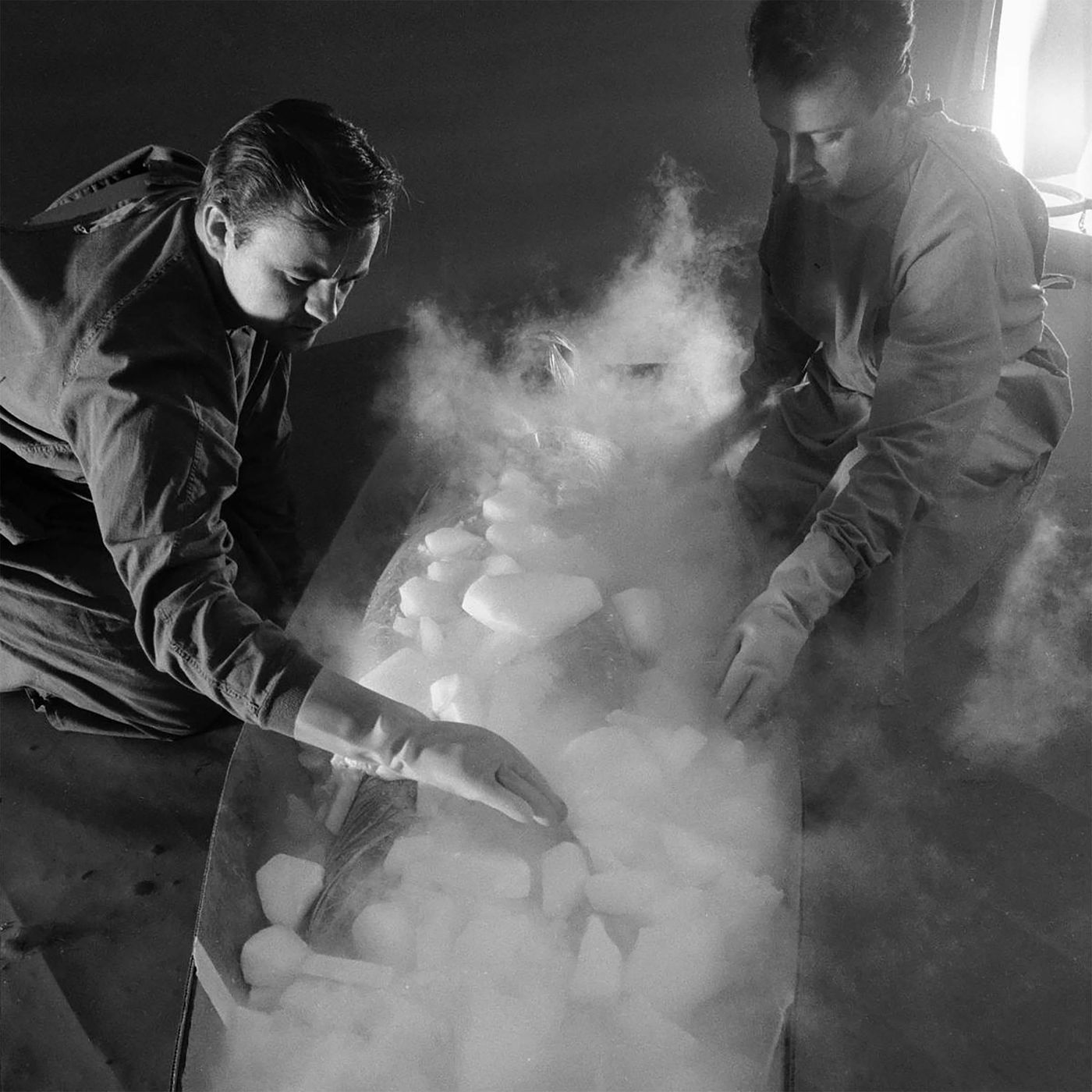
A half a year later, when a member of their own group turned up at the morgue wearing a medical bracelet saying she was supposed to be frozen, Bob wasn't much better prepared. Her name was Marie Sweet. And among the things she left when she died, there was a photograph someone had taken over 27 years earlier, along with a handwritten message. It said, this is as I wish to be restored. Bob called a couple student embalmers with access to equipment at the mortuary college, and they performed the freezing the only place they could in the Crownix Society office. On two desks, pushed together and covered with a sheet.
I was a nervous wreck because, you know, I'm thinking, I don't know how many violations I'm committing here. You know, for example, a dead body legally can only be moved by a mortician. And then, you know, I had no idea if I was committing any violations by having the body up in our offices and putting her in ice there and then carrying it down the stairs. It was all just really peculiar. One challenge with the Crownix is that the freezing process itself can do a lot of damage to the body.
Living cells are full of water, and when water freezes, it expands, like a house in winter where the pipes burst. To minimize the damage, Bob and his team replaced the blood with special chemicals, a process called perfusion. Meanwhile, they packed ice around the head and body. A lot of ice. The goal was to get Marie into a giant stainless steel container, cooled by liquid nitrogen.
A Crownix buff in Arizona had started building capsules for exactly this purpose. That's where Dr. Bedford ended up, sent there by his son after the first freezing. But it wasn't clear where to send Marie. The Crownix Society had no place to keep a frozen body.
For all they knew, centuries might pass before she could be thought out and brought back to life. Which is to say, they needed someplace really permanent. That was going to cost a lot of money. Marie Sweet's husband managed to scrape together a few hundred dollars. That's it. And the society was broke.
What the society did have was a lot of enthusiastic members, all of them hoping to be suspended. Bob figured he'd let them decide whether to keep Marie frozen. It wasn't a very tough room. They all said, yeah, go ahead Bob. Oh, okay. So, you know, I should have said, well, is anybody going to help here?
Or, you know, is it just me? But it turned out it was just me. And then it got to the point where I began to realize that this was me. I had the power, the decision, to say, okay, we're going to give up on Marie, which we should have done in hindsight. But I kept thinking that it's going to work. So it just seemed that it was worth going just a little bit further.
I never intended with Marie Sweet to forever keep her in preservation, at my own expense. No, I just felt for a while to see what happened next. This very reasonable position led Bob into a lot of very unreasonable decisions over the next few years. Decisions he's still explaining decades later. And what happened next is that another member of the society died.
Now Helen Klein, let me preface by saying, was for me very special. This was a lady that introduced me to the concept of chronic. She was the one that had that first meeting. She just somehow put a spell on me, you know, I just loved her. The society already had one body on its hands and no real plan of action.
Like Marie Sweet, Helen Klein had died more or less penniless, leaving no funds to pay for a proper crime or suspension. But the truth is Bob liked these people and he didn't want to let them down. And who knew? Maybe crimeics would be huge and there'd be money in it someday. Once again, Bob put the question to the group. And once again, they all agreed.
Their friend deserved a shot at a second life. So Helen Klein followed Marie Sweet to a mortuary in the city of Buena Park, where Bob had Jerry rigged a temporary storage container. Basically, a wooden box lined with polyurethane. Actually, what the wooden box is is that when they ship a casket, it's the outer box, the wooden box that they ship them in. And we would put styrofoam on the sides and the top and they make excellent refrigeration units.
In other words, a giant cooler filled with a lot of dry ice. The problem was dry ice expensive, so we made what seemed like a simple decision at the time. We had a container with the lady in dry ice already. It didn't cost any more to put this little lady in there. Once we put Helen Klein in, she was a tiny little thing, so was Marie.
Maintaining the cooler was a big job, but Bob didn't really see an alternative. Every week or so, he put hundreds of pounds of dry ice in the back seat of his little vintage Porsche and drove two hours from Woodland Hills to the mortuary in Buena Park, where the bodies were stored. Not in some state-of-the-art permanent facility, remember? Here's Joe Clockother, the mortician at the facility. It was in a garage that I had them. So I have to say to a storage facility because when you say storage facilities,
you'd think of something much neater. But it was a garage that didn't make any difference, really, except that, oh, you kept them in a garage. That didn't sound good. But yeah, I was anxious to get them out of here. Oh, come on. I got to use my garage.
I got things I want to do. I don't want to keep doing this here. I don't want to play around with the health department. See, there's a term, temporary storage. They don't really clarify what temporary means, but you or I know temporary doesn't mean forever.
Temporary. Something should be down the road. You should have something kind of a date. It was at this point with Bob Dodging Joe Clockother and Joe Clockother dodging the health department that a third member of the society died unexpectedly. Russ Stanley, a man in a position to solve all Bob's problems.
Russ Stanley used to call me at home every night and drive me nuts on the telephone for an hour, sometimes two hours. I couldn't get rid of him telling me about every little thing that happened everywhere in the country by chronics. To him, there was nothing else in life by chronics and assuring me always that when he died, the society would be in good good shape. Russ used to always say, I am loaded. I own my own house. So I expected him to leave a couple hundred thousand dollars or something.
But how'd he left that much money? He left his money to his next door neighbor who was his ex-lover, Mr. Coco. Mr. Coco hated chronics. So he called me about three or four days after we had dressed in drug.
We put him in the container too, so now we get three people in this dry ice container. It was big. I couldn't put anymore in there. Well, I figured that this was going to save the day. But Mr. Coco said Russ Stanley directed me to give the chronics a society $5,000 now and $5,000 in three months.
It was enough money, at least, to solve Bob's most pressing problem, to get a legal place to store the frozen bodies he was keeping in the garage. So he bought a plot of land and built a vault in a cemetery in Chatsworth, 30 miles north of LA, a 15 by 20 room dug like a bunker into a gently sloping hillside. Now all he needed were stainless steel capsules to hold the bodies into perpetuity. But as luck would have it, we got a call from Mrs. Bowers.
Mrs. Marie Bowers was a housewife from Detroit. A few years back, her father died and she'd arranged to have him frozen by Ed Hope, the same guy who was storing Dr. Bedford in Phoenix, Arizona. Her father had spent a year and a half there in a one-man capsule, the size of a standard water heater.
Now, as it turned out, Marie was in a fix of her own. She couldn't pay the storage that Ed Hope was charging. She couldn't pay the liquid nitrogen. She says, I owe him $1,500. And her exact where she says, he threatened to kick the effing capsule out into the street.
So she called me and I went away. Boy, if I could put a couple of people in that capsule, if I could get them all in there, I didn't know if four people would fit in one capsule. Well, would that solve my problem? And that would solve her problem? And again, that's probably the only thing that I am somewhat ashamed about, that I didn't tell her that I was going to put three more people in there.
Why didn't you tell her? I don't know. Probably fear. Were you afraid it was a party that was like a nervous kid that she might not go for it? I wasn't worried about that because she had no alternative. She had nowhere else to go.
So why not tell her? What's the risk? Well, I didn't think it was necessary to burden her with that. The complex problem of her dad being coupled with other people might have been a problem for her. I don't know. Maybe it wouldn't have been.
The capsule arrived at the mortuary in Buena Park in the spring of 1969, and Bob was there to greet it. A crown container is basically a giant thermos, one steel tube inside another with a vacuum in between. So long as you added liquid nitrogen once every few months, the tank stayed really cold. These containers weren't designed to be open and shut again. So when the time came to add the extra bodies, Bob had to improvise.
He drained the liquid nitrogen and had a welder open the capsule with a blowtorch. They spent most of the night unsealing the tank and arranging the bodies, which they wrapped head to toe in mylar. Joe clocka there was there too. Here again, I'm just kind of helping them because it's here. You know, I'm curious too. Anybody be curious just to see.
I was feeling excited and nervous because the question was, would we be able to orchestrate the arrangement of these bodies inside that container successfully? Well, first of all, you see much room was in there. Just to move because of the configuration of the container, what was around course, but just to get it to fit, right? You know, these people were frozen. And when they were frozen, it could have been maybe an elbow out, so you might have turned them another way to get the other one to slide beside them.
I mean, it was always cramped. Yeah, it was cramped. It was a gloves on because the body is like a steel and 300 degrees below zero. It's like holding a pot that's 300 degrees above zero. And it just, you can't do it. And it took probably a couple of hours to get them so that everyone was comfortably arranged.
Then they sealed the container back up. It was that simple. Bob told two confidants about the welder and the four bodies in the tank. Otherwise, he kept it a secret. He'd done what he felt he had to do. And for the moment, what he felt was relief.
He'd steered the car back onto the road, secured a working capsule for the four people in his care and a legal vault to keep it in. From here on out, he'd be practical and business-like. No more soft-hearted exceptions. No more pro bono freezings. But the capsule bobbed pinned his hopes on, needed round-the-clock attention.
When you're dealing with equipment that's supposed to last hundreds of years, you want the kind of engineering that goes into building a space capsule. This was not that. We had to keep a pump, an electronic pump, pulling the vacuum 24 hours a day, seven days a week. At Chatsworth, the temperatures got up to over 100 and 110 sometimes. And that was death to these vacuum pumps. They couldn't take that heat.
The pumps would burn out and need to be replaced and it just got worse and worse and worse. I was there, I would say virtually every day. After Bob opened up the tank, it was never quite the same. The vacuum was shot and the liquid nitrogen would boil away to nothing. Bob was constantly refilling the tank with coolant at a few hundred bucks a pop.
Sometimes he wrote checks from his personal bank account. Sometimes the checks would bounce. Meanwhile, he was flying around the country, getting lectures, showing off artists' renderings with a futuristic cryonics facility he planned to build, appearing on radio and TV talk shows. Regis Philbin, Phil Donahue. What exactly is the profusion process?
The profusion process... Here he is on a local LA newscast. He was protecting the patient biologically for the cold temperatures that he is going to be exposed to. He was seen in the movie Three Faces of Eve. This is with the two faces of Bob Nelson.
The dual role of my life was to, on the one hand, be a spokesman for the chronics. And then, on the other hand, was my nightmare responsibility of keeping this anti-capsule running. The publicity worked. It attracted new people to be frozen. Some of them with the ability to pay for it.
Then, in July of 1971, Bob got a call from a Canadian man named Guy, the father of a seven-year-old girl dying of a rare kidney cancer. One day, everything was fine. The next day, doctors were telling him his child had weeks to live. The way Guy saw it, it didn't matter if Crownix was a long shot. Bob Nelson presented the only slim hope his daughter had left.
Guy didn't have a lot of money, but he managed to fly Jean-Viet to California, where he got her admitted to a children's hospital. Bob remembers meeting her there. She was sitting on the bed, and her dad was with her. And she always had the expression of, it was so sad, so sad, because she knew how sick she was. She knew she was dying, and she didn't want to.
Did her parents talk to her about the idea of being frozen? Yes, they did. And she didn't seem to have much of an opinion one way or the other, because it still meant that she had to die. And she didn't want to leave her sisters and her family. She wanted to go back to school.
Bob knew he shouldn't be performing another free suspension, but he couldn't help it. He had a daughter of his own just a couple years older. He went to see Jean-Viet a lot. One day, she made a request. Jean-Viet only spoke French, so the mother wouldn't interpret.
Her mom said, Mr. Nelson, Jean-Viet wants to ask you a question. So I said, what? And she said, did I know where Disneyland was? And I said, yes, I do. Matter of fact, my buddy Donald Duck and Mickey Mouse worked there.
And so she told Jean-Viet and Jean-Viet. Oh, like that, you know. And I said to her, my wife, she said the doctor said that it would be okay for her to go, because sitting here is not good for her. I said, I can't believe it. So I said, tell Jean-Viet, could she be ready to go to Disneyland tomorrow morning?
We went to the next morning to pick up Jean-Viet and drove to Disneyland. And we got her in a wheelchair, and then Jean-Viet pushed her around, and she got in a teacup, and the different things with my young daughter. And then at one point, she was in there, one of these little kid turtle, turtle game I think it was. And her mom says, Mr. Nelson, Jean-Viet wants to ask you another question.
And I said, sure, what would that be? And she said, what I learned French so that you could talk to me. And I said, I will do that just for you. For a little while, it looked like Jean-Viet was improving. Then one morning, Bob was back at the hospital.
Guy was sitting on the bed, and he was holding her. And I thought, oh, I stopped. I knew this was a second moment. So he looked up and he said, get the nurse. I think Jean-Viet was passed.
And so I got the nurse, and sure enough, she had passed. So he put her back in the bed, and then it was all business. It was critically important to get her temperature down. That's the most important thing about it. Crying and suspension is that once the heart stops, the temperature has got to drop.
Nothing is more important than that. They packed her in ice, and put her in a what's called a body bag. It's a plastic bag that they put ice on the bottom, and then they lay her on that. And then totally covered her body with ice, and put her in a gurney, and put her in the hearse. So within an hour and a half, she was on the moatuary table receiving a profusion and pepping her temperature further lowered.
According to Bob, Guy hoped to raise $10,000 to pay for a capsule, but he just couldn't manage. He had a pile of medical bills and two other kids to worry about. So Bob found himself back in the same fix, short on funds, with a couple of bodies and temporary dry ice storage. He did the only thing he knew how to do. In 1972, Bob arranged to take custody of a crown-ox patient named Stephen Mandel, who'd been frozen and sealed in a capsule in New York.
It was the Marie Bowers capsule all over again. He opened it up, added John Viev and another woman he'd frozen, Mildred Harris, and welded it shut again. By now, the first capsule was breaking down more or less constantly, and Bob had hit a wall. The way he describes it is as if he was the captain of a sinking ship, throwing cargo over the side to stay afloat. He couldn't save them all, and so he'd come to a decision. He would let the first capsule fail.
This much is clear. He kept it a secret. The second capsule was practically as bad as the first, constantly malfunctioning, boiling off liquid nitrogen, but Bob kept it going. Then a few years later, he had to leave town for a week. He paid a groundskeeper $100 to babysit the capsule, and the pump broke.
And when the groundskeeper called a company to fix it, they never showed. They came back, drove up to the vault, looked at the capsule. There's a nozzle that comes out of the capsule that has steam, visible, because the liquid nitrogen is evaporating away. When I drove up and I looked, that steam wasn't there. So I just didn't want to acknowledge what that meant.
But the test was to go and touch that pipe, and if it was cold, then there was some hope that it was still cold inside. And then going through my mind, what if it's hot? What if those bodies have decomposed? So I walk up to the capsule, I put my finger on it, and it was like touching an odd friend, man. It was the most painful, emotional experience in my life.
I had failed that little girl, I promised her dad. And she was gone. Bob says he immediately flew to Montreal to tell Jean-Pierre's father in person. In Montreal, that was where the story really starts to get interesting. And that's coming up in a minute from Chicago Public Radio when our program continues.
It's a American life from our class. Each other show we choose a theme, bringing different kinds of stories on that theme. Today's program is a rerun. The mistakes were made. Sam Shaz's story about Bob Nelson continues.
Bob has just discovered that his second freezing capsule has failed. Liquid nitrogen has leaked out. And he says the first person that he went to tell was the little girl, Jean-Pierre's father. So he met me at the airport in a little snack shop, coffee shop. He was right in my face, instantly. What happened?
And I tried to tell him as gently as I could. Then when he pressed me, how many days? How long? I said, I don't know. Three, four, five? I don't know.
And what he said, totally blew me away. He said, well, I guess we'll just have to start it up again. And continue on. And I said, okay, I think I should have fought it out with him right there. But I didn't. I turned around and walked away.
Cowardly, I think. He was shook. He left and I could see his face was red. He was upset. Next, Bob says he flew to see Terry Harris, whose mother, Mildred Harris, was in the second capsule with Jean-Pierre, and his father, Gaylord, was also in the vault.
And he met me at the airport and introduced me to his wife. I told him what happened. And he just said, oh, well, did you fill it up again? I said, yeah. So he essentially said the same thing that he said.
Did he understand what it meant? It's almost like he didn't care. I mean, I don't know. Let me take that back. Not that he didn't care.
No, it was more like, oh well. Far enough into the future. They'll be able to fix that too. A few days after Bob told me his story, I talked on the phone with John V.ev's father, Guy. He was polite, and I must say, very patient with my questions. But he didn't want to be interviewed on the radio.
The memory of John V.ev's death and suspension was just too painful. He said a little ruefully that the whole idea of cryonics might be a moot point anyway, given the state of the world. The way things were going, even if the science panned out, there might not be a future to return to. And then he told me something else. That meeting at the airport, Bob remembers so vividly, Guy said it never happened.
So next I contacted Terry Harris, and I told him Bob's version of what transpired. Terry, you know, Bob tells this very detailed story about coming to tell you that the capsule. Terry says Bob never told him about the failure of the capsule. He had to hear about it from an article in a California newspaper that has sent him into Moen. They said in the article that the machinery had broken down, and it was just incredulous. I just couldn't believe it.
So I called Bob and he reassured me that everything was fine, and the paper was just trying to generate sensational readership. So I never saw him. I just talked to him on the phone at that point. Right. So there was never a time when Bob flew out and met with you at the airport.
No. That would have been, you know, the right and honorable thing to do. I wish it had occurred, but it's just not accurate. Terry Harris was in his early 20s when he met Bob Nelson. He'd lost both his parents in a span of three months.
And Crownics had seemed like this great thing he could give them in return. He sometimes imagined what it would be like when they were all reunited as a family in some distant dream-like future. It gave him hope. And then everything had gone so wrong. So I called Bob and I told him about my conversations with Guy and Terry.
He was shocked and he stuck to his story. Later that day, he sent me a long, pained email calling the situation a heart-wrenching predicament. He called Terry Harris a liar. But Guy was another matter. Bob said he was devastated that Guy didn't remember their talk in the Montreal airport.
He wondered if it was possible that Guy would repress the memory. Then I spoke to him a few days later, and he offered this take. I would say this about that. If Guy said that I never came to the airport in Montreal, then he's right. I have to concede that it's possible that what happened, because I've been mulling this over for the past few days, it's possible what I'm remembering is going through this scenario with him over the phone.
When you talked about it, it sounded so vivid. You remember it being in the sand which I've been in. In my mind, I must have been over a thousand times what it was going to be like to face him, to talk to him. It was just the horror of my life. I have to agree that most likely I didn't go to Montreal.
To be clear, Guy says he never heard from Bob at all. No visit, no phone call, nothing. I'm just wondering if when you look at that memory, that seems like it was a faulty memory if it gives you any pause and makes you wonder whether there are other parts of this set of memories that you have that may also not be totally trustworthy. Other parts, such as? No, Sam, I'm never going to budge one speck from that. You need to believe what you need to believe, Sam. I'm only telling you what I...
There would be no reason for me to make up that I went to see Terry Harris. That's not part of the story. That isn't important to my story. But don't you think that there might be a reason why it would be important for you to believe that you went out and had those conversations with them face to face? You know, how do you defend yourself? I don't know. How do you defend yourself against something that's not true? I don't know.
What's clear is that Bob's convinced he did right by Terry and Guy, and Terry and Guy are equally convinced that he didn't. If it sounds like Bob's harder on Terry than he is on Guy, there's one more thing you have to understand. When the truth about the two failed capsules and the nine bodies and the vault finally came to light, when all those hard decisions Bob had made on the fly became soundbites on the 10 o'clock news, there wasn't just a public reckoning. There was a trial. Terry and his brother were two of the plaintiffs.
And they won to the tune of $800,000. The half they actually collected came out of Mortician Joe Clock others in all practice insurance. In 1979, the Harris brothers flew out to California to meet an attorney who led them to the vault at Chatsworth along with the local TV news team. By that point, Bob had washed his hands with the Crownic Society. He was dead broke and his marriage had fallen apart and he just walked away.
And for the first time, Terry saw the reality of his parent's situation with his own eyes. Well, the door in the facility was made of steel and it was then chained and paddelock closed. The chain was rusty and there was grass growing around that door where it wasn't. And our attorney brought a pair of bolt cutters and removed that lock and chain and slid the door back. And we went down and you could just see that there was a piece of equipment here and there and the capsule lid open and it was unbearable.
And I was just numb. I couldn't look inside that capsule. But I just backed away when I realized that there were just remains inside. We'd run flowers and so we'd laid them there by the capsule and then I just went up the stairs and left.
I felt guilty because I should have been there night and day, which of course isn't very realistic, but at the time I felt very guilty. Here's the entrance. This is the management office over here. I mean, it looks identical to the day that I was here 40 years ago. This little shack was here. This chapel was exactly the same.
Bob and I drove out in the cemetery in Chatsworth on a sunny afternoon in March. We spent about an hour wandering the grounds, Bob pointing out landmarks and citing names and dates like a breezy tour guide. He said it felt good to be back. Soakwood is a really beautiful spot, a rolling park surrounded by jagged sandstone hilltops. Fred Astaire and Ginger Rogers are buried there and the cemetery staff will point you to the gravesites of a half dozen lesser stars.
But none of the groundskeepers we talked to had ever heard of a Crownix facility there. And really, it's no surprise. Where the vault used to be, there's just an empty swath of grass. No padlocked opening. No monument or plaque.
See where the ground rises up over here? This is where the vault is. See where these, they've put two benches right here. Bob says all but two of the people he froze are still sealed in the vault, now covered over with sod. The cemetery management tells a different story. They say the bodies were all disentered years ago.
Which leaves one final question. Again, Terry Harris. I have no idea where my parents are. You have no idea where they're buried now? No. No. The management of the cemetery said, well, they're gone.
And I said, well, what do you mean gone? And he said, well, that one day a big pickup truck came up there and disentered them. And took them away. And he said he didn't have any legal permit to do that. They didn't provide anything.
And that doesn't sound outlandish to you. This is where all Bob's secrets and lies about the bodies finally led. To Terry Harris, making phone calls, writing letters, combing through legal documents. Somewhere he figured there had to be a record, a clue that would tell him what had become of his parents. He's never found it.
Cryonox carried on without Bob Nelson. And all these years later, when people in the field tell Bob's story, they call it the Chatsworth disaster. On Cryonox discussion boards, he's been labeled a murderer. Though, of course, all the people he supposedly killed were dead to begin with. When Bob talks about those years, he says he's gotten a bad rap. He genuinely seems to feel bad about failing John Vev and her family, and for dragging the mortician, Joe Clock, either through the trial.
But just as emphatically, he'll tell you that his main mistake was caring too much, that the secrets he kept were necessary to keep the project going. And above all, that the people he froze had donated their bodies under the anatomical gift act. Which meant that they donated their body to the crime because it's out of California. And according to my attorney, we could grind them up for hamburger if that's what we wanted to do. We were given the right by the state of California to carry on research and do whatever we wanted in the perfection of suspended animation.
And so we just felt that there's no need to be telling other people. I mean, I could have just locked that capsule that vault up and not told anybody that we'd stop putting liquid nitrogen in there. I probably could have gone on until today. But at some point, I had to settle back down to reality. Bob says a lot depends on your perspective. If the science of Crownix pans out, it'll be possible to look at John Vev and Mildred Harris and Helen Klein as casualties of progress.
Or as Bob calls them, frozen heroes. Bob's not a rich guy, but he's managed to save $28,000 to pay for his own freezing at the Crownix Institute in Michigan. He thinks his odds of reanimation are pretty good. And in the end, that's the thing that sustains him. The hope that someday, in 50 years, or a hundred, or a thousand, he'll wake up in a world he barely recognizes.
A world where Chatsworth wasn't a disaster. But the first imperfect battle in the war that saved us all. Sam Shaw, he's the creator of the TV series Manhattan, the Castle Rock. Bob Nelson, Bob was a memoir about his years in Crownix. It's called Freezing People is Not Easy. As I said earlier, today shows are rerun. And years after we first ran this episode, Bob died.
That was in June 2018. And as his body, it took some time, but his family raised the money to honor his wishes. Bob is awaiting reanimation at the Crownix Institute in Clinton Township, Michigan, alongside his hero, Robert Edinger. His old friend and co-defendant, the mortician Joe Caulk, oversaw his suspension. And I'd like to, you're willing to sacrifice our love. So, one of our producers, Chanko, when we came up with this idea to do an episode about people who were apologizing without fully apologizing, he put out this poem, which is basically that in a nutshell.
In addition to making radio, Chaun has published poet. So, the poem's by William Carlos Williams. And it's a poem that's taught a lot in all sorts of poetry classes everywhere, in particularly elementary schools, which is where I heard about it. And the way it was taught to me was that it was an actual note that William Carlos Williams left for his wife. I always sort of imagined like it sitting there on the kitchen table waiting for her.
Right. And it's called, This is Just To Say. I have eaten the plums that were in the ice box, and which you were probably saving for breakfast. Forgive me. They were delicious. So sweet. And so cold.
What's funny about the poem is that he never really apologized. He never apologizes. He says, Forgive me, which is kind of a command. And so I feel like it's like, oh, you know, I ate the plums and that was a bad thing. But I'm not sorry I did it.
It's interesting to me that it makes you mad. The thing that really breaks my heart is that she was saving them. And when he says, Probably saving them for breakfast, he knew she was saving them for breakfast. It's no probably about that. They live together.
Now, this is a poem that is often imitated. Imitated. Spoofed by many a poet. It's kind of become a game among poets to like write a version of This Is Just To Say. My favorite one is by a poet named Kenneth Koch. Okay, that's your? I chopped down the house that you had been saving to live in next summer.
I am sorry, but it was morning and I had nothing to do. And it's wooden beams were so inviting. Last evening we went dancing and I broke your leg. Forgive me. I was clumsy and I wanted you here in the wards where I am the doctor.
That story has everything that last one. It really does. It's an entire novel in three lines. So my favorite of all the variations on this is written by a student named Andrew. Maybe it's pronounced Veccione. Veccione maybe.
Can I say that it's called Sorry, but it was beautiful. Sorry I took your money and burned it. But it looked like the world falling apart when it crackled and burned. So I think it was worth it. After all, you can't see the world fall apart every day.
That's the work of sixth grader Andrew Veccione from a book by Kenneth Koch about teaching poetry to kids in which he has their own versions of This Is Just To Say. The book is called Rose, Where Did You Get That Red. Sean Coles, most recent poetry on anthology is called After These Messages. He also produces the podcast The Writers, All Men Brother. We asked some of our regular contributors to do their own variations on the poem. Here they are.
This is Just To Say by Sarah Vowell. I carved your name, not mine, into the arm of Dad's chair. Sorry you were punished, but the wood was so gummy. And my knife was so sharp. This is Just To Say by David Rakoff. At our wedding I disappeared briefly to our sex with your sister up against the back of the Port of Sounds. What can I say?
The Chardonnay was so fresh and cold and I, so full of love and a sense of family. And I said I'm sure one day will laugh about this. Well by one day I meant that day, and by we I meant me. And by laugh, I meant laugh. This Is Just To Say by Starly Kind. One. I chose the other girl. I'm sorry. It's not just that I'm more attracted to her. It's also that she is more interesting.
Two. I used your dog as an excuse to pick up girls at the dog park, which is especially tacky since I'm your boyfriend. Please forgive me. I'm really bad at being in a relationship and I'm pretty sure I told you that my first got together. This Is Just To Say by Jonathan Goldstein. This Is Just To Say I have eaten the fruit of knowledge, but nothing happened. Not a word, no lightning or volcanoes, not even a drop of rain. So I was just wondering, are you there?
This Is Just To Say by Heather O'Neill. Dear Mom, This Is Just To Say I forgive you for eating all the plums, the apples, the paris, and even drinking the last of the orange juice. I forgive you for emptying dad's bank account and for painting stars on our station wagon right before you got in and drove away. I forgive you for leaving us without even saying goodbye.
Your plans were always so sweet, so delicious, and so cold. So cold, but this party. Well, I'm a programmer's producer today by Sarah Candy and myself with Alex Bloomberg, Jen Barrie, Lisa Pollack, Robyn Semyon, Elizabeth Nancey, Opdike, senior producer for Today's Show is Julie Snyder, production help from Seth Land, music help today from Jessica Hopper.
Additional help on today's rerun from Adrian Lilay, Molly Marcello, and Stone Nelson. Thanks to David Dickerson and Chris Gatherd, David Rakoff, one of our longtime contributors who wrote a variation of This Is Just To Say in that last act, he died back in 2012. He is not frozen, but his books are still out there. Our website, ThisAmericanLife.org. This American Life is delivered to public radio stations by PRX, the public radio exchange. Thanks as always to our co-founder, Mr. Tormella Tia, who reminds you, don't mess with him.
I am loaded. I own my own house. I'm out of glass. Back next week, with more stories of This American Life. Next week on the podcast of This American Life, if you're stuck in an ice detention facility right now, with no reliable way to communicate with the outside world, no money.
How do you tell your loved ones where you are? We can yell over the massive walls to people outside. Or not be able to do this and throw a bottle with a note. I had chills, you know, it's like that's insane. Hail Mary passes.
Then you're going to podcast on your vocal public radio station.