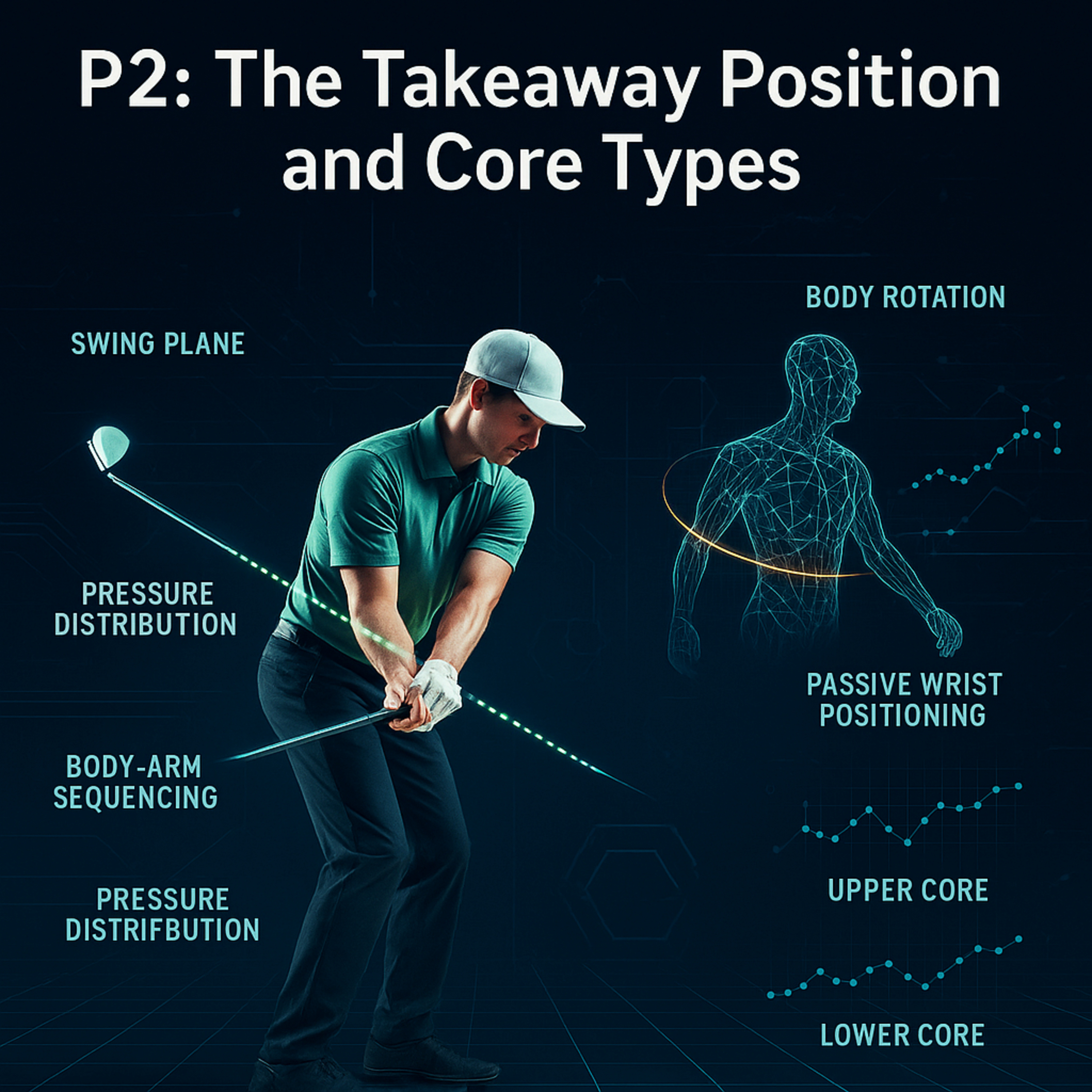
#377 Golf Swing P2: The Takeaway Position by Core Type episode artwork

EPISODE · Oct 15, 2025 · 10 MIN

#377 Golf Swing P2: The Takeaway Position by Core Type

from Golf 247.eu: The Global Platform for Innovative Technologies and Teaching Concepts. · host Golf247.eu

The P2 position—where the club shaft reaches parallel to the ground—marks the first dynamic moment of the golf swing. It bridges static setup (P1) and athletic motion, establishing the swing plane, rotation sequence, and energy storage that define power and consistency.Why P2 MattersAt P2, the golfer sets key fundamentals: how the club moves on plane, how the body coils, and how pressure begins to shift. A technically sound takeaway avoids compensations later in the swing and builds the foundation for efficient energy transfer.Core Type InfluenceEach golfer’s natural biomechanical “core type”—Upper, Middle, or Lower—shapes how the takeaway unfolds.Upper Core players move top-down. At P2, the club is slightly outside the hands, the shoulders rotate early, and the hands lift quickly, creating a steeper plane. Pressure stays centered or lightly in the trail heel.Middle Core golfers seek symmetry. The club stays on or just inside the hands; the torso and arms move as one while the hips begin turning. Pressure shifts subtly inside the trail foot, keeping balance and rhythm.Lower Core players initiate motion from the ground up. Their club travels deeper and flatter, with the shaft slightly behind the hands. The hips start the move, the shoulders stay quiet, and pressure shifts early to the trail heel—loading for explosive power.The Power of P2P2 initiates the coil between upper and lower body known as the X-Factor Stretch—a key to speed and control. As the chest and hips begin to rotate, separation builds: PGA Tour data shows roughly –38° chest turn and –22° pelvis turn; LPGA averages –41° and –24°. This early differential stores energy for release through impact.Key Technical ElementsClub Path: The club moves along or just under the original shaft plane. Too far inside or outside creates later compensations.Body Rotation: The chest and hips rotate together, initiating the X-Factor stretch.Arms & Wrists: The lead arm remains extended, trail arm softly folds, and wrists stay passive—avoiding premature hinging.Pressure & Posture: Light shift toward the trail foot without sway. Maintain spine angle and knee flex.Clubface Check: The leading edge should match spine angle; too open or closed invites timing issues.Core Type Variations at P2Each core type expresses the takeaway (P2) differently, influencing both club path and body motion:Upper Core – The shaft moves slightly outside the hands, creating a steeper swing plane. The shoulders rotate early with minimal hip motion, and the hands lift quickly.Middle Core – The shaft stays on or just inside the hands, maintaining a neutral plane. Rotation is balanced, keeping torso and arms connected throughout the move.Lower Core – The shaft moves behind the hands, producing a flatter plane. Motion is hip-led, with a deep hand path and passive shoulder action early in the backswing.ConclusionMastering P2 means mastering your motion’s DNA. It’s not just a checkpoint—it’s the start of rhythm, power, and sequence. Understanding how your core type drives the takeaway transforms P2 from a simple movement into the engine of your entire swing.www.Golf247.eu

The P2 position—where the club shaft reaches parallel to the ground—marks the first dynamic moment of the golf swing. It bridges static setup (P1) and athletic motion, establishing the swing plane, rotation sequence, and energy storage that define power and consistency.Why P2 MattersAt P2, the golfer sets key fundamentals: how the club moves on plane, how the body coils, and how pressure begins to shift. A technically sound takeaway avoids compensations later in the swing and builds the foundation for efficient energy transfer.Core Type InfluenceEach golfer’s natural biomechanical “core type”—Upper, Middle, or Lower—shapes how the takeaway unfolds.Upper Core players move top-down. At P2, the club is slightly outside the hands, the shoulders rotate early, and the hands lift quickly, creating a steeper plane. Pressure stays centered or lightly in the trail heel.Middle Core golfers seek symmetry. The club stays on or just inside the hands; the torso and arms move as one while the hips begin turning. Pressure shifts subtly inside the trail foot, keeping balance and rhythm.Lower Core players initiate motion from the ground up. Their club travels deeper and flatter, with the shaft slightly behind the hands. The hips start the move, the shoulders stay quiet, and pressure shifts early to the trail heel—loading for explosive power.The Power of P2P2 initiates the coil between upper and lower body known as the X-Factor Stretch—a key to speed and control. As the chest and hips begin to rotate, separation builds: PGA Tour data shows roughly –38° chest turn and –22° pelvis turn; LPGA averages –41° and –24°. This early differential stores energy for release through impact.Key Technical ElementsClub Path: The club moves along or just under the original shaft plane. Too far inside or outside creates later compensations.Body Rotation: The chest and hips rotate together, initiating the X-Factor stretch.Arms & Wrists: The lead arm remains extended, trail arm softly folds, and wrists stay passive—avoiding premature hinging.Pressure & Posture: Light shift toward the trail foot without sway. Maintain spine angle and knee flex.Clubface Check: The leading edge should match spine angle; too open or closed invites timing issues.Core Type Variations at P2Each core type expresses the takeaway (P2) differently, influencing both club path and body motion:Upper Core – The shaft moves slightly outside the hands, creating a steeper swing plane. The shoulders rotate early with minimal hip motion, and the hands lift quickly.Middle Core – The shaft stays on or just inside the hands, maintaining a neutral plane. Rotation is balanced, keeping torso and arms connected throughout the move.Lower Core – The shaft moves behind the hands, producing a flatter plane. Motion is hip-led, with a deep hand path and passive shoulder action early in the backswing.ConclusionMastering P2 means mastering your motion’s DNA. It’s not just a checkpoint—it’s the start of rhythm, power, and sequence. Understanding how your core type drives the takeaway transforms P2 from a simple movement into the engine of your entire swing.www.Golf247.eu

NOW PLAYING

#377 Golf Swing P2: The Takeaway Position by Core Type

0:00 10:26

No transcript for this episode yet

We transcribe on demand. Request one and we'll notify you when it's ready — usually under 10 minutes.

Frequently Asked Questions

How long is this episode of Golf 247.eu: The Global Platform for Innovative Technologies and Teaching Concepts.?

This episode is 10 minutes long.

When was this Golf 247.eu: The Global Platform for Innovative Technologies and Teaching Concepts. episode published?

This episode was published on October 15, 2025.

What is this episode about?

The P2 position—where the club shaft reaches parallel to the ground—marks the first dynamic moment of the golf swing. It bridges static setup (P1) and athletic motion, establishing the swing plane, rotation sequence, and energy storage that define...

Can I download this Golf 247.eu: The Global Platform for Innovative Technologies and Teaching Concepts. episode?

Yes, you can download this episode by clicking the download button on the episode player, or subscribe to the podcast in your preferred podcast app for automatic downloads.
URL copied to clipboard!