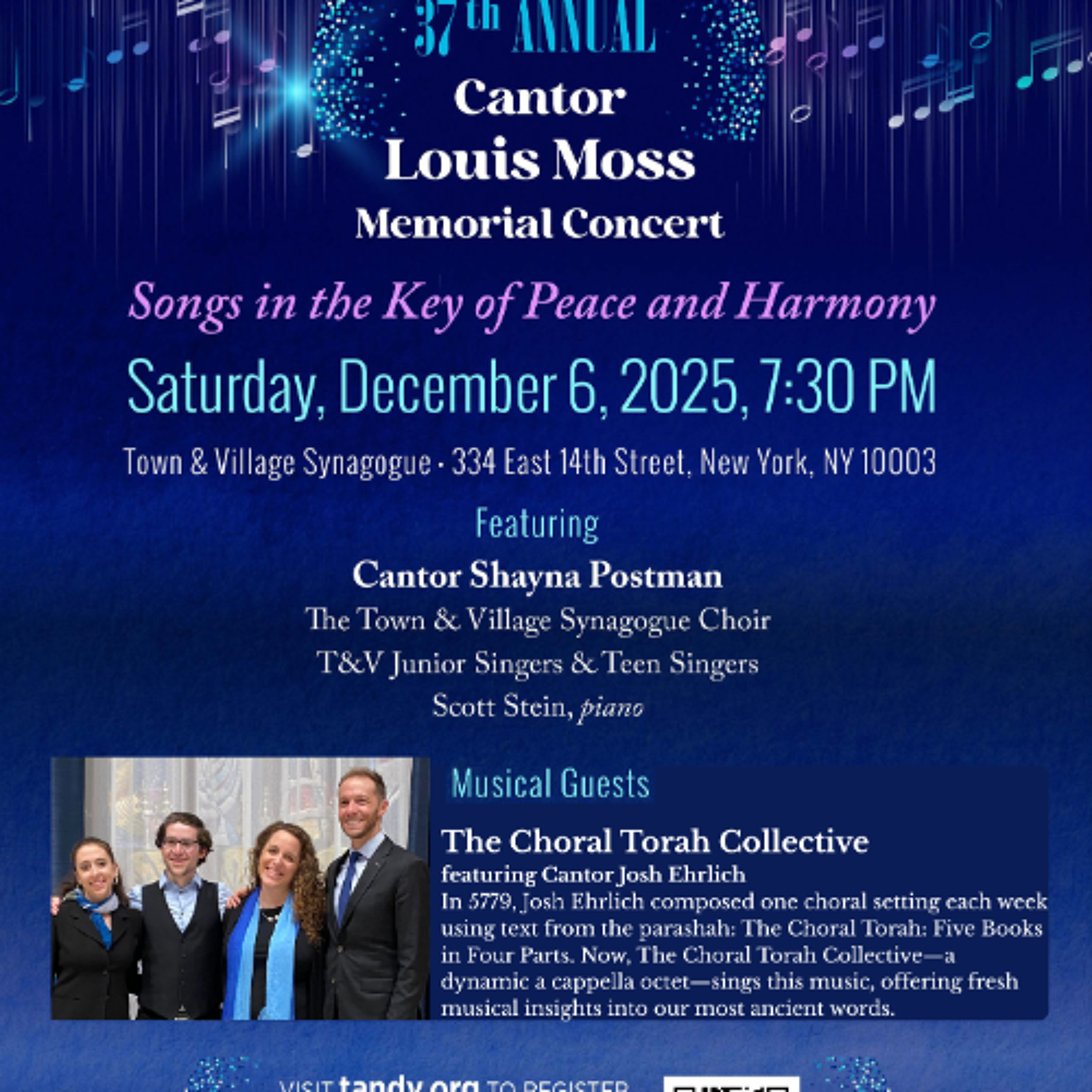
And when his congregation began, Cantor Lewis was invited by his brother-in-law to serve as the Cantor of our congregation. And he served for 38 years as our son.
Thirty-six. Oh, somebody said that. Thirty-six years. Thirty-six, maybe seven years. And he gave great life to this community and inspired tradition of song and love of music in this community. When Cantor Lorda Wallach became the Chazan, she formed a choir. And shortly thereafter, we had the very first Cantor Louis Mosque World concert and has been going ever since with the help of our Chazanim, who do exquisite work and bring our choral music and our music into this room each and every Shabbat.
A deep pleasure. I would also welcome the members of the mosque again who are here. Larry and Rina and Jess and Karen who are here with us. And it's nice to have you here. We treasure your father and your grandfather's memory. We are here for the evening of music. Cantor Hossman has been working incredibly long hours.
I see the effort working very, very hard. And you'll hear the results this evening, the beautiful music that will grace our presence here tonight. And it's a pleasure to introduce, actually, Cantor Shaina Postman. And thank you, Robert Ziba, for our conversation. We are beyond grateful to be here tonight together in peace and harmony. And we hope that he comes across the music. And we are really especially grateful to have our guest this evening, the Choral Toro Collective.
And I've got my incredibly talented and menchie colleague, Kendra Josh Ehrlich. And featuring Kendra Ehrlich in this octet of shimmering voices. We've got a little earful of them tonight. And I actually first got to hear them at the North American George Coral Festival. And so I'm really excited that we were able to bring them to our community and really excited to have them here tonight. Thank you all for being here.
We hear that many of the works in their eclectic set are from Canterbury's musical midrash of inspired compositions, entitled The Coral Torah, Five Books in Four Parts. And so you're in for a real treat in just a little while. For the first half of the program, I am really thrilled to be able to invite them in just a minute, almost after Junior Sinners to pop, and then they'll be followed by the Tally Village Sinatra Choir, and we'll be sharing songs and prayers of re-dedication and resilience. And you'll hear some prayerful yearnings that you keep over the gates that junior singers are going to sing in a little bit. And you'll find me, which is the adult part of me singing. But you'll also hear the yearning complimented by joyful spirit. We'll hear some common songs in three different languages. And our adults will wish you a week that's going to be the health and life. So in just a moment, we're going to invite the junior singers. But first, I'm going to have a few folks help me get the stage ready for that.
Village Choir to team the junior and team singers, the Scott Stein, and Cantor Postman for hosting and sharing the stage with us tonight. Open to a chassot or trumpets. And now we turn from the silver trumpets used to gather the community, Parshat Pahalot Decha, to the golden rule and its lesser known silver corollary. You see, in Parshat Kedoshim, we read what is perhaps the Torah's most famous guideline, so much so that Rabbi Hillel uttered it to somebody while standing on one foot. Anybody? Do unto others who would have done unto you. Love your neighbor as yourself. The lesser known silver corollary, though, is do not avenge and do not bear a grudge.
So the Do Not Avenge music will quote from musical theater's most famous avenger. See if you can guess who. And then in contrast, the Love Thy Neighbor music will give a nod to the sound of gospel music with a melody that gets passed around in a very neighborly fashion between all four voice parts. This is Lo Tico. Just this morning, we read about the reconciliation between Yaakov and Esav, brothers who, after Esav had sworn vengeance for Yaakov's deception, managed to run up to each other in ways, kiss, and cry.
And yet, this afternoon, we read about Yaakov continuing the cycle of playing favorites with his kids, leading Yosef's brothers to resent him, ultimately throwing him into a pit and selling him as a slave. But now, at the end of the family drama that is the entire book of Genesis, after Yaakov is laid to rest by his sons, Yosef's brothers beseech him to please forgive. This is Sad Na. of her wicked thing, so composed music inspired by the first two parsiot of the Torah in his musical called Children of Eden. And in his next song, The Spark of Creation, he imagines the character of Eve, the first female on the planet, before her exile from Eden, as she discovers an intoxicating new word, beyond. I'm now delighted to have cantors Mira Davis and Arielle Reisner singing of The Spark of Creation. Entirely canetchy Jewish people to take this, delegate some of his workload, and look at his life through Heaven's eyes. I invite Lila Rosen, the co-founder of the Choral Torah Collective, to come up and sing Through Heaven's Eyes.
And I invite all of you, when the time comes to join the dance. Parshat Bishalah, one of perhaps the most musical of all the Torah portions, so much so that the day we read it in synagogue, we call it Shabbat Shira, the Sabbath of Song. First, Moshe sings his triumphant song of the sea to celebrate the miraculous red sea crossing, and then his sister starts the epic after party.
Listen for the rhythm built into the language here. When you repeat the word tupim for drums with its two closives, you can't help but feel that beat. Perhaps the word tupim is a precursor for the word timpity. And where percussion goes, dance is sure to follow. You'll hear the melismatic motion of the word meholot dances, and you are very much invited to drum and dance along. This is Miriam Han-Niviyah.
Thank you very much.
The songs and stories of Parashat Beshalach are followed the very next week by Parashat Yidro, which has no shortage of blockbuster moments of its own, particularly God's grand revelation of Mount Sinai. God's presence manifests in fire and vigorous trembling of the entire mountain. And from the fire, of course, comes smoke. This is Ashan. I'm going to start playing my way up here and when I say a few words.
I'm going to thank all of you for being here tonight. Thank you, everyone who's joining us. Everyone who's here in person, everyone who's joining us virtually for this evening of harmony and community. There are so many people that are helping this evening come together. We are especially grateful for everyone who really is here who participated in any level of admission or sponsorship. And I just want to mention the donors who participated at the highest levels in helping sustain this event in our community. Concert benefactors, Albert Zuckerman and Claire Zuckerman-Zipan Ali Kaka.
Thank you so much. We thank you to all of our sponsors. I also want to take a moment to thank some people, more people who know how to see you. Our concert chairs, David the Steelman, our concert. Thank you.
Thank you so much for being with such dedication and warmth and good humor. You are one of the partners in this event. Sarah-Jane Sacks, thank you Sarah-Jane. Our CEO in air quotes, our community enhancement officer. She just makes everything so beautiful, all the decorations, upstairs, downstairs, everything. And to you and Lindy and the entire crew, thank you Sarah-Jane. Thank you Sarah-Jane for bringing the programs a little bit.
And you'll see on the inside cover, the names of so many of our community, each of whom played key roles in helping make tonight possible, including members of our team of co-chairs and our concert night volunteers. And we couldn't do this without all of you. And we couldn't do this without our sound members, Daria and Ladua, and Walters and the other day, and our president, Nina Lina and Tanara Lavrovina, and our senior staff, and the senior administrator, Joanna Heisenberg. And let's show our appreciation, once again, to our tremendous teens who let us at one o'clock tonight, to our joyful future winners, the transcendent teens being honored, our wonderful and powerful pianist Scott Stein, and of course, our captivating Choral Torah Collective.
I mean, thank you all again for being here. Actually, whether or not you're going to be a quick offer after this. And after this piece, which we are so delighted to take together with the Choral Torah Collective, we will invite the Jewish singers over after this one for one more. So we're going to have a conclusion of the concert. But before that, a great piece. Thank you, Kendrick Westman. I just want to quickly say the names of our Choral Torah Collective members who sang so beautifully tonight. On Soprano, we have Lila Rosen, Kenter Amir Davis, Kenter Arielle Rasner.
Sarah Baumgarten. And I'm Petter, we've got Andrew Wheeler. And I'm Petter, and Dahlia Petter Robinson. And filling in just this week on bass is Ada Bach. My name is Josh Ehrlich.
As Kendra Postman said, we're now going to shift from singing for you to singing with you and with the choir. Just so you know, we have a couple copies of the Choral Torah to peruse if anyone is interested. As we said at the beginning, this is our Manhattan debut, and we'd love to do more of this, so if you enjoyed me here tonight, please do spread the word. And without further ado, inspired by these beautiful tents on top of this ark I see over here, how beautiful are your tents.