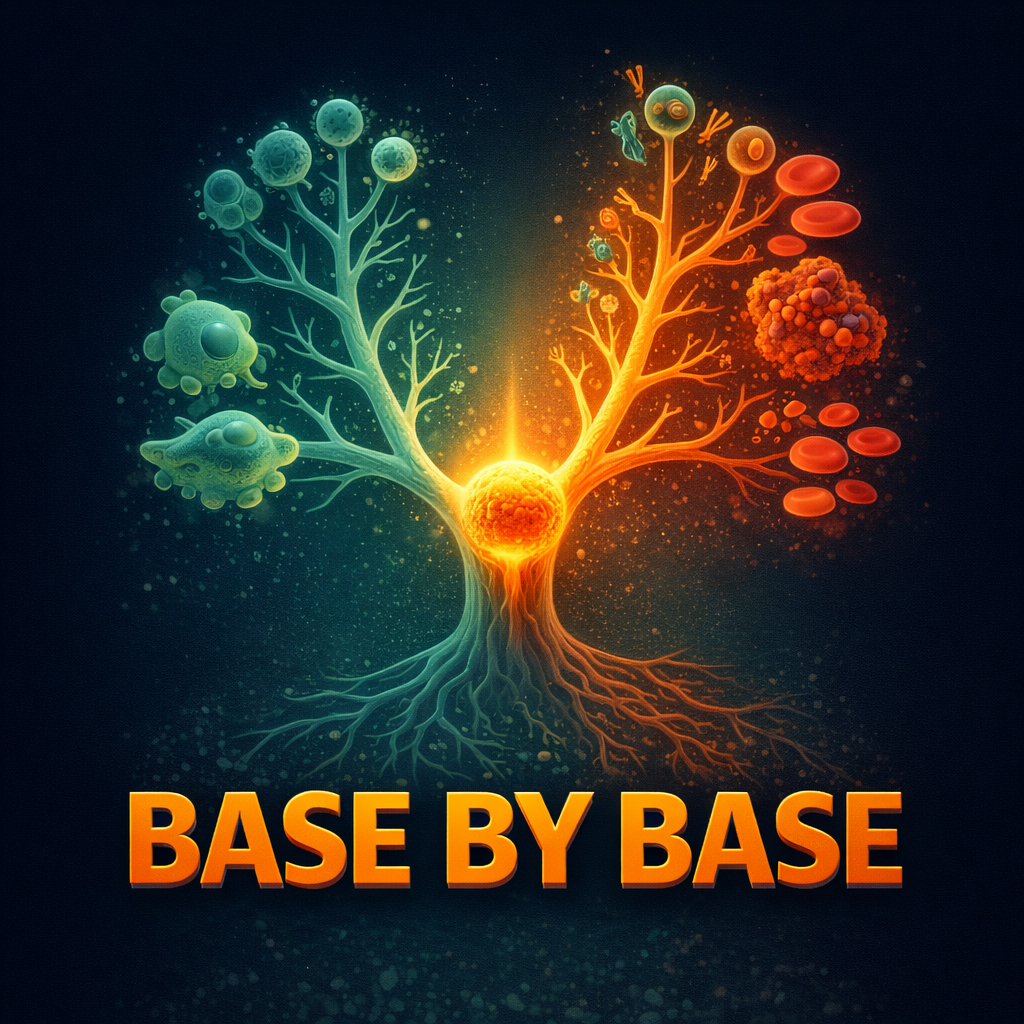
382: How animal blood cells evolved from unicellular ancestors episode artwork

EPISODE · Jun 2, 2026 · 26 MIN

382: How animal blood cells evolved from unicellular ancestors

from Base by Base · host Gustavo Barra

Nagahata Y et al., PNAS - A transcriptome-driven reconstruction of blood cell evolution shows modern animal blood lineages arose by repurposing an ancestral unicellular toolkit. The study traces macrophage-like origins, a bilaterian mast/killer split, and later deuterostome/vertebrate innovations. Key terms: blood cell evolution, macrophage, mast cell, Fos, thymus. Study Highlights:The authors used cross-species transcriptomics and TF-focused phylogenies to show that the metazoan blood cell program traces to a premetazoan toolkit governed by Fos, producing macrophage-like initial blood cells. They infer a first major bifurcation at the origin of Bilateria that gave rise to a mast/killer lineage equipped with granular proteases specialized for antiparasitic defense. Deuterostome and vertebrate ancestors then diversified this mast lineage into T/NK and erythrocyte/thrombocyte branches while B cells emerged from the macrophage branch, and a prototypic thymus formed at tunicate gill edges. Murine hematopoiesis retains vestiges of this history: macrophage and mast potentials are widely preserved and ancient HSC-like progenitors persist. Conclusion:Blood cell diversity in animals represents a Fos-mediated repurposing of an ancestral unicellular program, with macrophage-like cells as the earliest blood lineage and subsequent bilaterian and deuterostome innovations producing mast/killer, lymphoid, and erythroid branches. Music:Enjoy the music based on this article at the end of the episode. Article title:Animals have expanded the evolutionary legacy of unicellular ancestors in blood cells First author:Nagahata Y Journal:PNAS DOI:10.1073/pnas.2528110123 Reference:Nagahata Y, Ishidae T, Satou Y, Nishimura Y, Kaitani R, Leong JCK, Oda-Ishiie I, Carmona-Rivas M, Najle SR, Ruiz-Trillo I, Kohtsuka H, Abeg S, Ikuta K, Miura T, Kawamoto H, Casacuberta E, Ogasawara M, Irieda N. Animals have expanded the evolutionary legacy of unicellular ancestors in blood cells. PNAS. 2026;123(23):e2528110123. doi:10.1073/pnas.2528110123 License:This episode is based on an open-access article published under the Creative Commons Attribution 4.0 International License (CC BY 4.0) – https://creativecommons.org/licenses/by/4.0/ Support:Base by Base – Stripe donations: https://donate.stripe.com/7sY4gz71B2sN3RWac5gEg00 Official website https://basebybase.com On PaperCast Base by Base you'll discover the latest in genomics, functional genomics, structural genomics, and proteomics. Episode link: https://basebybase.com/episodes/base-by-base-382-blood-cell-evolution QC:This episode was checked against the original article PDF and publication metadata for the episode release published on 2026-06-02. QC Scope:- article metadata and core scientific claims from the narration- excludes analogies, intro/outro, and music- transcript coverage: Audited the spoken content describing the article’s core evolutionary timeline for blood cells, Fos-driven regulatory origins, macrophage-like ancestries, bilaterian mast/killer divergence, lineage branching to T/NK and erythrocyte/thrombocyte, B cell origin from macrophages, thymus evolution at gill edges, and implica- transcript topics: Origin of blood cells at the metazoan root and Fos-driven premetazoan toolkit; Cross-species transcriptomics and transcription factor phylogeny; Macrophage-like primitive blood cells; Divergence of mast/killer lineage at Bilateria origin and granzyme-containing cells; Erythrocyte/thrombocyte lineage derived from mast/killer cells; B cells arising from macrophages QC Summary:- factual score: 10/10- metadata score: 10/10- supported core claims: 6- claims flagged for review: 0- metadata checks passed: 4- metadata issues found: 0 Metadata Audited:

Nagahata Y et al., PNAS - A transcriptome-driven reconstruction of blood cell evolution shows modern animal blood lineages arose by repurposing an ancestral unicellular toolkit. The study traces macrophage-like origins, a bilaterian mast/killer split, and later deuterostome/vertebrate innovations. Key terms: blood cell evolution, macrophage, mast cell, Fos, thymus. Study Highlights:The authors used cross-species transcriptomics and TF-focused phylogenies to show that the metazoan blood cell program traces to a premetazoan toolkit governed by Fos, producing macrophage-like initial blood cells. They infer a first major bifurcation at the origin of Bilateria that gave rise to a mast/killer lineage equipped with granular proteases specialized for antiparasitic defense. Deuterostome and vertebrate ancestors then diversified this mast lineage into T/NK and erythrocyte/thrombocyte branches while B cells emerged from the macrophage branch, and a prototypic thymus formed at tunicate gill edges. Murine hematopoiesis retains vestiges of this history: macrophage and mast potentials are widely preserved and ancient HSC-like progenitors persist. Conclusion:Blood cell diversity in animals represents a Fos-mediated repurposing of an ancestral unicellular program, with macrophage-like cells as the earliest blood lineage and subsequent bilaterian and deuterostome innovations producing mast/killer, lymphoid, and erythroid branches. Music:Enjoy the music based on this article at the end of the episode. Article title:Animals have expanded the evolutionary legacy of unicellular ancestors in blood cells First author:Nagahata Y Journal:PNAS DOI:10.1073/pnas.2528110123 Reference:Nagahata Y, Ishidae T, Satou Y, Nishimura Y, Kaitani R, Leong JCK, Oda-Ishiie I, Carmona-Rivas M, Najle SR, Ruiz-Trillo I, Kohtsuka H, Abeg S, Ikuta K, Miura T, Kawamoto H, Casacuberta E, Ogasawara M, Irieda N. Animals have expanded the evolutionary legacy of unicellular ancestors in blood cells. PNAS. 2026;123(23):e2528110123. doi:10.1073/pnas.2528110123 License:This episode is based on an open-access article published under the Creative Commons Attribution 4.0 International License (CC BY 4.0) – https://creativecommons.org/licenses/by/4.0/ Support:Base by Base – Stripe donations: https://donate.stripe.com/7sY4gz71B2sN3RWac5gEg00 Official website https://basebybase.com On PaperCast Base by Base you'll discover the latest in genomics, functional genomics, structural genomics, and proteomics. Episode link: https://basebybase.com/episodes/base-by-base-382-blood-cell-evolution QC:This episode was checked against the original article PDF and publication metadata for the episode release published on 2026-06-02. QC Scope:- article metadata and core scientific claims from the narration- excludes analogies, intro/outro, and music- transcript coverage: Audited the spoken content describing the article’s core evolutionary timeline for blood cells, Fos-driven regulatory origins, macrophage-like ancestries, bilaterian mast/killer divergence, lineage branching to T/NK and erythrocyte/thrombocyte, B cell origin from macrophages, thymus evolution at gill edges, and implica- transcript topics: Origin of blood cells at the metazoan root and Fos-driven premetazoan toolkit; Cross-species transcriptomics and transcription factor phylogeny; Macrophage-like primitive blood cells; Divergence of mast/killer lineage at Bilateria origin and granzyme-containing cells; Erythrocyte/thrombocyte lineage derived from mast/killer cells; B cells arising from macrophages QC Summary:- factual score: 10/10- metadata score: 10/10- supported core claims: 6- claims flagged for review: 0- metadata checks passed: 4- metadata issues found: 0 Metadata Audited:

NOW PLAYING

382: How animal blood cells evolved from unicellular ancestors

0:00 26:12

No transcript for this episode yet

We transcribe on demand. Request one and we'll notify you when it's ready — usually under 10 minutes.

MG Show MG Show The MG Show, hosted by Jeffrey Pedersen and Shannon Townsend, is a leading alternative media platform dedicated to uncovering the truth behind today’s most pressing political issues. Launched in 2019, the show has grown exponentially, offering unfiltered insights, comprehensive research, and real-time analysis. With a commitment to independent journalism and factual integrity, the MG Show empowers its audience with knowledge and encourages active participation in the political discourse. That Hoarder: Overcome Compulsive Hoarding That Hoarder Hoarding disorder is stigmatised and people who hoard feel vast amounts of shame. This podcast began life as an audio diary, an anonymous outlet for somebody with this weird condition. That Hoarder speaks about her experiences living with compulsive hoarding, she interviews therapists, academics, researchers, children of hoarders, professional organisers and influencers, and she shares insight and tips for others with the problem. Listened to by people who hoard as well as those who love them and those who work with them, Overcome Compulsive Hoarding with That Hoarder aims to shatter the stigma, share the truth and speak openly and honestly to improve lives. Flottengeflüster ALD Automotive Österreich | LeasePlan Beim Flottengeflüster powered by ALD Automotive | LeasePlan präsentieren Jörg Janik und Peter Gutenbrunner alle zwei Wochen spannende Informationen rund um das Thema nachhaltige Mobilität. Beide beschäftigen sich schon lange mit der Thematik und bringen umfangreiches Fachwissen mit. Sollten sie aber doch einmal nicht weiter wissen, werden unsere Expert*innen hinzugezogen, die ihnen gerne mit Rat und Tat zur Seite stehen. The Small Business Startup School – Business Notes | Financial Literacy | Retail Psychology – For Professionals & Entrepreneurs The Small Business Startup School Inc. Starting or buying a small business? While personal circumstances may vary, business patterns remain timeless. On The Small Business Startup School, we explore strategies, insights, and practical solutions to help entrepreneurs confidently navigate their journey.Hosted by Ola Williams—a retail entrepreneur, fintech founder, and financial coach with over two decades of experience—this podcast marries financial awareness and retail psychology with optimism to deliver actionable takeaways.Join us to learn, grow, and connect as we uncover the keys to business success.Let’s continue to learn together and be encouraged to keep on connecting!

Frequently Asked Questions

How long is this episode of Base by Base?

This episode is 26 minutes long.

When was this Base by Base episode published?

This episode was published on June 2, 2026.

What is this episode about?

Nagahata Y et al., PNAS - A transcriptome-driven reconstruction of blood cell evolution shows modern animal blood lineages arose by repurposing an ancestral unicellular toolkit. The study traces macrophage-like origins, a bilaterian mast/killer...

Can I download this Base by Base episode?

Yes, you can download this episode by clicking the download button on the episode player, or subscribe to the podcast in your preferred podcast app for automatic downloads.
URL copied to clipboard!