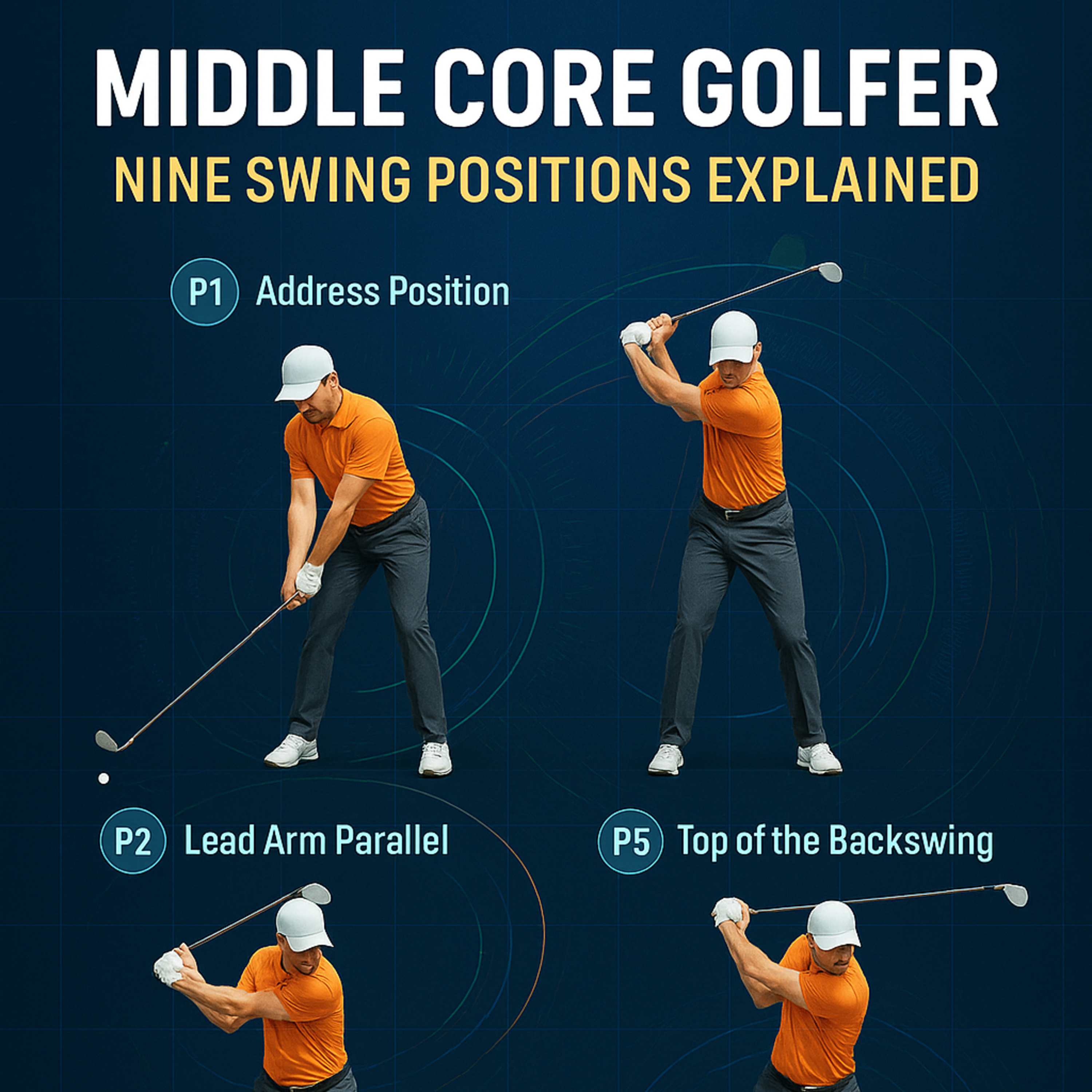
#387 Middle Core Golfer – Nine Swing Positions Explained episode artwork

EPISODE · Oct 25, 2025 · 15 MIN

#387 Middle Core Golfer – Nine Swing Positions Explained

from Golf 247.eu: The Global Platform for Innovative Technologies and Teaching Concepts. · host Golf247.eu

The Middle Core golfer’s swing is defined by balance, rhythm, and connection. In a podcast by Henrik Jentsch and Henrik Lienz, Jentsch—Head of the Golf Akademie 360°—explains how this golfer type maintains a synchronized, rotationally balanced motion throughout the nine key positions (P1–P9). Unlike Upper or Lower Core golfers, the Middle Core player’s motion is neutral, efficient, and repeatable, emphasizing connection between torso and arms and maintaining a consistent swing plane from start to finish.P1 – Address PositionThe swing begins with an athletic, balanced setup. The spine tilts moderately from the hips, hands rest directly under the shoulders, and weight is evenly distributed across both feet. The arms hang naturally, the chin is slightly raised, and posture remains relaxed yet stable. This connected position between torso and arms forms the foundation for a synchronized swing.P2 – Start of BackswingThe club, arms, and torso move together in one piece. The clubhead stays on or just outside the hands, while the chest rotates smoothly with minimal lower-body motion. The takeaway remains neutral and connected, establishing a natural swing arc and rhythm.P3 – Lead Arm ParallelWhen the lead arm reaches parallel to the ground, body connection is maintained. The torso and pelvis rotate together, preserving posture. Wrists hinge horizontally, and the trail elbow folds slightly in front of the rib cage, creating a compact, coiled position that stores energy without strain.P4 – Top of BackswingAt the top, the shoulders turn about 90°, the hips 40–45°. The spine angle is preserved, weight remains centered, and there is no excessive sway. The hands are over the trail shoulder, with the shaft parallel to or slightly across the target line. The swing is coiled but compact—ready for a smooth transition.P5 – Transition / Early DownswingThe downswing begins from the ground up. The lead hip opens while weight shifts gradually toward the lead side. Wrist lag is maintained, and motion stays on-plane. This stage defines the Middle Core golfer’s hallmark rhythm and coordination—controlled, balanced, and free of abrupt movements.P6 – Club Parallel on DownswingThe club returns to parallel with the ground before impact. The hands lead the clubhead, maintaining connection to the torso. The hips clear while the chest rotates open. Pressure builds into the lead leg, establishing a strong, stable base for the strike.P7 – ImpactImpact is centered and controlled. The hands are slightly ahead of the ball, the lead leg is braced, and the hips are open. The clubface is square, and weight is mostly on the lead foot. Power comes from timing and sequencing—not force—ensuring a clean, efficient strike.P8 – Post-Impact ExtensionAfter impact, the arms and club extend fully toward the target line. The trail arm straightens, and the torso continues rotating until the chest faces the target. This position confirms a free-flowing, connected release without manipulation.P9 – Finish PositionThe finish reflects balance and structure. The chest faces the target, the spine stands tall, and the trail foot is up on the toe. No over-rotation—just a smooth, complete motion. This balanced finish symbolizes the Middle Core golfer’s hallmark: control through connection.Weight Transfer SummaryP1: Evenly balanced setup.P5: Transition begins—lead hip opens, weight shifts forward.P6: Lead-side pressure increases through the ground.P7: Weight fully on the lead foot.Every stage of the Middle Core swing blends symmetry and timing. It’s the model of controlled rotation—athletic yet fluid—proving that in golf, true power comes from coordinated motion, not muscle.📺 The Explainer: www.Golf247.eu

The Middle Core golfer’s swing is defined by balance, rhythm, and connection. In a podcast by Henrik Jentsch and Henrik Lienz, Jentsch—Head of the Golf Akademie 360°—explains how this golfer type maintains a synchronized, rotationally balanced motion throughout the nine key positions (P1–P9). Unlike Upper or Lower Core golfers, the Middle Core player’s motion is neutral, efficient, and repeatable, emphasizing connection between torso and arms and maintaining a consistent swing plane from start to finish.P1 – Address PositionThe swing begins with an athletic, balanced setup. The spine tilts moderately from the hips, hands rest directly under the shoulders, and weight is evenly distributed across both feet. The arms hang naturally, the chin is slightly raised, and posture remains relaxed yet stable. This connected position between torso and arms forms the foundation for a synchronized swing.P2 – Start of BackswingThe club, arms, and torso move together in one piece. The clubhead stays on or just outside the hands, while the chest rotates smoothly with minimal lower-body motion. The takeaway remains neutral and connected, establishing a natural swing arc and rhythm.P3 – Lead Arm ParallelWhen the lead arm reaches parallel to the ground, body connection is maintained. The torso and pelvis rotate together, preserving posture. Wrists hinge horizontally, and the trail elbow folds slightly in front of the rib cage, creating a compact, coiled position that stores energy without strain.P4 – Top of BackswingAt the top, the shoulders turn about 90°, the hips 40–45°. The spine angle is preserved, weight remains centered, and there is no excessive sway. The hands are over the trail shoulder, with the shaft parallel to or slightly across the target line. The swing is coiled but compact—ready for a smooth transition.P5 – Transition / Early DownswingThe downswing begins from the ground up. The lead hip opens while weight shifts gradually toward the lead side. Wrist lag is maintained, and motion stays on-plane. This stage defines the Middle Core golfer’s hallmark rhythm and coordination—controlled, balanced, and free of abrupt movements.P6 – Club Parallel on DownswingThe club returns to parallel with the ground before impact. The hands lead the clubhead, maintaining connection to the torso. The hips clear while the chest rotates open. Pressure builds into the lead leg, establishing a strong, stable base for the strike.P7 – ImpactImpact is centered and controlled. The hands are slightly ahead of the ball, the lead leg is braced, and the hips are open. The clubface is square, and weight is mostly on the lead foot. Power comes from timing and sequencing—not force—ensuring a clean, efficient strike.P8 – Post-Impact ExtensionAfter impact, the arms and club extend fully toward the target line. The trail arm straightens, and the torso continues rotating until the chest faces the target. This position confirms a free-flowing, connected release without manipulation.P9 – Finish PositionThe finish reflects balance and structure. The chest faces the target, the spine stands tall, and the trail foot is up on the toe. No over-rotation—just a smooth, complete motion. This balanced finish symbolizes the Middle Core golfer’s hallmark: control through connection.Weight Transfer SummaryP1: Evenly balanced setup.P5: Transition begins—lead hip opens, weight shifts forward.P6: Lead-side pressure increases through the ground.P7: Weight fully on the lead foot.Every stage of the Middle Core swing blends symmetry and timing. It’s the model of controlled rotation—athletic yet fluid—proving that in golf, true power comes from coordinated motion, not muscle.📺 The Explainer: www.Golf247.eu

NOW PLAYING

#387 Middle Core Golfer – Nine Swing Positions Explained

0:00 15:32

No transcript for this episode yet

We transcribe on demand. Request one and we'll notify you when it's ready — usually under 10 minutes.

Frequently Asked Questions

How long is this episode of Golf 247.eu: The Global Platform for Innovative Technologies and Teaching Concepts.?

This episode is 15 minutes long.

When was this Golf 247.eu: The Global Platform for Innovative Technologies and Teaching Concepts. episode published?

This episode was published on October 25, 2025.

What is this episode about?

The Middle Core golfer’s swing is defined by balance, rhythm, and connection. In a podcast by Henrik Jentsch and Henrik Lienz, Jentsch—Head of the Golf Akademie 360°—explains how this golfer type maintains a synchronized, rotationally balanced...

Can I download this Golf 247.eu: The Global Platform for Innovative Technologies and Teaching Concepts. episode?

Yes, you can download this episode by clicking the download button on the episode player, or subscribe to the podcast in your preferred podcast app for automatic downloads.
URL copied to clipboard!