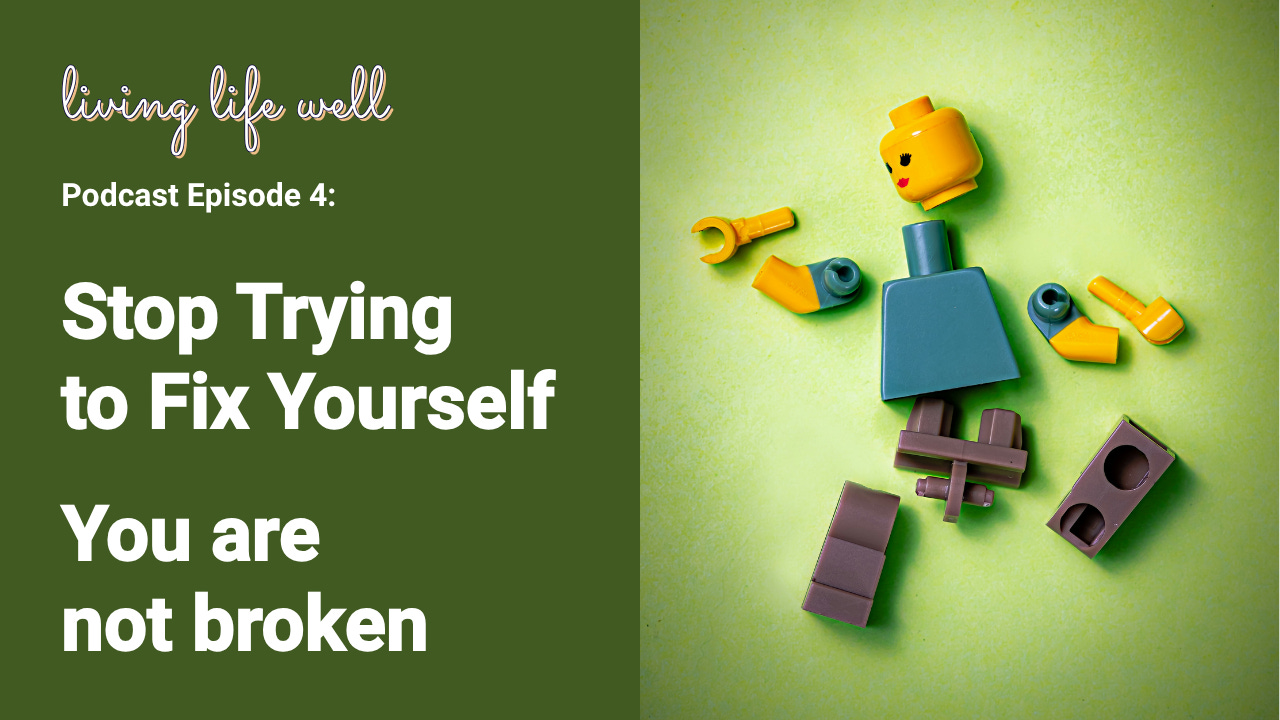
#4: Trying to Fix Everything Is Ruining Your Life
from Living Life Well Podcast Hosted by Janine Lattimore
Want More Inspiration, Information & Fun? If you want to be happy, healthy, wealthy and wise then you can subscribe for a weekly dose of inspiration and information from me. As my welcome gift to you, all subscribers receive a free copy of my short-cut guide Wired for Calm: Simple Nervous System Regulation for Everyday Stress Transcript Have you ever noticed how your mind moves from one thing to fix… to the next? You solve one problem, tick something off your list, maybe even have a moment where things feel okay—and then almost immediately, your attention shifts again. What’s not right yet? What needs improving? What could go wrong? For many of us, this way of thinking feels completely normal. It can even feel productive, responsible… like we’re doing what we’re supposed to do to build a better life. But what if this constant drive to fix, improve, and optimise is actually creating a quiet sense of pressure underneath everything? What if life starts to feel less like something to experience… and more like something to maintain? In this episode, I explore the causes and downsides of a “fixing mindset” and introduce a different way of relating to your life—one that isn’t about giving up growth, but about stepping out of the constant feeling that something is wrong. Because maybe… you don’t need fixing in the way you’ve been led to believe. Kia ora and hello, welcome to the Living Life Well podcast. I’m Janine Lattimore, a wellbeing writer and coach providing information and inspiration to make daily health and happiness simple. What if the very habit that’s meant to improve your life is quietly making it harder to enjoy? Many of us live with a mind that is always scanning for the next problem to solve, the next thing to fix, and the next way to be better. It can feel productive and responsible, but beneath that often sits a subtle tension, and a sense that something isn’t right. This way of thinking can lead you to get stuck in an endless loop of fixing and controlling, where you feel constantly anxious, incomplete and not enough. I want you to know that you are not broken. Let me tell you why this is happening and how you can feel satisfied with yourself and your life. The Pattern of Always Looking for What’s Wrong There is a common pattern of thinking that people experience where the mind consistently focuses on the next problem to solve or the next thing to fix. In this state moments that are good or enjoyable are only briefly noticed before your attention quickly shifts to what might go wrong or what needs improvement. This habit of thinking can be linked to personality characteristics and is also a familiar pattern for people who are trained to analyze, improve and achieve. There is also a link between this and experiencing high levels of fear, anxiety and a need to control your life. When Self-Improvement Turns into Subtle Dissatisfaction Many people fall into this way of thinking and it can be seen to be responsible and productive. The idea of needing to improve and become a better version of yourself flows through a lot of success oriented personal development teaching. While this problem-fixing mindset may help people to achieve more, it can also lead to a constant underlying dissatisfaction with life and with yourself, and an ongoing feeling of discontent in the striving for constant improvement. You Find What You Are Looking For When your mental filter is set to look for problems, then that is what you will perceive in your experience. If you are focused on what you think you need to fix, then that is what you will actually create more of. I know that may sound a bit crazy, but that is the way it works from a biological, science and spiritual energy perspective. I give a full breakdown of how this principle of attraction works in my book The Great Life Planner, but here is a summarized overview. Why Your Brain Is Wired to Find Problems Firstly, the biological perspective. There is an area in your brain called the reticular activating system (RAS). Your RAS filters what sensory information is let into your conscious mind because you take in a great deal more information from your senses than your conscious mind is able to process. Your RAS filters are set in terms of survival and safety first, and then in terms of your conscious focus and your beliefs. Problems and things that need to be fixed are potential survival and safety threats, therefore they get prioritized by your RAS and by the limbic area of your brain which connects to your subconscious beliefs and activates your stress response. The focus of your RAS and limbic system is to monitor the threat rather than look for a solution. Creating solutions and new ways of doing things is the domain of the pre-frontal cortex area of your brain and that gets down-regulated if your body does not feel safe. If you are constantly aware of problems and things that need to be fixed, then your body will be in survival and stress mode rather than in a relaxed, safe state. The Energy You Carry Shapes What You Experience The science aspect of this connects with physics. One of concepts of physics is that everything is energy and that all energy vibrates at a particular frequency. All vibrations transport their energy by waves. Two of the vibrational waves our brains and bodies emit are thought and emotional waves. These generate electromagnetic fields that extend beyond your physical body. Energy frequencies resonate with (connect with) other frequencies that are on the same frequency spectrum level. This means that the energy that you send out through your thoughts and emotions connects with similar energy in other people and the world around you. If you are thinking about problems and what could go wrong, and feeling fear and anxiety, then you will connect to and attract more of that into your field of experience. Spiritual energy concepts echo those of physics and usually frame it as the law of attraction or the law of resonance. These also state that “like attracts like” in terms of energy. What I will expand on in terms of this is that there is often a difference between the energy your subconscious mind and body are emitting, compared to the thought energy of your conscious mind. For example, your conscious mind may think I’ll start exercising to fix my weight issue. Your conscious mind chooses the creative solution, but it is rooted in thinking that you have a problem that needs to be fixed. You will also have a lot of subconscious beliefs and patterns of thought, emotion and behaviour connected to your current state which is why it is your current reality. The result of this is that you have one part of your energy directed towards the solution (exercising more), but the majority of your energy will come from everything else that is going on in your body: the stress response to seeing your weight issue as a threat, your RAS and nervous system scanning for anything connected to that threat, and your habitual automatic patterns of thought, emotion and behaviour that connect to your current state. Why Trying to Fix Everything Can Keep You Stuck Obviously, all this makes it very hard to change your current reality and is possibly how trying to fix everything is ruining your life. As I say that I am aware of the irony in my creating a podcast telling you how to fix a problem that is caused by trying to fix problems. However, I do want to give you three things that will help. The first is accepting all of the experience of life as okay. The second is to choose your self-worth, and the third is to foster safety and regulation in your nervous system. What If Life Isn’t a Problem to Solve? A fixing pattern of thought can come from believing that everything has to be good, positive or perfect all of the time. We can compare it to the idea of wanting to live in perpetual Summer. The reframe to this is letting go of resistance, and accepting the natural flow and cycles of life. Energy reserves are depleted if they are running on high all the time. Death and life are intertwined in a circle, as are light and darkness, and all have value and purpose. What if life isn’t a series of problems to be solved, but a variety of experiences to be lived. What if death, darkness, and emptiness were not something going wrong, but equal experiences with life, light and fullness. It’s mainly our survival based limbic system that resists discomfort. On top of that we have been trained to label uncomfortable sensations and emotions as negative or bad, and to live with certain ideas of what is right and what is wrong. What if some of the conditions that you thought of as things going wrong and needing to be fixed, you could choose to label as simply another form of experience? Maybe you could ask yourself, “what if this is not a problem to be solved, but an experience to be had?” Self-worth is a Choice At the core of a constant need to fix and be better is a sense of not-enoughness. My interest in health and personal development was initially sparked by a driving desire to fix myself. One of the first healing declarations I made when I embarked on my journey to truly loving myself in my mid-forties was: “There is nothing wrong with me. I don’t need to be fixed.” It took me a lot of courage to say, and I had to work through the fear of other people judging me for stating it. I had spent a lifetime up until that point thinking there was a lot wrong with me, and that belief had been fostered by a critical father and perpetuated by critical partners. Another thing that happens when we focus on our perceived flaws and think we need to be fixed is that we tend to project that, and also try to fix other people, usually under the guise of helping them. This is not to say that everyone is perfect in the sense of being all good, but you are perfectly you. The idea of accepting all of the experience of life can be applied to us as people as well. The variety of your characteristics, abilities and understanding is the unique and valuable expression of who you are. Your self-worth is something you choose to recognise, not something you have to earn. If you believe that you have to earn your worth, then you will get stuck in the problem fixing loop and never feel good enough. Believing you are enough is a choice, and an acceptance of the value of all life experience. Creating Safety and Calming the Nervous System A nervous system stuck in survival and stress will gravitate towards potential threats and things that are wrong. This often becomes a self-perpetuating loop. Breaking it is a matter of consciously creating conditions where your body can relax, reset and rewire. It starts in the body. When your body feels safety, then your mind will follow, but you cannot think your way into nervous system regulation. Switching off your inner stress alarm, signals the body to stop being hyper-vigilant about scanning for threat and allows your mind to open to creating something new. If you want to learn some easy ways to create safety within your body and a simple overview of what nervous system regulation actually is, then you can subscribe to my Substack publication and get my free short-cut guide: Wired for Calm – I will put the link in the podcast notes (if you are already a subscriber and missed out on getting the guide, then message me and I will send you the download link). Please understand that I am not saying that it is wrong to want more The desire for healing or to be more is not wrong. I think it is the calling of our soul to evolve and expand. What is important is the underlying reason for that. Is it coming from a place of not-enoughness and a perceived need to earn acceptance and worth, or is it coming from a place of exploration of what could be. Do you want to be better out of a desire to experience more and evolve, or because you think you are not good enough as you are? Cultivate an Expansive View of Life Satisfaction does not come from fixing more, but from relating to life differently. When you begin to accept the full spectrum of your experience as meaningful, choose to recognise your innate self-worth, and create safety within your body, something softens. The urgency to constantly improve starts to loosen its grip, and in its place comes a steadier sense of being. From here, growth doesn’t disappear, rather it becomes more natural, more curious, and far less pressured. Life is no longer an endless series of problems to solve, but a landscape to move through, experience, and enjoy as it is unfolding. Just One Thing This week’s “Just One Thing” action point to help you turn information into transformation through implementation is to practice physiological sighing, also known as cyclic sighing. This is a relaxation breathwork practice that you can do pretty much anywhere, any time and other people may not even notice you doing it. It is very quick and easy and has been scientifically shown to effectively reset your body’s nervous system when you are experiencing stress. To take a physiological sigh, breathe in through your nose, preferably slowly and fully consciously using your diaphragm, then take another small inhale through the nose before exhaling long and slow through the mouth as if you were letting out a big sigh of relief. So you are inhaling through the nose in two steps and then doing a long exhale through the mouth. Sometimes when I do this my body releases sound with the exhale as well. Releasing your voice in this way can add to the relaxation effect. This method uses the body’s natural sigh reflex to quickly calm the autonomic nervous system and reduce stress. The long exhale slows down the heart rate and lowers blood pressure. Another benefit is that it helps to balance oxygen and carbon dioxide levels in the blood which can improve your energy levels and increase mental clarity. Thanks for listening to this episode of Living Life Well I love Feedback If you try the just one thing action point for this week, I would love you know what happens for you. You can send me a direct message or add a comment. Wishing you a life lived fully and well. Aroha nui, much loveand I look forward to connecting again on the next episode. Bye for now. This is a public episode. If you would like to discuss this with other subscribers or get access to bonus episodes, visit janinelattimore.substack.com
Embed this episode
No transcript yet.