Hello, and welcome to Classical Stuff You Should Know, the podcast about the ancient classical world, where we tell you stuff you should know. Oh, that's good. Ancient classical world, except when we don't want to talk about the ancient classical world. That's true.
Where we spend two and a half hours talking about the Middle Ages. Yeah, the classical Middle Ages. That's classic. But I mean, this is a good point.
And this has been brought to our attention a couple of times, that we are a podcast that doesn't just talk about the ancient priests in Rome, which is what lots of people think when they hear classical. So anyway, my name is Graham Donaldson, and I am joined here today, as always, with the ombudsman of fun, Thomas Magby. Hello. And with AJ.
I was going to get a pile. I was going to get him to have to talk before he finished swallowing his Snickers. Poor guy. What is your actual title?
Dean of Student Life. Dean of Student Life. I like ombudsman of fun. Dispenser of mirth is also a good one.
Has anyone ever called me that before? Right now. You just made it. It's happening.
I like that. And we are teachers. We teach at Veritas Academy, which is a classical Christian school in Austin, Texas. And boys, it is summer.
Yeah. It is glorious, glorious summer. I have graduation tonight, so this is our last day. We're recording this on our last day.
That's right. There is a poppable excitement in the air. We are sitting in a room covered in dust and boxes, because Veritas Academy is moving from our home for the past, how many years have we been here? A long time.
A long time. Oh, man. If you count the elementary school before we moved over from Bannekering, it was, I don't know, nine years? But these portables have been six, because we just got them when we started here.
Anyway, we are moving to our own shiny new building about just a couple miles away, and everyone's super excited. Anyway, but today, Megby is going to crack eggs of wisdom all over this podcast. What? What do you think is an omelet metaphor with him?
Yeah, I've noticed this. What do you got for us there, Megby? So, I guess this is following in the tradition of way too late in the length of this podcast asking really basic questions about what the heck we're talking about. And so the topic for today is classical education.
That sounds super interesting. Okay, so many episodes ago, I think it might have been the first one when I came on the podcast was asking, what is classical? Do you all remember any of those definitions? We had just hired you.
So, I mean, you were literally, you were legitimately asking the question. I was like, guys, what is this classical thing about? So, I got this job at the school. I probably had been working for a year.
Did you say we hired him? No, he hired me. I don't even know the podcast. No, no, he didn't realize that.
He's been waiting for his paycheck for a while. So, what is classical? Do you remember any of those three definitions? Old.
Yeah, Greece and Rome. Coca-Cola classic, so we got this new thing, but it's kind of like the old thing, but the old thing now needs to be differentiated from the new thing. Yeah. Yeah.
So, Greek, Roman, or Latin literature and art is one definition that's the first one we're talking about. An exemplary standard would be a second one, so just a thing that's an important idea can be called a classic. So, when AJ has, like, a perfect day, and we say that is classic AJ. That is classic AJ.
It's like when he rock climbs, and when he teaches in English class, and what would be, like, peak AJ telos AJ day? Rock climbs, teach in English class. Don't eat breakfast. Wait, what?
I know breakfast. So, don't eat breakfast. Come to school. Have three cups of coffee.
Buy lunch. I'm shaking. And then, yeah, teach some. Climb some.
And then you're DJing a party at night. That's right. DJ a little bit. That's classic AJ.
You enjoy the DJ stuff that much? I think we're going for iconic, or like my ideal day. We're going classic AJ. Then DJ.
There you go. And then the last one on there is related to the first significant period of an area or study. So, a classic period. So, psychology is a relatively recent field.
Early studies of psychology would be regarded as the classics of that study. So, the first significant period. Classic rock. Yep.
Known for its significance, I guess. If you're saying classic rock and roll, I say 50s. If it's classic rock, then I think 80s. Okay.
So, those are the three definitions of classical that we talked about a while ago. But a phrase that we've thrown around a few times, but not addressed specifically, is classical education. Shame on us. On a previous episode, I said, we've never done enough of classical education.
And the reply was, well, we talked about the trivium. And I think, this might just be me, and I would love for the two of you to disagree, I think that's comparable to a previous statement on the podcast when someone said, we've never discussed Aristotle. If I had said, well, we talked about book eight and nickname ethics. Like, we talked about Aristotle, but we didn't cover the wholeness of Aristotle.
And saying the classical, that we often tie the trivium to it. I don't think it's the wholeness of classical education. Would you all disagree with that? No, I would agree.
When we talked about the trivium, we talked about the Dorothy Sayers commencement speech, the Lost Tools of Learning. And that was the speech that launched 1,000 Schools. And a lot of people sort of use that speech as the shorthand crib notes for what classical education is. And I think a lot of us who are in the classical education world, yeah, kind of fall back on that speech and say, classical education, trivium.
Right. But it's not it at all. Or that's not the entirety of it. But let's follow that for a while.
So, we talked about Dorothy Sayers a while ago on the trivium redo. Redux. Redux. Redux, yeah.
Anyway, so that was the episode on that. And so, you can go and listen to that. But the trivium originally is not the stages of development that we use now. What was the trivium originally?
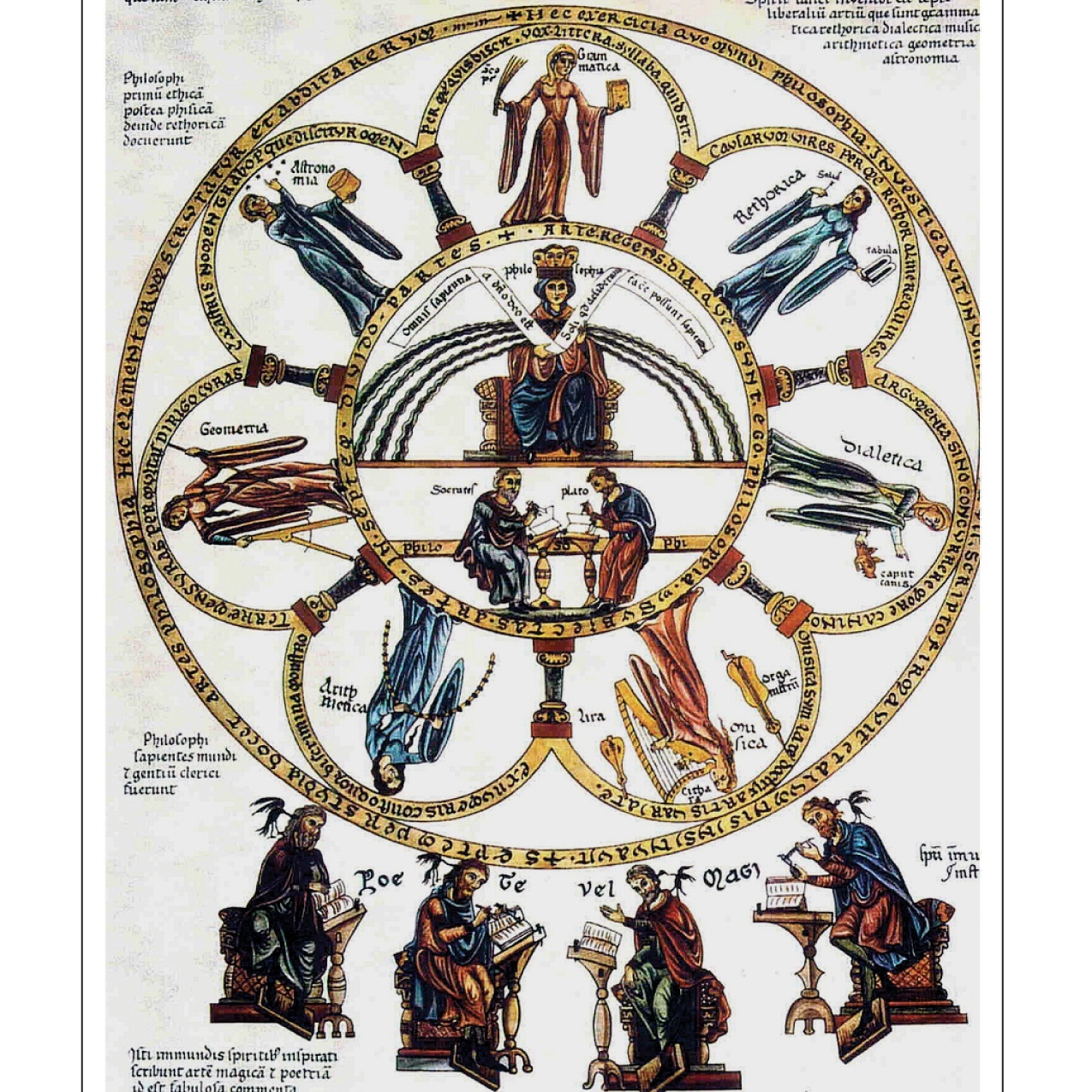
It was three out of the seven classes that you took, essentially. You took seven liberal arts, and three of them were grammar, logic, and rhetoric. Grammar, logic, rhetoric, arithmetic, geometry, music, astronomy. So, you were studying grammar.
You were studying logic. You were studying rhetoric. You were formal. I'm trying to avoid using the word subjects, because that's not the right word for it.
But, I guess, arts. You were studying studies. You were studying their formal studies. Each of them were each of their own formal study.
Well, then, the rest of the day looks at them and says, well, this trivium also applies to the development and growth of children. That, as they grow up, they are following this grammar, logic, rhetoric paradigm. And so, a weird thing that causes me to think is that classical education is kind of formed on an old idea, but it's a very new interpretation of a very old idea. Well, she's marrying the trivium with, for her time, modern child development psychology.
Yes, that. And she's marrying that together. And so, if she had given that speech in Latin to a bunch of people in the middle ages, they would have been like, no, children don't develop. They're just bad adults.
Which is kind of what the ancient understanding of a child is. So, her was like a new proposal of how to understand the development of children. Because, just like you were saying, psychology is this kind of new field. We're understanding the growth and development of children.
And so, instead of it being a modern sociological explanation, it's an attempt at an ancient explanation of how children grow up. But that's my fear of the trivium being the only way we describe classical education. Because the trivium is kind of a method, right? Like, I think there's more to classical education than just a different way that we split up the stuff we teach.
Yeah, the trivium, I'd say, is both a method and a study. You can study grammar, but you can also have the grammar of any subject. Learning the basics of geometry, learning the basics of music. And so, it depends on, I mean, there's a little bit of ambiguity there, depending on what you're talking about.
If I say, I'm going to study grammar, I probably mean English grammar, right? But there's grammar for everything. And so, in the classical world, or at least in the classical education world, we vacillate between these two meanings. Studying the study of actual rhetoric or the rhetorical, expressive study of anything, right?
The rhetoric of painting is... And that's the tension I'm getting at, that the way of looking at the development of a child as that being the defining aspect of classical education is in the last 100 years, last 60 years. And that's Dorothy Sayers. Oh, yeah.
And the way that we educate has changed so much from what it was back then, right? If you were wealthy, you could hire a teacher or send your kid to a teacher, and you specifically chose them. It usually wasn't like a school, right? But if you sent them to the academy, you usually knew what teachers were poking around at the academy.
And you might even try different teachers for different things. It was more like a tutoring system, at least for a big chunk of it. I mean, but to follow on to that, it's also not just the wealthy. It's also only for men.
Like, we're really looking at what the original... Yeah, wealthy, leisurely, non-slaves. Yeah. So if you were a true classical school...
No, no, no, no, no, no. So the only point to make here is that there's more to it than the trivium. And so then let's explore what other differences are. So, Graham, this is in your intro that Veritas Academy is classical Christian university model.
Trying to focus just on that classical aspect piece of it right now. So what else is different about teaching English here at a classical school than it would be teaching it elsewhere? What is different about that? So, okay, if we're going with that classical education is not a methodology, because it's not only a methodology, it's more than that.
So one way to look at it, and this is the way I think about it, so classical education also has, or all education has an implied anthropology. So all education has, at its beginning, a belief as to what a human person is. And what are the ends of that person. And what are the ends of that person.
And a belief as to sort of what is the best for a human person and how a human person receives or learns information. So this isn't a complete answer, but one way that English is different here than another place is the fundamental anthropology of a classical Christian school is that the human person is made in God's image. The human person is an image bearer of God. And so that means that, and they have a human nature, and then the Christian part of that, a human nature that has been broken by the fall.
So that is the driving method, again, methodology, the driving focus underneath how a thing is taught. And then, I don't want to go into, I mean, we can go into what are other sort of the predominant modern ways of understanding what a human person is, and then how to teach that. So the problem with talking about classical education, I guess we kind of just touched on it, is that it has to be modernized in some ways. So we're not just taking a Greek method from thousands of years ago and copying and paste it.
here in Austin, Texas. And so there's some, so Dorothy Sayers' method is a piece of that modernization. So that's why much of what I'll be reading from today is also very modern, which just seems kind of funny in, like, looking up, yeah, calling it classical education, but the resources on it, I feel, are pretty modern. Yeah, if we transported some of those ancient tutors from Plato's School in Athens and said, all right, you're teaching history today, maybe, what are you talking about?
Yeah, because, like, the subject didn't exist in the same way. So what I'll be reading from, as we're going through this, is from the Circe Institute, they have some resources on understanding what is classical. And so, again, you've got the first one, that classical educators have a high view of humanity. So, do we know why they call themselves the Circe Institute?
This is funny, a secondary acronym is insulting and integrated resources for classical educators. They have two acronyms for the same, wow. I can't help but think that Andrew Kern had some sort of influence on the whole naming process, and if that's true, then he's a big lover of the Iliadian policy. Anyway, so it's an answer, I didn't know that.
So, again, that first one, it's an acronym. Well, Veritas is an acronym for Verily, R, Wait, righteous, our? Where's the E? There's an E there.
Oh, Veritas. Not Varitas. Varitas. Verily, either.
I can't, I got nothing. So, that's funny in my head. Having a high view of humanity that a piece of what's happening in education is not just skill transfer, but it's growing and developing into a full human. Paideia.
Yes, Paideia. But when you say Paideia, how is Paideia different from when I use the English word education? What's different between those two? There is a sense of, well, if you want to take an extreme view of it, one is conditioning and one is like raising, one is like child rearing.
That's sort of the difference is that, and C.S. Lewis talks about this a little bit in The Abolition of Man, where he says when a Roman father teaches his son that dulce et decorum, that it is right and good, it is sweet and good to die for your country, he is doing that out of a place where he truly believes it and he is transmuting manhood from himself to his child versus a propagandist or somebody who says it would be really good if we could create citizens who want to die for our country. Therefore, we're going to create a lesson conditioning them to think that dying for their country is a great idea. Maybe you have the same ends, but one is done, I mean, one knowledge is human and one is sort of a streaming human like a machine.
Yeah, I was going to say you're pointing out, I actually wrote down some of the ways that I think classical education is different from typical modern education. One of those is that it attempts to stray away from industrialization, right? Rather than imparting skills to kids, rather than like saying, we need you to be able to do X, Y, and Z by the time you leave school, what we're trying to do is develop the whole person and give them the means to live freely. And so if that means good writing, understanding math, understanding science, and the way things happen around them, then that's what we're trying to do, but not in such a way that we can say, okay, we've cranked out 400 kids, they can all write a decent thing, right?
We're trying to make them free, not necessarily give them a skill. And this has been pointed out by other people in the classical education world, so I did not invent this, but the school, the modern school, is set up in the way that a factory is set up. So there is no reason, so there's no real reason why students are in one room and then a bell rings and then they go down the assembly line to another room and then they get their history widget and then a bell rings and they go down the assembly line to their math room and they get their math widget and then we've got a brand new minted 2018 rolling off the production line set of students. Like, that was, that came about in the 19th century because factories were super efficient and schools were like, well, we can be efficient too.
But when you think about, like, I think about this a lot, there is very big differences between, let's say, my 10th grade class of 15-year-old girls and 15-year-old boys. Like, just in terms of development and maturity, there are these vast differences and it's kind of this arbitrary thing that we have them go through class by ages as opposed to by aptitude, you know, where, anyway, so then that is a way that, and so we, I mean, at Veritas we have grades and they're by age and we have classes and we don't have a bell, but we have, you know, at the same time everybody knows, oh, our class has to be done no matter what we're doing at this time because it's time to move on to the next one and then they go off. I mean, that's still a modern way that Veritas operates. But it's not necessarily fair to say we should, therefore, chuck the whole thing because I think it was much easier to have a single teacher when there wasn't so much 600 students.
No, not the students, but the material. Like, we have now 2,000 years extra history that they didn't have. Whereas Mason Grease didn't have any of that. They're like, I can tell you, like, what happened 100 years ago.
I didn't tell you some myths and that was it, right? But the myth was also their English class. And they're just like, honestly, there wasn't as much to learn. We are victims of the vast depth of our knowledge and therefore specialization, right?
You are learning history and that has been a pet project of yours, right? I would love to be able to teach English and history myself. And then on top of that, maybe geometry. I always loved geometry.
And dancing and archery. And astronomy and wrestling and golf. Exactly. But that's the thing is we, like, I am educated primarily in English.
I did not take a whole lot of science classes in my four-year. And so I would, like, parents usually rather have those go to one of our other teachers who spent his whole career in there. And so now it makes sense, right? Where we have such drastic specialization that we just can't dip our toes in everywhere.
We actually have to give a depth of knowledge that would require far more training than I think is feasible for individual teachers. And that's, it's very easy. So I have this situation where I just want to be like, public school's the worst, but it's not. Oh, no, it's great.
And there are pieces of it where I agree that it's an industrialized model. But, like, there is an efficiency in the system. And that's not necessarily a bad thing, is it? Because there's some information that can be conveyed efficiently.
And that's okay. Oh, yeah, totally. And that's, I don't know. And there are other accomplishments of the wide availability of education, right?
We are more literate now than we ever have been in, like, any time ever in history. More people know how to read and write. More people know how to speak more than one language, right? Those things are available to the masses when they were, like we said, only available to the wealthy males of the world, right?
So there's something to be said for this method, right? Yeah, there needs to be some sort of blending. But, I don't know. We're not talking about the university model piece now.
But a thing that I love about the high school schedule is that it looks similar to a college schedule in that you'll have, you know, an hour and a half. class two times a week. A high school student will not have class back-to-back seven to four, whatever times. For confused listeners, what Thomas is talking about is one other part of our model at this school is called the university model.
We won't go too far into it, but suffice to say it's kind of like a half-homeschool, half-classroom model. Our students are not on campus every day. They're getting hold out by their moms. They're at home, and so there's a component of education that's happening at home with a home teacher, and that's usually their mother or father at home, and then they come to class and they have their class.
When they get to high school, the home teacher is no longer teaching them at home. They are teaching themselves at home, and they are on campus five days a week, but they are not having classes every hour of every day. There are these gaps. Which is an opportunity for what you're talking about.
These things they love, there's time to pursue it. There's time for that in the schedule. That's another component of how our school set up. My question is, why aren't we playing quiz show with the different elements of class education?
You said there were some in this... Have you been keeping track? What was my point? You have a long list.
In your last lecture, you talked about a party of the education is making them free. Do you want to say more about that? Is this a guiding... It's a liberal education aimed to make men free from...
I guess the confines that ignorance places upon a man, and giving them the skills to approach any endeavor that seems worthy to them. Yeah, that's good. So, do you want me to guide you? Because you're a really close one of them.
Is it close enough to give me the point? Yeah, sure. Oh, yeah, Graham. So you're tied.
I don't know what that means. So another piece from what we're talking about, having that high view of humanity, another important thing is the cultivation of wisdom and virtue, which I feel like is a great that we say a lot. I don't know if we could talk more about that. Maybe some thoughts on what wisdom and virtue are.
When I think about how education frees us, just to go back to education for a second, one of the great examples I can think of is vocabulary. And so vocabulary sounds like it's kind of this lame, boring thing. But if you've ever had that experience where you're sitting and you have a feeling or you have a thing that you want to convey, something that you experienced or feel, and you want to convey it and you just don't know the word for it, that is a kind of being bound. That is a kind of trapped.
Oh, what's that word? I just don't know what that word. What I'm trying to say is, oh, oh, oh. And if you have a limited vocabulary and the only way that you can describe things is in like a binary, it's cool, I love it, I hate it, I love it, I hate it.
And that's the only thing you have. Eventually, you are less free than somebody who can express the precise meaning or the precise feeling of something. So that's an example of one way of how education frees you. Or even just having one set of skills or one skill.
You can feel trapped in a job and that's all you can do and your only other option is to leave that job and find another one of the exact same type. A full liberal education gives you the ability to put your hand to any skill that seems necessary or at least have the means to learn those skills. And also the freedom from, we talk about advertising a lot, but the freedom from tyranny, like the freedom to understand what you're being acquainted to and not get into those feelings about that. Or being cheated, right?
I mean, in a pre-advertising age, you had to know when people were selling you just a little snake oil, you know? I'm not sure. This might eventually get more to the Christian English. Unless you're buying snake oil.
In which case? I mean, no kind of snake. Just add a little bit to the dish. Just a little snake oil.
A little snake oil. A little bite. A little bite. A little sting.
But then that ultimate freedom is over the simple tendencies in oneself. Like, I don't have to give in to the evil desires that are within me. I can rise above those things. I mean, I don't know.
I'd say that's probably the moral component you were digging for, is that kind of thing. But I'd also say that that sounds like a way to sell education to Christian parents because classical education, like, it definitely addressed philosophy, but I would not necessarily say that it was always a fully moral education, right? We also have these sophists whose, their primary goal was to teach you how to basically cheat at arguing, and that is not a moral education, but it was an education that people paid for. So, we can't just say that all the ancients taught these wonderful moral things.
I mean, every ancient taught something different. Epicurus taught that the end of man was pleasure, and the way to get to pleasure was by being virtuous. So, his goal wasn't even virtuous. His virtue was, like, individual happiness, and people mistook him for hedoness, but he wasn't.
He was something else. So, I think that, yeah, it might be too easy to say that it's a moral education or a virtuous education when it didn't always teach virtue. And most of the modern versions of classical education are tied with Christian. It's very rare to see classical not Christian.
Yeah, that's true. I mean, there are still, a lot of the British system still has, like, old classical hangovers. But we've got one coming to Veritas that's not awesome. Awesome, yeah.
Sorry, not Veritas. That would be strange. So, there's a classical charter school opening up. In Norms of Nobility, what's the guy's name?
David Hicks. David Hicks. Like, his opening story is about how the English system has a classical education, but it is tended toward the same aristocracy that AJ was talking about, that it's only certain kinds of people who get to have that education. And that hasn't been the case since Dorothy Sayers' essay, since kind of modern classical education, whatever that means.
Okay. Neoclassical. She calls him the neoliberalism. No.
Neolarroars was another one. She says neo-medieval studies. Anyway, Dorothy Sayers has another one in there. AJ, what else do you have?
There are two or three more things. Can I not play the game anymore? Sure, you want to. You don't have a list, right?
So, you didn't prepare them like some people. You came up with this list. Oh, sorry. If you can't think of one, I have more.
Go for it. So, I also wrote down things that make classical education different is material chosen. Yeah. So, we tend towards material that has stood the test of time and is widely regarded as classical rather than jumping at new material that is lauded in only our modern age.
And one of the reasons we do that is for all the reasons C.S. Lewis says that we should read old books, right? To keep ourselves from falling into the same pitfalls that happen when one society tends too far in one direction, right? So, every age has its own problems.
The best way to inoculate yourself against those problems is to read old books from societies that had their own problems, but problems that were different than yours. So, material, our methodology is a little different. We tend towards the Socratic method more than just teaching. I don't think that's totally fair to public education.
No, I just have a Socratic education in public. Yeah, exactly. I don't think that's exclusive to us. But when you do a Socratic dialogue, like, is it just so everyone can say their opinions?
Like, is there a different classical approach to a group discussion? Yeah, is there a difference in a group discussion for classical versus modern? The Socratic dialogue should be where the teacher is asking questions that the students have to answer to get the students to discover the truth for themselves. So, there's that Socratic irony where the teacher kind of pretends like he doesn't know the answer and sort of leads the students into understanding what that is.
So, that's different than just, like, everyone share their opinion time, which is what happened in my public school. I find that sometimes a good way to lead the class, but another good way is if you don't necessarily have a specific place you want them to end up and say, I want you to sort of poke around in this passage and find everything you can, they'll often get farther than I thought they were capable of, right? They'll pick the thing that I wanted them to get in the first 10 minutes and then go, if that allows them to go as far as they can possibly go, and I think that is the advantage of the Socratic method is the students will go as far as their ability can take them rather than as far as I think they can go that day, which is the great difference. But there's something you said for having, like, there are days where I want them to arrive at this certain place and I will drop crumbs on the ground until they get there.
Sure. Can I say on the old book one, is there a place where many of those old books come from? Are they just any old book? Yeah, I feel like you're guiding me here.
Yeah, I am. This is a specific word that is used on for Cersei. Cersei clarifies to say that it's the Western tradition primarily that is being drawn from for those old books. Yeah, the Western canon.
The Western canon, right. Sure. Okay. Well, that's a more specific group.
Like, you could read the Egyptian Book of the Dead. I mean, I don't know. There's more stuff you could read that's outside of the Western tradition. I read the Tibetan Book of the Dead.
Yeah, it was good. Yeah, right. Is that why you're not teaching it in your math grade class? It might not be useful.
It sounds really cool. I mean, if you're Tibetan, I don't mean to insult you. But it's not what you're expecting. You're expecting, like, spells to raise the dead and what.
Like, that's not exactly what I mean. So you could read the Bhagavad Gita, which is a famous Indian epic. So I don't know. I mean, there's old stuff that falls outside of the Western canon.
And I think we tend towards the Western canons because we are Western culture and it designs, like, it talks about where we came from. And, like, we could involve the Eastern canon, but that would be a whole second thing of study. This is why it fascinates me that there is a Christian classical school in mainland China that just started maybe about two years ago. And I just want to hear the stories about how that school goes about talking about Western civilization.
I would like to think about Eastern. I mean, it would make sense in China to pick instead of the Western canon, the Eastern canon, and then walk through those things. Would that still be classical? In the Eastern sense, yes.
I think. If it's still a Christian school and they're coming in, then they have that anthropology. And then you still have to, so if you're a Christian school, I mean, you have to talk about Jerusalem. And in some sense, then you sort of have to talk about Europe because that was the cradle of Christendip for, you know, a thousand years.
Progymnesmata. Progymnesmata. The purpose of the progymnesmata. I think I pronounced it right.
I never actually put a class. I email us at classical stuff and tell us if we got it wrong. But the purpose of those exercises was not just to do some exercises and be good at speaking, but it was to enter the life of politics, wasn't it? Like, there was a, it was to prepare you to be a citizen at the end of those exercises, not just to.
Yeah, one of the last things you did was very much like our thesis. You pick a law and you take a side. So, like, there's a piece of it where, like, if you're in China, you should be focused on things that prepare you well for China. And so many of those might be the same if they are in Veritas, but Austin is different than Shanghai.
And it should be different. Is that a criteria of classical education? Is that it is preparing people to be citizens? No.
Not right here. There's a second page that we probably won't get to about, like, implications of classical. But I think that's an element of... I think that is.
Like, yes, Progymnesmata is the best example of that. But what people are being prepared for is civic life. And that's why I'd say I'm kind of comfortable with a little bit Eurocentric method of teaching, just because you can get the full story of Western civilization. It's a big story, right?
It'd be hard to teach both Western and Eastern civ fully. But in an Eastern land, like in China, I think Eastern civ makes sense to teach. Yeah. All right.
Other aspects, other pieces of classical. So I didn't serialize in methodology. Yeah, so I'm going to get you right now. Grams at one, so I'm thinking.
My last two, I don't think they're going to be on your list, but we come at modern notions with a healthy skepticism. Oh, good. That's one. Like, every modern trend in education, we don't just automatically like iPads.
Yes, put them in. Put them in every single kid's hand. Fidget spinners makes your brain work better. Yeah, so we come with skepticism to those things.
And again, like, public schools do as well. It just depends on the school. And then the last was that we try as best we can to integrate the subjects. So I bring in history if I can to English.
We line up the curriculums. We're doing English and history. So while I'm talking about the Greeks, they are studying the Greeks. While I'm doing Julius Caesar, they are reading about the Romans.
Right? We try to line those up as much as we can. Because when the subject started, like the great painting masters, the first thing they learned was geometry. Right.
Integrated curriculum is talked about. It's not one of their big four things, but common features of classical education and integrated curriculum is usually part of that. Are there any more before I kind of spoil what's on this list? So it's teaching virtue.
The selection of material. Yeah. Those are the two we have so far? I split one of them into two so that your comment on, like, the people we're teaching are humans, they're not just receiving ideas, but also the education of wisdom and virtue.
Latin. Yep. Is that one? No.
Language focused? Yes. That's part of a bigger point. So classical education.
I'll actually give this to you. Yeah, yeah, yeah. I'll give this to you, but at the end, because it'll spoil the other one. So there's one more.
I never would have guessed this one. So I'll just read it. Classical educators are logocentric. In word, that means they believe that the world makes sense, and that the sense it makes it noble.
They base their approach to education on discovering that sense, that everything is noble. Yeah, I'd say that's true. And when you come to the books that you all teach, there are things that these students are going to get out of it. It's not a useless exercise that is only for passing a test.
There's something in that book that they're going to receive if they earnestly seek after it in that book. I would never guess that as only in classical education, but it's a deeply hopeful thing of the stuff we're doing is worthwhile, that the world makes sense, and that we as creatures have the capacity to make sense of it. Yes, yes. And that's an important piece of it also, that we can make sense of it.
There's this. Have you guys ended up reading the Father Brown mysteries yet? I haven't. Oh, man.
Listeners, they're so good. It's our bingo card for the summer. Yeah, there are these little tiny, you know, you can read one in 10 or 15 minutes, little vignette stories. There are these little tiny mysteries.
There's a bunch of them. You can, like, sit down and do one in an evening and then set it down for three months and then pick it up and not be lost. Because it's just the same character in a bunch of different places. So there's this little traveling priest.
His name is Father Brown. He looks really stupid. He's kind of clumsy. I'm not kidding.
He's got a big round head. No one thinks he's very smart. And then he just turns out to be this incredible, incredible detective. And one of the first stories, he's dealing with a famous French criminal, Flambeau, who sounds like a method of making sense.
But Flambeau is pretending to be another priest on the trip with him. They, like, meet on the rail car because Father Brown is carrying this cross for the church that has sapphires all over it, right? And he's like, yes, I am. And he goes, no, because I don't have the cross.
The box you're looking at is full of rocks and sticks. I left the cross in a store, like, yards and yards back. And I sent it back to the church in the mail. So it is gone already.
And he's like, how did you know? And he says, well, when we were talking before, you attacked reason. That's just bad theology. The church gives the foundation for reason to really run free because you can say our minds are not the end of happenstance, right?
They didn't just come about randomly. They were created to do a certain thing and they do that thing well. And so the church, creation, gives a good foundation for reason, whereas evolution may not, right? Saying that my brain came about by a whole bunch of random mutations and accidents and that at some point in the past, I was not reasoned clearly, kind of puts you on shaky footing.
It's like sawing up the branch that you're sitting on. That's not totally fair because we, in our experience, experience reason to work consistently. But it does put you on shaky ground. Yeah, you used the analogy of that analysis can be helpful, that we should ask questions, but there should be a foundation that we're getting down to.
And once you start shipping away the foundation, like, why are you asking questions? It's no longer beneficial at that point. You're left with nothing if you're asking enough questions. So these are the elements that Cersei has for it and I think are helpful to think about.
Classical educators have a high view of humanity. Classical educators are libocentric. They believe that the world makes sense and that the sense makes it knowable. Third, classical educators take responsibility for the Western tradition.
So those are the Western canon comments that Hanberg was talking about. And then kind of the implication of what we teach. This is what Graham was getting at. Classical educators teach in light of the three foregoing elements, which was the thing I just said, leading to an emphasis on language, mathematics, and modes of teaching, governance, and assessment that support the rich goals of classical education.
So emphasis on language and mathematics. And by that they mean the trivium and the quadrivium. So teaching the seven liberal arts, seven liberal arts. Other common features of classical education include the use of classical books.
Do either of you know how astronomy was done in the Middle Ages? Because I mean, it was a, astronomy was a, astronomy was a, astronomy was a, sorry, we're recording in the middle of the day and so people are barging into the room. Um, where was I? Astronomy.
So yeah, so I mean, I assume that astronomy, the way we talk about it now, is not the same way as astronomy was taught in the Middle Ages. It was more cosmology. I don't know, that's something that I personally want to learn more about is, when astronomy is considered a liberal art, what are they talking about? Because when I hear astronomy is a liberal art, I just think of looking at telescopes and like talking about burning balls of gas.
And that just doesn't sound very liberating. I need to find, because I was looking this up and it was like, the quadro. I don't know, I know Sherlock agrees with you. What?
Sherlock Holmes doesn't learn about space. It doesn't help him solve crimes on Earth. No, that's good. He's very practical in that way, I guess.
I wish I could find... Anyway, that's what the show is. Oh, here it is. So quadrivium is the teaching of number, which is arithmetic, number in space, which is geometry, number in time, which is music, number in space and time is astronomy.
The music of the spheres. Yes, so I don't know what that means in terms of how it's taught itself, but I think that's an interesting way of thinking about it, that like each, even in the quadrivium, they're building on top of each other. Yeah, okay. So I don't have a better answer than that.
So space was like the final frontier of the quadrivium? No, is it theology? Oh, the cleanest sciences, that's right. there's that what is that like Star Trek 7 where they look for God or something I don't know no there's one where Spock's brother comes and he's like emotional I'm googling friends I'm not crazy was it a recent one no no it was like back in the 80s is it one where they ride that big pink wave or is that just an episode of the next generation I think you'll make half this stuff up okay so that's about a little more than half of our time on the Discover Country pretty sure that's the name of it and Spock's brother's looking for God and they find him I feel like we should move on so that is what that is an attempt at the definition of classical education so as anyone listening can tell dealing with this balance between classical and modern education all in their own way like there's no like yes there's always going to be looking to the trivia there's always going to be the study of old books but some schools will say we don't have subjects we're all going to do this together some schools will say we will not go past you know the 19th century in our literature some schools will say everybody takes Latin no questions asked other schools have no as long as you're taking some sort of language it doesn't have to be Latin so it is kind of the wild west of like organization that all these schools are rediscovering or are looking at the education landscape saying we are losing something or we are missing something by just teaching skills and just teaching pragmatism and just teaching for accreditation for college humanity is lost at some point western civilization is being ignored on the level and all these schools are going about their own ways of doing it and it's kind of a fascinating thing I don't know if I don't think it needs standardization I think the fact that it's because it is not easy to find the benefit of it and there's probably something that we do that is very Texan in the way that we go about the way our school runs which is maybe a school in Virginia or a school in California doesn't course class yeah the required course class yeah our scholarship course yeah I don't think everybody else has those required classes so that was kind of our attempt at defining classical education so then for a little bit longer we could talk about an article by David Hicks in the Circe Institute's magazine where they the question he asks is is classical education still possible have you all read this article a long time ago nope so that makes this much more interesting so I guess I'll just read the intro because it's short do it okay I'm now old enough to look back on over half a century in the world of education as either a student or a teacher it's hard to make this backward glance without cynicism or to look ahead without despair all the time trend lines by almost any standard measure bent ever lower and lower while the language of reform never failed to beat upon the ear this world of education and all the performers in it seem to divide themselves roughly into two groups those who believe that in technology brain research mega data or some research-based breakthrough we will discover new tools and approaches that will revolutionize the way we learn and teach and those who believe that recovering the lost tools of learning will spark another renaissance and turn those trend lines around he then has a little bit more to say about how kind of that second option encompasses a lot of groups among them he includes classical education in some homeschooling communities and then his answer is that classical education is not possible is not possible in the current environment and he has four reasons for that so reason number one is that when the classical education when the classical method was being used in ancient Greece there was a conception that man had two parts to him that man was both the present material reality but also there was an eternal part to him and so yes the skills and yes the now mattered but what was far more important was the eternal because it lasted longer and so that's where the importance of virtue comes from but it's not just the thing I'm doing right now but it's who I'm going to be for a very long time in the future so by losing that sense of a human being to things classical education is not possible because we just think that human beings are just matters just material but that's where Christian classical education is different because like we were talking about earlier it has this different anthropology that man is made in God's image and is the eternal so I guess it can't be done I guess it can't be done in a culture that thinks man is just like a big walking bag of electric meat but it can in a community that like you said has this high view of man I definitely agree with that so that's why when there are classical schools that don't have a religious component or don't have a strong statement of like what a human person is when push comes to shove that's going to build interesting dynamics on the inside of like how they make administrative choices I know someone's joked that Christian schools they have statements of faith that parents need to sign or that all the stakeholders need to sign but that Christian classical schools should also have statements of like classical education statements of belief that also need to be assigned and adhere to or else we're all coming at it from a different idea as to what is the goal or what is the person I think that's kind of what he's getting at with this first problem is that you need people to agree in these two parts of a person but like the student doesn't have to agree because the kid doesn't know what he is because you're aging and growing up so the student doesn't have to be on board with all this because the reasoning is is that if a human person actually is a creature made in God's image then what we do should work regardless of whether the student conceptually agrees with it or not it doesn't matter if a rose bush thinks it's not a rose bush but if you're doing all the rose bush things and it's starting to blossom roses then that may be true up to a certain point for a child like when they come out you still don't want them thinking that they're just electric meat because that will eventually play out on how they think about morality or how they think about other people yeah and so it's possible to get parents who are on board with it and we have I mean that's what Veritas is like a community of people who are on board with both I'm a human right now but I'm also going to exist for a very long time in the future and so they're on board with that but there's a complication of everything that's communicated to the student being your actions kind of don't matter or you can be immoral and that's fine and you'll still get praised for it I don't know there are things that we can teach at school that are contradicted by what they're hearing outside of school at least that makes classical education more difficult you all might disagree no I agree so the way I'm thinking about this is I don't know that public education believes only that we are electric meat or at least at least not everyone involved in public education does because everyone has other religions and you have to deal with all those things and so it's not necessarily everyone in the system but the system to be a public system and to deal with all of that has to be one of two things either go to the lowest common denominator and disregard every single piece of that which is I think why we lose art and drama and that sort of curriculum is because we are going to be base skills that are needed to make a person functioning in society not necessarily a good citizen but a citizen some sort of piece that can fit into the puzzle or you have to insist that those elements are highly regulated and everyone kind of has to agree to some extent on the matter the way in which those things will come into schools which is why we have laws against proselytization by teachers and why you see prayers appearing from schools and why there's this separation of church and state thing and why there's a lot of controversy around that but even so we are still getting some sort of dogma about who we are as human beings we can define our own reality which assumes that there is no external reality and that morals are only a thing made up in the mind of man so I see it going one of two ways either there's an underlying kind of ethos that is insisted upon and everyone kind of signs up for it but then quibbles over or you just delete it all together what was the last bit you were just talking about before I sort of said that shoot you were talking about I have a two part thing I was going to say I forget where you were right before I did it internal parts of a person oh that the students taught one thing here but they hear a method oh yeah so two things there remember that medieval man did believe that we were soul but that the soul was reached by kind of a smoke given off by the blood so he also believed that there was a scientific component to the soul just like there are Christians who probably believe that the eternal soul is perhaps a function of the brain the brain is electricity and meat but there's still something going on there just like with a computer if you point out that it has components it doesn't mean it can't run programs and do a job and be something more than just a pile of electric plastic so there's that and then the external pressures of society sorry I'm not going over it but I definitely feel that pressure in class when it comes to talking about relativism when it comes to talking about even spirituality and God and talking to kids who grew up in Christian homes I actually chatted with a couple of my students and they said what I hear from you is one thing but what I hear from everybody else is that your thing is ridiculous and my response was maybe a little heavy handed but it was that and they decided to kind of land in the middle he's like why don't I just kind of split the difference and say I can't know and be agnostic and I said well if you take that tack in every societal trend the Nazis said that the Jews were vermin and were good to be exterminated and perhaps your pastor was saying that a horrible way to look at humans and human beings and if you split the difference then where you end is racism you say that the Jews are subhuman but maybe not vermin so that is where you can end if you capitulate to societal trends this is why the reading of old books classical education is so important is because every society has its own tendencies and problems we think because we are progressive we don't make the mistakes of the past or we have no holes or flaws but I think the way we have been treating each other for the past several years bears out that that is not necessarily true I guess we talked about that last time with the view of things improving over time versus kind of time being cyclical that we can still learn things from classical materials I like the school a lot that's not the only thing I'm thinking right now any other comments on the first pillar kind of this loss of an idea of man being both just that I don't know how schools so the reason why schools are always such a sort of a touch point in society is it's because it's where three of the biggest drivers of a civilization or of a city a people meet it's where the family and the state and religion and Netflix all come together right so you have families who want something for their child you have the state that want something for their citizens and then you have religion which is making statements about telos about the end and what you should be and so if you have a school that is going to sort of try to be all to all you are going to have this like you said the lowest common denominator thing and so there has to be this kind of like low grade peace between all of these three components the family, the state and ideologies and faiths and religion and I just don't know how long those kinds of how long that peace can last and this is what you see you see these things flare up when there are these controversial things that either the families want the school to do or the state wants the school to do or religion wants the school to do when I was a kid that was when saying the Lord's Prayer during assemblies I remember doing it and I remember it being no longer done and I don't know I don't know how schools that don't have that just go lowest common denominator will survive frankly so yeah sorry go ahead I was going to keep going so I think I'll just can I just list these next three and then there's one I think there's one of those three that you'll want to talk about but maybe not so his second pillar that is missing from I guess society from culture that makes classical education either much more difficult or not possible is that follows from this from that first pillar that our modern approach to science and the study of the natural world is decidedly not classical we study not to understand the natural world in order to shape our lives and societies around the requirements of nature but in order to manipulate and improve upon nature for our own comfort and profit so we're too much of a technocratism argument that we we don't study stuff for the sake of studying stuff we study stuff so that we neither so with science use it or break it yes and so what we want is what shapes how we use the stuff around us not understanding stuff so that we can shape ourselves which ties in with that first one of like well I don't need to change myself if I'm just a material person so I might as well just be comfortable and so a tool of that is science and is a modern conception the third is the loss of a telos a loss of like an ideal person he has a quote and his physics says the end anyway the loss of telos there's no like thing that we're working these students toward I'm not sure I agree with that one I just think the telos has changed I think the telos has changed I think I mean it would be like self-actualization or some sort of self-determination you choose what you want to make you happy yeah vaguely it's success and I think success as it is defined by each individual person probably which is why a lot of I think students or adults feel a big cognitive dissonance or some sort of big letdown post-college because you're sort of passing the telos buck while the kids are there why am I doing this in elementary school well because ninth grade is going to be hard and I'm preparing you for that okay why am I doing this in ninth grade well I'm preparing you for junior year when you need to think about colleges why am I doing this in junior year well next year a couple of years and I've been sort of shuffling along this path that were plausible answers when I was young but the ending is nothing right or you're not in as successful a job as you would want it you're welding but you don't have a good welding job you've got kind of a mediocre welding job and either way isn't making you happy or you did get a good job and it still isn't making you happy and so you're in this weirdo past and then the fourth pillar of the final one above all a classical education is about preserving and passing on the culture's norms for individual and social behavior education as the ancients understood and practiced it indeed as all teachers in schools until this 20th century understood it was overwhelmingly about transferring the norms of civilization from one generation to the next there are norms for everything to go through a long list but we no longer are teaching those norms to our next generation and so we're not teaching so again I don't know if I necessarily agree with that I think the norm we do teach is the norm of iconoclasm like the norm we teach is the norm of question everything rip it down rip the system revolution progress I think that combined with I think the more overwhelming one is tolerance acceptance like I think that is probably smashing paradigms like sort of hailed as a great good of the modern world like look at this person they came in and they questioned everything and they defied what everybody thought they were going to be and now they started this new movement of them for the sake of acceptance sure he says almost exactly that classical education is unthinkable outside the normative framework yet as I've written elsewhere it's hard to think of a single segment of modern life in which denorming has not become the norm art, music, fashion, language, manners, beliefs what would have been regarded as outside the norm if not beyond the pale 50 years ago is now common currency and hardly provokes notice so yeah deconstructing is the word of academics so those are all four of them which then leads us to the end where he says well I'll say what he says in a second are you also go by these four like yeah I think so I think what he's so this is why I think classical education Christian classical education can only happen in this small localized community of like-minded individuals I don't think we can replicate what Veritas Academy is doing nationwide I think yeah it is in many ways it's kind of like well if you want to go there it's kind of like Dreher's Benedict Option or these small localized communities resident aliens we are people that believe man is different than the predominant culture that we find ourselves in, and we are going to cultivate that vision of what man is, that kingdom, of God's kingdom in a school, in a community, in a people, up and against the culture around it.
So it is kind of like a subversive and alien thing. So can you read them one more time? So the first pillar is that there is both an eternal and present reality of man, so there's a body and there's a soul. The second is that we study in order to manipulate, not in order to understand.
Three is the loss of telos, the loss of a purpose that we're working toward with each person. And then four, that instead of teaching norms, we're teaching the breaking of norms. They're no longer norms that we can pass on from generation to generation. While I agree that it would be hard to replicate this form of education on any large scale, and I agree with most of the things you said, Graham, I'm skeptical of any big generalizations like that.
And I think there are obvious breaks in each of those. The first was, the last one, what we teach is a breaking of norms. Well, that's one of the norms that we teach. We also teach a lot of other ones, that you should be productive, that you should study hard, that you should be diligent, that you should tolerate.
That your life's greatest fulfillment is your sexual prowess and satisfaction. That is a norm of society today. Yeah, or that you get to define your own person in almost every degree. These are all norms that are being passed on.
And so to say that we are passing on only the breaking of norms, well, if that were true, we would be in complete and utter chaos. We at least have some still semblance of societal drift, I think. What was the one again? The loss of belief in both the present and the eternal part of a person.
See, that's not true of everyone. I'd say that's true of a good chunk of society, but I think if you were to look at the census data and find out how many of us believe in a higher power and believe in some sort of spirituality, I think that number's incredibly high, even though what we see on the airwaves is probably not, you know, doesn't testify. But there's a great subset of people in the United States who are either Christian or some other type of religion that does believe in an eternal soul or some type of... But they would all, they would say, all right, it would not surprise me if they said, and that, and talking about that or thinking about that has no real place in a school.
Like, a school is not a place to talk about the eternal part. So, when I was a kid, you know, Christian family went to public school and basically was just kind of like, my parents, it was kind of like a hold your nose kind of situation. When they're talking about things that we don't believe as a family, you just know that we don't believe as a family. And hold your nose while you're doing it.
And so that's something about what I said earlier, was that if you are going to function as a public school, it has to deal with everyone believing something different. Either you have to get rid of all that or find some way to coexist with it. And that's what you guys were doing. But then he's saying, no, no, that statement is that this is the way our society is drifting, I believe.
And I'm not sure that that is true of each of those statements, right? There are, I think, big caveats. And it's a kind of doom and gloom look about where we are headed as a society, sure. But I'm always wary of big sweeping statements like that.
And I mean, he would probably explain it away incredibly well. And I haven't read the entire article, but... I mean, the modern world, on the other hand, places made exclusively in time and rejects the notion of an eternal soul. Not true.
He's making a problem. Yeah, that's a broad generalization that I'm not sure census data would bear up. Yeah. Yes, I think there are quibbles with each one.
Would you disagree that, like, I don't know, just from the culture that they're supposed to do, the things that they are consuming, like, I don't know, meta-meditation, where it's a three-step process. You send good vibes to your friends, you send good vibes to your enemies, you send good vibes to yourself. And that was almost based entirely upon spiritual components, right? So that is mixed with, hey, I'm going to get mine thing on Facebook, but I also see posts about people saying, like, here are some things that are not okay, and we should do our best to make them better, and then people support them.
So I think it's a mix, right? I don't think that all of the internet, you know, aside from the ads, is designed at, I am going to fulfill myself and my sexuality always and only. I'm not sure that's true. Yeah.
In a way, my thought on this whole thing ends up really close to what AJ is saying. So, like, I think for classical education to be anything other than, like, I think it has to be paired with the Christian aspect as well. And so, what you basically just said is that, like, you need a certain worldview to get something out of classical education, and I think that's largely the Christian worldview. And I think that's why classical and Christian have gone together so well, which is kind of weird because the Greeks were pagan, but anyway.
So, yeah, it's easy to be negative on everything. There is a hope. I do think there's a certain worldview necessary to get something out of classical education. I think that's the Christian.
And that's actually how David takes into the article. So, he says, There's a hope. One of my questions is how, what are we to tell to our listeners who do not have kids in school or are not teachers themselves? Like, what can our non-education-related listeners take from this?
Oh, um, yeah, so sorry, this is a, you'll probably get more out of the first 40 minutes, which is the definition of classical education. Um, maybe the last part was just for people who attend one. Um, yeah, so some people who find the podcast are here because they want to explore classical things in the study of history, which is awesome. Like, please listen for that.
You will learn about Homer, you will learn about Dante. Like, stick on, you'll enjoy it. Um, but for some people who are listening, it's, they're either part of Veritas or they, um, go to a classical school or they homeschool and want to incorporate classical elements. Um, I think, I think it's just, these four pillars are important to classical education working.
And I think maybe, like, if you're listening to our podcast, then you clearly want to educate yourself somehow. And so, maybe knowing where you stand on what that means for the way you function in the world, just as the way a classical-educated school has to function in the world, right? If your perspectives are anywhere similar to ours, it means that you are going to meet with opposition just in your everyday life. And so, knowing what that means and how to meet that and why you think the way you do is always important, I guess, maybe?
You can find us at classicalstuffatveritasacademy.net. Um, so yeah, email us and tell us why you listen. Why do you listen to classical stuff? I love that.
That would be really fascinating. I'm still waiting for someone to say, I don't. Yeah. Um, and you can find us at classicalstuff.net.
Uh, I've said the email address. We have a Twitter page, which is something, some butchering of the word classical stuff, classical stuff, um, at twits. Uh, you can quote at us. And it was on Twitter and an email that I was told it is not a Tennessee Yankee Yankee report.
It's a Connecticut Yankee Yankee report. So this is by far our most popular classical stuff we got wrong. Many people have written in to tell us that there are not many Yankees in Tennessee. I, I'm from Washington state.
I'm from the Northwest. I have no dog in this fight. I do not know where the Yankees come from. I'm Canadian.
You're all Summoners. Um, anyway, um, so yeah, that was a classical stuff we got wrong. It was a Connecticut Yankee Yankee Yankee Arthur's Court. I'm a Tennessee Yankee Yankee Yankee Arthur's Court.
Um, don't know if those exist. Um, and we thank you for listening. This is AJ Thomas and I'm Graham signing off. Bye.
Signing off now. Bye.