
EPISODE · Jan 11, 2026 · 1H 9M
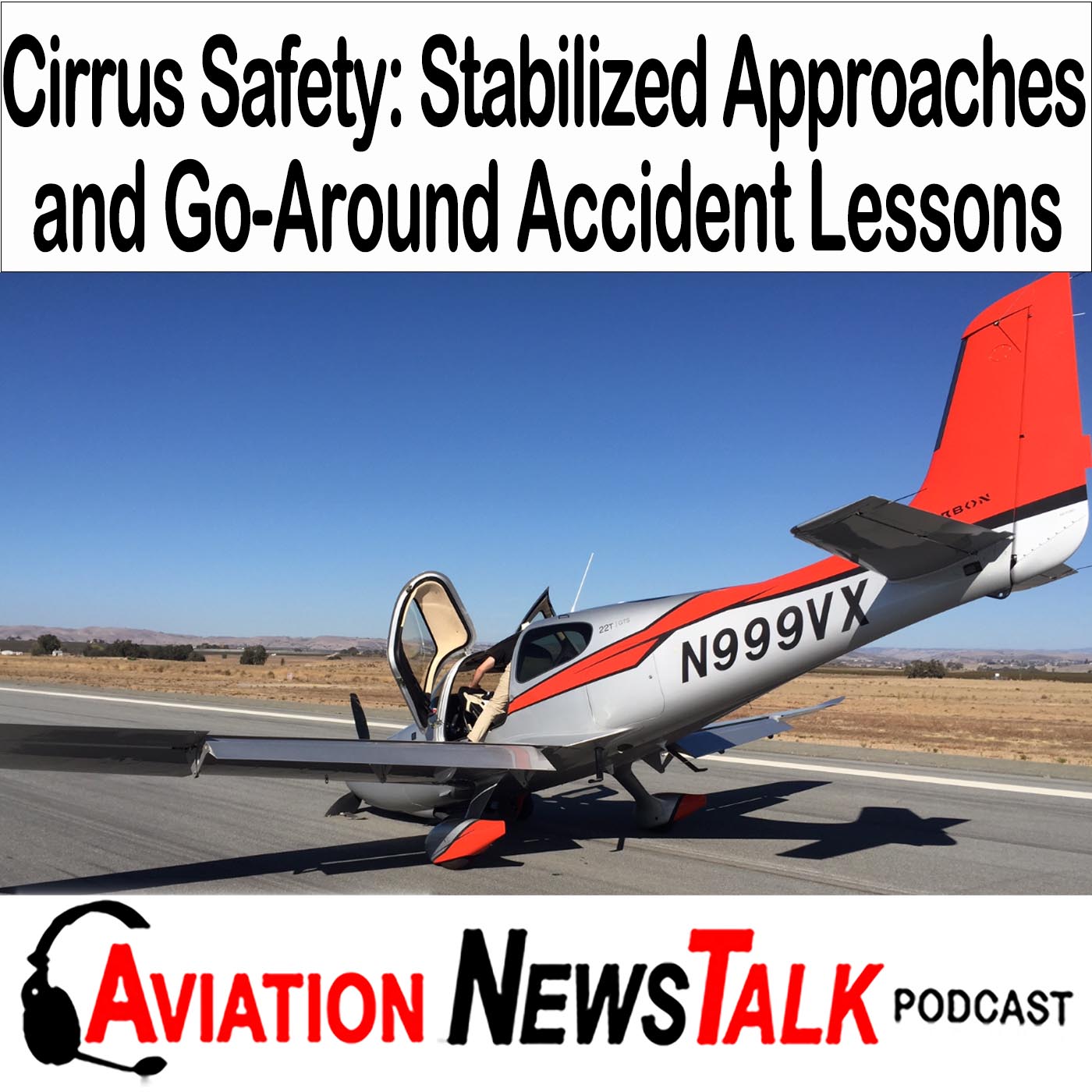
410 Cirrus SR22 Safety: Stabilized Approaches and Go-Around Accident Lessons
from Aviation News Talk – Pilot Stories, Safety Tips & General Aviation News · host Max Trescott interview Mark Waddell
Max talks with Mark Waddell of the Cirrus Owner and Pilots Association (COPA) about how Cirrus pilots can reduce accidents by focusing on the places where the accident chain most often begins: unstable approaches, indecisive go-arounds, and delayed choices during power-loss events. They discuss what pilots are doing in the cockpit that turns routine flights into incidents, and what specific habits and training standards reduce that risk. Mark explains that 2025 included eight fatal Cirrus accidents and twelve CAPS saves. Mark argues that the big safety wins come from addressing repeatable patterns: how pilots manage energy on final, how quickly they reject a bad approach, and how early they commit to the safest outcome when the engine isn't reliable. A major theme is decisiveness in abnormal situations, especially anything involving power. Mark walks through how power-loss or engine-roughness events can seduce pilots into flying a normal pattern and hoping things stabilize. That often burns altitude and distance in exchange for false comfort. The operational hazard is simple: the moment a pilot realizes the runway is no longer assured, they're already low, already out of options, and now forced into rushed decisions. Mark emphasizes that when the engine is uncertain, "normal" is the enemy. The airplane doesn't care that the pattern looked tidy; it only cares whether you end up with a survivable outcome. This ties directly into CAPS decision-making. Mark's message is not "CAPS solves everything," but rather that pilots need an explicit decision framework that prevents them from negotiating with themselves while altitude evaporates. He discusses the idea of a CAPS hard deck—an altitude by which, if a pilot is not certain of a safe landing outcome, they commit to pulling the handle. The point of a hard deck isn't to remove judgment; it's to remove hesitation. If you wait until you're low, you've converted a controlled, survivable deployment into a desperate last-second attempt. In that sense, the hard deck is less about the parachute and more about training the pilot's brain to act early enough for any option to work. From emergency decisions, the discussion moves to the most universal risk zone: landing and go-around. Mark notes that a large share of reportable events occur during landing or during an attempted go-around. That makes this phase-of-flight a high-leverage target for training, standards, and self-discipline. The trap is that approaches feel "fixable" until they suddenly aren't. Pilots often rationalize small deviations—slightly fast, slightly high, slightly untrimmed—because they believe they can correct it in the last few hundred feet. But each late correction is an energy trade, and those trades frequently end with excessive speed over the threshold, a flat touchdown, a bounce, or a rushed go-around. They get specific about the "flat landing" pattern. Mark challenges a common cultural habit: equating "smooth" with "good." In many airplanes—and especially in a fast, slick airplane—chasing smoothness can encourage a flatter attitude and higher speed, which increases the chances of touching down on the nose gear or loading it too early. That can lead to nose-gear abuse, shimmy events, prop strikes, and expensive engine tear-downs. Max reinforces the technique side: trimming matters. If pilots are muscling the airplane through configuration changes and final approach, they're behind the airplane before the flare even begins. A well-trimmed airplane is easier to slow, easier to pitch correctly, and easier to land in the right attitude without forcing it onto the runway. Go-arounds get treated as a primary skill, not a backup plan. Mark describes why late go-arounds are especially dangerous: if a pilot waits until a bounce or a deep, unstable touchdown attempt, the airplane is close to the ground, slow, and in a configuration that can punish abrupt changes. The go-around itself is not complicated, but it requires coordinated execution: power comes in, right rudder counters yaw, pitch is managed to prevent an excessive nose-up attitude, and configuration changes are timed rather than rushed. A common failure mode is trying to do everything at once—adding power, retracting flaps too aggressively, and pitching up—creating a stall-prone situation at the worst possible altitude. Mark's guidance pushes pilots toward objective gates: if the approach isn't stable by a defined point, you go around—period. The pilots who get into trouble tend to have elastic standards. They keep moving the goalposts because they want the landing to work. Mark argues that consistency is the cure: standardized stabilized-approach criteria, practiced go-arounds that feel routine, and an acceptance that a go-around is not a failure, it's good judgment. They also address proficiency and recency, emphasizing that safe performance is less about total hours and more about how frequently a pilot is flying and practicing the right skills. Mark points out that annual hours correlate strongly with landing outcomes; low annual utilization can create a false sense of competence because the pilot has experience, but not recent repetition. The solution isn't heroic flying—it's structured practice: recurring instruction, intentional go-around reps, and consistent standards that prevent "drift" back into sloppy technique. To make those standards stick, Mark advocates data-driven debriefing. Instead of relying on subjective feel—"that was fine"—pilots can use post-flight tools, such as FlySto and ForeFlight's Cloud Ahoy, to evaluate approach stability, speed control, glidepath consistency, and touchdown energy. The goal isn't chasing a score; it's finding patterns that predict future mistakes. If your data repeatedly shows fast thresholds, unstable vertical paths, or late corrections, you now have something specific to train. Mark's point is blunt: most pilots don't need more aviation wisdom; they need feedback that's objective enough to change behavior. The episode's bottom line is that Cirrus safety is not about secret techniques. It's about earlier decisions, tighter standards, and repeated practice in the phases of flight where accidents are born. Nail stabilized approaches, normalize early go-arounds, commit sooner in power-loss scenarios, and use honest debriefing to identify risk trends before they turn into an NTSB report. If you're getting value from this show, please support the show via PayPal, Venmo, Zelle or Patreon. Support the Show by buying a Lightspeed ANR Headsets Max has been using only Lightspeed headsets for nearly 25 years! I love their tradeup program that let's you trade in an older Lightspeed headset for a newer model. Start with one of the links below, and Lightspeed will pay a referral fee to support Aviation News Talk. Lightspeed Delta Zulu Headset $1199 HOLIDAY SPECIALNEW – Lightspeed Zulu 4 Headset $1099 Lightspeed Zulu 3 Headset $849 HOLIDAY SPECIALLightspeed Sierra Headset $749 My Review on the Lightspeed Delta Zulu Send us your feedback or comments via email If you have a question you'd like answered on the show, let listeners hear you ask the question, by recording your listener question using your phone. Mentioned on the ShowCirrus Owner Pilots Association (COPA) COPA YouTube Channel Video: Garmin Green Donut Explained Buy Max Trescott's G3000 Book Call 800-247-6553 a Aviation News Talk Network podcasts NTSB News Talk podcast UAV News Talk podcast Rotary Wing Show podcast Free Index to the first 282 episodes of Aviation New Talk So You Want To Learn to Fly or Buy a Cirrus seminars Online Version of the Seminar Coming Soon – Register for Notification Check out our recommended ADS-B receivers, and order one for yourself. Yes, we'll make a couple of dollars if you do. Get the Free Aviation News Talk app for iOS or Android. Check out Max's Online Courses: G1000 VFR, G1000 IFR, and Flying WAAS & GPS Approaches. Find them all at: https://www.pilotlearning.com/ Social Media Like Aviation News Talk podcast on Facebook Follow Max on Instagram Follow Max on Twitter Listen to all Aviation News Talk podcasts on YouTube or YouTube Premium "Go Around" song used by permission of Ken Dravis; you can buy his music at kendravis.com If you purchase a product through a link on our site, we may receive compensation.
Embed this episode
NOW PLAYING
410 Cirrus SR22 Safety: Stabilized Approaches and Go-Around Accident Lessons
No transcript for this episode yet
Similar Episodes
No similar episodes found.
Similar Podcasts
No similar podcasts found.